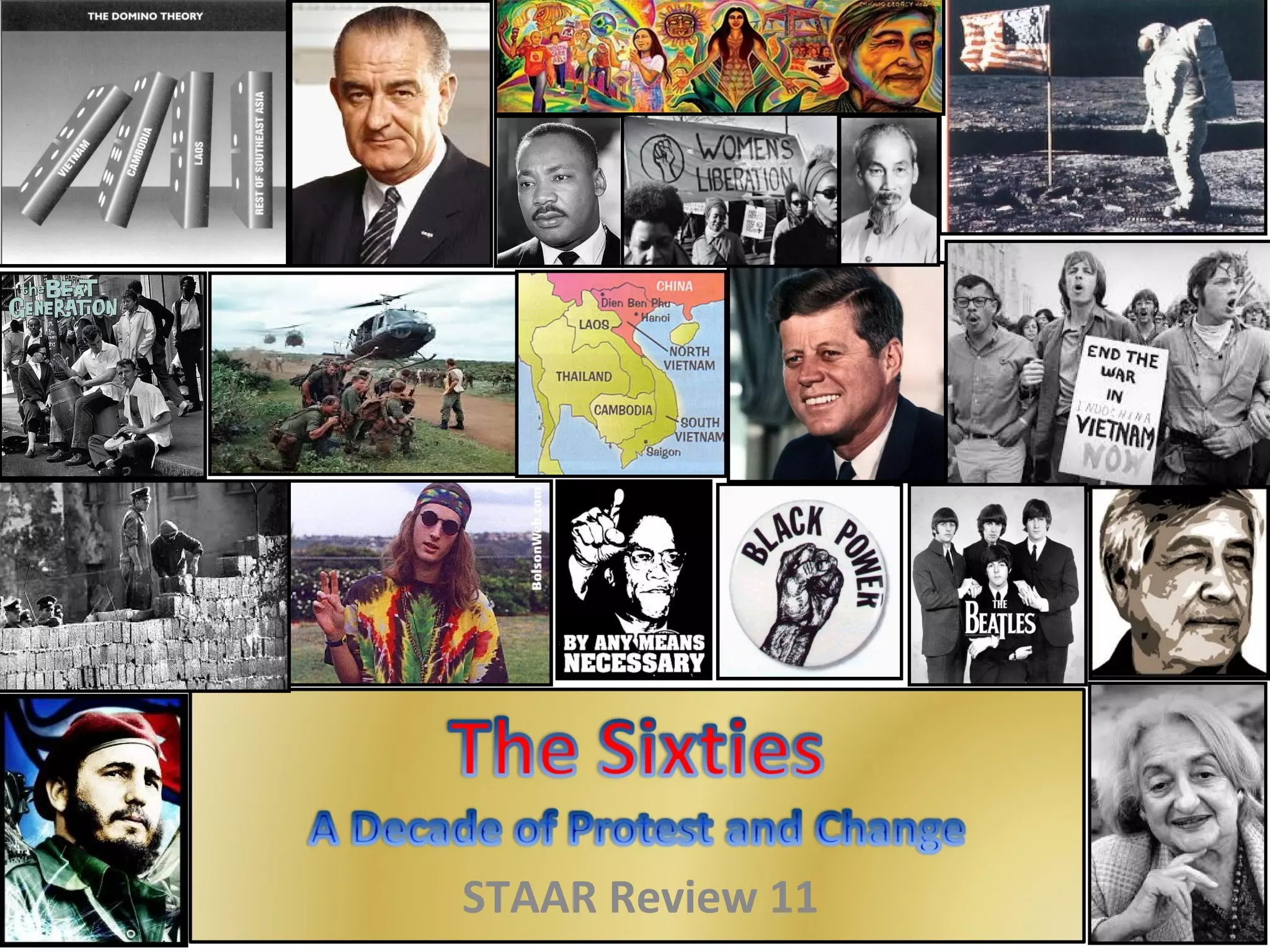
STAAR Review 11
The Kennedy Presidency, 1960 - 1963
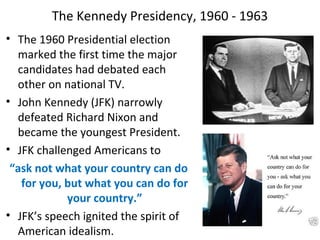
• The 1960 Presidential election
marked the first time the major
candidates had debated each
other on national TV.
• John Kennedy (JFK) narrowly
defeated Richard Nixon and
became the youngest President.
• JFK challenged Americans to
“ask not what your country can do
for you, but what you can do for
your country.”
• JFK’s speech ignited the spirit of
American idealism.
JFK’s Domestic Policy
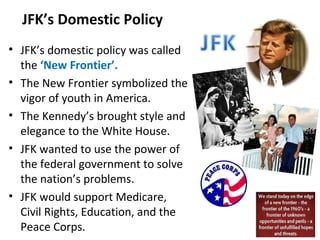
• JFK’s domestic policy was called
the ‘New Frontier’.
• The New Frontier symbolized the
vigor of youth in America.
• The Kennedy’s brought style and
elegance to the White House.
• JFK wanted to use the power of
the federal government to solve
the nation’s problems.
• JFK would support Medicare,
Civil Rights, Education, and the
Peace Corps.
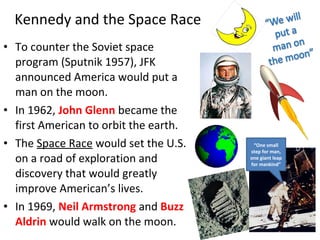
• To counter the Soviet space
program (Sputnik 1957), JFK
announced America would put a
man on the moon.
• In 1962, John Glenn became the
first American to orbit the earth.
• The Space Race would set the U.S.
on a road of exploration and
discovery that would greatly
improve American’s lives.
• In 1969, Neil Armstrong and Buzz
Aldrin would walk on the moon.
Kennedy and the Space Race
“One small
step for man,
one giant leap
for mankind”
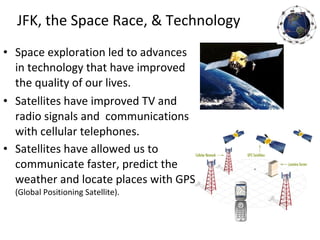
• Space exploration led to advances
in technology that have improved
the quality of our lives.
• Satellites have improved TV and
radio signals and communications
with cellular telephones.
• Satellites have allowed us to
communicate faster, predict the
weather and locate places with GPS
(Global Positioning Satellite).
JFK, the Space Race, & Technology
• JFK opposed communism, pledging to
contain it as previous Presidents had.
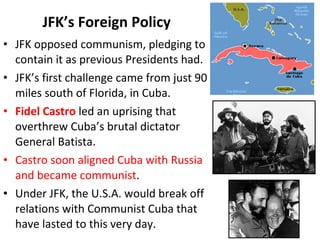
• JFK’s first challenge came from just 90
miles south of Florida, in Cuba.
• Fidel Castro led an uprising that
overthrew Cuba’s brutal dictator
General Batista.
• Castro soon aligned Cuba with Russia
and became communist.
• Under JFK, the U.S.A. would break off
relations with Communist Cuba that
have lasted to this very day.
JFK’s Foreign Policy
• In the 1950s, Pres. Eisenhower
planned an overthrow of Cuba’s
dictator Fidel Castro.
• The plan included secretly training
Cuban exiles on how to invade Cuba.
• Pres. Kennedy continued with the
plan, but he refused to provide air
support for an invasion that might tie
the U.S. to the plan.
• The planned invasion sight was called
the ‘Bay of Pigs’.
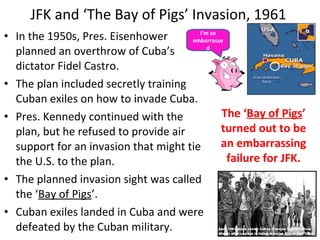
• Cuban exiles landed in Cuba and were
defeated by the Cuban military.
JFK and ‘The Bay of Pigs’ Invasion, 1961
The ‘Bay of Pigs’
turned out to be
an embarrassing
failure for JFK.
I’m so
embarrasse
d
• The German city of Berlin had been
divided after W.W. II and many East
Germans had fled to West Berlin
looking for a better life in the
democratic West.
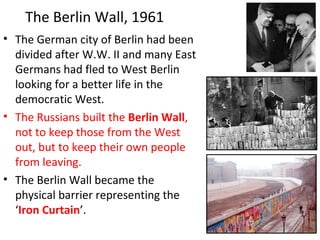
• The Russians built the Berlin Wall,
not to keep those from the West
out, but to keep their own people
from leaving.
• The Berlin Wall became the
physical barrier representing the
‘Iron Curtain’.
The Berlin Wall, 1961
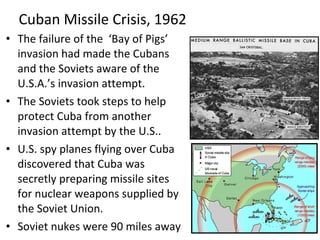
• The failure of the ‘Bay of Pigs’
invasion had made the Cubans
and the Soviets aware of the
U.S.A.’s invasion attempt.
• The Soviets took steps to help
protect Cuba from another
invasion attempt by the U.S..
• U.S. spy planes flying over Cuba
discovered that Cuba was
secretly preparing missile sites
for nuclear weapons supplied by
the Soviet Union.
• Soviet nukes were 90 miles away
Cuban Missile Crisis, 1962
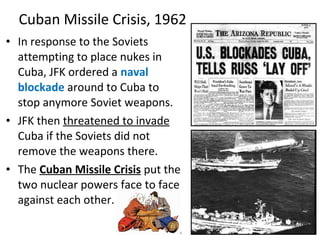
• In response to the Soviets
attempting to place nukes in
Cuba, JFK ordered a naval
blockade around to Cuba to
stop anymore Soviet weapons.
• JFK then threatened to invade
Cuba if the Soviets did not
remove the weapons there.
• The Cuban Missile Crisis put the
two nuclear powers face to face
against each other.
Cuban Missile Crisis, 1962
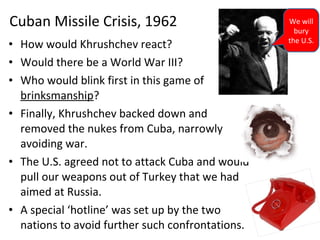
• How would Khrushchev react?
• Would there be a World War III?
• Who would blink first in this game of
brinksmanship?
• Finally, Khrushchev backed down and
removed the nukes from Cuba, narrowly
avoiding war.
• The U.S. agreed not to attack Cuba and would
pull our weapons out of Turkey that we had
aimed at Russia.
• A special ‘hotline’ was set up by the two
nations to avoid further such confrontations.
Cuban Missile Crisis, 1962 We will
bury
the U.S.
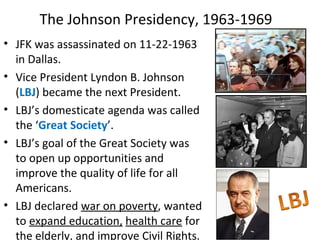
• JFK was assassinated on 11-22-1963
in Dallas.
• Vice President Lyndon B. Johnson
(LBJ) became the next President.
• LBJ’s domesticate agenda was called
the ‘Great Society’.
• LBJ’s goal of the Great Society was
to open up opportunities and
improve the quality of life for all
Americans.
• LBJ declared war on poverty, wanted
to expand education, health care for
the elderly, and improve Civil Rights.
The Johnson Presidency, 1963-1969
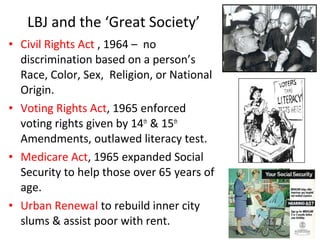
• Civil Rights Act , 1964 – no
discrimination based on a person’s
Race, Color, Sex, Religion, or National
Origin.
• Voting Rights Act, 1965 enforced
voting rights given by 14th
& 15th
Amendments, outlawed literacy test.
• Medicare Act, 1965 expanded Social
Security to help those over 65 years of
age.
• Urban Renewal to rebuild inner city
slums & assist poor with rent.
LBJ and the ‘Great Society’
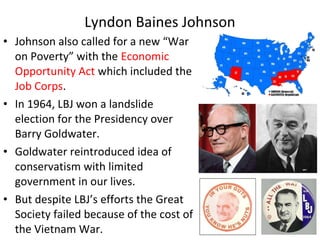
• Johnson also called for a new “War
on Poverty” with the Economic
Opportunity Act which included the
Job Corps.
• In 1964, LBJ won a landslide
election for the Presidency over
Barry Goldwater.
• Goldwater reintroduced idea of
conservatism with limited
government in our lives.
• But despite LBJ’s efforts the Great
Society failed because of the cost of
the Vietnam War.
Lyndon Baines Johnson
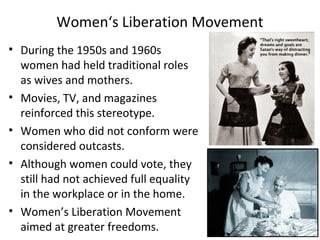
• During the 1950s and 1960s
women had held traditional roles
as wives and mothers.
• Movies, TV, and magazines
reinforced this stereotype.
• Women who did not conform were
considered outcasts.
• Although women could vote, they
still had not achieved full equality
in the workplace or in the home.
• Women’s Liberation Movement
aimed at greater freedoms.
Women‘s Liberation Movement
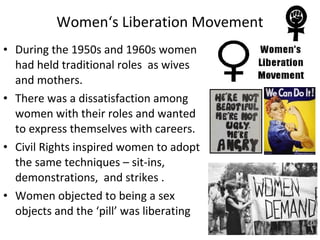
• During the 1950s and 1960s women
had held traditional roles as wives
and mothers.
• There was a dissatisfaction among
women with their roles and wanted
to express themselves with careers.
• Civil Rights inspired women to adopt
the same techniques – sit-ins,
demonstrations, and strikes .
• Women objected to being a sex
objects and the ‘pill’ was liberating
Women‘s Liberation Movement
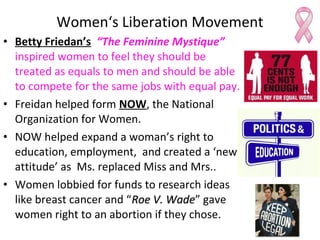
• Betty Friedan’s “The Feminine Mystique”
inspired women to feel they should be
treated as equals to men and should be able
to compete for the same jobs with equal pay.
• Freidan helped form NOW, the National
Organization for Women.
• NOW helped expand a woman’s right to
education, employment, and created a ‘new
attitude’ as Ms. replaced Miss and Mrs..
• Women lobbied for funds to research ideas
like breast cancer and “Roe V. WadeRoe V. Wade” gave
women right to an abortion if they chose.
Women‘s Liberation Movement
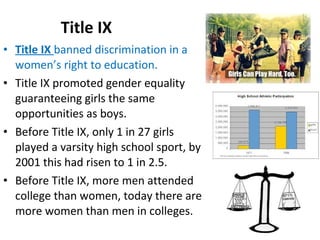
• Title IX banned discrimination in a
women’s right to education.
• Title IX promoted gender equality
guaranteeing girls the same
opportunities as boys.
• Before Title IX, only 1 in 27 girls
played a varsity high school sport, by
2001 this had risen to 1 in 2.5.
• Before Title IX, more men attended
college than women, today there are
more women than men in colleges.
Title IX
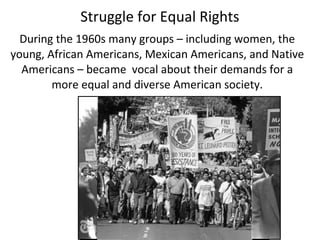
During the 1960s many groups – including women, the
young, African Americans, Mexican Americans, and Native
Americans – became vocal about their demands for a
more equal and diverse American society.
Struggle for Equal Rights
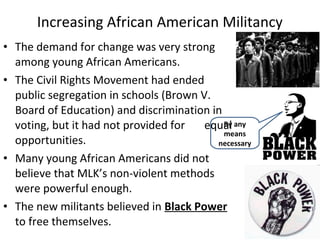
• The demand for change was very strong
among young African Americans.
• The Civil Rights Movement had ended
public segregation in schools (Brown V.
Board of Education) and discrimination in
voting, but it had not provided for equal
opportunities.
• Many young African Americans did not
believe that MLK’s non-violent methods
were powerful enough.
• The new militants believed in Black Power
to free themselves.
Increasing African American Militancy
By any
means
necessary
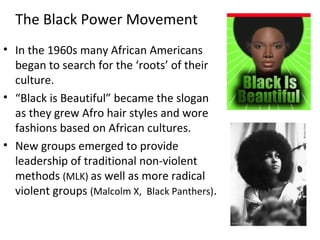
• In the 1960s many African Americans
began to search for the ‘roots’ of their
culture.
• “Black is Beautiful” became the slogan
as they grew Afro hair styles and wore
fashions based on African cultures.
• New groups emerged to provide
leadership of traditional non-violent
methods (MLK) as well as more radical
violent groups (Malcolm X, Black Panthers).
The Black Power Movement
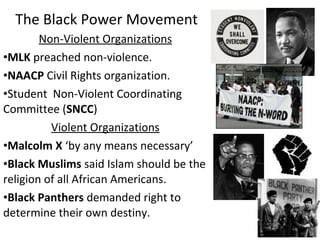
Non-Violent Organizations
•MLK preached non-violence.
•NAACP Civil Rights organization.
•Student Non-Violent Coordinating
Committee (SNCC)
Violent Organizations
•Malcolm X ‘by any means necessary’
•Black Muslims said Islam should be the
religion of all African Americans.
•Black Panthers demanded right to
determine their own destiny.
The Black Power Movement
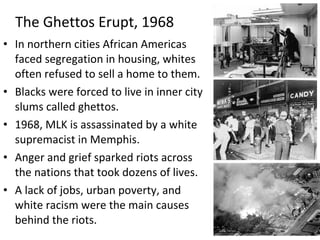
• In northern cities African Americas
faced segregation in housing, whites
often refused to sell a home to them.
• Blacks were forced to live in inner city
slums called ghettos.
• 1968, MLK is assassinated by a white
supremacist in Memphis.
• Anger and grief sparked riots across
the nations that took dozens of lives.
• A lack of jobs, urban poverty, and
white racism were the main causes
behind the riots.
The Ghettos Erupt, 1968
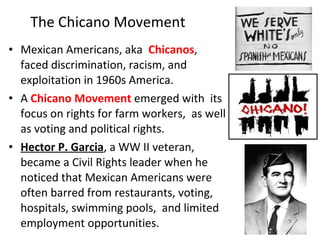
• Mexican Americans, aka Chicanos,
faced discrimination, racism, and
exploitation in 1960s America.
• A Chicano Movement emerged with its
focus on rights for farm workers, as well
as voting and political rights.
• Hector P. Garcia, a WW II veteran,
became a Civil Rights leader when he
noticed that Mexican Americans were
often barred from restaurants, voting,
hospitals, swimming pools, and limited
employment opportunities.
The Chicano Movement
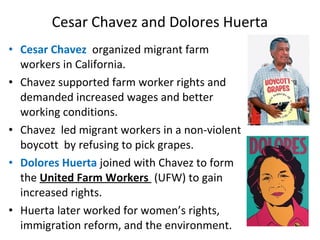
• Cesar Chavez organized migrant farm
workers in California.
• Chavez supported farm worker rights and
demanded increased wages and better
working conditions.
• Chavez led migrant workers in a non-violent
boycott by refusing to pick grapes.
• Dolores Huerta joined with Chavez to form
the United Farm Workers (UFW) to gain
increased rights.
• Huerta later worked for women’s rights,
immigration reform, and the environment.
Cesar Chavez and Dolores Huerta
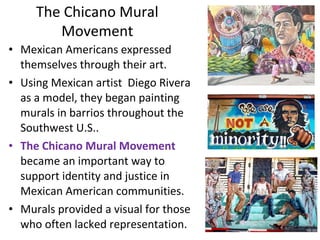
• Mexican Americans expressed
themselves through their art.
• Using Mexican artist Diego Rivera
as a model, they began painting
murals in barrios throughout the
Southwest U.S..
• The Chicano Mural Movement
became an important way to
support identity and justice in
Mexican American communities.
• Murals provided a visual for those
who often lacked representation.
The Chicano Mural
Movement
• Native Americans have been exploited
since the beginning of America.
• The Civil Rights Act of 1964, prohibited
discrimination against Native
Americans, but many still felt they were
being mistreated by the government.
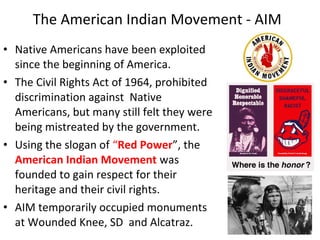
• Using the slogan of “Red Power”, the
American Indian Movement was
founded to gain respect for their
heritage and their civil rights.
• AIM temporarily occupied monuments
at Wounded Knee, SD and Alcatraz.
The American Indian Movement - AIM
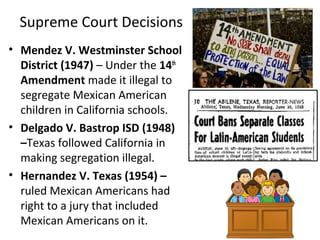
• Mendez V. Westminster School
District (1947) – Under the 14th
Amendment made it illegal to
segregate Mexican American
children in California schools.
• Delgado V. Bastrop ISD (1948)
–Texas followed California in
making segregation illegal.
• Hernandez V. Texas (1954) –
ruled Mexican Americans had
right to a jury that included
Mexican Americans on it.
Supreme Court Decisions
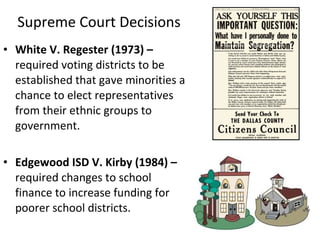
• White V. Regester (1973) –
required voting districts to be
established that gave minorities a
chance to elect representatives
from their ethnic groups to
government.
• Edgewood ISD V. Kirby (1984) –
required changes to school
finance to increase funding for
poorer school districts.
Supreme Court Decisions
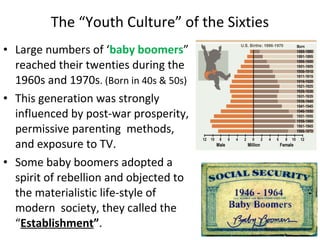
• Large numbers of ‘baby boomers”
reached their twenties during the
1960s and 1970s. (Born in 40s & 50s)
• This generation was strongly
influenced by post-war prosperity,
permissive parenting methods,
and exposure to TV.
• Some baby boomers adopted a
spirit of rebellion and objected to
the materialistic life-style of
modern society, they called the
“Establishment”.
The “Youth Culture” of the Sixties
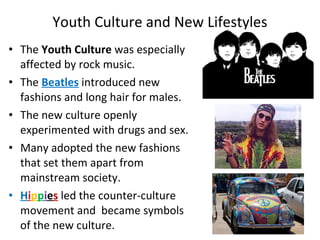
• The Youth Culture was especially
affected by rock music.
• The Beatles introduced new
fashions and long hair for males.
• The new culture openly
experimented with drugs and sex.
• Many adopted the new fashions
that set them apart from
mainstream society.
• Hippies led the counter-culture
movement and became symbols
of the new culture.
Youth Culture and New Lifestyles
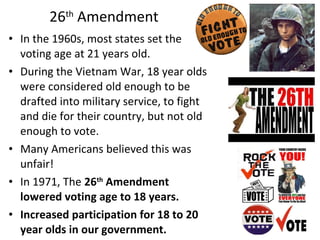
• In the 1960s, most states set the
voting age at 21 years old.
• During the Vietnam War, 18 year olds
were considered old enough to be
drafted into military service, to fight
and die for their country, but not old
enough to vote.
• Many Americans believed this was
unfair!
• In 1971, The 26th
Amendment
lowered voting age to 18 years.
• Increased participation for 18 to 20
year olds in our government.
26th
Amendment
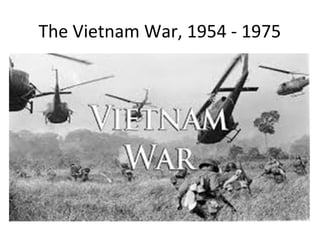
The Vietnam War, 1954 - 1975
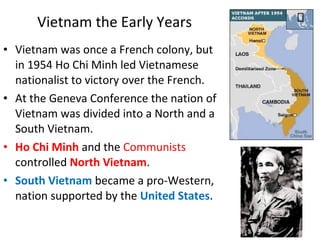
• Vietnam was once a French colony, but
in 1954 Ho Chi Minh led Vietnamese
nationalist to victory over the French.
• At the Geneva Conference the nation of
Vietnam was divided into a North and a
South Vietnam.
• Ho Chi Minh and the Communists
controlled North Vietnam.
• South Vietnam became a pro-Western,
nation supported by the United States.
Vietnam the Early Years
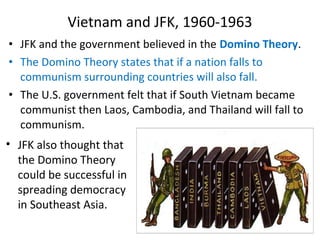
• JFK and the government believed in the Domino Theory.
• The Domino Theory states that if a nation falls to
communism surrounding countries will also fall.
• The U.S. government felt that if South Vietnam became
communist then Laos, Cambodia, and Thailand will fall to
communism.
Vietnam and JFK, 1960-1963
• JFK also thought that
the Domino Theory
could be successful in
spreading democracy
in Southeast Asia.
• When LBJ became President, the
U.S.A. became even more involved
in the war in Vietnam.
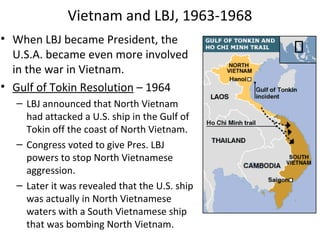
• Gulf of Tokin Resolution – 1964
– LBJ announced that North Vietnam
had attacked a U.S. ship in the Gulf of
Tokin off the coast of North Vietnam.
– Congress voted to give Pres. LBJ
powers to stop North Vietnamese
aggression.
– Later it was revealed that the U.S. ship
was actually in North Vietnamese
waters with a South Vietnamese ship
that was bombing North Vietnam.
Vietnam and LBJ, 1963-1968
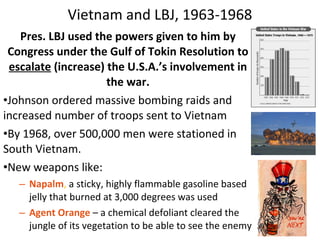
Pres. LBJ used the powers given to him by
Congress under the Gulf of Tokin Resolution to
escalate (increase) the U.S.A.’s involvement in
the war.
•Johnson ordered massive bombing raids and
increased number of troops sent to Vietnam
•By 1968, over 500,000 men were stationed in
South Vietnam.
•New weapons like:
– Napalm, a sticky, highly flammable gasoline based
jelly that burned at 3,000 degrees was used
– Agent Orange – a chemical defoliant cleared the
jungle of its vegetation to be able to see the enemy
Vietnam and LBJ, 1963-1968
• TET is a holiday celebrating the
Vietnamese New Year.
• In previous years a cease fire was called
so both side of the war could celebrate.
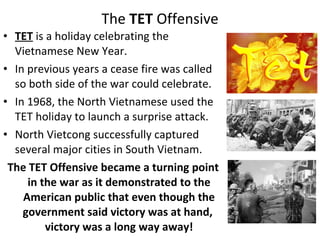
• In 1968, the North Vietnamese used the
TET holiday to launch a surprise attack.
• North Vietcong successfully captured
several major cities in South Vietnam.
The TET Offensive became a turning point
in the war as it demonstrated to the
American public that even though the
government said victory was at hand,
victory was a long way away!
The TET Offensive
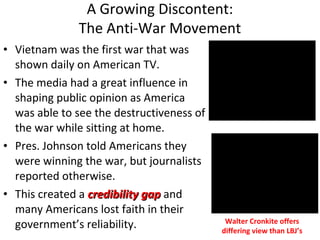
• Vietnam was the first war that was
shown daily on American TV.
• The media had a great influence in
shaping public opinion as America
was able to see the destructiveness of
the war while sitting at home.
• Pres. Johnson told Americans they
were winning the war, but journalists
reported otherwise.
• This created a credibility gapcredibility gap and
many Americans lost faith in their
government’s reliability.
A Growing Discontent:
The Anti-War Movement
Walter Cronkite offers
differing view than LBJ’s
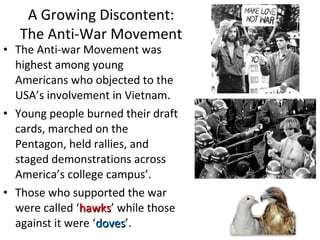
• The Anti-war Movement was
highest among young
Americans who objected to the
USA’s involvement in Vietnam.
• Young people burned their draft
cards, marched on the
Pentagon, held rallies, and
staged demonstrations across
America’s college campus’.
• Those who supported the war
were called ‘hawkshawks’ while those
against it were ‘dovesdoves’.
A Growing Discontent:
The Anti-War Movement
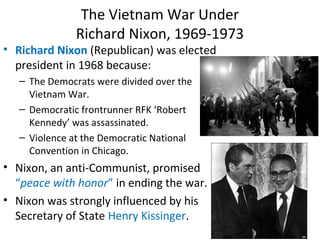
• Richard Nixon (Republican) was elected
president in 1968 because:
– The Democrats were divided over the
Vietnam War.
– Democratic frontrunner RFK ‘Robert
Kennedy’ was assassinated.
– Violence at the Democratic National
Convention in Chicago.
• Nixon, an anti-Communist, promised
“peace with honor” in ending the war.
• Nixon was strongly influenced by his
Secretary of State Henry Kissinger.
The Vietnam War Under
Richard Nixon, 1969-1973
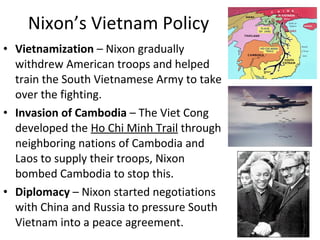
• Vietnamization – Nixon gradually
withdrew American troops and helped
train the South Vietnamese Army to take
over the fighting.
• Invasion of Cambodia – The Viet Cong
developed the Ho Chi Minh Trail through
neighboring nations of Cambodia and
Laos to supply their troops, Nixon
bombed Cambodia to stop this.
• Diplomacy – Nixon started negotiations
with China and Russia to pressure South
Vietnam into a peace agreement.
Nixon’s Vietnam Policy
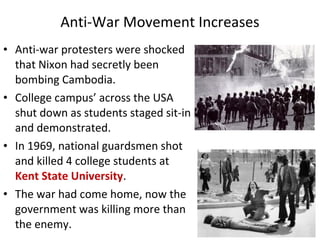
• Anti-war protesters were shocked
that Nixon had secretly been
bombing Cambodia.
• College campus’ across the USA
shut down as students staged sit-in
and demonstrated.
• In 1969, national guardsmen shot
and killed 4 college students at
Kent State University.
• The war had come home, now the
government was killing more than
the enemy.
Anti-War Movement Increases
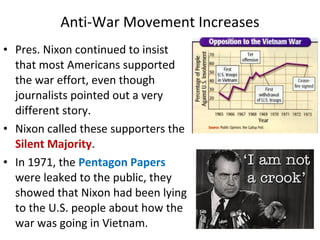
• Pres. Nixon continued to insist
that most Americans supported
the war effort, even though
journalists pointed out a very
different story.
• Nixon called these supporters the
Silent Majority.
• In 1971, the Pentagon Papers
were leaked to the public, they
showed that Nixon had been lying
to the U.S. people about how the
war was going in Vietnam.
Anti-War Movement Increases
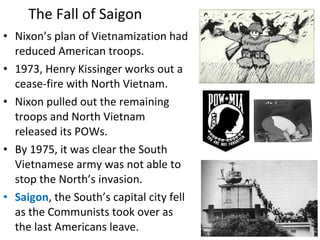
• Nixon’s plan of Vietnamization had
reduced American troops.
• 1973, Henry Kissinger works out a
cease-fire with North Vietnam.
• Nixon pulled out the remaining
troops and North Vietnam
released its POWs.
• By 1975, it was clear the South
Vietnamese army was not able to
stop the North’s invasion.
• Saigon, the South’s capital city fell
as the Communists took over as
the last Americans leave.
The Fall of Saigon
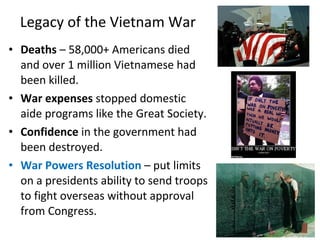
• Deaths – 58,000+ Americans died
and over 1 million Vietnamese had
been killed.
• War expenses stopped domestic
aide programs like the Great Society.
• Confidence in the government had
been destroyed.
• War Powers Resolution – put limits
on a presidents ability to send troops
to fight overseas without approval
from Congress.
Legacy of the Vietnam War
Post-War Literature, Art, & Music
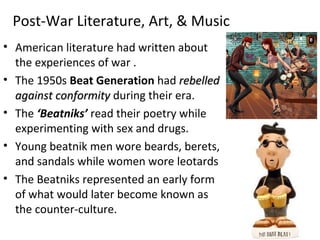
• American literature had written about
the experiences of war .
• The 1950s Beat Generation had rebelledrebelled
against conformityagainst conformity during their era.
• The ‘Beatniks’ read their poetry while
experimenting with sex and drugs.
• Young beatnik men wore beards, berets,
and sandals while women wore leotards
• The Beatniks represented an early form
of what would later become known as
the counter-culture.
1960s Counter-culture Writers
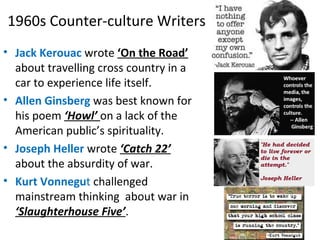
• Jack Kerouac wrote ‘On the Road’
about travelling cross country in a
car to experience life itself.
• Allen Ginsberg was best known for
his poem ‘Howl’ on a lack of the
American public’s spirituality.
• Joseph Heller wrote ‘Catch 22’
about the absurdity of war.
• Kurt Vonnegut challenged
mainstream thinking about war in
‘Slaughterhouse Five’.
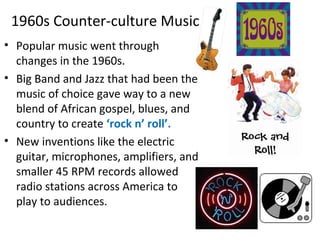
1960s Counter-culture Music
• Popular music went through
changes in the 1960s.
• Big Band and Jazz that had been the
music of choice gave way to a new
blend of African gospel, blues, and
country to create ‘rock n’ roll’.
• New inventions like the electric
guitar, microphones, amplifiers, and
smaller 45 RPM records allowed
radio stations across America to
play to audiences.
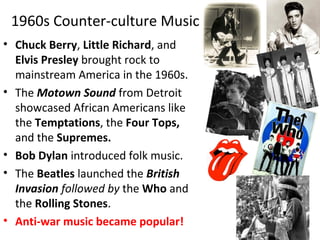
1960s Counter-culture Music
• Chuck Berry, Little Richard, and
Elvis Presley brought rock to
mainstream America in the 1960s.
• The Motown Sound from Detroit
showcased African Americans like
the Temptations, the Four Tops,
and the Supremes.
• Bob Dylan introduced folk music.
• The Beatles launched the British
Invasion followed by the Who and
the Rolling Stones.
• Anti-war music became popular!
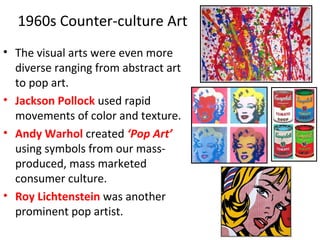
1960s Counter-culture Art
• The visual arts were even more
diverse ranging from abstract art
to pop art.
• Jackson Pollock used rapid
movements of color and texture.
• Andy Warhol created ‘Pop Art’
using symbols from our mass-
produced, mass marketed
consumer culture.
• Roy Lichtenstein was another
prominent pop artist.

(11) the sixties

  • 1.
  • 2.
    The Kennedy Presidency,1960 - 1963 • The 1960 Presidential election marked the first time the major candidates had debated each other on national TV. • John Kennedy (JFK) narrowly defeated Richard Nixon and became the youngest President. • JFK challenged Americans to “ask not what your country can do for you, but what you can do for your country.” • JFK’s speech ignited the spirit of American idealism.
  • 3.
    JFK’s Domestic Policy •JFK’s domestic policy was called the ‘New Frontier’. • The New Frontier symbolized the vigor of youth in America. • The Kennedy’s brought style and elegance to the White House. • JFK wanted to use the power of the federal government to solve the nation’s problems. • JFK would support Medicare, Civil Rights, Education, and the Peace Corps.
  • 4.
    • To counterthe Soviet space program (Sputnik 1957), JFK announced America would put a man on the moon. • In 1962, John Glenn became the first American to orbit the earth. • The Space Race would set the U.S. on a road of exploration and discovery that would greatly improve American’s lives. • In 1969, Neil Armstrong and Buzz Aldrin would walk on the moon. Kennedy and the Space Race “One small step for man, one giant leap for mankind”
  • 5.
    • Space explorationled to advances in technology that have improved the quality of our lives. • Satellites have improved TV and radio signals and communications with cellular telephones. • Satellites have allowed us to communicate faster, predict the weather and locate places with GPS (Global Positioning Satellite). JFK, the Space Race, & Technology
  • 6.
    • JFK opposedcommunism, pledging to contain it as previous Presidents had. • JFK’s first challenge came from just 90 miles south of Florida, in Cuba. • Fidel Castro led an uprising that overthrew Cuba’s brutal dictator General Batista. • Castro soon aligned Cuba with Russia and became communist. • Under JFK, the U.S.A. would break off relations with Communist Cuba that have lasted to this very day. JFK’s Foreign Policy
  • 7.
    • In the1950s, Pres. Eisenhower planned an overthrow of Cuba’s dictator Fidel Castro. • The plan included secretly training Cuban exiles on how to invade Cuba. • Pres. Kennedy continued with the plan, but he refused to provide air support for an invasion that might tie the U.S. to the plan. • The planned invasion sight was called the ‘Bay of Pigs’. • Cuban exiles landed in Cuba and were defeated by the Cuban military. JFK and ‘The Bay of Pigs’ Invasion, 1961 The ‘Bay of Pigs’ turned out to be an embarrassing failure for JFK. I’m so embarrasse d
  • 8.
    • The Germancity of Berlin had been divided after W.W. II and many East Germans had fled to West Berlin looking for a better life in the democratic West. • The Russians built the Berlin Wall, not to keep those from the West out, but to keep their own people from leaving. • The Berlin Wall became the physical barrier representing the ‘Iron Curtain’. The Berlin Wall, 1961
  • 9.
    • The failureof the ‘Bay of Pigs’ invasion had made the Cubans and the Soviets aware of the U.S.A.’s invasion attempt. • The Soviets took steps to help protect Cuba from another invasion attempt by the U.S.. • U.S. spy planes flying over Cuba discovered that Cuba was secretly preparing missile sites for nuclear weapons supplied by the Soviet Union. • Soviet nukes were 90 miles away Cuban Missile Crisis, 1962
  • 10.
    • In responseto the Soviets attempting to place nukes in Cuba, JFK ordered a naval blockade around to Cuba to stop anymore Soviet weapons. • JFK then threatened to invade Cuba if the Soviets did not remove the weapons there. • The Cuban Missile Crisis put the two nuclear powers face to face against each other. Cuban Missile Crisis, 1962
  • 11.
    • How wouldKhrushchev react? • Would there be a World War III? • Who would blink first in this game of brinksmanship? • Finally, Khrushchev backed down and removed the nukes from Cuba, narrowly avoiding war. • The U.S. agreed not to attack Cuba and would pull our weapons out of Turkey that we had aimed at Russia. • A special ‘hotline’ was set up by the two nations to avoid further such confrontations. Cuban Missile Crisis, 1962 We will bury the U.S.
  • 12.
    • JFK wasassassinated on 11-22-1963 in Dallas. • Vice President Lyndon B. Johnson (LBJ) became the next President. • LBJ’s domesticate agenda was called the ‘Great Society’. • LBJ’s goal of the Great Society was to open up opportunities and improve the quality of life for all Americans. • LBJ declared war on poverty, wanted to expand education, health care for the elderly, and improve Civil Rights. The Johnson Presidency, 1963-1969
  • 13.
    • Civil RightsAct , 1964 – no discrimination based on a person’s Race, Color, Sex, Religion, or National Origin. • Voting Rights Act, 1965 enforced voting rights given by 14th & 15th Amendments, outlawed literacy test. • Medicare Act, 1965 expanded Social Security to help those over 65 years of age. • Urban Renewal to rebuild inner city slums & assist poor with rent. LBJ and the ‘Great Society’
  • 14.
    • Johnson alsocalled for a new “War on Poverty” with the Economic Opportunity Act which included the Job Corps. • In 1964, LBJ won a landslide election for the Presidency over Barry Goldwater. • Goldwater reintroduced idea of conservatism with limited government in our lives. • But despite LBJ’s efforts the Great Society failed because of the cost of the Vietnam War. Lyndon Baines Johnson
  • 15.
    • During the1950s and 1960s women had held traditional roles as wives and mothers. • Movies, TV, and magazines reinforced this stereotype. • Women who did not conform were considered outcasts. • Although women could vote, they still had not achieved full equality in the workplace or in the home. • Women’s Liberation Movement aimed at greater freedoms. Women‘s Liberation Movement
  • 16.
    • During the1950s and 1960s women had held traditional roles as wives and mothers. • There was a dissatisfaction among women with their roles and wanted to express themselves with careers. • Civil Rights inspired women to adopt the same techniques – sit-ins, demonstrations, and strikes . • Women objected to being a sex objects and the ‘pill’ was liberating Women‘s Liberation Movement
  • 17.
    • Betty Friedan’s“The Feminine Mystique” inspired women to feel they should be treated as equals to men and should be able to compete for the same jobs with equal pay. • Freidan helped form NOW, the National Organization for Women. • NOW helped expand a woman’s right to education, employment, and created a ‘new attitude’ as Ms. replaced Miss and Mrs.. • Women lobbied for funds to research ideas like breast cancer and “Roe V. WadeRoe V. Wade” gave women right to an abortion if they chose. Women‘s Liberation Movement
  • 18.
    • Title IXbanned discrimination in a women’s right to education. • Title IX promoted gender equality guaranteeing girls the same opportunities as boys. • Before Title IX, only 1 in 27 girls played a varsity high school sport, by 2001 this had risen to 1 in 2.5. • Before Title IX, more men attended college than women, today there are more women than men in colleges. Title IX
  • 19.
    During the 1960smany groups – including women, the young, African Americans, Mexican Americans, and Native Americans – became vocal about their demands for a more equal and diverse American society. Struggle for Equal Rights
  • 20.
    • The demandfor change was very strong among young African Americans. • The Civil Rights Movement had ended public segregation in schools (Brown V. Board of Education) and discrimination in voting, but it had not provided for equal opportunities. • Many young African Americans did not believe that MLK’s non-violent methods were powerful enough. • The new militants believed in Black Power to free themselves. Increasing African American Militancy By any means necessary
  • 21.
    • In the1960s many African Americans began to search for the ‘roots’ of their culture. • “Black is Beautiful” became the slogan as they grew Afro hair styles and wore fashions based on African cultures. • New groups emerged to provide leadership of traditional non-violent methods (MLK) as well as more radical violent groups (Malcolm X, Black Panthers). The Black Power Movement
  • 22.
    Non-Violent Organizations •MLK preachednon-violence. •NAACP Civil Rights organization. •Student Non-Violent Coordinating Committee (SNCC) Violent Organizations •Malcolm X ‘by any means necessary’ •Black Muslims said Islam should be the religion of all African Americans. •Black Panthers demanded right to determine their own destiny. The Black Power Movement
  • 23.
    • In northerncities African Americas faced segregation in housing, whites often refused to sell a home to them. • Blacks were forced to live in inner city slums called ghettos. • 1968, MLK is assassinated by a white supremacist in Memphis. • Anger and grief sparked riots across the nations that took dozens of lives. • A lack of jobs, urban poverty, and white racism were the main causes behind the riots. The Ghettos Erupt, 1968
  • 24.
    • Mexican Americans,aka Chicanos, faced discrimination, racism, and exploitation in 1960s America. • A Chicano Movement emerged with its focus on rights for farm workers, as well as voting and political rights. • Hector P. Garcia, a WW II veteran, became a Civil Rights leader when he noticed that Mexican Americans were often barred from restaurants, voting, hospitals, swimming pools, and limited employment opportunities. The Chicano Movement
  • 25.
    • Cesar Chavezorganized migrant farm workers in California. • Chavez supported farm worker rights and demanded increased wages and better working conditions. • Chavez led migrant workers in a non-violent boycott by refusing to pick grapes. • Dolores Huerta joined with Chavez to form the United Farm Workers (UFW) to gain increased rights. • Huerta later worked for women’s rights, immigration reform, and the environment. Cesar Chavez and Dolores Huerta
  • 26.
    • Mexican Americansexpressed themselves through their art. • Using Mexican artist Diego Rivera as a model, they began painting murals in barrios throughout the Southwest U.S.. • The Chicano Mural Movement became an important way to support identity and justice in Mexican American communities. • Murals provided a visual for those who often lacked representation. The Chicano Mural Movement
  • 27.
    • Native Americanshave been exploited since the beginning of America. • The Civil Rights Act of 1964, prohibited discrimination against Native Americans, but many still felt they were being mistreated by the government. • Using the slogan of “Red Power”, the American Indian Movement was founded to gain respect for their heritage and their civil rights. • AIM temporarily occupied monuments at Wounded Knee, SD and Alcatraz. The American Indian Movement - AIM
  • 28.
    • Mendez V.Westminster School District (1947) – Under the 14th Amendment made it illegal to segregate Mexican American children in California schools. • Delgado V. Bastrop ISD (1948) –Texas followed California in making segregation illegal. • Hernandez V. Texas (1954) – ruled Mexican Americans had right to a jury that included Mexican Americans on it. Supreme Court Decisions
  • 29.
    • White V.Regester (1973) – required voting districts to be established that gave minorities a chance to elect representatives from their ethnic groups to government. • Edgewood ISD V. Kirby (1984) – required changes to school finance to increase funding for poorer school districts. Supreme Court Decisions
  • 30.
    • Large numbersof ‘baby boomers” reached their twenties during the 1960s and 1970s. (Born in 40s & 50s) • This generation was strongly influenced by post-war prosperity, permissive parenting methods, and exposure to TV. • Some baby boomers adopted a spirit of rebellion and objected to the materialistic life-style of modern society, they called the “Establishment”. The “Youth Culture” of the Sixties
  • 31.
    • The YouthCulture was especially affected by rock music. • The Beatles introduced new fashions and long hair for males. • The new culture openly experimented with drugs and sex. • Many adopted the new fashions that set them apart from mainstream society. • Hippies led the counter-culture movement and became symbols of the new culture. Youth Culture and New Lifestyles
  • 32.
    • In the1960s, most states set the voting age at 21 years old. • During the Vietnam War, 18 year olds were considered old enough to be drafted into military service, to fight and die for their country, but not old enough to vote. • Many Americans believed this was unfair! • In 1971, The 26th Amendment lowered voting age to 18 years. • Increased participation for 18 to 20 year olds in our government. 26th Amendment
  • 33.
    The Vietnam War,1954 - 1975
  • 34.
    • Vietnam wasonce a French colony, but in 1954 Ho Chi Minh led Vietnamese nationalist to victory over the French. • At the Geneva Conference the nation of Vietnam was divided into a North and a South Vietnam. • Ho Chi Minh and the Communists controlled North Vietnam. • South Vietnam became a pro-Western, nation supported by the United States. Vietnam the Early Years
  • 35.
    • JFK andthe government believed in the Domino Theory. • The Domino Theory states that if a nation falls to communism surrounding countries will also fall. • The U.S. government felt that if South Vietnam became communist then Laos, Cambodia, and Thailand will fall to communism. Vietnam and JFK, 1960-1963 • JFK also thought that the Domino Theory could be successful in spreading democracy in Southeast Asia.
  • 36.
    • When LBJbecame President, the U.S.A. became even more involved in the war in Vietnam. • Gulf of Tokin Resolution – 1964 – LBJ announced that North Vietnam had attacked a U.S. ship in the Gulf of Tokin off the coast of North Vietnam. – Congress voted to give Pres. LBJ powers to stop North Vietnamese aggression. – Later it was revealed that the U.S. ship was actually in North Vietnamese waters with a South Vietnamese ship that was bombing North Vietnam. Vietnam and LBJ, 1963-1968
  • 37.
    Pres. LBJ usedthe powers given to him by Congress under the Gulf of Tokin Resolution to escalate (increase) the U.S.A.’s involvement in the war. •Johnson ordered massive bombing raids and increased number of troops sent to Vietnam •By 1968, over 500,000 men were stationed in South Vietnam. •New weapons like: – Napalm, a sticky, highly flammable gasoline based jelly that burned at 3,000 degrees was used – Agent Orange – a chemical defoliant cleared the jungle of its vegetation to be able to see the enemy Vietnam and LBJ, 1963-1968
  • 38.
    • TET isa holiday celebrating the Vietnamese New Year. • In previous years a cease fire was called so both side of the war could celebrate. • In 1968, the North Vietnamese used the TET holiday to launch a surprise attack. • North Vietcong successfully captured several major cities in South Vietnam. The TET Offensive became a turning point in the war as it demonstrated to the American public that even though the government said victory was at hand, victory was a long way away! The TET Offensive
  • 39.
    • Vietnam wasthe first war that was shown daily on American TV. • The media had a great influence in shaping public opinion as America was able to see the destructiveness of the war while sitting at home. • Pres. Johnson told Americans they were winning the war, but journalists reported otherwise. • This created a credibility gapcredibility gap and many Americans lost faith in their government’s reliability. A Growing Discontent: The Anti-War Movement Walter Cronkite offers differing view than LBJ’s
  • 40.
    • The Anti-warMovement was highest among young Americans who objected to the USA’s involvement in Vietnam. • Young people burned their draft cards, marched on the Pentagon, held rallies, and staged demonstrations across America’s college campus’. • Those who supported the war were called ‘hawkshawks’ while those against it were ‘dovesdoves’. A Growing Discontent: The Anti-War Movement
  • 41.
    • Richard Nixon(Republican) was elected president in 1968 because: – The Democrats were divided over the Vietnam War. – Democratic frontrunner RFK ‘Robert Kennedy’ was assassinated. – Violence at the Democratic National Convention in Chicago. • Nixon, an anti-Communist, promised “peace with honor” in ending the war. • Nixon was strongly influenced by his Secretary of State Henry Kissinger. The Vietnam War Under Richard Nixon, 1969-1973
  • 42.
    • Vietnamization –Nixon gradually withdrew American troops and helped train the South Vietnamese Army to take over the fighting. • Invasion of Cambodia – The Viet Cong developed the Ho Chi Minh Trail through neighboring nations of Cambodia and Laos to supply their troops, Nixon bombed Cambodia to stop this. • Diplomacy – Nixon started negotiations with China and Russia to pressure South Vietnam into a peace agreement. Nixon’s Vietnam Policy
  • 43.
    • Anti-war protesterswere shocked that Nixon had secretly been bombing Cambodia. • College campus’ across the USA shut down as students staged sit-in and demonstrated. • In 1969, national guardsmen shot and killed 4 college students at Kent State University. • The war had come home, now the government was killing more than the enemy. Anti-War Movement Increases
  • 44.
    • Pres. Nixoncontinued to insist that most Americans supported the war effort, even though journalists pointed out a very different story. • Nixon called these supporters the Silent Majority. • In 1971, the Pentagon Papers were leaked to the public, they showed that Nixon had been lying to the U.S. people about how the war was going in Vietnam. Anti-War Movement Increases
  • 45.
    • Nixon’s planof Vietnamization had reduced American troops. • 1973, Henry Kissinger works out a cease-fire with North Vietnam. • Nixon pulled out the remaining troops and North Vietnam released its POWs. • By 1975, it was clear the South Vietnamese army was not able to stop the North’s invasion. • Saigon, the South’s capital city fell as the Communists took over as the last Americans leave. The Fall of Saigon
  • 46.
    • Deaths –58,000+ Americans died and over 1 million Vietnamese had been killed. • War expenses stopped domestic aide programs like the Great Society. • Confidence in the government had been destroyed. • War Powers Resolution – put limits on a presidents ability to send troops to fight overseas without approval from Congress. Legacy of the Vietnam War
  • 47.
    Post-War Literature, Art,& Music • American literature had written about the experiences of war . • The 1950s Beat Generation had rebelledrebelled against conformityagainst conformity during their era. • The ‘Beatniks’ read their poetry while experimenting with sex and drugs. • Young beatnik men wore beards, berets, and sandals while women wore leotards • The Beatniks represented an early form of what would later become known as the counter-culture.
  • 48.
    1960s Counter-culture Writers •Jack Kerouac wrote ‘On the Road’ about travelling cross country in a car to experience life itself. • Allen Ginsberg was best known for his poem ‘Howl’ on a lack of the American public’s spirituality. • Joseph Heller wrote ‘Catch 22’ about the absurdity of war. • Kurt Vonnegut challenged mainstream thinking about war in ‘Slaughterhouse Five’.
  • 49.
    1960s Counter-culture Music •Popular music went through changes in the 1960s. • Big Band and Jazz that had been the music of choice gave way to a new blend of African gospel, blues, and country to create ‘rock n’ roll’. • New inventions like the electric guitar, microphones, amplifiers, and smaller 45 RPM records allowed radio stations across America to play to audiences.
  • 50.
    1960s Counter-culture Music •Chuck Berry, Little Richard, and Elvis Presley brought rock to mainstream America in the 1960s. • The Motown Sound from Detroit showcased African Americans like the Temptations, the Four Tops, and the Supremes. • Bob Dylan introduced folk music. • The Beatles launched the British Invasion followed by the Who and the Rolling Stones. • Anti-war music became popular!
  • 51.
    1960s Counter-culture Art •The visual arts were even more diverse ranging from abstract art to pop art. • Jackson Pollock used rapid movements of color and texture. • Andy Warhol created ‘Pop Art’ using symbols from our mass- produced, mass marketed consumer culture. • Roy Lichtenstein was another prominent pop artist.