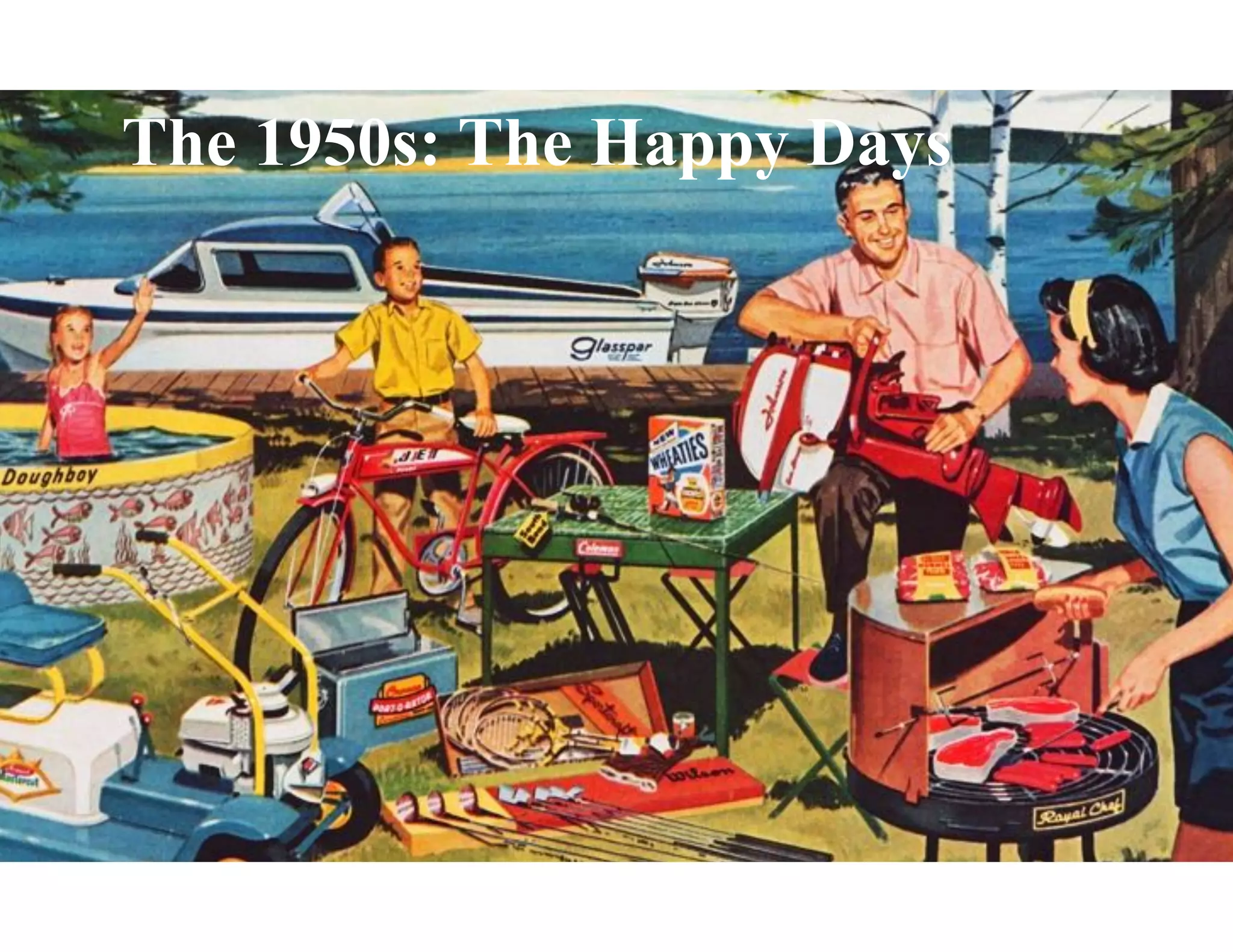
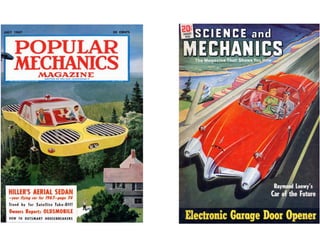
The 1950s: The Happy Days
SRQ for Ch. 28
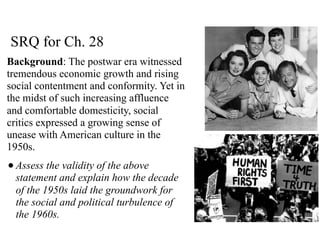
Background: The postwar era witnessed
tremendous economic growth and rising
social contentment and conformity. Yet in
the midst of such increasing affluence
and comfortable domesticity, social
critics expressed a growing sense of
unease with American culture in the
1950s.
•Assess the validity of the above
statement and explain how the decade
of the 1950s laid the groundwork for
the social and political turbulence of
the 1960s.
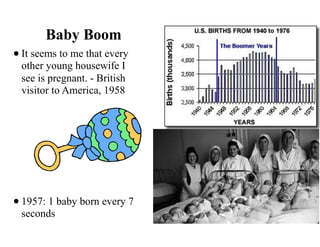
Baby Boom
•It seems to me that every
other young housewife I
see is pregnant. - British
visitor to America, 1958
•1957: 1 baby born every 7
seconds
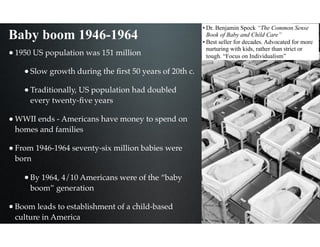
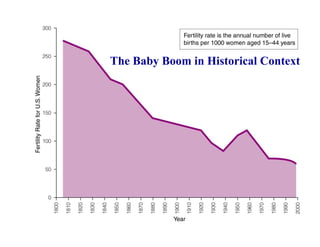
Baby boom 1946-1964
•1950 US population was 151 million
•Slow growth during the first 50 years of 20th c.
•Traditionally, US population had doubled
every twenty-five years
•WWII ends - Americans have money to spend on
homes and families
•From 1946-1964 seventy-six million babies were
born
•By 1964, 4/10 Americans were of the “baby
boom” generation
•Boom leads to establishment of a child-based
culture in America
• Dr. Benjamin Spock “The Common Sense
Book of Baby and Child Care”
• Best seller for decades. Advocated for more
nurturing with kids, rather than strict or
tough. “Focus on Individualism”
The Baby Boom in Historical Context
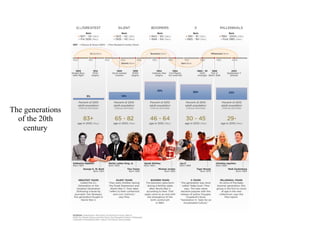
The generations
of the 20th
century
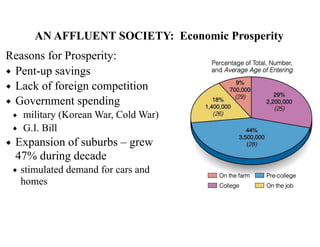
AN AFFLUENT SOCIETY: Economic Prosperity
Reasons for Prosperity:
◆ Pent-up savings
◆ Lack of foreign competition
◆ Government spending
◆ military (Korean War, Cold War)
◆ G.I. Bill
◆ Expansion of suburbs – grew
47% during decade
◆ stimulated demand for cars and
homes
AN AFFLUENT SOCIETY: Economic Prosperity
◆ Regional
Growth: The
Sunbelt
◆ Warmer
climate, lower
taxes, lower
labor costs
◆ Military
spending
Population Change, 1950-1960
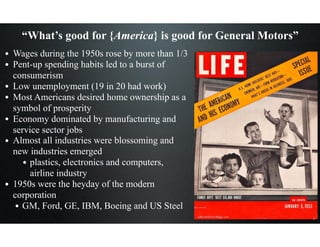
“What’s good for {America} is good for General Motors”
• Wages during the 1950s rose by more than 1/3
• Pent-up spending habits led to a burst of
consumerism
• Low unemployment (19 in 20 had work)
• Most Americans desired home ownership as a
symbol of prosperity
• Economy dominated by manufacturing and
service sector jobs
• Almost all industries were blossoming and
new industries emerged
• plastics, electronics and computers,
airline industry
• 1950s were the heyday of the modern
corporation
• GM, Ford, GE, IBM, Boeing and US Steel
CONSENSUS AND CONFORMITY: Corporate America
◆ Automation
◆ 1947-1957: Factory workers
decreased by 4.3% (1.5 million jobs)
◆ By 1956 more white collar jobs in
America than blue collar
◆ IBM mainframe 1951 - growth of
science and computers
◆ Consolidation
◆ 1960 - 600 corporations (1/2% of all U.S.
companies) accounted for 53% of total
corporate income
◆ Why? Cold War military buildup
◆ Conglomerates (food processing, hotels,
transportation, insurance, banking)
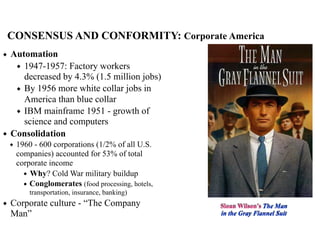
◆ Corporate culture - “The Company
Man”
Sloan Wilson’s The Man
in the Gray Flannel Suit
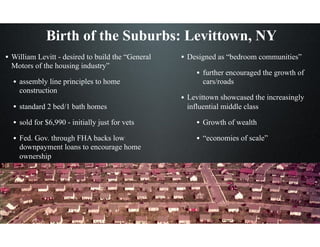
Birth of the Suburbs: Levittown, NY
• William Levitt - desired to build the “General
Motors of the housing industry”
• assembly line principles to home
construction
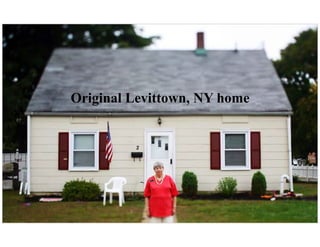
• standard 2 bed/1 bath homes
• sold for $6,990 - initially just for vets
• Fed. Gov. through FHA backs low
downpayment loans to encourage home
ownership
• Designed as “bedroom communities”
• further encouraged the growth of
cars/roads
• Levittown showcased the increasingly
influential middle class
• Growth of wealth
• “economies of scale”
Original Levittown, NY home
Population
Shifts
1940s
Cities 32%
Suburbs 20%
Rural 49%
1950s
Cities 32%
Suburbs 24%
Rural 44%
1960s
Cities 33%
Suburbs 31%
Rural 37%
1970s
Cities 32%
Suburbs 42%
Rural 26%
REASONS FOR THE
GROWTH OF
SUBURBS
◆ Growth of families
(“baby boom”)
◆ Home-ownership
became more affordable
◆ Low-interest mortgage
loans
◆ gov’t-backed & interest tax
deductible
◆ Mass-produced
subdivisions
◆ Expressways –
facilitated commuting
◆ Decline in inner city
housing stock
◆ Also: congestion, pollution
◆ Race – “white flight”
REASONS FOR THE
GROWTH OF SUBURBS
◆ Growth of suburbs came with
growth of TV - connected
them to national culture
“Americana”
◆ Shows focused on
‘families’
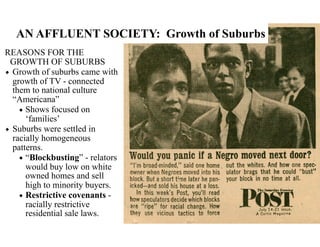
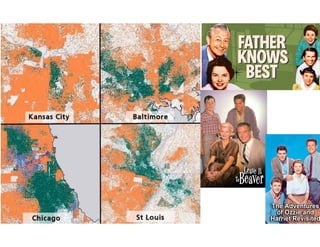
◆ Suburbs were settled in
racially homogeneous
patterns.
◆ “Blockbusting” - relators
would buy low on white
owned homes and sell
high to minority buyers.
◆ Restrictive covenants -
racially restrictive
residential sale laws.
AN AFFLUENT SOCIETY: Growth of Suburbs
EPA
MP
PA
RWC
Woodside
Atherton
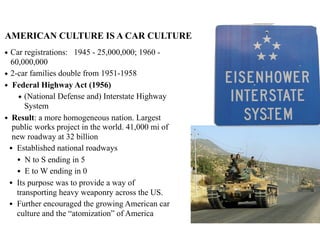
AMERICAN CULTURE IS A CAR CULTURE
◆ Car registrations: 1945 - 25,000,000; 1960 -
60,000,000
◆ 2-car families double from 1951-1958
◆ Federal Highway Act (1956)
◆ (National Defense and) Interstate Highway
System
◆ Result: a more homogeneous nation. Largest
public works project in the world. 41,000 mi of
new roadway at 32 billion
• Established national roadways
• N to S ending in 5
• E to W ending in 0
• Its purpose was to provide a way of
transporting heavy weaponry across the US.
• Further encouraged the growing American car
culture and the “atomization” of America
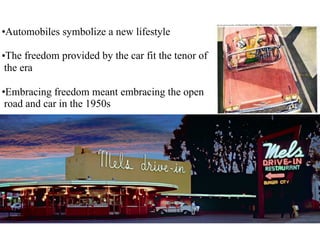
•Automobiles symbolize a new lifestyle
•The freedom provided by the car fit the tenor of
the era
•Embracing freedom meant embracing the open
road and car in the 1950s
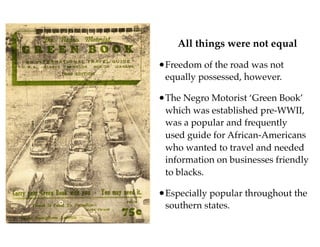
All things were not equal
•Freedom of the road was not
equally possessed, however.
•The Negro Motorist ‘Green Book’
which was established pre-WWII,
was a popular and frequently
used guide for African-Americans
who wanted to travel and needed
information on businesses friendly
to blacks.
•Especially popular throughout the
southern states.
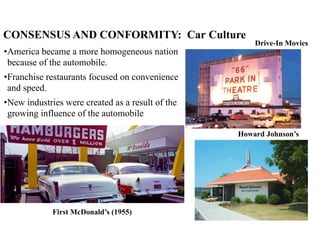
CONSENSUS AND CONFORMITY: Car Culture
First McDonald’s (1955)
•America became a more homogeneous nation
because of the automobile.
•Franchise restaurants focused on convenience
and speed.
•New industries were created as a result of the
growing influence of the automobile
Drive-In Movies
Howard Johnson’s
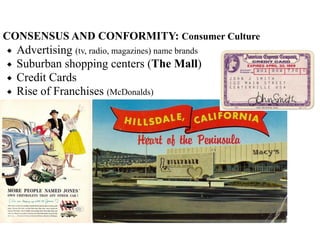
CONSENSUS AND CONFORMITY: Consumer Culture
◆ Advertising (tv, radio, magazines) name brands
◆ Suburban shopping centers (The Mall)
◆ Credit Cards
◆ Rise of Franchises (McDonalds)
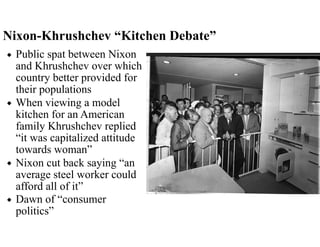
Nixon-Khrushchev “Kitchen Debate”
◆ Public spat between Nixon
and Khrushchev over which
country better provided for
their populations
◆ When viewing a model
kitchen for an American
family Khrushchev replied
“it was capitalized attitude
towards woman”
◆ Nixon cut back saying “an
average steel worker could
afford all of it”
◆ Dawn of “consumer
politics”
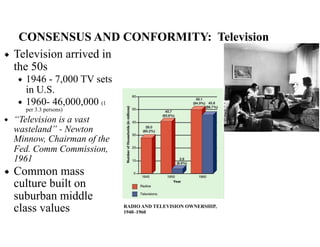
CONSENSUS AND CONFORMITY: Television
◆ Television arrived in
the 50s
◆ 1946 - 7,000 TV sets
in U.S.
◆ 1960- 46,000,000 (1
per 3.3 persons)
◆ “Television is a vast
wasteland” - Newton
Minnow, Chairman of the
Fed. Comm Commission,
1961
◆ Common mass
culture built on
suburban middle
class values RADIO AND TELEVISION OWNERSHIP,
1940–1960
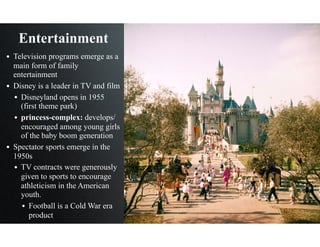
Entertainment
• Television programs emerge as a
main form of family
entertainment
• Disney is a leader in TV and film
• Disneyland opens in 1955
(first theme park)
• princess-complex: develops/
encouraged among young girls
of the baby boom generation
• Spectator sports emerge in the
1950s
• TV contracts were generously
given to sports to encourage
athleticism in the American
youth.
• Football is a Cold War era
product
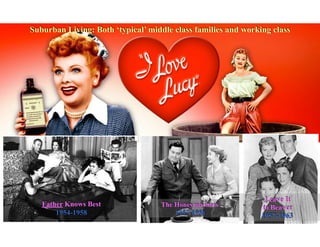
Suburban Living: Both ‘typical’ middle class families and working class
Leave It 

to Beaver

1957-1963
Father Knows Best

1954-1958
The Honeymooners

1957-1958
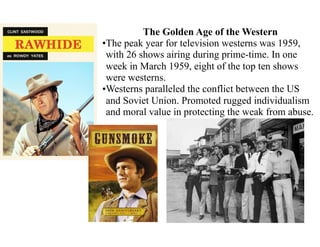
The Golden Age of the Western
•The peak year for television westerns was 1959,
with 26 shows airing during prime-time. In one
week in March 1959, eight of the top ten shows
were westerns.
•Westerns paralleled the conflict between the US
and Soviet Union. Promoted rugged individualism
and moral value in protecting the weak from abuse.
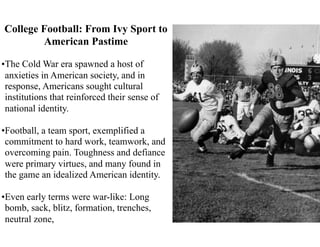
College Football: From Ivy Sport to
American Pastime
•The Cold War era spawned a host of
anxieties in American society, and in
response, Americans sought cultural
institutions that reinforced their sense of
national identity.
•Football, a team sport, exemplified a
commitment to hard work, teamwork, and
overcoming pain. Toughness and defiance
were primary virtues, and many found in
the game an idealized American identity.
•Even early terms were war-like: Long
bomb, sack, blitz, formation, trenches,
neutral zone,
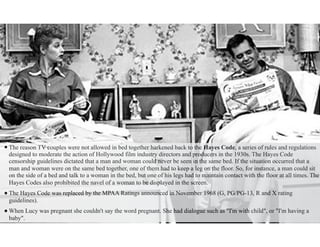
•The reason TV couples were not allowed in bed together harkened back to the Hayes Code, a series of rules and regulations
designed to moderate the action of Hollywood film industry directors and producers in the 1930s. The Hayes Code
censorship guidelines dictated that a man and woman could never be seen in the same bed. If the situation occurred that a
man and woman were on the same bed together, one of them had to keep a leg on the floor. So, for instance, a man could sit
on the side of a bed and talk to a woman in the bed, but one of his legs had to maintain contact with the floor at all times. The
Hayes Codes also prohibited the navel of a woman to be displayed in the screen.
•The Hayes Code was replaced by the MPAA Ratings announced in November 1968 (G, PG/PG-13, R and X rating
guidelines).
•When Lucy was pregnant she couldn't say the word pregnant. She had dialogue such as "I'm with child", or "I'm having a
baby".
Sexuality
• Alfred Kinsey, “Kinsey Reports” in 1948 and 1953
• Findings:
1.Premarital sex was common
2.Extramarital affairs were frequent/not
uncommon
3.Same sex/homosexuality was present and
homosexuals did engage in sex as frequently as
heterosexuals
4.People commonly valued sex for pleasure not
procreation.
• “Kinsey’s results are an assault on the family as a basic
unit of society, a negation of moral law, and a
celebration of licentiousness.” - Life Magazine, early
1950s
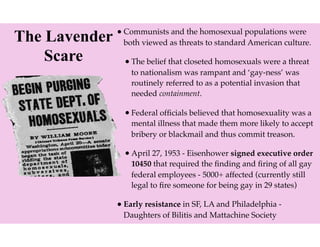
The Lavender
Scare
•Communists and the homosexual populations were
both viewed as threats to standard American culture.
•The belief that closeted homosexuals were a threat
to nationalism was rampant and ‘gay-ness’ was
routinely referred to as a potential invasion that
needed containment.
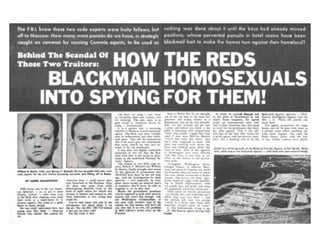
•Federal officials believed that homosexuality was a
mental illness that made them more likely to accept
bribery or blackmail and thus commit treason.
•April 27, 1953 - Eisenhower signed executive order
10450 that required the finding and firing of all gay
federal employees - 5000+ affected (currently still
legal to fire someone for being gay in 29 states)
•Early resistance in SF, LA and Philadelphia -
Daughters of Bilitis and Mattachine Society
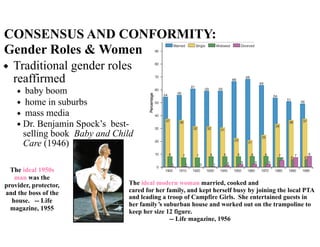
CONSENSUS AND CONFORMITY:
Gender Roles & Women
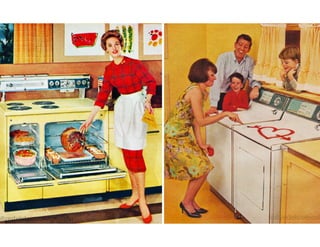
◆ Traditional gender roles
reaffirmed
◆ baby boom
◆ home in suburbs
◆ mass media
◆ Dr. Benjamin Spock’s best-
selling book Baby and Child
Care (1946)
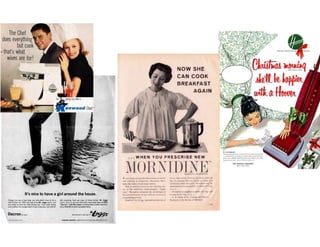
The ideal modern woman married, cooked and 

cared for her family, and kept herself busy by joining the local PTA
and leading a troop of Campfire Girls. She entertained guests in
her family’s suburban house and worked out on the trampoline to
keep her size 12 figure.

-- Life magazine, 1956
The ideal 1950s
man was the
provider, protector, 

and the boss of the
house. -- Life
magazine, 1955
CONSENSUS AND CONFORMITY:
Gender Roles & Women
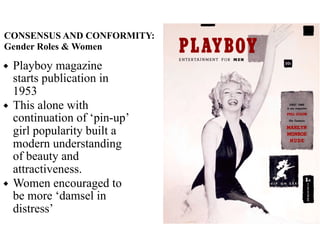
◆ Playboy magazine
starts publication in
1953
◆ This alone with
continuation of ‘pin-up’
girl popularity built a
modern understanding
of beauty and
attractiveness.
◆ Women encouraged to
be more ‘damsel in
distress’
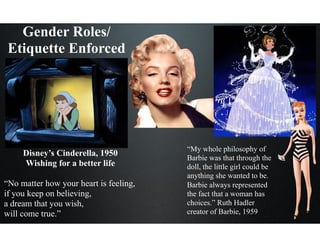
Gender Roles/
Etiquette Enforced
“My whole philosophy of
Barbie was that through the
doll, the little girl could be
anything she wanted to be.
Barbie always represented
the fact that a woman has
choices.” Ruth Hadler
creator of Barbie, 1959
Disney’s Cinderella, 1950
Wishing for a better life
“No matter how your heart is feeling,
if you keep on believing,
a dream that you wish,
will come true.”
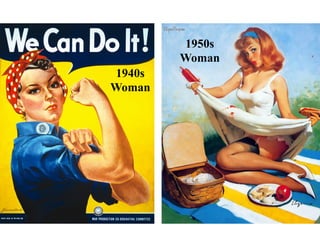
1940s
Woman
1950s
Woman
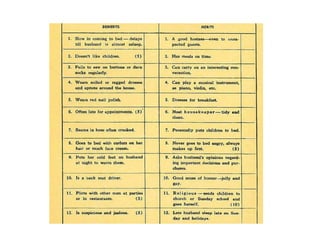
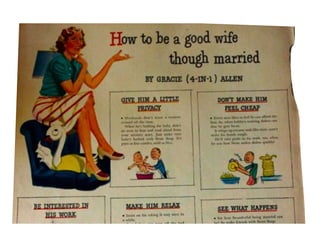
•1. DON'T TALK
•Oh, did Mavis from next door insult your prize winning squash? Did little Timmy get sent home for starting fires again? That
shooting pain in your left arm just keeps getting more intense? Keep it to yourself! Your man works all through his day and the
last thing he needs to hear about is yours. Refer to the first four commandments on “How to be a Good Wife” Edward Podolsky
gives in his 1943 book, Sex Today in Wedded Life:
•Don’t bother your husband with petty troubles and complaints when he comes home from work.
•Be a good listener. Let him tell you his troubles; yours will seem trivial in comparison.
•Remember your most important job is to build up and maintain his ego (which gets bruised plenty in business). Morale is a
woman’s business.
•Let him relax before dinner. Discuss family problems after the inner man has been satisfied.
•In his 1951 book, Sex Satisfaction and Happy Marriage, Reverend Alfred Henry Tyrer has more to add to that. Do not ask for
things. This is called "nagging":
•I verily believe that the happiness of homes is destroyed more frequently by the habit of nagging than by any other one. A
man may stand that sort of thing (nagging) for a long time, but the chances are against his standing it permanently. If he
needs peace to make life bearable, he will have to look for it elsewhere than in his own house. And it is quite likely that he
will look.
•Unless your husband wants you to talk. Then don’t you dare disappoint him. Says Reverend Tyrer:
•“If [the husband] is intellectually inclined, and from time to time seeks to explain little things to her so that she may have at
least a bare knowledge of what it is that interests him, and, without the slightest comment, she takes up again the fashion
magazine she laid down when he commenced to speak, we may be pretty sure that there is going to be a ‘rift in the lute’
sooner or later in that house.”
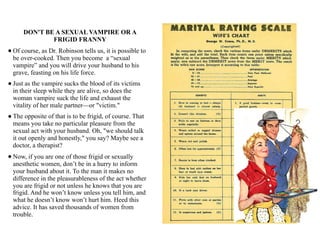
DON'T BE A SEXUAL VAMPIRE OR A
FRIGID FRANNY
•Of course, as Dr. Robinson tells us, it is possible to
be over-cooked. Then you become a “sexual
vampire” and you will drive your husband to his
grave, feasting on his life force.
•Just as the vampire sucks the blood of its victims
in their sleep while they are alive, so does the
woman vampire suck the life and exhaust the
vitality of her male partner—or "victim."
•The opposite of that is to be frigid, of course. That
means you take no particular pleasure from the
sexual act with your husband. Oh, "we should talk
it out openly and honestly," you say? Maybe see a
doctor, a therapist?
•Now, if you are one of those frigid or sexually
anesthetic women, don’t be in a hurry to inform
your husband about it. To the man it makes no
difference in the pleasurableness of the act whether
you are frigid or not unless he knows that you are
frigid. And he won’t know unless you tell him, and
what he doesn’t know won’t hurt him. Heed this
advice. It has saved thousands of women from
trouble.
CONSENSUS AND CONFORMITY:
Gender Roles & Women
◆ At end of WWII, many women left the
work force
◆ “pink collar” jobs
◆ Paid less - seen primarily as wives and mothers
◆ However, by end of decade 33% of
women held jobs
◆ More married women joined workforce,
especially as they reached middle age
◆ Why? - Betty Friedan Feminine Mystique
◆ "The problem lay buried, unspoken, for many years
in the minds of American women. It was a strange
stirring, a sense of dissatisfaction, a longing that
women suffered in the middle of the 20th century in
the United States. Each suburban [house]wife
struggled with it alone. As she made the beds,
shopped for groceries … she was afraid to ask even
of herself the silent question — 'Is this all?"
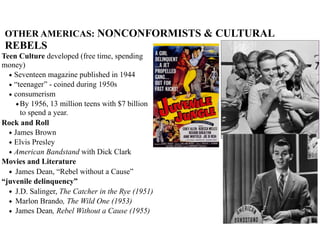
OTHER AMERICAS: NONCONFORMISTS & CULTURAL
REBELS
Teen Culture developed (free time, spending
money)
◆ Seventeen magazine published in 1944
◆ “teenager” - coined during 1950s
◆ consumerism
◆By 1956, 13 million teens with $7 billion
to spend a year.
Rock and Roll
◆ James Brown
◆ Elvis Presley
◆ American Bandstand with Dick Clark
Movies and Literature
◆ James Dean, “Rebel without a Cause”
“juvenile delinquency”
◆ J.D. Salinger, The Catcher in the Rye (1951)
◆ Marlon Brando, The Wild One (1953)
◆ James Dean, Rebel Without a Cause (1955)
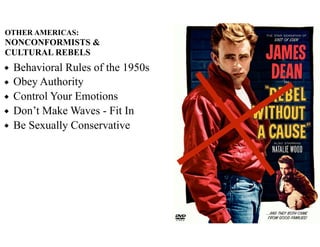
OTHER AMERICAS:
NONCONFORMISTS &
CULTURAL REBELS
◆ Behavioral Rules of the 1950s
◆ Obey Authority
◆ Control Your Emotions
◆ Don’t Make Waves - Fit In
◆ Be Sexually Conservative
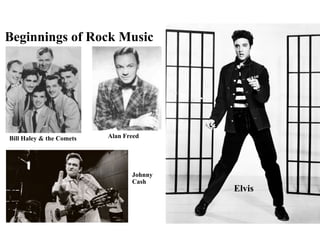
Beginnings of Rock Music
Alan FreedBill Haley & the Comets
Elvis
Johnny
Cash
OTHER AMERICAS: NONCONFORMISTS & CULTURAL
REBELS
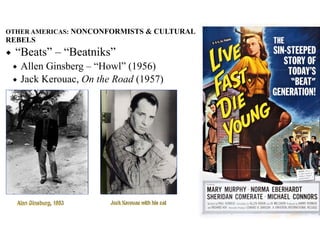
◆ “Beats” – “Beatniks”
◆ Allen Ginsberg – “Howl” (1956)
◆ Jack Kerouac, On the Road (1957)
Alan Ginsburg, 1953 Jack Kerouac with his cat
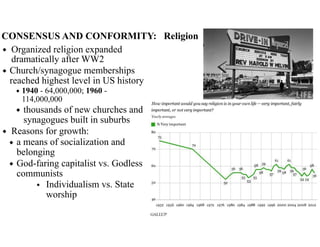
CONSENSUS AND CONFORMITY: Religion
◆ Organized religion expanded
dramatically after WW2
◆ Church/synagogue memberships
reached highest level in US history
◆ 1940 - 64,000,000; 1960 -
114,000,000
◆ thousands of new churches and
synagogues built in suburbs
◆ Reasons for growth:
◆ a means of socialization and
belonging
◆ God-faring capitalist vs. Godless
communists
• Individualism vs. State
worship
CONSENSUS AND CONFORMITY: Religion
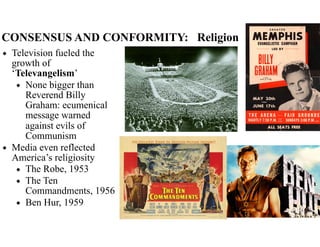
◆ Television fueled the
growth of
‘Televangelism’
◆ None bigger than
Reverend Billy
Graham: ecumenical
message warned
against evils of
Communism
◆ Media even reflected
America’s religiosity
◆ The Robe, 1953
◆ The Ten
Commandments, 1956
◆ Ben Hur, 1959
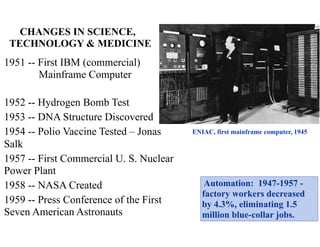
CHANGES IN SCIENCE,
TECHNOLOGY & MEDICINE
1951 -- First IBM (commercial)
Mainframe Computer
1952 -- Hydrogen Bomb Test
1953 -- DNA Structure Discovered
1954 -- Polio Vaccine Tested – Jonas
Salk
1957 -- First Commercial U. S. Nuclear
Power Plant
1958 -- NASA Created
1959 -- Press Conference of the First
Seven American Astronauts
ENIAC, first mainframe computer, 1945
Automation: 1947-1957 -
factory workers decreased
by 4.3%, eliminating 1.5
million blue-collar jobs.
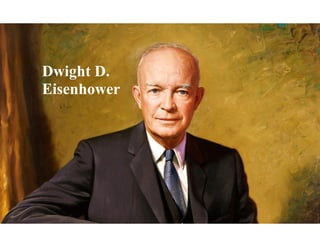
Dwight D.
Eisenhower
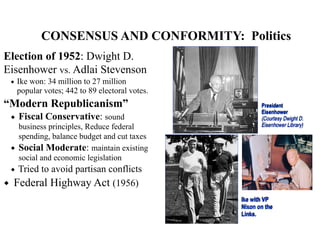
CONSENSUS AND CONFORMITY: Politics
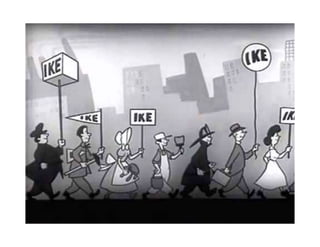
Election of 1952: Dwight D.
Eisenhower vs. Adlai Stevenson
◆ Ike won: 34 million to 27 million
popular votes; 442 to 89 electoral votes.
“Modern Republicanism”
◆ Fiscal Conservative: sound
business principles, Reduce federal
spending, balance budget and cut taxes
◆ Social Moderate: maintain existing
social and economic legislation
◆ Tried to avoid partisan conflicts
◆ Federal Highway Act (1956)
President
Eisenhower
(Courtesy Dwight D.
Eisenhower Library)
Ike with VP
Nixon on the
Links.
Dwight Eisenhower: Foreign Policy
•Ended the Korean War
•US failure in Hungary increases
involvement in other regions, including
Latin America, East Asia and Middle East
(Vietnam, Iran, Egypt, Cuba, Guatemala)
•US paying 80% of costs for France in
Vietnam
•1953 CIA coup props up Shah Pahlavi in
Iran
•Suez Canal Crisis with Gamal Nasser,
1956
•1959, Fidel Castro takes power and joins
with USSR
Dwight D. Eisenhower
•Eisenhower Doctrine - that the US was prepared to
use force to defend any country from communism.
•Sputnik and Sputnik II, 1957
•race over ICBM capability consumed the 1950s
defense industry
•John Foster Dulles warned of a “science and
missile gap.” We needed military investment to
catch up.
•1958 - National Defense Education Act
•Increase in math and science, inc. start of AP
program
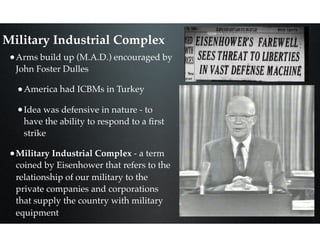
Military Industrial Complex
•Arms build up (M.A.D.) encouraged by
John Foster Dulles
•America had ICBMs in Turkey
•Idea was defensive in nature - to
have the ability to respond to a first
strike
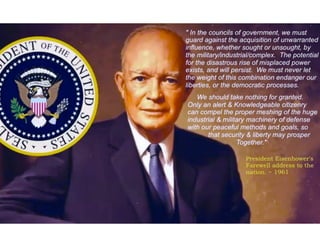
•Military Industrial Complex - a term
coined by Eisenhower that refers to the
relationship of our military to the
private companies and corporations
that supply the country with military
equipment
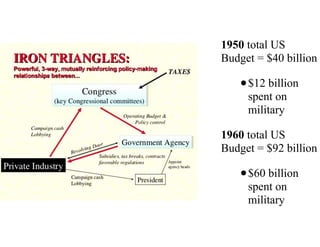
1950 total US
Budget = $40 billion
•$12 billion
spent on
military
1960 total US
Budget = $92 billion
•$60 billion
spent on
military
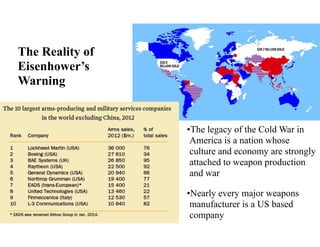
•The legacy of the Cold War in
America is a nation whose
culture and economy are strongly
attached to weapon production
and war
•Nearly every major weapons
manufacturer is a US based
company
The Reality of
Eisenhower’s
Warning
•While military spending as a
% of budget has declined
from the 1950s, the US still
spends more than the next 10
nations combined.
•All of these nations are allies
•Recent Brown and Harvard
studies place total cost of just
the Iraq war from 2003-2010
from 1.1 to 3 trillion dollars
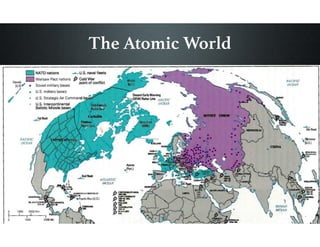
The Atomic World
Girl in front of dome atomic
bomb shelter
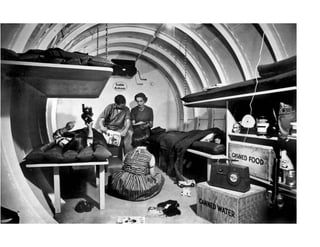
As the Cold War intensified and
the Soviets became a nuclear
power, the government began
to consider methods to survive
a nuclear war. One "solution"
was to encourage people to
build backyard bomb shelters.
Pictured here is one family's
atomic bomb shelter that slept
six. The cost was $1,250 in
1951.
Girl in front of dome atomic bomb shelter
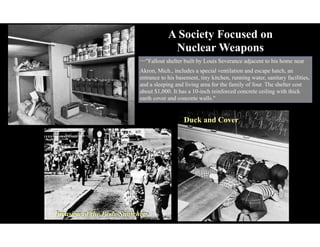
A Society Focused on
Nuclear Weapons
Duck and Cover
Invasion of the Body Snatchers
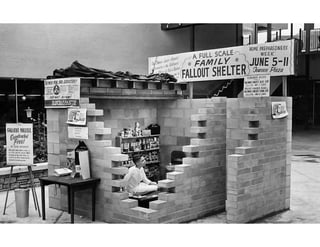
⇦"Fallout shelter built by Louis Severance adjacent to his home near
Akron, Mich., includes a special ventilation and escape hatch, an
entrance to his basement, tiny kitchen, running water, sanitary facilities,
and a sleeping and living area for the family of four. The shelter cost
about $1,000. It has a 10-inch reinforced concrete ceiling with thick
earth cover and concrete walls."
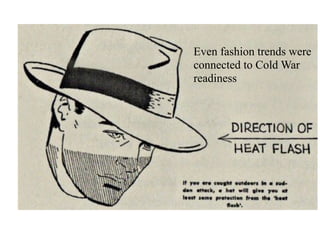
Even fashion trends were
connected to Cold War
readiness
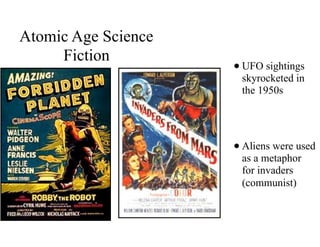
Atomic Age Science
Fiction
•UFO sightings
skyrocketed in
the 1950s
•Aliens were used
as a metaphor
for invaders
(communist)
The Duck and Cover
Generation
•Atomic Anxieties
•Testing of atomic weapons
from 1946-1962
•217 nuclear weapons tests in
Pacific Ocean and in Nevada
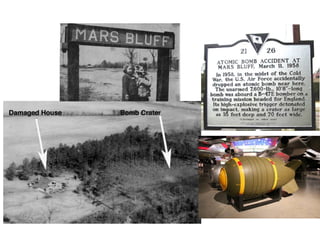
Mars Bluff - Or that 1st time we almost dropped a bomb on
ourselves
•On March 11, 1958, an Air Force B-47 flying to UK from Georgia carrying a 26-kiloton Mark 6 nuclear
bomb (about twice the strength of Hiroshima bomb, Little Boy)
•As the plane was cruising over South Carolina, the pilots noticed that a light in the cockpit was indicating a
problem with the locking pin on the bomb harnesses in the cargo bay. (It was standard M.A.D. policy to
carry nuclear weapons at all times just in case a war broke out with the Soviet Union).
•Air Force Captain Bruce Kulka decided to go back and check out the problem.
•While pulling himself up from the plane floor, he reached around the bomb to steady himself, but ended
up grabbing the the bomb’s emergency release pin instead.
•The bomb dropped to the floor of the plane, and its weight pushed open the bomb bay doors, and fell
15,000 feet toward rural South Carolina.
•Fortunately for the entire East Coast, the bomb’s fission core was stored in a separate part of the plane,
meaning that it wasn’t technically armed.
•Unfortunately for Walter Gregg, it was still loaded with about 7,600 pounds of traditional explosives. The
resulting explosion leveled his house, flattened a good section of the forest, and created a mushroom cloud
that could be seen for miles. When the dust had settled, the bomb had caused a 25-foot-deep crater that
measured 75 feet wide, and while it had injured a number of Gregg’s family members, miraculously, not a
single person was killed.
Phew that was close, part 2:
Must be a Carolina thing?
•January 23, 1961, a B-52 bomber broke
up mid air, dropping two Mark 39
hydrogen bombs over Goldsboro, North
Carolina.
•While one bomb never activated, the
second one had its trigger mechanisms
engage and its parachute open, two things
that only happen when the bomb is
intended to explode on target.
•By luck, one low-voltage trigger
malfunction kept it from detonating upon
landing.

APUSH Lecture Ch. 28

  • 1.
    The 1950s: TheHappy Days
  • 2.
    SRQ for Ch.28 Background: The postwar era witnessed tremendous economic growth and rising social contentment and conformity. Yet in the midst of such increasing affluence and comfortable domesticity, social critics expressed a growing sense of unease with American culture in the 1950s. •Assess the validity of the above statement and explain how the decade of the 1950s laid the groundwork for the social and political turbulence of the 1960s.
  • 3.
    Baby Boom •It seemsto me that every other young housewife I see is pregnant. - British visitor to America, 1958 •1957: 1 baby born every 7 seconds
  • 4.
    Baby boom 1946-1964 •1950US population was 151 million •Slow growth during the first 50 years of 20th c. •Traditionally, US population had doubled every twenty-five years •WWII ends - Americans have money to spend on homes and families •From 1946-1964 seventy-six million babies were born •By 1964, 4/10 Americans were of the “baby boom” generation •Boom leads to establishment of a child-based culture in America • Dr. Benjamin Spock “The Common Sense Book of Baby and Child Care” • Best seller for decades. Advocated for more nurturing with kids, rather than strict or tough. “Focus on Individualism”
  • 5.
    The Baby Boomin Historical Context
  • 6.
  • 7.
    AN AFFLUENT SOCIETY:Economic Prosperity Reasons for Prosperity: ◆ Pent-up savings ◆ Lack of foreign competition ◆ Government spending ◆ military (Korean War, Cold War) ◆ G.I. Bill ◆ Expansion of suburbs – grew 47% during decade ◆ stimulated demand for cars and homes
  • 8.
    AN AFFLUENT SOCIETY:Economic Prosperity ◆ Regional Growth: The Sunbelt ◆ Warmer climate, lower taxes, lower labor costs ◆ Military spending Population Change, 1950-1960
  • 9.
    “What’s good for{America} is good for General Motors” • Wages during the 1950s rose by more than 1/3 • Pent-up spending habits led to a burst of consumerism • Low unemployment (19 in 20 had work) • Most Americans desired home ownership as a symbol of prosperity • Economy dominated by manufacturing and service sector jobs • Almost all industries were blossoming and new industries emerged • plastics, electronics and computers, airline industry • 1950s were the heyday of the modern corporation • GM, Ford, GE, IBM, Boeing and US Steel
  • 10.
    CONSENSUS AND CONFORMITY:Corporate America ◆ Automation ◆ 1947-1957: Factory workers decreased by 4.3% (1.5 million jobs) ◆ By 1956 more white collar jobs in America than blue collar ◆ IBM mainframe 1951 - growth of science and computers ◆ Consolidation ◆ 1960 - 600 corporations (1/2% of all U.S. companies) accounted for 53% of total corporate income ◆ Why? Cold War military buildup ◆ Conglomerates (food processing, hotels, transportation, insurance, banking) ◆ Corporate culture - “The Company Man” Sloan Wilson’s The Man in the Gray Flannel Suit
  • 11.
    Birth of theSuburbs: Levittown, NY • William Levitt - desired to build the “General Motors of the housing industry” • assembly line principles to home construction • standard 2 bed/1 bath homes • sold for $6,990 - initially just for vets • Fed. Gov. through FHA backs low downpayment loans to encourage home ownership • Designed as “bedroom communities” • further encouraged the growth of cars/roads • Levittown showcased the increasingly influential middle class • Growth of wealth • “economies of scale”
  • 12.
  • 13.
    Population Shifts 1940s Cities 32% Suburbs 20% Rural49% 1950s Cities 32% Suburbs 24% Rural 44% 1960s Cities 33% Suburbs 31% Rural 37% 1970s Cities 32% Suburbs 42% Rural 26%
  • 15.
    REASONS FOR THE GROWTHOF SUBURBS ◆ Growth of families (“baby boom”) ◆ Home-ownership became more affordable ◆ Low-interest mortgage loans ◆ gov’t-backed & interest tax deductible ◆ Mass-produced subdivisions ◆ Expressways – facilitated commuting ◆ Decline in inner city housing stock ◆ Also: congestion, pollution ◆ Race – “white flight”
  • 16.
    REASONS FOR THE GROWTHOF SUBURBS ◆ Growth of suburbs came with growth of TV - connected them to national culture “Americana” ◆ Shows focused on ‘families’ ◆ Suburbs were settled in racially homogeneous patterns. ◆ “Blockbusting” - relators would buy low on white owned homes and sell high to minority buyers. ◆ Restrictive covenants - racially restrictive residential sale laws. AN AFFLUENT SOCIETY: Growth of Suburbs
  • 18.
  • 19.
    AMERICAN CULTURE ISA CAR CULTURE ◆ Car registrations: 1945 - 25,000,000; 1960 - 60,000,000 ◆ 2-car families double from 1951-1958 ◆ Federal Highway Act (1956) ◆ (National Defense and) Interstate Highway System ◆ Result: a more homogeneous nation. Largest public works project in the world. 41,000 mi of new roadway at 32 billion • Established national roadways • N to S ending in 5 • E to W ending in 0 • Its purpose was to provide a way of transporting heavy weaponry across the US. • Further encouraged the growing American car culture and the “atomization” of America
  • 21.
    •Automobiles symbolize anew lifestyle •The freedom provided by the car fit the tenor of the era •Embracing freedom meant embracing the open road and car in the 1950s
  • 22.
    All things werenot equal •Freedom of the road was not equally possessed, however. •The Negro Motorist ‘Green Book’ which was established pre-WWII, was a popular and frequently used guide for African-Americans who wanted to travel and needed information on businesses friendly to blacks. •Especially popular throughout the southern states.
  • 23.
    CONSENSUS AND CONFORMITY:Car Culture First McDonald’s (1955) •America became a more homogeneous nation because of the automobile. •Franchise restaurants focused on convenience and speed. •New industries were created as a result of the growing influence of the automobile Drive-In Movies Howard Johnson’s
  • 24.
    CONSENSUS AND CONFORMITY:Consumer Culture ◆ Advertising (tv, radio, magazines) name brands ◆ Suburban shopping centers (The Mall) ◆ Credit Cards ◆ Rise of Franchises (McDonalds)
  • 25.
    Nixon-Khrushchev “Kitchen Debate” ◆Public spat between Nixon and Khrushchev over which country better provided for their populations ◆ When viewing a model kitchen for an American family Khrushchev replied “it was capitalized attitude towards woman” ◆ Nixon cut back saying “an average steel worker could afford all of it” ◆ Dawn of “consumer politics”
  • 26.
    CONSENSUS AND CONFORMITY:Television ◆ Television arrived in the 50s ◆ 1946 - 7,000 TV sets in U.S. ◆ 1960- 46,000,000 (1 per 3.3 persons) ◆ “Television is a vast wasteland” - Newton Minnow, Chairman of the Fed. Comm Commission, 1961 ◆ Common mass culture built on suburban middle class values RADIO AND TELEVISION OWNERSHIP, 1940–1960
  • 27.
    Entertainment • Television programsemerge as a main form of family entertainment • Disney is a leader in TV and film • Disneyland opens in 1955 (first theme park) • princess-complex: develops/ encouraged among young girls of the baby boom generation • Spectator sports emerge in the 1950s • TV contracts were generously given to sports to encourage athleticism in the American youth. • Football is a Cold War era product
  • 28.
    Suburban Living: Both‘typical’ middle class families and working class Leave It 
 to Beaver
 1957-1963 Father Knows Best
 1954-1958 The Honeymooners
 1957-1958
  • 29.
    The Golden Ageof the Western •The peak year for television westerns was 1959, with 26 shows airing during prime-time. In one week in March 1959, eight of the top ten shows were westerns. •Westerns paralleled the conflict between the US and Soviet Union. Promoted rugged individualism and moral value in protecting the weak from abuse.
  • 30.
    College Football: FromIvy Sport to American Pastime •The Cold War era spawned a host of anxieties in American society, and in response, Americans sought cultural institutions that reinforced their sense of national identity. •Football, a team sport, exemplified a commitment to hard work, teamwork, and overcoming pain. Toughness and defiance were primary virtues, and many found in the game an idealized American identity. •Even early terms were war-like: Long bomb, sack, blitz, formation, trenches, neutral zone,
  • 31.
    •The reason TVcouples were not allowed in bed together harkened back to the Hayes Code, a series of rules and regulations designed to moderate the action of Hollywood film industry directors and producers in the 1930s. The Hayes Code censorship guidelines dictated that a man and woman could never be seen in the same bed. If the situation occurred that a man and woman were on the same bed together, one of them had to keep a leg on the floor. So, for instance, a man could sit on the side of a bed and talk to a woman in the bed, but one of his legs had to maintain contact with the floor at all times. The Hayes Codes also prohibited the navel of a woman to be displayed in the screen. •The Hayes Code was replaced by the MPAA Ratings announced in November 1968 (G, PG/PG-13, R and X rating guidelines). •When Lucy was pregnant she couldn't say the word pregnant. She had dialogue such as "I'm with child", or "I'm having a baby".

  • 32.
    Sexuality • Alfred Kinsey,“Kinsey Reports” in 1948 and 1953 • Findings: 1.Premarital sex was common 2.Extramarital affairs were frequent/not uncommon 3.Same sex/homosexuality was present and homosexuals did engage in sex as frequently as heterosexuals 4.People commonly valued sex for pleasure not procreation. • “Kinsey’s results are an assault on the family as a basic unit of society, a negation of moral law, and a celebration of licentiousness.” - Life Magazine, early 1950s
  • 34.
    The Lavender Scare •Communists andthe homosexual populations were both viewed as threats to standard American culture. •The belief that closeted homosexuals were a threat to nationalism was rampant and ‘gay-ness’ was routinely referred to as a potential invasion that needed containment. •Federal officials believed that homosexuality was a mental illness that made them more likely to accept bribery or blackmail and thus commit treason. •April 27, 1953 - Eisenhower signed executive order 10450 that required the finding and firing of all gay federal employees - 5000+ affected (currently still legal to fire someone for being gay in 29 states) •Early resistance in SF, LA and Philadelphia - Daughters of Bilitis and Mattachine Society
  • 37.
    CONSENSUS AND CONFORMITY: GenderRoles & Women ◆ Traditional gender roles reaffirmed ◆ baby boom ◆ home in suburbs ◆ mass media ◆ Dr. Benjamin Spock’s best- selling book Baby and Child Care (1946) The ideal modern woman married, cooked and 
 cared for her family, and kept herself busy by joining the local PTA and leading a troop of Campfire Girls. She entertained guests in her family’s suburban house and worked out on the trampoline to keep her size 12 figure.
 -- Life magazine, 1956 The ideal 1950s man was the provider, protector, 
 and the boss of the house. -- Life magazine, 1955
  • 38.
    CONSENSUS AND CONFORMITY: GenderRoles & Women ◆ Playboy magazine starts publication in 1953 ◆ This alone with continuation of ‘pin-up’ girl popularity built a modern understanding of beauty and attractiveness. ◆ Women encouraged to be more ‘damsel in distress’
  • 39.
    Gender Roles/ Etiquette Enforced “Mywhole philosophy of Barbie was that through the doll, the little girl could be anything she wanted to be. Barbie always represented the fact that a woman has choices.” Ruth Hadler creator of Barbie, 1959 Disney’s Cinderella, 1950 Wishing for a better life “No matter how your heart is feeling, if you keep on believing, a dream that you wish, will come true.”
  • 40.
  • 41.
    •1. DON'T TALK •Oh,did Mavis from next door insult your prize winning squash? Did little Timmy get sent home for starting fires again? That shooting pain in your left arm just keeps getting more intense? Keep it to yourself! Your man works all through his day and the last thing he needs to hear about is yours. Refer to the first four commandments on “How to be a Good Wife” Edward Podolsky gives in his 1943 book, Sex Today in Wedded Life: •Don’t bother your husband with petty troubles and complaints when he comes home from work. •Be a good listener. Let him tell you his troubles; yours will seem trivial in comparison. •Remember your most important job is to build up and maintain his ego (which gets bruised plenty in business). Morale is a woman’s business. •Let him relax before dinner. Discuss family problems after the inner man has been satisfied. •In his 1951 book, Sex Satisfaction and Happy Marriage, Reverend Alfred Henry Tyrer has more to add to that. Do not ask for things. This is called "nagging": •I verily believe that the happiness of homes is destroyed more frequently by the habit of nagging than by any other one. A man may stand that sort of thing (nagging) for a long time, but the chances are against his standing it permanently. If he needs peace to make life bearable, he will have to look for it elsewhere than in his own house. And it is quite likely that he will look. •Unless your husband wants you to talk. Then don’t you dare disappoint him. Says Reverend Tyrer: •“If [the husband] is intellectually inclined, and from time to time seeks to explain little things to her so that she may have at least a bare knowledge of what it is that interests him, and, without the slightest comment, she takes up again the fashion magazine she laid down when he commenced to speak, we may be pretty sure that there is going to be a ‘rift in the lute’ sooner or later in that house.”
  • 43.
    DON'T BE ASEXUAL VAMPIRE OR A FRIGID FRANNY •Of course, as Dr. Robinson tells us, it is possible to be over-cooked. Then you become a “sexual vampire” and you will drive your husband to his grave, feasting on his life force. •Just as the vampire sucks the blood of its victims in their sleep while they are alive, so does the woman vampire suck the life and exhaust the vitality of her male partner—or "victim." •The opposite of that is to be frigid, of course. That means you take no particular pleasure from the sexual act with your husband. Oh, "we should talk it out openly and honestly," you say? Maybe see a doctor, a therapist? •Now, if you are one of those frigid or sexually anesthetic women, don’t be in a hurry to inform your husband about it. To the man it makes no difference in the pleasurableness of the act whether you are frigid or not unless he knows that you are frigid. And he won’t know unless you tell him, and what he doesn’t know won’t hurt him. Heed this advice. It has saved thousands of women from trouble.
  • 46.
    CONSENSUS AND CONFORMITY: GenderRoles & Women ◆ At end of WWII, many women left the work force ◆ “pink collar” jobs ◆ Paid less - seen primarily as wives and mothers ◆ However, by end of decade 33% of women held jobs ◆ More married women joined workforce, especially as they reached middle age ◆ Why? - Betty Friedan Feminine Mystique ◆ "The problem lay buried, unspoken, for many years in the minds of American women. It was a strange stirring, a sense of dissatisfaction, a longing that women suffered in the middle of the 20th century in the United States. Each suburban [house]wife struggled with it alone. As she made the beds, shopped for groceries … she was afraid to ask even of herself the silent question — 'Is this all?"
  • 47.
    OTHER AMERICAS: NONCONFORMISTS& CULTURAL REBELS Teen Culture developed (free time, spending money) ◆ Seventeen magazine published in 1944 ◆ “teenager” - coined during 1950s ◆ consumerism ◆By 1956, 13 million teens with $7 billion to spend a year. Rock and Roll ◆ James Brown ◆ Elvis Presley ◆ American Bandstand with Dick Clark Movies and Literature ◆ James Dean, “Rebel without a Cause” “juvenile delinquency” ◆ J.D. Salinger, The Catcher in the Rye (1951) ◆ Marlon Brando, The Wild One (1953) ◆ James Dean, Rebel Without a Cause (1955)
  • 48.
    OTHER AMERICAS: NONCONFORMISTS & CULTURALREBELS ◆ Behavioral Rules of the 1950s ◆ Obey Authority ◆ Control Your Emotions ◆ Don’t Make Waves - Fit In ◆ Be Sexually Conservative
  • 49.
    Beginnings of RockMusic Alan FreedBill Haley & the Comets Elvis Johnny Cash
  • 50.
    OTHER AMERICAS: NONCONFORMISTS& CULTURAL REBELS ◆ “Beats” – “Beatniks” ◆ Allen Ginsberg – “Howl” (1956) ◆ Jack Kerouac, On the Road (1957) Alan Ginsburg, 1953 Jack Kerouac with his cat
  • 51.
    CONSENSUS AND CONFORMITY:Religion ◆ Organized religion expanded dramatically after WW2 ◆ Church/synagogue memberships reached highest level in US history ◆ 1940 - 64,000,000; 1960 - 114,000,000 ◆ thousands of new churches and synagogues built in suburbs ◆ Reasons for growth: ◆ a means of socialization and belonging ◆ God-faring capitalist vs. Godless communists • Individualism vs. State worship
  • 52.
    CONSENSUS AND CONFORMITY:Religion ◆ Television fueled the growth of ‘Televangelism’ ◆ None bigger than Reverend Billy Graham: ecumenical message warned against evils of Communism ◆ Media even reflected America’s religiosity ◆ The Robe, 1953 ◆ The Ten Commandments, 1956 ◆ Ben Hur, 1959
  • 53.
    CHANGES IN SCIENCE, TECHNOLOGY& MEDICINE 1951 -- First IBM (commercial) Mainframe Computer 1952 -- Hydrogen Bomb Test 1953 -- DNA Structure Discovered 1954 -- Polio Vaccine Tested – Jonas Salk 1957 -- First Commercial U. S. Nuclear Power Plant 1958 -- NASA Created 1959 -- Press Conference of the First Seven American Astronauts ENIAC, first mainframe computer, 1945 Automation: 1947-1957 - factory workers decreased by 4.3%, eliminating 1.5 million blue-collar jobs.
  • 55.
  • 57.
    CONSENSUS AND CONFORMITY:Politics Election of 1952: Dwight D. Eisenhower vs. Adlai Stevenson ◆ Ike won: 34 million to 27 million popular votes; 442 to 89 electoral votes. “Modern Republicanism” ◆ Fiscal Conservative: sound business principles, Reduce federal spending, balance budget and cut taxes ◆ Social Moderate: maintain existing social and economic legislation ◆ Tried to avoid partisan conflicts ◆ Federal Highway Act (1956) President Eisenhower (Courtesy Dwight D. Eisenhower Library) Ike with VP Nixon on the Links.
  • 58.
    Dwight Eisenhower: ForeignPolicy •Ended the Korean War •US failure in Hungary increases involvement in other regions, including Latin America, East Asia and Middle East (Vietnam, Iran, Egypt, Cuba, Guatemala) •US paying 80% of costs for France in Vietnam •1953 CIA coup props up Shah Pahlavi in Iran •Suez Canal Crisis with Gamal Nasser, 1956 •1959, Fidel Castro takes power and joins with USSR
  • 59.
    Dwight D. Eisenhower •EisenhowerDoctrine - that the US was prepared to use force to defend any country from communism. •Sputnik and Sputnik II, 1957 •race over ICBM capability consumed the 1950s defense industry •John Foster Dulles warned of a “science and missile gap.” We needed military investment to catch up. •1958 - National Defense Education Act •Increase in math and science, inc. start of AP program
  • 60.
    Military Industrial Complex •Armsbuild up (M.A.D.) encouraged by John Foster Dulles •America had ICBMs in Turkey •Idea was defensive in nature - to have the ability to respond to a first strike •Military Industrial Complex - a term coined by Eisenhower that refers to the relationship of our military to the private companies and corporations that supply the country with military equipment
  • 62.
    1950 total US Budget= $40 billion •$12 billion spent on military 1960 total US Budget = $92 billion •$60 billion spent on military
  • 63.
    •The legacy ofthe Cold War in America is a nation whose culture and economy are strongly attached to weapon production and war •Nearly every major weapons manufacturer is a US based company The Reality of Eisenhower’s Warning
  • 64.
    •While military spendingas a % of budget has declined from the 1950s, the US still spends more than the next 10 nations combined. •All of these nations are allies •Recent Brown and Harvard studies place total cost of just the Iraq war from 2003-2010 from 1.1 to 3 trillion dollars
  • 65.
  • 66.
    Girl in frontof dome atomic bomb shelter As the Cold War intensified and the Soviets became a nuclear power, the government began to consider methods to survive a nuclear war. One "solution" was to encourage people to build backyard bomb shelters. Pictured here is one family's atomic bomb shelter that slept six. The cost was $1,250 in 1951. Girl in front of dome atomic bomb shelter
  • 68.
    A Society Focusedon Nuclear Weapons Duck and Cover Invasion of the Body Snatchers ⇦"Fallout shelter built by Louis Severance adjacent to his home near Akron, Mich., includes a special ventilation and escape hatch, an entrance to his basement, tiny kitchen, running water, sanitary facilities, and a sleeping and living area for the family of four. The shelter cost about $1,000. It has a 10-inch reinforced concrete ceiling with thick earth cover and concrete walls."
  • 70.
    Even fashion trendswere connected to Cold War readiness
  • 73.
    Atomic Age Science Fiction •UFOsightings skyrocketed in the 1950s •Aliens were used as a metaphor for invaders (communist)
  • 74.
    The Duck andCover Generation •Atomic Anxieties •Testing of atomic weapons from 1946-1962 •217 nuclear weapons tests in Pacific Ocean and in Nevada
  • 75.
    Mars Bluff -Or that 1st time we almost dropped a bomb on ourselves •On March 11, 1958, an Air Force B-47 flying to UK from Georgia carrying a 26-kiloton Mark 6 nuclear bomb (about twice the strength of Hiroshima bomb, Little Boy) •As the plane was cruising over South Carolina, the pilots noticed that a light in the cockpit was indicating a problem with the locking pin on the bomb harnesses in the cargo bay. (It was standard M.A.D. policy to carry nuclear weapons at all times just in case a war broke out with the Soviet Union). •Air Force Captain Bruce Kulka decided to go back and check out the problem. •While pulling himself up from the plane floor, he reached around the bomb to steady himself, but ended up grabbing the the bomb’s emergency release pin instead. •The bomb dropped to the floor of the plane, and its weight pushed open the bomb bay doors, and fell 15,000 feet toward rural South Carolina. •Fortunately for the entire East Coast, the bomb’s fission core was stored in a separate part of the plane, meaning that it wasn’t technically armed. •Unfortunately for Walter Gregg, it was still loaded with about 7,600 pounds of traditional explosives. The resulting explosion leveled his house, flattened a good section of the forest, and created a mushroom cloud that could be seen for miles. When the dust had settled, the bomb had caused a 25-foot-deep crater that measured 75 feet wide, and while it had injured a number of Gregg’s family members, miraculously, not a single person was killed.
  • 77.
    Phew that wasclose, part 2: Must be a Carolina thing? •January 23, 1961, a B-52 bomber broke up mid air, dropping two Mark 39 hydrogen bombs over Goldsboro, North Carolina. •While one bomb never activated, the second one had its trigger mechanisms engage and its parachute open, two things that only happen when the bomb is intended to explode on target. •By luck, one low-voltage trigger malfunction kept it from detonating upon landing.