Biology
 The invention of the lens
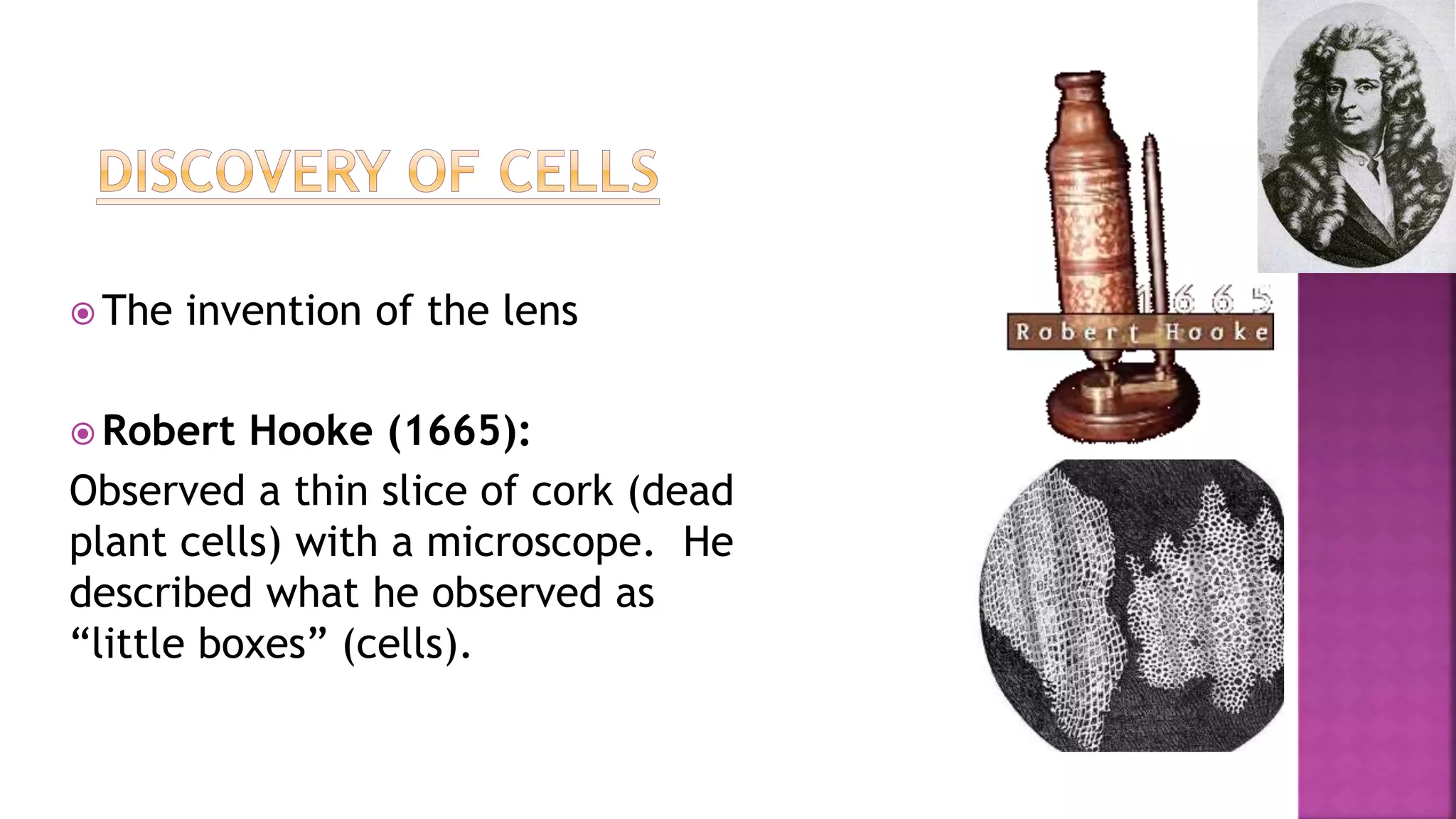
 Robert Hooke (1665):
Observed a thin slice of cork (dead
plant cells) with a microscope. He
described what he observed as
“little boxes” (cells).
 Studied plant cells and noticed that each one had a
dark spot inside it.
 He named the spot the ‘nucleus’ which means ‘the
little nut’
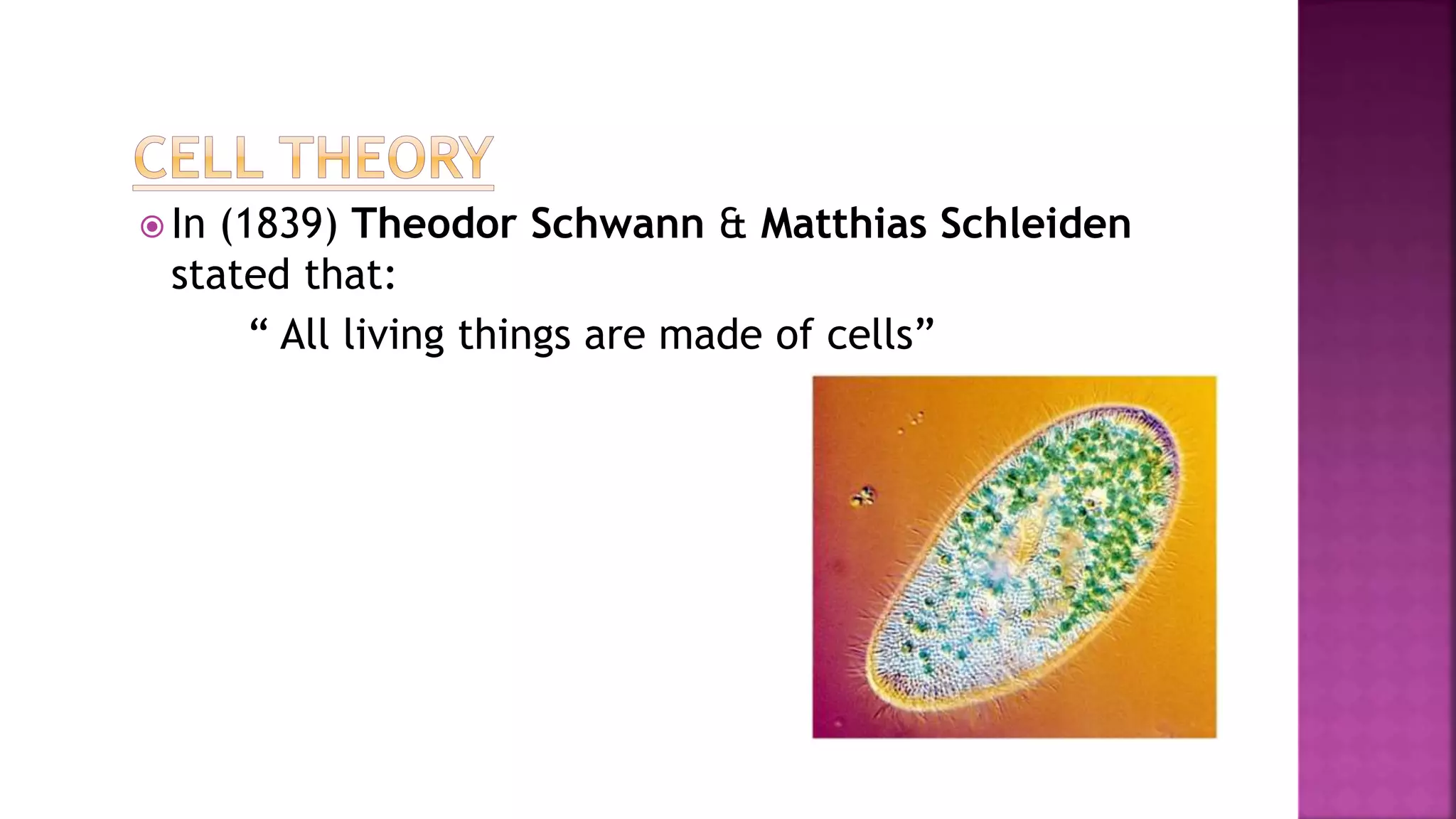
 In (1839) Theodor Schwann & Matthias Schleiden
stated that:
“ All living things are made of cells”
 All living things are made of cells
 Smallest living unit of structure and function of
all organisms is the cell
 All cells arise from preexisting cells.
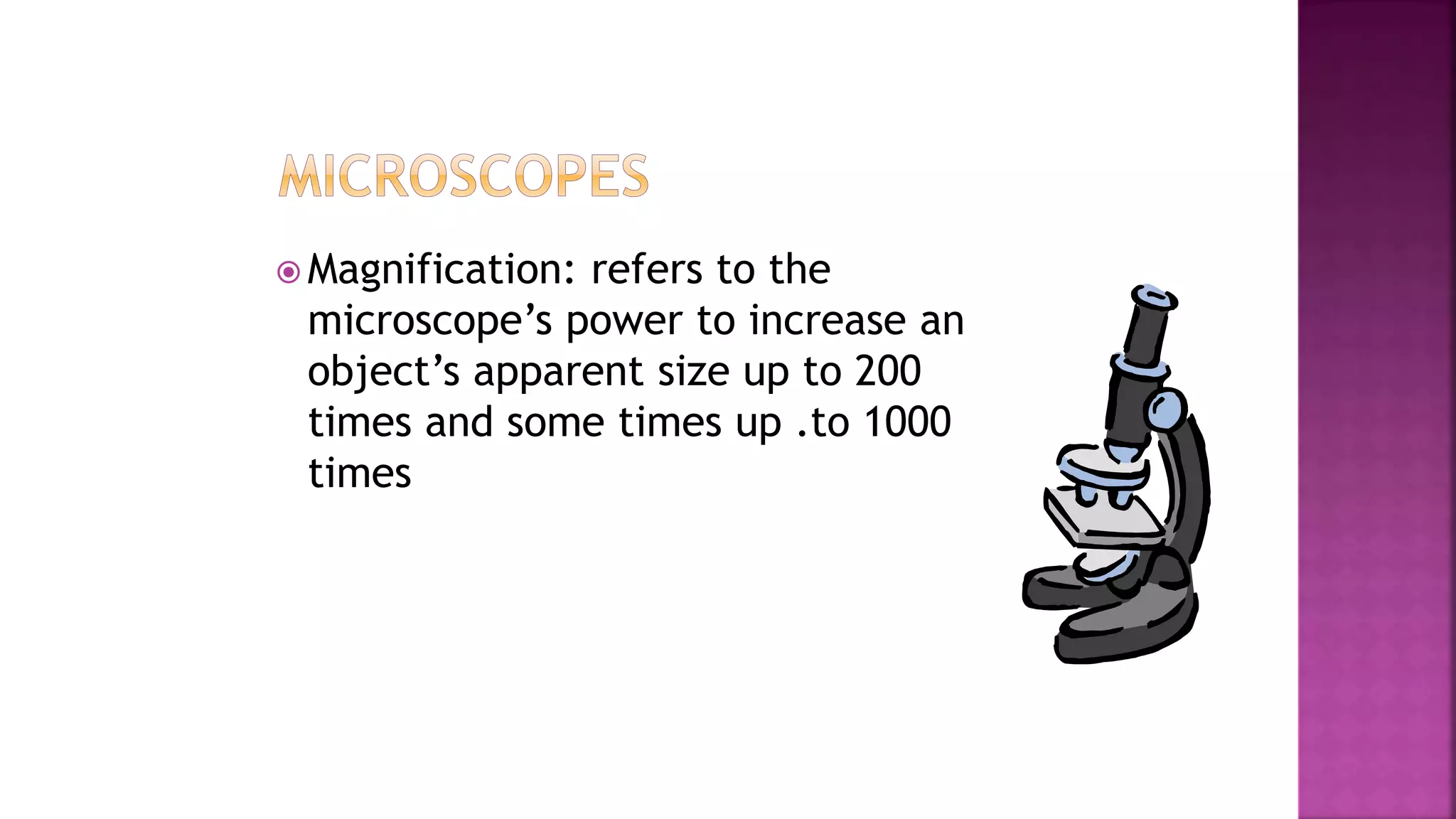
 Magnification: refers to the
microscope’s power to increase an
object’s apparent size up to 200
times and some times up .to 1000
times
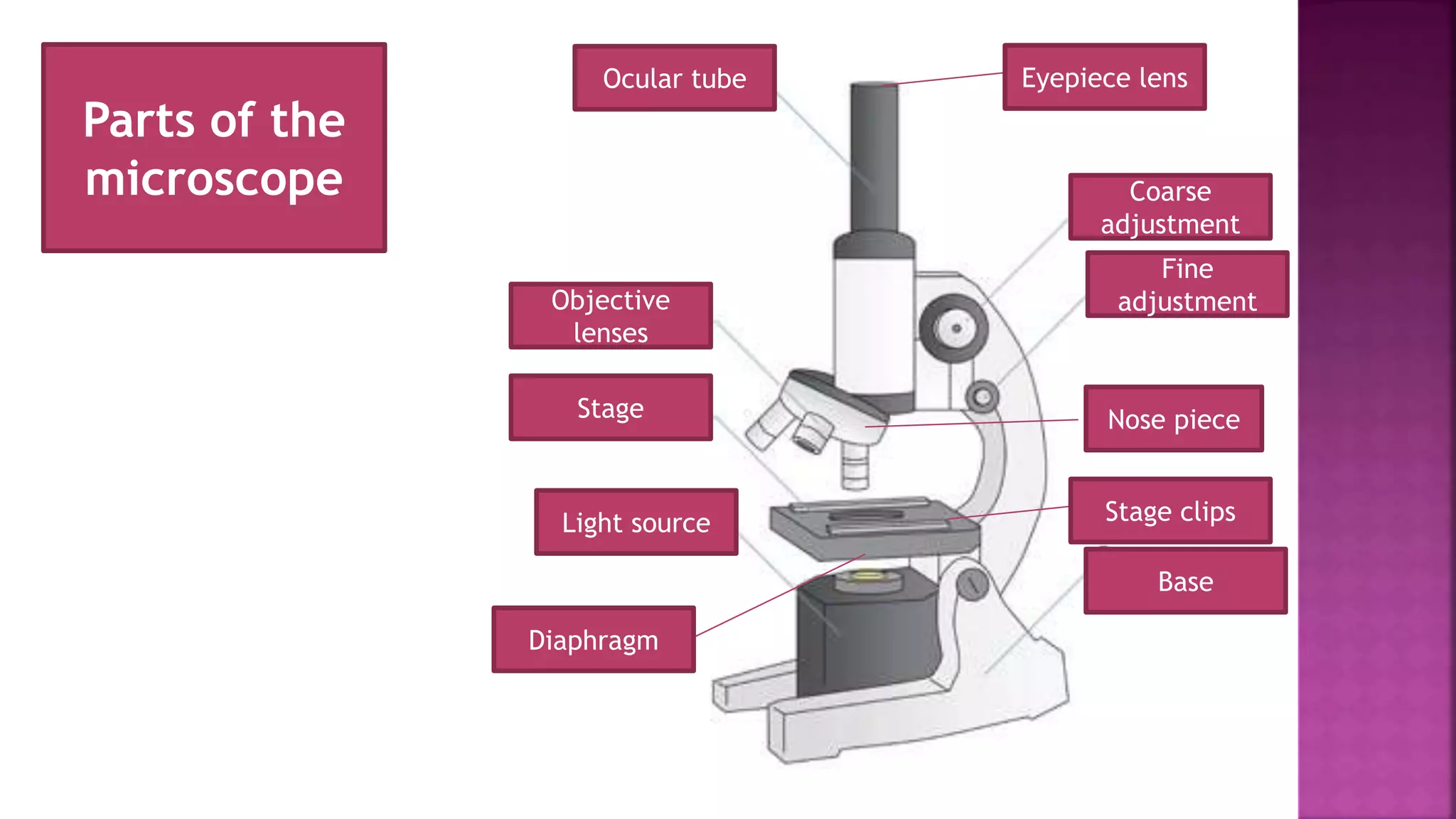
Parts of the
microscope
Ocular tube Eyepiece lens
Coarse
adjustment
Fine
adjustmentObjective
lenses
Stage
Stage clipsLight source
Base
Nose piece
Diaphragm
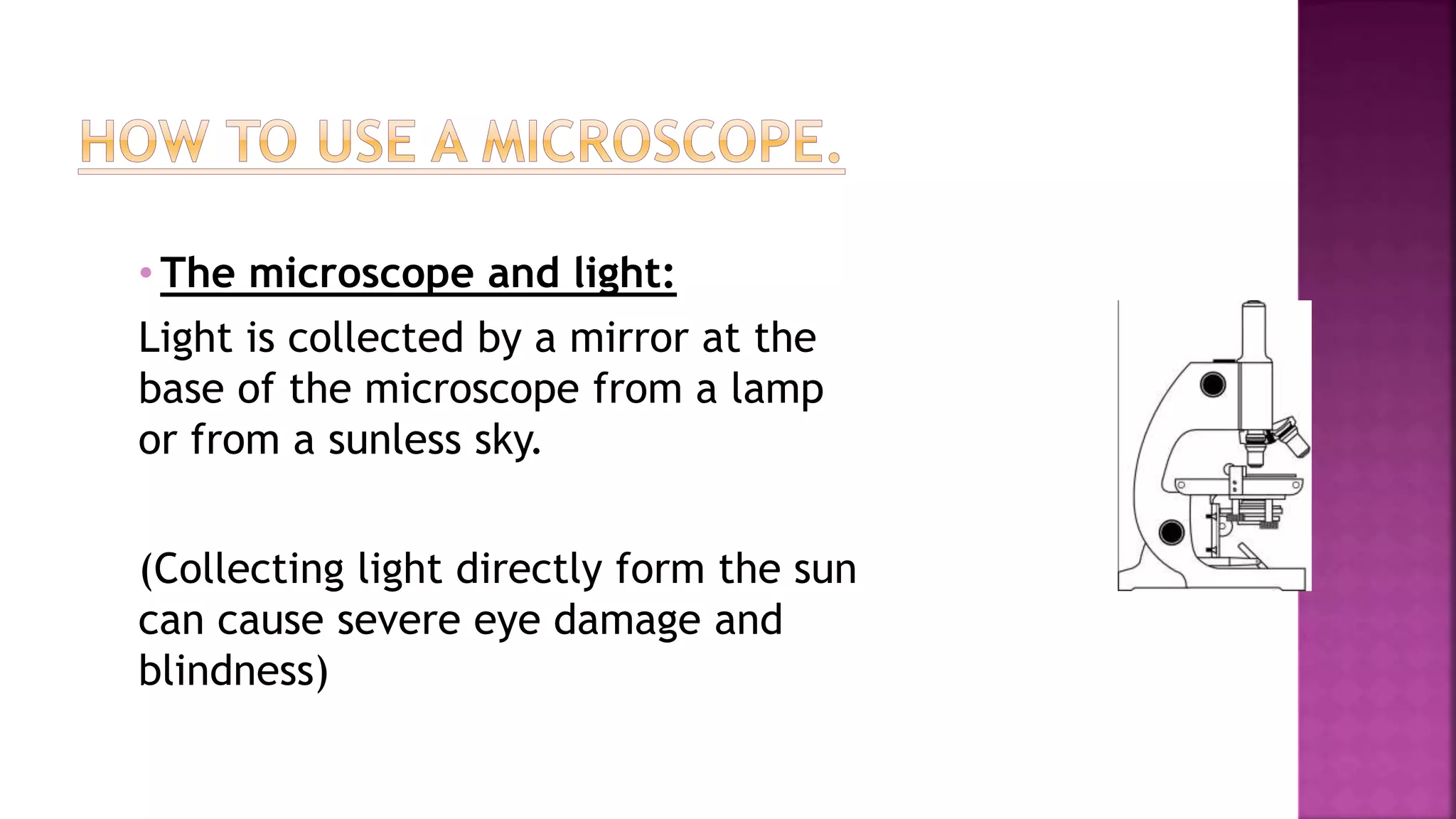
• The microscope and light:
Light is collected by a mirror at the
base of the microscope from a lamp
or from a sunless sky.
(Collecting light directly form the sun
can cause severe eye damage and
blindness)
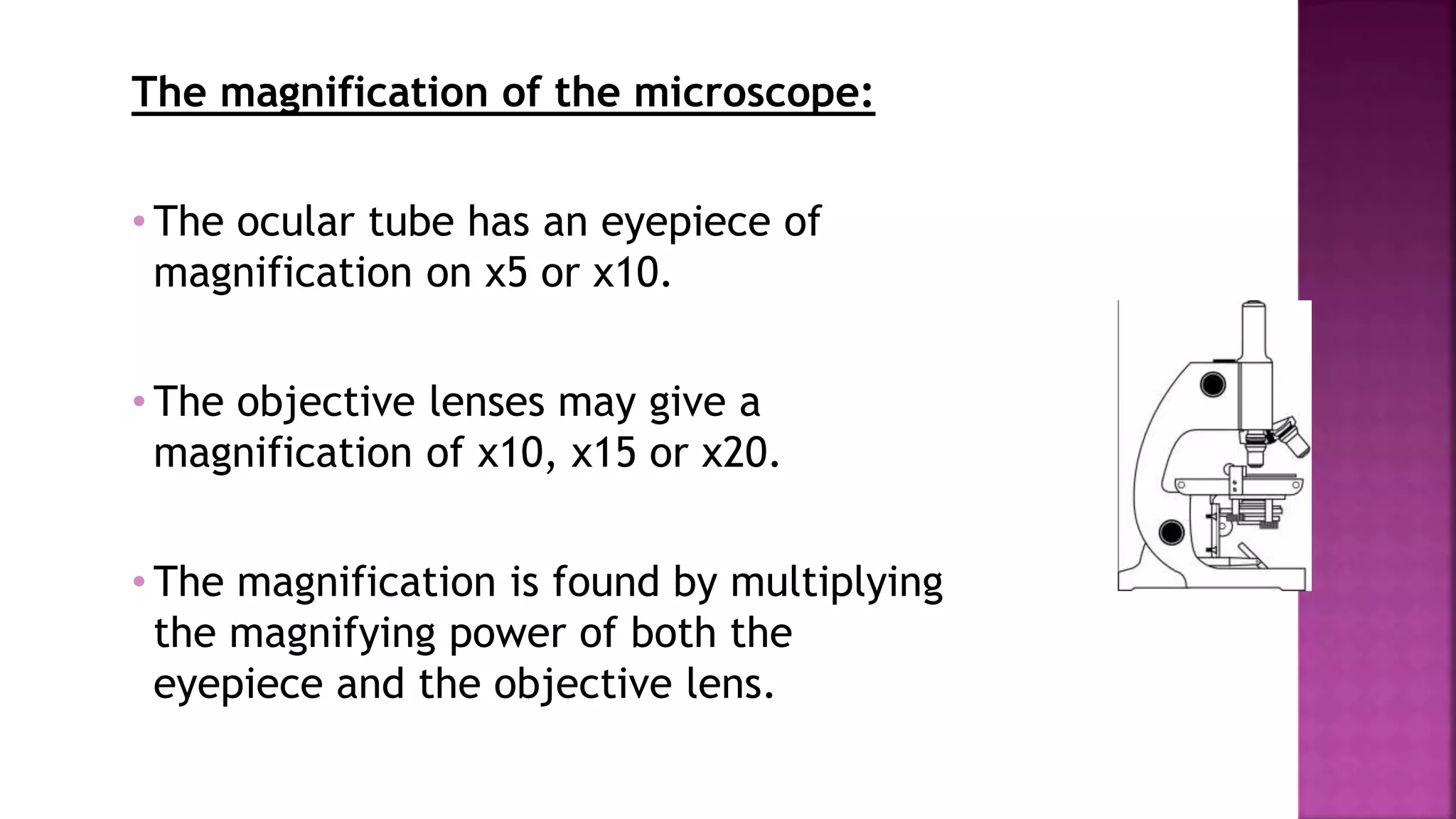
The magnification of the microscope:
• The ocular tube has an eyepiece of
magnification on x5 or x10.
• The objective lenses may give a
magnification of x10, x15 or x20.
• The magnification is found by multiplying
the magnifying power of both the
eyepiece and the objective lens.
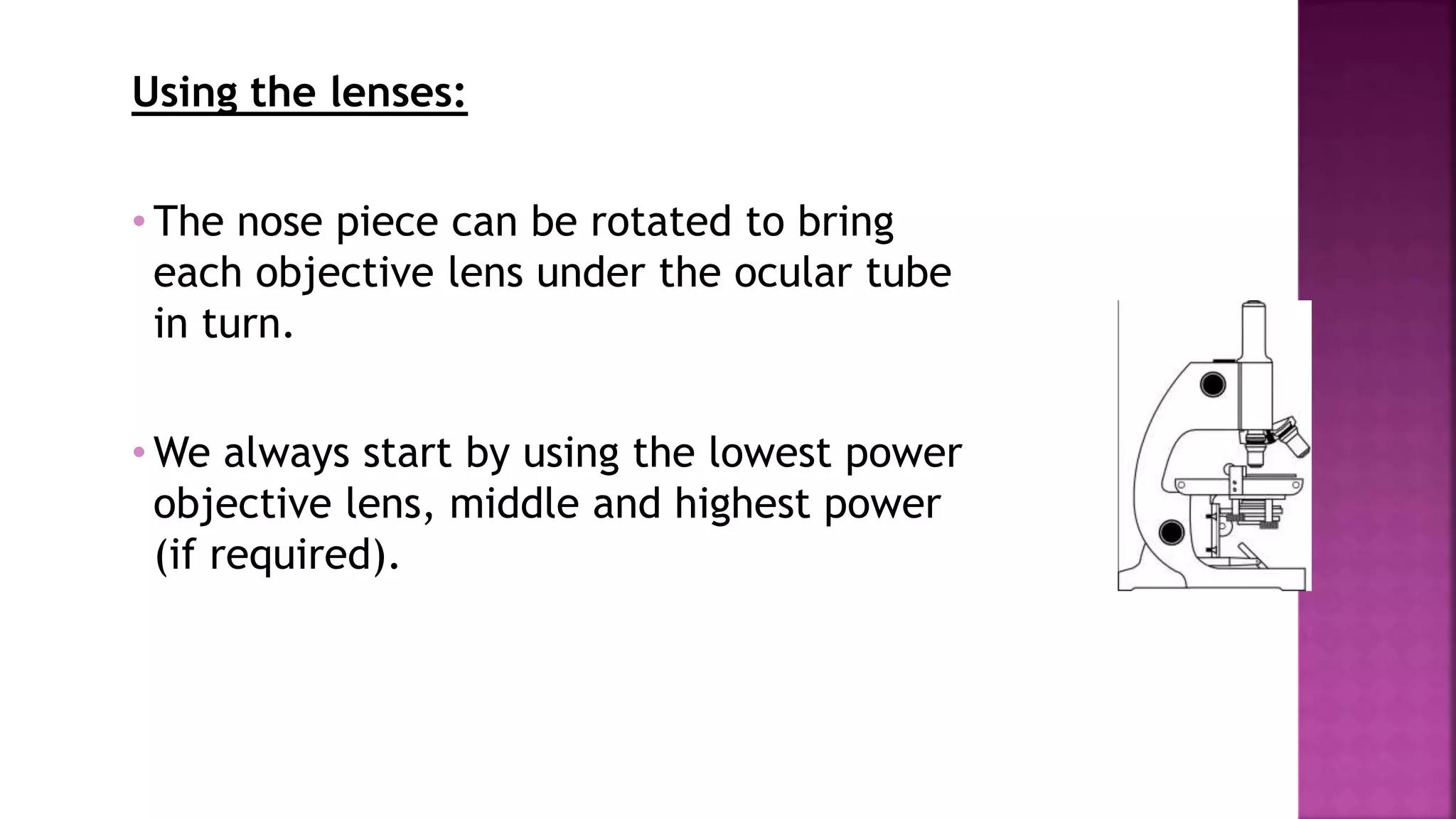
Using the lenses:
• The nose piece can be rotated to bring
each objective lens under the ocular tube
in turn.
• We always start by using the lowest power
objective lens, middle and highest power
(if required).
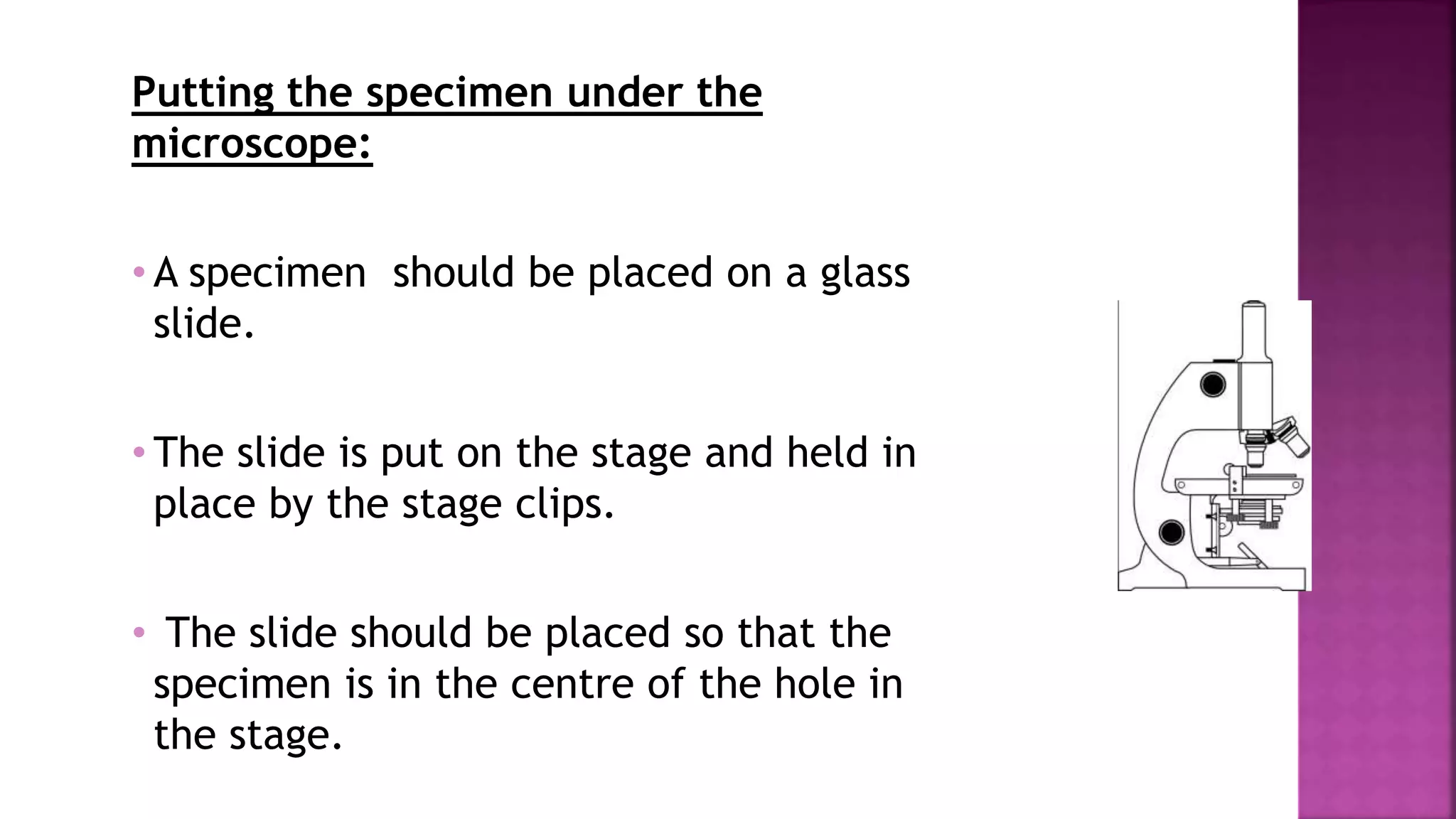
Putting the specimen under the
microscope:
• A specimen should be placed on a glass
slide.
• The slide is put on the stage and held in
place by the stage clips.
• The slide should be placed so that the
specimen is in the centre of the hole in
the stage.
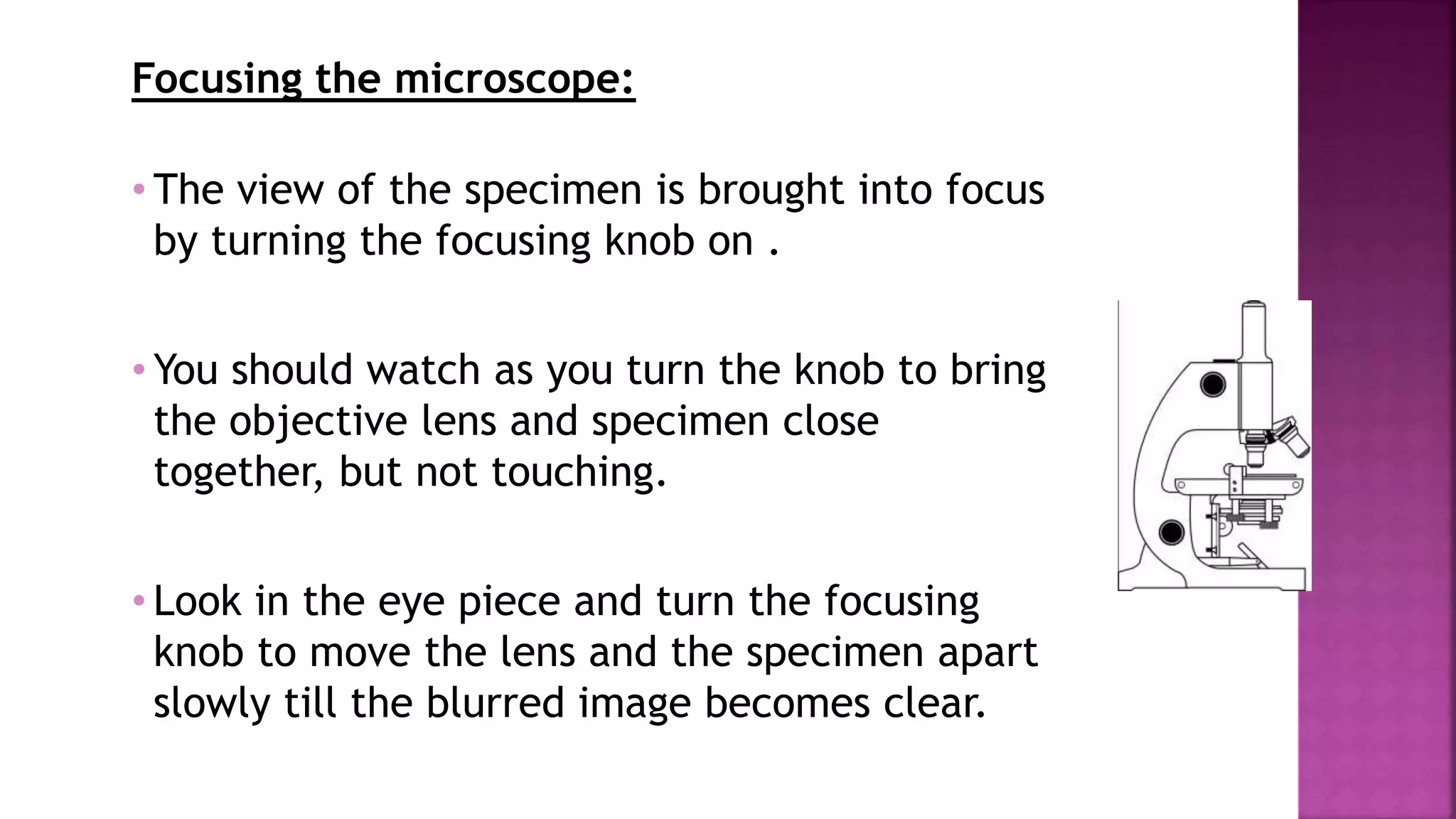
Focusing the microscope:
• The view of the specimen is brought into focus
by turning the focusing knob on .
• You should watch as you turn the knob to bring
the objective lens and specimen close
together, but not touching.
• Look in the eye piece and turn the focusing
knob to move the lens and the specimen apart
slowly till the blurred image becomes clear.
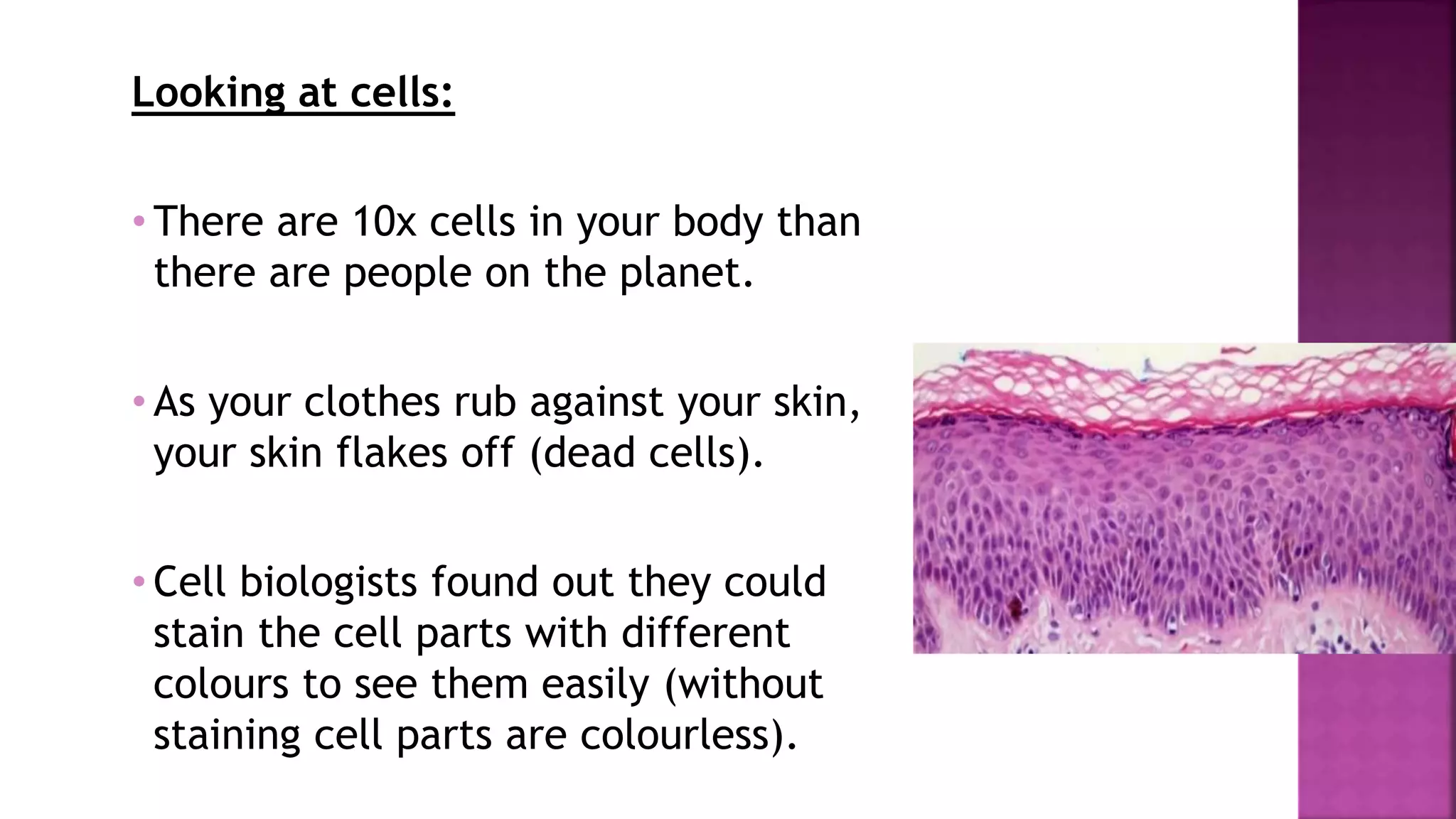
Looking at cells:
• There are 10x cells in your body than
there are people on the planet.
• As your clothes rub against your skin,
your skin flakes off (dead cells).
• Cell biologists found out they could
stain the cell parts with different
colours to see them easily (without
staining cell parts are colourless).
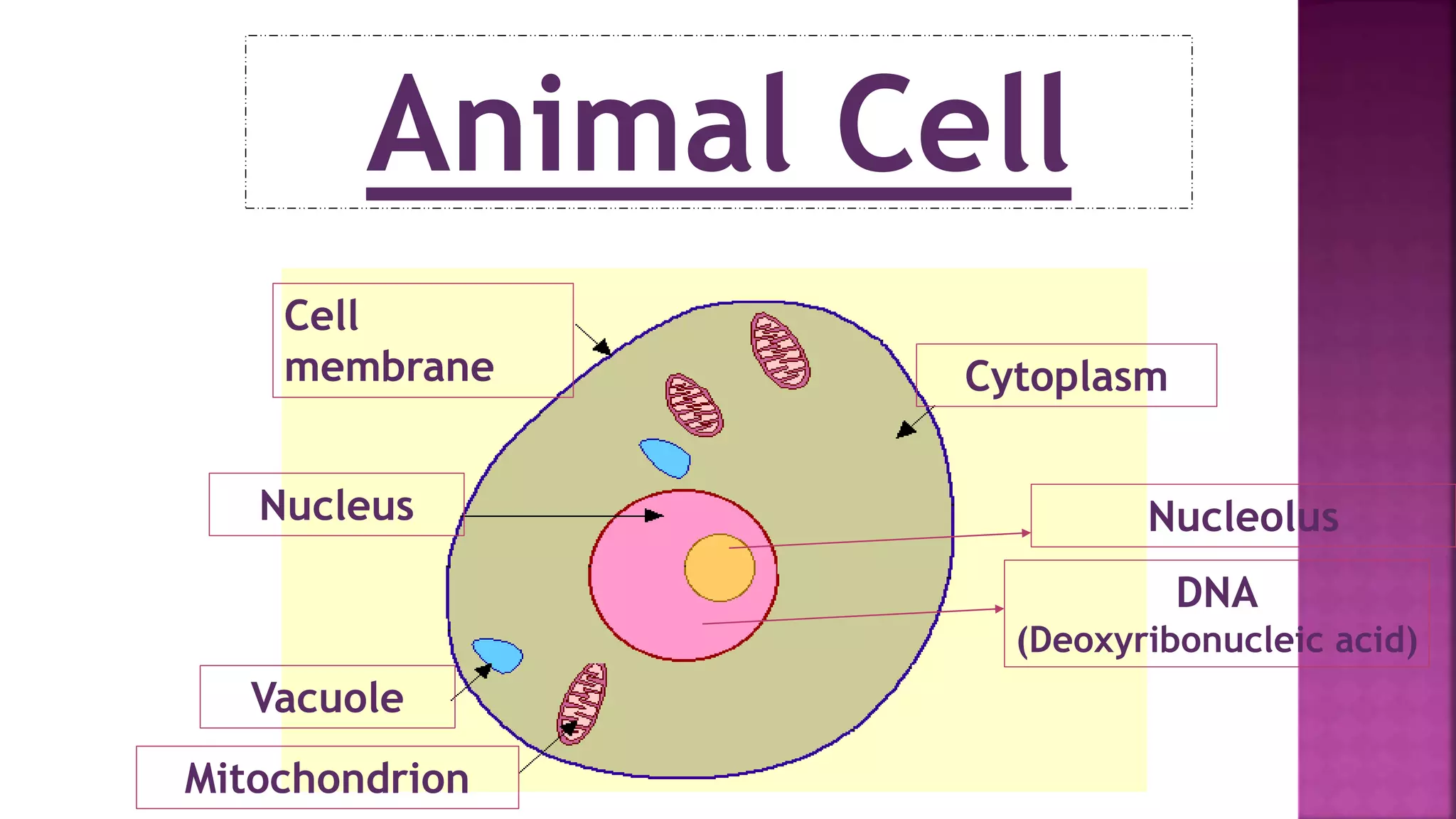
Animal Cell
Cell
membrane Cytoplasm
Nucleus
Vacuole
Mitochondrion
Nucleolus
DNA
(Deoxyribonucleic acid)
Animal Cell
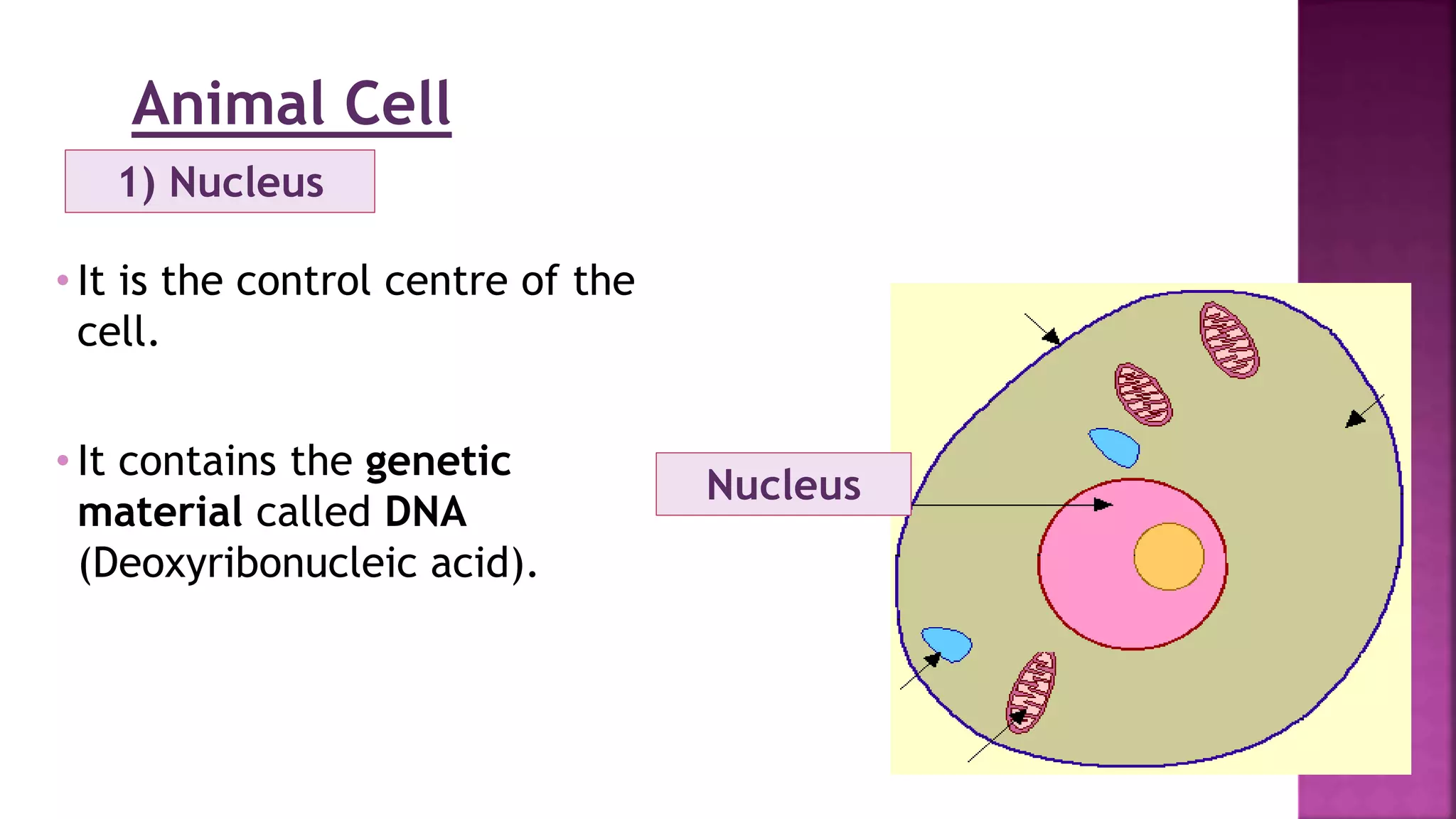
Nucleus
1) Nucleus
• It is the control centre of the
cell.
• It contains the genetic
material called DNA
(Deoxyribonucleic acid).
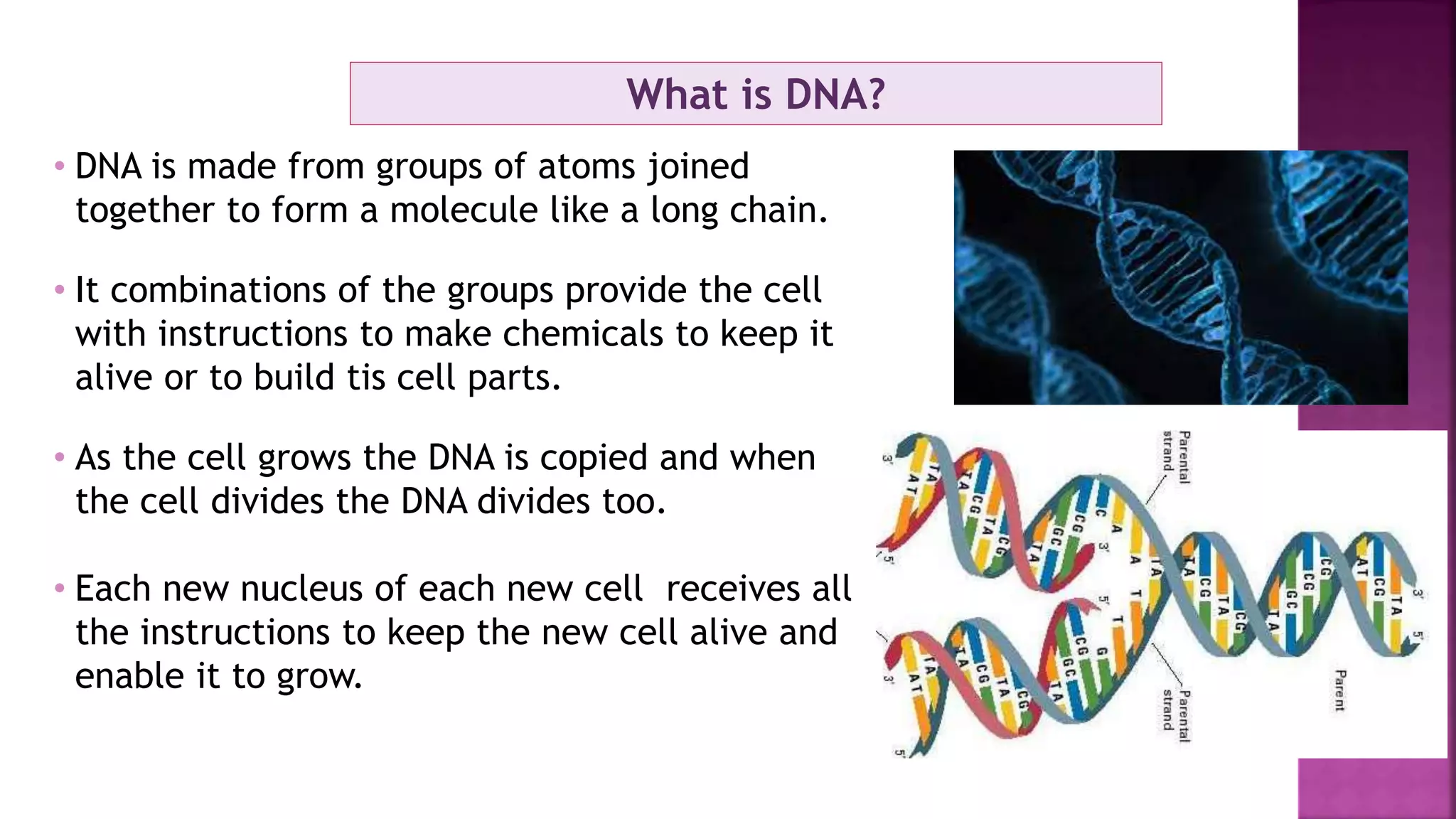
What is DNA?
• DNA is made from groups of atoms joined
together to form a molecule like a long chain.
• It combinations of the groups provide the cell
with instructions to make chemicals to keep it
alive or to build tis cell parts.
• As the cell grows the DNA is copied and when
the cell divides the DNA divides too.
• Each new nucleus of each new cell receives all
the instructions to keep the new cell alive and
enable it to grow.
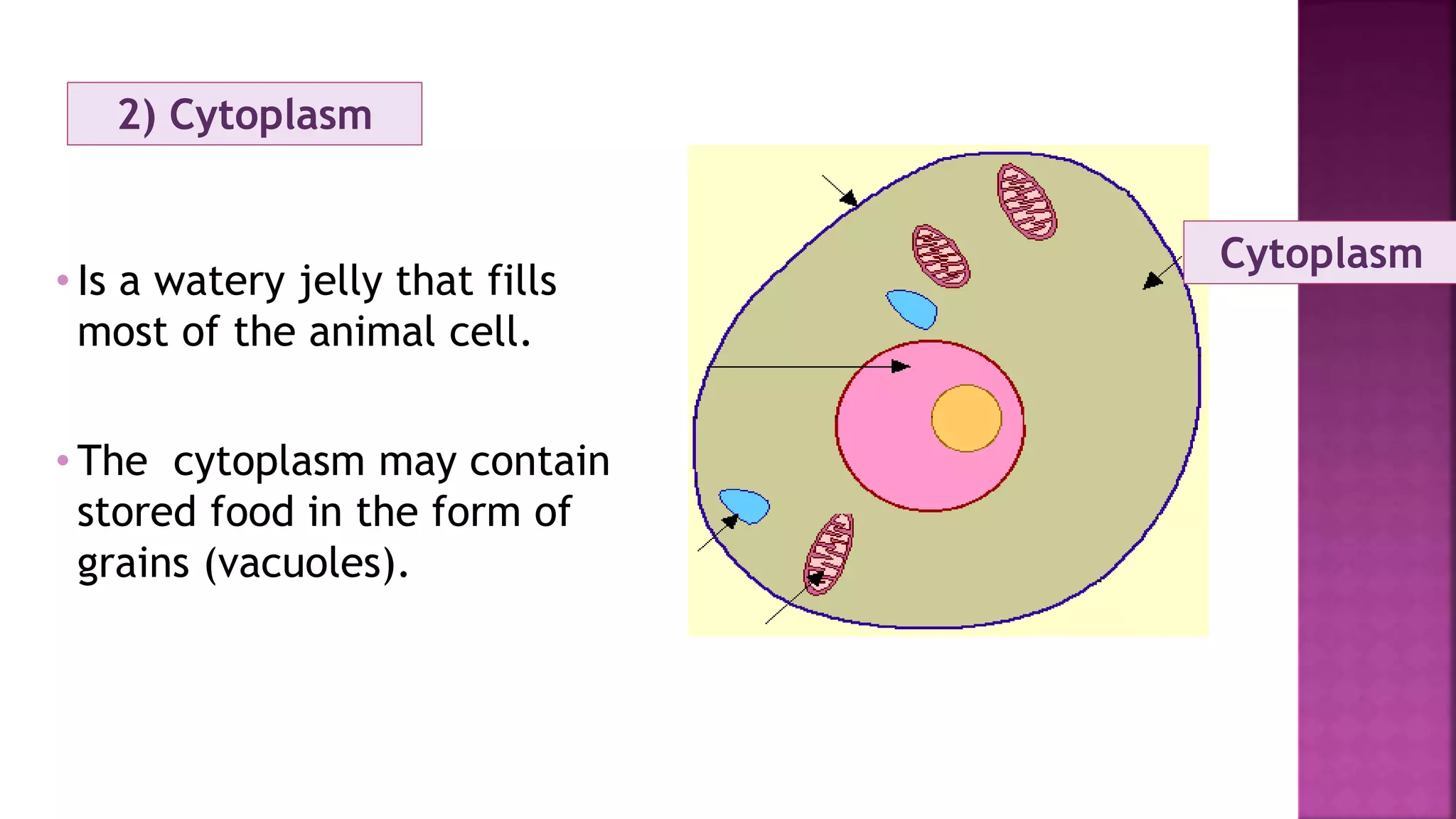
Cytoplasm
2) Cytoplasm
• Is a watery jelly that fills
most of the animal cell.
• The cytoplasm may contain
stored food in the form of
grains (vacuoles).
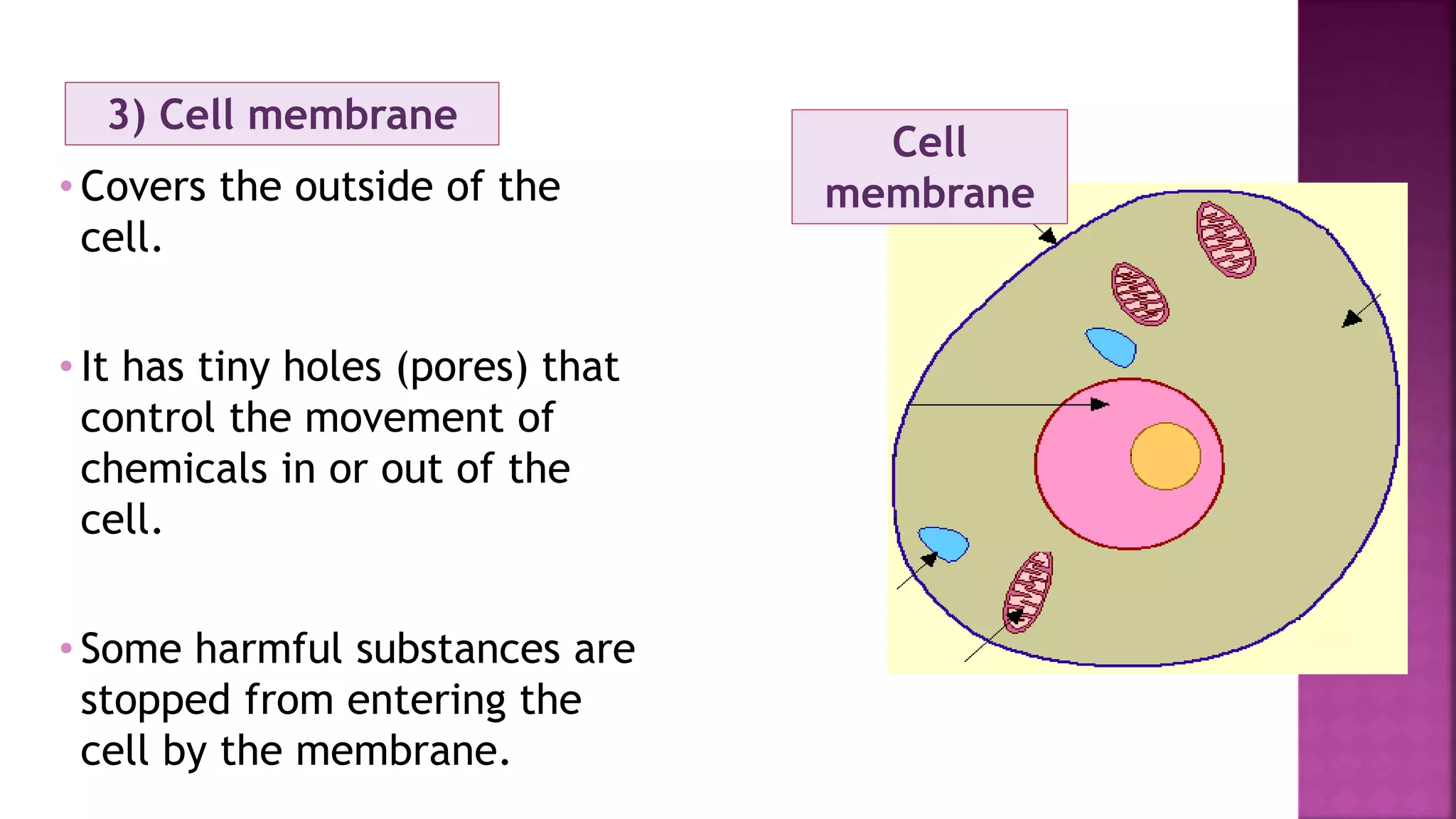
Cell
membrane
3) Cell membrane
• Covers the outside of the
cell.
• It has tiny holes (pores) that
control the movement of
chemicals in or out of the
cell.
• Some harmful substances are
stopped from entering the
cell by the membrane.
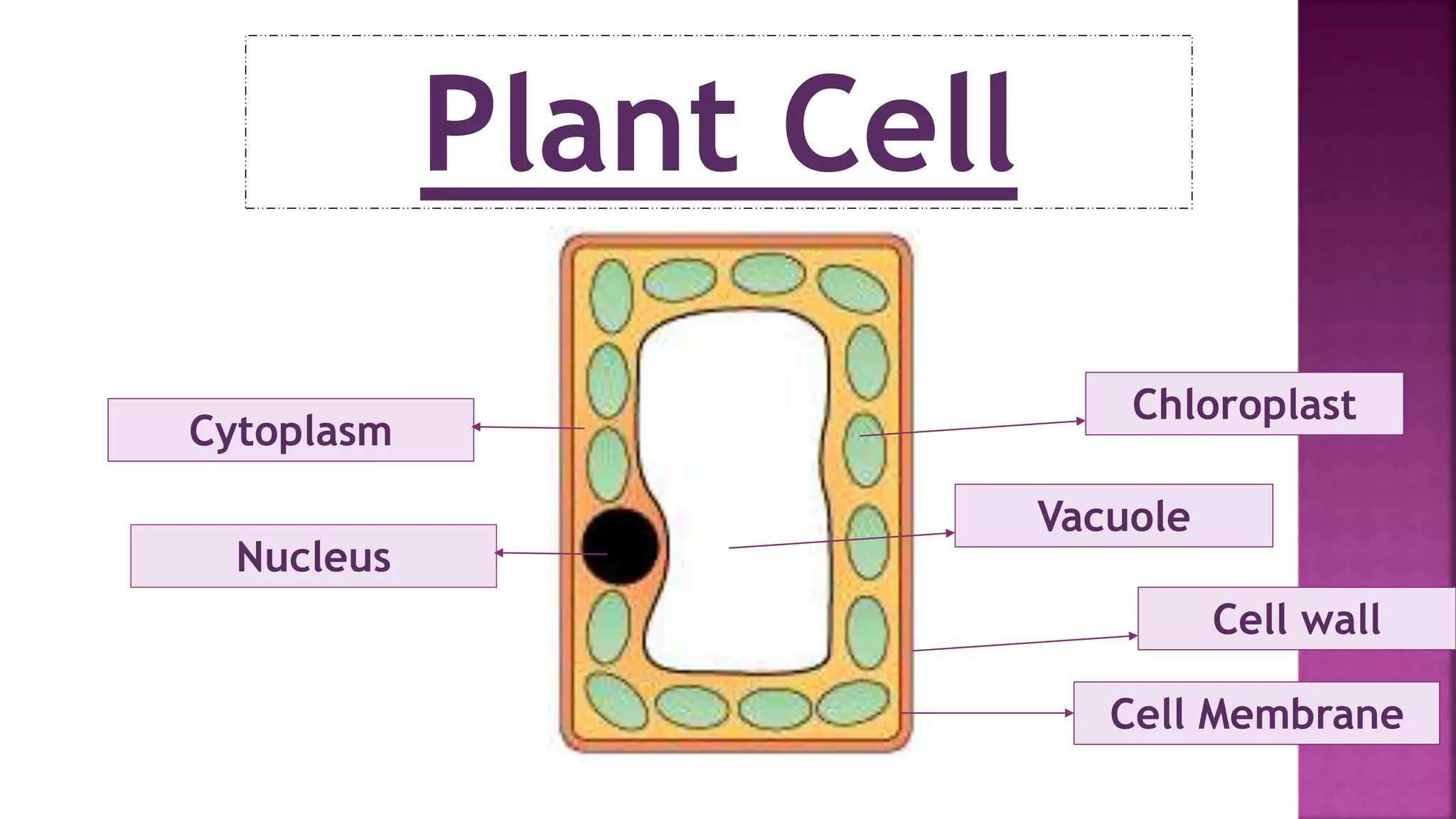
Plant Cell
Vacuole
Chloroplast
Cell wall
Cell Membrane
Cytoplasm
Nucleus
Plant Cell
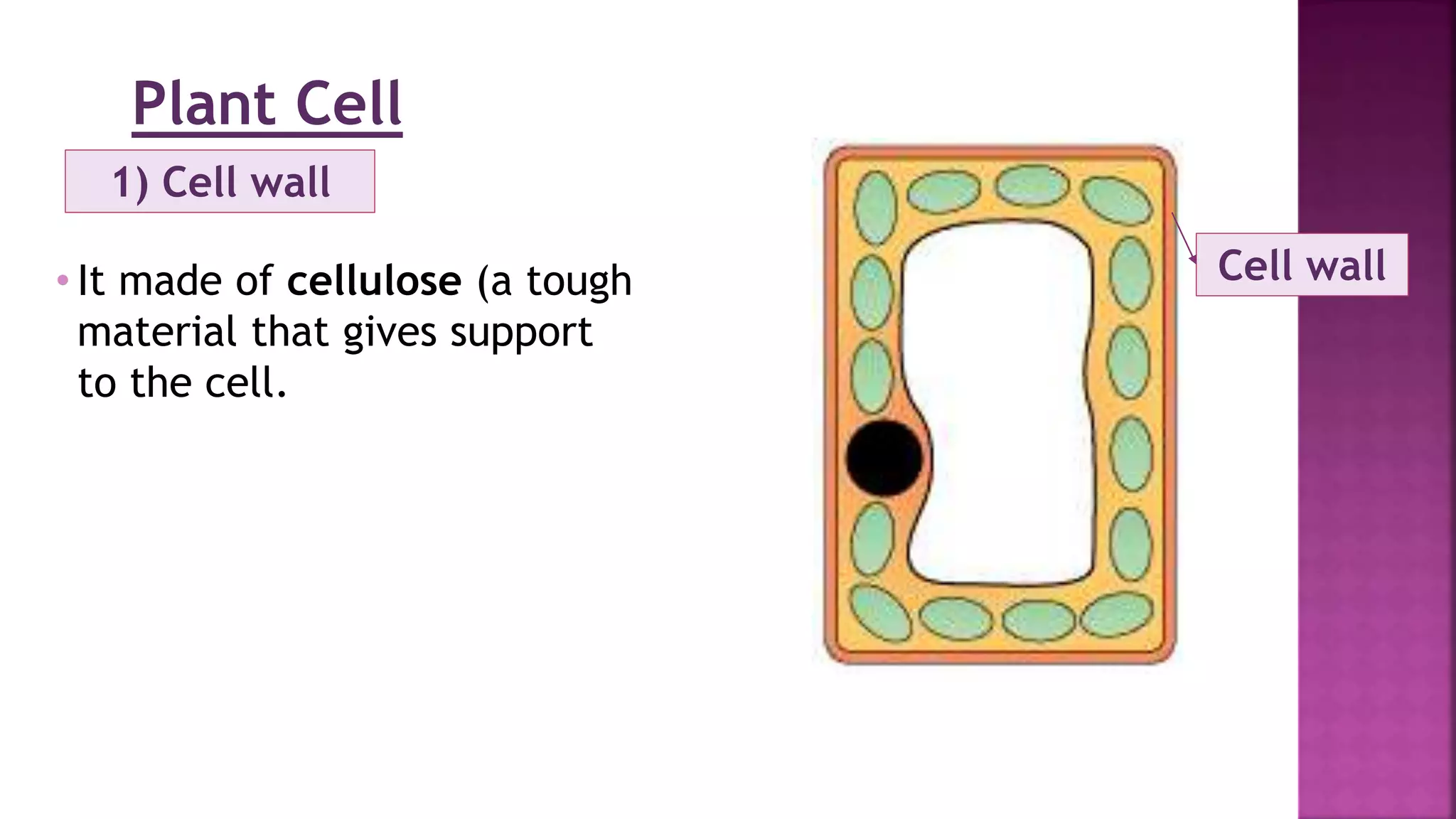
1) Cell wall
• It made of cellulose (a tough
material that gives support
to the cell.
Cell wall
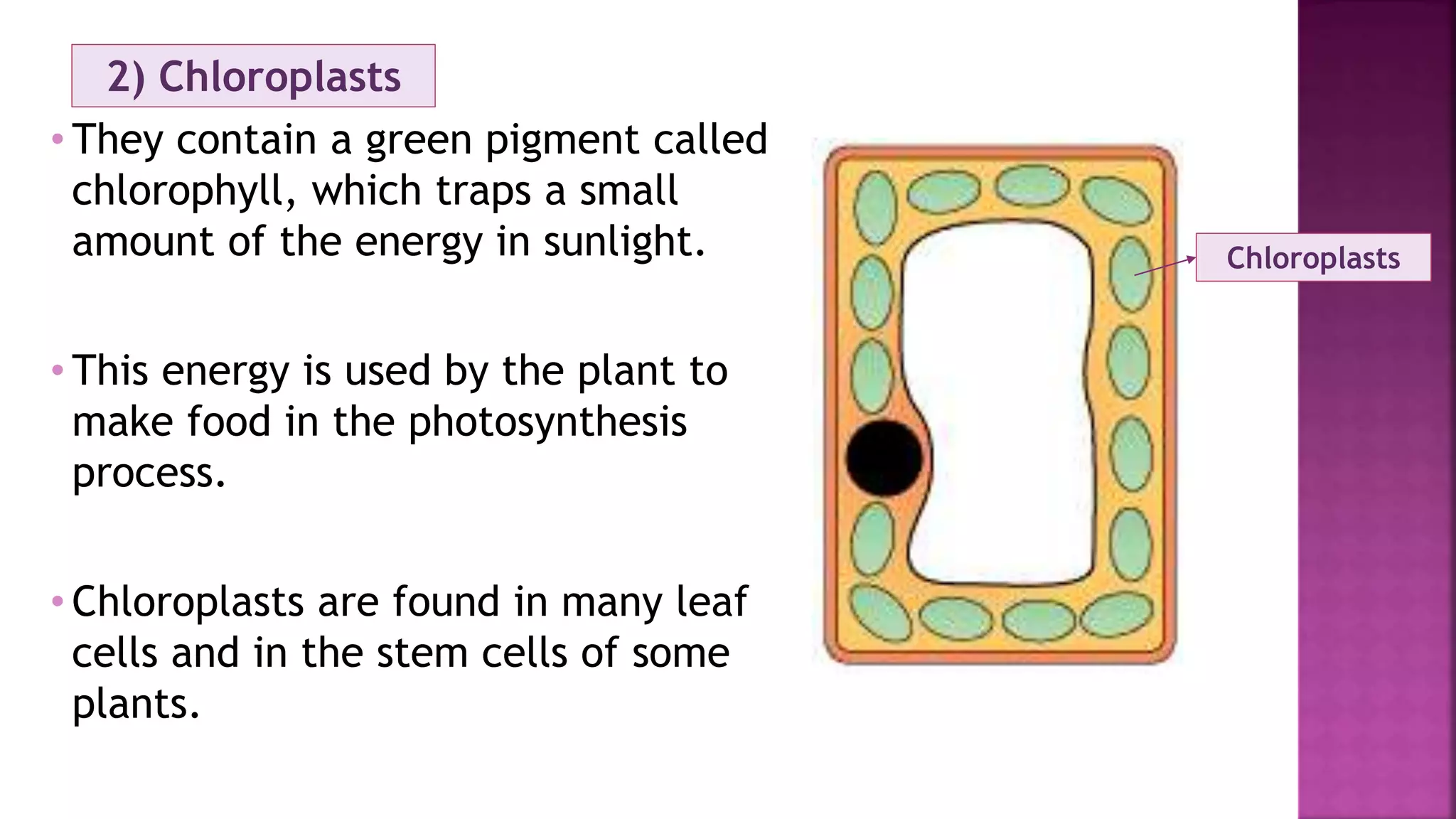
2) Chloroplasts
• They contain a green pigment called
chlorophyll, which traps a small
amount of the energy in sunlight.
• This energy is used by the plant to
make food in the photosynthesis
process.
• Chloroplasts are found in many leaf
cells and in the stem cells of some
plants.
Chloroplasts
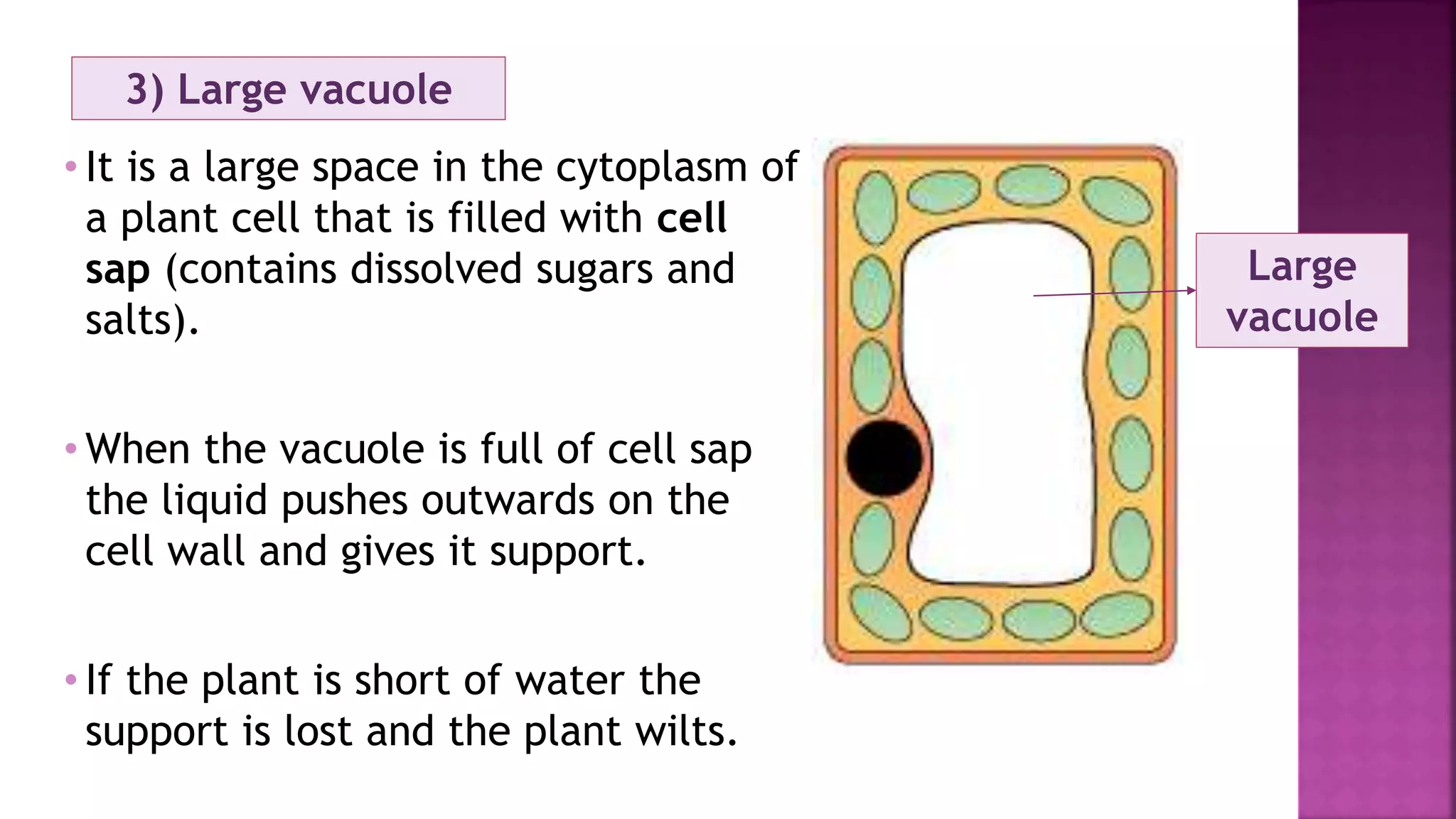
3) Large vacuole
• It is a large space in the cytoplasm of
a plant cell that is filled with cell
sap (contains dissolved sugars and
salts).
• When the vacuole is full of cell sap
the liquid pushes outwards on the
cell wall and gives it support.
• If the plant is short of water the
support is lost and the plant wilts.
Large
vacuole
Adaptation in cells.
• Adaptation means the change in shape for a particular task.
• Many cells are adapted to perform particular tasks.
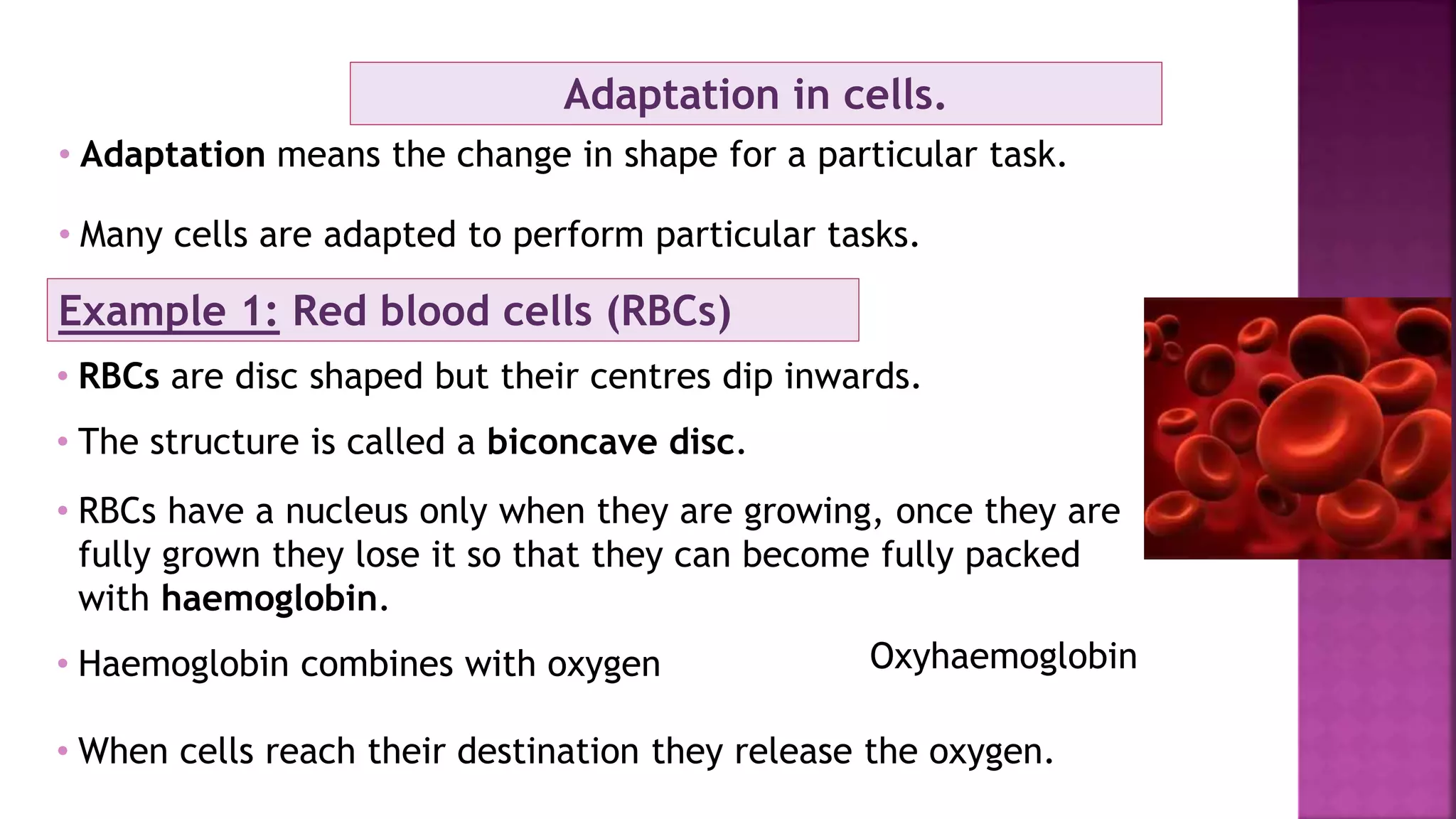
Example 1: Red blood cells (RBCs)
• RBCs are disc shaped but their centres dip inwards.
• The structure is called a biconcave disc.
• RBCs have a nucleus only when they are growing, once they are
fully grown they lose it so that they can become fully packed
with haemoglobin.
• Haemoglobin combines with oxygen
• When cells reach their destination they release the oxygen.
Oxyhaemoglobin
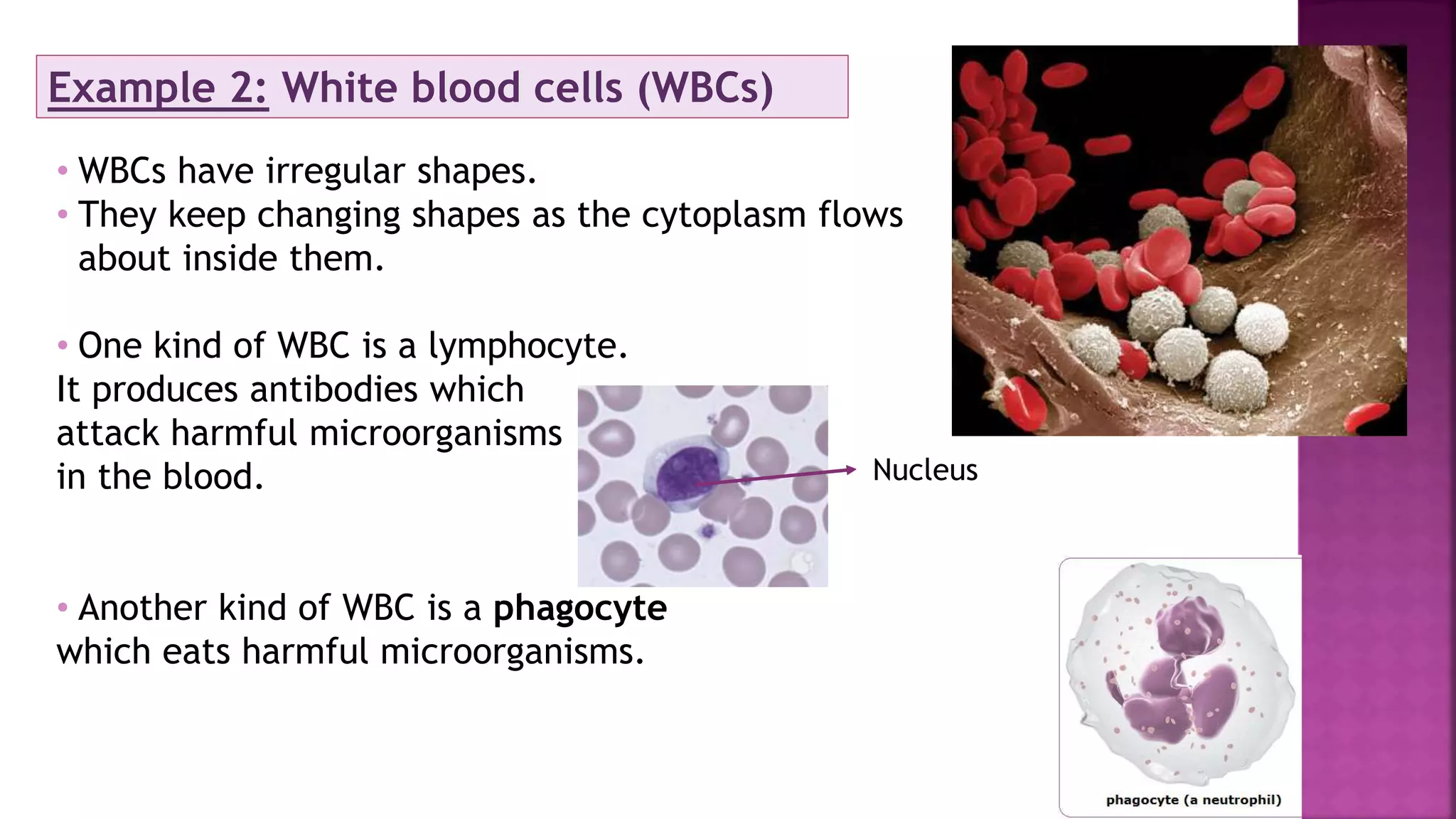
Example 2: White blood cells (WBCs)
• WBCs have irregular shapes.
• They keep changing shapes as the cytoplasm flows
about inside them.
• One kind of WBC is a lymphocyte.
It produces antibodies which
attack harmful microorganisms
in the blood.
• Another kind of WBC is a phagocyte
which eats harmful microorganisms.
Nucleus
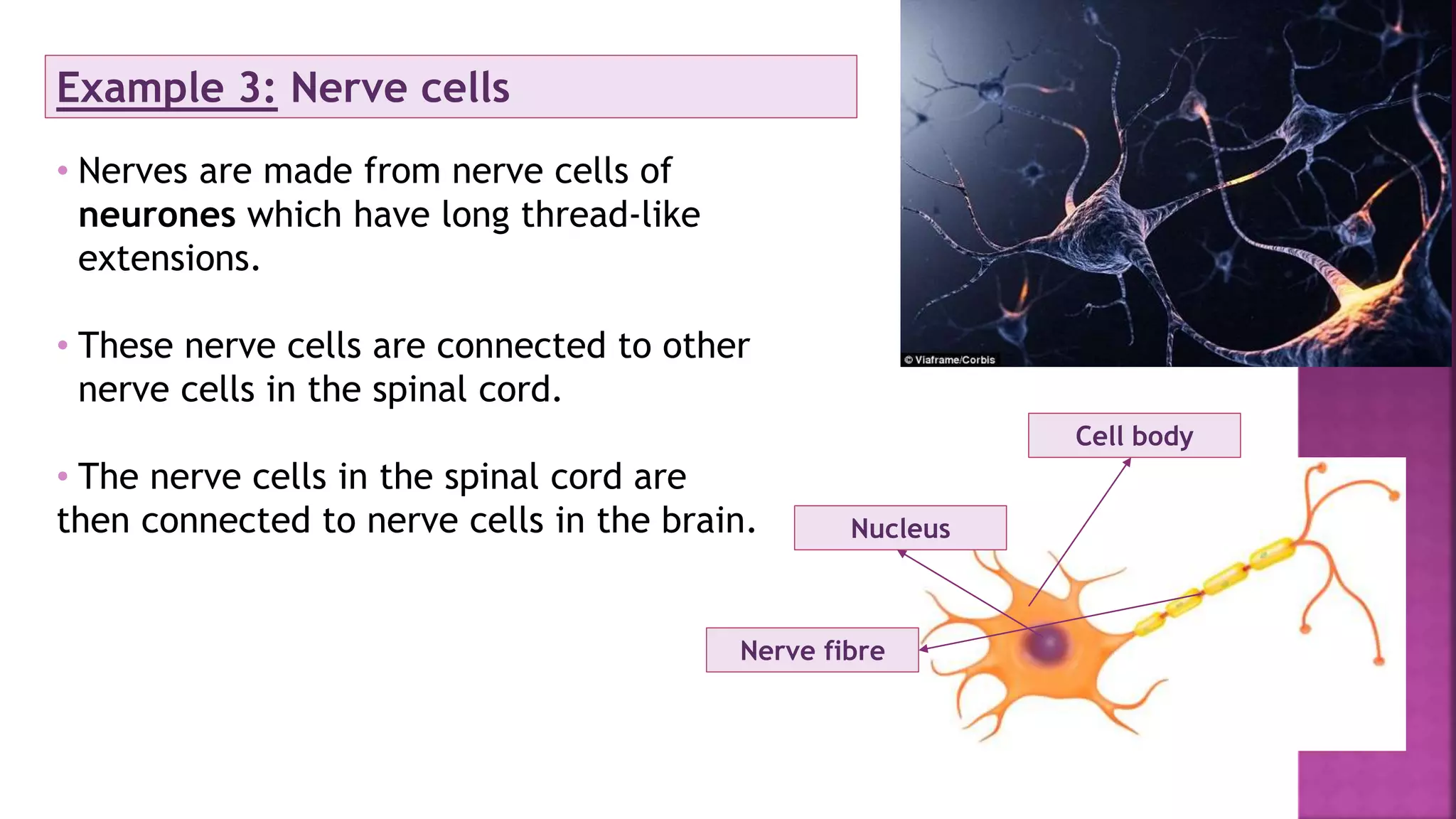
Example 3: Nerve cells
• Nerves are made from nerve cells of
neurones which have long thread-like
extensions.
• These nerve cells are connected to other
nerve cells in the spinal cord.
• The nerve cells in the spinal cord are
then connected to nerve cells in the brain.
Cell body
Nucleus
Nerve fibre
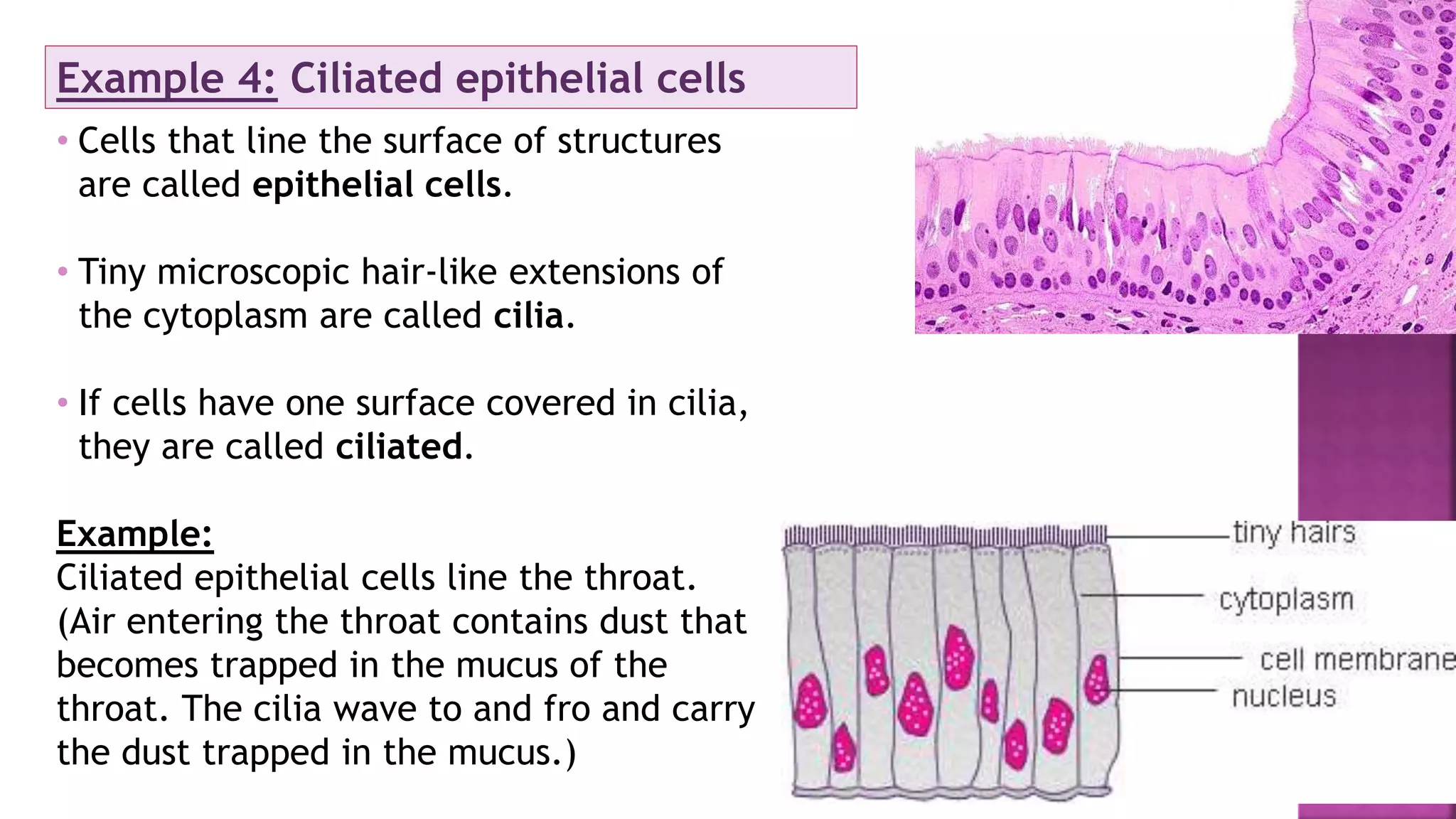
Example 4: Ciliated epithelial cells
• Cells that line the surface of structures
are called epithelial cells.
• Tiny microscopic hair-like extensions of
the cytoplasm are called cilia.
• If cells have one surface covered in cilia,
they are called ciliated.
Example:
Ciliated epithelial cells line the throat.
(Air entering the throat contains dust that
becomes trapped in the mucus of the
throat. The cilia wave to and fro and carry
the dust trapped in the mucus.)
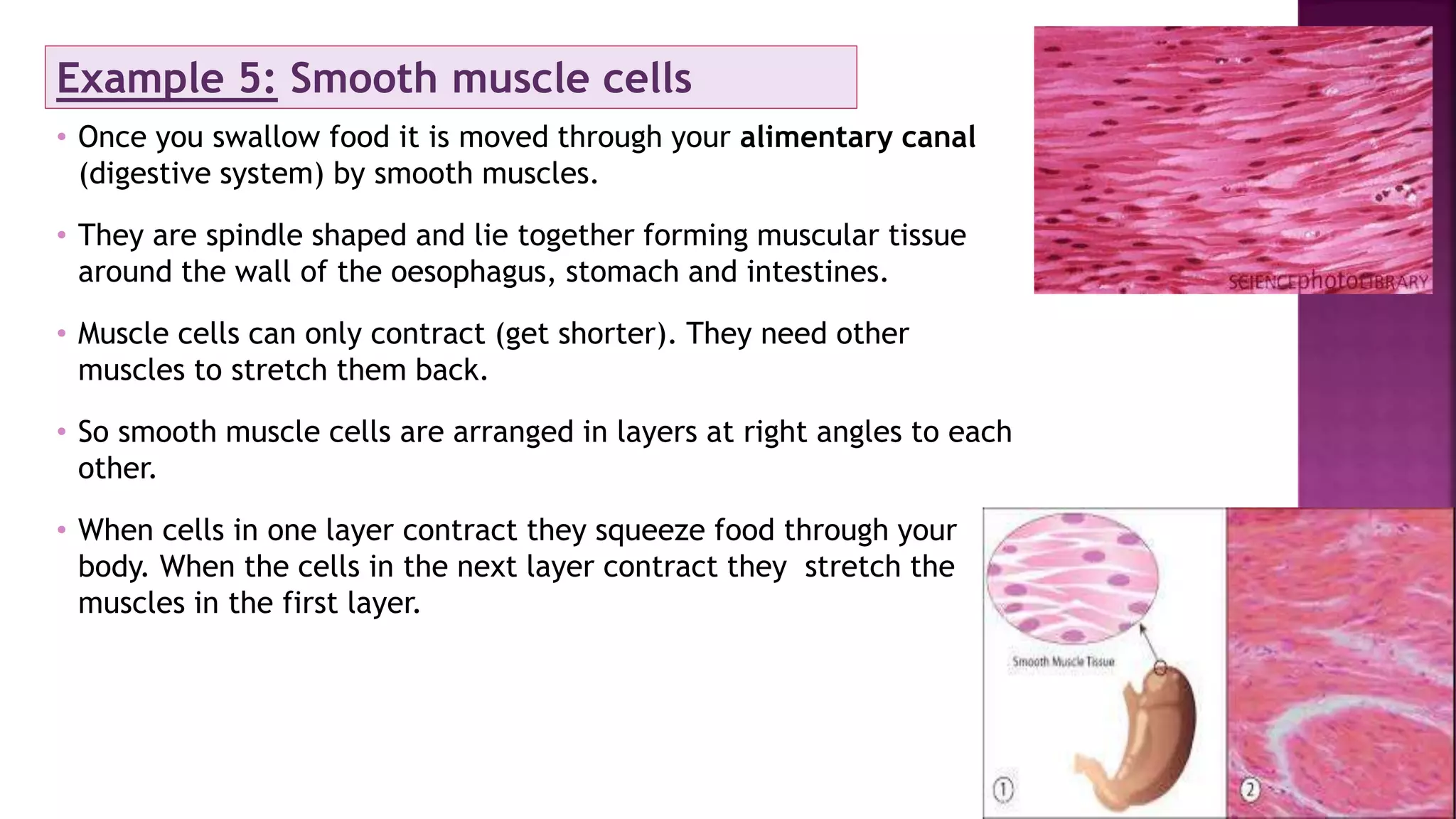
Example 5: Smooth muscle cells
• Once you swallow food it is moved through your alimentary canal
(digestive system) by smooth muscles.
• They are spindle shaped and lie together forming muscular tissue
around the wall of the oesophagus, stomach and intestines.
• Muscle cells can only contract (get shorter). They need other
muscles to stretch them back.
• So smooth muscle cells are arranged in layers at right angles to each
other.
• When cells in one layer contract they squeeze food through your
body. When the cells in the next layer contract they stretch the
muscles in the first layer.
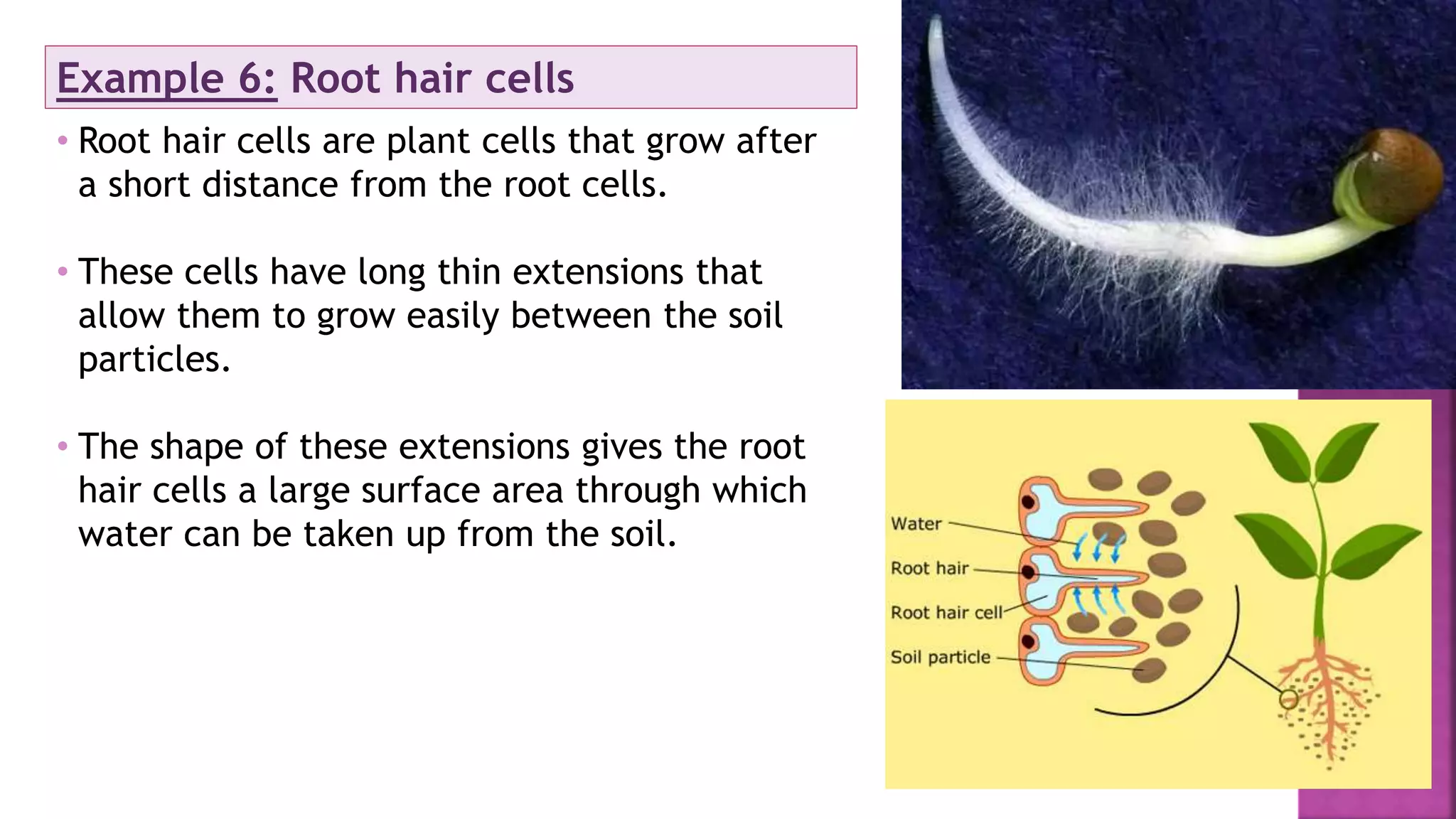
Example 6: Root hair cells
• Root hair cells are plant cells that grow after
a short distance from the root cells.
• These cells have long thin extensions that
allow them to grow easily between the soil
particles.
• The shape of these extensions gives the root
hair cells a large surface area through which
water can be taken up from the soil.
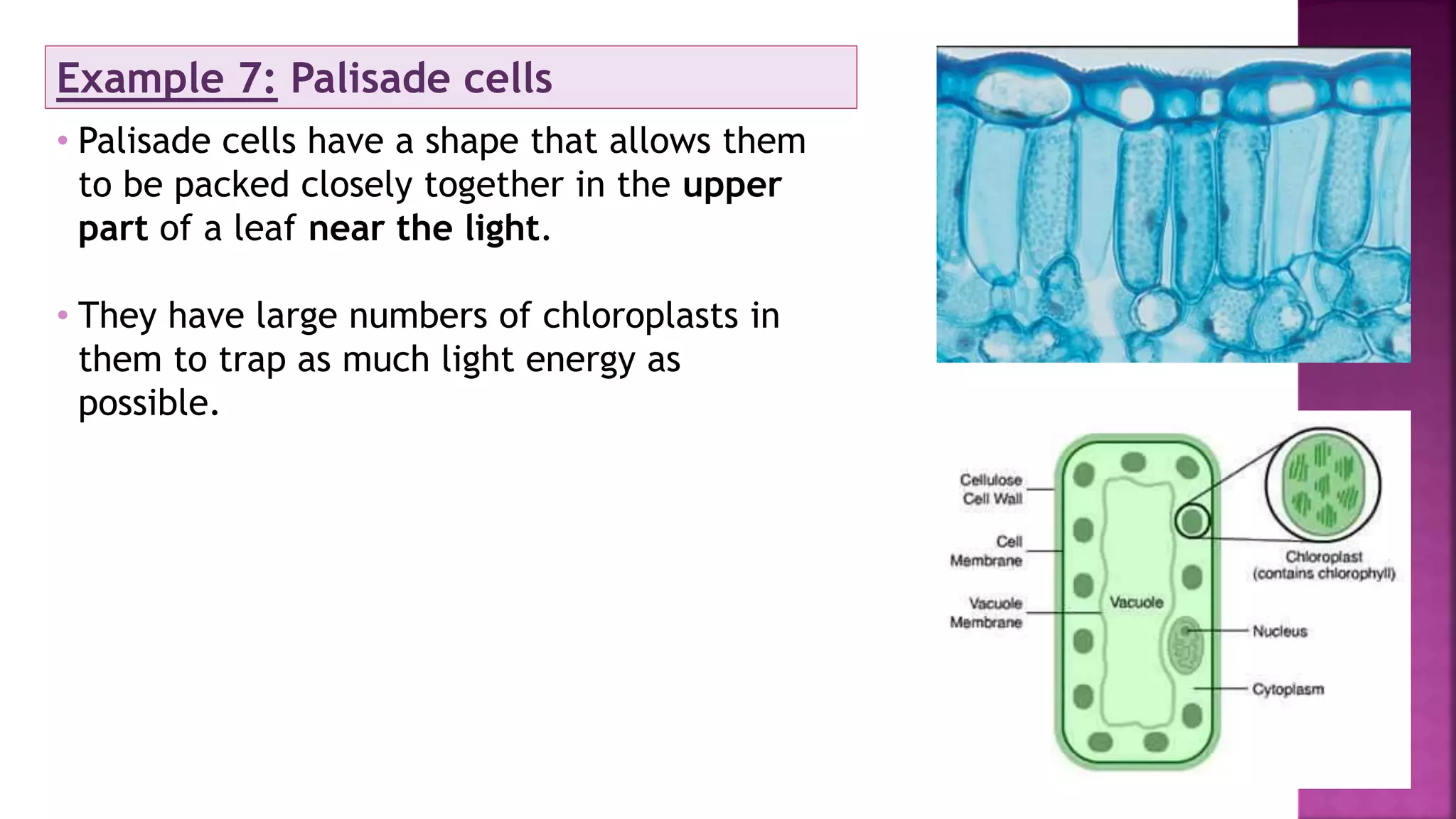
Example 7: Palisade cells
• Palisade cells have a shape that allows them
to be packed closely together in the upper
part of a leaf near the light.
• They have large numbers of chloroplasts in
them to trap as much light energy as
possible.
Cells, tissues, organs and organisms.
Cells of the same kind grouped together form
Tissue.
Tissues of different kinds grouped together form
Organ.
Organs of different kinds grouped together form
Organ system.
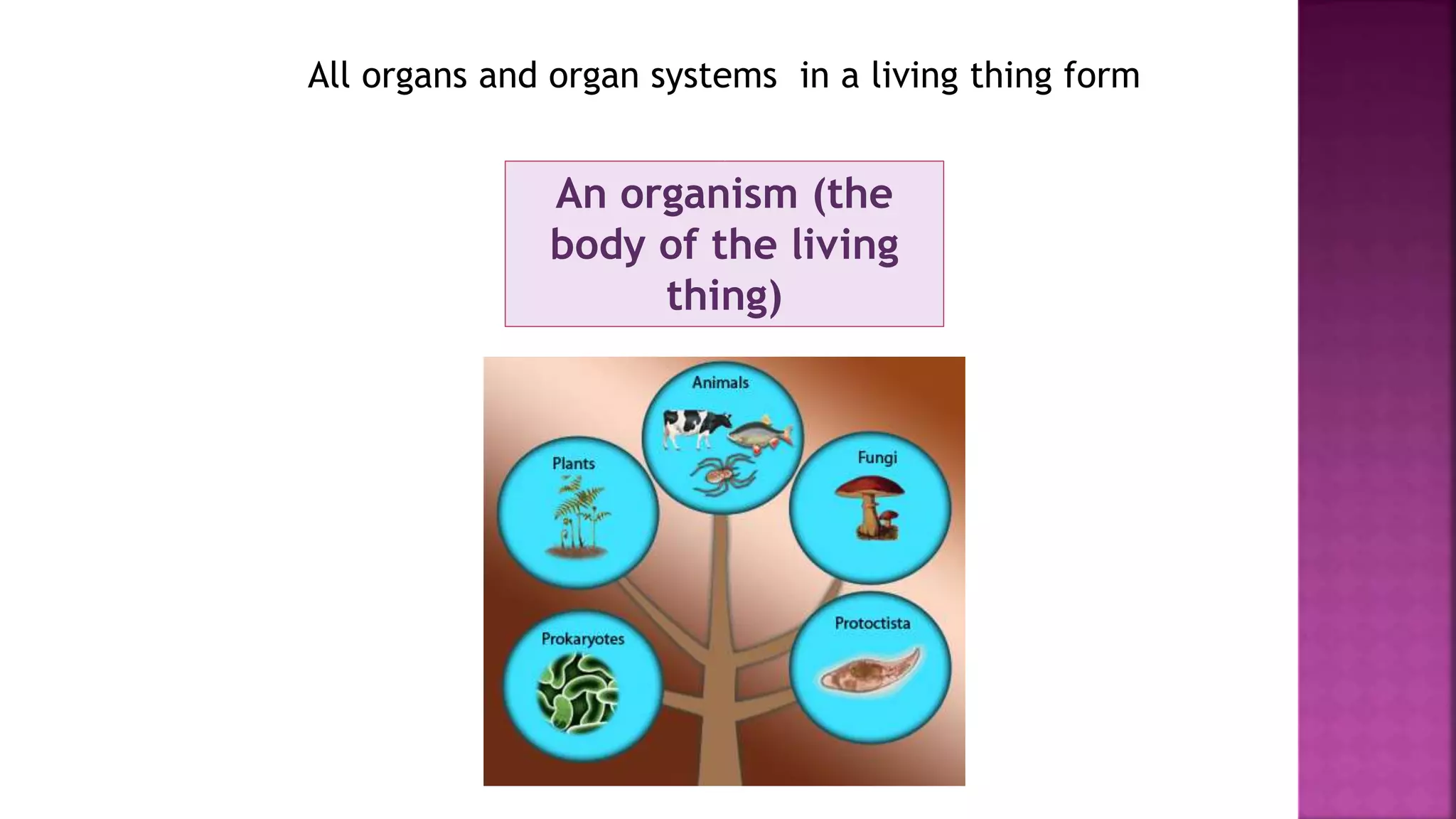
All organs and organ systems in a living thing form
An organism (the
body of the living
thing)

16chapter 3 cells

  • 1.
  • 2.
     The inventionof the lens  Robert Hooke (1665): Observed a thin slice of cork (dead plant cells) with a microscope. He described what he observed as “little boxes” (cells).
  • 3.
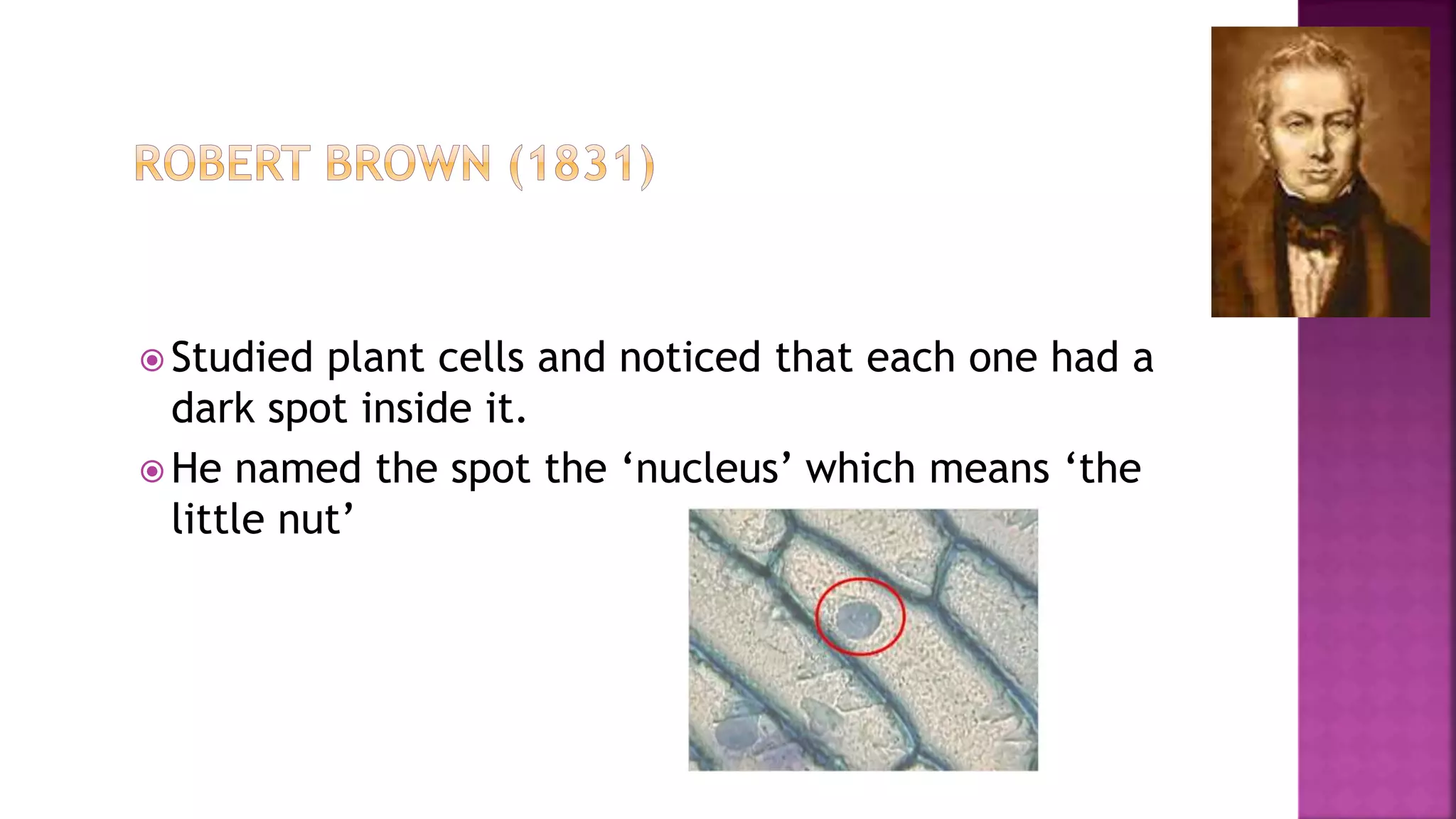
     Studied plantcells and noticed that each one had a dark spot inside it.  He named the spot the ‘nucleus’ which means ‘the little nut’
  • 4.
     In (1839)Theodor Schwann & Matthias Schleiden stated that: “ All living things are made of cells”
  • 5.
     All livingthings are made of cells  Smallest living unit of structure and function of all organisms is the cell  All cells arise from preexisting cells.
  • 7.
     Magnification: refersto the microscope’s power to increase an object’s apparent size up to 200 times and some times up .to 1000 times
  • 8.
    Parts of the microscope Oculartube Eyepiece lens Coarse adjustment Fine adjustmentObjective lenses Stage Stage clipsLight source Base Nose piece Diaphragm
  • 9.
    • The microscopeand light: Light is collected by a mirror at the base of the microscope from a lamp or from a sunless sky. (Collecting light directly form the sun can cause severe eye damage and blindness)
  • 10.
    The magnification ofthe microscope: • The ocular tube has an eyepiece of magnification on x5 or x10. • The objective lenses may give a magnification of x10, x15 or x20. • The magnification is found by multiplying the magnifying power of both the eyepiece and the objective lens.
  • 11.
    Using the lenses: •The nose piece can be rotated to bring each objective lens under the ocular tube in turn. • We always start by using the lowest power objective lens, middle and highest power (if required).
  • 12.
    Putting the specimenunder the microscope: • A specimen should be placed on a glass slide. • The slide is put on the stage and held in place by the stage clips. • The slide should be placed so that the specimen is in the centre of the hole in the stage.
  • 13.
    Focusing the microscope: •The view of the specimen is brought into focus by turning the focusing knob on . • You should watch as you turn the knob to bring the objective lens and specimen close together, but not touching. • Look in the eye piece and turn the focusing knob to move the lens and the specimen apart slowly till the blurred image becomes clear.
  • 14.
    Looking at cells: •There are 10x cells in your body than there are people on the planet. • As your clothes rub against your skin, your skin flakes off (dead cells). • Cell biologists found out they could stain the cell parts with different colours to see them easily (without staining cell parts are colourless).
  • 15.
  • 16.
    Animal Cell Nucleus 1) Nucleus •It is the control centre of the cell. • It contains the genetic material called DNA (Deoxyribonucleic acid).
  • 17.
    What is DNA? •DNA is made from groups of atoms joined together to form a molecule like a long chain. • It combinations of the groups provide the cell with instructions to make chemicals to keep it alive or to build tis cell parts. • As the cell grows the DNA is copied and when the cell divides the DNA divides too. • Each new nucleus of each new cell receives all the instructions to keep the new cell alive and enable it to grow.
  • 18.
    Cytoplasm 2) Cytoplasm • Isa watery jelly that fills most of the animal cell. • The cytoplasm may contain stored food in the form of grains (vacuoles).
  • 19.
    Cell membrane 3) Cell membrane •Covers the outside of the cell. • It has tiny holes (pores) that control the movement of chemicals in or out of the cell. • Some harmful substances are stopped from entering the cell by the membrane.
  • 20.
  • 21.
    Plant Cell 1) Cellwall • It made of cellulose (a tough material that gives support to the cell. Cell wall
  • 22.
    2) Chloroplasts • Theycontain a green pigment called chlorophyll, which traps a small amount of the energy in sunlight. • This energy is used by the plant to make food in the photosynthesis process. • Chloroplasts are found in many leaf cells and in the stem cells of some plants. Chloroplasts
  • 23.
    3) Large vacuole •It is a large space in the cytoplasm of a plant cell that is filled with cell sap (contains dissolved sugars and salts). • When the vacuole is full of cell sap the liquid pushes outwards on the cell wall and gives it support. • If the plant is short of water the support is lost and the plant wilts. Large vacuole
  • 24.
    Adaptation in cells. •Adaptation means the change in shape for a particular task. • Many cells are adapted to perform particular tasks. Example 1: Red blood cells (RBCs) • RBCs are disc shaped but their centres dip inwards. • The structure is called a biconcave disc. • RBCs have a nucleus only when they are growing, once they are fully grown they lose it so that they can become fully packed with haemoglobin. • Haemoglobin combines with oxygen • When cells reach their destination they release the oxygen. Oxyhaemoglobin
  • 25.
    Example 2: Whiteblood cells (WBCs) • WBCs have irregular shapes. • They keep changing shapes as the cytoplasm flows about inside them. • One kind of WBC is a lymphocyte. It produces antibodies which attack harmful microorganisms in the blood. • Another kind of WBC is a phagocyte which eats harmful microorganisms. Nucleus
  • 26.
    Example 3: Nervecells • Nerves are made from nerve cells of neurones which have long thread-like extensions. • These nerve cells are connected to other nerve cells in the spinal cord. • The nerve cells in the spinal cord are then connected to nerve cells in the brain. Cell body Nucleus Nerve fibre
  • 27.
    Example 4: Ciliatedepithelial cells • Cells that line the surface of structures are called epithelial cells. • Tiny microscopic hair-like extensions of the cytoplasm are called cilia. • If cells have one surface covered in cilia, they are called ciliated. Example: Ciliated epithelial cells line the throat. (Air entering the throat contains dust that becomes trapped in the mucus of the throat. The cilia wave to and fro and carry the dust trapped in the mucus.)
  • 28.
    Example 5: Smoothmuscle cells • Once you swallow food it is moved through your alimentary canal (digestive system) by smooth muscles. • They are spindle shaped and lie together forming muscular tissue around the wall of the oesophagus, stomach and intestines. • Muscle cells can only contract (get shorter). They need other muscles to stretch them back. • So smooth muscle cells are arranged in layers at right angles to each other. • When cells in one layer contract they squeeze food through your body. When the cells in the next layer contract they stretch the muscles in the first layer.
  • 29.
    Example 6: Roothair cells • Root hair cells are plant cells that grow after a short distance from the root cells. • These cells have long thin extensions that allow them to grow easily between the soil particles. • The shape of these extensions gives the root hair cells a large surface area through which water can be taken up from the soil.
  • 30.
    Example 7: Palisadecells • Palisade cells have a shape that allows them to be packed closely together in the upper part of a leaf near the light. • They have large numbers of chloroplasts in them to trap as much light energy as possible.
  • 31.
    Cells, tissues, organsand organisms. Cells of the same kind grouped together form Tissue. Tissues of different kinds grouped together form Organ. Organs of different kinds grouped together form Organ system.
  • 32.
    All organs andorgan systems in a living thing form An organism (the body of the living thing)