Fraction
  By Charles
ADDITION WITH
             FRACTIONS

Adding fractions are actually not that difficult if you get
the hang of it. It’s basically adding numbers, except it’s
a bit more complicated.

Let’s add 2/5 and 1/5. to do this you just have to add 2
and 1 which equals 3. and that 3 can go in to 5 so the
final answer is 3/5.
ADDITION WITH
            FRACTIONS 2
But what happens when you add two numbers that can’t
fit in the denominator? Well, let’s use an example, 2/4
plus 3/4. first you add 2 and 3 which equals 5. 5 cannot fit
in 4, so from that 5 you have to minus 4, but theres still a
remainder of 1. So you take that 1 and and use it as the
numerator for this fraction. and than you put another 1
next to that fraction because remember when we minused
4 from that 5? Well, because you can only minus 4 from 5
one time, you put one 1 next to that fraction so it becomes
sort of a mixed fraction. So the final answer should look
like this: 1 1/4 or one and one-fourth.
ADDITION WITH
             FRACTIONS 3

This page is sort of related to the last one because this is
something that happens when the fractions your
adding fit perfectly into your denominator. Let’s use an
example, 1/3 and 2/3. first you have to add the
numerators, which equals 3. but 3 goes perfectly into
the denominator which is 3 once, so all you have to do
is write 1 since 3 goes into 3 once
ADDITION WITH
               FRACTIONS 4
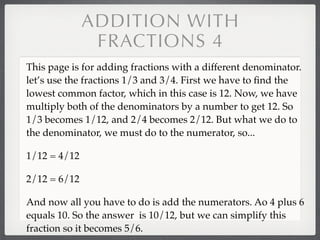
This page is for adding fractions with a different denominator.
let’s use the fractions 1/3 and 3/4. First we have to find the
lowest common factor, which in this case is 12. Now, we have
multiply both of the denominators by a number to get 12. So
1/3 becomes 1/12, and 2/4 becomes 2/12. But what we do to
the denominator, we must do to the numerator, so...

1/12 = 4/12

2/12 = 6/12

And now all you have to do is add the numerators. Ao 4 plus 6
equals 10. So the answer is 10/12, but we can simplify this
fraction so it becomes 5/6.
SUBTRACTION WITH
        FRACTIONS


This is basically the same as adding fractions except
now we are subtracting the fractions. Subtracting has
the same concept as normal subtraction, the only
difference is you just you use it on the numerator. so
let’s use the fractions 3/4 and 1/4. All you have to do
is minus 3 and 1 which equals 2. so the answer is 2/4.
SUBTRACTION WITH
          FRACTIONS 2
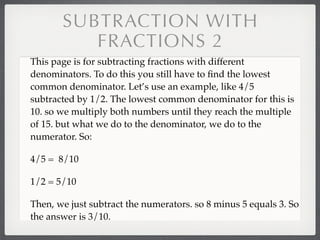
This page is for subtracting fractions with different
denominators. To do this you still have to find the lowest
common denominator. Let’s use an example, like 4/5
subtracted by 1/2. The lowest common denominator for this is
10. so we multiply both numbers until they reach the multiple
of 15. but what we do to the denominator, we do to the
numerator. So:

4/5 = 8/10

1/2 = 5/10

Then, we just subtract the numerators. so 8 minus 5 equals 3. So
the answer is 3/10.
MULTIPLICATION WITH
         FRACTIONS
This is the page for multiplying fractions. When you
multiply fractions, the denominator doesn’t really
matter. So let’s start with multiplying the fraction 2/3
by 1/4. To do this, all you have to do is just multiply
the denominators and the numerators.

2 x 1=2

3 x 4=12

So the answer is 2/12, but we can simplify it so it
becomes 1/6.
MULTIPLICATION WITH
     FRACTIONS 2

This page is for multiplying 3 fractions. let’s use the
fractions 2/3, 3/4, and 1/2. so it’s basically the same
thing. let’s multiply now!

2 x 3 x 1=6

3 x 4 x 2=24

So the answer is 6/24 but we can simplify it so it
becomes 1/4.
DIVIDING WITH
            FRACTIONS
To divide a fraction is basically the same as
multiplying one. let’s divide the fraction 1/3 and 2/4.
to do this, you basically only have to multiply, but
first, you have to switch the second fraction(it doesn’t
really matter which order these fractions are in)
upside-down! So now let’s multiply!

1 x 4=4

3 x 2=6

so the answer is 4/6, but we can simplify it so it
becomes 2/3.
DIVIDING WITH
           FRACTIONS 2
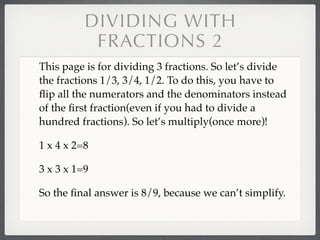
This page is for dividing 3 fractions. So let’s divide
the fractions 1/3, 3/4, 1/2. To do this, you have to
flip all the numerators and the denominators instead
of the first fraction(even if you had to divide a
hundred fractions). So let’s multiply(once more)!

1 x 4 x 2=8

3 x 3 x 1=9

So the final answer is 8/9, because we can’t simplify.

Fraction operations

  • 1.
    Fraction ByCharles
  • 2.
    ADDITION WITH FRACTIONS Adding fractions are actually not that difficult if you get the hang of it. It’s basically adding numbers, except it’s a bit more complicated. Let’s add 2/5 and 1/5. to do this you just have to add 2 and 1 which equals 3. and that 3 can go in to 5 so the final answer is 3/5.
  • 3.
    ADDITION WITH FRACTIONS 2 But what happens when you add two numbers that can’t fit in the denominator? Well, let’s use an example, 2/4 plus 3/4. first you add 2 and 3 which equals 5. 5 cannot fit in 4, so from that 5 you have to minus 4, but theres still a remainder of 1. So you take that 1 and and use it as the numerator for this fraction. and than you put another 1 next to that fraction because remember when we minused 4 from that 5? Well, because you can only minus 4 from 5 one time, you put one 1 next to that fraction so it becomes sort of a mixed fraction. So the final answer should look like this: 1 1/4 or one and one-fourth.
  • 4.
    ADDITION WITH FRACTIONS 3 This page is sort of related to the last one because this is something that happens when the fractions your adding fit perfectly into your denominator. Let’s use an example, 1/3 and 2/3. first you have to add the numerators, which equals 3. but 3 goes perfectly into the denominator which is 3 once, so all you have to do is write 1 since 3 goes into 3 once
  • 5.
    ADDITION WITH FRACTIONS 4 This page is for adding fractions with a different denominator. let’s use the fractions 1/3 and 3/4. First we have to find the lowest common factor, which in this case is 12. Now, we have multiply both of the denominators by a number to get 12. So 1/3 becomes 1/12, and 2/4 becomes 2/12. But what we do to the denominator, we must do to the numerator, so... 1/12 = 4/12 2/12 = 6/12 And now all you have to do is add the numerators. Ao 4 plus 6 equals 10. So the answer is 10/12, but we can simplify this fraction so it becomes 5/6.
  • 6.
    SUBTRACTION WITH FRACTIONS This is basically the same as adding fractions except now we are subtracting the fractions. Subtracting has the same concept as normal subtraction, the only difference is you just you use it on the numerator. so let’s use the fractions 3/4 and 1/4. All you have to do is minus 3 and 1 which equals 2. so the answer is 2/4.
  • 7.
    SUBTRACTION WITH FRACTIONS 2 This page is for subtracting fractions with different denominators. To do this you still have to find the lowest common denominator. Let’s use an example, like 4/5 subtracted by 1/2. The lowest common denominator for this is 10. so we multiply both numbers until they reach the multiple of 15. but what we do to the denominator, we do to the numerator. So: 4/5 = 8/10 1/2 = 5/10 Then, we just subtract the numerators. so 8 minus 5 equals 3. So the answer is 3/10.
  • 8.
    MULTIPLICATION WITH FRACTIONS This is the page for multiplying fractions. When you multiply fractions, the denominator doesn’t really matter. So let’s start with multiplying the fraction 2/3 by 1/4. To do this, all you have to do is just multiply the denominators and the numerators. 2 x 1=2 3 x 4=12 So the answer is 2/12, but we can simplify it so it becomes 1/6.
  • 9.
    MULTIPLICATION WITH FRACTIONS 2 This page is for multiplying 3 fractions. let’s use the fractions 2/3, 3/4, and 1/2. so it’s basically the same thing. let’s multiply now! 2 x 3 x 1=6 3 x 4 x 2=24 So the answer is 6/24 but we can simplify it so it becomes 1/4.
  • 10.
    DIVIDING WITH FRACTIONS To divide a fraction is basically the same as multiplying one. let’s divide the fraction 1/3 and 2/4. to do this, you basically only have to multiply, but first, you have to switch the second fraction(it doesn’t really matter which order these fractions are in) upside-down! So now let’s multiply! 1 x 4=4 3 x 2=6 so the answer is 4/6, but we can simplify it so it becomes 2/3.
  • 11.
    DIVIDING WITH FRACTIONS 2 This page is for dividing 3 fractions. So let’s divide the fractions 1/3, 3/4, 1/2. To do this, you have to flip all the numerators and the denominators instead of the first fraction(even if you had to divide a hundred fractions). So let’s multiply(once more)! 1 x 4 x 2=8 3 x 3 x 1=9 So the final answer is 8/9, because we can’t simplify.

Editor's Notes