Catchment
Management
Abstractions/Hydromorphology
Learning Objectives
• Abstraction risk
• Impacts from Abstractions
• Environmental Flows
• Potential Measures
Abstractions
• Most water abstractions are currently sustainable
• Large amounts of water are abstracted daily for domestic
use and for use in agriculture, industry and recreation.
• Too much abstraction reduces flow in springs and rivers
and lowers water levels in lakes, wetlands and
groundwater.
• Impact on Environmental flows (E-Flows)
• That can make water supplies unsustainable and
adversely affect aquatic plants and animals and wetland
areas.
– Reduced dilution
– Reduced habitat Quantity/Quality
– Fine Sediment deposition
Abstractions – Risk assessment
• 1st RBMP Cycle Risk Assessment – based on net
abstraction as percentage of Q95
• Net abstraction > 40% Q95 – “at risk”
• Net abstraction 10-40% Q95 – “probably at
risk”
• 238 river water bodies covering 1,485 km of
river were either ‘at risk’ or ‘probably at risk’
from abstraction pressures - 90% not at risk
• However over half of water bodies with
surface water abstraction are considered to
represent a risk to ecological status
• Summed abstraction rates
against average recharge
across each GWB
• For the most part sustainable
abstractions
Abstractions – Risk assessment
Impacts from Abstractions
• Physico-chemical
• Hydromorphological
– Impounding structure
– Barriers migration
• Ecological
Physico-chemical impacts
• Changes in nutrient conditions
• Temperature increases
• Dissolved Oxygen decreases
• Sedimentation
Hydromorphological impacts
• Alteration to flow regime
• Alteration to sediment regime
• Physical alterations to channel
due to impounding structures
Ecological impacts
• Changes in flow at an ecologically relevant level can
be a key component of freshwater habitat and
species decline
• Lower baseflows
– Dry river edges – reduced habitat
– Lower quantities of flow – reduced velocities
– Reduce dilution and assimilative capacity
• Lower velocities
– Sediment deposition in sensitive aquatic habitats
Lower Flow/Reduced Velocities
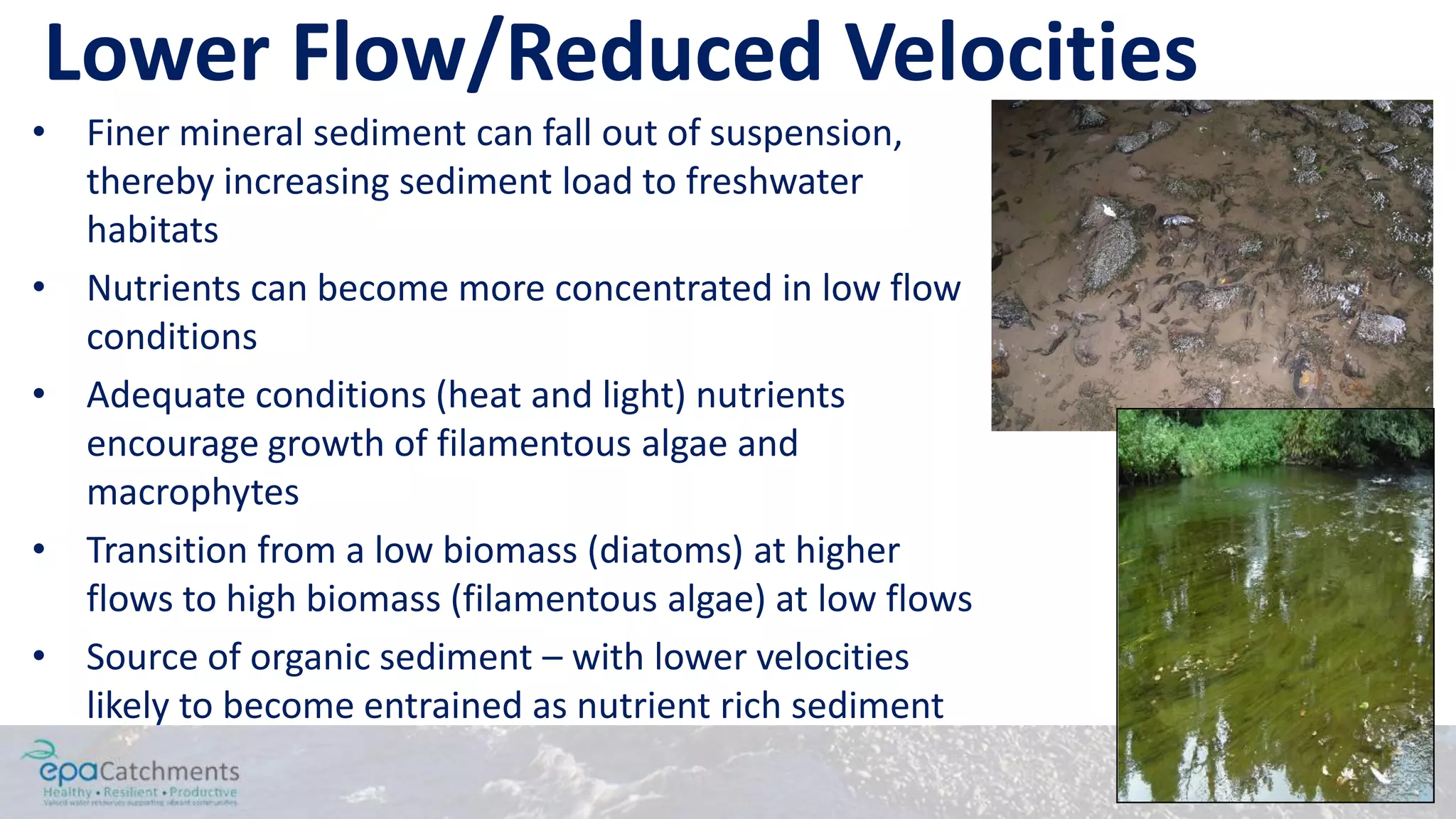
• Finer mineral sediment can fall out of suspension,
thereby increasing sediment load to freshwater
habitats
• Nutrients can become more concentrated in low flow
conditions
• Adequate conditions (heat and light) nutrients
encourage growth of filamentous algae and
macrophytes
• Transition from a low biomass (diatoms) at higher
flows to high biomass (filamentous algae) at low flows
• Source of organic sediment – with lower velocities
likely to become entrained as nutrient rich sediment
Environmental Flows (E Flows)
• Determination of the quantity or volume of water through time required to
sustain the function and integrity of freshwater ecosystems
• Non-ecological methods:
– Hydrological index methods, e.g. Q95
– Hydraulic rating methods - hydraulic variable assumed to be limiting to
target biota, e.g. wetted perimeter
• Ecological methods – consideration of aquatic biota
– Habitat simulation methodologies – targeted species, e.g. PHABSIM
– Holistic methodologies – entire river ecosystem
• For purposes of WFD ecological methods are required
Environmental Flows
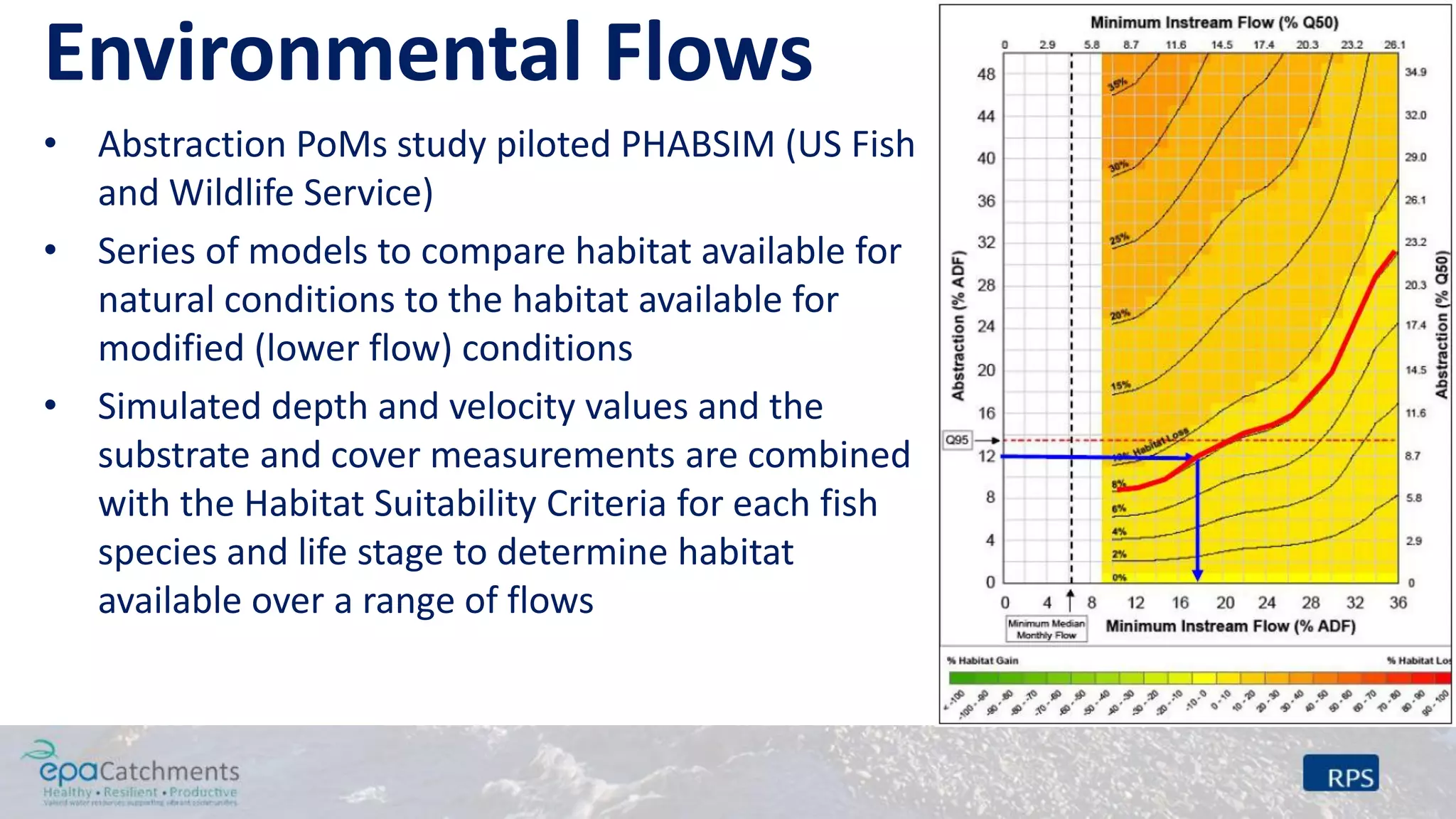
• Abstraction PoMs study piloted PHABSIM (US Fish
and Wildlife Service)
• Series of models to compare habitat available for
natural conditions to the habitat available for
modified (lower flow) conditions
• Simulated depth and velocity values and the
substrate and cover measurements are combined
with the Habitat Suitability Criteria for each fish
species and life stage to determine habitat
available over a range of flows
Environmental Flows
• EPA Strive Project - Development of an ecohydrology framework for setting
environmental flow standards for Irish rivers
• Objective:
– review state of the art EFlow methodology to identify alternatives most suited to the Irish
context and for developing flow standard
– Alternative approaches for estimating EFlows will be applied to hydrometric flow data from
a number of rivers in contrasting catchments representing different water pathway
configurations
– availability of ecological and water chemistry data will be assessed, and, where possible,
related to flow regime to develop relationships for setting flow standards
Abstraction Regulations - Existing Measures
Environmental Impact Assessment Regulations (SI 349 of 1989) as amended from 1994 to 2006:
Undertake environmental impact assessment for drilling for water supplies above specified
thresholds, groundwater abstraction and artificial groundwater recharge schemes above specified
thresholds and works for the transfer of water resources between river basins above specified
thresholds.
Water Pollution Act (No 1 of 1977) as amended in 1990:
Maintain registers of abstractions and make available to the public.
Water Supplies Act (SI 1 of 1942):
Local authorities must adhere to conditions set down in provisional orders when abstracting drinking
water from a water source.
Planning and Development Act (No. 30 of 2000) as amended in 2002:
Local authorities must obtain planning permission for groundwater abstractions for public drinking
water supplies.
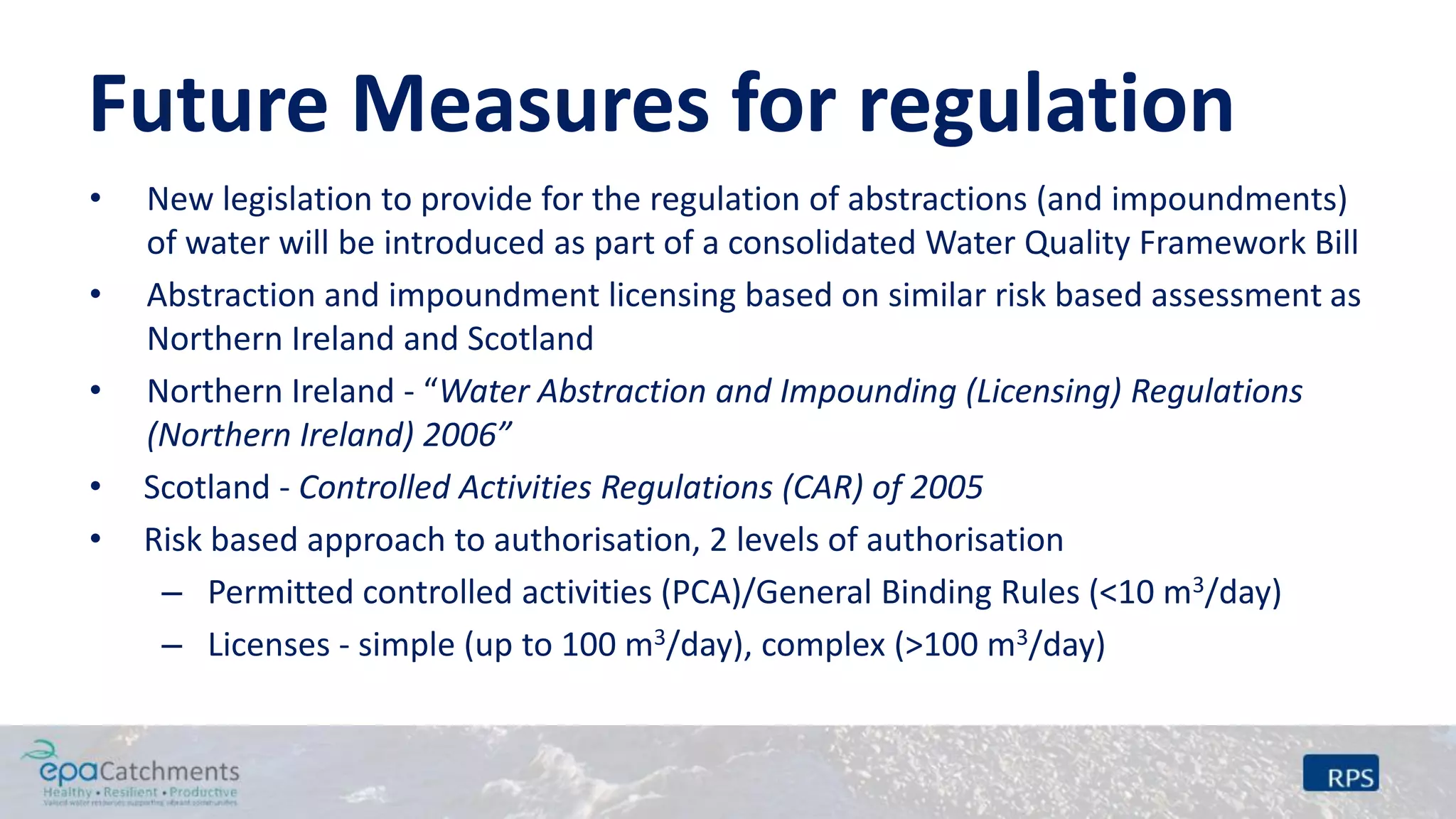
Future Measures for regulation
• New legislation to provide for the regulation of abstractions (and impoundments)
of water will be introduced as part of a consolidated Water Quality Framework Bill
• Abstraction and impoundment licensing based on similar risk based assessment as
Northern Ireland and Scotland
• Northern Ireland - “Water Abstraction and Impounding (Licensing) Regulations
(Northern Ireland) 2006”
• Scotland - Controlled Activities Regulations (CAR) of 2005
• Risk based approach to authorisation, 2 levels of authorisation
– Permitted controlled activities (PCA)/General Binding Rules (<10 m3/day)
– Licenses - simple (up to 100 m3/day), complex (>100 m3/day)
ICM - Drinking Water Safety Plans
• Drinking Water Safety Plans
• WHO approach to water
safety plans – Safe and
Secure
• Safe – meets DW standards
at tap
• Secure – management
system for risk
identification and
management of risk
Drinking Water Safety Plans
• Document and describe the supply – from catchment to
consumer
• Risk assess hazardous events
• Define and validate control measures
• Establish Action Plans for Risks
• Verify Effectiveness of DWSP
• Management Procedures and documentation
• Supporting programmes – develop skills & knowledge
• Regular review of hazards, risks, controls (e.g. new equipment)
Comprehensive Risk
Assessment and Risk
Management process
Groundwater Protection Plans
• Need to protect groundwater and ensure adequate
development control – incorporation in CDPs
• Two key components
– Land surface zoning maps
– Ground water protection responses
Land Surface Zoning maps – Zone of Contribution
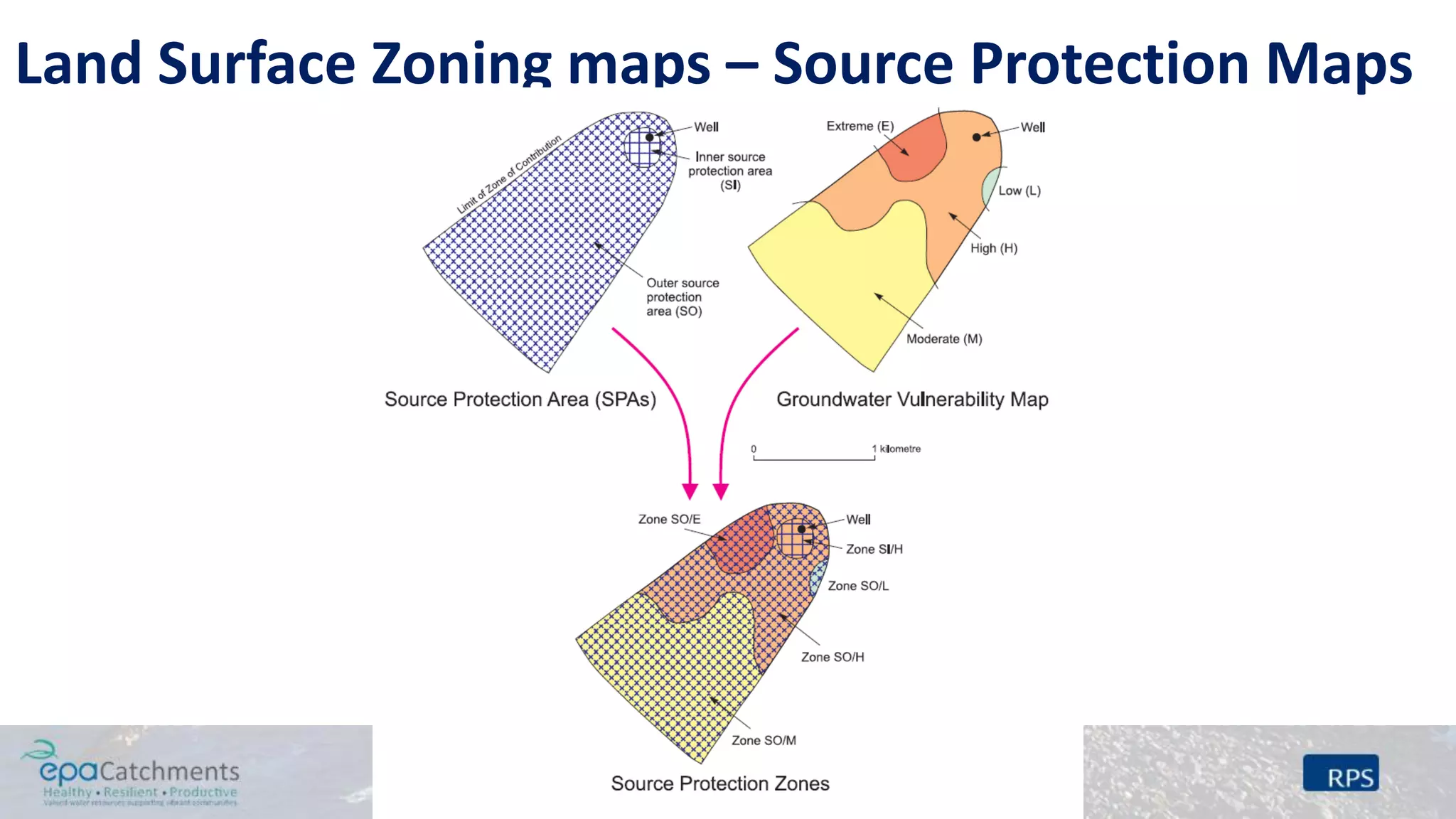
Land Surface Zoning maps – Source Protection Maps
Groundwater protection responses
• Source Protection zones – provide protection by
placing tighter controls of activities within ZoC
• Groundwater protection pollution responses
– Landfills
– Landspreading
– Onsite wastewater treatment systems
– Earth Lined Stores
– Out wintering pads
ICM and drinking water quality
• Many UK utilities are now
realising the benefit of ICM in
their drinking water catchments
• Integral part of asset
management plans
• NI Water SCaMP programme –
scoping studies for 8 raw water
sources
• INTERREG application with Irish
Water for cross border supplies
Roy Taylor, NI Water
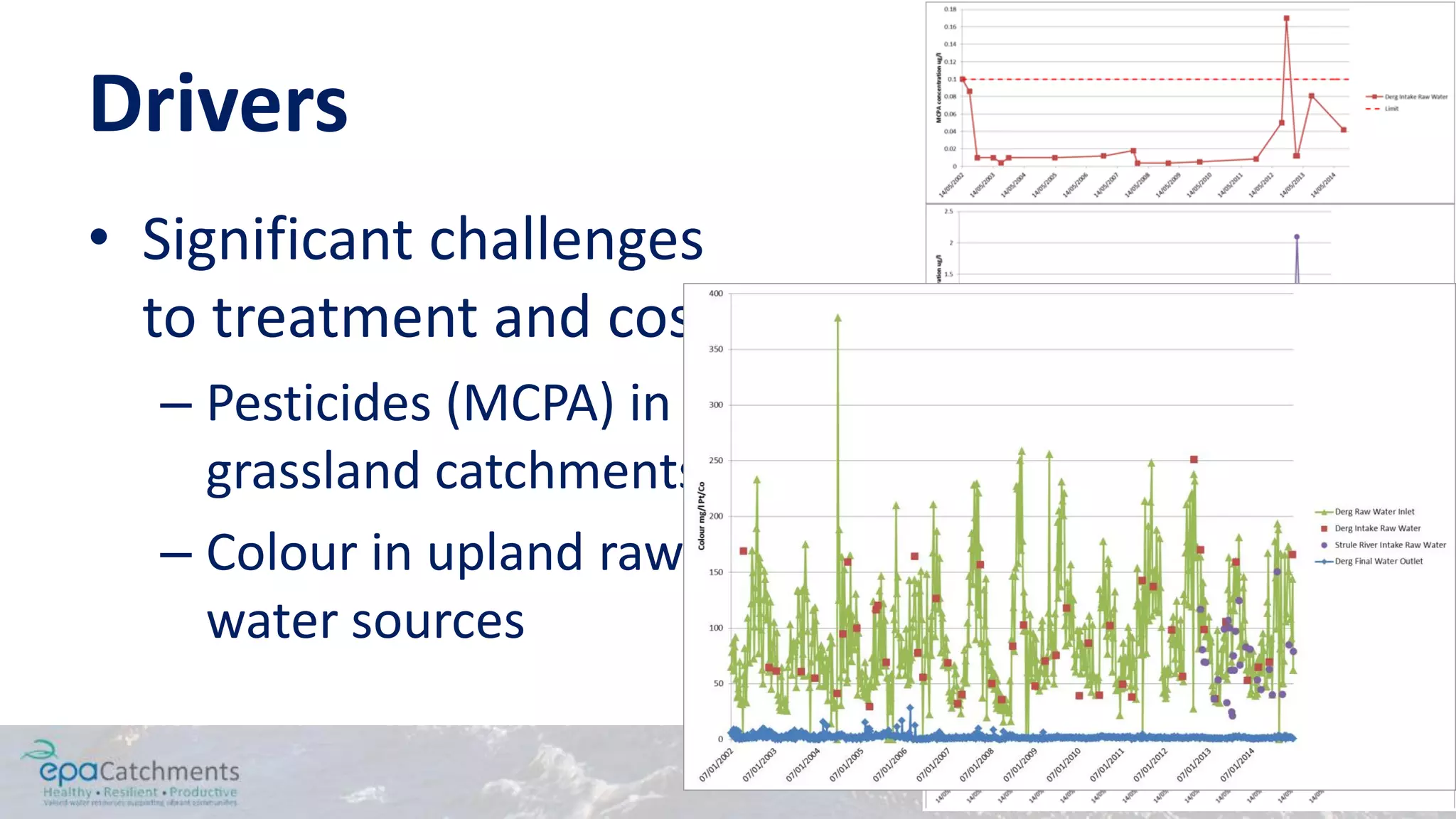
Drivers
• Significant challenges
to treatment and cost
– Pesticides (MCPA) in
grassland catchments
– Colour in upland raw
water sources
SCaMP Programme
• Scoping studies to establish
feasibility and potential
measures. Eight
catchments to date
• More detail analysis of cost
benefit based on UKWIR
Benefit Assessment
Framework
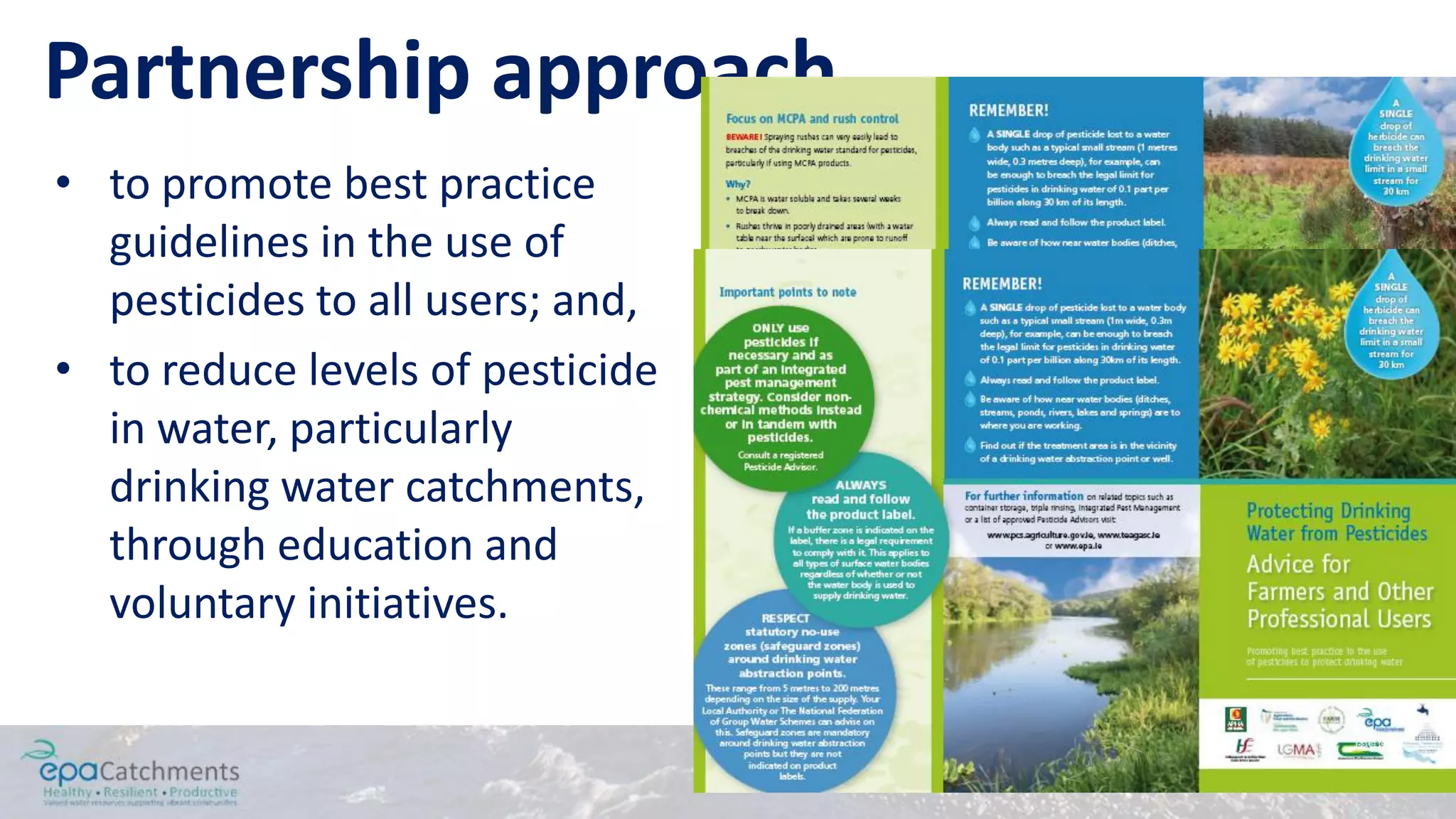
Partnership approach
• to promote best practice
guidelines in the use of
pesticides to all users; and,
• to reduce levels of pesticide
in water, particularly
drinking water catchments,
through education and
voluntary initiatives.

16. Abstractions/Hydromorphology

  • 1.
  • 2.
    Learning Objectives • Abstractionrisk • Impacts from Abstractions • Environmental Flows • Potential Measures
  • 3.
    Abstractions • Most waterabstractions are currently sustainable • Large amounts of water are abstracted daily for domestic use and for use in agriculture, industry and recreation. • Too much abstraction reduces flow in springs and rivers and lowers water levels in lakes, wetlands and groundwater. • Impact on Environmental flows (E-Flows) • That can make water supplies unsustainable and adversely affect aquatic plants and animals and wetland areas. – Reduced dilution – Reduced habitat Quantity/Quality – Fine Sediment deposition
  • 4.
    Abstractions – Riskassessment • 1st RBMP Cycle Risk Assessment – based on net abstraction as percentage of Q95 • Net abstraction > 40% Q95 – “at risk” • Net abstraction 10-40% Q95 – “probably at risk” • 238 river water bodies covering 1,485 km of river were either ‘at risk’ or ‘probably at risk’ from abstraction pressures - 90% not at risk • However over half of water bodies with surface water abstraction are considered to represent a risk to ecological status
  • 5.
    • Summed abstractionrates against average recharge across each GWB • For the most part sustainable abstractions Abstractions – Risk assessment
  • 6.
    Impacts from Abstractions •Physico-chemical • Hydromorphological – Impounding structure – Barriers migration • Ecological
  • 7.
    Physico-chemical impacts • Changesin nutrient conditions • Temperature increases • Dissolved Oxygen decreases • Sedimentation
  • 8.
    Hydromorphological impacts • Alterationto flow regime • Alteration to sediment regime • Physical alterations to channel due to impounding structures
  • 9.
    Ecological impacts • Changesin flow at an ecologically relevant level can be a key component of freshwater habitat and species decline • Lower baseflows – Dry river edges – reduced habitat – Lower quantities of flow – reduced velocities – Reduce dilution and assimilative capacity • Lower velocities – Sediment deposition in sensitive aquatic habitats
  • 10.
    Lower Flow/Reduced Velocities •Finer mineral sediment can fall out of suspension, thereby increasing sediment load to freshwater habitats • Nutrients can become more concentrated in low flow conditions • Adequate conditions (heat and light) nutrients encourage growth of filamentous algae and macrophytes • Transition from a low biomass (diatoms) at higher flows to high biomass (filamentous algae) at low flows • Source of organic sediment – with lower velocities likely to become entrained as nutrient rich sediment
  • 11.
    Environmental Flows (EFlows) • Determination of the quantity or volume of water through time required to sustain the function and integrity of freshwater ecosystems • Non-ecological methods: – Hydrological index methods, e.g. Q95 – Hydraulic rating methods - hydraulic variable assumed to be limiting to target biota, e.g. wetted perimeter • Ecological methods – consideration of aquatic biota – Habitat simulation methodologies – targeted species, e.g. PHABSIM – Holistic methodologies – entire river ecosystem • For purposes of WFD ecological methods are required
  • 12.
    Environmental Flows • AbstractionPoMs study piloted PHABSIM (US Fish and Wildlife Service) • Series of models to compare habitat available for natural conditions to the habitat available for modified (lower flow) conditions • Simulated depth and velocity values and the substrate and cover measurements are combined with the Habitat Suitability Criteria for each fish species and life stage to determine habitat available over a range of flows
  • 13.
    Environmental Flows • EPAStrive Project - Development of an ecohydrology framework for setting environmental flow standards for Irish rivers • Objective: – review state of the art EFlow methodology to identify alternatives most suited to the Irish context and for developing flow standard – Alternative approaches for estimating EFlows will be applied to hydrometric flow data from a number of rivers in contrasting catchments representing different water pathway configurations – availability of ecological and water chemistry data will be assessed, and, where possible, related to flow regime to develop relationships for setting flow standards
  • 14.
    Abstraction Regulations -Existing Measures Environmental Impact Assessment Regulations (SI 349 of 1989) as amended from 1994 to 2006: Undertake environmental impact assessment for drilling for water supplies above specified thresholds, groundwater abstraction and artificial groundwater recharge schemes above specified thresholds and works for the transfer of water resources between river basins above specified thresholds. Water Pollution Act (No 1 of 1977) as amended in 1990: Maintain registers of abstractions and make available to the public. Water Supplies Act (SI 1 of 1942): Local authorities must adhere to conditions set down in provisional orders when abstracting drinking water from a water source. Planning and Development Act (No. 30 of 2000) as amended in 2002: Local authorities must obtain planning permission for groundwater abstractions for public drinking water supplies.
  • 15.
    Future Measures forregulation • New legislation to provide for the regulation of abstractions (and impoundments) of water will be introduced as part of a consolidated Water Quality Framework Bill • Abstraction and impoundment licensing based on similar risk based assessment as Northern Ireland and Scotland • Northern Ireland - “Water Abstraction and Impounding (Licensing) Regulations (Northern Ireland) 2006” • Scotland - Controlled Activities Regulations (CAR) of 2005 • Risk based approach to authorisation, 2 levels of authorisation – Permitted controlled activities (PCA)/General Binding Rules (<10 m3/day) – Licenses - simple (up to 100 m3/day), complex (>100 m3/day)
  • 16.
    ICM - DrinkingWater Safety Plans • Drinking Water Safety Plans • WHO approach to water safety plans – Safe and Secure • Safe – meets DW standards at tap • Secure – management system for risk identification and management of risk
  • 17.
    Drinking Water SafetyPlans • Document and describe the supply – from catchment to consumer • Risk assess hazardous events • Define and validate control measures • Establish Action Plans for Risks • Verify Effectiveness of DWSP • Management Procedures and documentation • Supporting programmes – develop skills & knowledge • Regular review of hazards, risks, controls (e.g. new equipment) Comprehensive Risk Assessment and Risk Management process
  • 18.
    Groundwater Protection Plans •Need to protect groundwater and ensure adequate development control – incorporation in CDPs • Two key components – Land surface zoning maps – Ground water protection responses
  • 19.
    Land Surface Zoningmaps – Zone of Contribution
  • 20.
    Land Surface Zoningmaps – Source Protection Maps
  • 21.
    Groundwater protection responses •Source Protection zones – provide protection by placing tighter controls of activities within ZoC • Groundwater protection pollution responses – Landfills – Landspreading – Onsite wastewater treatment systems – Earth Lined Stores – Out wintering pads
  • 22.
    ICM and drinkingwater quality • Many UK utilities are now realising the benefit of ICM in their drinking water catchments • Integral part of asset management plans • NI Water SCaMP programme – scoping studies for 8 raw water sources • INTERREG application with Irish Water for cross border supplies Roy Taylor, NI Water
  • 23.
    Drivers • Significant challenges totreatment and cost – Pesticides (MCPA) in grassland catchments – Colour in upland raw water sources
  • 24.
    SCaMP Programme • Scopingstudies to establish feasibility and potential measures. Eight catchments to date • More detail analysis of cost benefit based on UKWIR Benefit Assessment Framework
  • 25.
    Partnership approach • topromote best practice guidelines in the use of pesticides to all users; and, • to reduce levels of pesticide in water, particularly drinking water catchments, through education and voluntary initiatives.