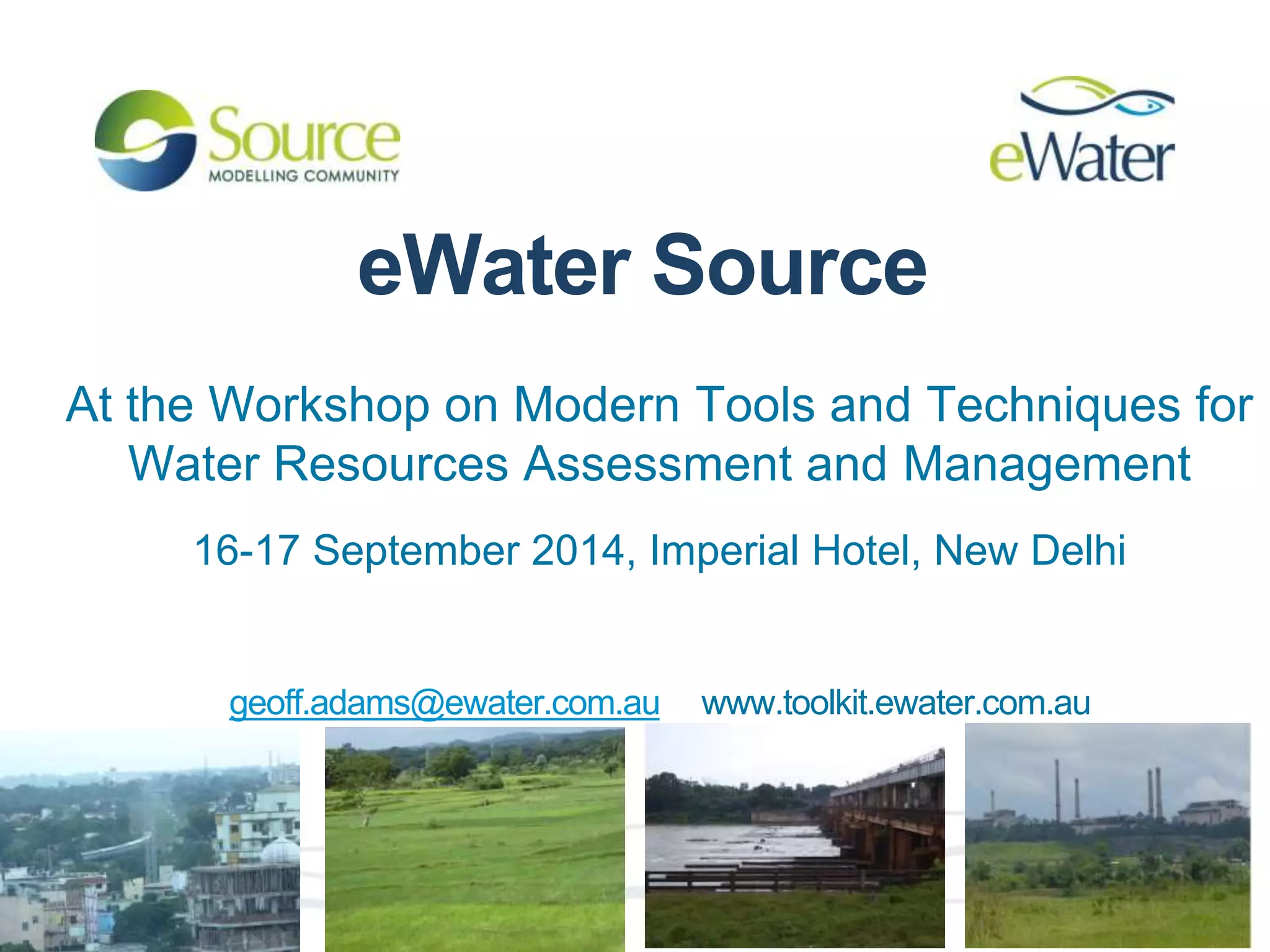
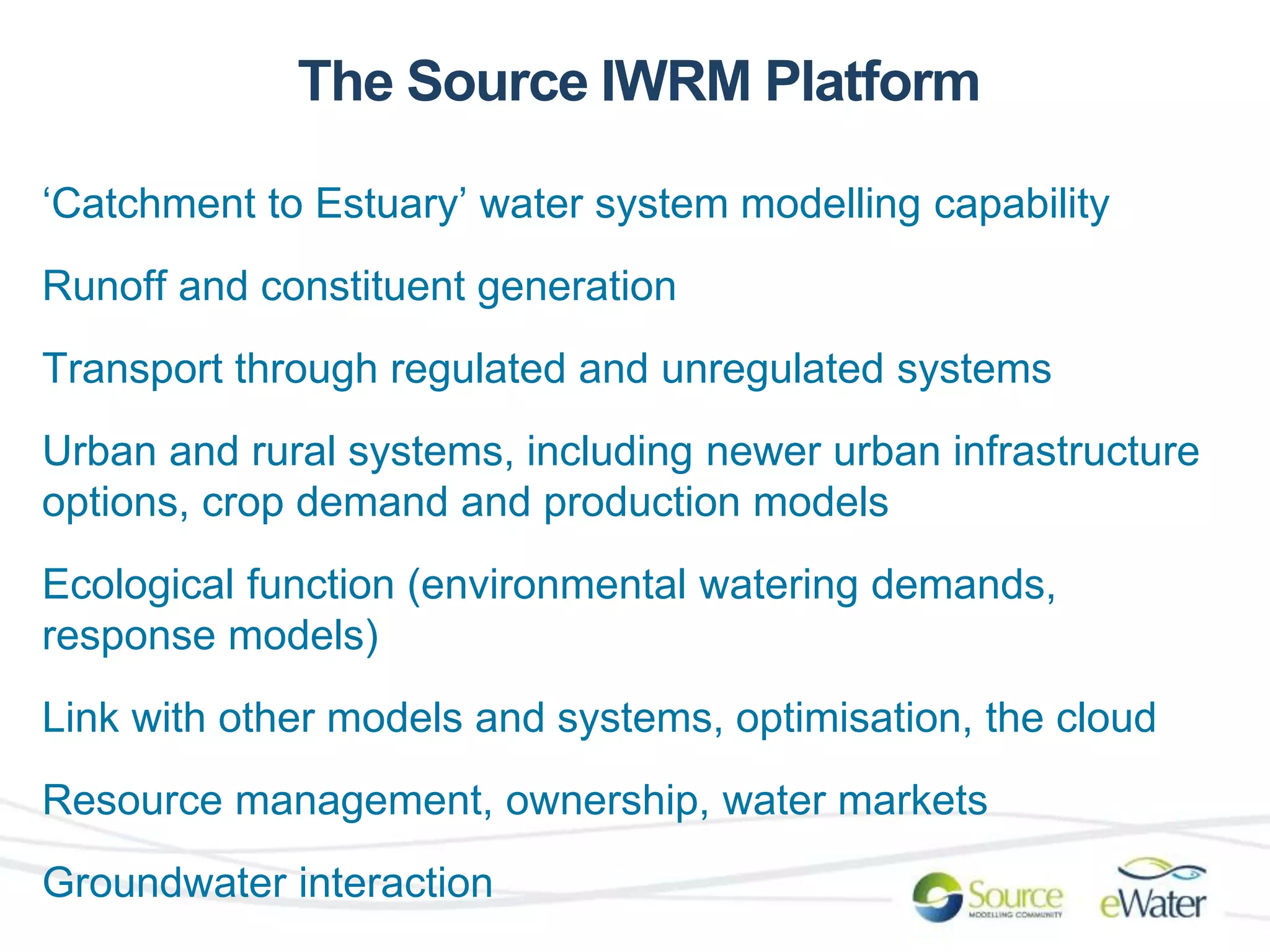
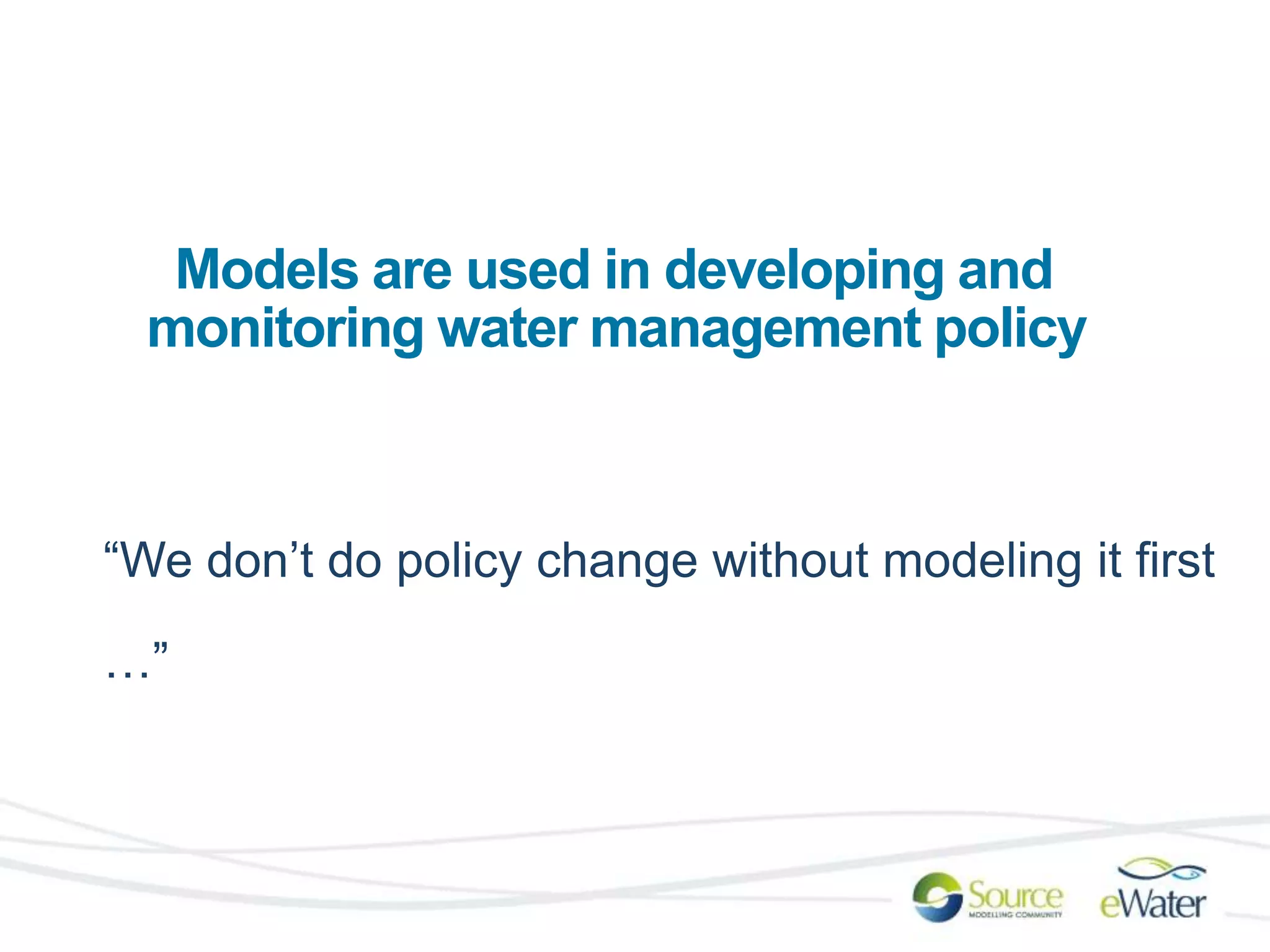
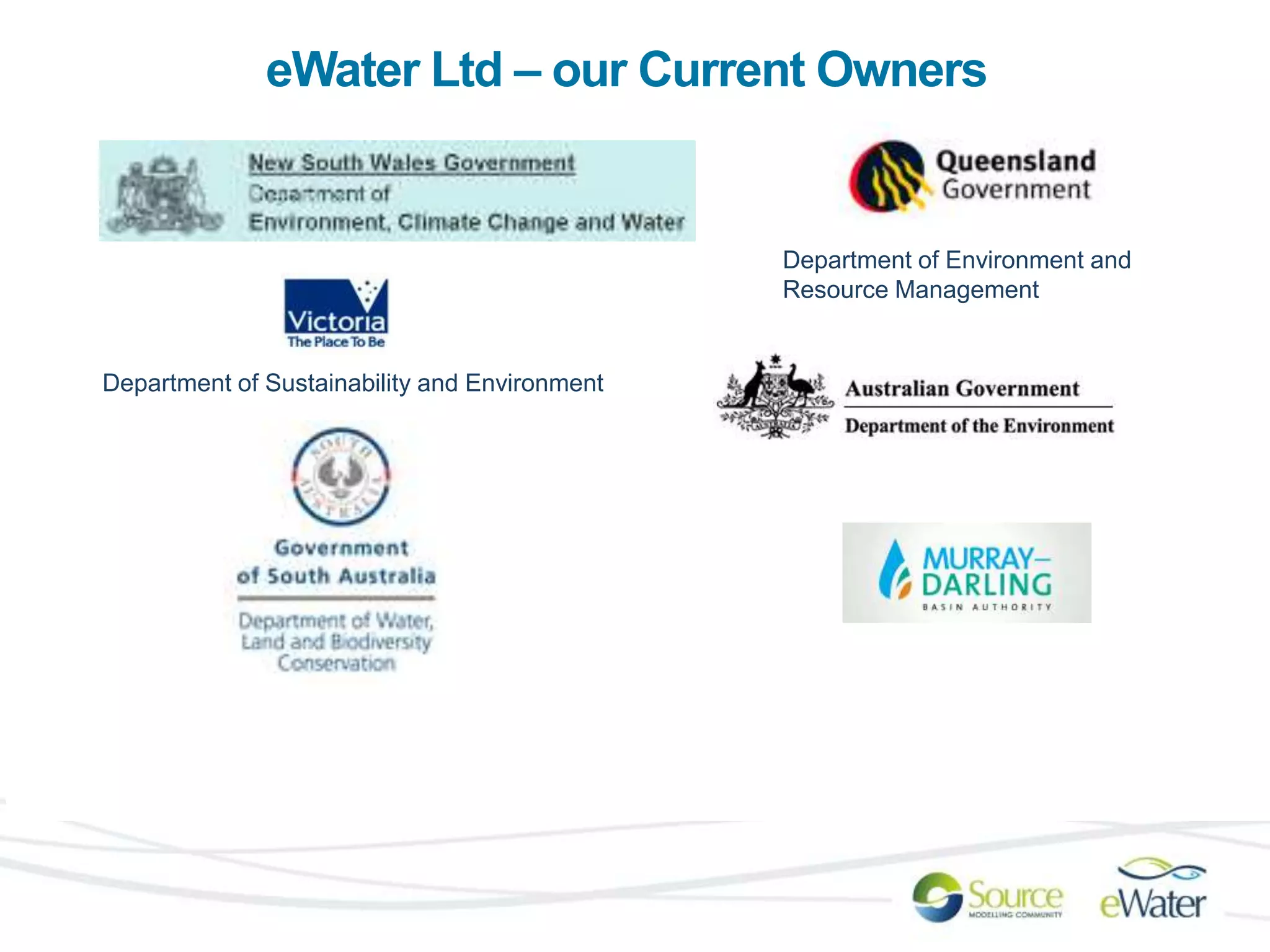
eWater Source 
At the Workshop on Modern Tools and Techniques for 
Water Resources Assessment and Management 
16-17 September 2014, Imperial Hotel, New Delhi 
geoff.adams@ewater.com.au www.toolkit.ewater.com.au
The Source IWRM Platform 
‘Catchment to Estuary’ water system modelling capability 
Runoff and constituent generation 
Transport through regulated and unregulated systems 
Urban and rural systems, including newer urban infrastructure 
options, crop demand and production models 
Ecological function (environmental watering demands, 
response models) 
Link with other models and systems, optimisation, the cloud 
Resource management, ownership, water markets 
Groundwater interaction
Models are used in developing and 
monitoring water management policy 
“We don’t do policy change without modeling it first 
…”
eWater Ltd – our Current Owners 
Department of Sustainability and Environment 
Department of Environment and 
Resource Management
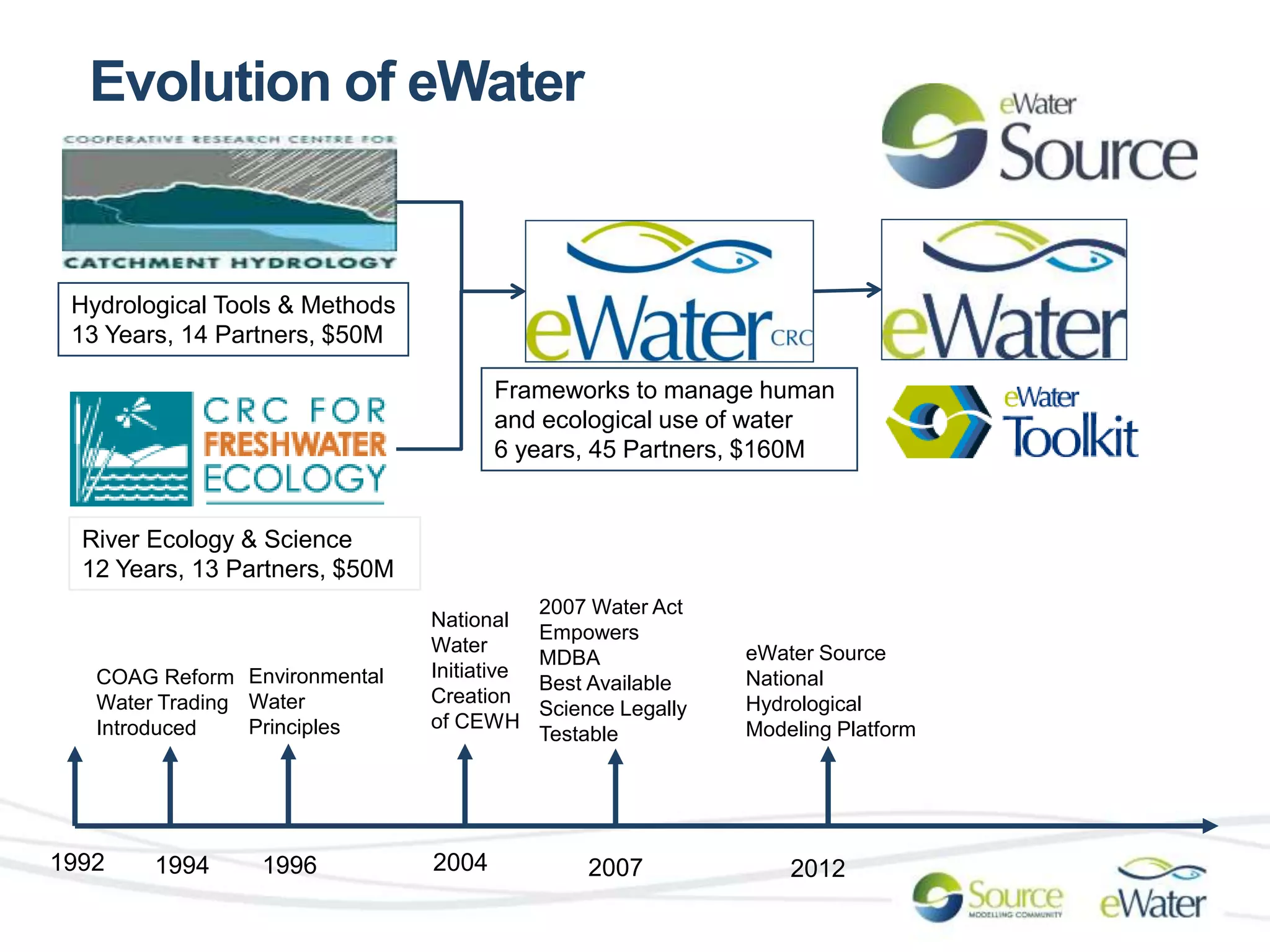
Evolution of eWater 
Hydrological Tools & Methods 
13 Years, 14 Partners, $50M 
River Ecology & Science 
12 Years, 13 Partners, $50M 
COAG Reform 
Water Trading 
Introduced 
Frameworks to manage human 
and ecological use of water 
6 years, 45 Partners, $160M 
National 
Water 
Initiative 
Creation 
of CEWH 
Environmental 
Water 
Principles 
1992 1994 2004 2007 
2012 
2007 Water Act 
Empowers 
MDBA 
Best Available 
Science Legally 
Testable 
eWater Source 
National 
Hydrological 
Modeling Platform 
1996
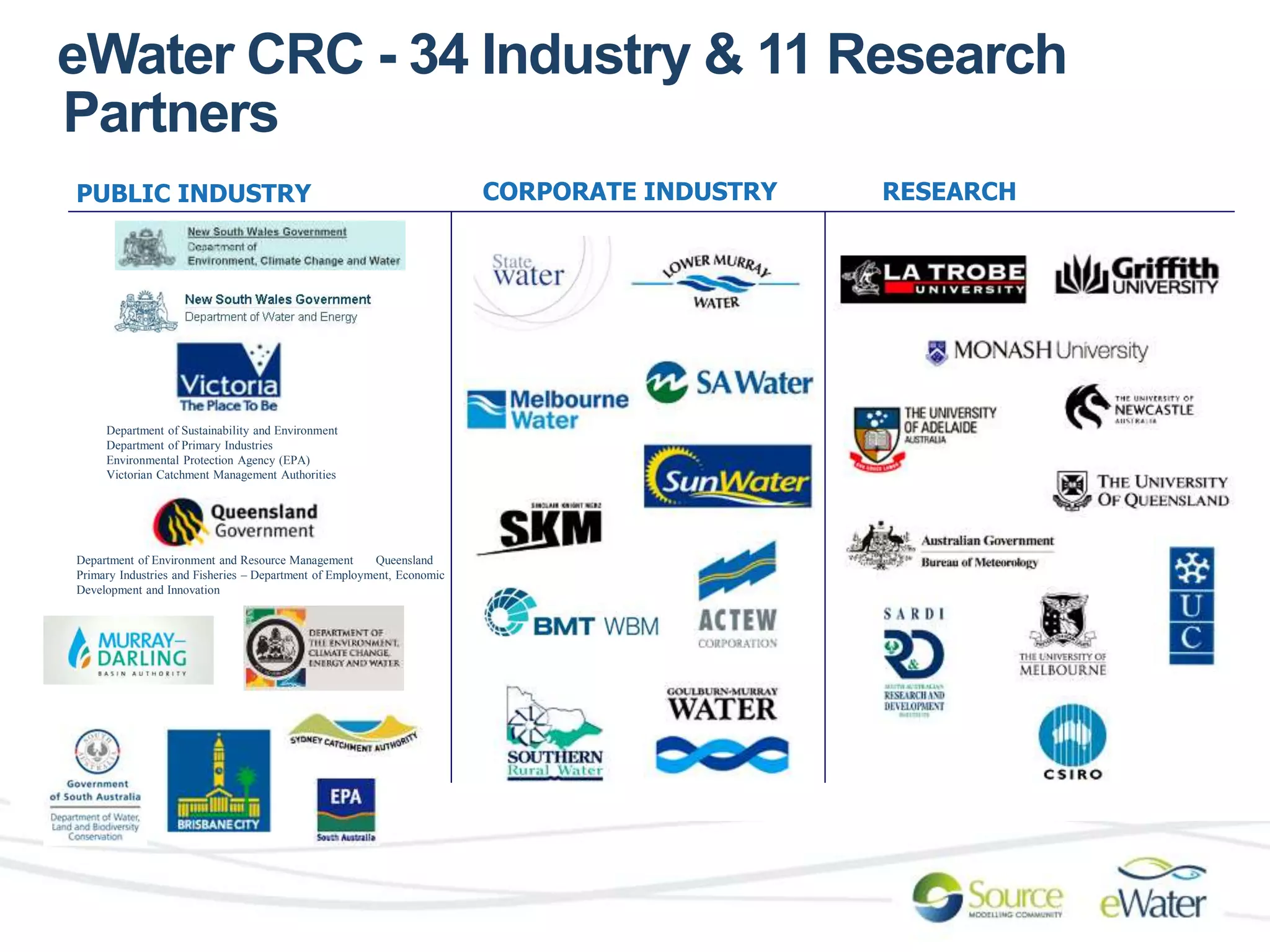
eWater CRC - 34 Industry & 11 Research 
Partners 
PUBLIC INDUSTRY CORPORATE INDUSTRY RESEARCH 
Department of Sustainability and Environment 
Department of Primary Industries 
Environmental Protection Agency (EPA) 
Victorian Catchment Management Authorities 
Department of Environment and Resource Management Queensland 
Primary Industries and Fisheries – Department of Employment, Economic 
Development and Innovation
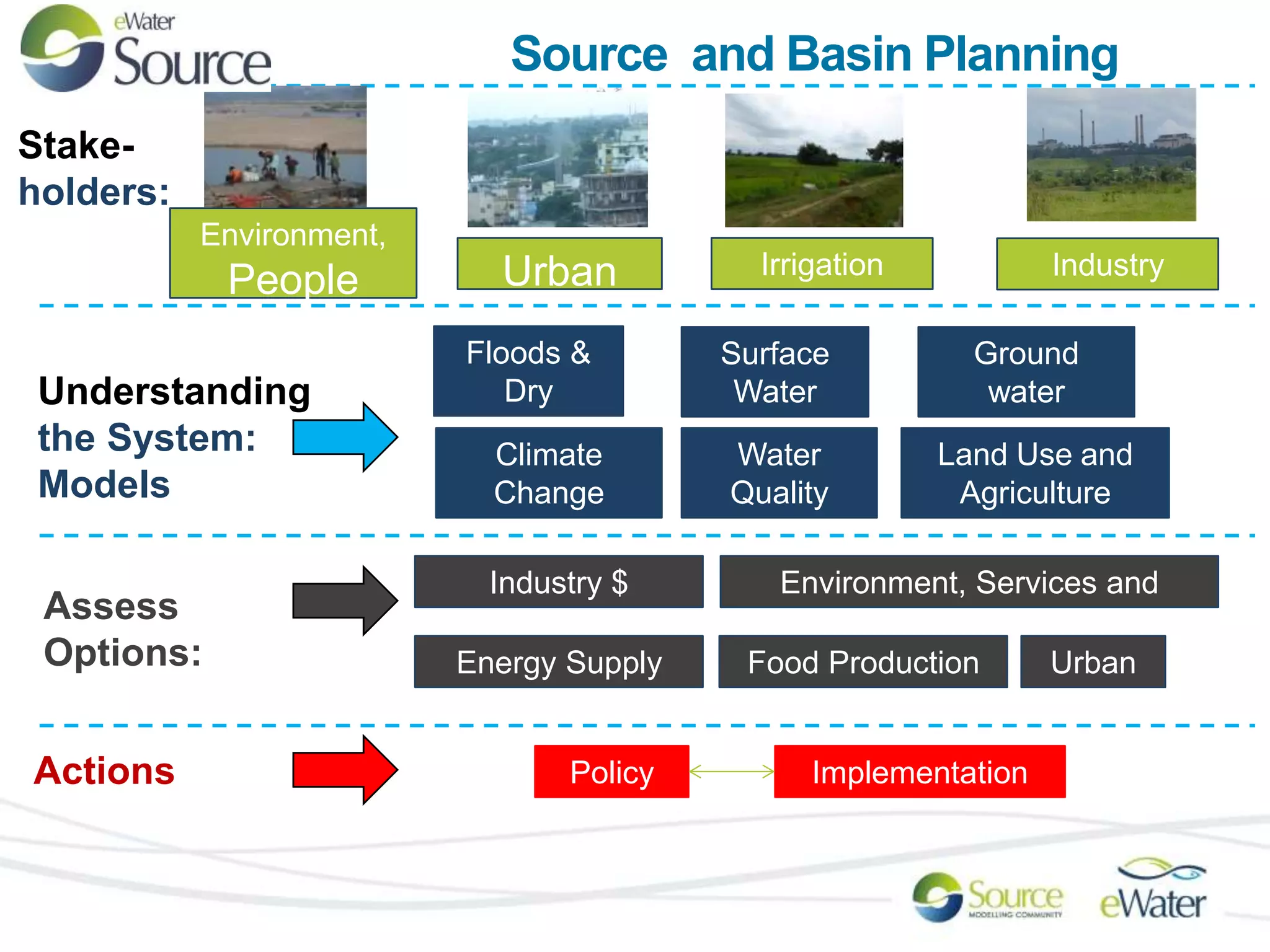
Source and Basin Planning 
Environment, 
People Urban Irrigation 
Floods & 
Dry 
Water 
Quality 
Land Use and 
Agriculture 
Industry $ Environment, Services and 
People 
Climate 
Change 
Ground 
water 
Surface 
Understanding Water 
the System: 
Models 
Assess 
Options: 
Actions Policy 
Implementation 
Industry 
Energy Supply Food Production Urban 
Stake-holders:
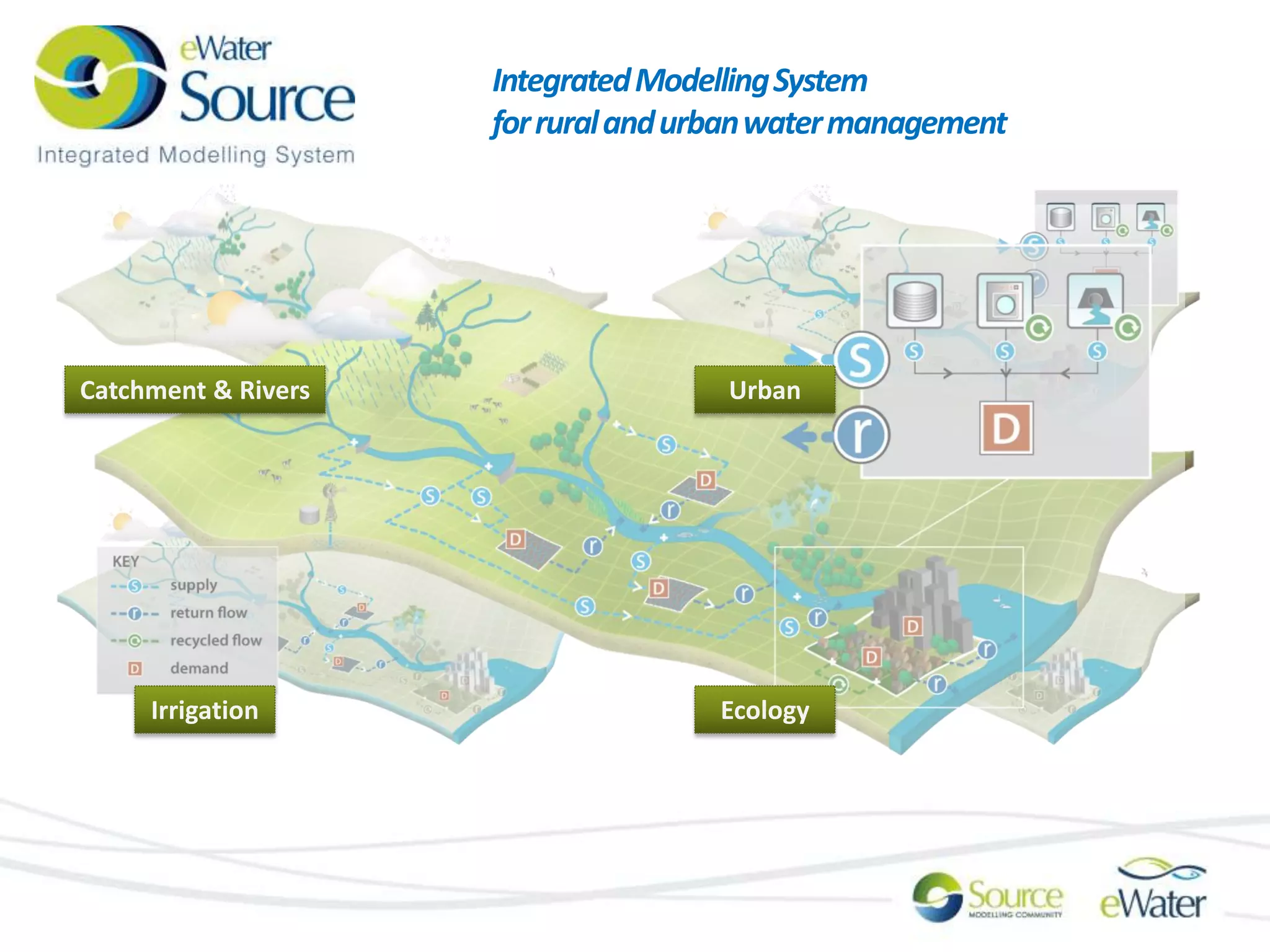
Integrated Modelling System 
for rural and urban water management 
Catchment & Rivers Urban 
Irrigation Ecology
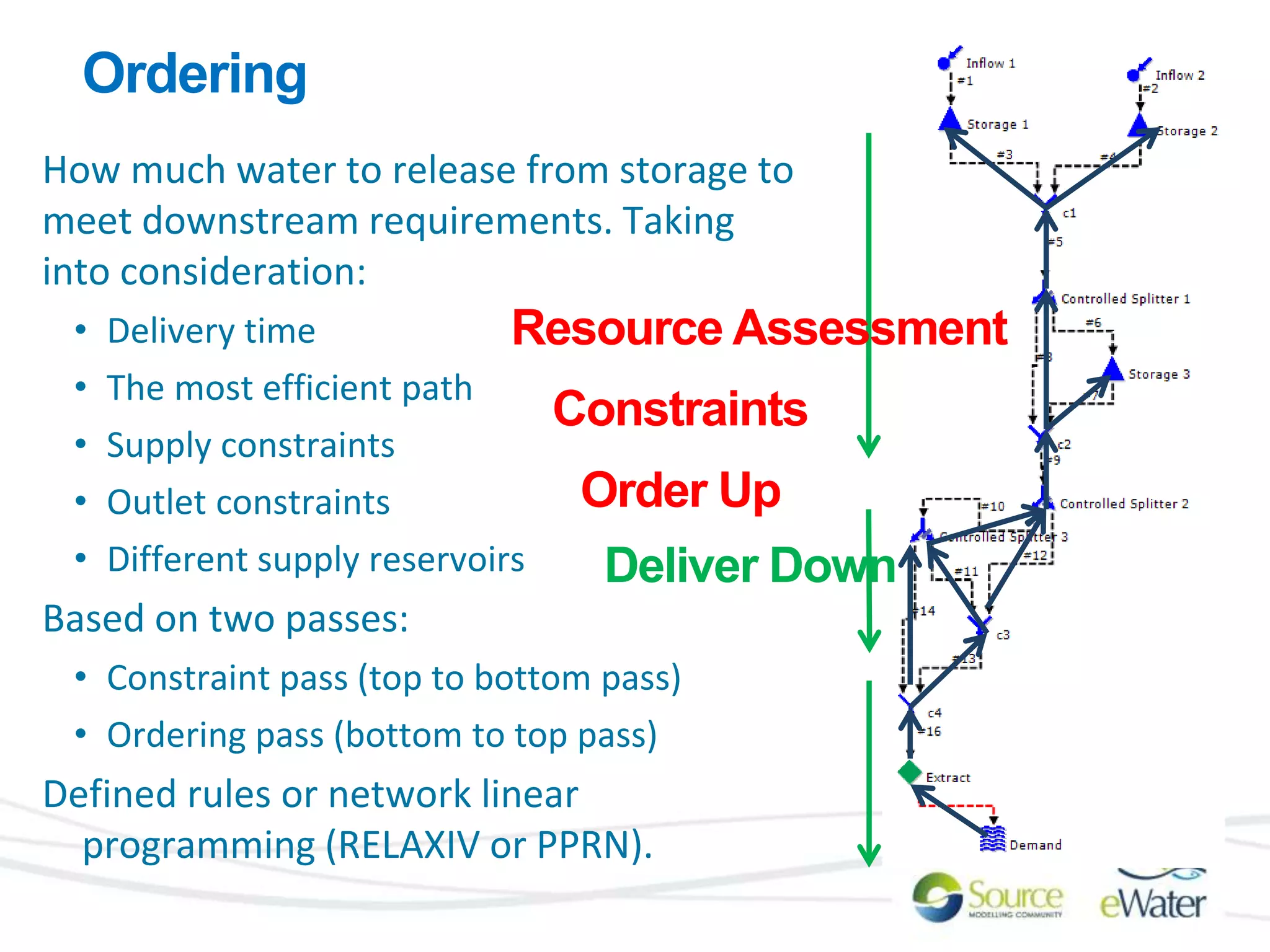
Ordering 
How much water to release from storage to 
meet downstream requirements. Taking 
into consideration: 
• Delivery time 
• The most efficient path 
• Supply constraints 
• Outlet constraints 
• Different supply reservoirs 
Based on two passes: 
• Constraint pass (top to bottom pass) 
• Ordering pass (bottom to top pass) 
Defined rules or network linear 
programming (RELAXIV or PPRN). 
Resource Assessment 
Constraints 
Order Up 
Deliver Down
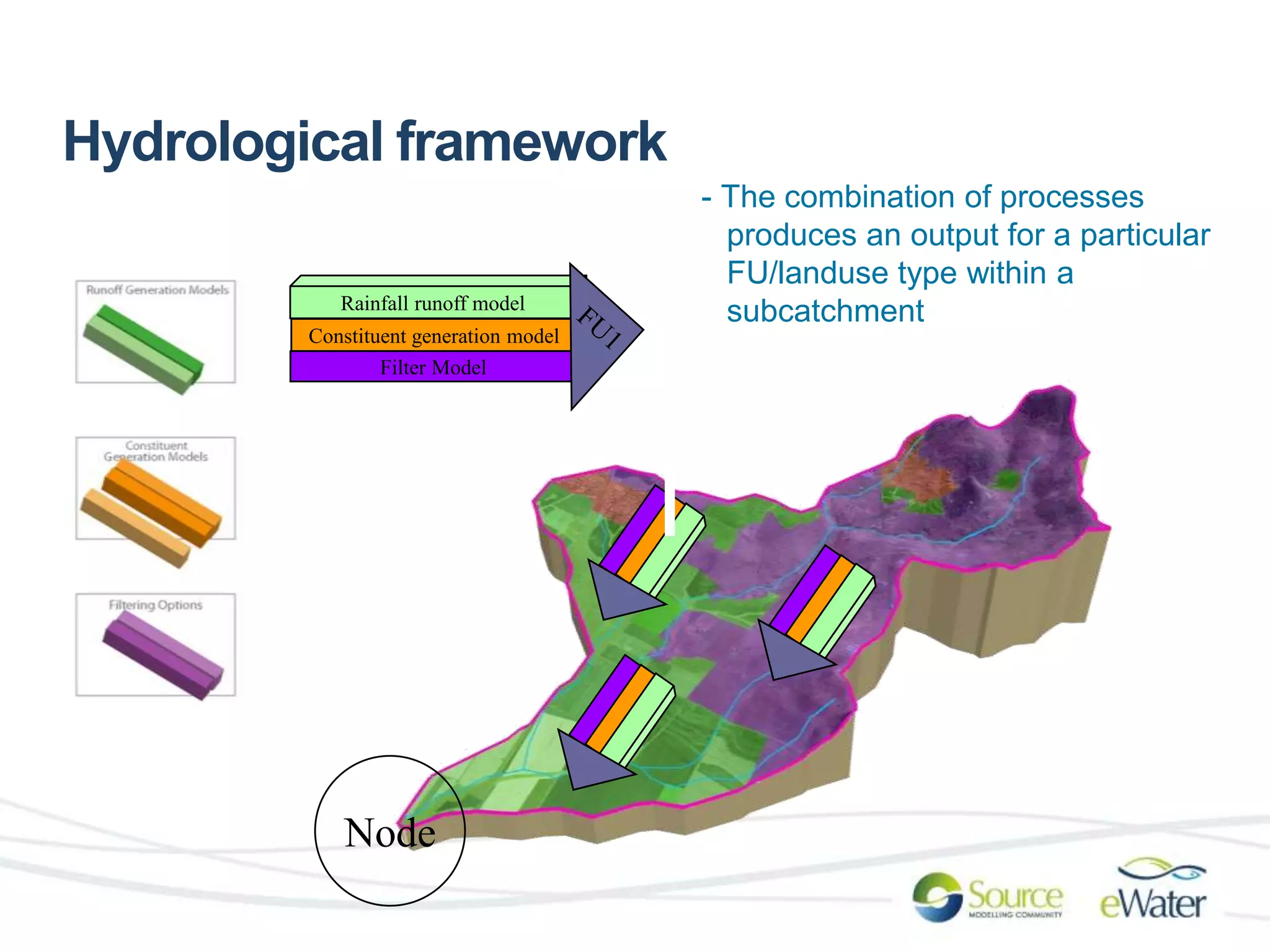
Hydrological framework 
Rainfall runoff model 
Constituent generation model 
Node 
- The combination of processes 
produces an output for a particular 
FU/landuse type within a 
subcatchment 
Filter Model
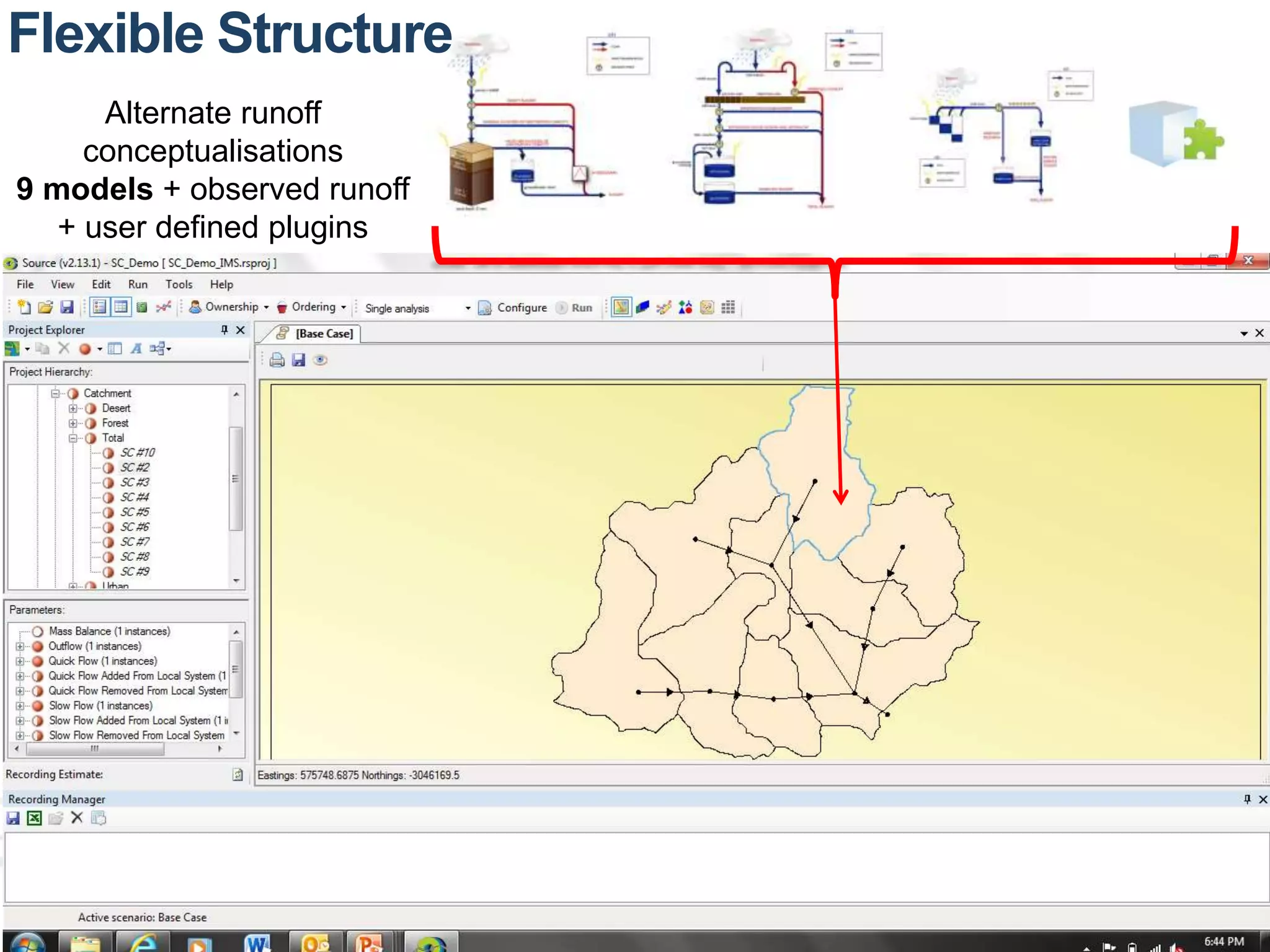
Flexible Structure 
Alternate runoff 
conceptualisations 
9 models + observed runoff 
+ user defined plugins
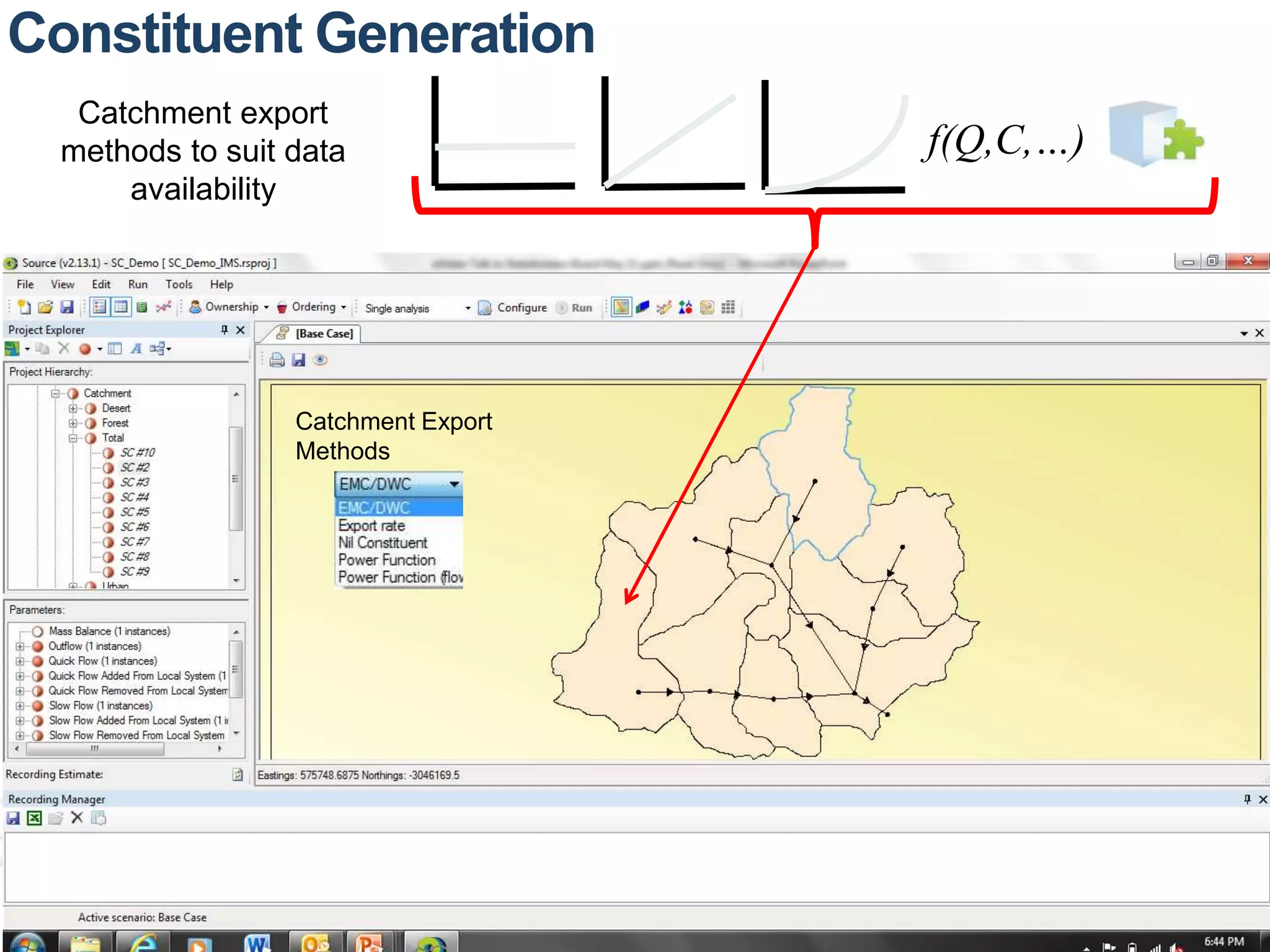
Constituent Generation 
Catchment export 
methods to suit data 
Catchment Export 
Methods 
availability 
f(Q,C,…)
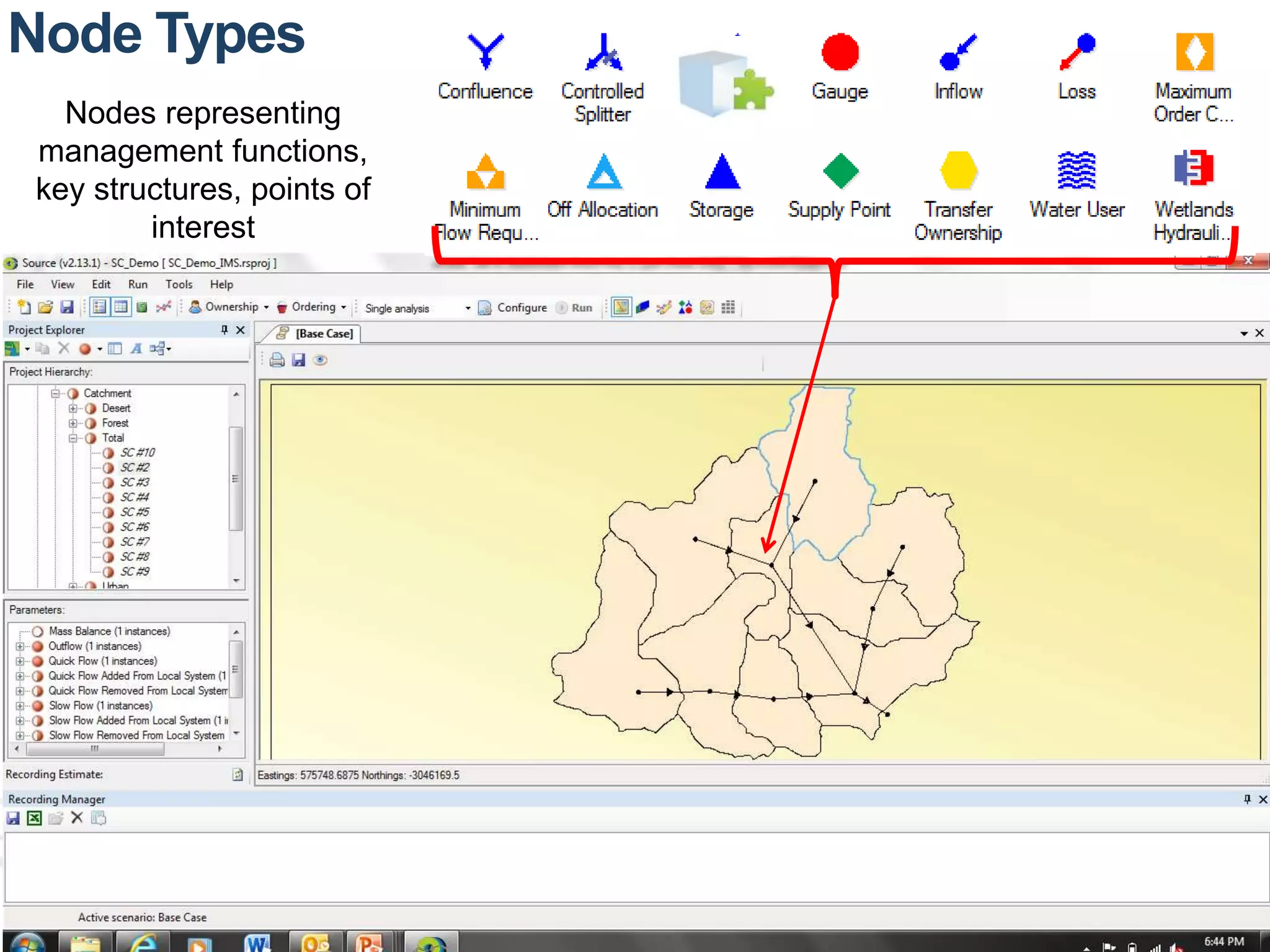
Node Types 
Nodes representing 
management functions, 
key structures, points of 
interest
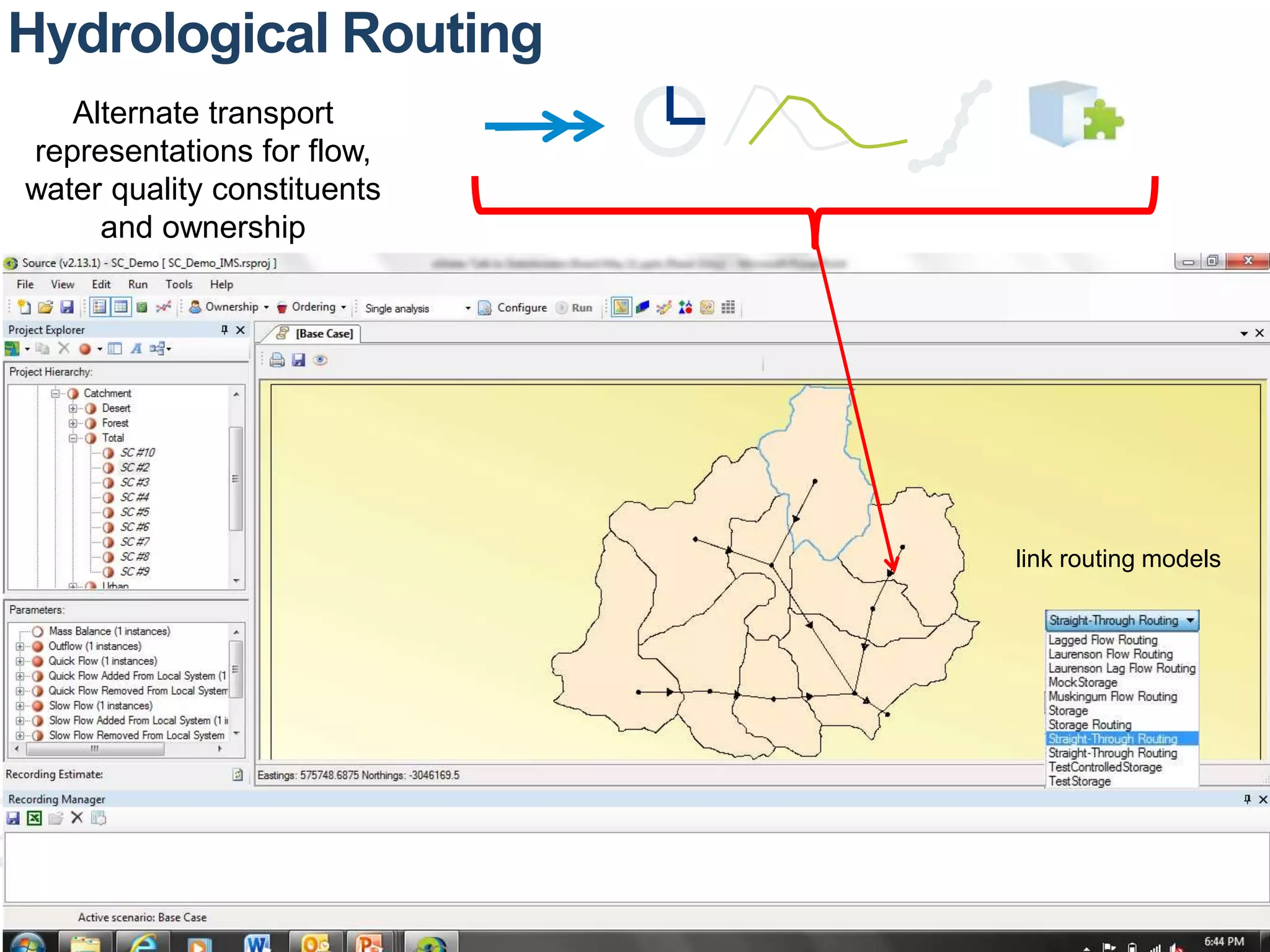
link routing models 
Hydrological Routing 
Alternate transport 
representations for flow, 
water quality constituents 
and ownership
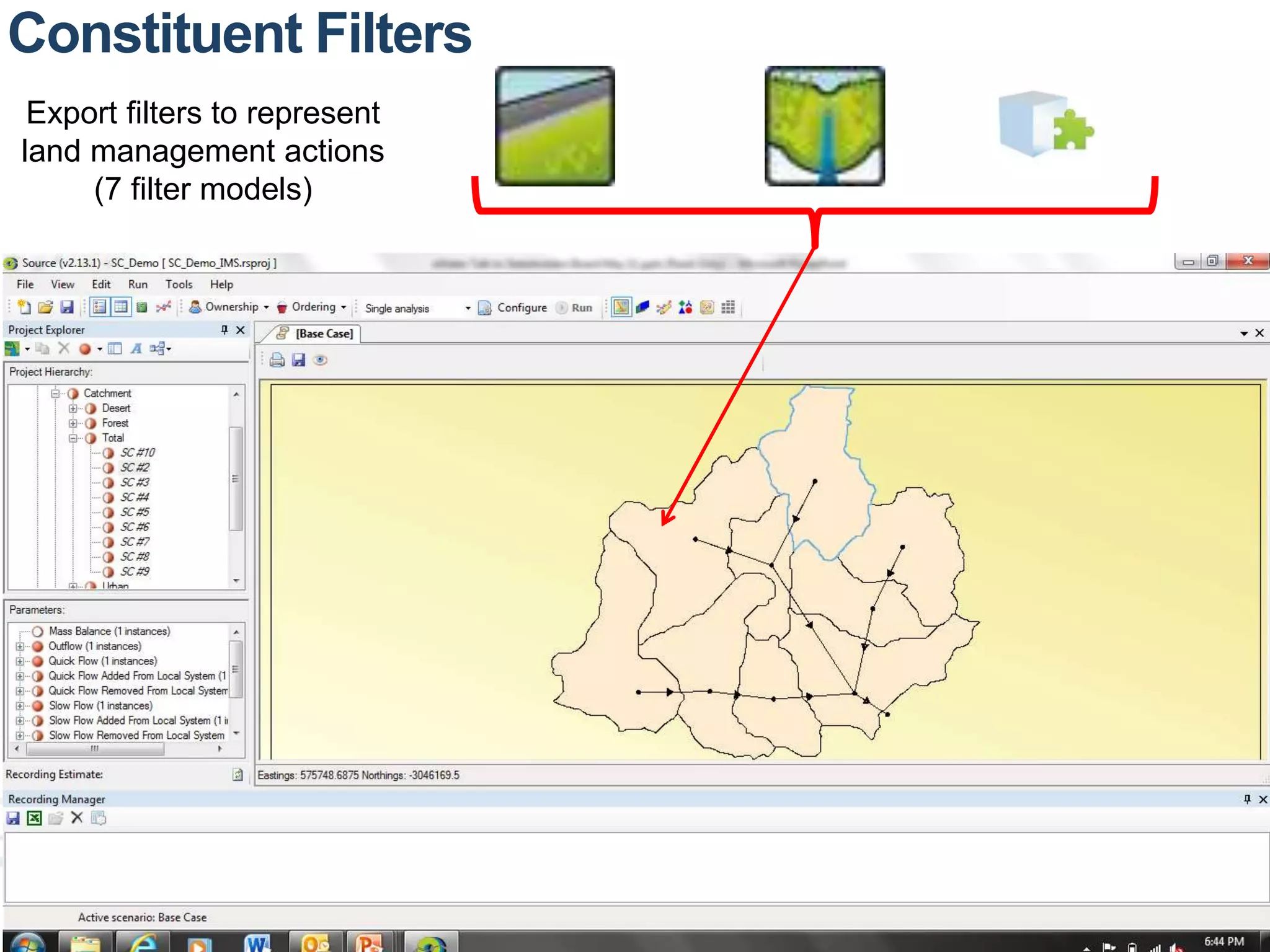
Constituent Filters 
Export filters to represent 
land management actions 
(7 filter models)
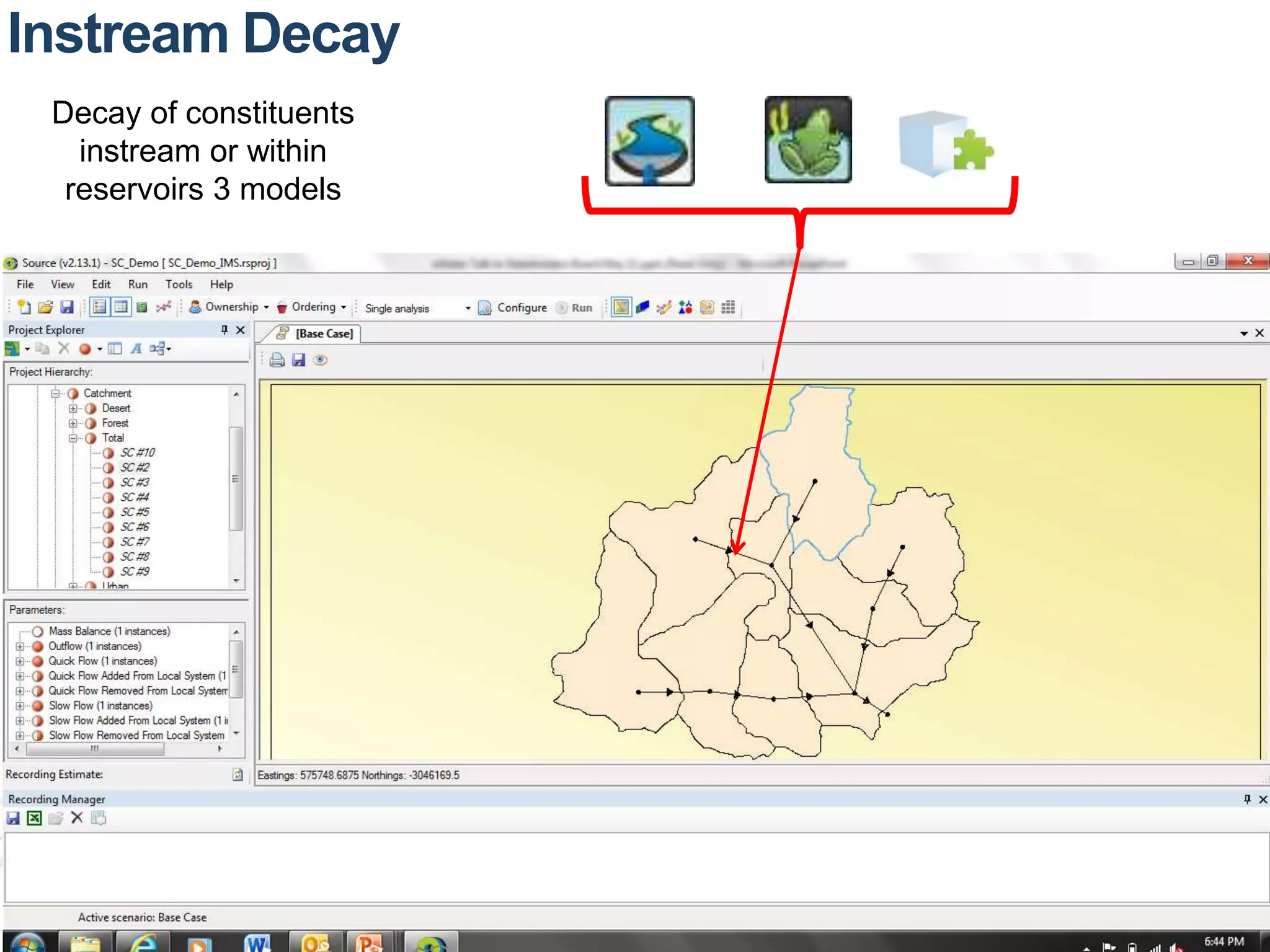
Instream Decay 
Decay of constituents 
instream or within 
reservoirs 3 models
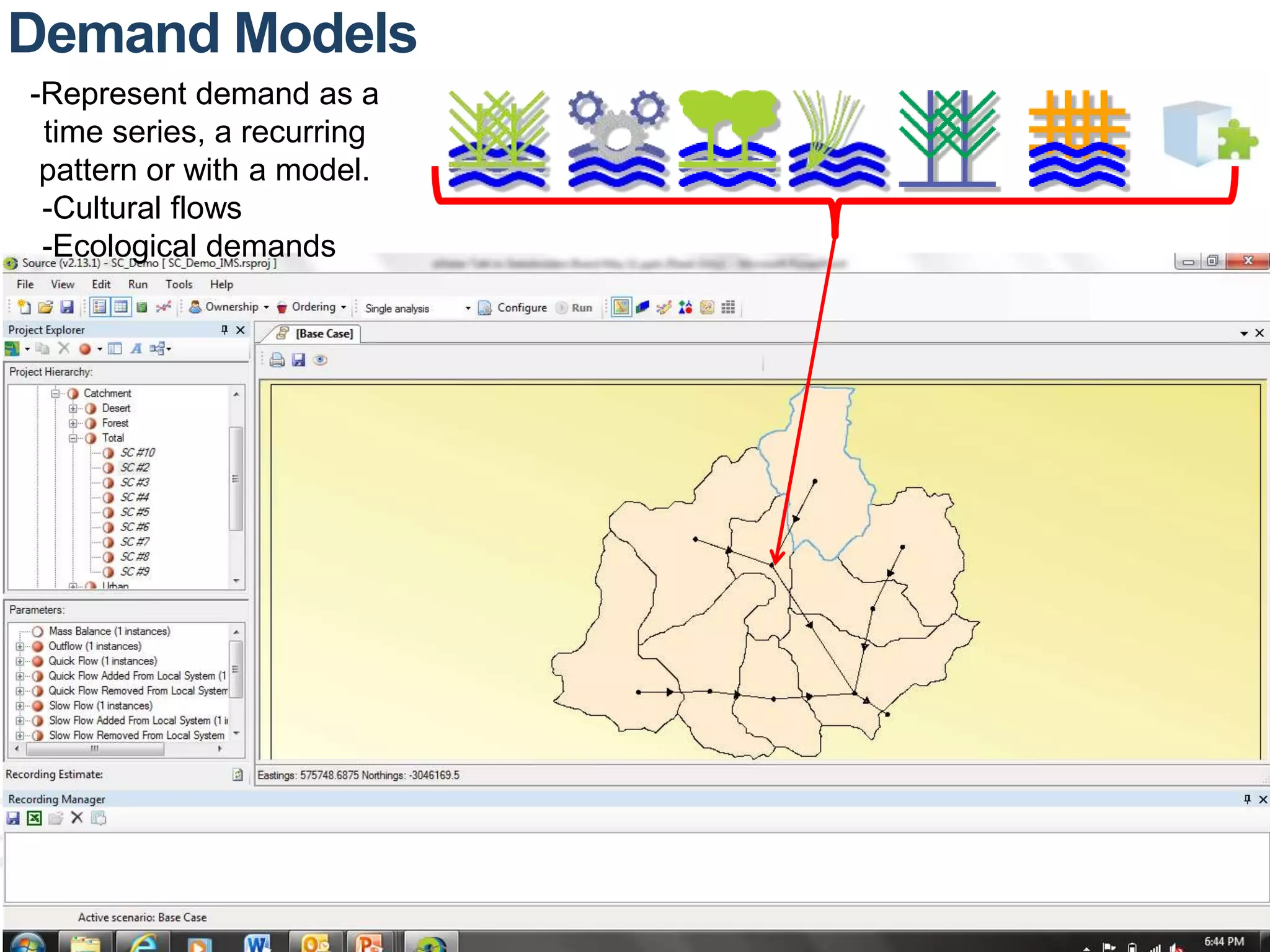
Demand Models 
-Represent demand as a 
time series, a recurring 
pattern or with a model. 
-Cultural flows 
-Ecological demands
Options for Customising Source 
1. Functions 
Powerful math and logic language built into Source (MS 
Excel-style formulae) 
2. Custom Functions 
User defined extensions to the Function Manager 
3. Plugins! 
Open ended system for changing the algorithms, user 
interface or operation of Source 
…
Options for Customising Source cont. 
4. External Scripting 
Batch runs, calibration, uncertainty analysis, links to other 
systems – models, FEWS 
5. Optimisation 
Multi-objective optimisation, trade-off analysis 
6. Run-time Configuration Changes 
Scenario analysis
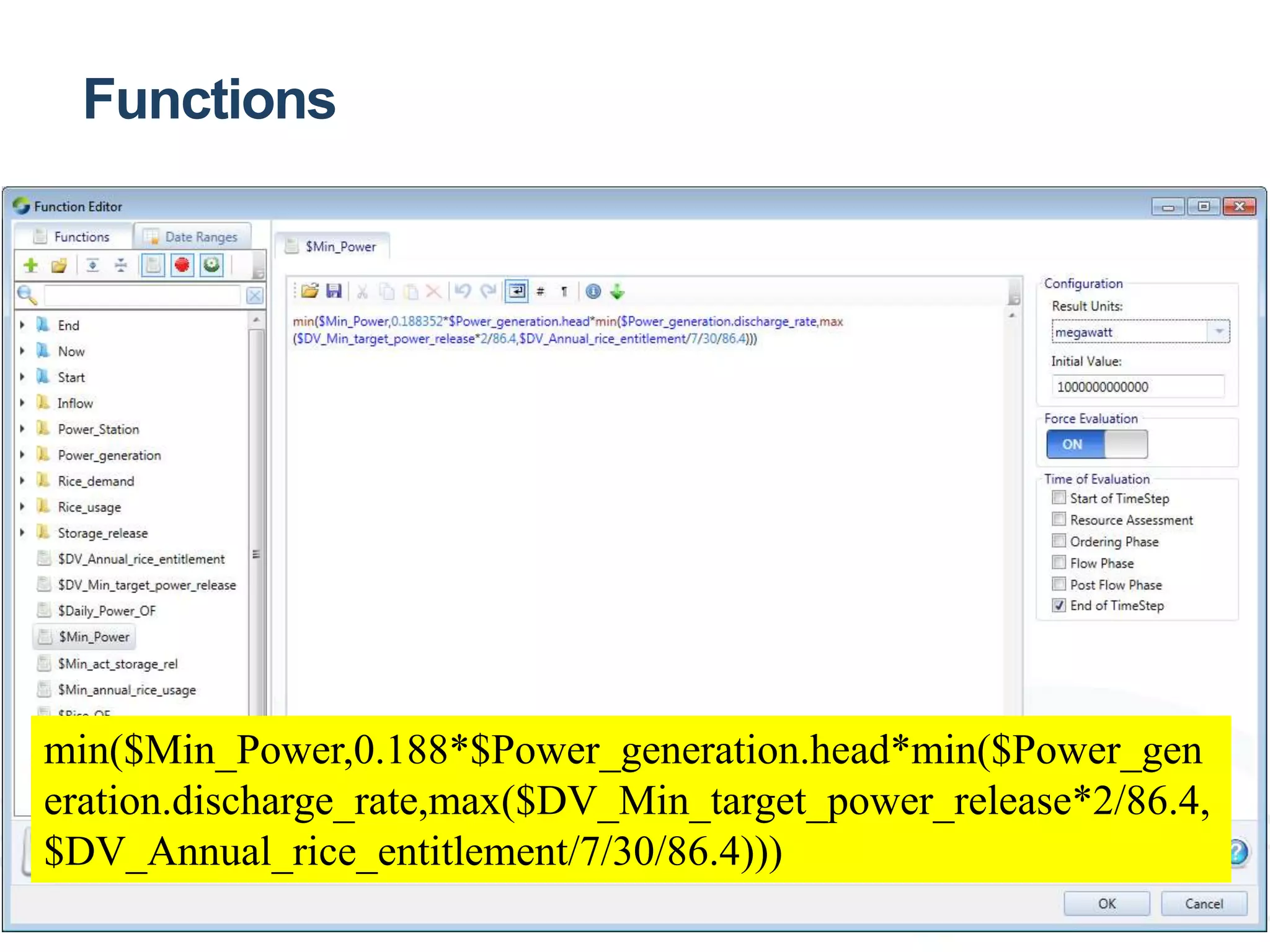
Functions 
Ability to calculate mathematical expressions within Source 
using system variables 
Has similar syntax to Excel 
Large set of common used functions (trigonomic, 
statistical, logical) 
Piecewise Linear, Patterns and Time of Evaluation 
Custom Functions 
Extend the language of the expression editor 
Reuse common logic 
Written in C# and loaded as a plugin
Functions 
Custom Functions 
min($Min_Power,0.188*$Power_generation.head*min($Power_gen 
eration.discharge_rate,max($DV_Min_target_power_release*2/86.4, 
$DV_Annual_rice_entitlement/7/30/86.4)))
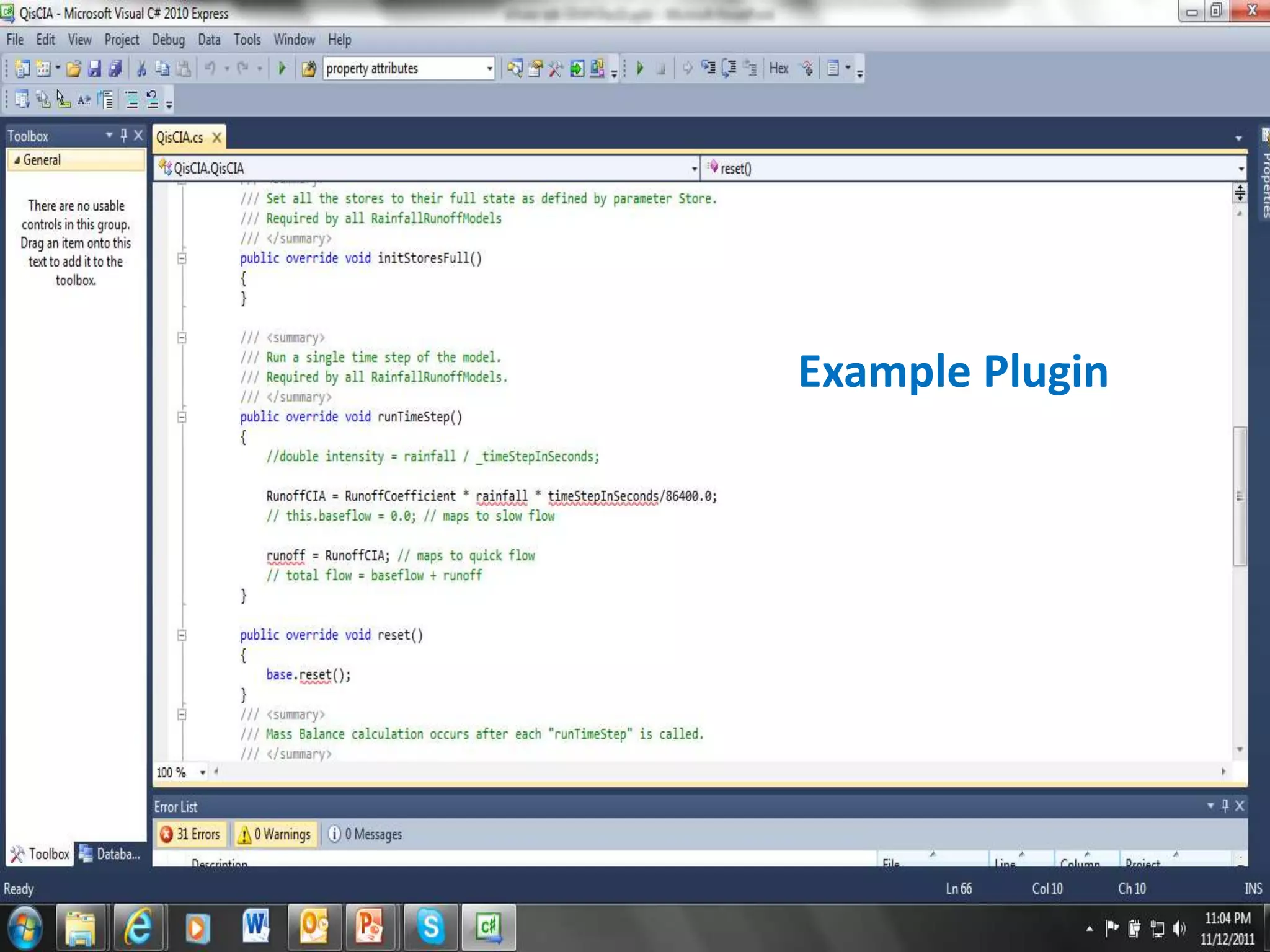
Plugins 
•Replacement component models (demand, runoff, routing, 
etc) 
•Provide a tailored user interface 
•Automate repetitive tasks, such as data pre processing, 
output report generation 
•Written in a .NET language such as C# or Visual Basic 
•Basic development tool set free of charge from Microsoft
Example Plugin
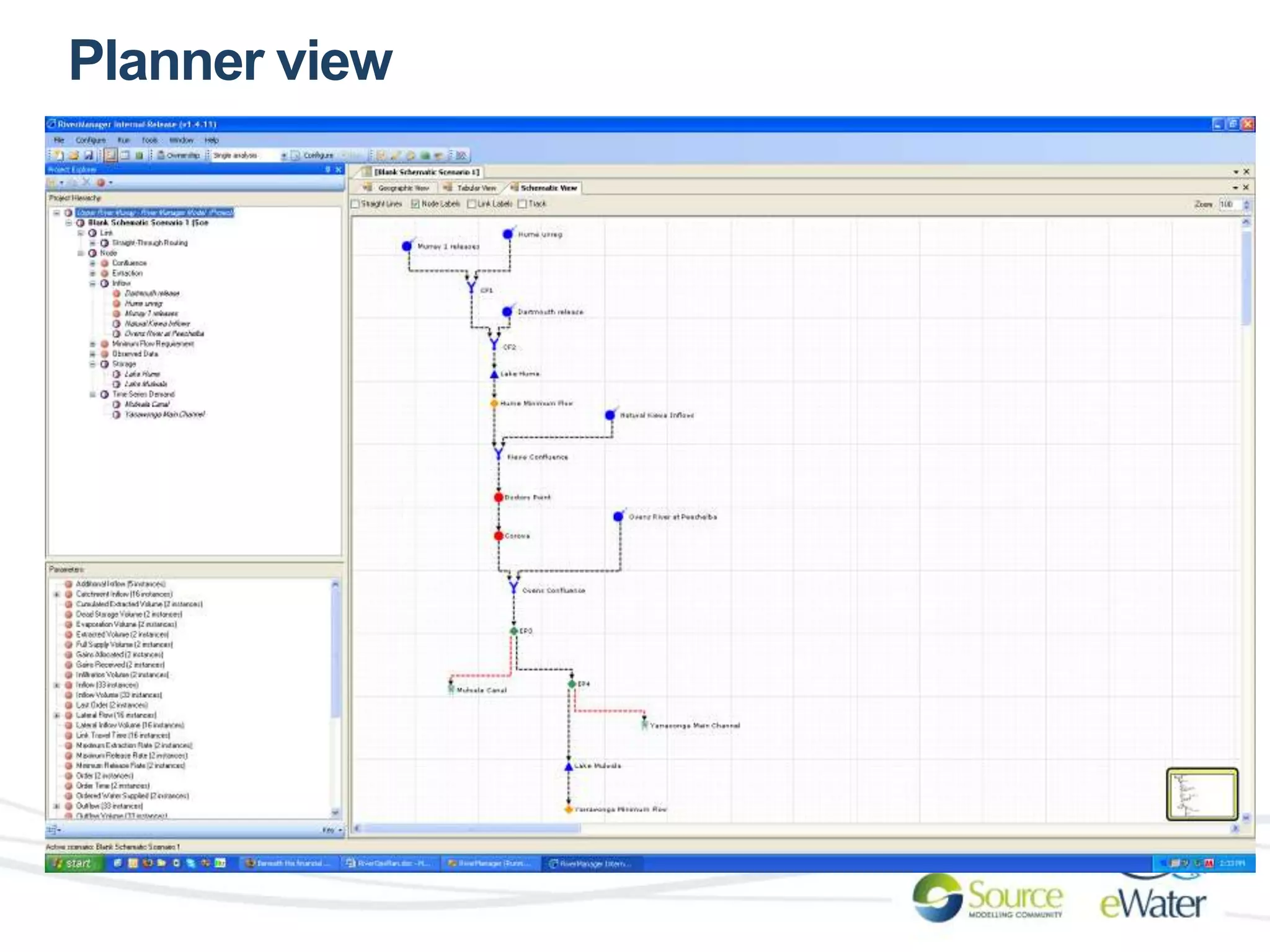
Planner view
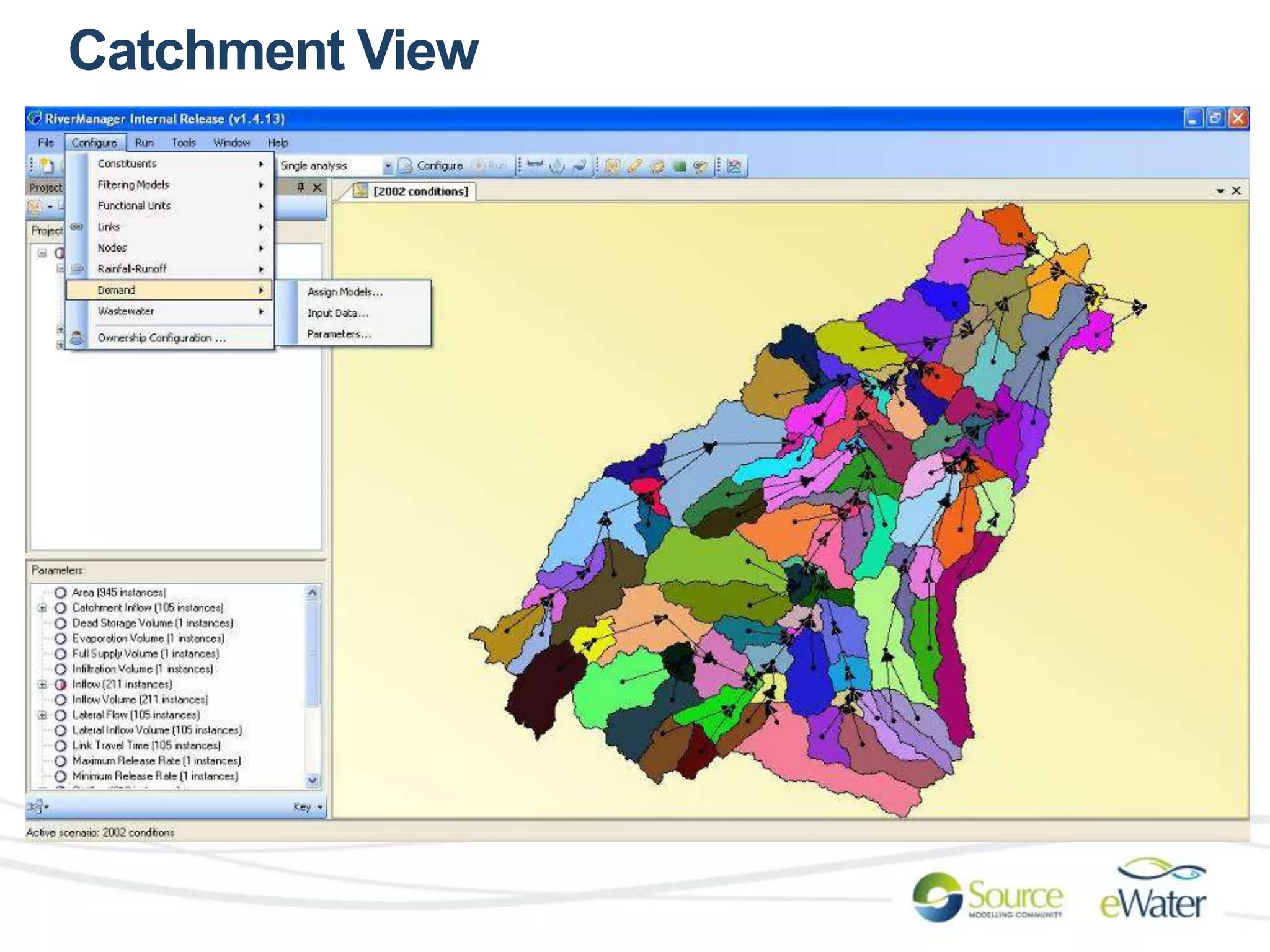
Catchment View
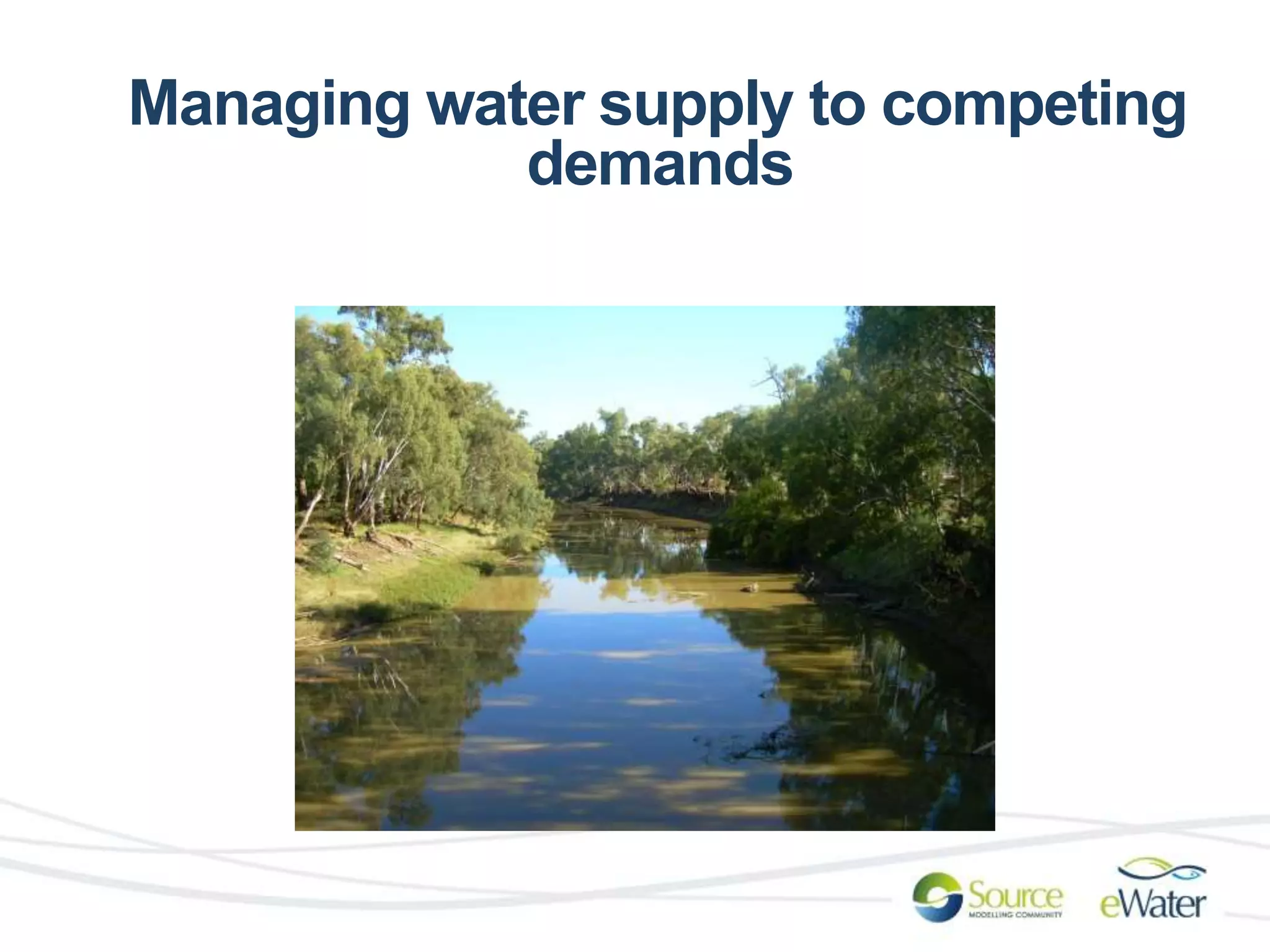
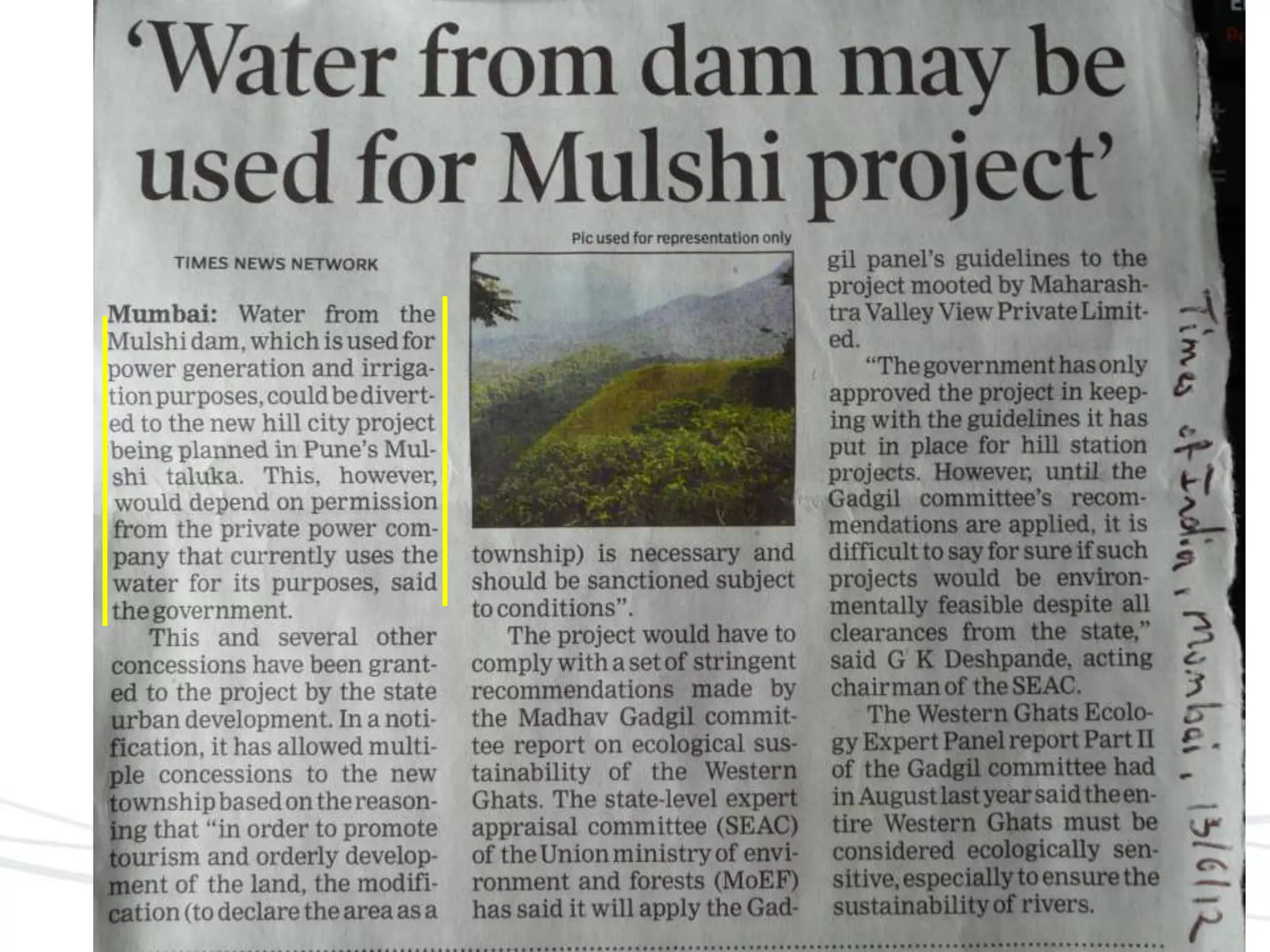
Managing water supply to competing 
demands
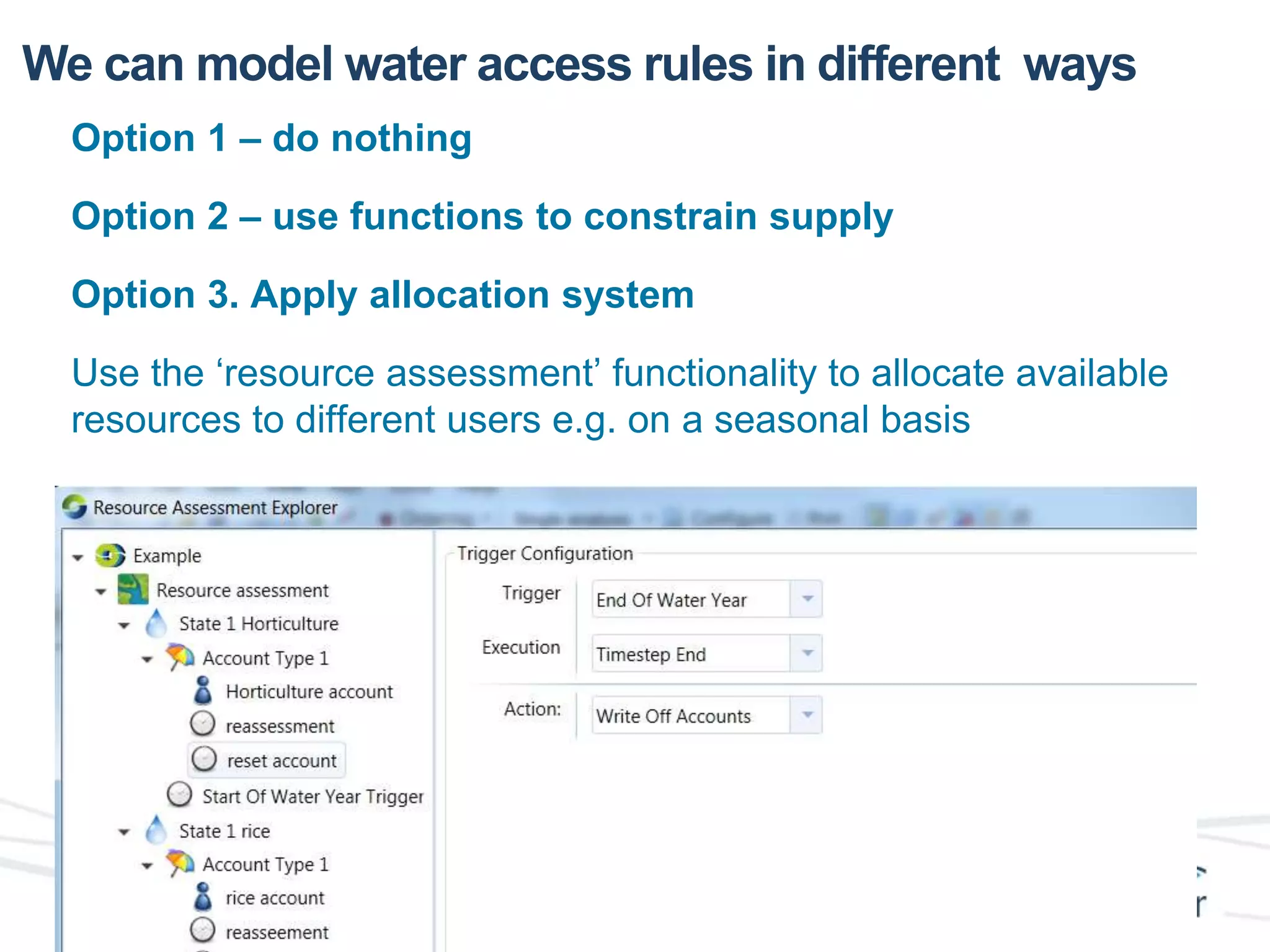
We can model water access rules in different ways 
Option 1 – do nothing 
Option 2 – use functions to constrain supply 
Option 3. Apply allocation system 
Use the ‘resource assessment’ functionality to allocate available 
resources to different users e.g. on a seasonal basis
Ways for modelling different water access rules 
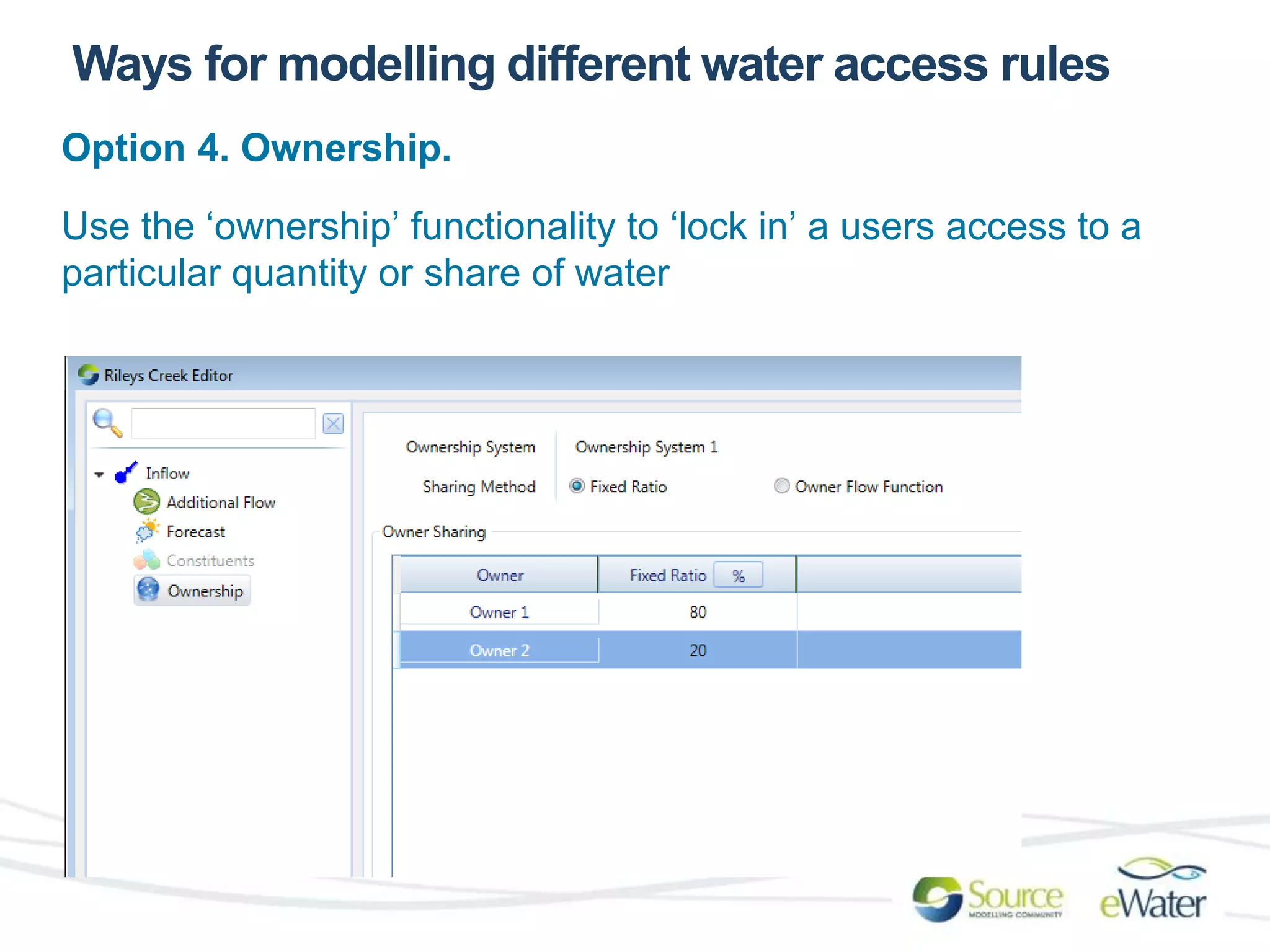
Option 4. Ownership. 
Use the ‘ownership’ functionality to ‘lock in’ a users access to a 
particular quantity or share of water
Groundwater/Surface Water 
Interaction
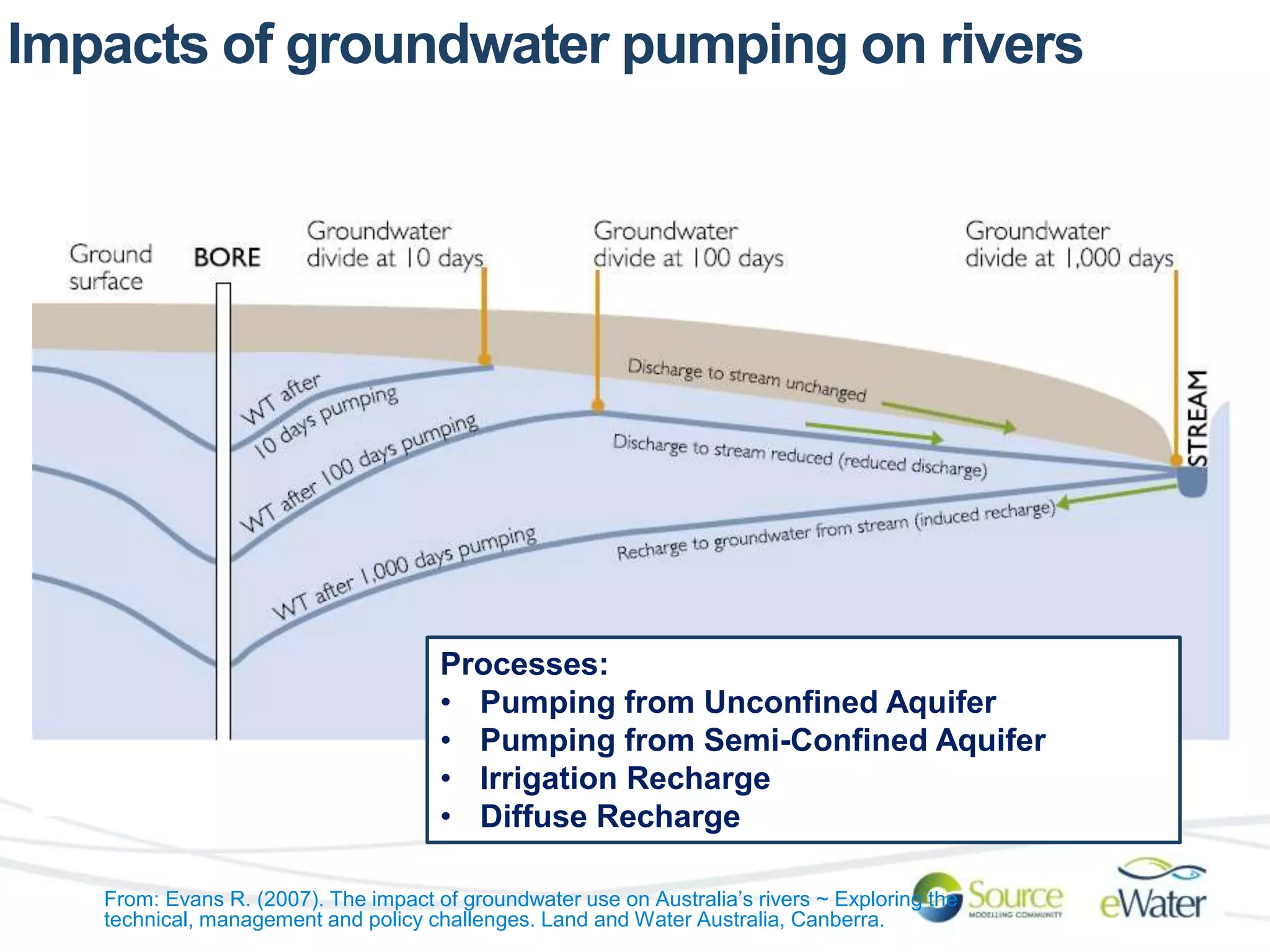
Impacts of groundwater pumping on rivers 
Processes: 
• Pumping from Unconfined Aquifer 
• Pumping from Semi-Confined Aquifer 
• Irrigation Recharge 
• Diffuse Recharge 
From: Evans R. (2007). The impact of groundwater use on Australia’s rivers ~ Exploring the 
technical, management and policy challenges. Land and Water Australia, Canberra.
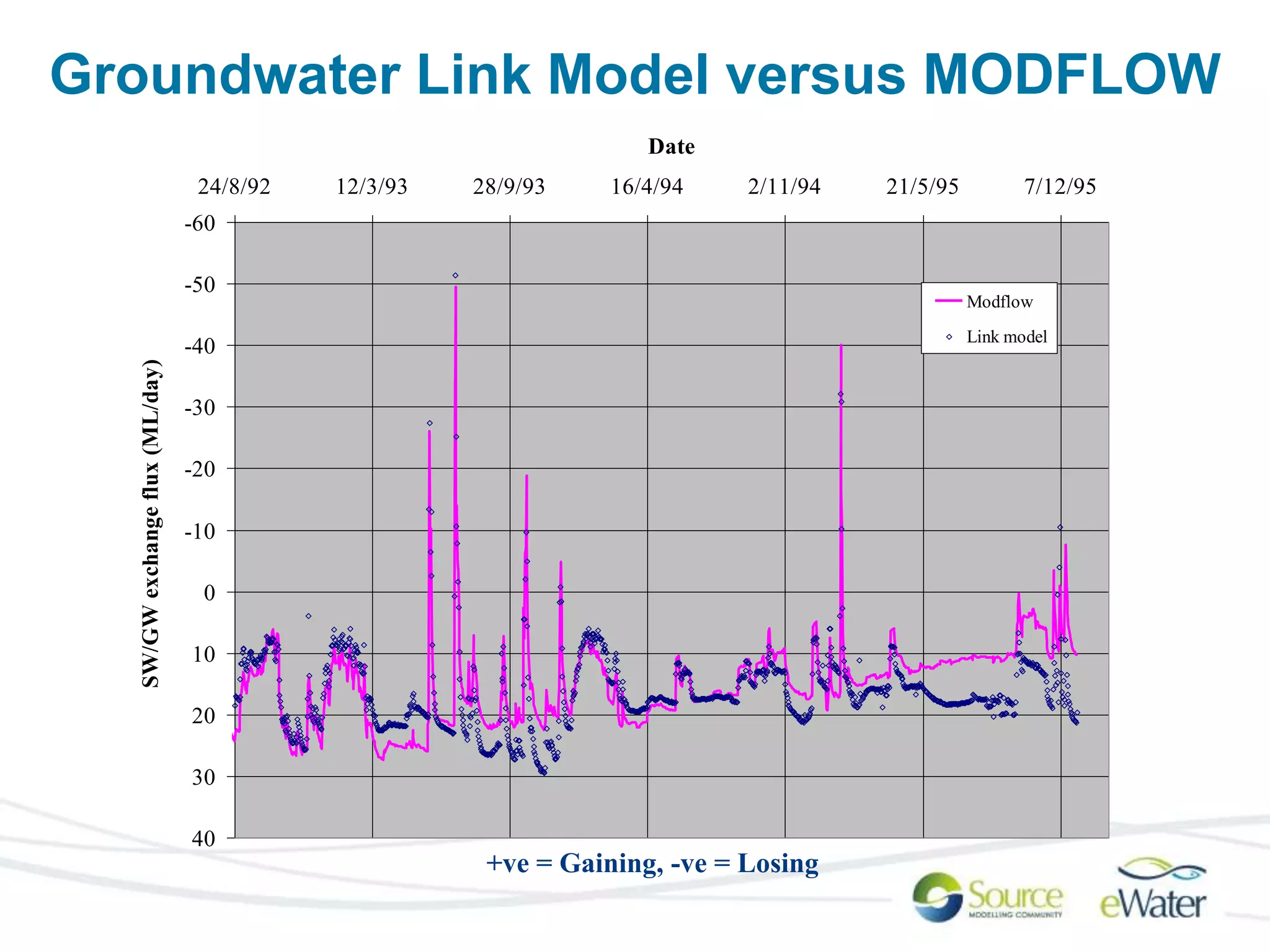
Groundwater Link Model versus MODFLOW 
24/8/92 12/3/93 28/9/93 16/4/94 2/11/94 21/5/95 7/12/95 
+ve = Gaining, -ve = Losing 
-60 
-50 
-40 
-30 
-20 
-10 
0 
10 
20 
30 
40 
Date 
SW/GW exchange flux (ML/day) 
Modflow 
Link model
The Source IWRM Platform 
• The freely available ‘Public Release’ is a fully featured 
IWRM platform 
• 330 downloads from 42 countries 
• Pricing for the full featured release, which also covers water 
markets, resource assessment etc. is targeted at 
commercial use 
• Under the Government to Government Agreement we can 
customise Source to the Indian context 
• The Australian Central and State governments are 
committed to Source. Source is being used for statutory 
WRM in Australia.
The Source IWRM Platform 
• Quality software engineering 
• Extensive unit tests 
• Hundreds of regression tests to ensure stability 
• User models are added to the regression test suite for assurance 
• Readily customisable for specific users – e.g. 
• Glacier, snowmelt 
• Resource assessment 
• Small catchment dams 
• GIS
Thank You!
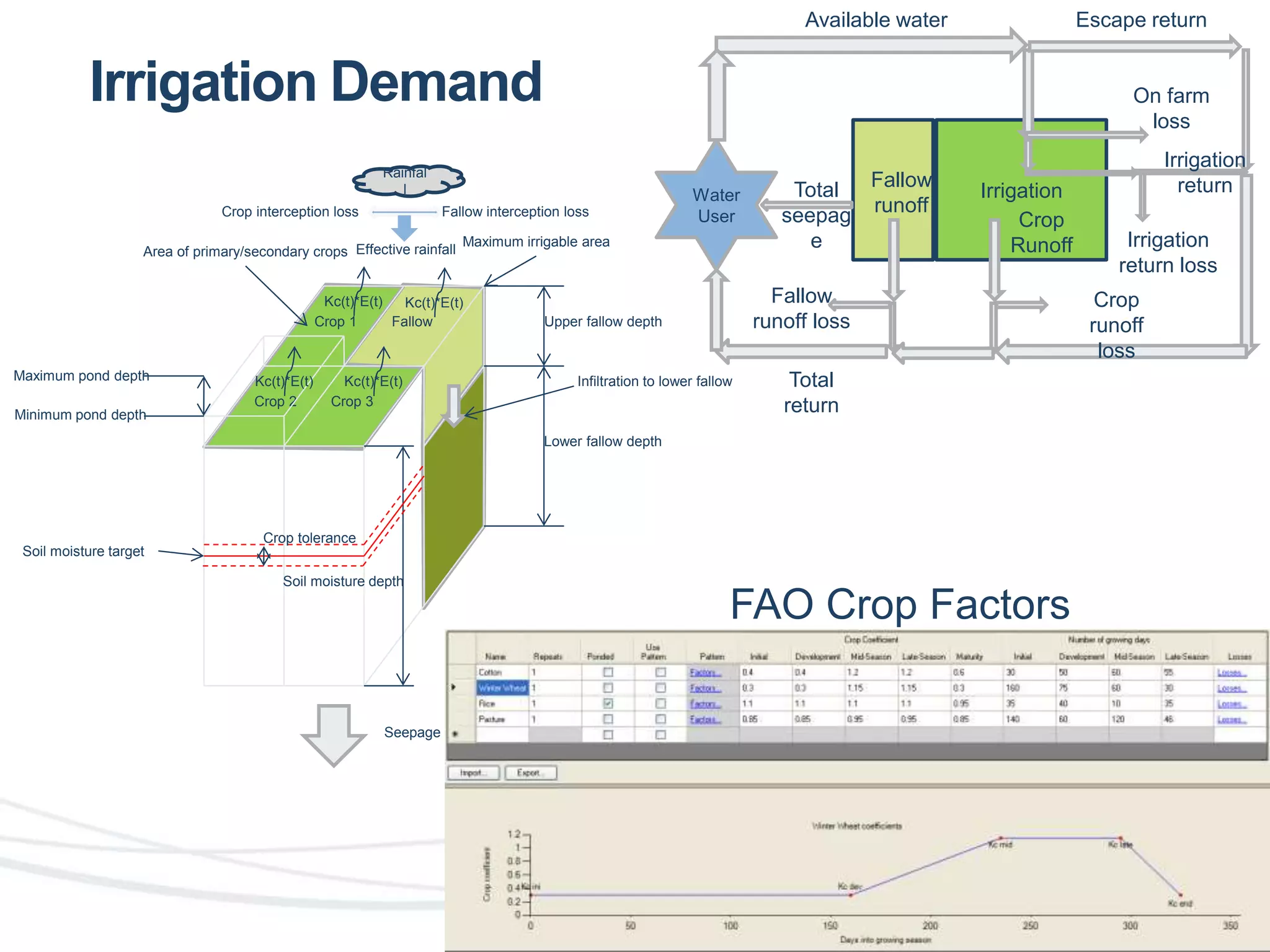
Irrigation Demand 
Crop interception loss Fallow interception loss 
Area of primary/secondary crops 
Effective rainfall 
Crop 1 
Crop 2 Crop 3 
Fallow 
Soil moisture depth 
Maximum irrigable area 
Upper fallow depth 
Irrigation 
return Water 
User 
Infiltration to lower fallow 
Lower fallow depth 
Seepage 
Maximum pond depth 
Soil moisture target 
Crop tolerance 
Minimum pond depth 
Rainfal 
l 
Kc(t)*E(t) Kc(t)*E(t) 
Available water Escape return 
Irrigation 
On farm 
loss 
Irrigation 
return loss 
Crop 
runoff 
loss 
Total 
seepag 
e 
Fallow 
runoff loss 
Fallow 
runoff 
Crop 
Runoff 
Total 
return 
FAO Crop Factors
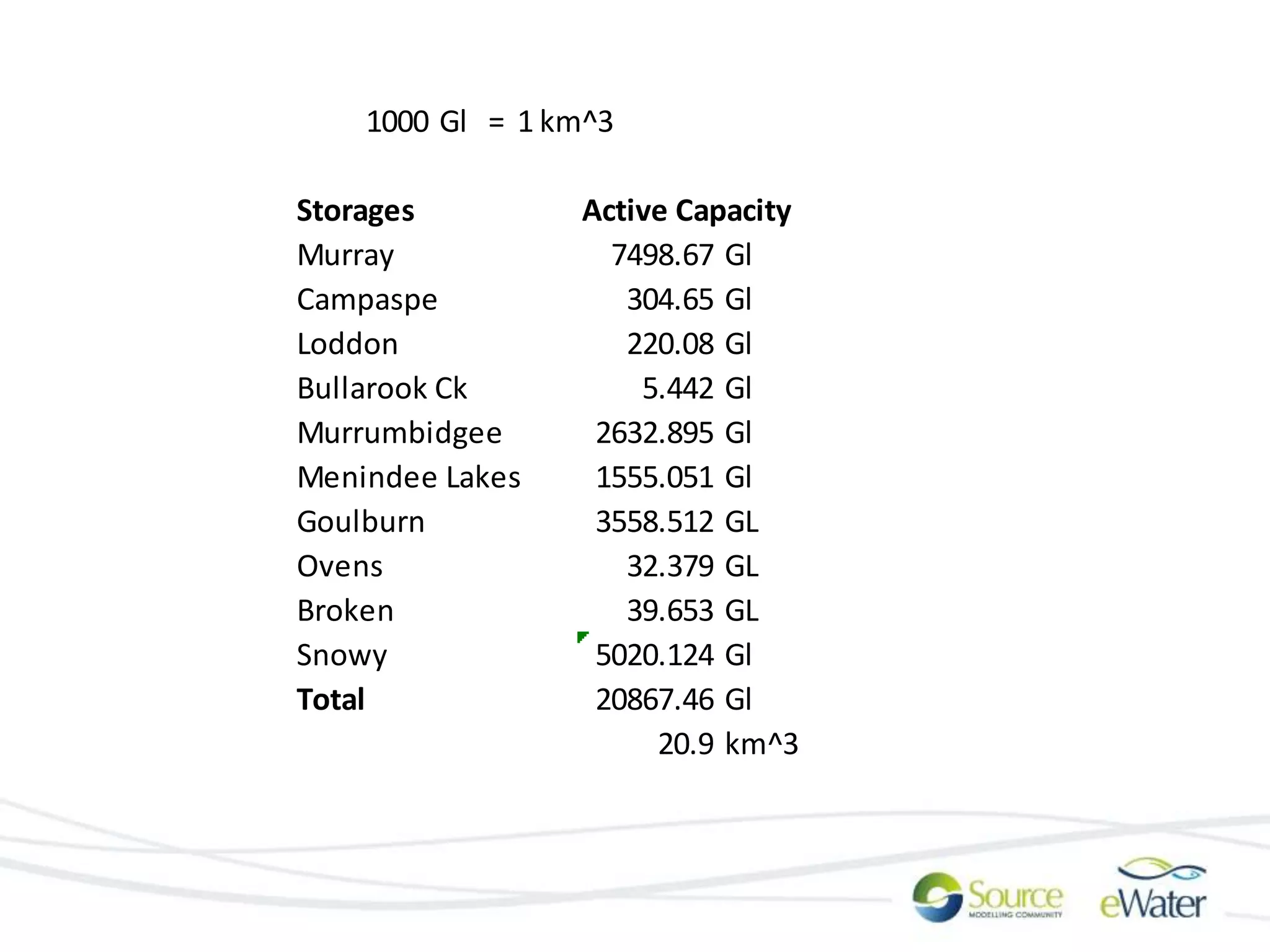
1000 Gl = 1 km^3 
Storages Active Capacity 
Murray 7498.67 Gl 
Campaspe 304.65 Gl 
Loddon 220.08 Gl 
Bullarook Ck 5.442 Gl 
Murrumbidgee 2632.895 Gl 
Menindee Lakes 1555.051 Gl 
Goulburn 3558.512 GL 
Ovens 32.379 GL 
Broken 39.653 GL 
Snowy 5020.124 Gl 
Total 20867.46 Gl 
20.9 km^3
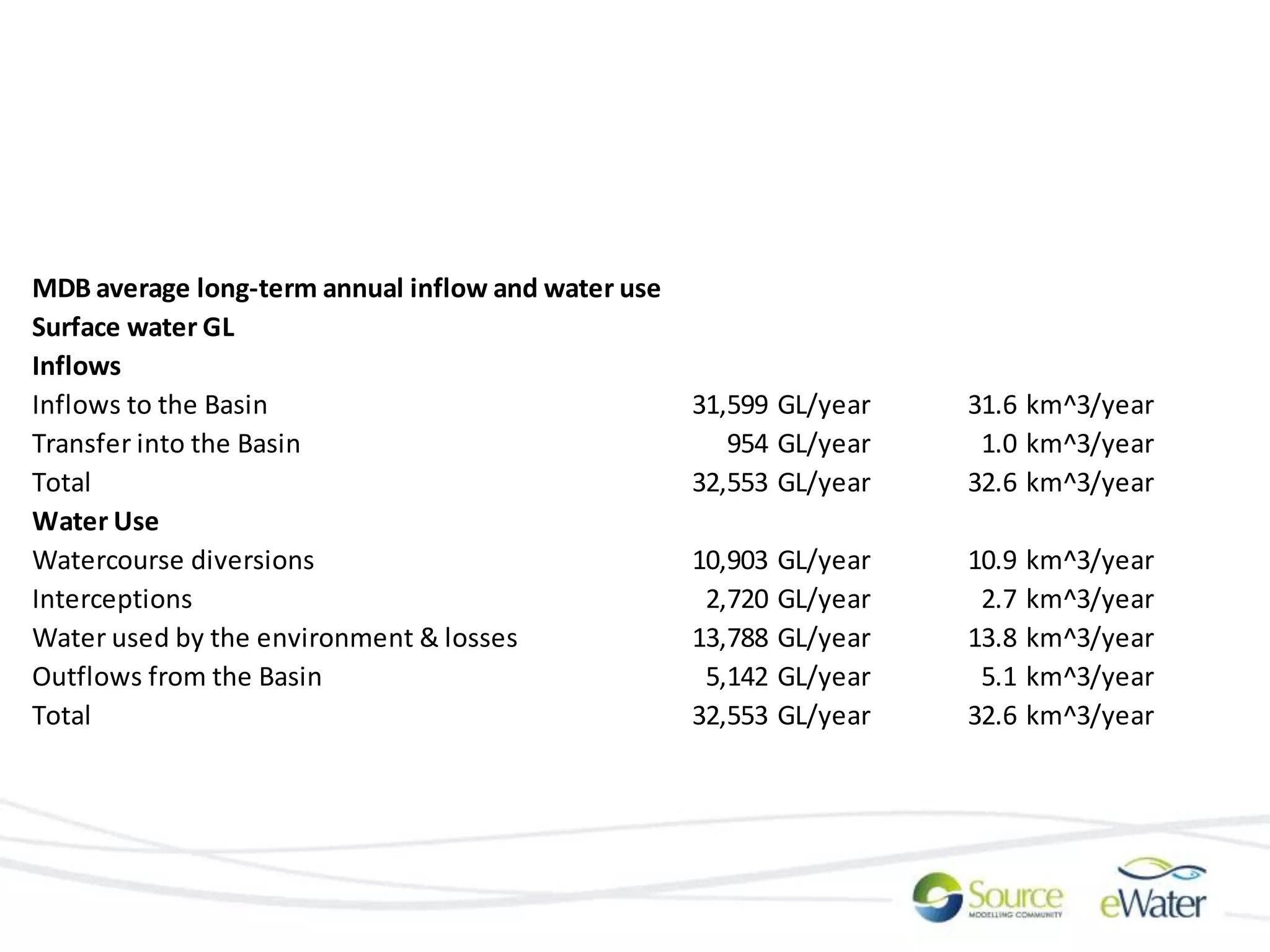
MDB average long-term annual inflow and water use 
Surface water GL 
Inflows 
Inflows to the Basin 31,599 GL/year 31.6 km^3/year 
Transfer into the Basin 954 GL/year 1.0 km^3/year 
Total 32,553 GL/year 32.6 km^3/year 
Water Use 
Watercourse diversions 10,903 GL/year 10.9 km^3/year 
Interceptions 2,720 GL/year 2.7 km^3/year 
Water used by the environment & losses 13,788 GL/year 13.8 km^3/year 
Outflows from the Basin 5,142 GL/year 5.1 km^3/year 
Total 32,553 GL/year 32.6 km^3/year

6 - eWater - General_SOURCE-Sep-16

  • 1.
    eWater Source Atthe Workshop on Modern Tools and Techniques for Water Resources Assessment and Management 16-17 September 2014, Imperial Hotel, New Delhi geoff.adams@ewater.com.au www.toolkit.ewater.com.au
  • 2.
    The Source IWRMPlatform ‘Catchment to Estuary’ water system modelling capability Runoff and constituent generation Transport through regulated and unregulated systems Urban and rural systems, including newer urban infrastructure options, crop demand and production models Ecological function (environmental watering demands, response models) Link with other models and systems, optimisation, the cloud Resource management, ownership, water markets Groundwater interaction
  • 3.
    Models are usedin developing and monitoring water management policy “We don’t do policy change without modeling it first …”
  • 4.
    eWater Ltd –our Current Owners Department of Sustainability and Environment Department of Environment and Resource Management
  • 5.
    Evolution of eWater Hydrological Tools & Methods 13 Years, 14 Partners, $50M River Ecology & Science 12 Years, 13 Partners, $50M COAG Reform Water Trading Introduced Frameworks to manage human and ecological use of water 6 years, 45 Partners, $160M National Water Initiative Creation of CEWH Environmental Water Principles 1992 1994 2004 2007 2012 2007 Water Act Empowers MDBA Best Available Science Legally Testable eWater Source National Hydrological Modeling Platform 1996
  • 6.
    eWater CRC -34 Industry & 11 Research Partners PUBLIC INDUSTRY CORPORATE INDUSTRY RESEARCH Department of Sustainability and Environment Department of Primary Industries Environmental Protection Agency (EPA) Victorian Catchment Management Authorities Department of Environment and Resource Management Queensland Primary Industries and Fisheries – Department of Employment, Economic Development and Innovation
  • 7.
    Source and BasinPlanning Environment, People Urban Irrigation Floods & Dry Water Quality Land Use and Agriculture Industry $ Environment, Services and People Climate Change Ground water Surface Understanding Water the System: Models Assess Options: Actions Policy Implementation Industry Energy Supply Food Production Urban Stake-holders:
  • 8.
    Integrated Modelling System for rural and urban water management Catchment & Rivers Urban Irrigation Ecology
  • 9.
    Ordering How muchwater to release from storage to meet downstream requirements. Taking into consideration: • Delivery time • The most efficient path • Supply constraints • Outlet constraints • Different supply reservoirs Based on two passes: • Constraint pass (top to bottom pass) • Ordering pass (bottom to top pass) Defined rules or network linear programming (RELAXIV or PPRN). Resource Assessment Constraints Order Up Deliver Down
  • 10.
    Hydrological framework Rainfallrunoff model Constituent generation model Node - The combination of processes produces an output for a particular FU/landuse type within a subcatchment Filter Model
  • 11.
    Flexible Structure Alternaterunoff conceptualisations 9 models + observed runoff + user defined plugins
  • 12.
    Constituent Generation Catchmentexport methods to suit data Catchment Export Methods availability f(Q,C,…)
  • 13.
    Node Types Nodesrepresenting management functions, key structures, points of interest
  • 14.
    link routing models Hydrological Routing Alternate transport representations for flow, water quality constituents and ownership
  • 15.
    Constituent Filters Exportfilters to represent land management actions (7 filter models)
  • 16.
    Instream Decay Decayof constituents instream or within reservoirs 3 models
  • 17.
    Demand Models -Representdemand as a time series, a recurring pattern or with a model. -Cultural flows -Ecological demands
  • 18.
    Options for CustomisingSource 1. Functions Powerful math and logic language built into Source (MS Excel-style formulae) 2. Custom Functions User defined extensions to the Function Manager 3. Plugins! Open ended system for changing the algorithms, user interface or operation of Source …
  • 19.
    Options for CustomisingSource cont. 4. External Scripting Batch runs, calibration, uncertainty analysis, links to other systems – models, FEWS 5. Optimisation Multi-objective optimisation, trade-off analysis 6. Run-time Configuration Changes Scenario analysis
  • 20.
    Functions Ability tocalculate mathematical expressions within Source using system variables Has similar syntax to Excel Large set of common used functions (trigonomic, statistical, logical) Piecewise Linear, Patterns and Time of Evaluation Custom Functions Extend the language of the expression editor Reuse common logic Written in C# and loaded as a plugin
  • 21.
    Functions Custom Functions min($Min_Power,0.188*$Power_generation.head*min($Power_gen eration.discharge_rate,max($DV_Min_target_power_release*2/86.4, $DV_Annual_rice_entitlement/7/30/86.4)))
  • 22.
    Plugins •Replacement componentmodels (demand, runoff, routing, etc) •Provide a tailored user interface •Automate repetitive tasks, such as data pre processing, output report generation •Written in a .NET language such as C# or Visual Basic •Basic development tool set free of charge from Microsoft
  • 23.
  • 24.
  • 25.
  • 26.
    Managing water supplyto competing demands
  • 28.
    We can modelwater access rules in different ways Option 1 – do nothing Option 2 – use functions to constrain supply Option 3. Apply allocation system Use the ‘resource assessment’ functionality to allocate available resources to different users e.g. on a seasonal basis
  • 29.
    Ways for modellingdifferent water access rules Option 4. Ownership. Use the ‘ownership’ functionality to ‘lock in’ a users access to a particular quantity or share of water
  • 30.
  • 31.
    Impacts of groundwaterpumping on rivers Processes: • Pumping from Unconfined Aquifer • Pumping from Semi-Confined Aquifer • Irrigation Recharge • Diffuse Recharge From: Evans R. (2007). The impact of groundwater use on Australia’s rivers ~ Exploring the technical, management and policy challenges. Land and Water Australia, Canberra.
  • 32.
    Groundwater Link Modelversus MODFLOW 24/8/92 12/3/93 28/9/93 16/4/94 2/11/94 21/5/95 7/12/95 +ve = Gaining, -ve = Losing -60 -50 -40 -30 -20 -10 0 10 20 30 40 Date SW/GW exchange flux (ML/day) Modflow Link model
  • 33.
    The Source IWRMPlatform • The freely available ‘Public Release’ is a fully featured IWRM platform • 330 downloads from 42 countries • Pricing for the full featured release, which also covers water markets, resource assessment etc. is targeted at commercial use • Under the Government to Government Agreement we can customise Source to the Indian context • The Australian Central and State governments are committed to Source. Source is being used for statutory WRM in Australia.
  • 34.
    The Source IWRMPlatform • Quality software engineering • Extensive unit tests • Hundreds of regression tests to ensure stability • User models are added to the regression test suite for assurance • Readily customisable for specific users – e.g. • Glacier, snowmelt • Resource assessment • Small catchment dams • GIS
  • 35.
  • 36.
    Irrigation Demand Cropinterception loss Fallow interception loss Area of primary/secondary crops Effective rainfall Crop 1 Crop 2 Crop 3 Fallow Soil moisture depth Maximum irrigable area Upper fallow depth Irrigation return Water User Infiltration to lower fallow Lower fallow depth Seepage Maximum pond depth Soil moisture target Crop tolerance Minimum pond depth Rainfal l Kc(t)*E(t) Kc(t)*E(t) Kc(t)*E(t) Kc(t)*E(t) Available water Escape return Irrigation On farm loss Irrigation return loss Crop runoff loss Total seepag e Fallow runoff loss Fallow runoff Crop Runoff Total return FAO Crop Factors
  • 37.
    1000 Gl =1 km^3 Storages Active Capacity Murray 7498.67 Gl Campaspe 304.65 Gl Loddon 220.08 Gl Bullarook Ck 5.442 Gl Murrumbidgee 2632.895 Gl Menindee Lakes 1555.051 Gl Goulburn 3558.512 GL Ovens 32.379 GL Broken 39.653 GL Snowy 5020.124 Gl Total 20867.46 Gl 20.9 km^3
  • 38.
    MDB average long-termannual inflow and water use Surface water GL Inflows Inflows to the Basin 31,599 GL/year 31.6 km^3/year Transfer into the Basin 954 GL/year 1.0 km^3/year Total 32,553 GL/year 32.6 km^3/year Water Use Watercourse diversions 10,903 GL/year 10.9 km^3/year Interceptions 2,720 GL/year 2.7 km^3/year Water used by the environment & losses 13,788 GL/year 13.8 km^3/year Outflows from the Basin 5,142 GL/year 5.1 km^3/year Total 32,553 GL/year 32.6 km^3/year