Group III
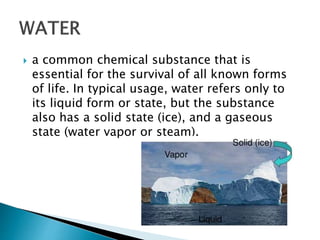
 a common chemical substance that is 
essential for the survival of all known forms 
of life. In typical usage, water refers only to 

its liquid form or state, but the substance 
also has a solid state (ice), and a gaseous 
state (water vapor or steam).
 Water resources are sources of water that are 
useful or potentially useful. Uses of water 
include agricultural, industrial, household, 
recreational and environmental activities. The 
majority of human uses require fresh water.
 Water is widely distributed on Earth as 
freshwater and salt water in the oceans. The 
Earth is often referred to as the "blue planet" 
because when viewed from space it appears 
blue. This blue color is caused by reflection 
from the oceans which cover roughly 71% of 
the area of the Earth.
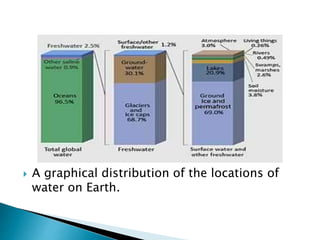
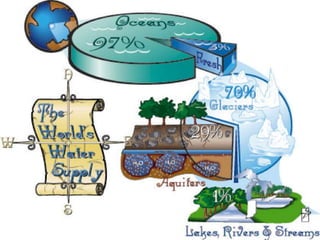
 97% of the water on the Earth is salt water. 
Only three percent is fresh water; slightly 
over two thirds of this is frozen in glaciers 
and polar ice caps. The remaining unfrozen 
freshwater is found mainly as groundwater, 
with only a small fraction present above 
ground or in the air.
 A graphical distribution of the locations of 
water on Earth.
 Rain Water 
- collects on the earth in the form of 
surface water and underground water.
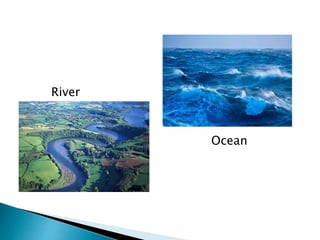
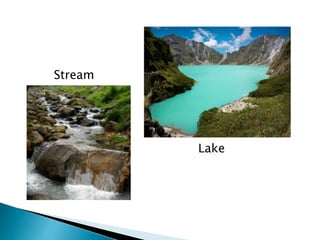
 Surface Water 
- Water present on the surface of the 
earth in the form of oceans, rivers, lakes, 
ponds and streams is called surface water. 
The water in rivers and lakes comes from rain 
and melting of snow on mountains. Rivers 
flow into the sea.
River 
Ocean
Stream 
Lake
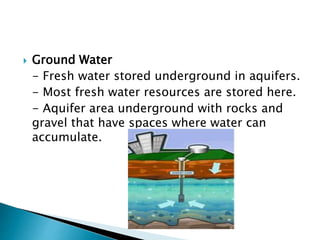
 Ground Water 
- Fresh water stored underground in aquifers. 
- Most fresh water resources are stored here. 
- Aquifer area underground with rocks and 
gravel that have spaces where water can 
accumulate.
 Rainfall depths for specific durations and 
streamflow peaks occurring during long 
period of time are stochastic variables and 
can be analyzed as such. Statistical and 
probabilistic analyses allow the development 
of probability statements or estimates related 
to the magnitude of certain events.
 For the programming of irrigation supply and 
simulation of irrigation management 
conditions, the concept of dependable rainfall 
is often employed. Dependable rainfall is 
defined as the amount of rainfall which can 
be exceeded over a given location for a fixed 
number of years out of given total number of 
years.
 For instance, the 80% dependable rainfall is 
normally used in calculating the capacity of 
storage reservoirs and of main irrigation 
canals. This dependable monthly or annual 
rainfall is the value that will be exceeded on 
the average four out of five years that is with 
a probability of exceedance of 80%. For 
drainage projects, the 20% dependable 
rainfall is usually adopted.
 The rainfall in a given period is considered 
normal if the rainfall that fell within the 
period is 50% dependable, i.e., it will be 
exceeded on the average every other year.
 Streamflow records may be extended in time 
for purpose other than curve improvement. A 
mean for some past month or year may be 
needed. This can be obtained by simple 
regression or by regression models with both 
streamflow and precipitation as independent 
variables.
 Schneider (1961), Riggs (1964) and Martin 
(1964) proposed and evaluated several 
models for estimating monthly mean 
discharges for months outside the period of 
record from discharge at a nearby gauged 
site and from the monthly precipitation totals 
on the two sites. Carroon (1970) extended 
monthly flow records at many sites in the 
upper Colorado River basin by a graphical 
method. The reliability of such a regression 
estimate is indicated by the standard error.
 Rainfall-runoff models which can account for 
the detailed disposition of rainfall may be 
used to extend streamflow records. These 
may be regression models in which runoff is 
related to storm magnitude, storm duration, 
and an index of antecedent soil moisture or 
digital computer models which model the 
land phase of the hydrologic cycle. Both types 
of models require several years of concurrent 
streamflow and hourly precipitation records 
for calibration their output.
 Surface water and groundwater are not 
isolated components of the hydrologic 
system, but instead interact in a variety 
of physiographic and climatic 
landscapes. Thus, development or 
contamination of one commonly affects 
the other.
 Groundwater is a hidden resource. At one 
time, its purity and availability were taken for 
granted. 
 Groundwater is the water that saturates the 
tiny spaces between alluvial material (sand, 
gravel, silt, clay) or the crevices of fractures in 
rocks.
 Scientists estimate groundwater accounts for 
more than 95% of all fresh water available for 
use. 
 Approximately 50% of Americans obtain all or 
part of their drinking water from 
groundwater. 
 Nearly 95% of rural residents rely on 
groundwater for their drinking supply.
 About half of irrigated cropland uses 
groundwater. 
 Approximately one third of industrial water 
needs are fulfilled by using groundwater. 
 About 40% of river flow nationwide (on 
average) depends on groundwater.
 The source of groundwater (recharge) is 
through precipitation or surface water that 
percolates downward. Approximately 5-50% 
(depending on climate, land use and many 
other factors) of annual precipitation results 
in groundwater recharge.
 Losing streams. 
In some areas, streams literally recharge 
the aquifer through stream bed infiltration. 
These are called losing streams.
 One of the most commonly used forms of 
groundwater comes from unconfined shallow 
water table aquifers. 
 These aquifers are major sources of drinking 
and irrigation water. They also interact 
closely with streams, sometimes flowing 
(discharging) water into a stream or lake and 
sometimes receiving water from the stream 
or lake.
 Gaining streams. 
 An unconfined aquifer that feeds 
streams provides the stream’s base flow. This 
is called a gaining stream. In fact, 
groundwater can be responsible for 
maintaining the hydrologic balance of surface 
streams, springs, lakes, wetlands, and 
marshes. This is why successful watershed 
partnerships take a special interest in the 
unconfined aquifer adjacent to the stream, 
lake or other surface water body.
 Left untouched, groundwater naturally 
achieves balance—discharging and 
recharging—depending on hydrologic 
conditions. In fact, some streams are gaining 
streams at times and losing streams at other 
times.
 Water Quality in the Philippines 
◦ Water quality protection and operation and 
maintenance of sanitation facilities are a 
collaborative undertaking of the Department 
of Environment and Natural Resources 
(DENR) through the Environmental 
Management Bureau (EMB), Department of 
Health (DOH), Department of Works and 
Sewerage System (DWSS).
 The Philippine government aims to maintain 
the quality of its surface waters according to 
their best beneficial use. This is embodied in 
the DENR Administrative Order (DAO) No. 34, 
which classifies bodies of water according to 
the degree of protection required. Class AA 
and SA have the most stringent water quality 
for fresh surface waters and marine/coastal 
waters; and D and SD waters have the least 
stringent water quality for fresh surface water 
and marine waters, respectively.
 Hot spots areas of surface water quality were 
assessed by province using Dissolved Oxygen 
(DO) and Biochemical Oxygen Demand (BOD) 
as parameters. 
 Groundwater quality was assessed by using 
Total Dissolved Solids (TDS) and Coliform.
 Saltwater intrusion was mapped based on 
National Water Resources Board (NWRB) data. 
Other hot spots were identified and rated on 
the basis of the objective of recovering the 
water quality of surface waters (rivers, lakes, 
and bays) for beneficial use, i.e., Class A (for 
fresh surface waters) for drinking, and Class 
SB ( for coastal and marine waters) for 
recreation.
 Categories 
◦ The parameters for water quality are 
determined by the intended use. Work in 
the area of water quality tends to be 
focused on water that is treated for human 
consumption or in the environment.
 Alkalinity, Color of water, pH, Taste, and 
odor. Dissolved metals and salts (sodium, 
chloride, potassium, calcium, manganese, 
magnesium). Microorganisms such as fecal 
coliform bacteria (Escherichia coli), 
Cryptosporidium, and Giardia lamblia. 
Dissolved metals and metalloids (lead, 
mercury, arsenic, etc.) Dissolved organics: 
colored dissolved organic matter (CDOM), 
dissolved organic carbon (DOC) Radon Heavy 
metals.
 Physical Properties: Color, odor, temperature, 
solids (residues), turbidity, oil content, and 
grease content. Chemical Properties - pH - 
Conductivity - Dissolved oxygen (DO) - 
Nitrate - Orthophosphate - Chemical oxygen 
demand (COD) - Biochemical oxygen demand 
(BOD) - Pesticides Biological Properties 
Bacteriological parameters: coliforms, fecal 
coliforms, specific pathogens, and viruses.
 www.wikipedia.org 
 www.slideshare.net 
 Google books 
 GROUNDWATER & SURFACE WATER: 
UNDERSTANDING THE INTERACTION
Antioquia, Gail 
Capistrano, Gavino 
Bolivar, Kim Jonah 
Zamudio, Pedro 
Barrameda, Joppet 
Ibo, Maria Louisa 
Dimaiwat, Reynaldo 
Researcher & Reporter 
Researcher & Preparation 
Researcher 
Researcher 
Researcher 
Researcher 
Researcher

Water resources

  • 2.
  • 3.
     a commonchemical substance that is essential for the survival of all known forms of life. In typical usage, water refers only to its liquid form or state, but the substance also has a solid state (ice), and a gaseous state (water vapor or steam).
  • 4.
     Water resourcesare sources of water that are useful or potentially useful. Uses of water include agricultural, industrial, household, recreational and environmental activities. The majority of human uses require fresh water.
  • 5.
     Water iswidely distributed on Earth as freshwater and salt water in the oceans. The Earth is often referred to as the "blue planet" because when viewed from space it appears blue. This blue color is caused by reflection from the oceans which cover roughly 71% of the area of the Earth.
  • 6.
     97% ofthe water on the Earth is salt water. Only three percent is fresh water; slightly over two thirds of this is frozen in glaciers and polar ice caps. The remaining unfrozen freshwater is found mainly as groundwater, with only a small fraction present above ground or in the air.
  • 7.
     A graphicaldistribution of the locations of water on Earth.
  • 9.
     Rain Water - collects on the earth in the form of surface water and underground water.
  • 10.
     Surface Water - Water present on the surface of the earth in the form of oceans, rivers, lakes, ponds and streams is called surface water. The water in rivers and lakes comes from rain and melting of snow on mountains. Rivers flow into the sea.
  • 11.
  • 12.
  • 13.
     Ground Water - Fresh water stored underground in aquifers. - Most fresh water resources are stored here. - Aquifer area underground with rocks and gravel that have spaces where water can accumulate.
  • 14.
     Rainfall depthsfor specific durations and streamflow peaks occurring during long period of time are stochastic variables and can be analyzed as such. Statistical and probabilistic analyses allow the development of probability statements or estimates related to the magnitude of certain events.
  • 15.
     For theprogramming of irrigation supply and simulation of irrigation management conditions, the concept of dependable rainfall is often employed. Dependable rainfall is defined as the amount of rainfall which can be exceeded over a given location for a fixed number of years out of given total number of years.
  • 16.
     For instance,the 80% dependable rainfall is normally used in calculating the capacity of storage reservoirs and of main irrigation canals. This dependable monthly or annual rainfall is the value that will be exceeded on the average four out of five years that is with a probability of exceedance of 80%. For drainage projects, the 20% dependable rainfall is usually adopted.
  • 17.
     The rainfallin a given period is considered normal if the rainfall that fell within the period is 50% dependable, i.e., it will be exceeded on the average every other year.
  • 18.
     Streamflow recordsmay be extended in time for purpose other than curve improvement. A mean for some past month or year may be needed. This can be obtained by simple regression or by regression models with both streamflow and precipitation as independent variables.
  • 19.
     Schneider (1961),Riggs (1964) and Martin (1964) proposed and evaluated several models for estimating monthly mean discharges for months outside the period of record from discharge at a nearby gauged site and from the monthly precipitation totals on the two sites. Carroon (1970) extended monthly flow records at many sites in the upper Colorado River basin by a graphical method. The reliability of such a regression estimate is indicated by the standard error.
  • 20.
     Rainfall-runoff modelswhich can account for the detailed disposition of rainfall may be used to extend streamflow records. These may be regression models in which runoff is related to storm magnitude, storm duration, and an index of antecedent soil moisture or digital computer models which model the land phase of the hydrologic cycle. Both types of models require several years of concurrent streamflow and hourly precipitation records for calibration their output.
  • 21.
     Surface waterand groundwater are not isolated components of the hydrologic system, but instead interact in a variety of physiographic and climatic landscapes. Thus, development or contamination of one commonly affects the other.
  • 23.
     Groundwater isa hidden resource. At one time, its purity and availability were taken for granted.  Groundwater is the water that saturates the tiny spaces between alluvial material (sand, gravel, silt, clay) or the crevices of fractures in rocks.
  • 24.
     Scientists estimategroundwater accounts for more than 95% of all fresh water available for use.  Approximately 50% of Americans obtain all or part of their drinking water from groundwater.  Nearly 95% of rural residents rely on groundwater for their drinking supply.
  • 25.
     About halfof irrigated cropland uses groundwater.  Approximately one third of industrial water needs are fulfilled by using groundwater.  About 40% of river flow nationwide (on average) depends on groundwater.
  • 26.
     The sourceof groundwater (recharge) is through precipitation or surface water that percolates downward. Approximately 5-50% (depending on climate, land use and many other factors) of annual precipitation results in groundwater recharge.
  • 27.
     Losing streams. In some areas, streams literally recharge the aquifer through stream bed infiltration. These are called losing streams.
  • 28.
     One ofthe most commonly used forms of groundwater comes from unconfined shallow water table aquifers.  These aquifers are major sources of drinking and irrigation water. They also interact closely with streams, sometimes flowing (discharging) water into a stream or lake and sometimes receiving water from the stream or lake.
  • 29.
     Gaining streams.  An unconfined aquifer that feeds streams provides the stream’s base flow. This is called a gaining stream. In fact, groundwater can be responsible for maintaining the hydrologic balance of surface streams, springs, lakes, wetlands, and marshes. This is why successful watershed partnerships take a special interest in the unconfined aquifer adjacent to the stream, lake or other surface water body.
  • 30.
     Left untouched,groundwater naturally achieves balance—discharging and recharging—depending on hydrologic conditions. In fact, some streams are gaining streams at times and losing streams at other times.
  • 31.
     Water Qualityin the Philippines ◦ Water quality protection and operation and maintenance of sanitation facilities are a collaborative undertaking of the Department of Environment and Natural Resources (DENR) through the Environmental Management Bureau (EMB), Department of Health (DOH), Department of Works and Sewerage System (DWSS).
  • 32.
     The Philippinegovernment aims to maintain the quality of its surface waters according to their best beneficial use. This is embodied in the DENR Administrative Order (DAO) No. 34, which classifies bodies of water according to the degree of protection required. Class AA and SA have the most stringent water quality for fresh surface waters and marine/coastal waters; and D and SD waters have the least stringent water quality for fresh surface water and marine waters, respectively.
  • 33.
     Hot spotsareas of surface water quality were assessed by province using Dissolved Oxygen (DO) and Biochemical Oxygen Demand (BOD) as parameters.  Groundwater quality was assessed by using Total Dissolved Solids (TDS) and Coliform.
  • 34.
     Saltwater intrusionwas mapped based on National Water Resources Board (NWRB) data. Other hot spots were identified and rated on the basis of the objective of recovering the water quality of surface waters (rivers, lakes, and bays) for beneficial use, i.e., Class A (for fresh surface waters) for drinking, and Class SB ( for coastal and marine waters) for recreation.
  • 35.
     Categories ◦The parameters for water quality are determined by the intended use. Work in the area of water quality tends to be focused on water that is treated for human consumption or in the environment.
  • 36.
     Alkalinity, Colorof water, pH, Taste, and odor. Dissolved metals and salts (sodium, chloride, potassium, calcium, manganese, magnesium). Microorganisms such as fecal coliform bacteria (Escherichia coli), Cryptosporidium, and Giardia lamblia. Dissolved metals and metalloids (lead, mercury, arsenic, etc.) Dissolved organics: colored dissolved organic matter (CDOM), dissolved organic carbon (DOC) Radon Heavy metals.
  • 37.
     Physical Properties:Color, odor, temperature, solids (residues), turbidity, oil content, and grease content. Chemical Properties - pH - Conductivity - Dissolved oxygen (DO) - Nitrate - Orthophosphate - Chemical oxygen demand (COD) - Biochemical oxygen demand (BOD) - Pesticides Biological Properties Bacteriological parameters: coliforms, fecal coliforms, specific pathogens, and viruses.
  • 38.
     www.wikipedia.org www.slideshare.net  Google books  GROUNDWATER & SURFACE WATER: UNDERSTANDING THE INTERACTION
  • 41.
    Antioquia, Gail Capistrano,Gavino Bolivar, Kim Jonah Zamudio, Pedro Barrameda, Joppet Ibo, Maria Louisa Dimaiwat, Reynaldo Researcher & Reporter Researcher & Preparation Researcher Researcher Researcher Researcher Researcher