




200523
GAMBAR COVER BUKU/
GAMBAR PENDUKUNG LAIN
lia s. Associates
BOOKCLUB
Google Analytics
for Beginners
1.1 Why Digital Analytics
1.2 How Google Analytics Works
1.3 Google Analytics Setup
1.4 How to Set Up Views with Filters
Chapter 1: Introducing Google Analytics
1.1_Why Digital Analytics?
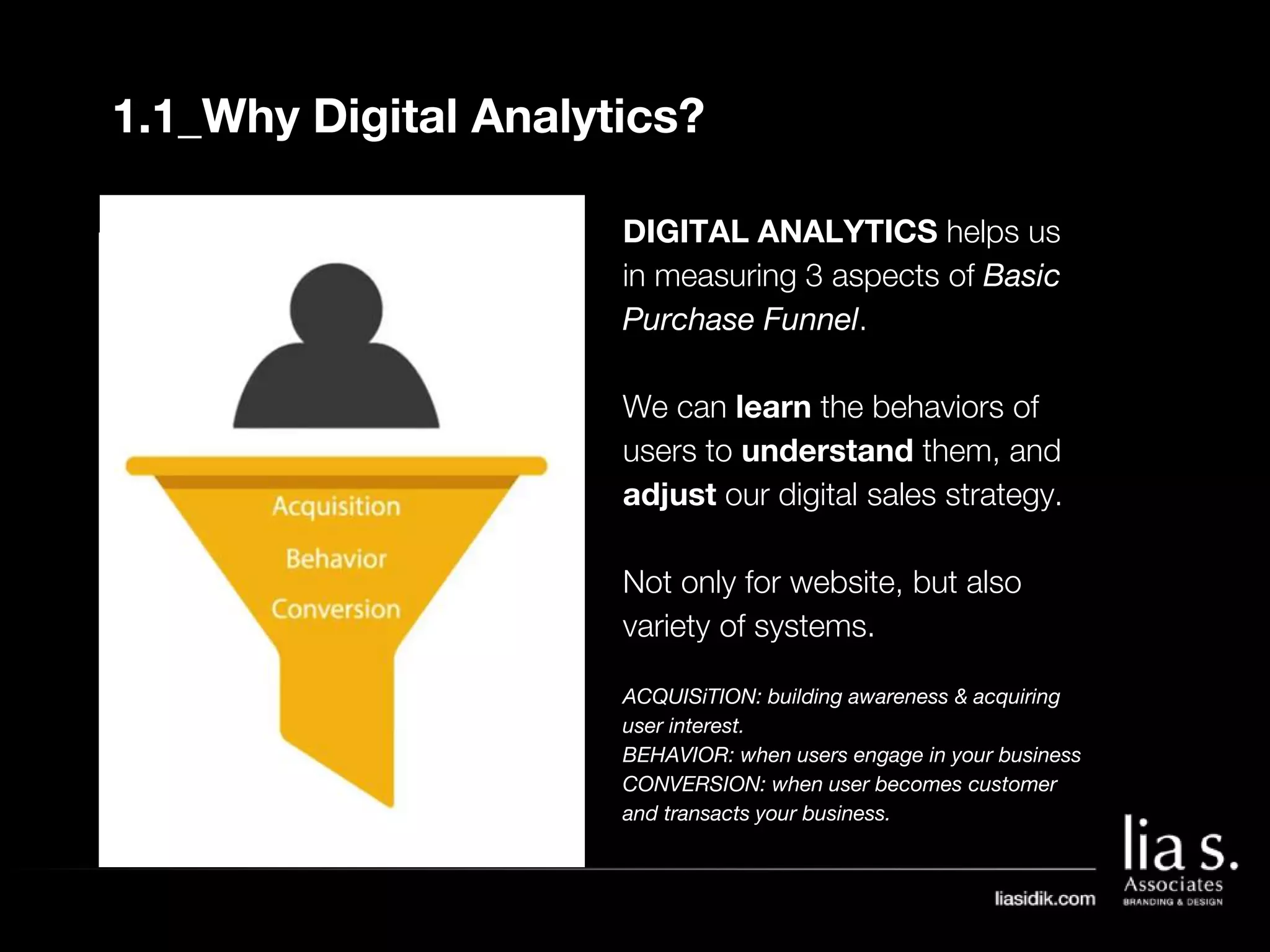
DIGITAL ANALYTICS helps us
in measuring 3 aspects of Basic
Purchase Funnel.
We can learn the behaviors of
users to understand them, and
adjust our digital sales strategy.
Not only for website, but also
variety of systems.
ACQUISiTION: building awareness & acquiring
user interest.
BEHAVIOR: when users engage in your business
CONVERSION: when user becomes customer
and transacts your business.
1.2_How Google Analytics Works
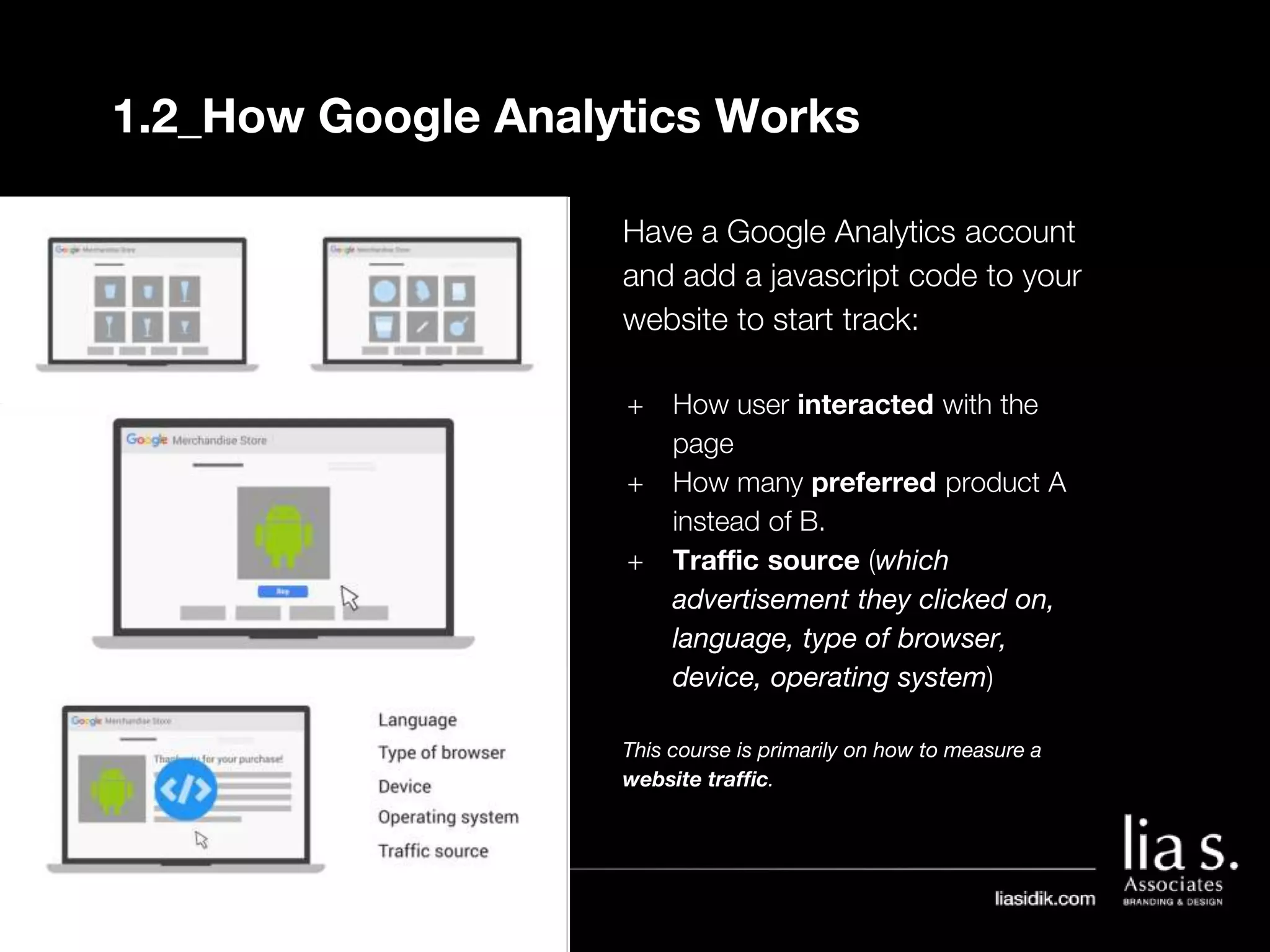
Have a Google Analytics account
and add a javascript code to your
website to start track:
+ How user interacted with the
page
+ How many preferred product A
instead of B.
+ Traffic source (which
advertisement they clicked on,
language, type of browser,
device, operating system)
This course is primarily on how to measure a
website traffic.
1.2_How Google Analytics Works
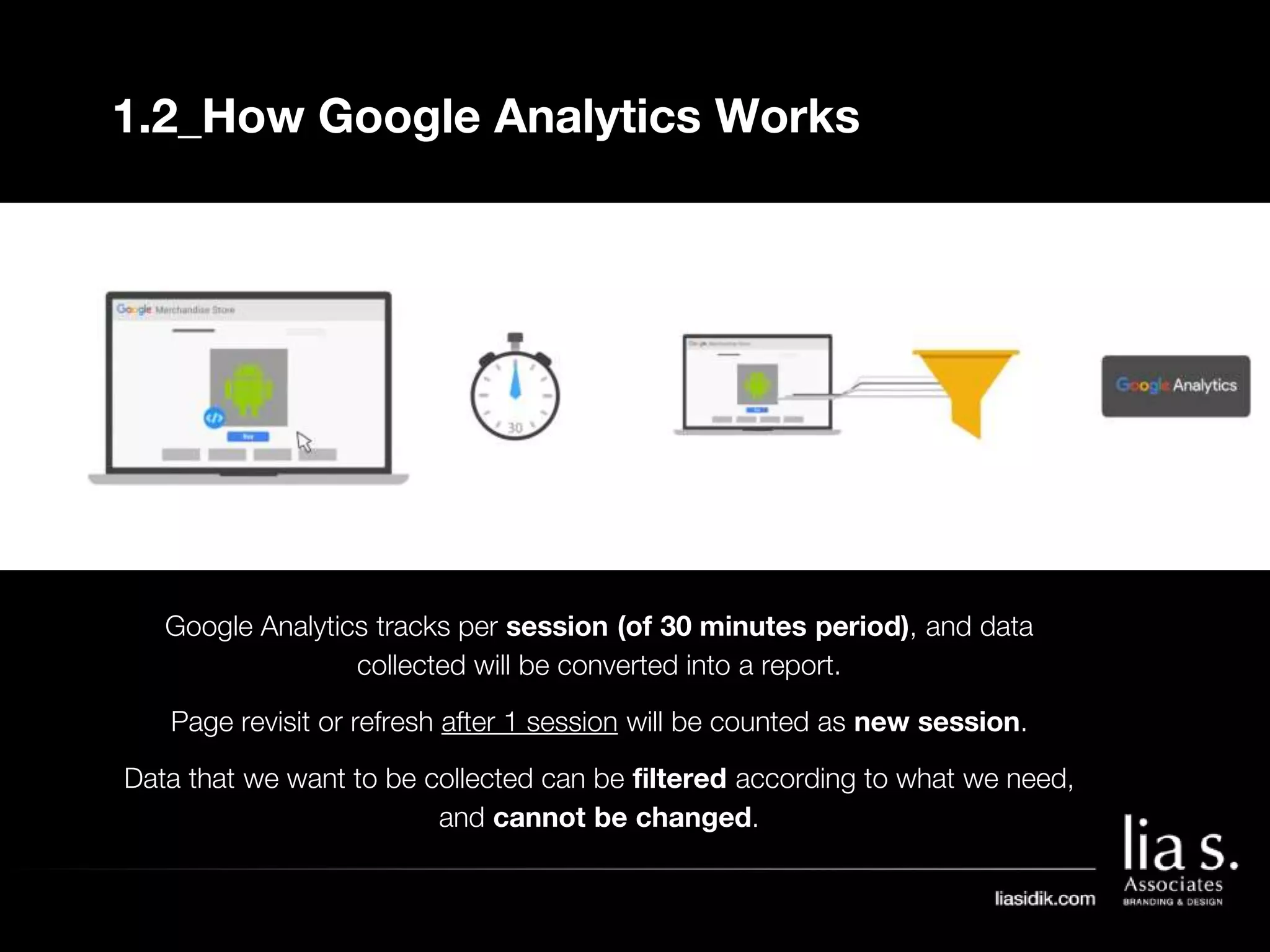
Google Analytics tracks per session (of 30 minutes period), and data
collected will be converted into a report.
Page revisit or refresh after 1 session will be counted as new session.
Data that we want to be collected can be filtered according to what we need,
and cannot be changed.
1.3_Google Analytics Setup
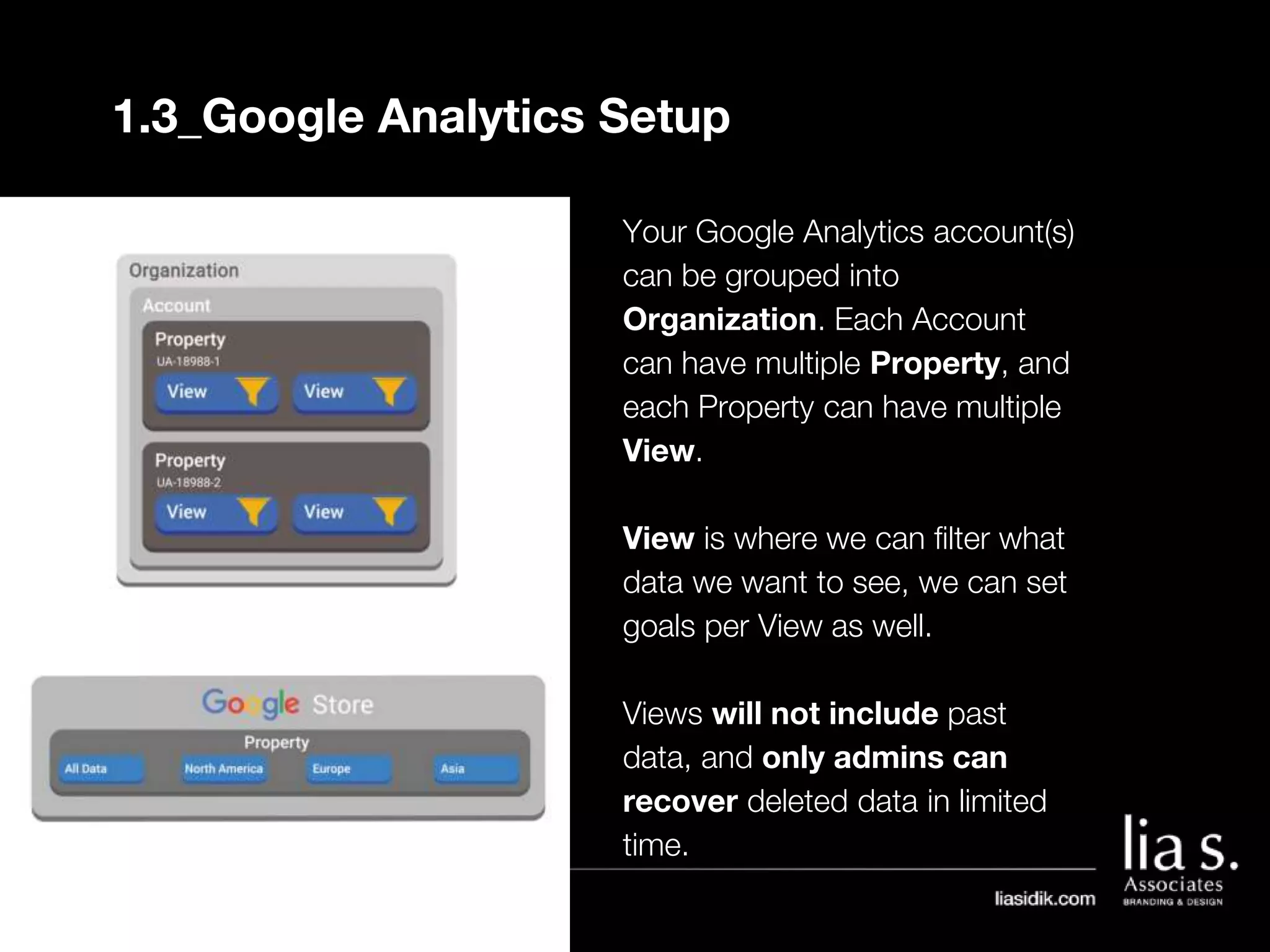
Your Google Analytics account(s)
can be grouped into
Organization. Each Account
can have multiple Property, and
each Property can have multiple
View.
View is where we can filter what
data we want to see, we can set
goals per View as well.
Views will not include past
data, and only admins can
recover deleted data in limited
time.
1.3_Google Analytics Setup
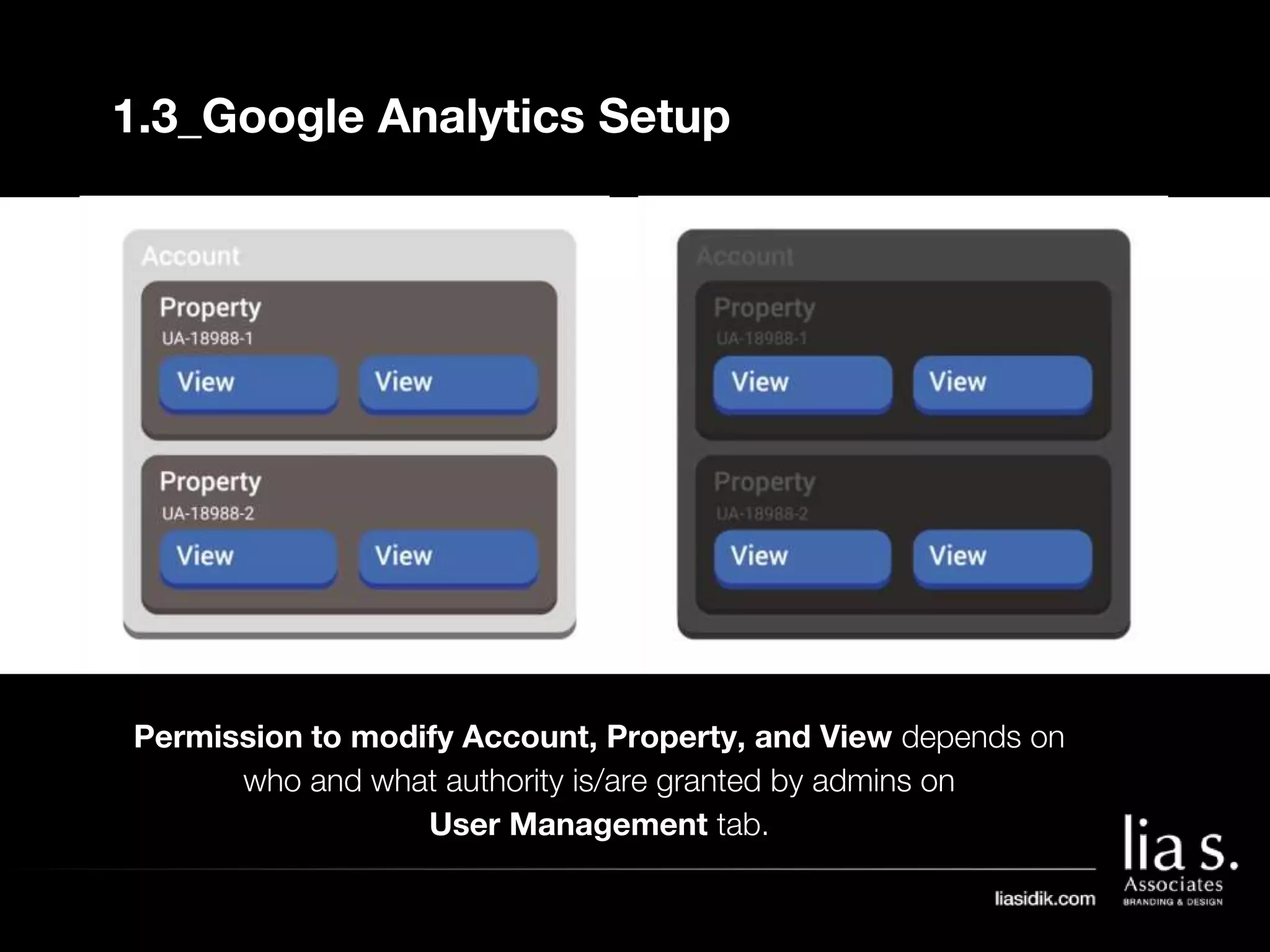
Permission to modify Account, Property, and View depends on
who and what authority is/are granted by admins on
User Management tab.
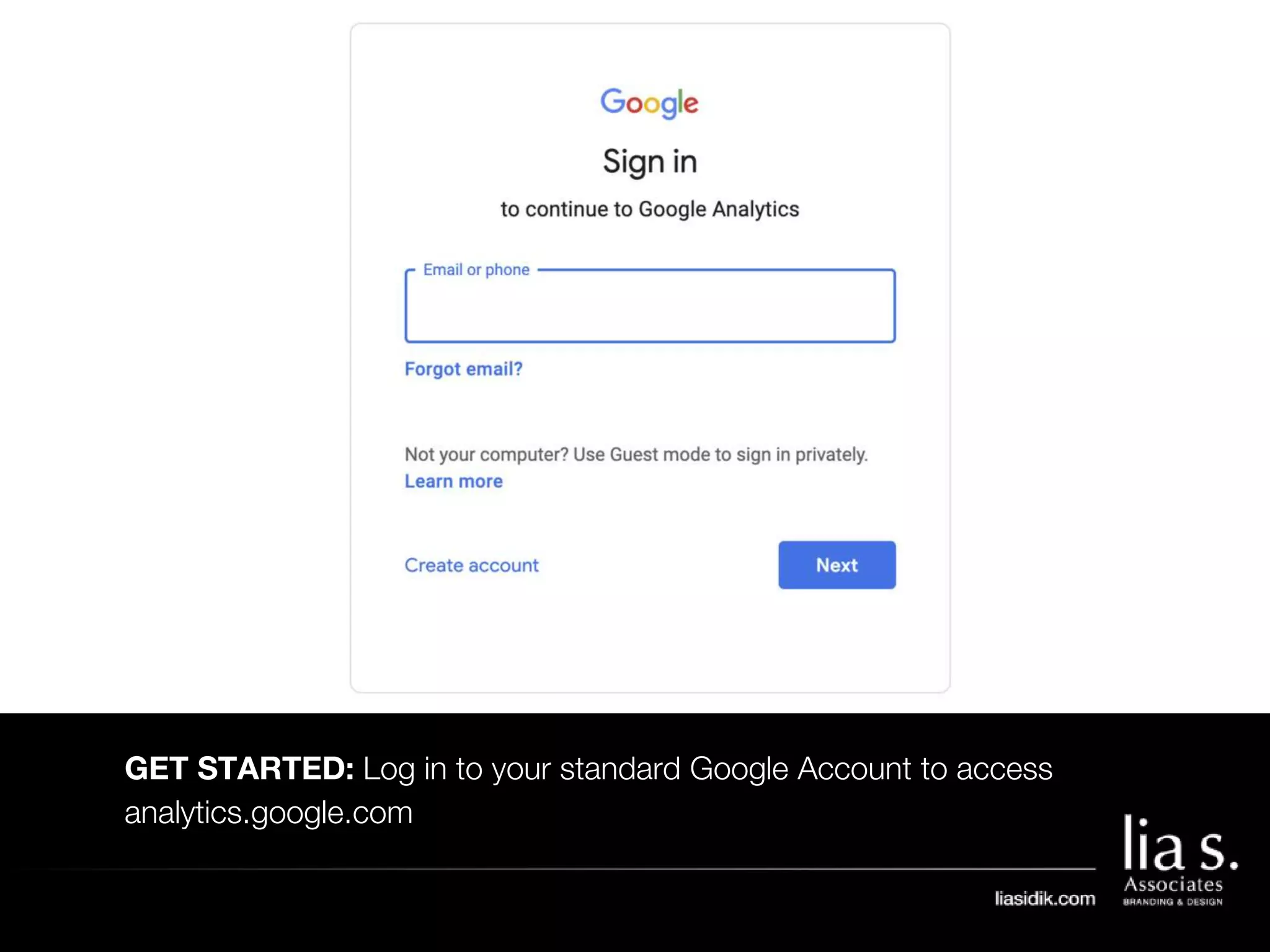
GET STARTED: Log in to your standard Google Account to access
analytics.google.com
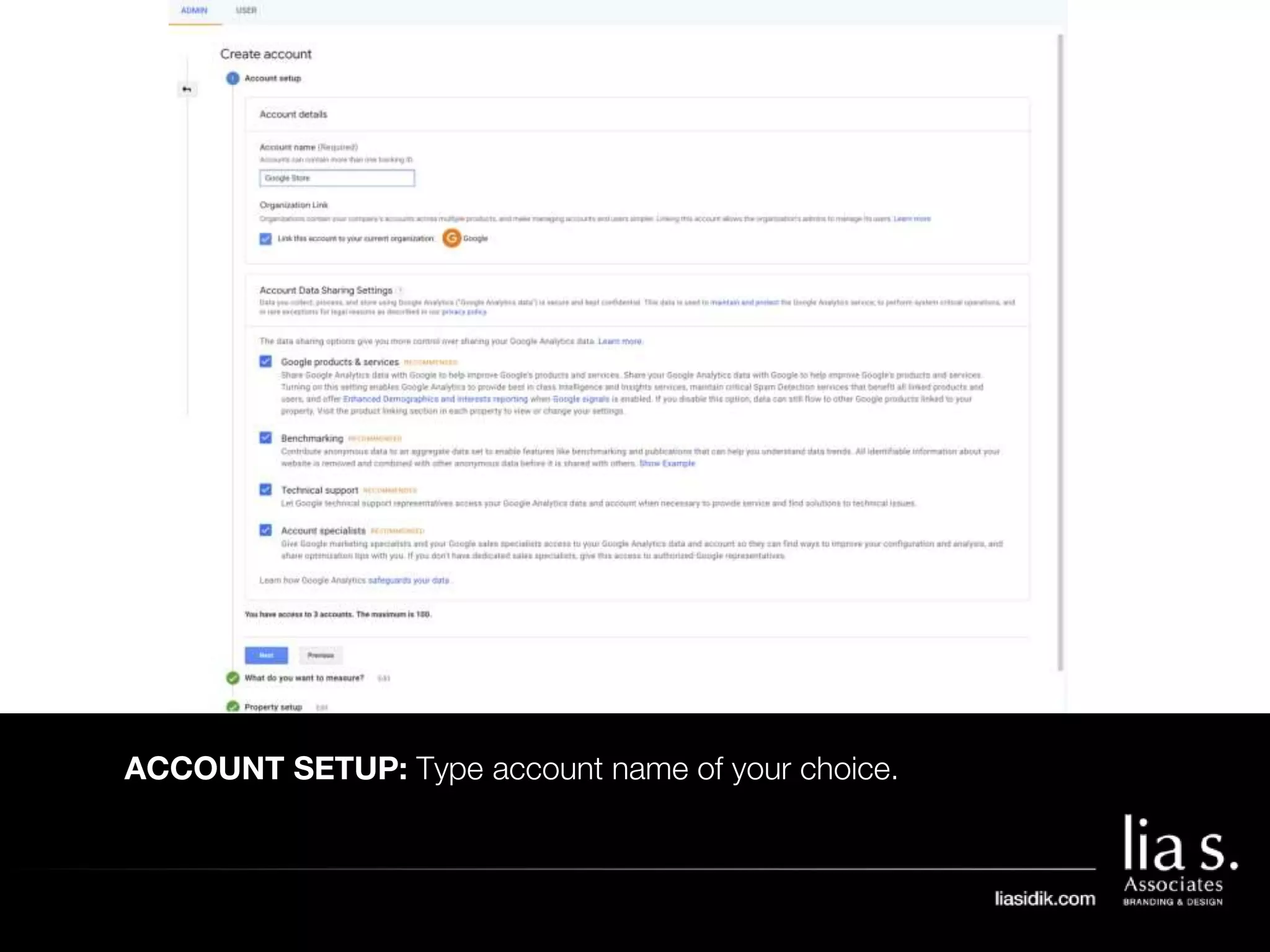
ACCOUNT SETUP: Type account name of your choice.
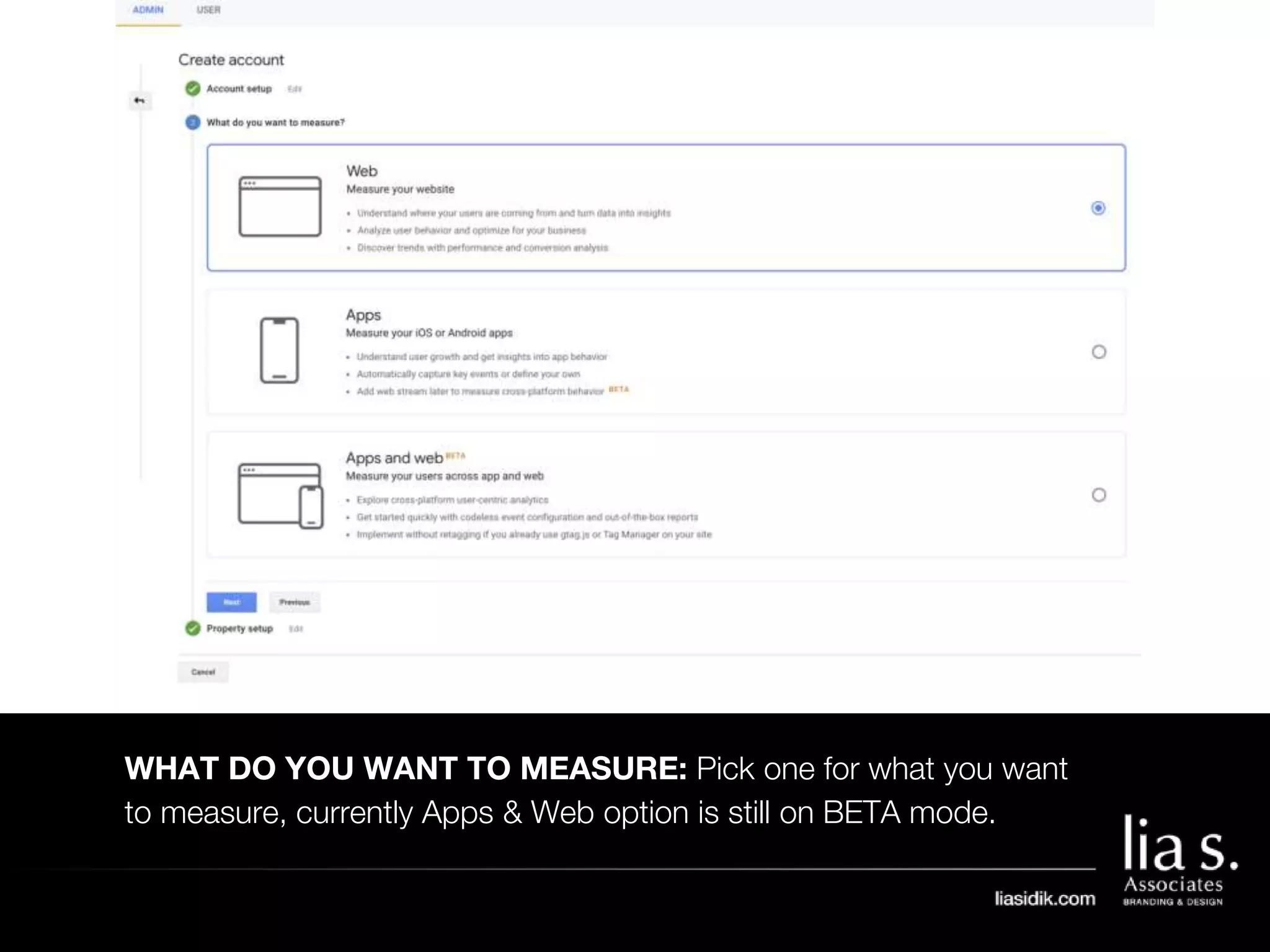
WHAT DO YOU WANT TO MEASURE: Pick one for what you want
to measure, currently Apps & Web option is still on BETA mode.
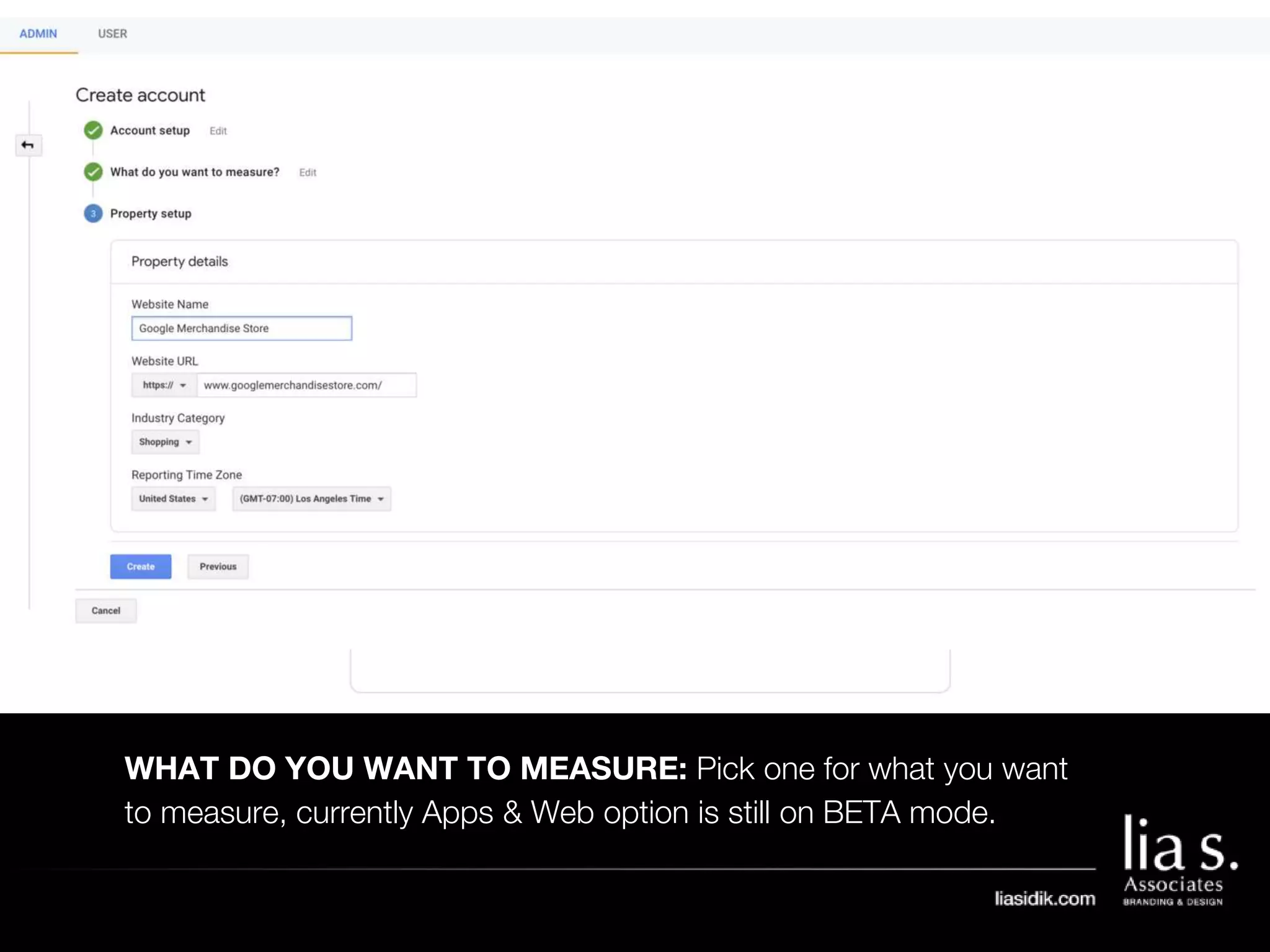
WHAT DO YOU WANT TO MEASURE: Pick one for what you want
to measure, currently Apps & Web option is still on BETA mode.
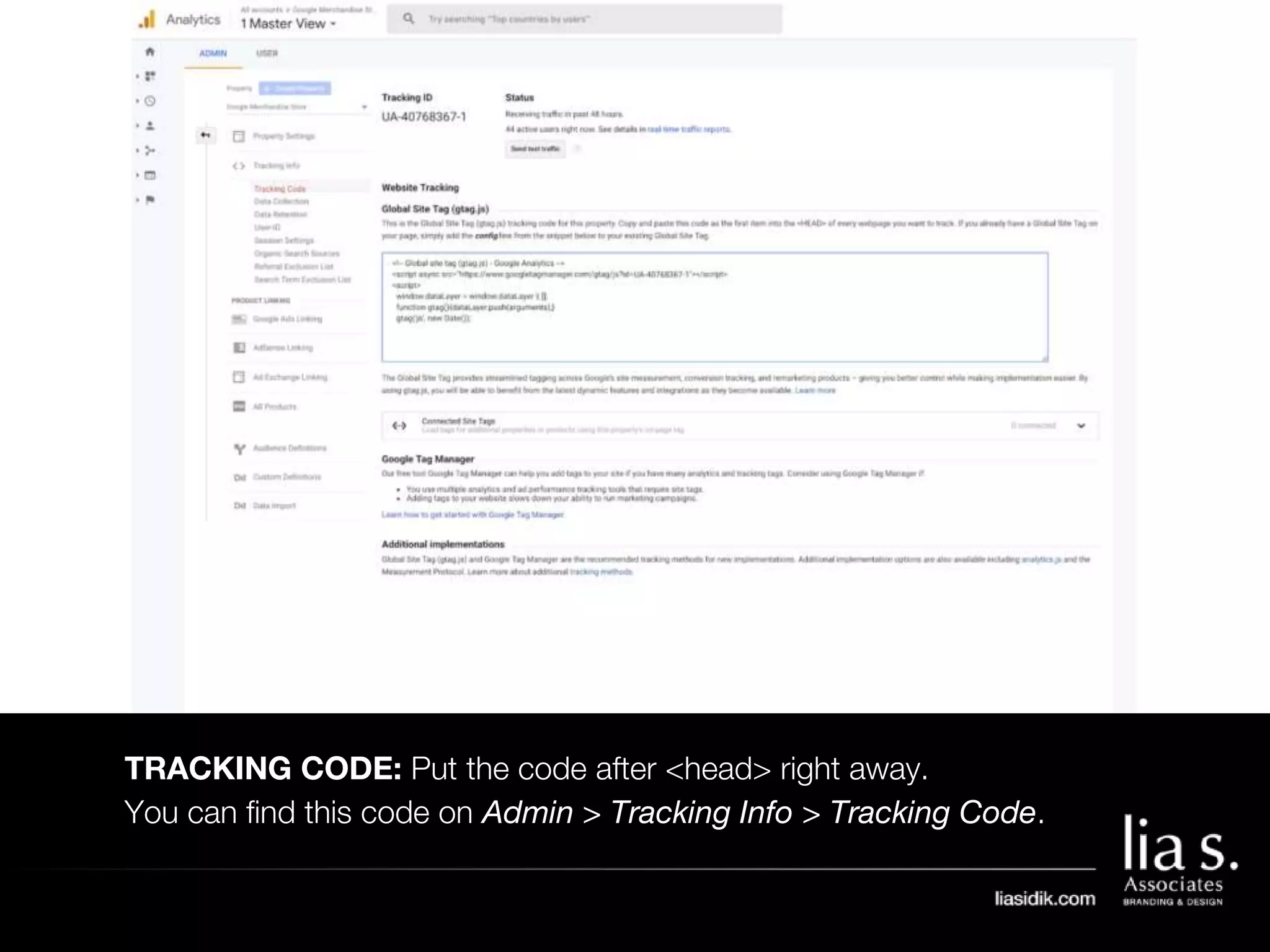
TRACKING CODE: Put the code after <head> right away.
You can find this code on Admin > Tracking Info > Tracking Code.
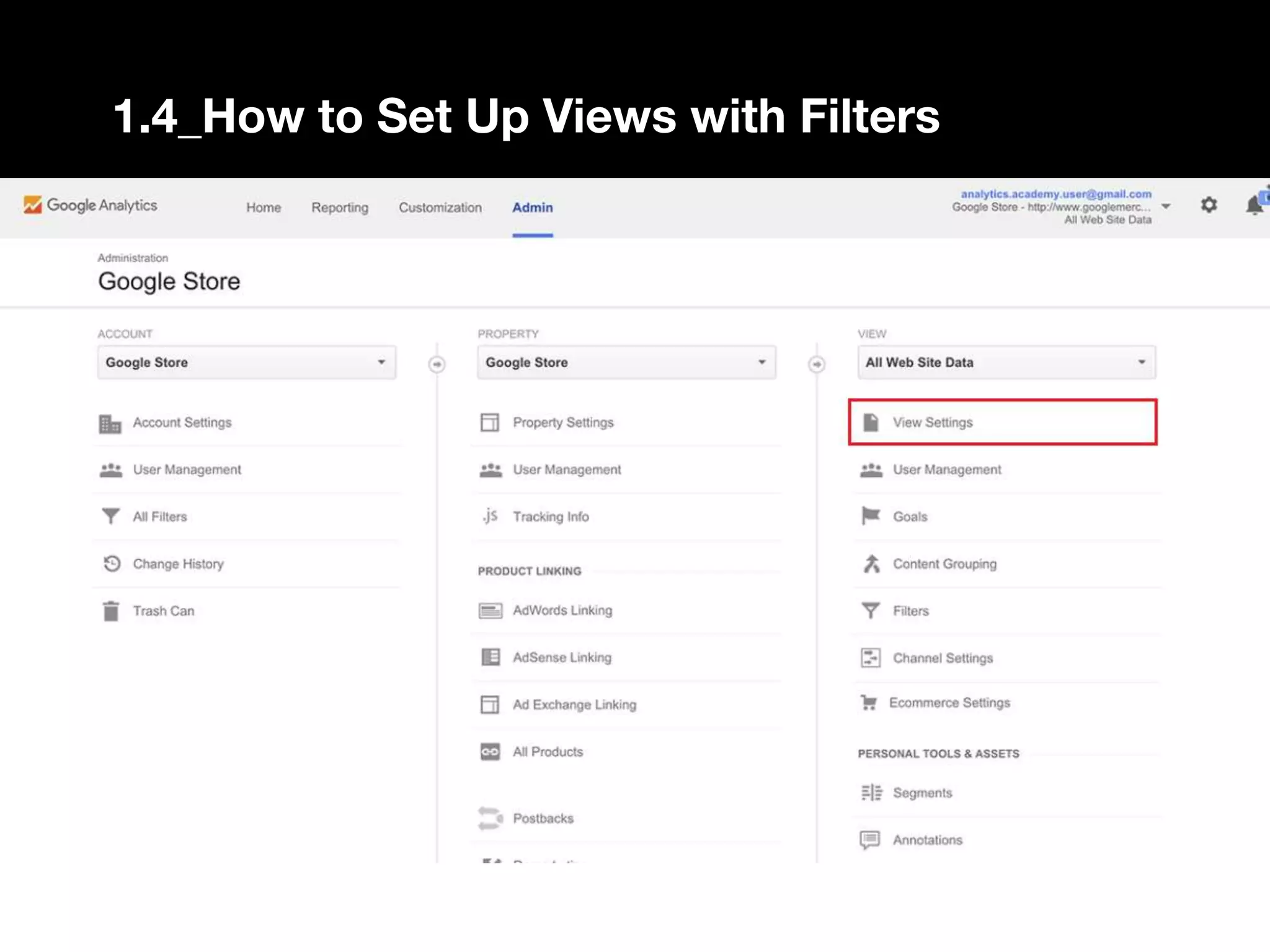
1.4_How to Set Up Views with Filters
You can change View Name (left)
and Create New View as well (right)
1.4_How to Set Up Views with Filters
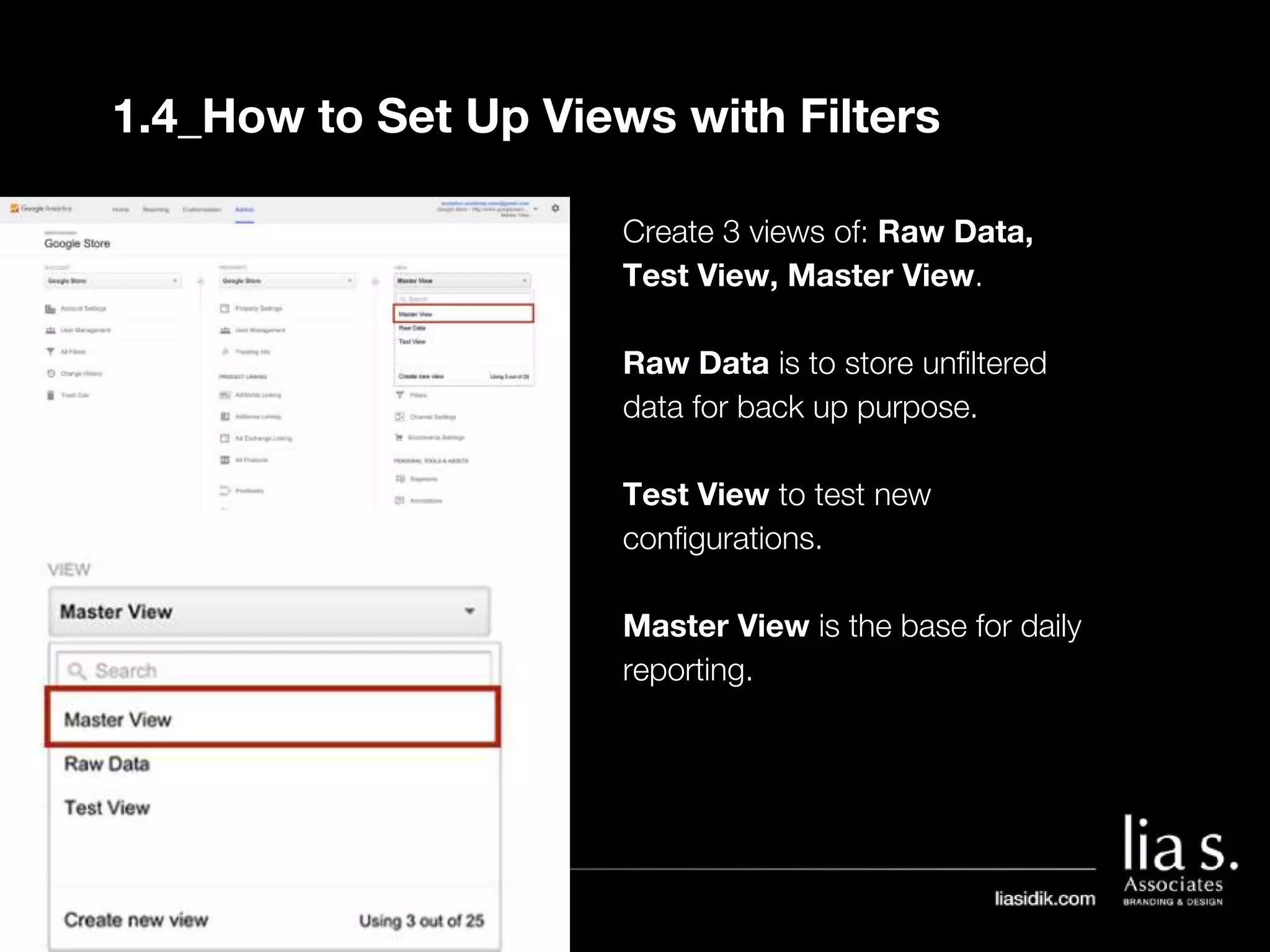
Create 3 views of: Raw Data,
Test View, Master View.
Raw Data is to store unfiltered
data for back up purpose.
Test View to test new
configurations.
Master View is the base for daily
reporting.
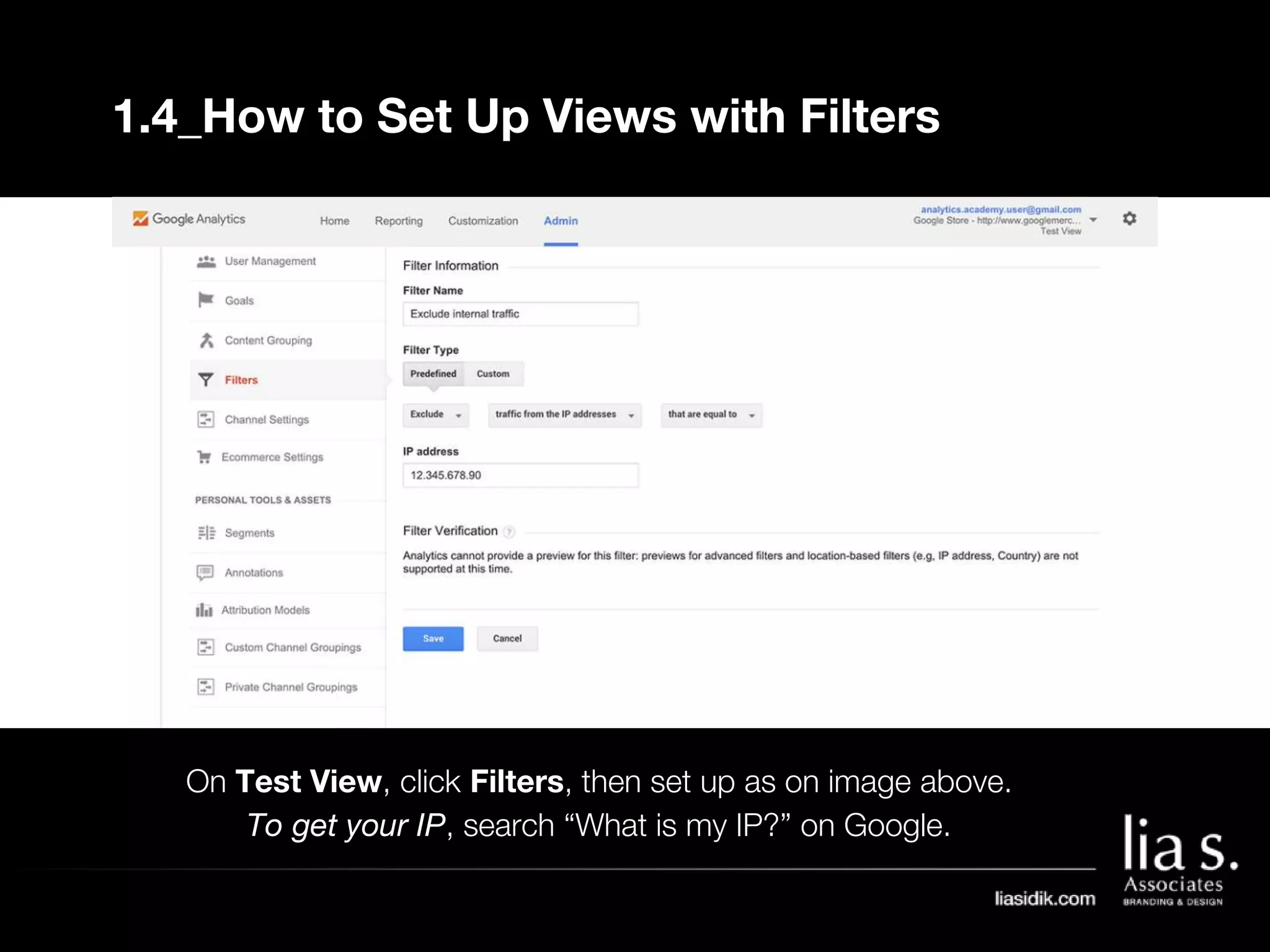
On Test View, click Filters, then set up as on image above.
To get your IP, search “What is my IP?” on Google.
1.4_How to Set Up Views with Filters
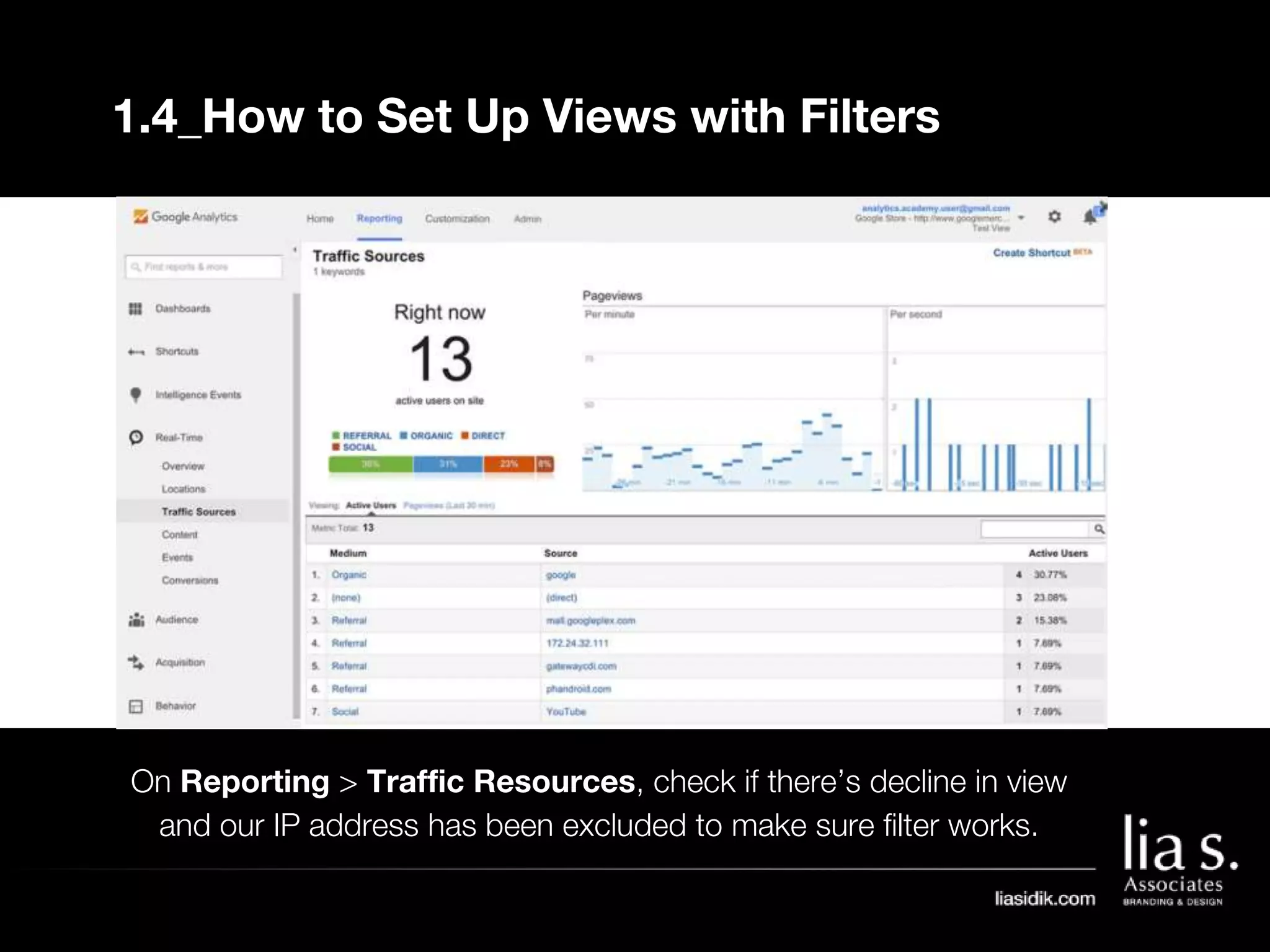
On Reporting > Traffic Resources, check if there’s decline in view
and our IP address has been excluded to make sure filter works.
1.4_How to Set Up Views with Filters
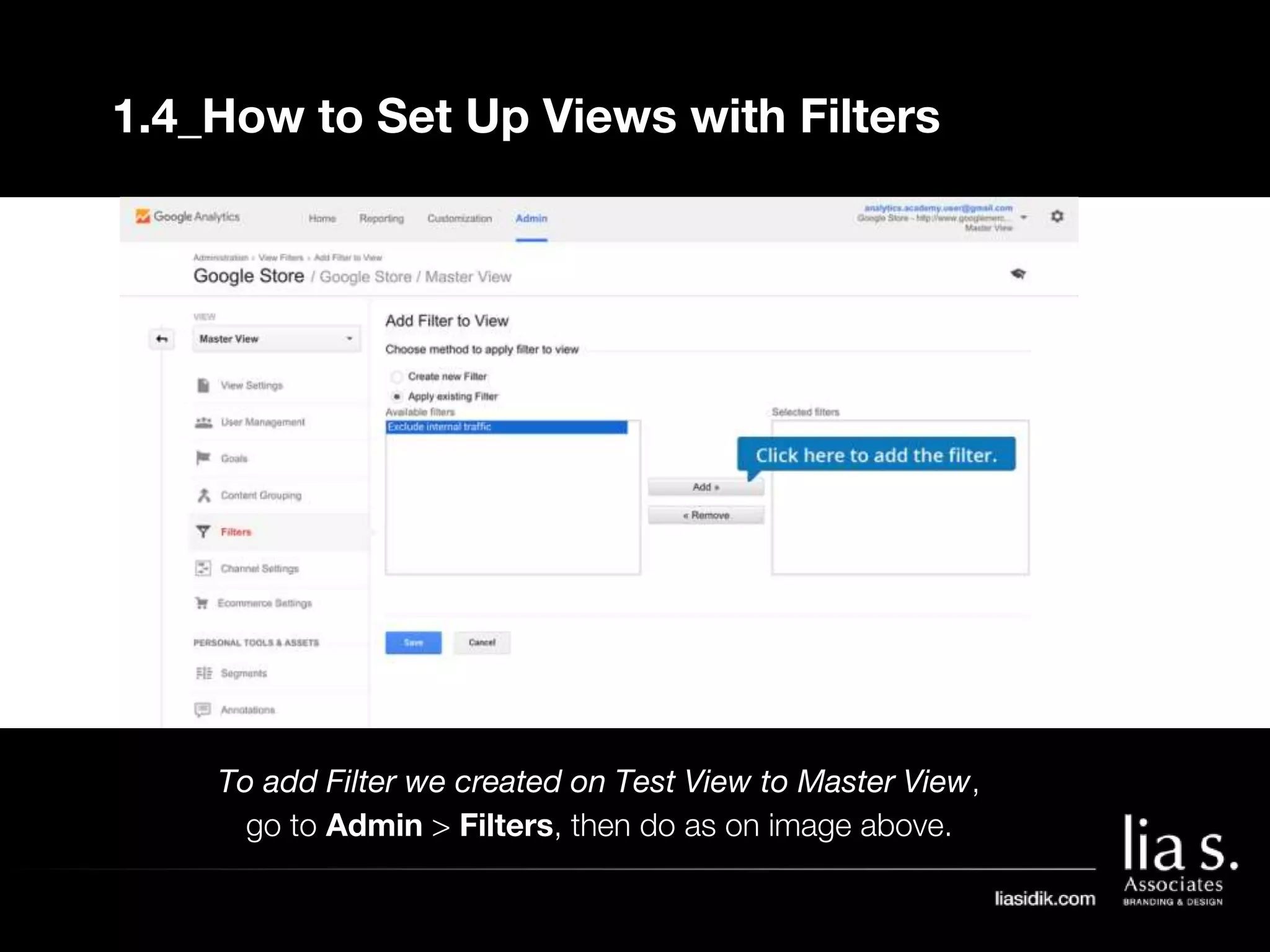
To add Filter we created on Test View to Master View,
go to Admin > Filters, then do as on image above.
1.4_How to Set Up Views with Filters
To add Filter we created on Test View to Master View,
go to Admin > Filters, then do as on image above.
1.4_How to Set Up Views with Filters
2.1_Navigating Google Analytics
2.2_Understanding Overview Reports
2.3_Understanding Full Reports
2.4_How to Share Reports
2.5_How to Set Up Dashboards and Shortcuts
Chapter 2: The Google Analytics Interface
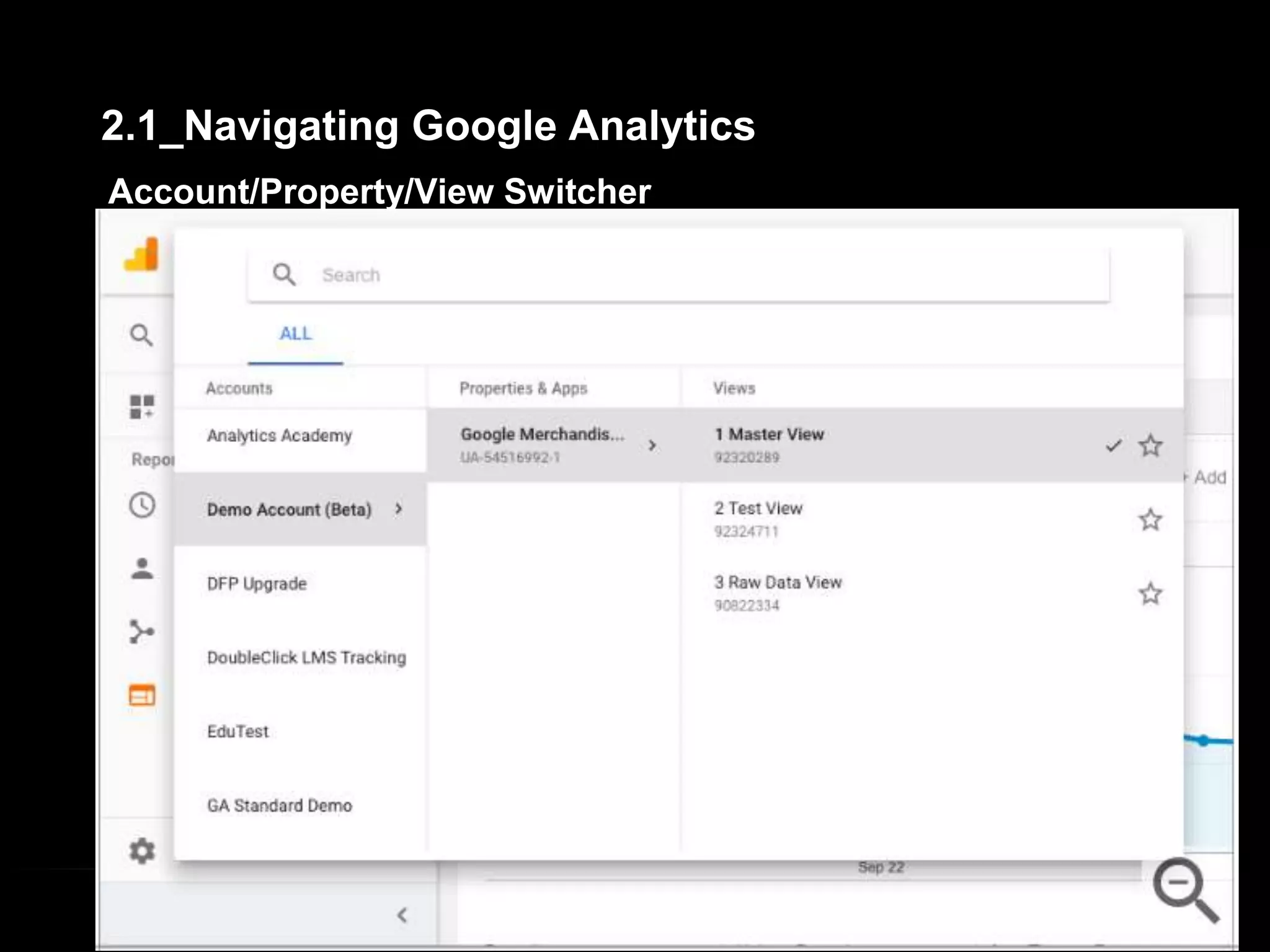
Account/Property/View Switcher
2.1_Navigating Google Analytics
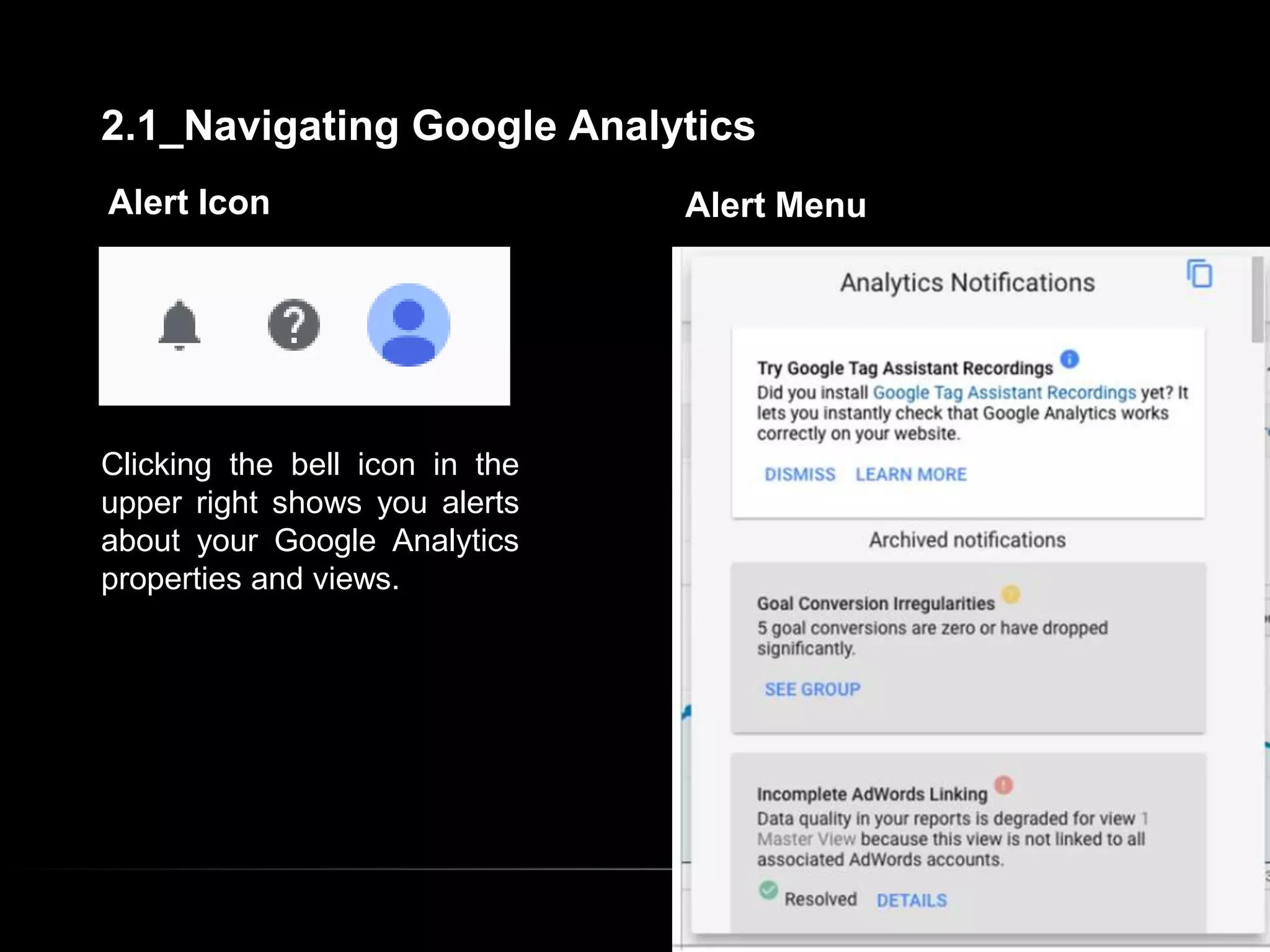
Alert Icon Alert Menu
Clicking the bell icon in the
upper right shows you alerts
about your Google Analytics
properties and views.
2.1_Navigating Google Analytics
Feedback, Help, and Settings
At the top right of your Analytics view are two more
icons:
• The "question mark" icon lets you send feedback to
Google Analytics or search Help articles
• The user icon lets you switch between different
Google accounts, manage your current Google
account, or sign out
2.1_Navigating Google Analytics
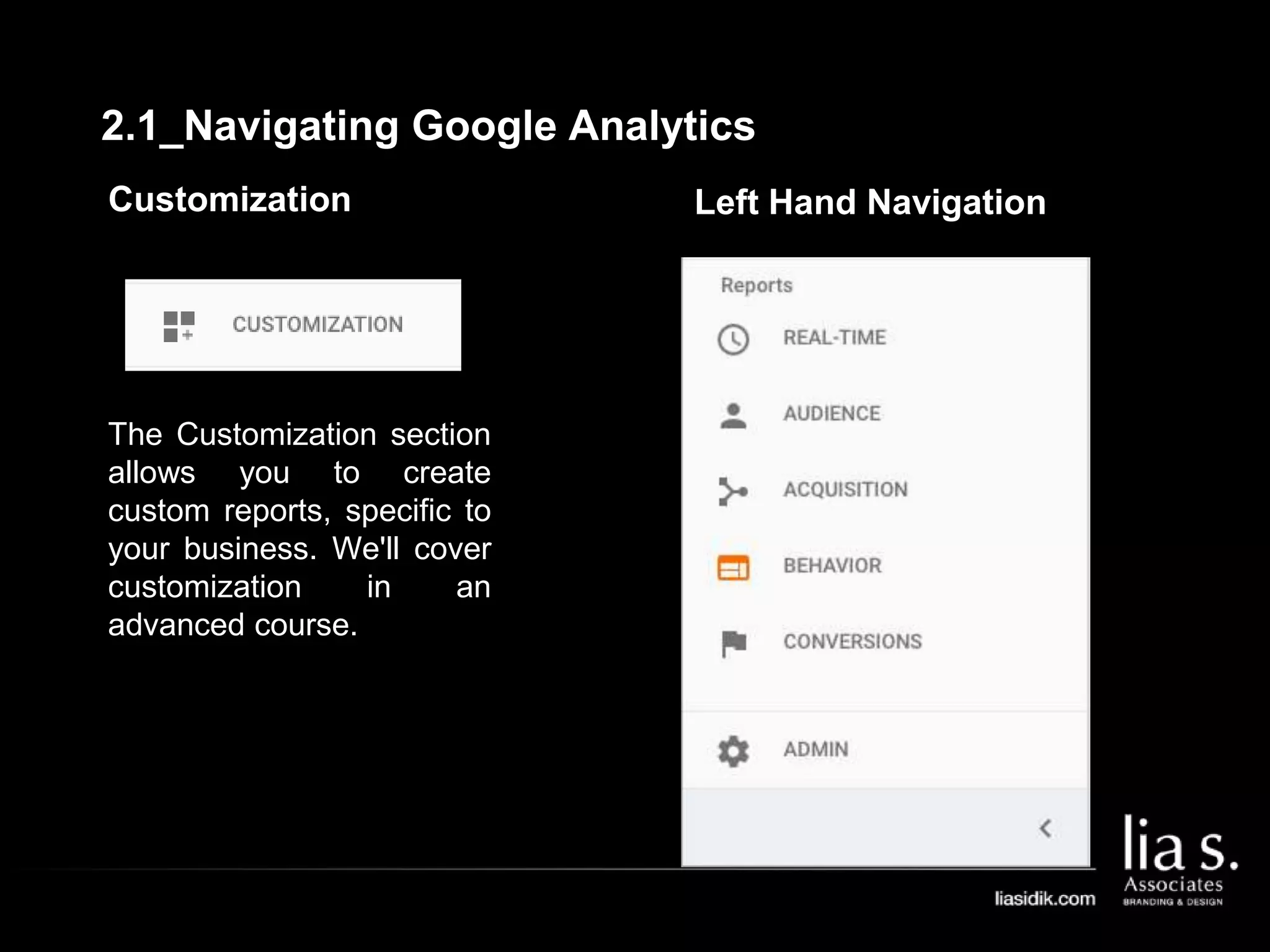
Customization
The Customization section
allows you to create
custom reports, specific to
your business. We'll cover
customization in an
advanced course.
Left Hand Navigation
2.1_Navigating Google Analytics
Real Time Reports
Real-Time reports let you
look at live user behavior
on your website including
information like where
your users are coming
from and if they’re
converting.
Audience Reports
Audience reports show you
characteristics about your users
like age and gender, where
they’re from, their interests, how
engaged they were, whether
they’re new or returning users,
and what technology they’re
using.
2.1_Navigating Google Analytics
Acquisition Reports
Acquisition reports show you which channels (such as advertising or
marketing campaigns) brought users to your site. This could include
different marketing channels such as:
• "Organic” (or unpaid search)
• “CPC” (“cost per click” or paid search)
• “Referral” (traffic that comes from another website)
• “Social” (from a social network)
• or “Other,” (a group of low volume traffic sources)
2.1_Navigating Google Analytics
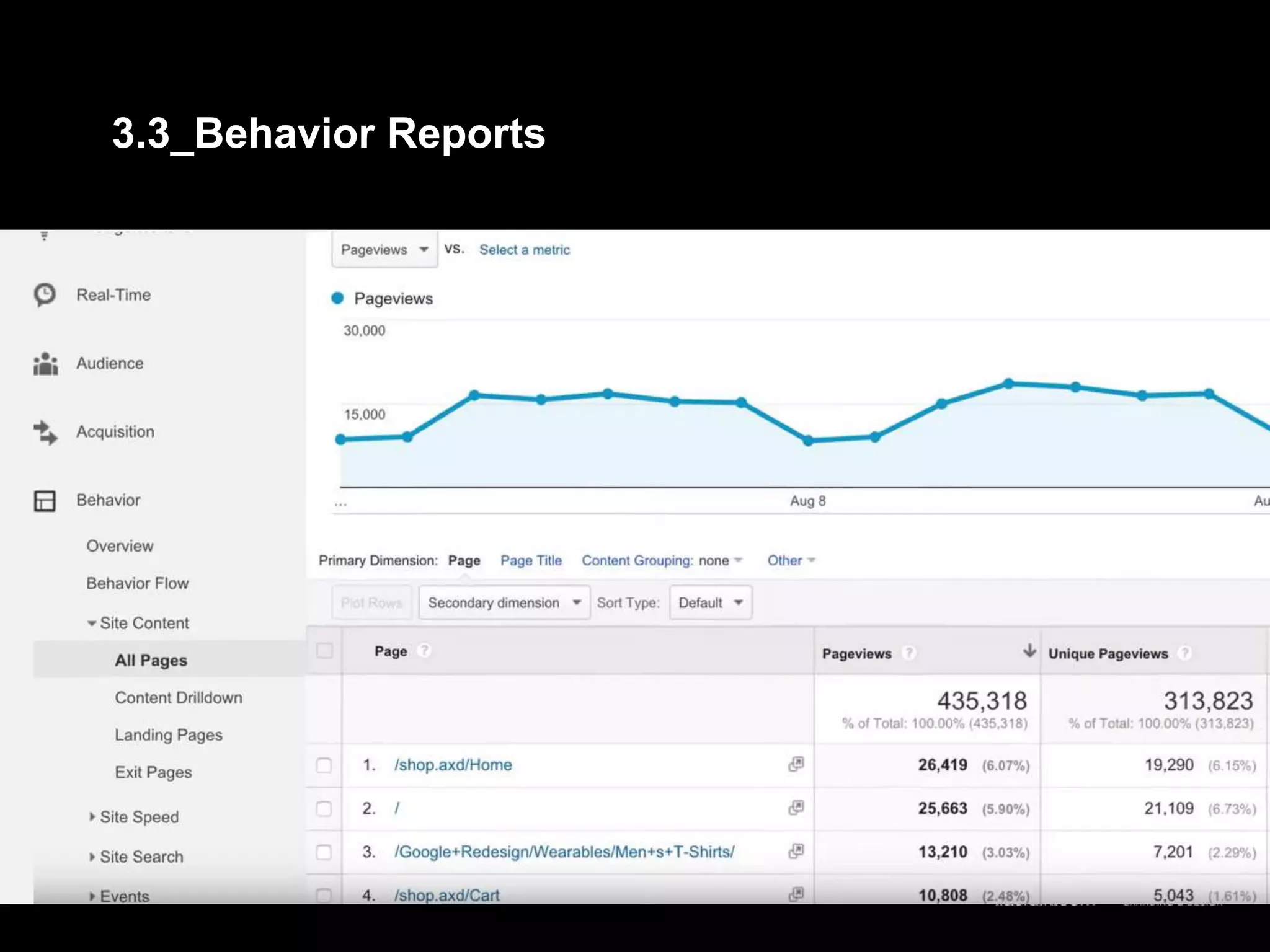
Behavior Reports
Behavior reports show
how people engaged on
your site including which
pages they viewed, and
their landing and exit
pages.
Conversion Reports
Conversion reports allow you to
track website goals based on
your business objectives.
2.1_Navigating Google Analytics
Admin Section
The Admin section contains
all of your Google Analytics
settings such as user
permissions, tracking code,
view settings, and filters.
Collapse Left-Hand Navigation
Use this pointer to shrink the
navigation and provide more
space for your reports.
2.1_Navigating Google Analytics
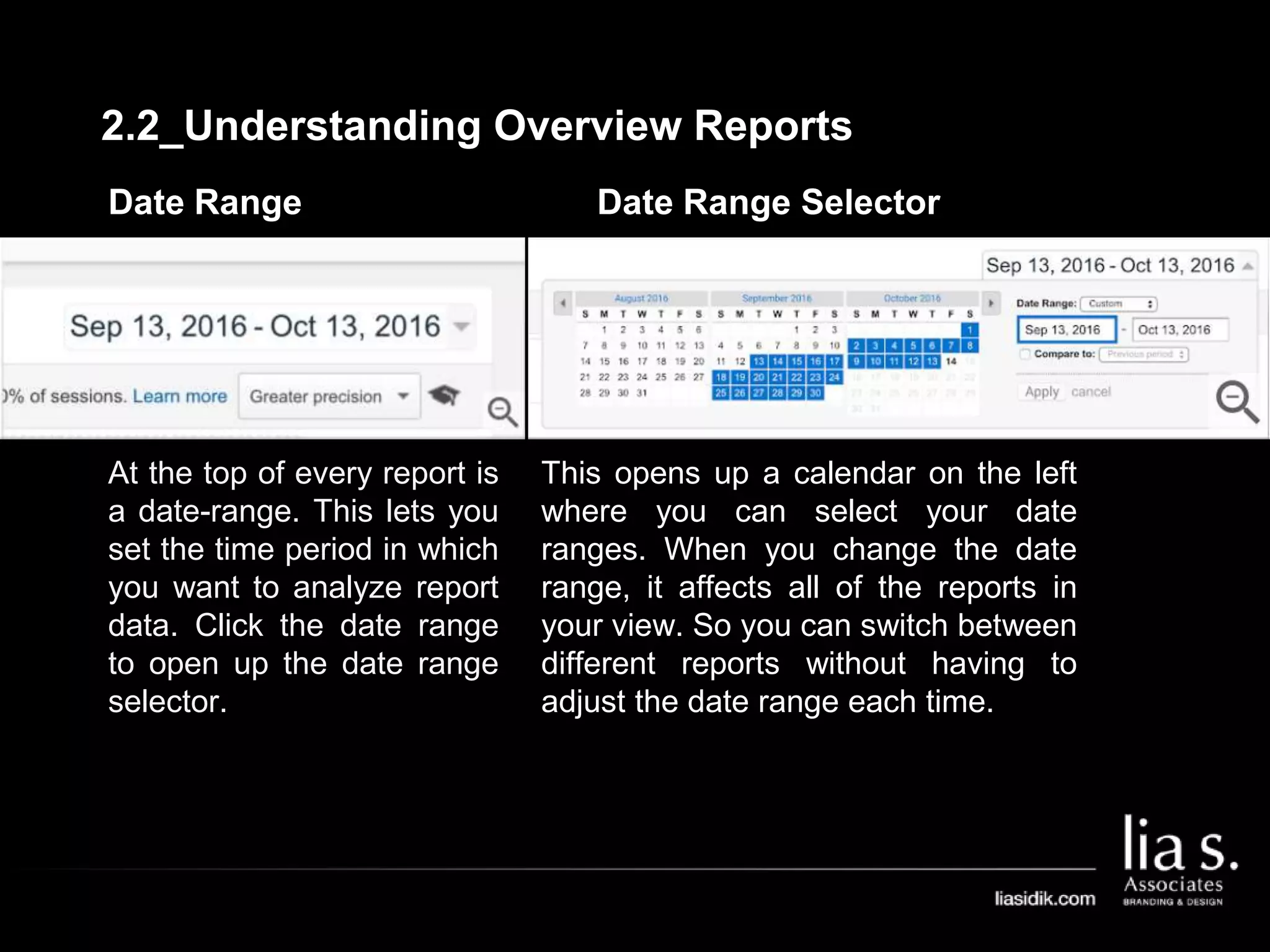
Date Range
At the top of every report is
a date-range. This lets you
set the time period in which
you want to analyze report
data. Click the date range
to open up the date range
selector.
Date Range Selector
This opens up a calendar on the left
where you can select your date
ranges. When you change the date
range, it affects all of the reports in
your view. So you can switch between
different reports without having to
adjust the date range each time.
2.2_Understanding Overview Reports
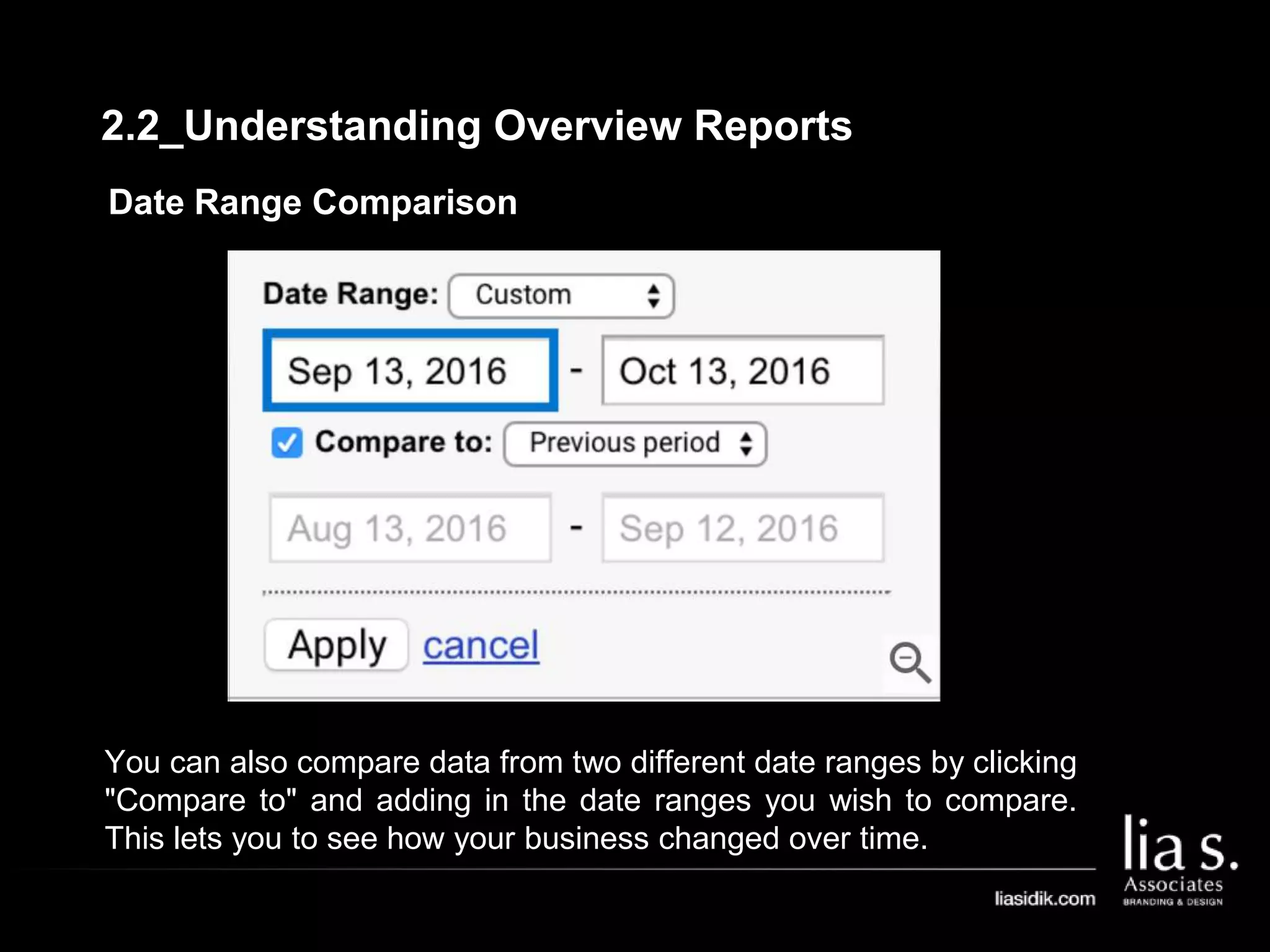
Date Range Comparison
You can also compare data from two different date ranges by clicking
"Compare to" and adding in the date ranges you wish to compare.
This lets you to see how your business changed over time.
2.2_Understanding Overview Reports
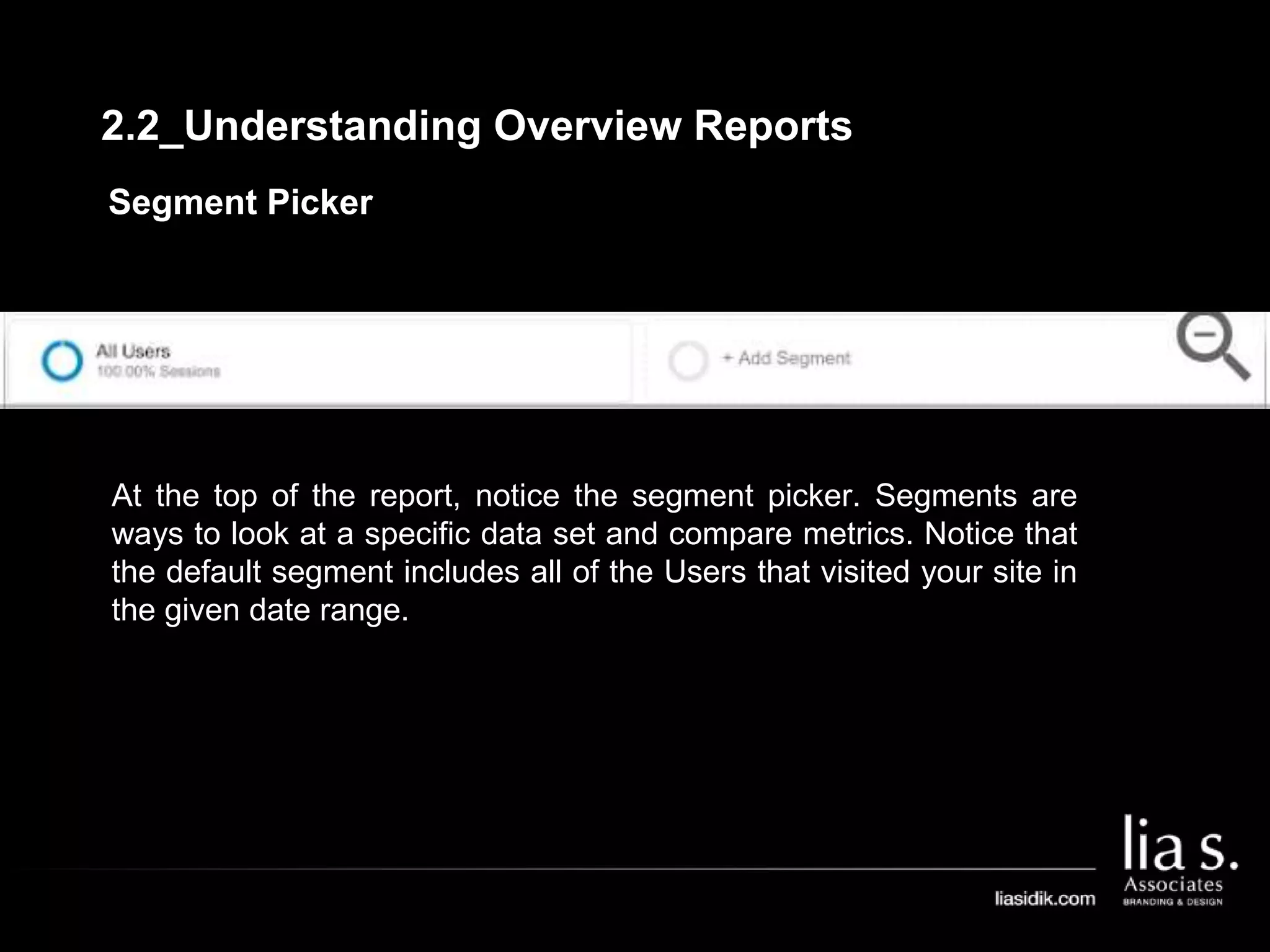
Segment Picker
At the top of the report, notice the segment picker. Segments are
ways to look at a specific data set and compare metrics. Notice that
the default segment includes all of the Users that visited your site in
the given date range.
2.2_Understanding Overview Reports
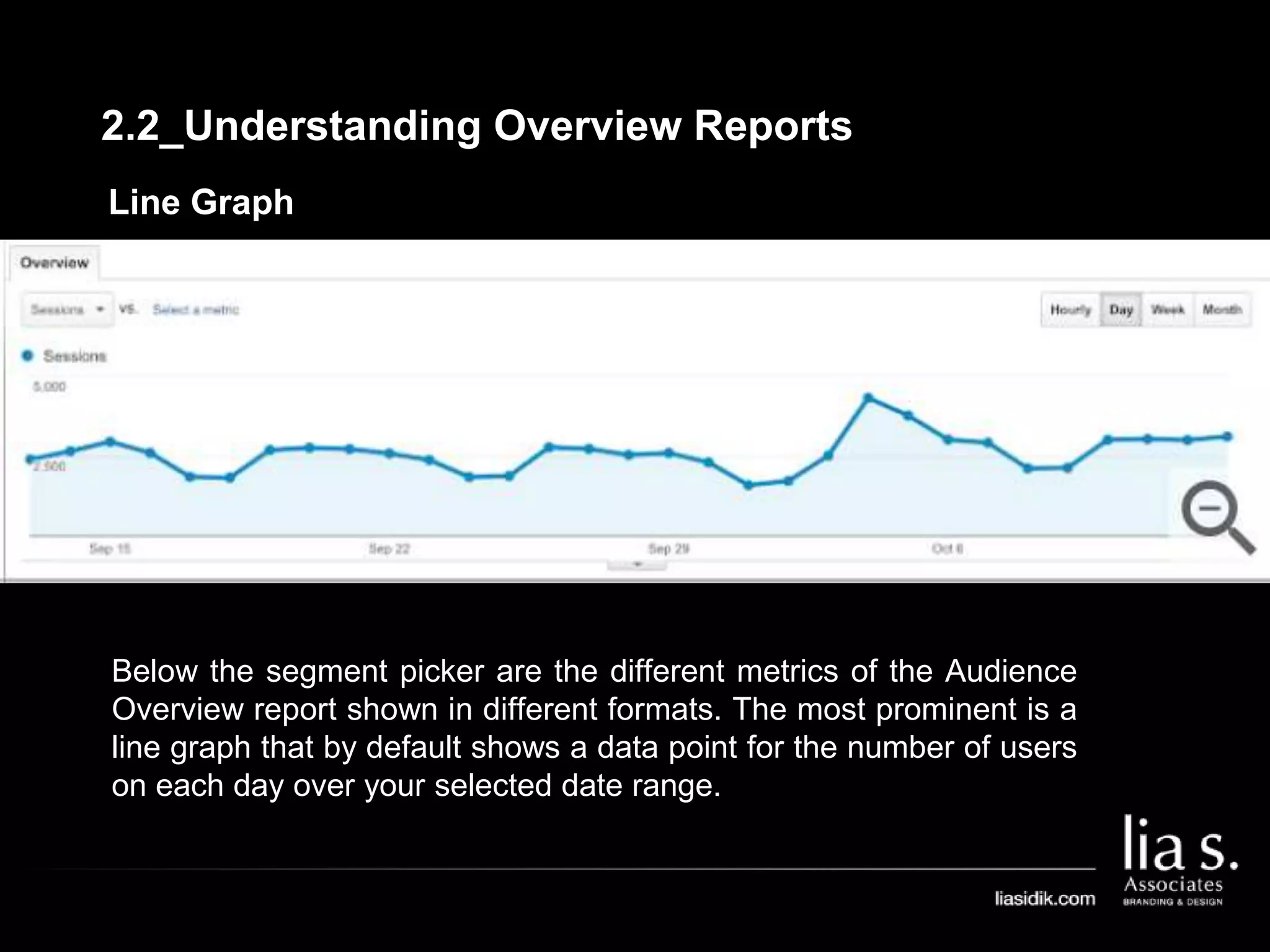
Line Graph
Below the segment picker are the different metrics of the Audience
Overview report shown in different formats. The most prominent is a
line graph that by default shows a data point for the number of users
on each day over your selected date range.
2.2_Understanding Overview Reports
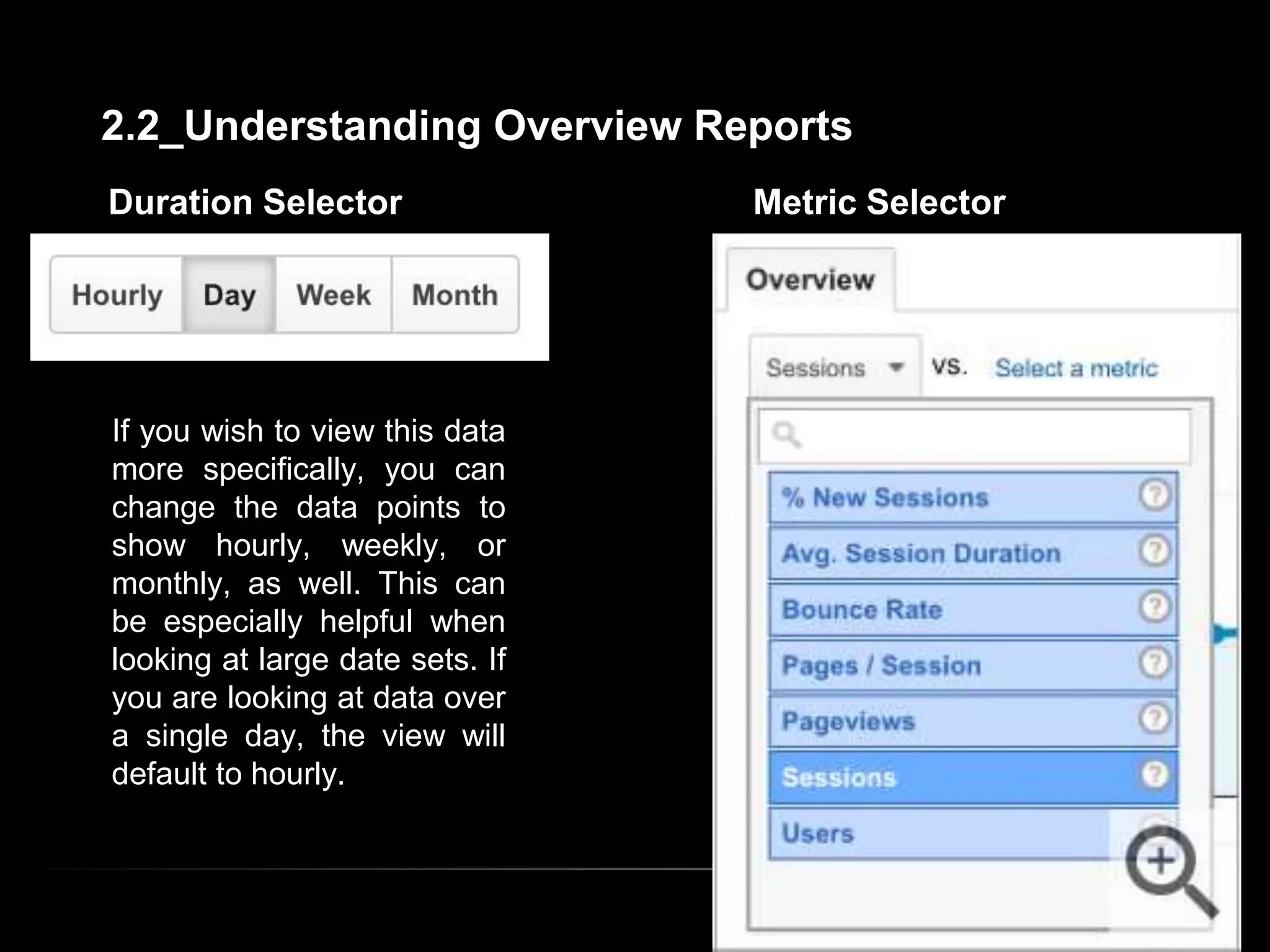
Duration Selector
If you wish to view this data
more specifically, you can
change the data points to
show hourly, weekly, or
monthly, as well. This can
be especially helpful when
looking at large date sets. If
you are looking at data over
a single day, the view will
default to hourly.
Metric Selector
2.2_Understanding Overview Reports
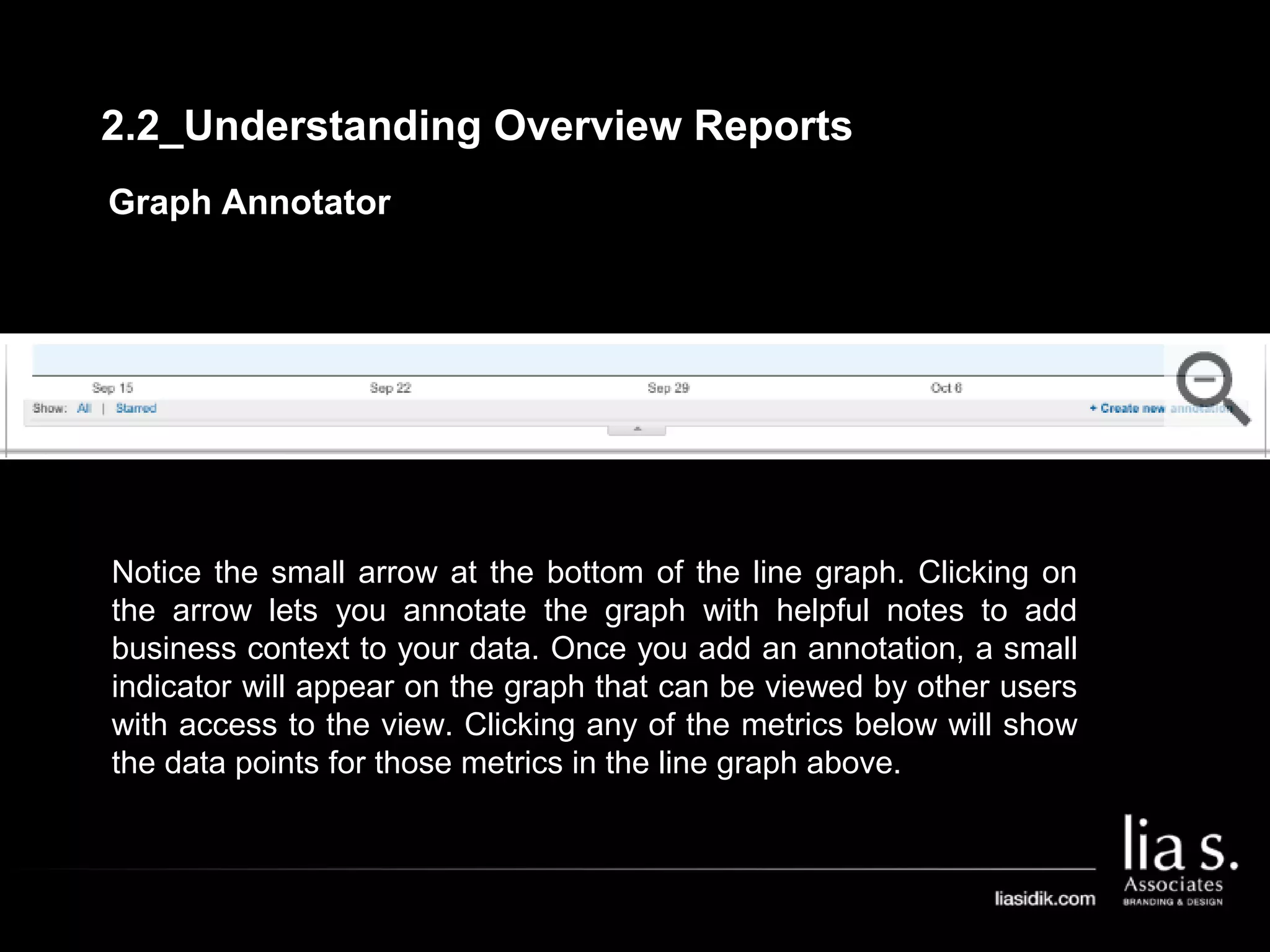
Graph Annotator
Notice the small arrow at the bottom of the line graph. Clicking on
the arrow lets you annotate the graph with helpful notes to add
business context to your data. Once you add an annotation, a small
indicator will appear on the graph that can be viewed by other users
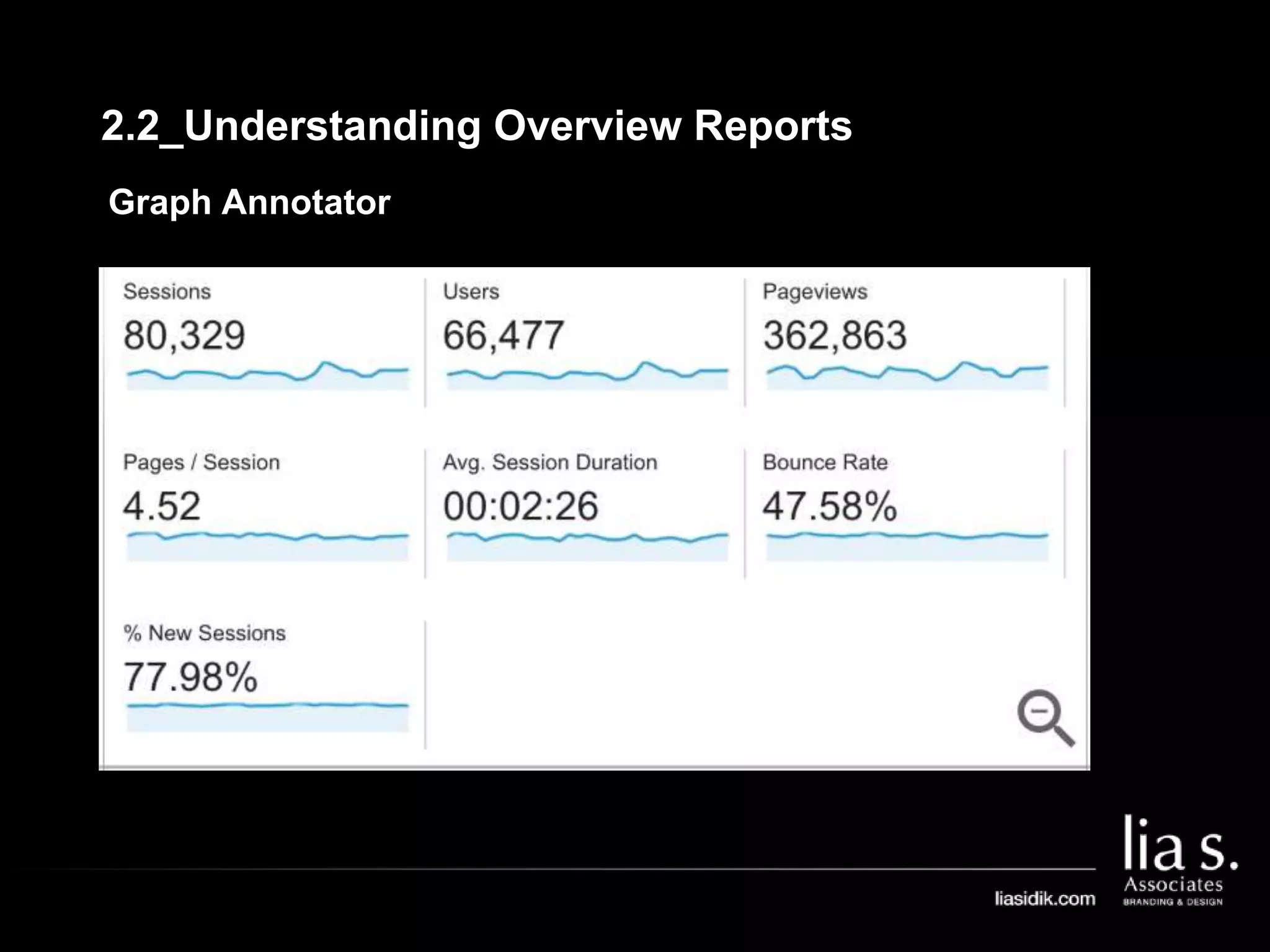
with access to the view. Clicking any of the metrics below will show
the data points for those metrics in the line graph above.
2.2_Understanding Overview Reports
Graph Annotator
2.2_Understanding Overview Reports
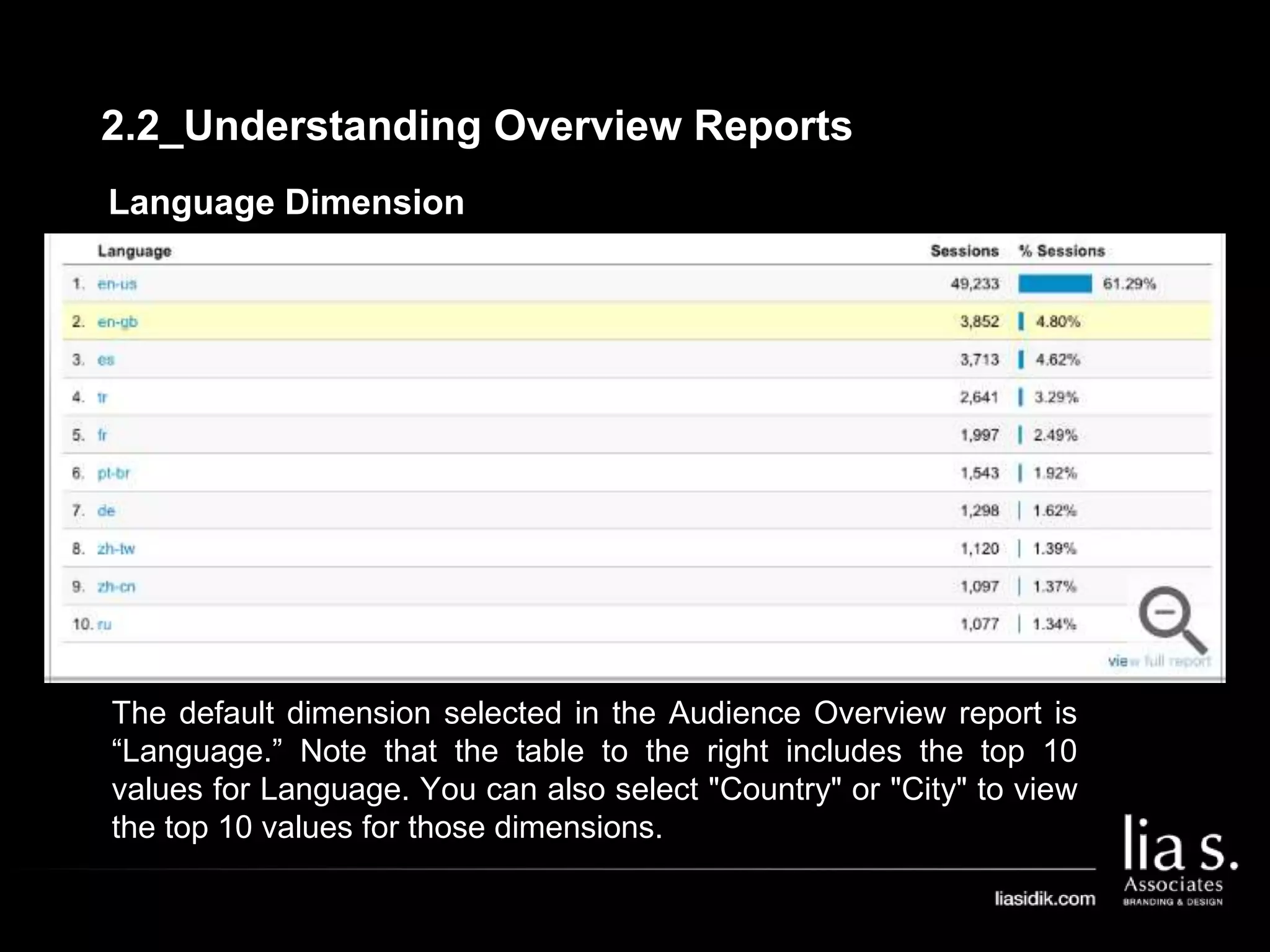
Language Dimension
The default dimension selected in the Audience Overview report is
“Language.” Note that the table to the right includes the top 10
values for Language. You can also select "Country" or "City" to view
the top 10 values for those dimensions.
2.2_Understanding Overview Reports
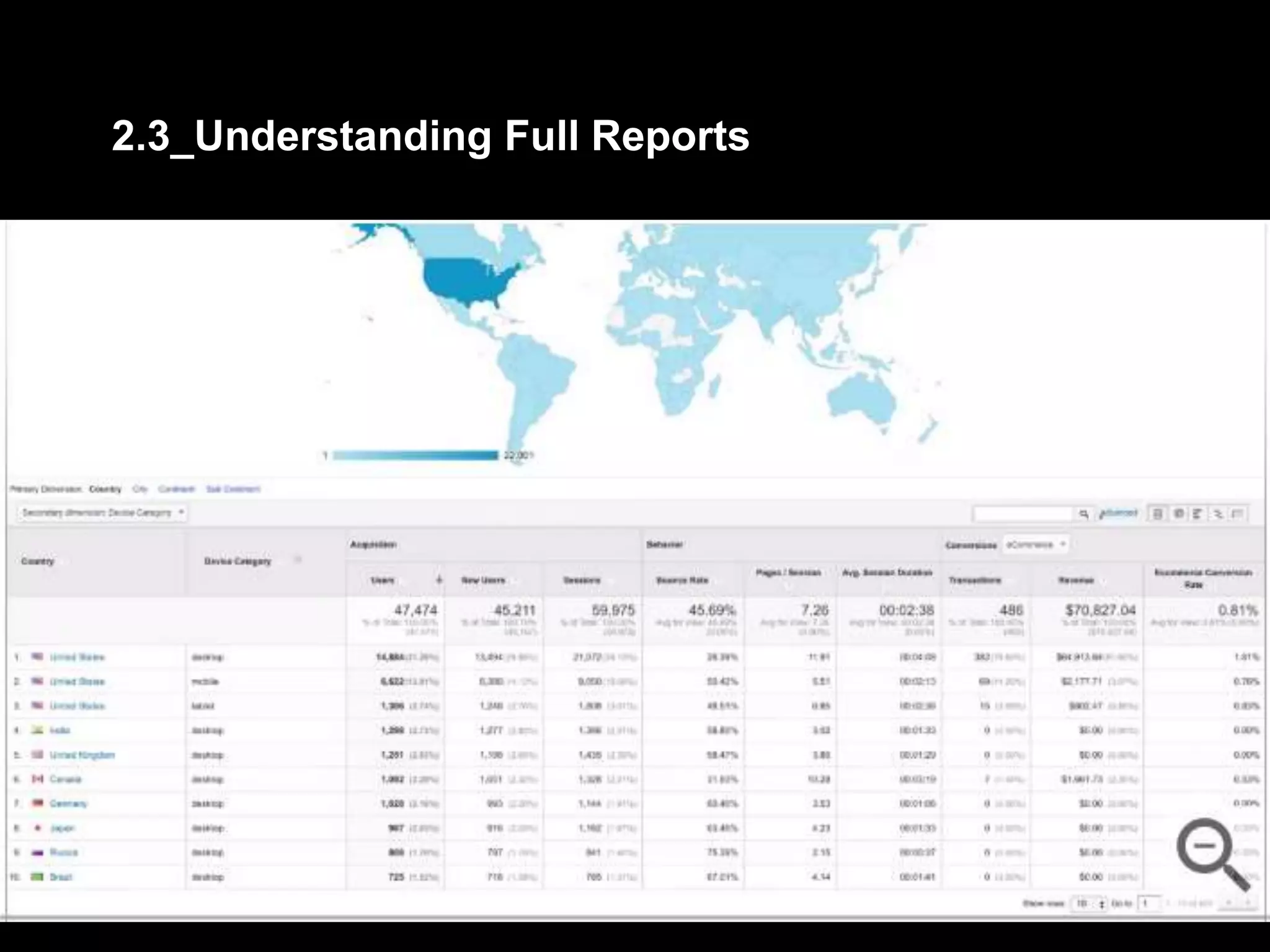
2.3_Understanding Full Reports
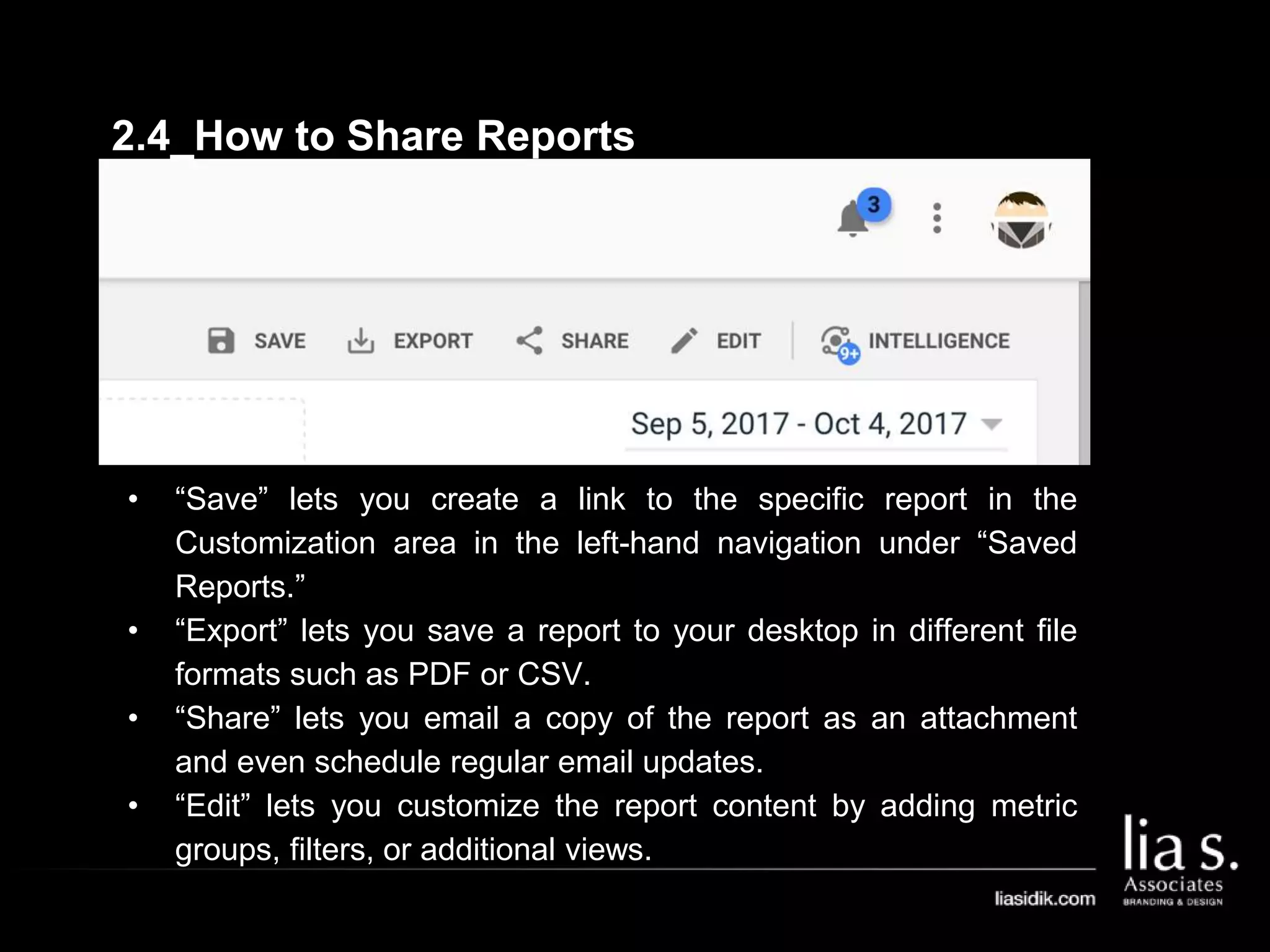
• “Save” lets you create a link to the specific report in the
Customization area in the left-hand navigation under “Saved
Reports.”
• “Export” lets you save a report to your desktop in different file
formats such as PDF or CSV.
• “Share” lets you email a copy of the report as an attachment
and even schedule regular email updates.
• “Edit” lets you customize the report content by adding metric
groups, filters, or additional views.
2.4_How to Share Reports
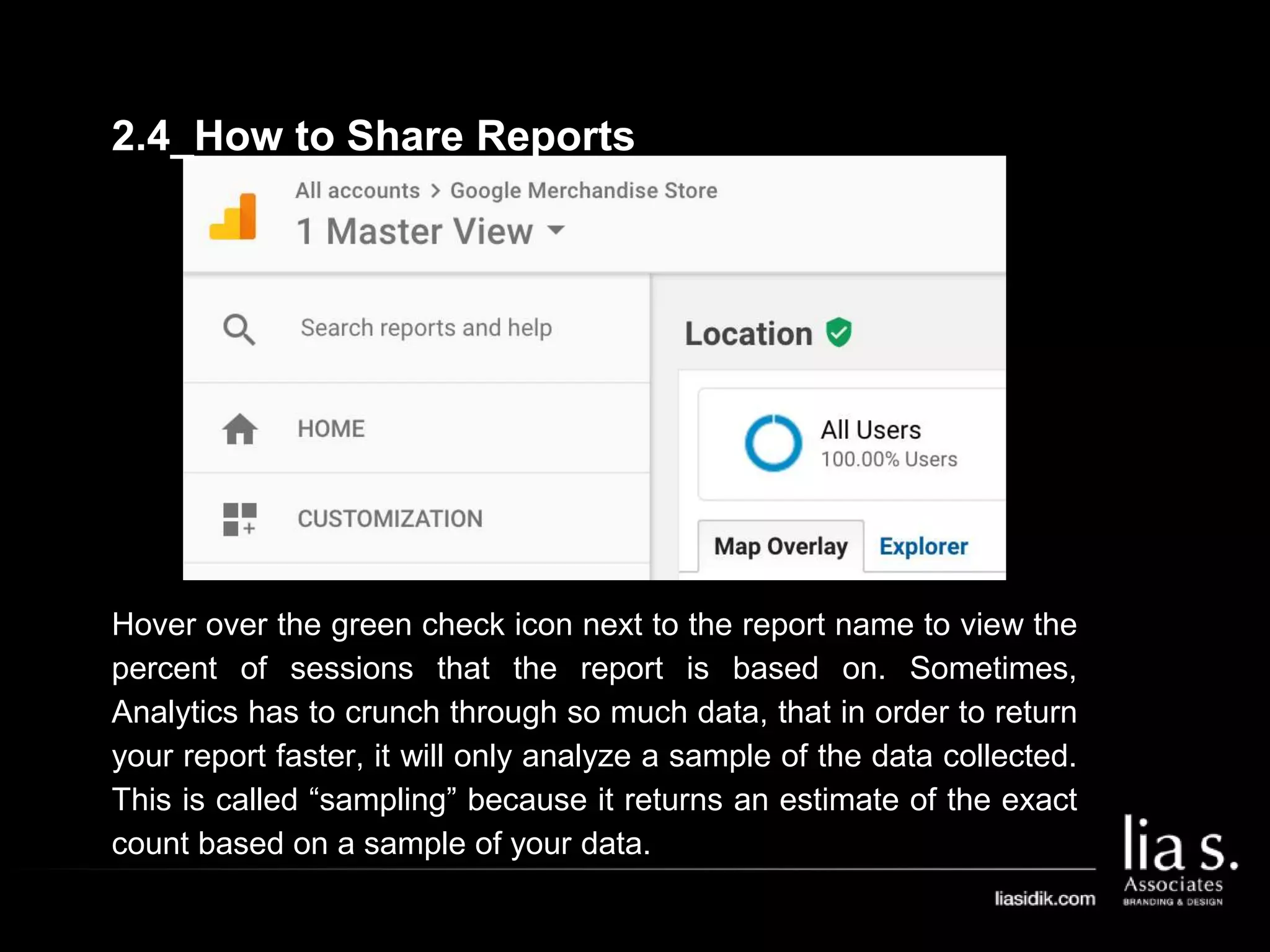
Hover over the green check icon next to the report name to view the
percent of sessions that the report is based on. Sometimes,
Analytics has to crunch through so much data, that in order to return
your report faster, it will only analyze a sample of the data collected.
This is called “sampling” because it returns an estimate of the exact
count based on a sample of your data.
2.4_How to Share Reports
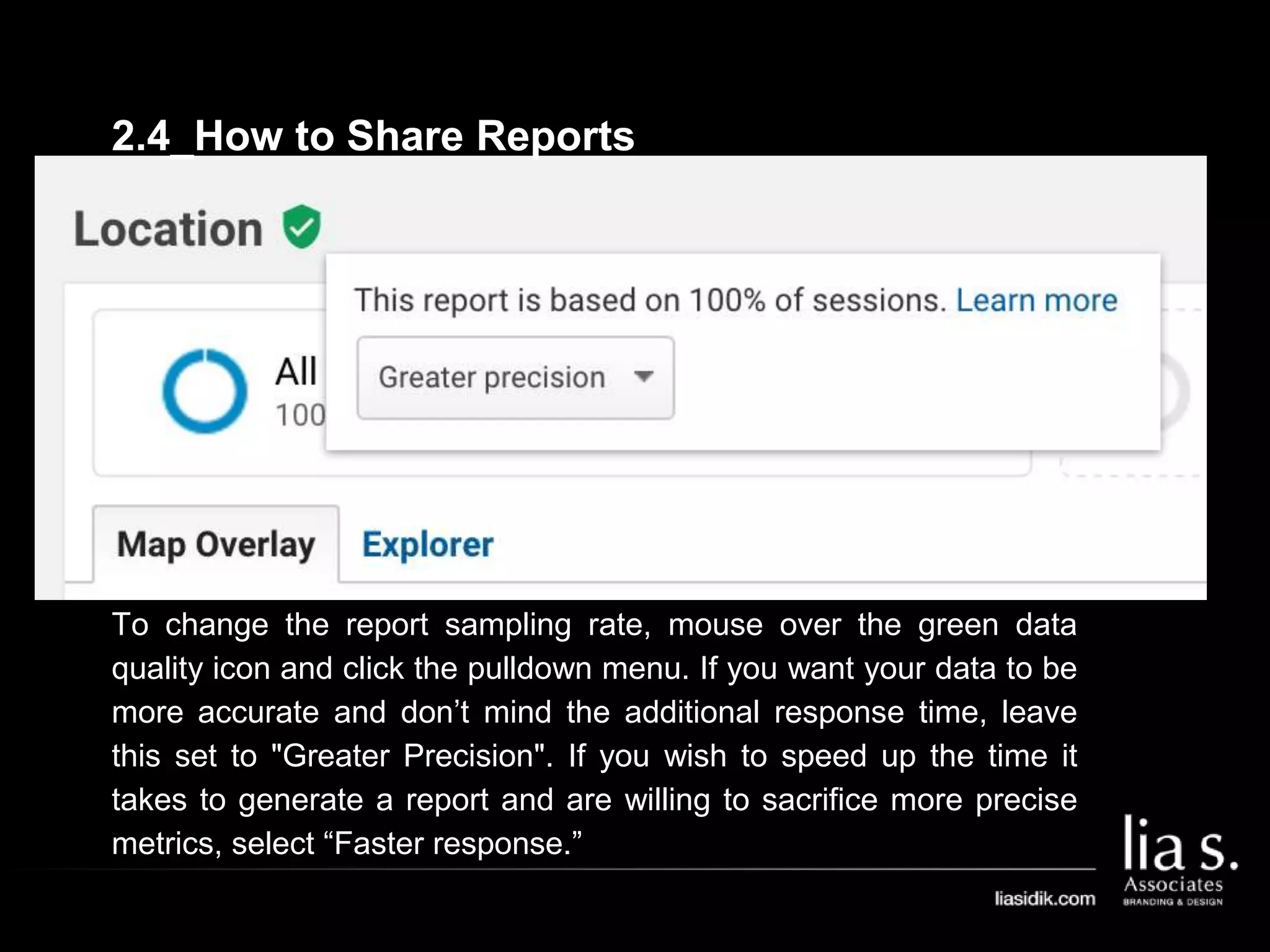
To change the report sampling rate, mouse over the green data
quality icon and click the pulldown menu. If you want your data to be
more accurate and don’t mind the additional response time, leave
this set to "Greater Precision". If you wish to speed up the time it
takes to generate a report and are willing to sacrifice more precise
metrics, select “Faster response.”
2.4_How to Share Reports
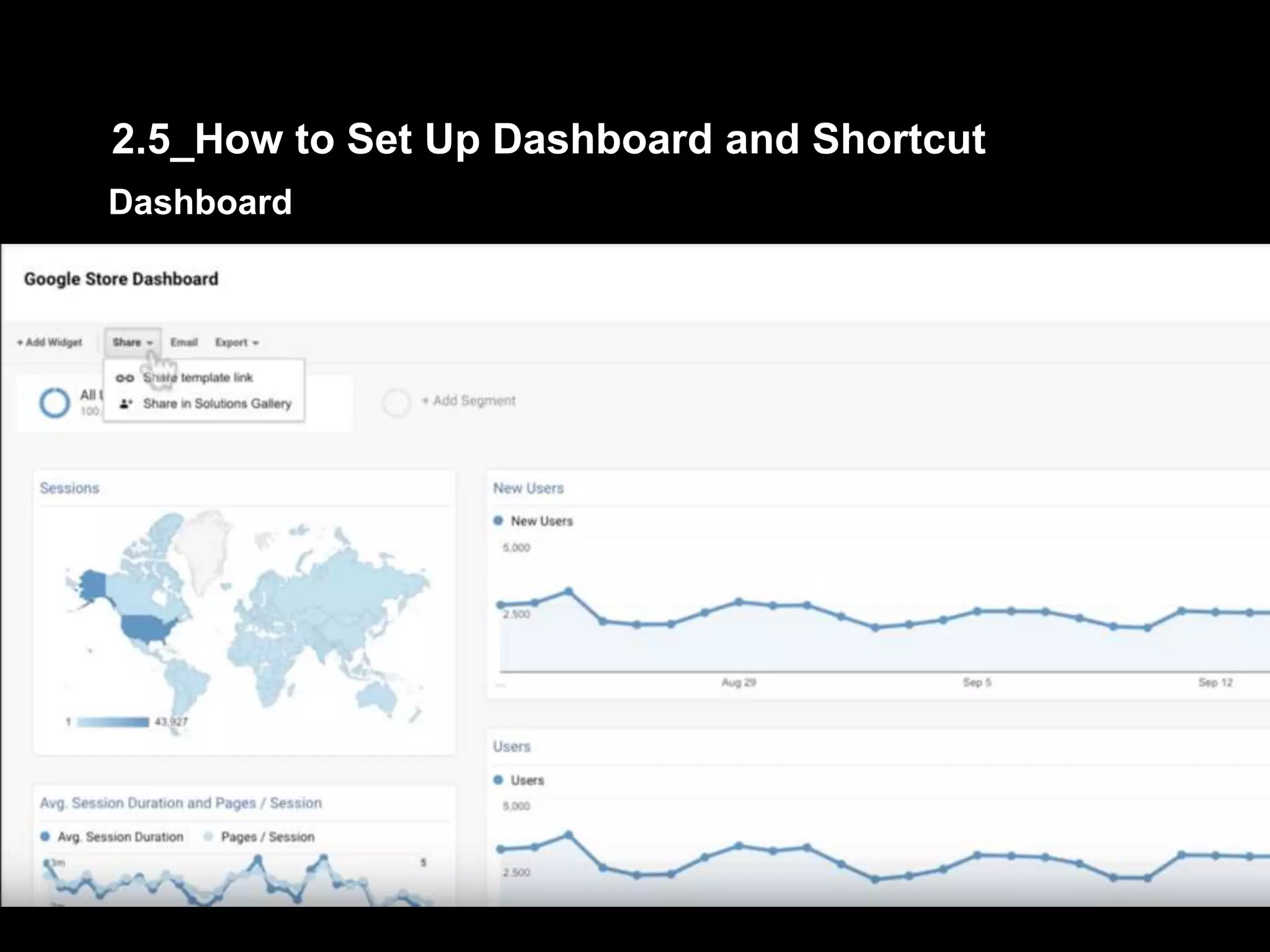
2.5_How to Set Up Dashboard and Shortcut
Dashboard
Dashboard
2.5_How to Set Up Dashboard and Shortcut
Dashboard
2.5_How to Set Up Dashboard and Shortcut
Dashboard
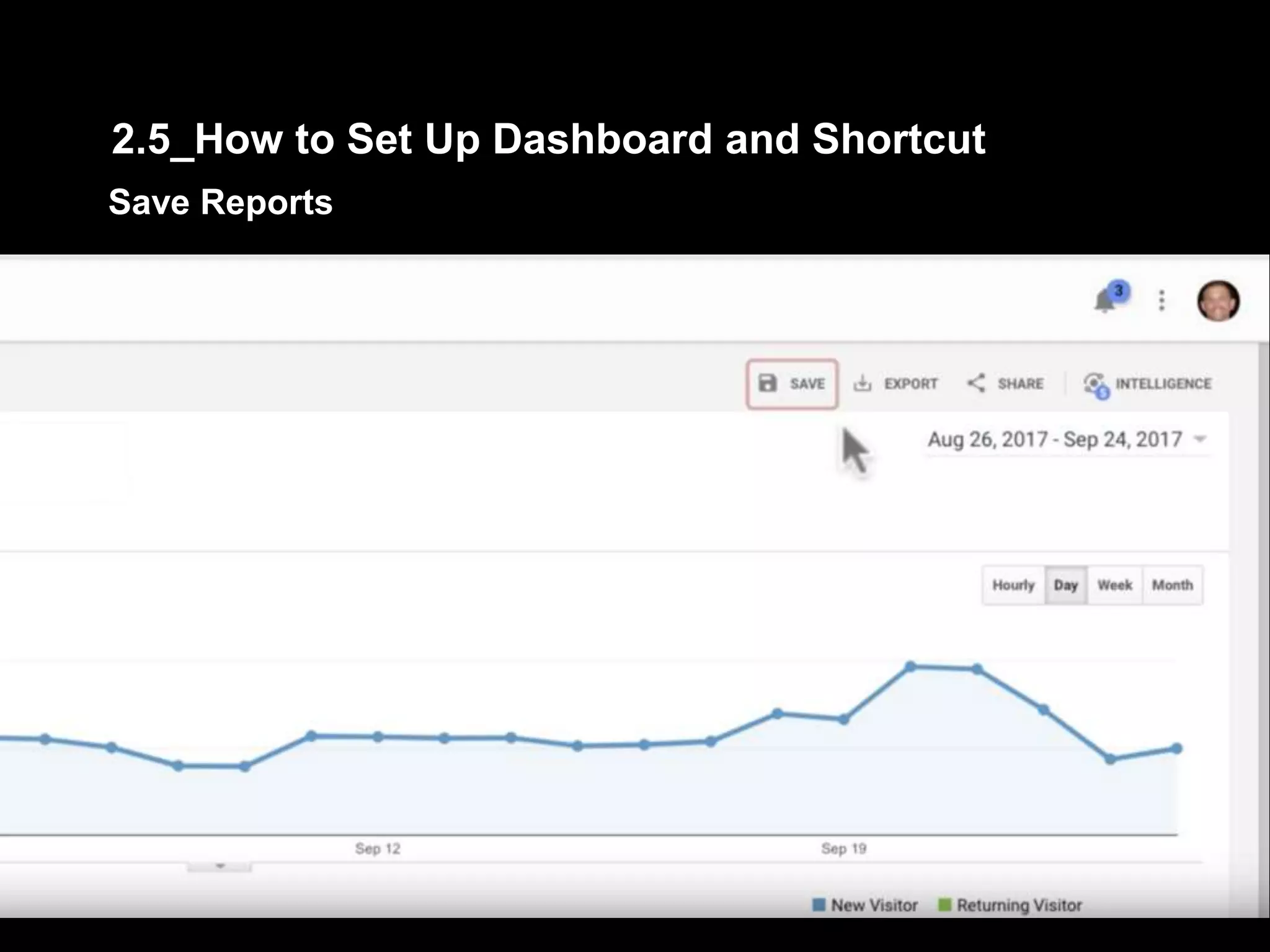
2.5_How to Set Up Dashboard and Shortcut
Save Reports
2.5_How to Set Up Dashboard and Shortcut
3.1_Audience Reports
3.2_Acquisition Reports
3.3_Behavior Reports
Chapter 3: Basic Reports
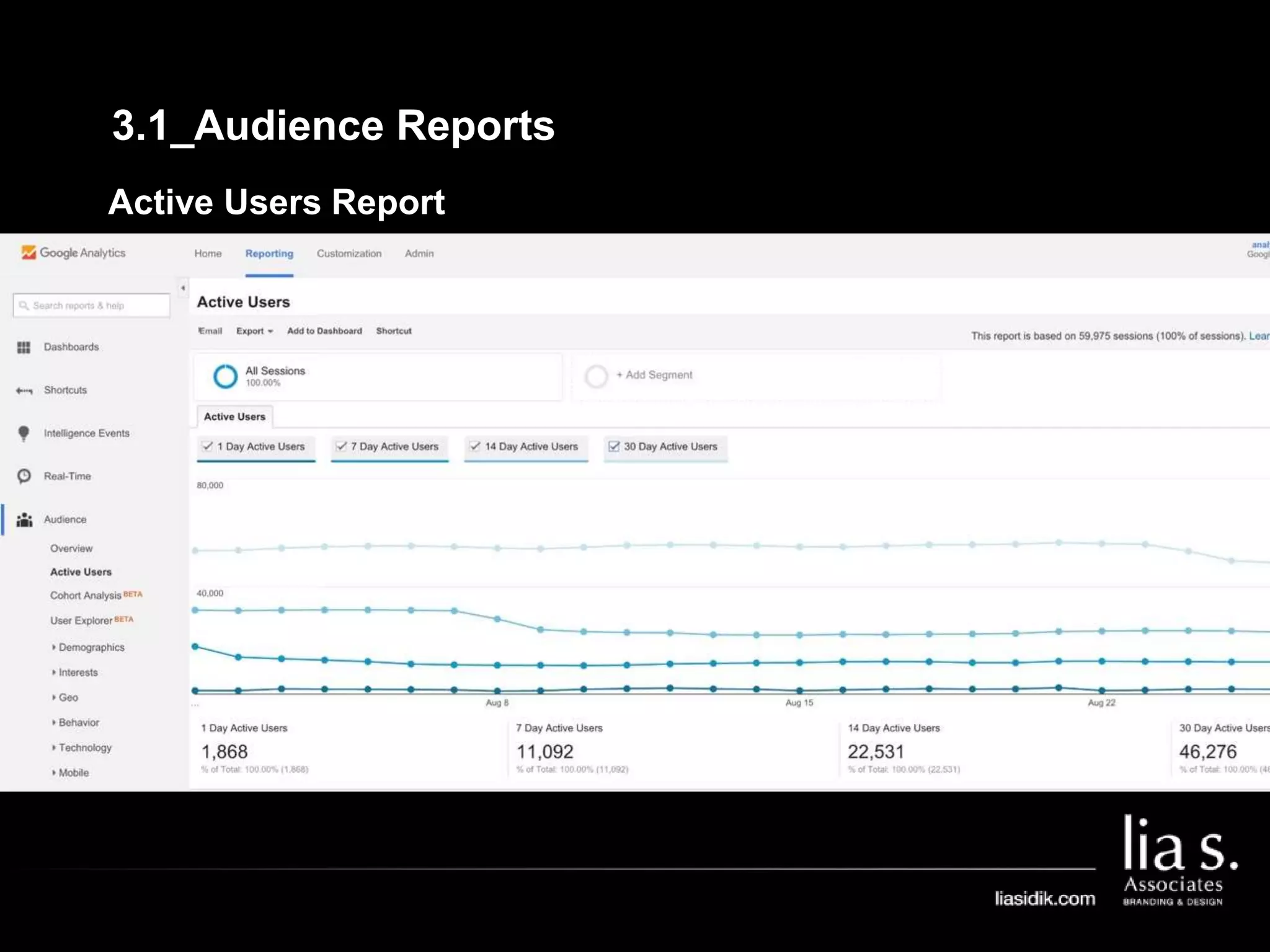
3.1_Audience Reports
Active Users Report
Demographic and Interests Report
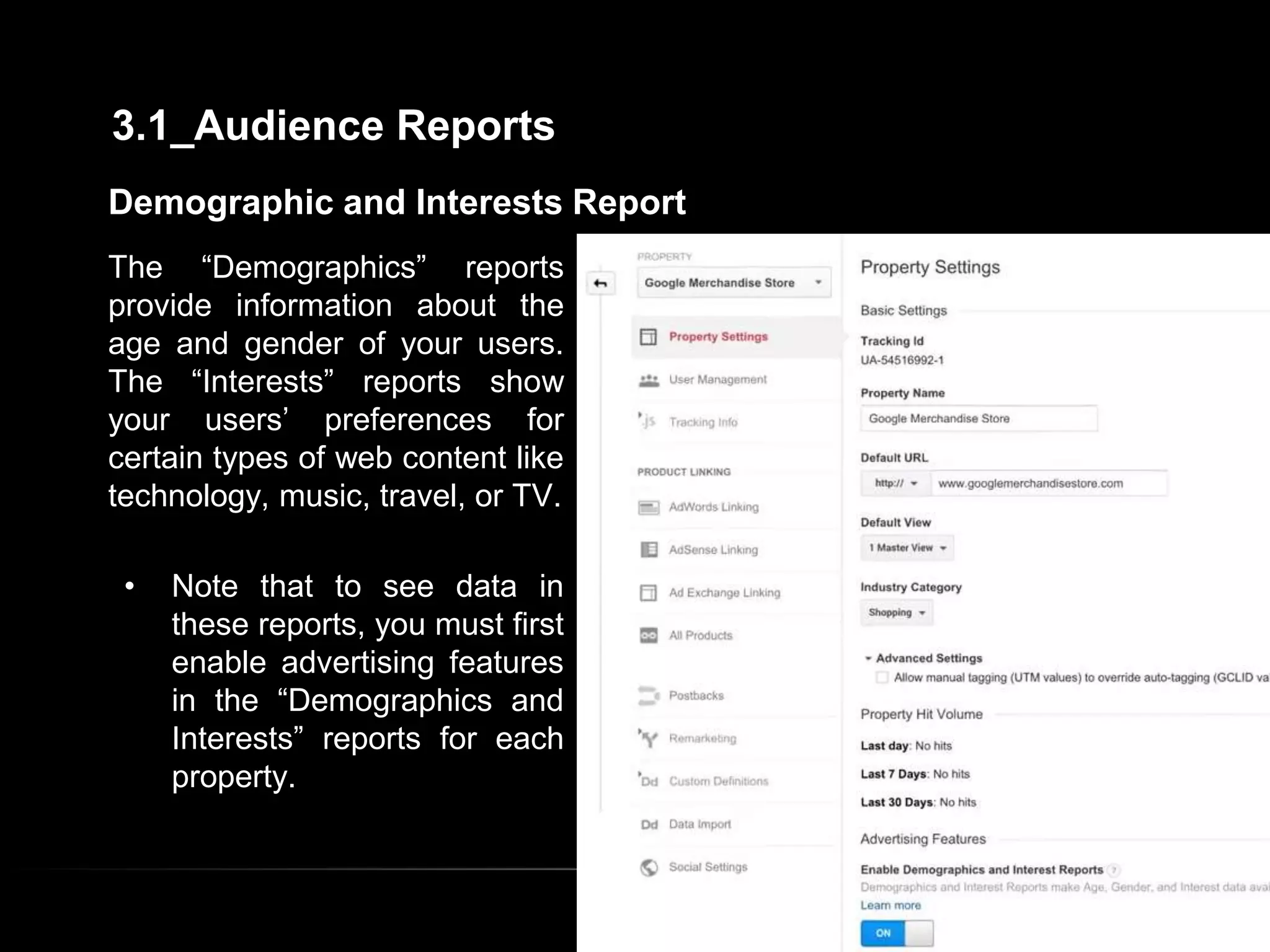
The “Demographics” reports
provide information about the
age and gender of your users.
The “Interests” reports show
your users’ preferences for
certain types of web content like
technology, music, travel, or TV.
• Note that to see data in
these reports, you must first
enable advertising features
in the “Demographics and
Interests” reports for each
property.
3.1_Audience Reports
Geographic Reports
The “Location” report under “Geo” is one of the most useful
Audience reports. Google Analytics can anonymously determine a
user’s continent, sub-continent, country, and city through the IP
address used by their browser. Notice the geographic heat map at
the top of the report, which you can adjust to display different
metrics. This can help you decide whether to build awareness or
invest in customer loyalty in particular locations.
3.1_Audience Reports
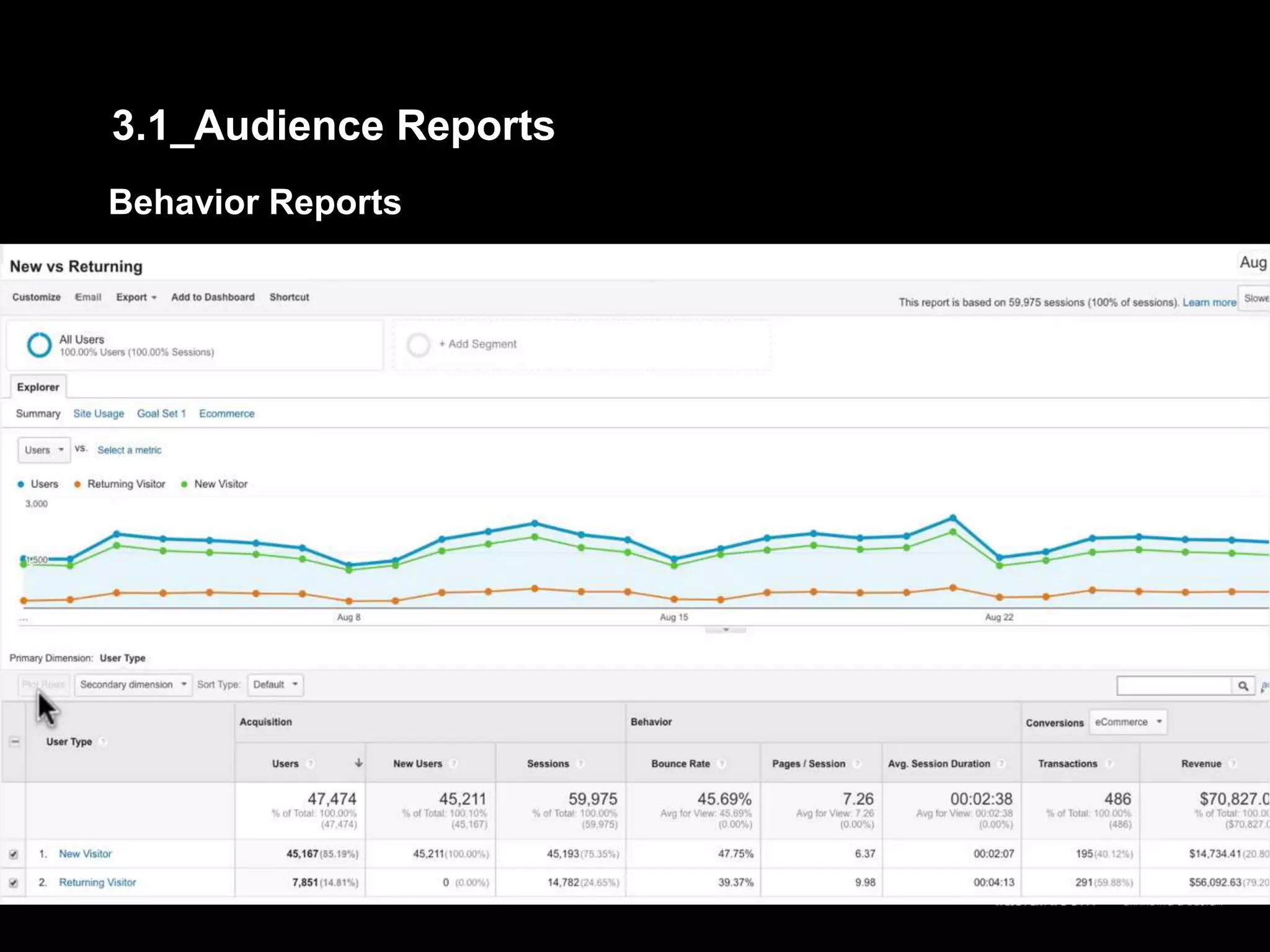
Behavior Reports
3.1_Audience Reports
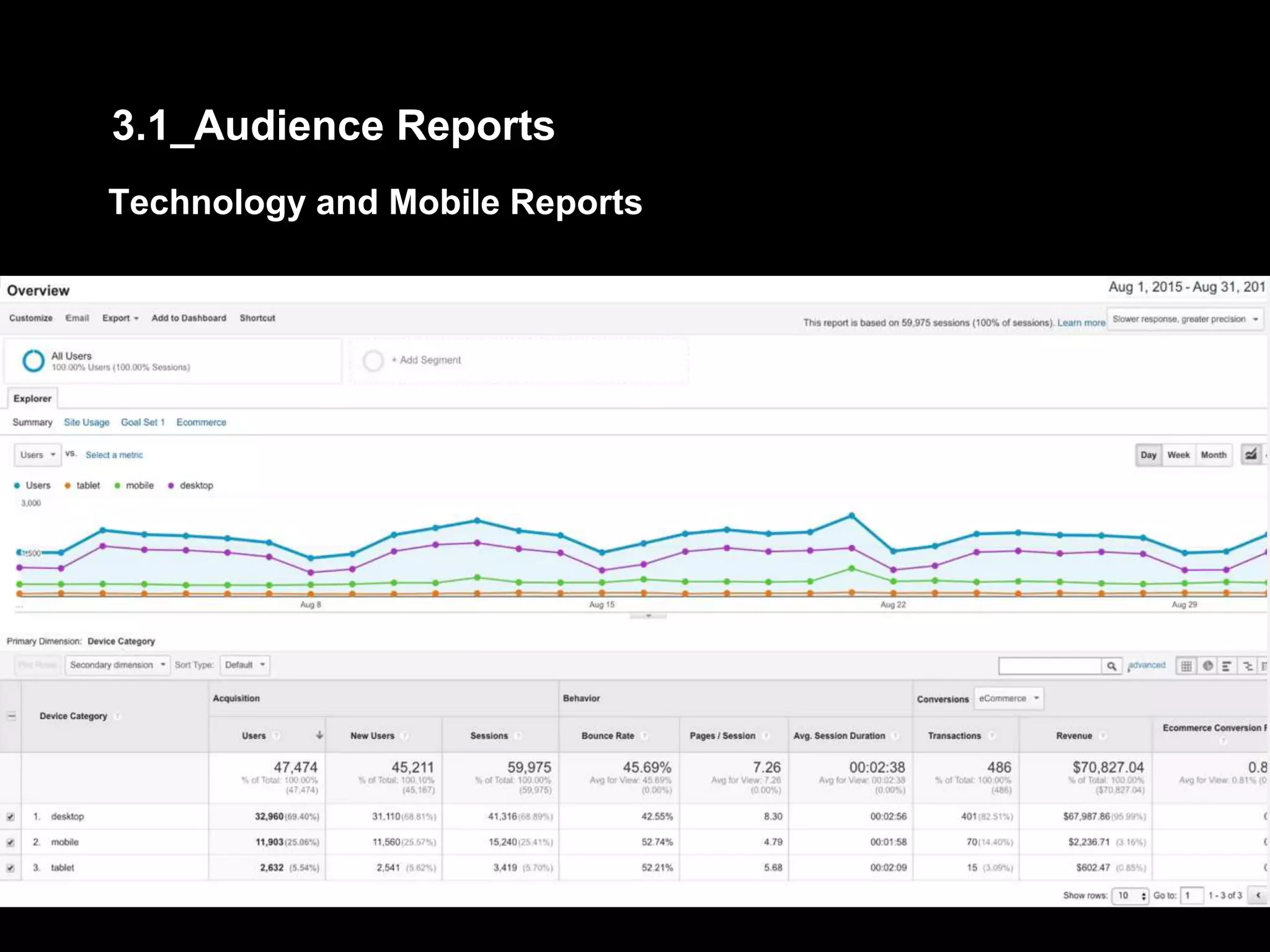
Technology and Mobile Reports
3.1_Audience Reports
3.2_Acquisition Reports
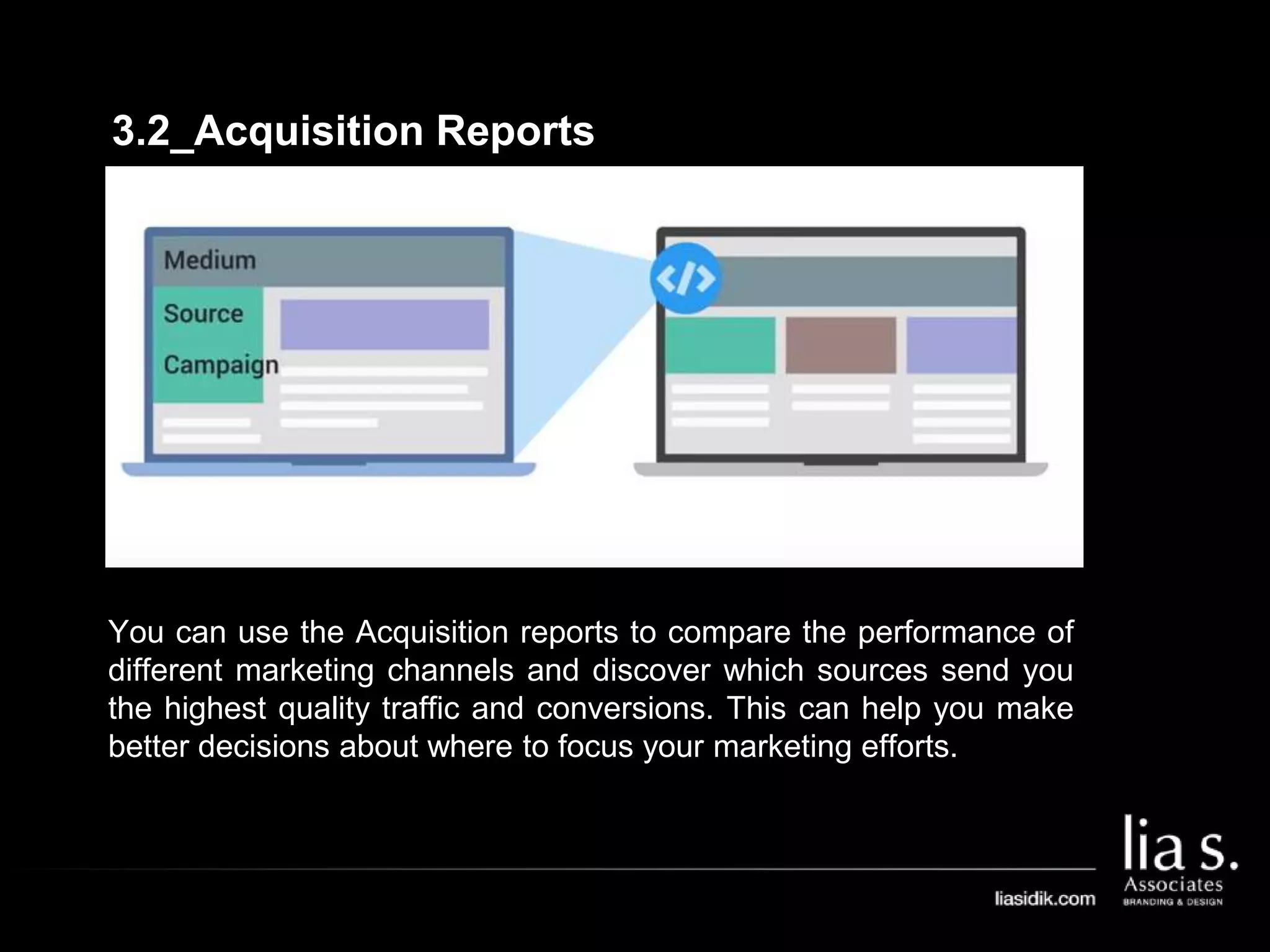
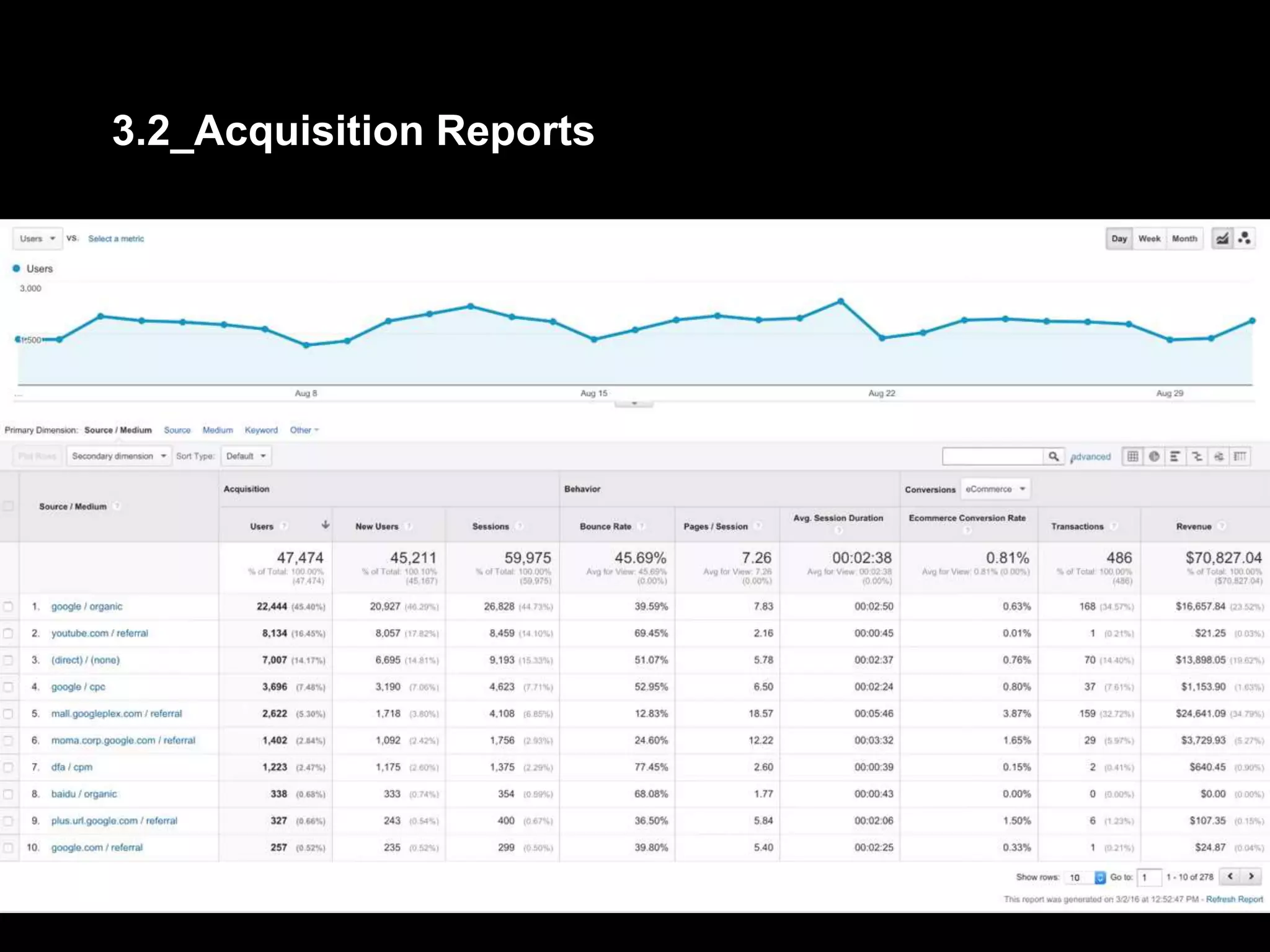
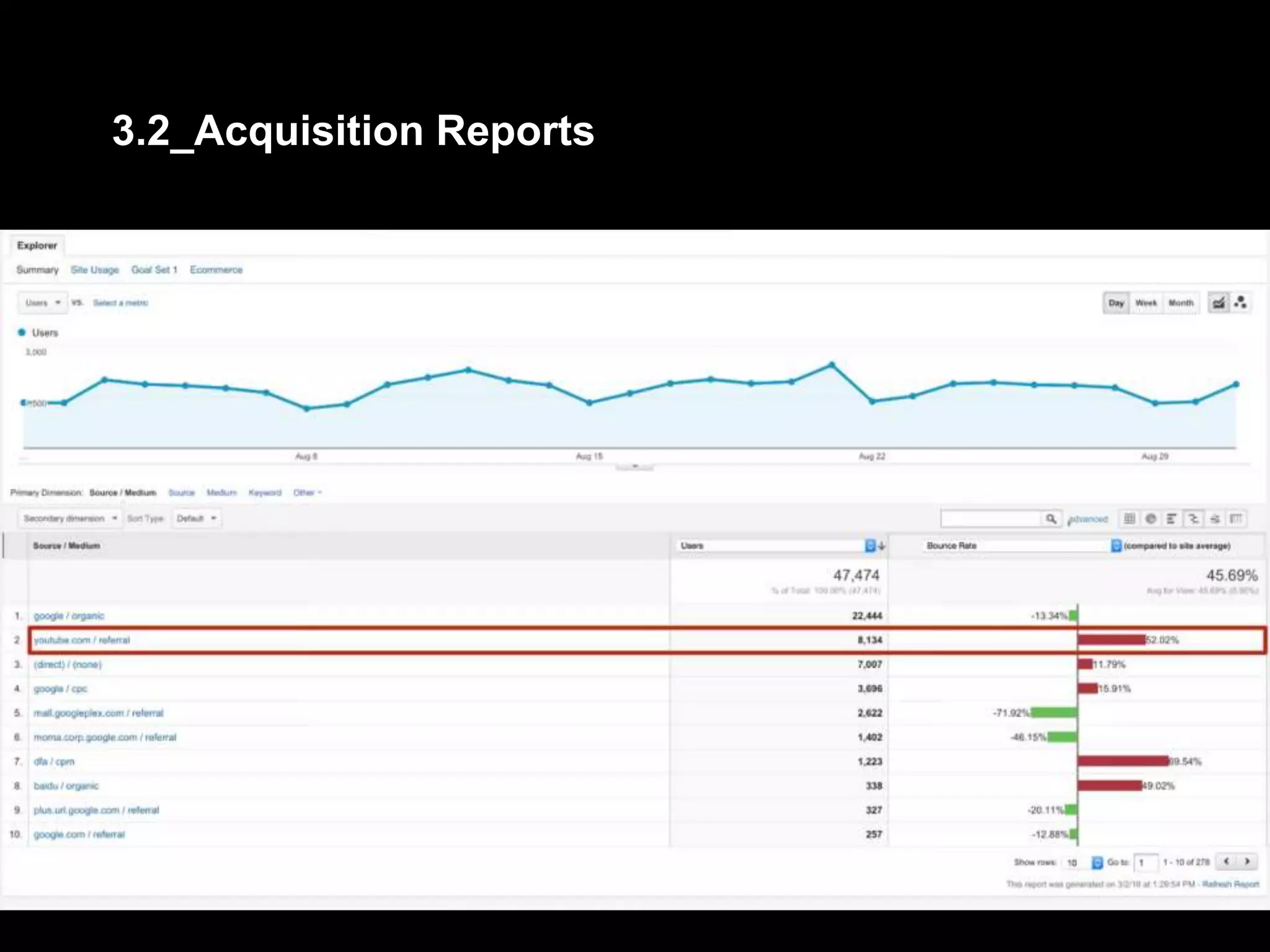
You can use the Acquisition reports to compare the performance of
different marketing channels and discover which sources send you
the highest quality traffic and conversions. This can help you make
better decisions about where to focus your marketing efforts.
3.2_Acquisition Reports
Channels Report
There are other ways to view which traffic sources bring the most
engaged users to the site. Using the “Channels” report, we could
view traffic by channel, which bundles the sources together under
each medium. Traffic sources are automatically grouped into basic
categories (or channels) like Organic, Social, Direct, Referral,
Display, etc.
Referrals Report
If you want to view your traffic organized by which sites have linked
to yours, you can look at the “Referrals” report.
You can even click into individual referrals to see which specific web
pages link back to your site. If you want to understand which specific
pages of your site are being linked to, you can add a secondary
dimension of “landing page” to the report.
3.2_Acquisition Reports
3.3_Behavior Reports
4.1_How to Track A Marketing Campaign
4.2_Tracking Campaigns with URL Builder
4.3_How to Set Up Goals in Analytics
4.4_How to Use Analytics with Google Ads
Chapter 4: Basic Campaign and Conversion
Tracking
4.1_How to Track A Marketing Campaign
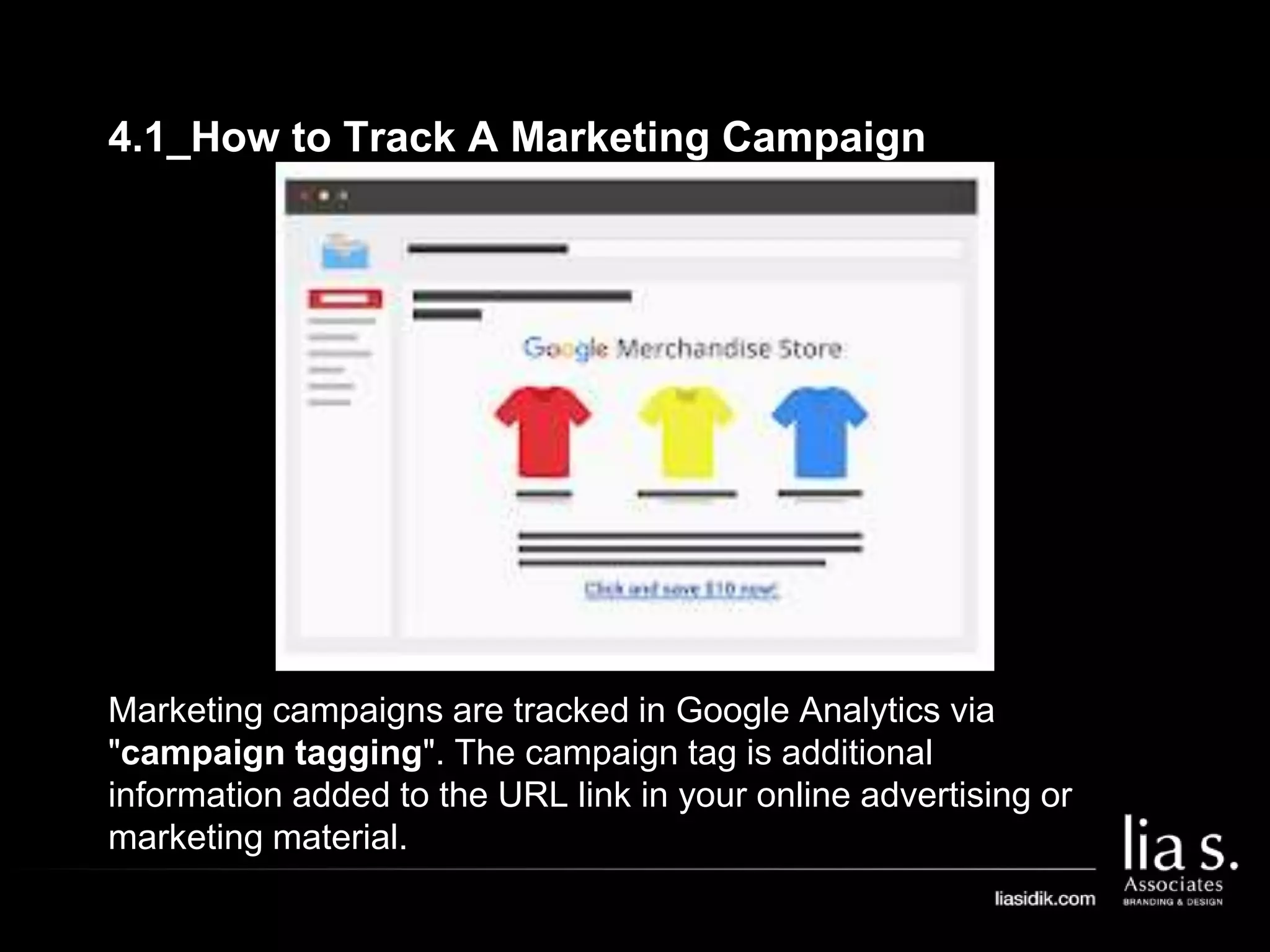
Marketing campaigns are tracked in Google Analytics via
"campaign tagging". The campaign tag is additional
information added to the URL link in your online advertising or
marketing material.
4.1_How to Track A Marketing Campaign
There are 5 different campaign tags that can help
you identify specific information about campaign
traffic.
1. Media
2. Source
3. Campaign
4. Content
5. Term
4.2_Tracking Campaigns with URL Builder
Google Analytics provides a feature called "URL Builder"
that helps you easily add campaign parameters to URLs to
track Custom Campaigns.
4.2_Tracking Campaigns with URL Builder
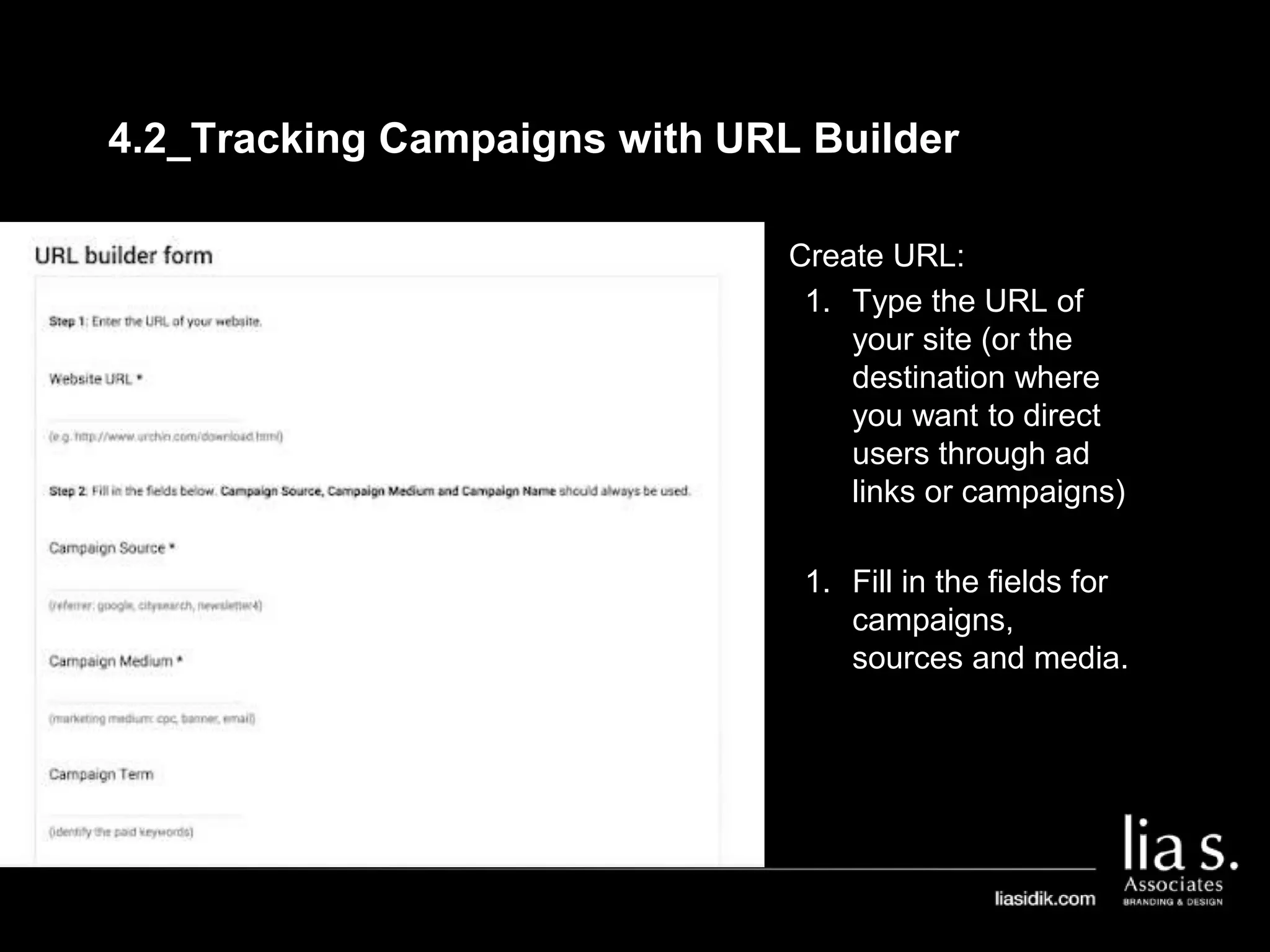
Create URL:
1. Type the URL of
your site (or the
destination where
you want to direct
users through ad
links or campaigns)
1. Fill in the fields for
campaigns,
sources and media.
4.2_Tracking Campaigns with URL Builder
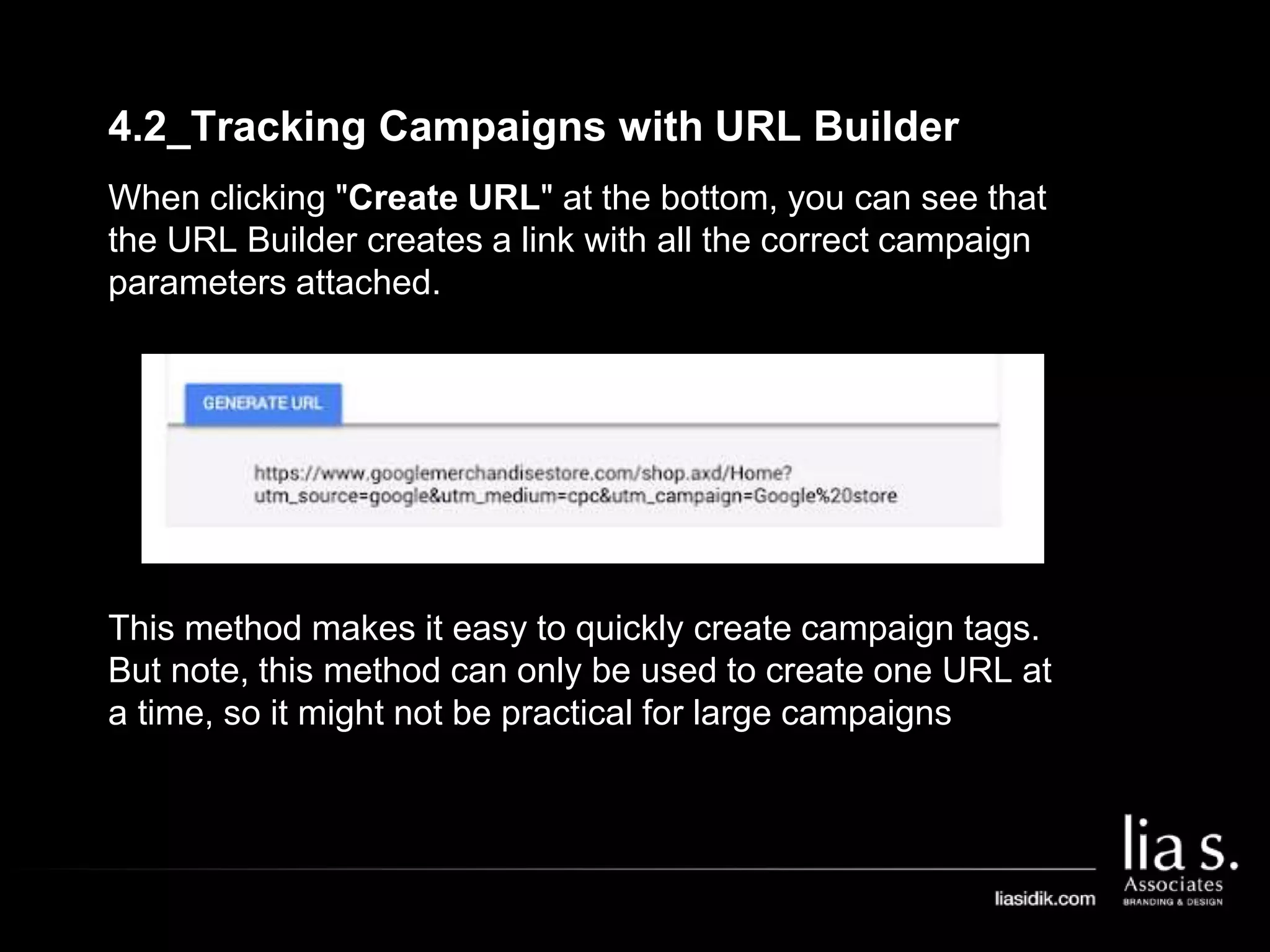
When clicking "Create URL" at the bottom, you can see that
the URL Builder creates a link with all the correct campaign
parameters attached.
This method makes it easy to quickly create campaign tags.
But note, this method can only be used to create one URL at
a time, so it might not be practical for large campaigns
4.2_Tracking Campaigns with URL Builder
Here's an easy way to test a campaign before launching it.
1. Open an incognito window or a secret browsing session.
2. Copy and paste the link that was created into the browser
URL column to track the campaign.
3. After the site loads, explore your site and complete a
number of important actions.
Then open the "All Campaigns" report in the "Acquisition"
section under "Campaigns". This report allows you to
compare incoming traffic from various marketing campaigns.
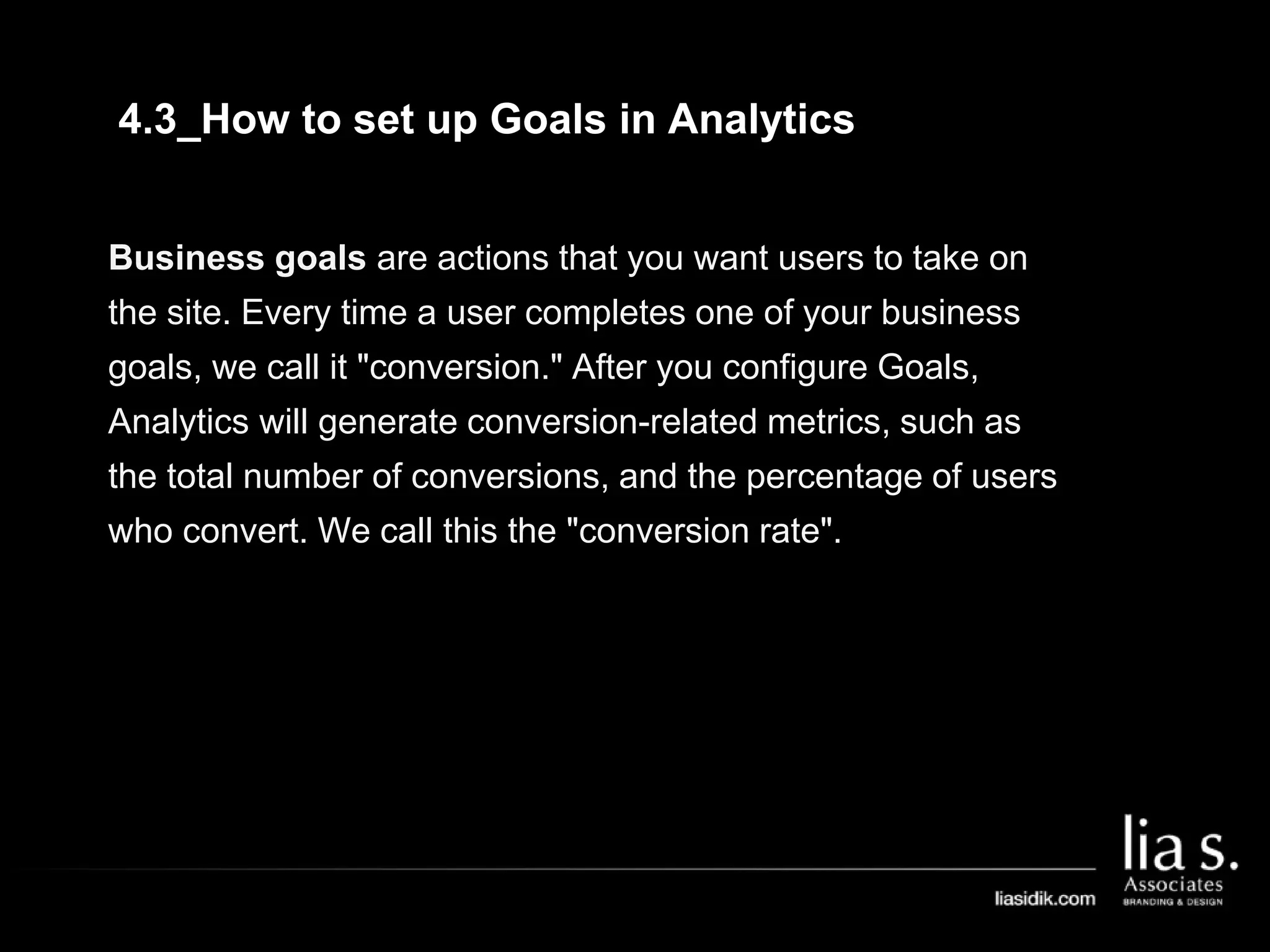
4.3_How to set up Goals in Analytics
Business goals are actions that you want users to take on
the site. Every time a user completes one of your business
goals, we call it "conversion." After you configure Goals,
Analytics will generate conversion-related metrics, such as
the total number of conversions, and the percentage of users
who convert. We call this the "conversion rate".
But in Google Analytics, you use a feature called "Goals" to
track this conversion. After you configure Goals, Analytics will
generate conversion-related metrics, such as the total number
of conversions, and the percentage of users who convert. We
call this the "conversion rate".xccc
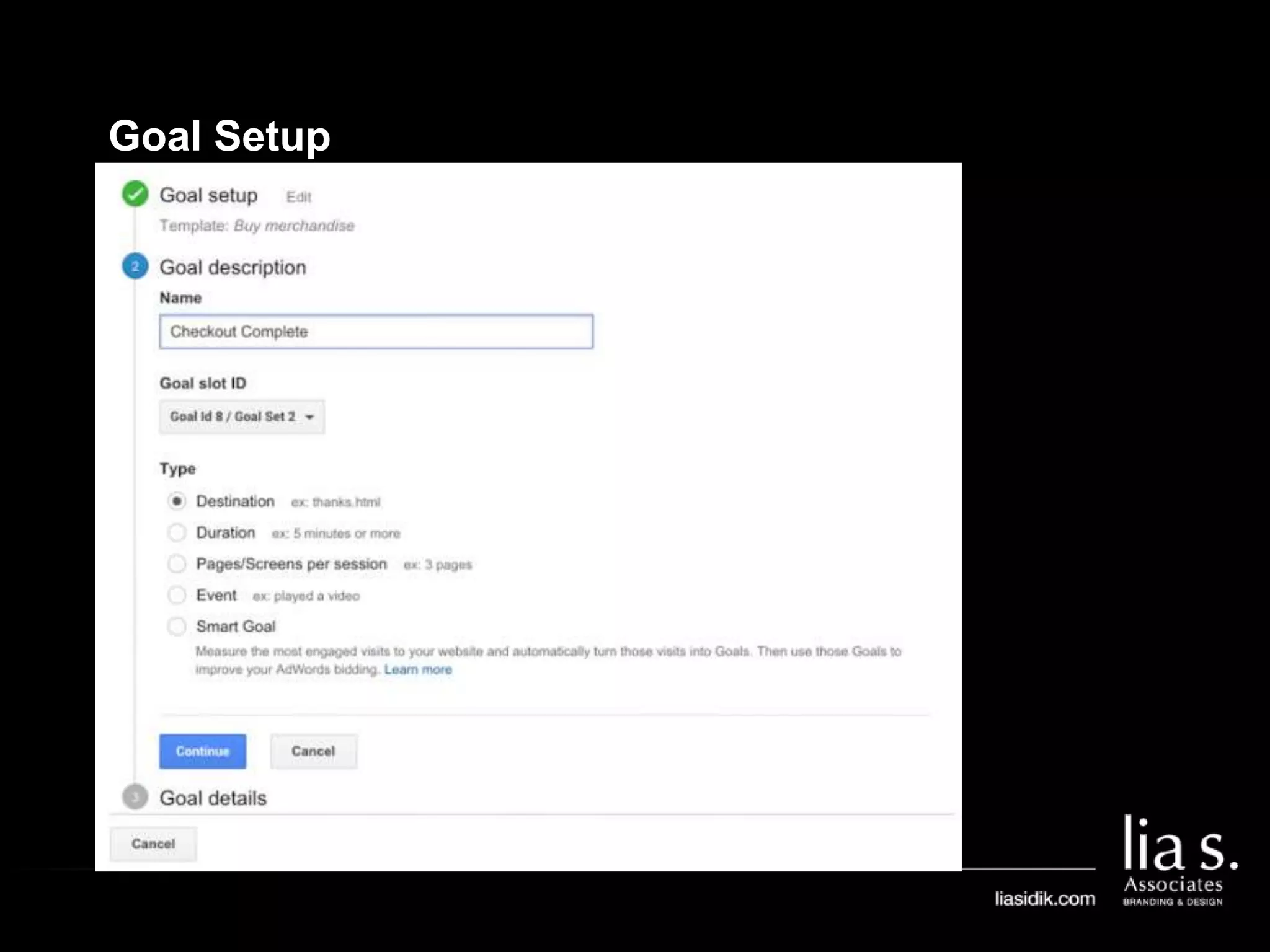
Goal Setup
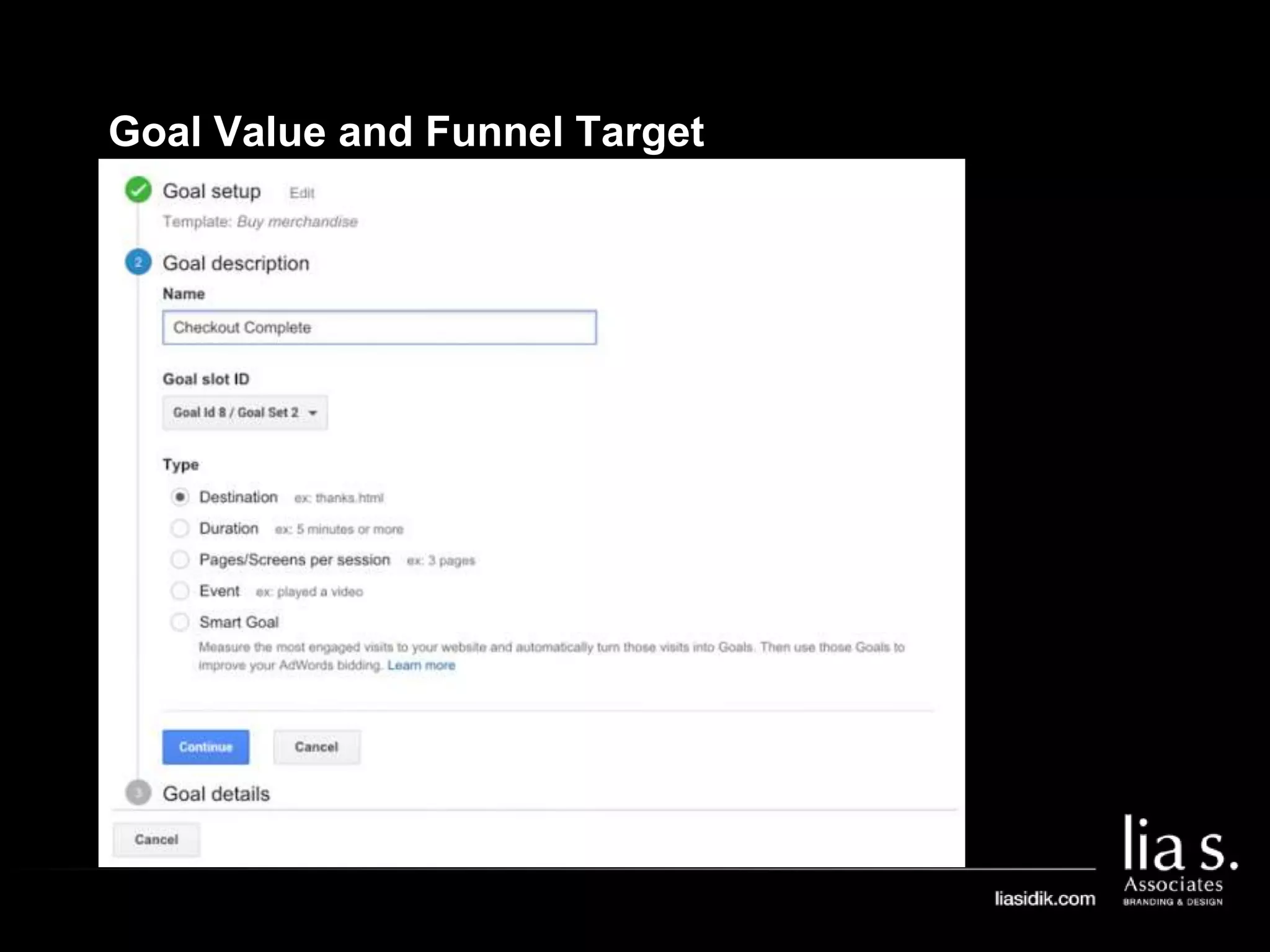
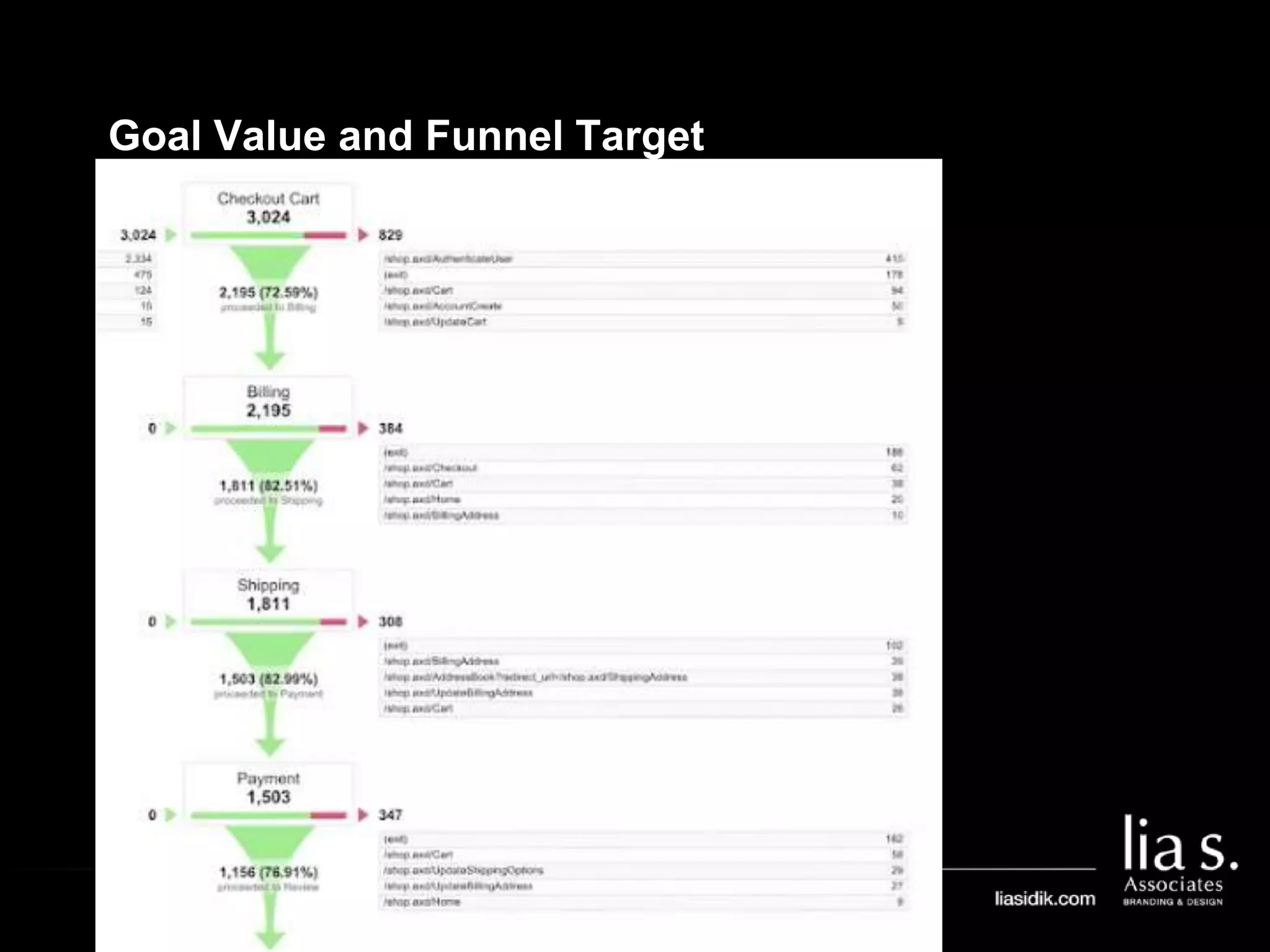
Goal Value and Funnel Target
4.4_How to Use Analytics with Google Ads
Google Ads is a Google advertising system that allows
businesses to produce text and display ads. Text ads appear
next to Google search results by matching keywords that you
can bid with user search queries.
Display ads are ads that consist of text, images, animations,
and videos that appear on a large collection of sites called the
Google Display Network.
4.4_How to Use Analytics with Google Ads
If your Google Analytics account is linked to a Google Ads
account, you can:
1. view Google Ads click and cost data along with site
interaction data in Google Analytics;
2. create remarketing lists in Analytics for use in Google Ads
campaigns;
3. import Analytics goals and transactions into Google Ads
as conversions;
4. and see Analytics site interaction data on Google Ads.
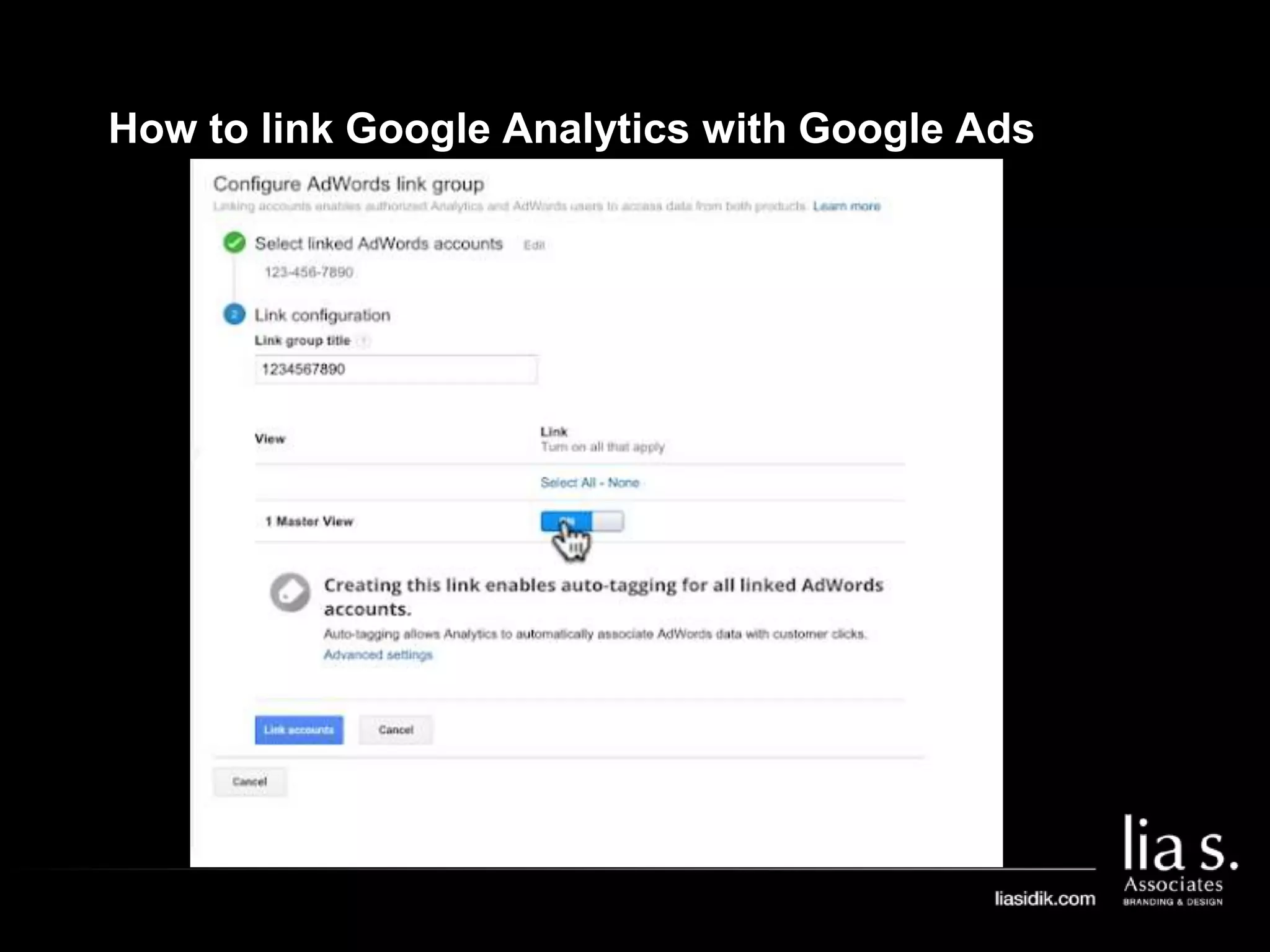
How to link Google Analytics with Google Ads
1. You login to Analytics using the same email as your
Google Ads account.
2. Note that you must be an administrator on both accounts.
3. Click the Admin tab. Next, make sure you select the
account and property that you want to link to the Google
Ads account.
4. In the Property section, select "Google Ads".
5. Click the "New link group" button.
6. The Google Ads account that is linked to your Google
account will appear automatically.
7. Check the account you want to link, then click "continue".
8. Next, type "Link Group Title". This title can be your
Google Ads account ID.
How to link Google Analytics with Google Ads
Auto-tagging
Google Ads can automatically add special campaign tags to
your Google Ads URL through a feature called auto-tagging.
Auto-tagging is required to send specific Google Ads
dimensions to Google Analytics.
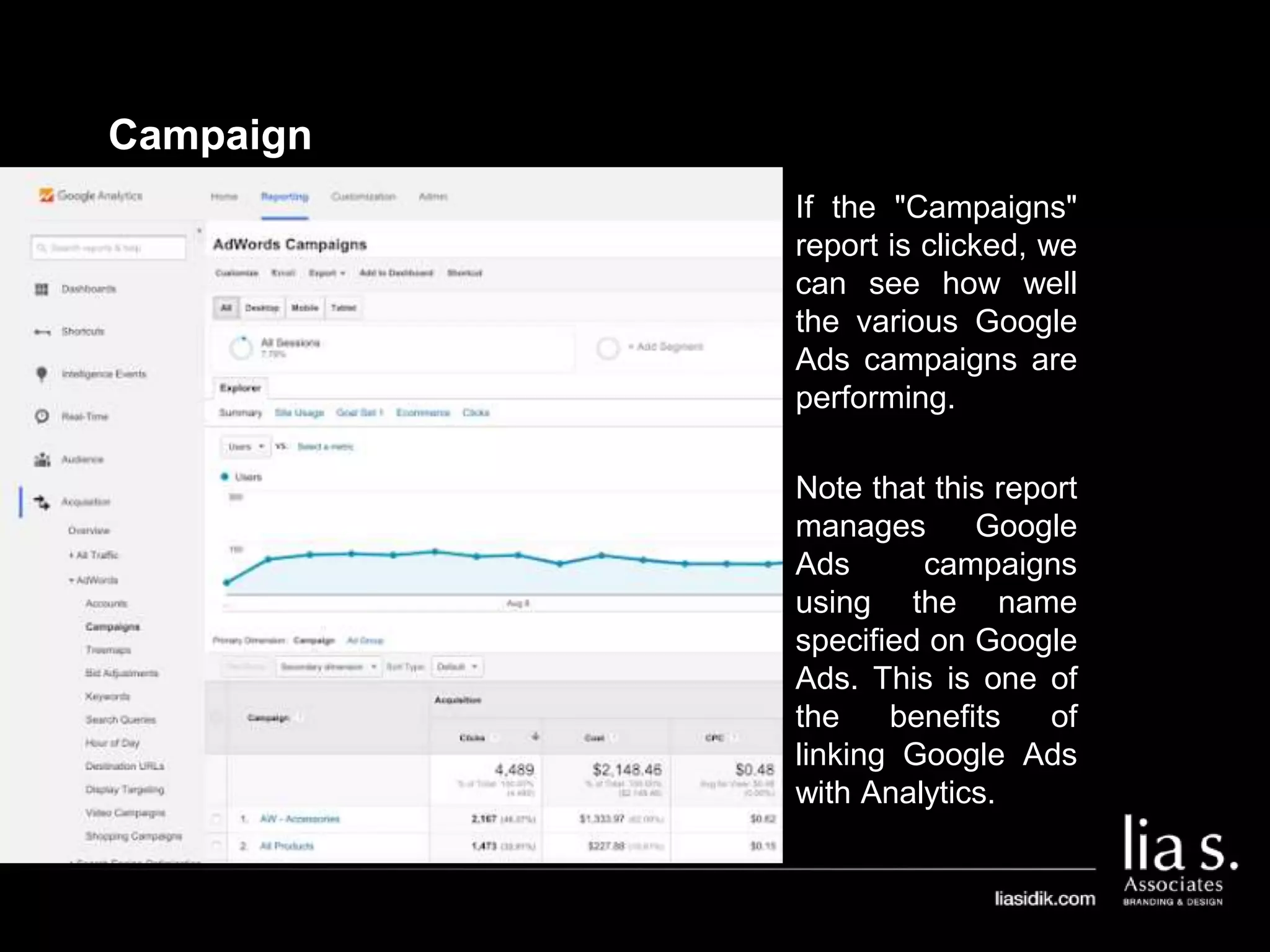
Campaign
If the "Campaigns"
report is clicked, we
can see how well
the various Google
Ads campaigns are
performing.
Note that this report
manages Google
Ads campaigns
using the name
specified on Google
Ads. This is one of
the benefits of
linking Google Ads
with Analytics.
Keyword
The "Keywords" report can help you understand how well
individual keywords and ads are performing. For example, if a
keyword generates a lot of traffic but has a high bounce rate,
then this might indicate an ad disconnection from the landing
page content.
Bid adjustment
Bid adjustment is a Google Ads feature that is used to
automatically adjust keyword bids based on user device,
location, or time. The Bid Adjustment report in Analytics
allows you to analyze Google Ads performance for bid
adjustments set for campaigns.
4.5_Course Summary
What we’ve learned in Google Analytics for Beginners. We
have discussed:
1. Ways digital analytics can help your business
2. How Google Analytics works through the demos
displayed
3. A step-by-step guide for creating an account, installing
the tracking code, and preparing various views with filters
for testing.
THANK YOU
lia s. Associates
159 200523 Google Analytics For Beginners

159 200523 Google Analytics For Beginners

  • 1.
    200523 GAMBAR COVER BUKU/ GAMBARPENDUKUNG LAIN lia s. Associates BOOKCLUB Google Analytics for Beginners
  • 2.
    1.1 Why DigitalAnalytics 1.2 How Google Analytics Works 1.3 Google Analytics Setup 1.4 How to Set Up Views with Filters Chapter 1: Introducing Google Analytics
  • 3.
    1.1_Why Digital Analytics? DIGITALANALYTICS helps us in measuring 3 aspects of Basic Purchase Funnel. We can learn the behaviors of users to understand them, and adjust our digital sales strategy. Not only for website, but also variety of systems. ACQUISiTION: building awareness & acquiring user interest. BEHAVIOR: when users engage in your business CONVERSION: when user becomes customer and transacts your business.
  • 4.
    1.2_How Google AnalyticsWorks Have a Google Analytics account and add a javascript code to your website to start track: + How user interacted with the page + How many preferred product A instead of B. + Traffic source (which advertisement they clicked on, language, type of browser, device, operating system) This course is primarily on how to measure a website traffic.
  • 5.
    1.2_How Google AnalyticsWorks Google Analytics tracks per session (of 30 minutes period), and data collected will be converted into a report. Page revisit or refresh after 1 session will be counted as new session. Data that we want to be collected can be filtered according to what we need, and cannot be changed.
  • 6.
    1.3_Google Analytics Setup YourGoogle Analytics account(s) can be grouped into Organization. Each Account can have multiple Property, and each Property can have multiple View. View is where we can filter what data we want to see, we can set goals per View as well. Views will not include past data, and only admins can recover deleted data in limited time.
  • 7.
    1.3_Google Analytics Setup Permissionto modify Account, Property, and View depends on who and what authority is/are granted by admins on User Management tab.
  • 9.
    GET STARTED: Login to your standard Google Account to access analytics.google.com
  • 10.
    ACCOUNT SETUP: Typeaccount name of your choice.
  • 11.
    WHAT DO YOUWANT TO MEASURE: Pick one for what you want to measure, currently Apps & Web option is still on BETA mode.
  • 12.
    WHAT DO YOUWANT TO MEASURE: Pick one for what you want to measure, currently Apps & Web option is still on BETA mode.
  • 13.
    TRACKING CODE: Putthe code after <head> right away. You can find this code on Admin > Tracking Info > Tracking Code.
  • 14.
    1.4_How to SetUp Views with Filters
  • 15.
    You can changeView Name (left) and Create New View as well (right) 1.4_How to Set Up Views with Filters
  • 16.
    1.4_How to SetUp Views with Filters Create 3 views of: Raw Data, Test View, Master View. Raw Data is to store unfiltered data for back up purpose. Test View to test new configurations. Master View is the base for daily reporting.
  • 17.
    On Test View,click Filters, then set up as on image above. To get your IP, search “What is my IP?” on Google. 1.4_How to Set Up Views with Filters
  • 18.
    On Reporting >Traffic Resources, check if there’s decline in view and our IP address has been excluded to make sure filter works. 1.4_How to Set Up Views with Filters
  • 19.
    To add Filterwe created on Test View to Master View, go to Admin > Filters, then do as on image above. 1.4_How to Set Up Views with Filters
  • 20.
    To add Filterwe created on Test View to Master View, go to Admin > Filters, then do as on image above. 1.4_How to Set Up Views with Filters
  • 21.
    2.1_Navigating Google Analytics 2.2_UnderstandingOverview Reports 2.3_Understanding Full Reports 2.4_How to Share Reports 2.5_How to Set Up Dashboards and Shortcuts Chapter 2: The Google Analytics Interface
  • 22.
  • 23.
    Alert Icon AlertMenu Clicking the bell icon in the upper right shows you alerts about your Google Analytics properties and views. 2.1_Navigating Google Analytics
  • 24.
    Feedback, Help, andSettings At the top right of your Analytics view are two more icons: • The "question mark" icon lets you send feedback to Google Analytics or search Help articles • The user icon lets you switch between different Google accounts, manage your current Google account, or sign out 2.1_Navigating Google Analytics
  • 25.
    Customization The Customization section allowsyou to create custom reports, specific to your business. We'll cover customization in an advanced course. Left Hand Navigation 2.1_Navigating Google Analytics
  • 26.
    Real Time Reports Real-Timereports let you look at live user behavior on your website including information like where your users are coming from and if they’re converting. Audience Reports Audience reports show you characteristics about your users like age and gender, where they’re from, their interests, how engaged they were, whether they’re new or returning users, and what technology they’re using. 2.1_Navigating Google Analytics
  • 27.
    Acquisition Reports Acquisition reportsshow you which channels (such as advertising or marketing campaigns) brought users to your site. This could include different marketing channels such as: • "Organic” (or unpaid search) • “CPC” (“cost per click” or paid search) • “Referral” (traffic that comes from another website) • “Social” (from a social network) • or “Other,” (a group of low volume traffic sources) 2.1_Navigating Google Analytics
  • 28.
    Behavior Reports Behavior reportsshow how people engaged on your site including which pages they viewed, and their landing and exit pages. Conversion Reports Conversion reports allow you to track website goals based on your business objectives. 2.1_Navigating Google Analytics
  • 29.
    Admin Section The Adminsection contains all of your Google Analytics settings such as user permissions, tracking code, view settings, and filters. Collapse Left-Hand Navigation Use this pointer to shrink the navigation and provide more space for your reports. 2.1_Navigating Google Analytics
  • 30.
    Date Range At thetop of every report is a date-range. This lets you set the time period in which you want to analyze report data. Click the date range to open up the date range selector. Date Range Selector This opens up a calendar on the left where you can select your date ranges. When you change the date range, it affects all of the reports in your view. So you can switch between different reports without having to adjust the date range each time. 2.2_Understanding Overview Reports
  • 31.
    Date Range Comparison Youcan also compare data from two different date ranges by clicking "Compare to" and adding in the date ranges you wish to compare. This lets you to see how your business changed over time. 2.2_Understanding Overview Reports
  • 32.
    Segment Picker At thetop of the report, notice the segment picker. Segments are ways to look at a specific data set and compare metrics. Notice that the default segment includes all of the Users that visited your site in the given date range. 2.2_Understanding Overview Reports
  • 33.
    Line Graph Below thesegment picker are the different metrics of the Audience Overview report shown in different formats. The most prominent is a line graph that by default shows a data point for the number of users on each day over your selected date range. 2.2_Understanding Overview Reports
  • 34.
    Duration Selector If youwish to view this data more specifically, you can change the data points to show hourly, weekly, or monthly, as well. This can be especially helpful when looking at large date sets. If you are looking at data over a single day, the view will default to hourly. Metric Selector 2.2_Understanding Overview Reports
  • 35.
    Graph Annotator Notice thesmall arrow at the bottom of the line graph. Clicking on the arrow lets you annotate the graph with helpful notes to add business context to your data. Once you add an annotation, a small indicator will appear on the graph that can be viewed by other users with access to the view. Clicking any of the metrics below will show the data points for those metrics in the line graph above. 2.2_Understanding Overview Reports
  • 36.
  • 37.
    Language Dimension The defaultdimension selected in the Audience Overview report is “Language.” Note that the table to the right includes the top 10 values for Language. You can also select "Country" or "City" to view the top 10 values for those dimensions. 2.2_Understanding Overview Reports
  • 38.
  • 39.
  • 40.
    • “Save” letsyou create a link to the specific report in the Customization area in the left-hand navigation under “Saved Reports.” • “Export” lets you save a report to your desktop in different file formats such as PDF or CSV. • “Share” lets you email a copy of the report as an attachment and even schedule regular email updates. • “Edit” lets you customize the report content by adding metric groups, filters, or additional views. 2.4_How to Share Reports
  • 41.
    Hover over thegreen check icon next to the report name to view the percent of sessions that the report is based on. Sometimes, Analytics has to crunch through so much data, that in order to return your report faster, it will only analyze a sample of the data collected. This is called “sampling” because it returns an estimate of the exact count based on a sample of your data. 2.4_How to Share Reports
  • 42.
    To change thereport sampling rate, mouse over the green data quality icon and click the pulldown menu. If you want your data to be more accurate and don’t mind the additional response time, leave this set to "Greater Precision". If you wish to speed up the time it takes to generate a report and are willing to sacrifice more precise metrics, select “Faster response.” 2.4_How to Share Reports
  • 43.
    2.5_How to SetUp Dashboard and Shortcut Dashboard
  • 44.
    Dashboard 2.5_How to SetUp Dashboard and Shortcut
  • 45.
    Dashboard 2.5_How to SetUp Dashboard and Shortcut
  • 46.
    Dashboard 2.5_How to SetUp Dashboard and Shortcut
  • 47.
    Save Reports 2.5_How toSet Up Dashboard and Shortcut
  • 48.
  • 49.
  • 50.
    Demographic and InterestsReport The “Demographics” reports provide information about the age and gender of your users. The “Interests” reports show your users’ preferences for certain types of web content like technology, music, travel, or TV. • Note that to see data in these reports, you must first enable advertising features in the “Demographics and Interests” reports for each property. 3.1_Audience Reports
  • 51.
    Geographic Reports The “Location”report under “Geo” is one of the most useful Audience reports. Google Analytics can anonymously determine a user’s continent, sub-continent, country, and city through the IP address used by their browser. Notice the geographic heat map at the top of the report, which you can adjust to display different metrics. This can help you decide whether to build awareness or invest in customer loyalty in particular locations. 3.1_Audience Reports
  • 52.
  • 53.
    Technology and MobileReports 3.1_Audience Reports
  • 54.
    3.2_Acquisition Reports You canuse the Acquisition reports to compare the performance of different marketing channels and discover which sources send you the highest quality traffic and conversions. This can help you make better decisions about where to focus your marketing efforts.
  • 55.
  • 56.
  • 57.
    Channels Report There areother ways to view which traffic sources bring the most engaged users to the site. Using the “Channels” report, we could view traffic by channel, which bundles the sources together under each medium. Traffic sources are automatically grouped into basic categories (or channels) like Organic, Social, Direct, Referral, Display, etc. Referrals Report If you want to view your traffic organized by which sites have linked to yours, you can look at the “Referrals” report. You can even click into individual referrals to see which specific web pages link back to your site. If you want to understand which specific pages of your site are being linked to, you can add a secondary dimension of “landing page” to the report. 3.2_Acquisition Reports
  • 58.
  • 59.
    4.1_How to TrackA Marketing Campaign 4.2_Tracking Campaigns with URL Builder 4.3_How to Set Up Goals in Analytics 4.4_How to Use Analytics with Google Ads Chapter 4: Basic Campaign and Conversion Tracking
  • 60.
    4.1_How to TrackA Marketing Campaign Marketing campaigns are tracked in Google Analytics via "campaign tagging". The campaign tag is additional information added to the URL link in your online advertising or marketing material.
  • 61.
    4.1_How to TrackA Marketing Campaign There are 5 different campaign tags that can help you identify specific information about campaign traffic. 1. Media 2. Source 3. Campaign 4. Content 5. Term
  • 62.
    4.2_Tracking Campaigns withURL Builder Google Analytics provides a feature called "URL Builder" that helps you easily add campaign parameters to URLs to track Custom Campaigns.
  • 63.
    4.2_Tracking Campaigns withURL Builder Create URL: 1. Type the URL of your site (or the destination where you want to direct users through ad links or campaigns) 1. Fill in the fields for campaigns, sources and media.
  • 64.
    4.2_Tracking Campaigns withURL Builder When clicking "Create URL" at the bottom, you can see that the URL Builder creates a link with all the correct campaign parameters attached. This method makes it easy to quickly create campaign tags. But note, this method can only be used to create one URL at a time, so it might not be practical for large campaigns
  • 65.
    4.2_Tracking Campaigns withURL Builder Here's an easy way to test a campaign before launching it. 1. Open an incognito window or a secret browsing session. 2. Copy and paste the link that was created into the browser URL column to track the campaign. 3. After the site loads, explore your site and complete a number of important actions. Then open the "All Campaigns" report in the "Acquisition" section under "Campaigns". This report allows you to compare incoming traffic from various marketing campaigns.
  • 66.
    4.3_How to setup Goals in Analytics Business goals are actions that you want users to take on the site. Every time a user completes one of your business goals, we call it "conversion." After you configure Goals, Analytics will generate conversion-related metrics, such as the total number of conversions, and the percentage of users who convert. We call this the "conversion rate".
  • 67.
    But in GoogleAnalytics, you use a feature called "Goals" to track this conversion. After you configure Goals, Analytics will generate conversion-related metrics, such as the total number of conversions, and the percentage of users who convert. We call this the "conversion rate".xccc
  • 68.
  • 69.
    Goal Value andFunnel Target
  • 70.
    Goal Value andFunnel Target
  • 71.
    4.4_How to UseAnalytics with Google Ads Google Ads is a Google advertising system that allows businesses to produce text and display ads. Text ads appear next to Google search results by matching keywords that you can bid with user search queries. Display ads are ads that consist of text, images, animations, and videos that appear on a large collection of sites called the Google Display Network.
  • 72.
    4.4_How to UseAnalytics with Google Ads If your Google Analytics account is linked to a Google Ads account, you can: 1. view Google Ads click and cost data along with site interaction data in Google Analytics; 2. create remarketing lists in Analytics for use in Google Ads campaigns; 3. import Analytics goals and transactions into Google Ads as conversions; 4. and see Analytics site interaction data on Google Ads.
  • 73.
    How to linkGoogle Analytics with Google Ads 1. You login to Analytics using the same email as your Google Ads account. 2. Note that you must be an administrator on both accounts. 3. Click the Admin tab. Next, make sure you select the account and property that you want to link to the Google Ads account. 4. In the Property section, select "Google Ads". 5. Click the "New link group" button. 6. The Google Ads account that is linked to your Google account will appear automatically. 7. Check the account you want to link, then click "continue". 8. Next, type "Link Group Title". This title can be your Google Ads account ID.
  • 74.
    How to linkGoogle Analytics with Google Ads
  • 75.
    Auto-tagging Google Ads canautomatically add special campaign tags to your Google Ads URL through a feature called auto-tagging. Auto-tagging is required to send specific Google Ads dimensions to Google Analytics.
  • 76.
    Campaign If the "Campaigns" reportis clicked, we can see how well the various Google Ads campaigns are performing. Note that this report manages Google Ads campaigns using the name specified on Google Ads. This is one of the benefits of linking Google Ads with Analytics.
  • 77.
    Keyword The "Keywords" reportcan help you understand how well individual keywords and ads are performing. For example, if a keyword generates a lot of traffic but has a high bounce rate, then this might indicate an ad disconnection from the landing page content.
  • 78.
    Bid adjustment Bid adjustmentis a Google Ads feature that is used to automatically adjust keyword bids based on user device, location, or time. The Bid Adjustment report in Analytics allows you to analyze Google Ads performance for bid adjustments set for campaigns.
  • 79.
    4.5_Course Summary What we’velearned in Google Analytics for Beginners. We have discussed: 1. Ways digital analytics can help your business 2. How Google Analytics works through the demos displayed 3. A step-by-step guide for creating an account, installing the tracking code, and preparing various views with filters for testing.
  • 80.
    THANK YOU lia s.Associates