Squamous Cell
Carcinoma
Novita Hianto
07120020021
Bedah
Definition
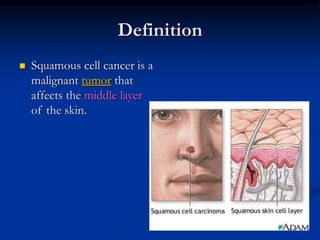
 Squamous cell cancer is a
malignant tumor that
affects the middle layer
of the skin.
Causes, incidence, and risk factors
 Any change in an existing wart (kutil) , mole (tai lalat) or other
skin lesion, or the development of a new growth that ulcerates
and does not heal well,
 a high cure rate if it is treated early, but neglect can allow the
cancer to spread, causing disability or death.
 exposed to sunlight or other ultraviolet radiation. This is
considered the primary cause of all skin cancers.
 older age,
 genetic predisposition (skin cancers are more common in those
who have light-colored skin, blue or green eyes, and blond or red
hair),
 chemical pollution
 overexposure to x-rays or other forms of radiation.
 arsenic, which may be present in some herbicides,
 malignant tumor. It is more aggressive than basal cell cancer, but
still may be relatively slow-growing.
 More to spread (metastasize) to other locations, including
internal organs.
 changes to the cells of the middle portion of the epidermal skin
layer.
 painless initially, but may become painful with the development
of ulcers that do not heal.
 begin in normal skin -- in the skin of a burn, injury, or scar -- or
at a site of chronic inflammation (which may occur with many
skin disorders). It most often originates from sun-damaged skin
areas, such as actinic keratosis.
 after age 50.
Symptoms
 Skin lesion, growth, or bump
 Small
 Firm (keras)
 Reddened
 Nodule or flat growth
 Growth may be cone-shaped
 Surface may be scaly (bersisik) or crusted (tebal)
 Usually located on the face, ears, neck, hands, arms
 May occur on the lip, mouth, tongue, genitals or other areas
Siqn & Test
 . A biopsy and examination of the lesion
confirms the diagnosis.
Treatment
 Depend on
 tumor's size,
 depth,
 location and
 how much it has spread (metastasis).
 Surgical removal of the tumor,
 removal of the skin around the tumor (wide excision), is often
recommended.
 Microscopic shaving (Mohs' surgery) may remove small tumors.
 Skin grafting may be needed if wide areas of skin are removed.
 The tumor may be reduced in size by radiation treatments.
 Chemotherapy can be used if surgery and radiation fail, but it is
usually minimally effective.
 Expectations (prognosis) Return to top
 cured if removed promptly.
 New tumors may develop, so affected individuals
should be diligent about examining the skin.
 Complications Return to top
 Local spread of the tumor
 Metastasis to other locations, including the internal
organs
Prevention
 Minimize sun exposure. Protect skin from the sun by wearing protective
clothing such as hats, long-sleeved shirts, long skirts or pants. Sunlight is most
intense at mid-day, so try to avoid exposure during these hours. Use high-
quality sunscreens, preferably with SPF (sun protection factor) ratings of at
least 15. Apply the sunscreen at least a half hour before exposure and re-
apply frequently. Use a sunscreen throughout the year, even for winter sun
exposure.
 Examine the skin regularly for development of suspicious growths or changes
in an existing skin lesion. A new growth that ulcerates or is slow to heal is
suspicious.
 Suspicious changes in an existing growth includes a change in color, size,
texture, and appearance, or development of pain, inflammation, bleeding, or
itching.
 A lesion that is asymmetrical, has irregular or diffuse borders, has multiple
colors mixed in one lesion, or is larger than 6 mm (millimeters) diameter is
suspicious.

142915125 squamous-cell-carcinoma

  • 1.
  • 2.
    Definition  Squamous cellcancer is a malignant tumor that affects the middle layer of the skin.
  • 3.
    Causes, incidence, andrisk factors  Any change in an existing wart (kutil) , mole (tai lalat) or other skin lesion, or the development of a new growth that ulcerates and does not heal well,  a high cure rate if it is treated early, but neglect can allow the cancer to spread, causing disability or death.  exposed to sunlight or other ultraviolet radiation. This is considered the primary cause of all skin cancers.  older age,  genetic predisposition (skin cancers are more common in those who have light-colored skin, blue or green eyes, and blond or red hair),  chemical pollution  overexposure to x-rays or other forms of radiation.  arsenic, which may be present in some herbicides,
  • 4.
     malignant tumor.It is more aggressive than basal cell cancer, but still may be relatively slow-growing.  More to spread (metastasize) to other locations, including internal organs.  changes to the cells of the middle portion of the epidermal skin layer.  painless initially, but may become painful with the development of ulcers that do not heal.  begin in normal skin -- in the skin of a burn, injury, or scar -- or at a site of chronic inflammation (which may occur with many skin disorders). It most often originates from sun-damaged skin areas, such as actinic keratosis.  after age 50.
  • 5.
    Symptoms  Skin lesion,growth, or bump  Small  Firm (keras)  Reddened  Nodule or flat growth  Growth may be cone-shaped  Surface may be scaly (bersisik) or crusted (tebal)  Usually located on the face, ears, neck, hands, arms  May occur on the lip, mouth, tongue, genitals or other areas
  • 6.
    Siqn & Test . A biopsy and examination of the lesion confirms the diagnosis.
  • 7.
    Treatment  Depend on tumor's size,  depth,  location and  how much it has spread (metastasis).  Surgical removal of the tumor,  removal of the skin around the tumor (wide excision), is often recommended.  Microscopic shaving (Mohs' surgery) may remove small tumors.  Skin grafting may be needed if wide areas of skin are removed.  The tumor may be reduced in size by radiation treatments.  Chemotherapy can be used if surgery and radiation fail, but it is usually minimally effective.
  • 8.
     Expectations (prognosis)Return to top  cured if removed promptly.  New tumors may develop, so affected individuals should be diligent about examining the skin.  Complications Return to top  Local spread of the tumor  Metastasis to other locations, including the internal organs
  • 9.
    Prevention  Minimize sunexposure. Protect skin from the sun by wearing protective clothing such as hats, long-sleeved shirts, long skirts or pants. Sunlight is most intense at mid-day, so try to avoid exposure during these hours. Use high- quality sunscreens, preferably with SPF (sun protection factor) ratings of at least 15. Apply the sunscreen at least a half hour before exposure and re- apply frequently. Use a sunscreen throughout the year, even for winter sun exposure.  Examine the skin regularly for development of suspicious growths or changes in an existing skin lesion. A new growth that ulcerates or is slow to heal is suspicious.  Suspicious changes in an existing growth includes a change in color, size, texture, and appearance, or development of pain, inflammation, bleeding, or itching.  A lesion that is asymmetrical, has irregular or diffuse borders, has multiple colors mixed in one lesion, or is larger than 6 mm (millimeters) diameter is suspicious.