Nursing Management:
Breast Disorders
Chapter 52 Overview
Copyright © 2011, 2007 by Mosby, Inc., an affiliate of Elsevier Inc.
Assessment of Breast Disorders
Copyright © 2011, 2007 by Mosby, Inc., an affiliate of Elsevier Inc. 2
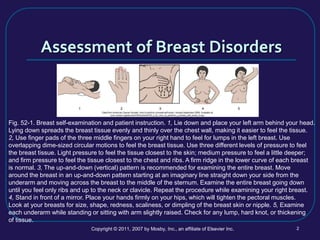
Fig. 52-1. Breast self-examination and patient instruction. 1, Lie down and place your left arm behind your head.
Lying down spreads the breast tissue evenly and thinly over the chest wall, making it easier to feel the tissue.
2, Use finger pads of the three middle fingers on your right hand to feel for lumps in the left breast. Use
overlapping dime-sized circular motions to feel the breast tissue. Use three different levels of pressure to feel
the breast tissue. Light pressure to feel the tissue closest to the skin; medium pressure to feel a little deeper;
and firm pressure to feel the tissue closest to the chest and ribs. A firm ridge in the lower curve of each breast
is normal. 3, The up-and-down (vertical) pattern is recommended for examining the entire breast. Move
around the breast in an up-and-down pattern starting at an imaginary line straight down your side from the
underarm and moving across the breast to the middle of the sternum. Examine the entire breast going down
until you feel only ribs and up to the neck or clavicle. Repeat the procedure while examining your right breast.
4, Stand in front of a mirror. Place your hands firmly on your hips, which will tighten the pectoral muscles.
Look at your breasts for size, shape, redness, scaliness, or dimpling of the breast skin or nipple. 5, Examine
each underarm while standing or sitting with arm slightly raised. Check for any lump, hard knot, or thickening
of tissue.
Assessment of Breast Disorders
 Diagnostic Studies
Copyright © 2011, 2007 by Mosby, Inc., an affiliate of Elsevier Inc. 3
Assessment of Breast Disorders
Copyright © 2011, 2007 by Mosby, Inc., an affiliate of Elsevier Inc. 4
Fig. 52-2. Screening mammogram showing dense breast tissue and benign, scattered microcalcifications
of a 57-year-old. A, Using conventional x-rays. B, Using digital x-rays.
Benign Breast Disorders
Copyright © 2011, 2007 by Mosby, Inc., an affiliate of Elsevier Inc. 5
Mastalgia
Copyright © 2011, 2007 by Mosby, Inc., an affiliate of Elsevier Inc. 6
Breast Infections
 Mastitis
 Lactational Breast Abscess
Copyright © 2011, 2007 by Mosby, Inc., an affiliate of Elsevier Inc. 7
Fibrocystic Changes
Copyright © 2011, 2007 by Mosby, Inc., an affiliate of Elsevier Inc. 8
Fig. 52-3. A, Normal breast tissue. B, Fibrocystic breast tissue.
Nursing and Collaborative Management:
Fibrocystic Changes
Copyright © 2011, 2007 by Mosby, Inc., an affiliate of Elsevier Inc. 9
Fibroadenoma
Copyright © 2011, 2007 by Mosby, Inc., an affiliate of Elsevier Inc. 10
Nursing and Collaborative Management:
Fibroadenoma
Copyright © 2011, 2007 by Mosby, Inc., an affiliate of Elsevier Inc. 11
Fig. 52-4. Well-defined encapsulated fibroadenoma.
Nipple Discharge
 Intraductal Papilloma
 Ductal Ectasia
Copyright © 2011, 2007 by Mosby, Inc., an affiliate of Elsevier Inc. 12
Gynecomastia in Men
 Senescent Gynecomastia
Copyright © 2011, 2007 by Mosby, Inc., an affiliate of Elsevier Inc.
Gerontologic Considerations:
Age-Related Breast Changes
Copyright © 2011, 2007 by Mosby, Inc., an affiliate of Elsevier Inc. 14
Breast Cancer
 Etiology and Risk Factors
 Pathophysiology
Copyright © 2011, 2007 by Mosby, Inc., an affiliate of Elsevier Inc.
Breast Cancer
Copyright © 2011, 2007 by Mosby, Inc., an affiliate of Elsevier Inc. 16
Table 52-3. Types of Breast Cancer.
Breast Cancer
 Pathophysiology, continued
• Noninvasive breast cancer
• Paget’s disease
• Inflammatory breast cancer
 Clinical Manifestations
Copyright © 2011, 2007 by Mosby, Inc., an affiliate of Elsevier Inc. 17
Breast Cancer
Copyright © 2011, 2007 by Mosby, Inc., an affiliate of Elsevier Inc. 18
Fig. 52-5. Distribution of where breast cancer occurs.
Breast Cancer
Copyright © 2011, 2007 by Mosby, Inc., an affiliate of Elsevier Inc. 19
Breast Cancer
 Complications
 Diagnostic Studies
Copyright © 2011, 2007 by Mosby, Inc., an affiliate of Elsevier Inc. 20
Breast Cancer
 Collaborative Care
• Surgical therapy
• Axillary node dissection
Copyright © 2011, 2007 by Mosby, Inc., an affiliate of Elsevier Inc. 21
Breast Cancer
Copyright © 2011, 2007 by Mosby, Inc., an affiliate of Elsevier Inc. 22
Fig. 52-6. Lymph nodes and drainage in the axilla. The sentinel lymph node is usually found in the external
mammary nodes. A complete axillary dissection would remove all nodes.
Breast Cancer
 Collaborative Care
• Surgical therapy, continued
• Breast-conserving surgery
• Modified radical mastectomy
• Follow-up and survivorship care
• Postmastectomy pain syndrome
Copyright © 2011, 2007 by Mosby, Inc., an affiliate of Elsevier Inc. 23
Breast Cancer
 Collaborative Care, continued
• Adjuvant therapy
• Radiation therapy
• Primary radiation therapy
• High-dose brachytherapy
Copyright © 2011, 2007 by Mosby, Inc., an affiliate of Elsevier Inc. 24
Breast Cancer
Copyright © 2011, 2007 by Mosby, Inc., an affiliate of Elsevier Inc. 25
Fig. 52-8. High-dose brachytherapy for breast cancer. The MammoSite system involves the insertion of a single
small balloon catheter (B) at the time of the lumpectomy or shortly thereafter into the tumor resection
cavity—the space that is left after the surgeon removes the tumor. A tiny radioactive seed (A) is inserted into
the balloon, connected to a machine called an afterloader (C), and delivers the radiation therapy.
Breast Cancer
 Collaborative Care
• Adjuvant therapy
• Radiation therapy, continued
• Palliative radiation therapy
• Systemic therapy
• Chemotherapy
• Hormonal therapy
• Biologic and targeted therapy
Copyright © 2011, 2007 by Mosby, Inc., an affiliate of Elsevier Inc. 26
Culturally Competent Care:
Breast Cancer
Copyright © 2011, 2007 by Mosby, Inc., an affiliate of Elsevier Inc. 27
Nursing Management:
Breast Cancer
 Nursing Assessment
 Nursing Diagnoses
 Planning
 Nursing Implementation
• Acute intervention
Copyright © 2011, 2007 by Mosby, Inc., an affiliate of Elsevier Inc. 28
Nursing Management:
Breast Cancer
Copyright © 2011, 2007 by Mosby, Inc., an affiliate of Elsevier Inc. 29
Fig. 52-9. Postoperative exercises for the patient with a mastectomy or lumpectomy with axillary lymph node
dissection.
Nursing Management:
Breast Cancer
Copyright © 2011, 2007 by Mosby, Inc., an affiliate of Elsevier Inc. 30
Fig. 52-7. Lymphedema. Accumulation of fluid in the tissue after excision of lymph nodes.
Nursing Management:
Breast Cancer
 Nursing Implementation
• Acute intervention, continued
• Psychologic care
• Ambulatory and home care
 Evaluation
Copyright © 2011, 2007 by Mosby, Inc., an affiliate of Elsevier Inc. 31
Gerontologic Considerations:
Breast Cancer
Copyright © 2011, 2007 by Mosby, Inc., an affiliate of Elsevier Inc. 32
Mammoplasty
 Breast Reconstruction
• Indications
Copyright © 2011, 2007 by Mosby, Inc., an affiliate of Elsevier Inc. 33
Mammoplasty
Copyright © 2011, 2007 by Mosby, Inc., an affiliate of Elsevier Inc. 34
Fig. 52-10. A, Appearance of chest following bilateral mastectomy. B, Postoperative breast reconstruction
before nipple-areolar reconstruction. C, Postoperative breast reconstruction after nipple-areolar reconstruction.
Mammoplasty
 Breast Reconstruction, continued
• Types of reconstruction
• Breast implants and tissue expansion
Copyright © 2011, 2007 by Mosby, Inc., an affiliate of Elsevier Inc. 35
Mammoplasty
Copyright © 2011, 2007 by Mosby, Inc., an affiliate of Elsevier Inc. 36
Fig. 52-11. A, Tissue expander with gradual expansion. B, Tissue expander in place after mastectomy.
Mammoplasty
 Breast Reconstruction
• Types of reconstruction, continued
• Musculocutaneous flap procedure
Copyright © 2011, 2007 by Mosby, Inc., an affiliate of Elsevier Inc. 37
Mammoplasty
Copyright © 2011, 2007 by Mosby, Inc., an affiliate of Elsevier Inc. 38
Fig. 52-12. TRAM flap. A, TRAM flap is planned. B, The abdominal tissue, while attached to the rectus
muscle, nerve, and blood supply, is tunneled through the abdomen to the chest. C, The flap is trimmed to
shape the breast. The lower abdominal incision is closed. D, Nipple and areola are reconstructed after the
breast is healed.
Mammoplasty
 Breast Reconstruction
• Types of reconstruction, continued
• Nipple-areolar reconstruction
 Breast Augmentation
 Breast Reduction
Copyright © 2011, 2007 by Mosby, Inc., an affiliate of Elsevier Inc. 39
Nursing Management:
Breast Augmentation and Reduction
Copyright © 2011, 2007 by Mosby, Inc., an affiliate of Elsevier Inc. 40

Breast disorders chapter 052

  • 1.
    Nursing Management: Breast Disorders Chapter52 Overview Copyright © 2011, 2007 by Mosby, Inc., an affiliate of Elsevier Inc.
  • 2.
    Assessment of BreastDisorders Copyright © 2011, 2007 by Mosby, Inc., an affiliate of Elsevier Inc. 2 Fig. 52-1. Breast self-examination and patient instruction. 1, Lie down and place your left arm behind your head. Lying down spreads the breast tissue evenly and thinly over the chest wall, making it easier to feel the tissue. 2, Use finger pads of the three middle fingers on your right hand to feel for lumps in the left breast. Use overlapping dime-sized circular motions to feel the breast tissue. Use three different levels of pressure to feel the breast tissue. Light pressure to feel the tissue closest to the skin; medium pressure to feel a little deeper; and firm pressure to feel the tissue closest to the chest and ribs. A firm ridge in the lower curve of each breast is normal. 3, The up-and-down (vertical) pattern is recommended for examining the entire breast. Move around the breast in an up-and-down pattern starting at an imaginary line straight down your side from the underarm and moving across the breast to the middle of the sternum. Examine the entire breast going down until you feel only ribs and up to the neck or clavicle. Repeat the procedure while examining your right breast. 4, Stand in front of a mirror. Place your hands firmly on your hips, which will tighten the pectoral muscles. Look at your breasts for size, shape, redness, scaliness, or dimpling of the breast skin or nipple. 5, Examine each underarm while standing or sitting with arm slightly raised. Check for any lump, hard knot, or thickening of tissue.
  • 3.
    Assessment of BreastDisorders  Diagnostic Studies Copyright © 2011, 2007 by Mosby, Inc., an affiliate of Elsevier Inc. 3
  • 4.
    Assessment of BreastDisorders Copyright © 2011, 2007 by Mosby, Inc., an affiliate of Elsevier Inc. 4 Fig. 52-2. Screening mammogram showing dense breast tissue and benign, scattered microcalcifications of a 57-year-old. A, Using conventional x-rays. B, Using digital x-rays.
  • 5.
    Benign Breast Disorders Copyright© 2011, 2007 by Mosby, Inc., an affiliate of Elsevier Inc. 5
  • 6.
    Mastalgia Copyright © 2011,2007 by Mosby, Inc., an affiliate of Elsevier Inc. 6
  • 7.
    Breast Infections  Mastitis Lactational Breast Abscess Copyright © 2011, 2007 by Mosby, Inc., an affiliate of Elsevier Inc. 7
  • 8.
    Fibrocystic Changes Copyright ©2011, 2007 by Mosby, Inc., an affiliate of Elsevier Inc. 8 Fig. 52-3. A, Normal breast tissue. B, Fibrocystic breast tissue.
  • 9.
    Nursing and CollaborativeManagement: Fibrocystic Changes Copyright © 2011, 2007 by Mosby, Inc., an affiliate of Elsevier Inc. 9
  • 10.
    Fibroadenoma Copyright © 2011,2007 by Mosby, Inc., an affiliate of Elsevier Inc. 10
  • 11.
    Nursing and CollaborativeManagement: Fibroadenoma Copyright © 2011, 2007 by Mosby, Inc., an affiliate of Elsevier Inc. 11 Fig. 52-4. Well-defined encapsulated fibroadenoma.
  • 12.
    Nipple Discharge  IntraductalPapilloma  Ductal Ectasia Copyright © 2011, 2007 by Mosby, Inc., an affiliate of Elsevier Inc. 12
  • 13.
    Gynecomastia in Men Senescent Gynecomastia Copyright © 2011, 2007 by Mosby, Inc., an affiliate of Elsevier Inc.
  • 14.
    Gerontologic Considerations: Age-Related BreastChanges Copyright © 2011, 2007 by Mosby, Inc., an affiliate of Elsevier Inc. 14
  • 15.
    Breast Cancer  Etiologyand Risk Factors  Pathophysiology Copyright © 2011, 2007 by Mosby, Inc., an affiliate of Elsevier Inc.
  • 16.
    Breast Cancer Copyright ©2011, 2007 by Mosby, Inc., an affiliate of Elsevier Inc. 16 Table 52-3. Types of Breast Cancer.
  • 17.
    Breast Cancer  Pathophysiology,continued • Noninvasive breast cancer • Paget’s disease • Inflammatory breast cancer  Clinical Manifestations Copyright © 2011, 2007 by Mosby, Inc., an affiliate of Elsevier Inc. 17
  • 18.
    Breast Cancer Copyright ©2011, 2007 by Mosby, Inc., an affiliate of Elsevier Inc. 18 Fig. 52-5. Distribution of where breast cancer occurs.
  • 19.
    Breast Cancer Copyright ©2011, 2007 by Mosby, Inc., an affiliate of Elsevier Inc. 19
  • 20.
    Breast Cancer  Complications Diagnostic Studies Copyright © 2011, 2007 by Mosby, Inc., an affiliate of Elsevier Inc. 20
  • 21.
    Breast Cancer  CollaborativeCare • Surgical therapy • Axillary node dissection Copyright © 2011, 2007 by Mosby, Inc., an affiliate of Elsevier Inc. 21
  • 22.
    Breast Cancer Copyright ©2011, 2007 by Mosby, Inc., an affiliate of Elsevier Inc. 22 Fig. 52-6. Lymph nodes and drainage in the axilla. The sentinel lymph node is usually found in the external mammary nodes. A complete axillary dissection would remove all nodes.
  • 23.
    Breast Cancer  CollaborativeCare • Surgical therapy, continued • Breast-conserving surgery • Modified radical mastectomy • Follow-up and survivorship care • Postmastectomy pain syndrome Copyright © 2011, 2007 by Mosby, Inc., an affiliate of Elsevier Inc. 23
  • 24.
    Breast Cancer  CollaborativeCare, continued • Adjuvant therapy • Radiation therapy • Primary radiation therapy • High-dose brachytherapy Copyright © 2011, 2007 by Mosby, Inc., an affiliate of Elsevier Inc. 24
  • 25.
    Breast Cancer Copyright ©2011, 2007 by Mosby, Inc., an affiliate of Elsevier Inc. 25 Fig. 52-8. High-dose brachytherapy for breast cancer. The MammoSite system involves the insertion of a single small balloon catheter (B) at the time of the lumpectomy or shortly thereafter into the tumor resection cavity—the space that is left after the surgeon removes the tumor. A tiny radioactive seed (A) is inserted into the balloon, connected to a machine called an afterloader (C), and delivers the radiation therapy.
  • 26.
    Breast Cancer  CollaborativeCare • Adjuvant therapy • Radiation therapy, continued • Palliative radiation therapy • Systemic therapy • Chemotherapy • Hormonal therapy • Biologic and targeted therapy Copyright © 2011, 2007 by Mosby, Inc., an affiliate of Elsevier Inc. 26
  • 27.
    Culturally Competent Care: BreastCancer Copyright © 2011, 2007 by Mosby, Inc., an affiliate of Elsevier Inc. 27
  • 28.
    Nursing Management: Breast Cancer Nursing Assessment  Nursing Diagnoses  Planning  Nursing Implementation • Acute intervention Copyright © 2011, 2007 by Mosby, Inc., an affiliate of Elsevier Inc. 28
  • 29.
    Nursing Management: Breast Cancer Copyright© 2011, 2007 by Mosby, Inc., an affiliate of Elsevier Inc. 29 Fig. 52-9. Postoperative exercises for the patient with a mastectomy or lumpectomy with axillary lymph node dissection.
  • 30.
    Nursing Management: Breast Cancer Copyright© 2011, 2007 by Mosby, Inc., an affiliate of Elsevier Inc. 30 Fig. 52-7. Lymphedema. Accumulation of fluid in the tissue after excision of lymph nodes.
  • 31.
    Nursing Management: Breast Cancer Nursing Implementation • Acute intervention, continued • Psychologic care • Ambulatory and home care  Evaluation Copyright © 2011, 2007 by Mosby, Inc., an affiliate of Elsevier Inc. 31
  • 32.
    Gerontologic Considerations: Breast Cancer Copyright© 2011, 2007 by Mosby, Inc., an affiliate of Elsevier Inc. 32
  • 33.
    Mammoplasty  Breast Reconstruction •Indications Copyright © 2011, 2007 by Mosby, Inc., an affiliate of Elsevier Inc. 33
  • 34.
    Mammoplasty Copyright © 2011,2007 by Mosby, Inc., an affiliate of Elsevier Inc. 34 Fig. 52-10. A, Appearance of chest following bilateral mastectomy. B, Postoperative breast reconstruction before nipple-areolar reconstruction. C, Postoperative breast reconstruction after nipple-areolar reconstruction.
  • 35.
    Mammoplasty  Breast Reconstruction,continued • Types of reconstruction • Breast implants and tissue expansion Copyright © 2011, 2007 by Mosby, Inc., an affiliate of Elsevier Inc. 35
  • 36.
    Mammoplasty Copyright © 2011,2007 by Mosby, Inc., an affiliate of Elsevier Inc. 36 Fig. 52-11. A, Tissue expander with gradual expansion. B, Tissue expander in place after mastectomy.
  • 37.
    Mammoplasty  Breast Reconstruction •Types of reconstruction, continued • Musculocutaneous flap procedure Copyright © 2011, 2007 by Mosby, Inc., an affiliate of Elsevier Inc. 37
  • 38.
    Mammoplasty Copyright © 2011,2007 by Mosby, Inc., an affiliate of Elsevier Inc. 38 Fig. 52-12. TRAM flap. A, TRAM flap is planned. B, The abdominal tissue, while attached to the rectus muscle, nerve, and blood supply, is tunneled through the abdomen to the chest. C, The flap is trimmed to shape the breast. The lower abdominal incision is closed. D, Nipple and areola are reconstructed after the breast is healed.
  • 39.
    Mammoplasty  Breast Reconstruction •Types of reconstruction, continued • Nipple-areolar reconstruction  Breast Augmentation  Breast Reduction Copyright © 2011, 2007 by Mosby, Inc., an affiliate of Elsevier Inc. 39
  • 40.
    Nursing Management: Breast Augmentationand Reduction Copyright © 2011, 2007 by Mosby, Inc., an affiliate of Elsevier Inc. 40