Mucoepidermoid Carcinoma
The structure of the salivary glands
THE NORMAL SALIVARY GLAND
“Parotid’’
serous acini&
straited duct
lymph node
facial nerve
THE NORMAL SALIVARY GLAND
sublingual submandibualr minor
Bengin salivary glad tuomar Malignant salivery galnd tumor
On set Slow -growing Sometimes fast growing
consistency Soft or Rubbery Hard
Incidence of type 85% of parotid tumors 45%of minor s.g
Covering epithelium Don’t ulcerate May ulcerate and invade bone
mobility Not fixed to underlying structuress
Fixed to the underlying structures
Involvement of nerve No involvement of nerve May cause cranial nerve paralysis
Mucoepidermoid Carcinoma
What is Mucoepidermoid Carcinoma of
Salivary Gland?
 A Mucoepidermoid Carcinoma (MEC) is a type of malignant glandular
epithelial tumor affecting either the major or minor salivary glands.
 It contains both epidermoid cells type and mucous secreting cells in
varying proportions.
 It is observed in a wide age category of children and adults
 MEC constitutes the most common primary tumor affecting the
salivary glands.
 It accounts for about 5% of all salivary gland tumors arise in the
parotid gland. However their realitve incidence is higher in minor
salivary gland for about 10-15% of tumors
Site
 Extraoral :- parotid gland(most common site)
 Intraoral :- the palate being the site of predilection of minor salivary gland followed by lower lip, floor
of the mouth ,tongue and retromolar area respectively)
Palate> buccal mucosa> tongue> & retromolar area - intraorally
Intraosseous :- Man>max: 3times
Gender
both genders are affected, a slight female predominance is noted
Age
Generally, the mean age for these carcinomas is 47 years, however, there exists
a broad age range, and is one of the few salivary gland malignancies occurring in childhood
Etiology
The cause of formation of this salivary gland malignancy is generally unknown, but may be due to
genetic factors. No definitive risk factors are observed, though salivary gland cancers are known to be
influenced by factors such as exposure to radiation sources
clinical feature:-
 slowly enlarging painless mass which
simulate the pleomorphic adenoma but never
exceed 5 cm in diameter
 It is not completely encapsulated and
often contain cyctic cavities which may be
filled with mucoid material
 It is fluctuant swelling and red or blue
in color
 may be mistaken as mucocele.
Low Grade Tumor :-
Blue-pigmented mass of the posterior
lateral hard palate.
Mucoepidermoid carcinoma.
Mass of the tongue
High Grade Tumor :-
clinical feature :-
 grows rapidly and cause pain particulary in late
stage
 In the parotid gland facial palsy involvement indicate
poor prognosis
 Trismus, Drainage of ear, dysphagia, numbness of
adjacent areas & ulceration (minor salivary gland)
 typical feature include fixation ulceration, and
involvement of Metastasize regional lymph nodes
 Distant metastases to lung, bone, brain & sub-
MORPHOLOGIC FEATURES :-
Grossly, the tumour is usually circumscribed but not
encapsulated.
It varies in size from 1 to 5 cm.
Histopathological features:
Characterized by: variety of cell types and often in cystic
Patterns
Composed of-
a)mucous secreting cells
b)epidermoid cells
c)intermediate cells
Grades:
a) low grade
b) intermediate grade
c) high grade
Histopathological Grades are based on-
 Amount of cyst formation
 Degree of cytoplasmic atypia
 Relative number of mucous, epidermoid &
intermediate cells.
The three types of cell – together forms cystic
space or solid masses or cords
MICROSCOPIC FEATURES :-
The name is a contraction of epidermiod and mucus -
secreating cell
a close
association
bettwen mucus
and epidermoid
Mucoepidermoid carcinoma. At higher power the
finely
granular mucous cells are seen to the right with the
underlying epidermoid cells to the left.
 It is believed to arise from
salivary duct system
Normal duct- lining epithelium
neoplastic transformation
 Fluctuant because of cyst formation:-
mucin filled cystic spaces
LOW GRADE TUMOR
(well differentiated tumors tumor) show large number of
mucous secreting cells
Numerous cystic spaces
Small number of intermediate
and epidermoid cells
with few cellular atypia
.
Low grade: cystic spaces and mucous
tumor cells
Low-grade mucoepidermoid
carcinoma: with a prominent
cystic component.
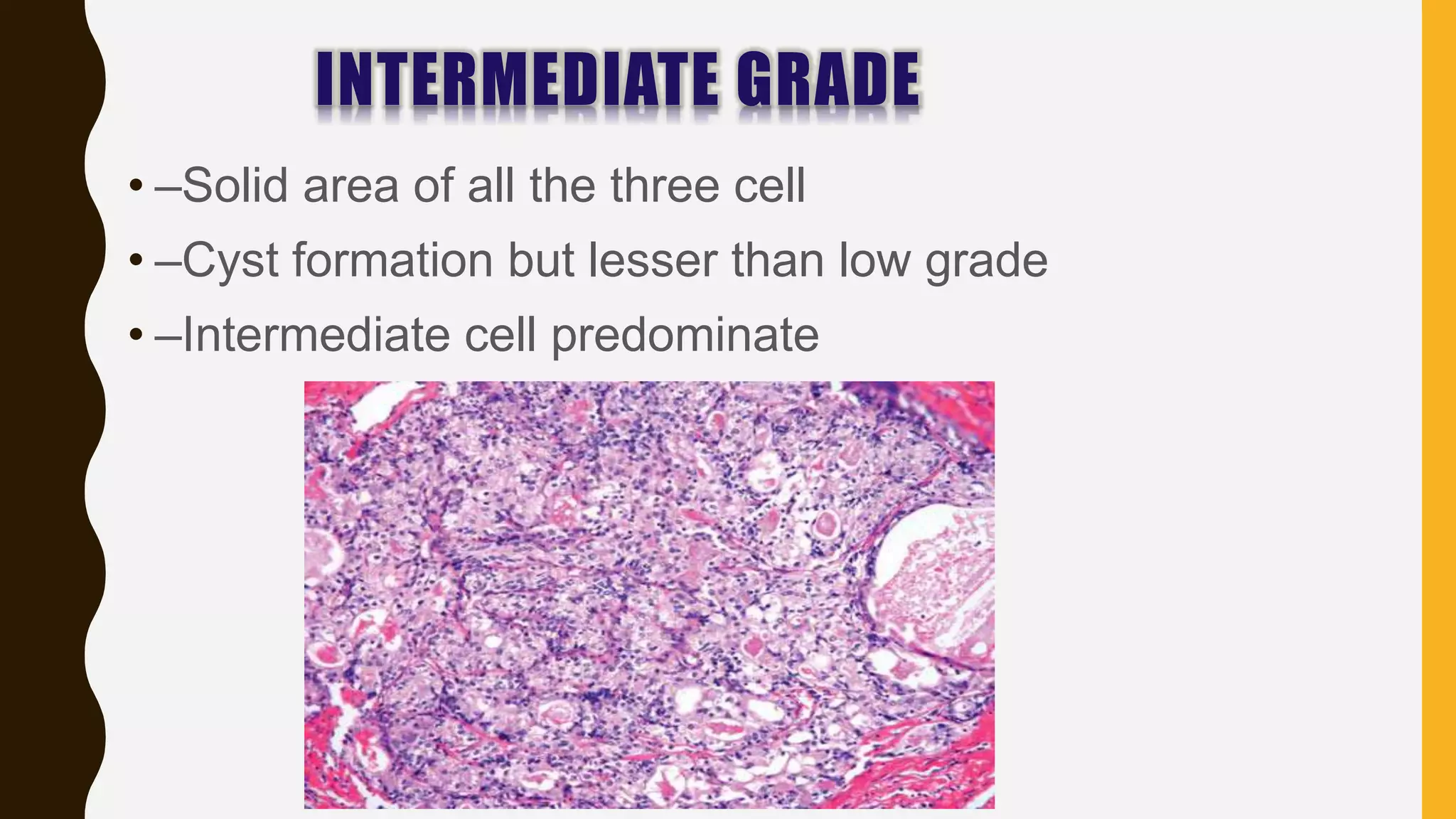
INTERMEDIATE GRADE
• –Solid area of all the three cell
• –Cyst formation but lesser than low grade
• –Intermediate cell predominate
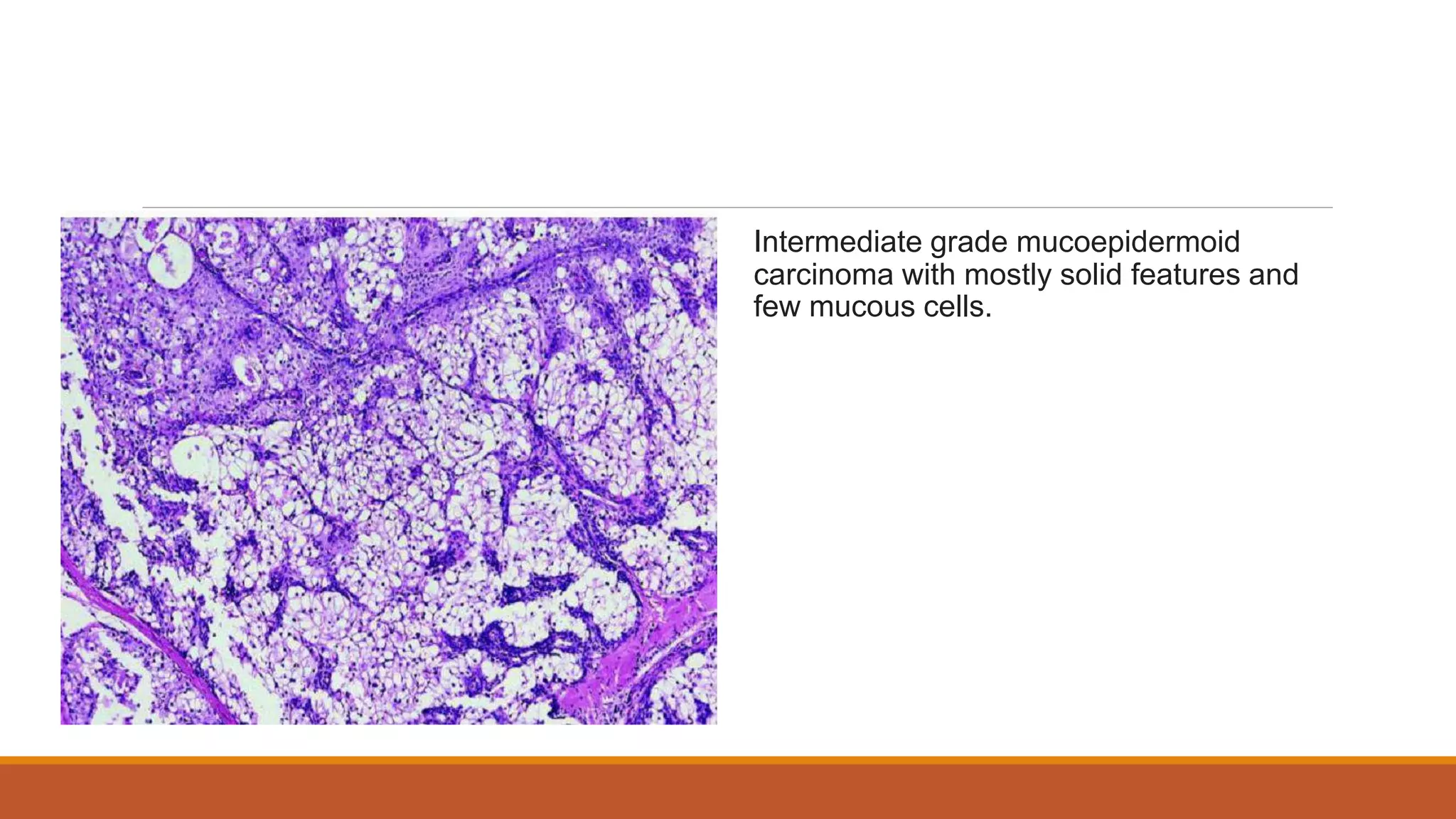
Intermediate grade mucoepidermoid
carcinoma with mostly solid features and
few mucous cells.
HIGH GRADE TUMOR
•Solid nests or cords
•Mitotic activity
•Prominent nuclear pleomorphism
•Cystic component is very less
•Glandular component rare, necrosis & perineural
invasion may be present
High grade: few tumor
ducts and mucous cells
lowspace
low grade. Note intracystic space
Intermediate grade
Hyperchromatic nuclei &
Several microcystic spaces
High grade
Focal necrosis
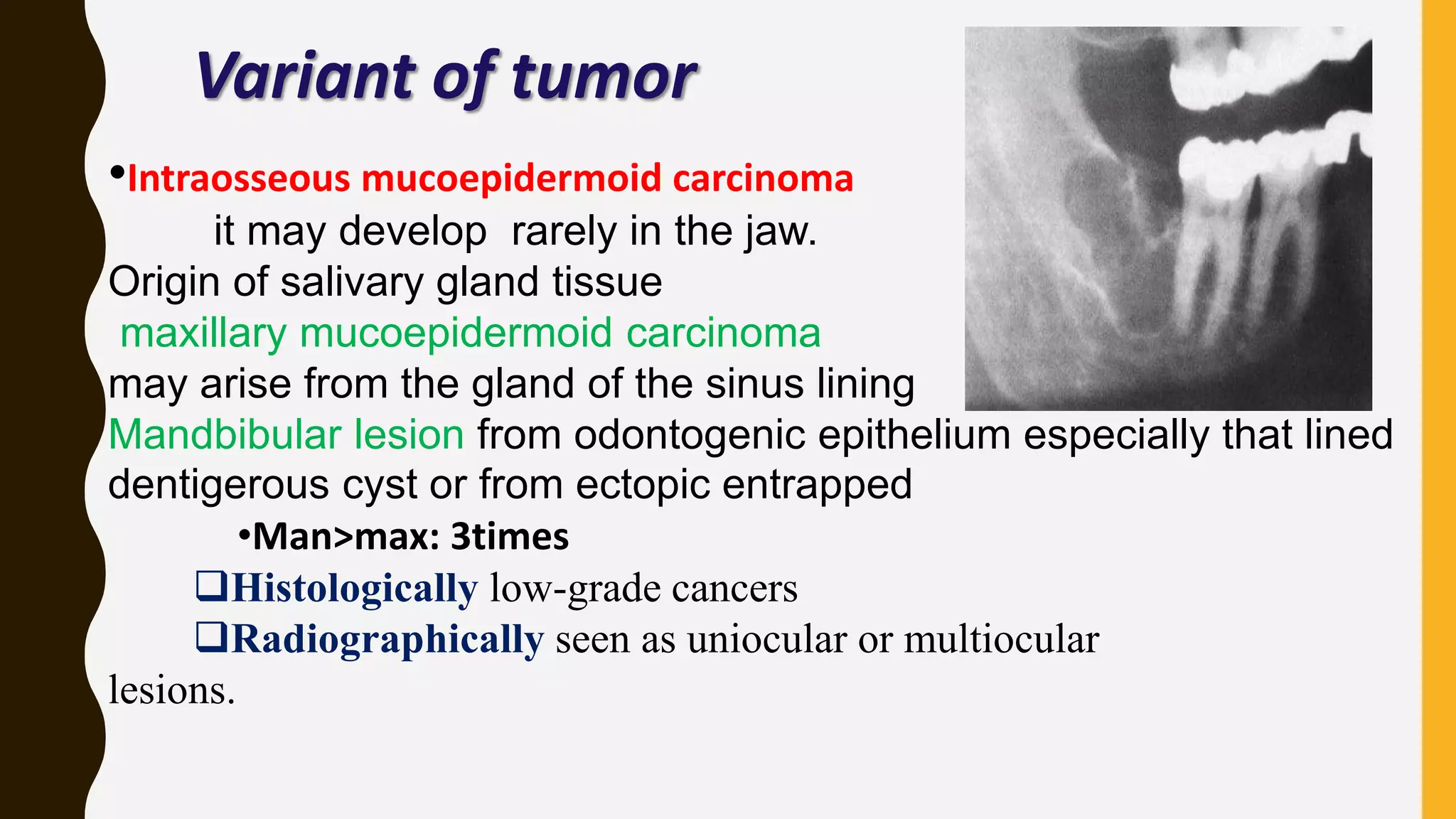
•Intraosseous mucoepidermoid carcinoma
it may develop rarely in the jaw.
Origin of salivary gland tissue
maxillary mucoepidermoid carcinoma
may arise from the gland of the sinus lining
Mandbibular lesion from odontogenic epithelium especially that lined
dentigerous cyst or from ectopic entrapped
•Man>max: 3times
Histologically low-grade cancers
Radiographically seen as uniocular or multiocular
lesions.
Variant of tumor
Treatment
•Conservative excision – preservation of facial nerve – low
& intermediate grade of parotid.
•Complete – submandibular gland
•Radical neck dissection – evidences of cervical node
metastasis & T3 lesion
•Postoperative radiotherapy & Chemotherapy – may be
used for high grade malignancy.
•Low grade lesion – 92 %, 5 yr cure rate
•Intermediate and high grade – 49 %, 5 year cure rate
Mucoepidermoid carcinoma

Mucoepidermoid carcinoma

  • 1.
  • 3.
    The structure ofthe salivary glands
  • 4.
    THE NORMAL SALIVARYGLAND “Parotid’’ serous acini& straited duct lymph node facial nerve
  • 5.
    THE NORMAL SALIVARYGLAND sublingual submandibualr minor
  • 7.
    Bengin salivary gladtuomar Malignant salivery galnd tumor On set Slow -growing Sometimes fast growing consistency Soft or Rubbery Hard Incidence of type 85% of parotid tumors 45%of minor s.g Covering epithelium Don’t ulcerate May ulcerate and invade bone mobility Not fixed to underlying structuress Fixed to the underlying structures Involvement of nerve No involvement of nerve May cause cranial nerve paralysis
  • 8.
  • 9.
    What is MucoepidermoidCarcinoma of Salivary Gland?  A Mucoepidermoid Carcinoma (MEC) is a type of malignant glandular epithelial tumor affecting either the major or minor salivary glands.  It contains both epidermoid cells type and mucous secreting cells in varying proportions.  It is observed in a wide age category of children and adults  MEC constitutes the most common primary tumor affecting the salivary glands.  It accounts for about 5% of all salivary gland tumors arise in the parotid gland. However their realitve incidence is higher in minor salivary gland for about 10-15% of tumors
  • 10.
    Site  Extraoral :-parotid gland(most common site)  Intraoral :- the palate being the site of predilection of minor salivary gland followed by lower lip, floor of the mouth ,tongue and retromolar area respectively) Palate> buccal mucosa> tongue> & retromolar area - intraorally Intraosseous :- Man>max: 3times Gender both genders are affected, a slight female predominance is noted Age Generally, the mean age for these carcinomas is 47 years, however, there exists a broad age range, and is one of the few salivary gland malignancies occurring in childhood Etiology The cause of formation of this salivary gland malignancy is generally unknown, but may be due to genetic factors. No definitive risk factors are observed, though salivary gland cancers are known to be influenced by factors such as exposure to radiation sources
  • 11.
    clinical feature:-  slowlyenlarging painless mass which simulate the pleomorphic adenoma but never exceed 5 cm in diameter  It is not completely encapsulated and often contain cyctic cavities which may be filled with mucoid material  It is fluctuant swelling and red or blue in color  may be mistaken as mucocele. Low Grade Tumor :-
  • 12.
    Blue-pigmented mass ofthe posterior lateral hard palate. Mucoepidermoid carcinoma. Mass of the tongue
  • 14.
    High Grade Tumor:- clinical feature :-  grows rapidly and cause pain particulary in late stage  In the parotid gland facial palsy involvement indicate poor prognosis  Trismus, Drainage of ear, dysphagia, numbness of adjacent areas & ulceration (minor salivary gland)  typical feature include fixation ulceration, and involvement of Metastasize regional lymph nodes  Distant metastases to lung, bone, brain & sub-
  • 16.
    MORPHOLOGIC FEATURES :- Grossly,the tumour is usually circumscribed but not encapsulated. It varies in size from 1 to 5 cm.
  • 17.
    Histopathological features: Characterized by:variety of cell types and often in cystic Patterns Composed of- a)mucous secreting cells b)epidermoid cells c)intermediate cells Grades: a) low grade b) intermediate grade c) high grade
  • 18.
    Histopathological Grades arebased on-  Amount of cyst formation  Degree of cytoplasmic atypia  Relative number of mucous, epidermoid & intermediate cells. The three types of cell – together forms cystic space or solid masses or cords
  • 19.
    MICROSCOPIC FEATURES :- Thename is a contraction of epidermiod and mucus - secreating cell a close association bettwen mucus and epidermoid Mucoepidermoid carcinoma. At higher power the finely granular mucous cells are seen to the right with the underlying epidermoid cells to the left.
  • 21.
     It isbelieved to arise from salivary duct system Normal duct- lining epithelium neoplastic transformation
  • 22.
     Fluctuant becauseof cyst formation:- mucin filled cystic spaces
  • 23.
    LOW GRADE TUMOR (welldifferentiated tumors tumor) show large number of mucous secreting cells Numerous cystic spaces Small number of intermediate and epidermoid cells with few cellular atypia
  • 24.
    . Low grade: cysticspaces and mucous tumor cells
  • 25.
    Low-grade mucoepidermoid carcinoma: witha prominent cystic component.
  • 26.
    INTERMEDIATE GRADE • –Solidarea of all the three cell • –Cyst formation but lesser than low grade • –Intermediate cell predominate
  • 27.
    Intermediate grade mucoepidermoid carcinomawith mostly solid features and few mucous cells.
  • 28.
    HIGH GRADE TUMOR •Solidnests or cords •Mitotic activity •Prominent nuclear pleomorphism •Cystic component is very less •Glandular component rare, necrosis & perineural invasion may be present
  • 29.
    High grade: fewtumor ducts and mucous cells
  • 31.
    lowspace low grade. Noteintracystic space Intermediate grade Hyperchromatic nuclei & Several microcystic spaces High grade Focal necrosis
  • 32.
    •Intraosseous mucoepidermoid carcinoma itmay develop rarely in the jaw. Origin of salivary gland tissue maxillary mucoepidermoid carcinoma may arise from the gland of the sinus lining Mandbibular lesion from odontogenic epithelium especially that lined dentigerous cyst or from ectopic entrapped •Man>max: 3times Histologically low-grade cancers Radiographically seen as uniocular or multiocular lesions. Variant of tumor
  • 33.
    Treatment •Conservative excision –preservation of facial nerve – low & intermediate grade of parotid. •Complete – submandibular gland •Radical neck dissection – evidences of cervical node metastasis & T3 lesion •Postoperative radiotherapy & Chemotherapy – may be used for high grade malignancy. •Low grade lesion – 92 %, 5 yr cure rate •Intermediate and high grade – 49 %, 5 year cure rate