ACUTE MEDIASTINITIS:
Typical Clinical Features of Acute Mediastinitis
Clinical Classification of Acute Mediastinitis
Etiologies and Clinical Settings
diagnosis
management
Complications of acute mediastinitis
ACUTE MEDIASTINITIS
Acute mediastinitis is rare and dramatic condition of
a fulminating and usually fatal course
Typical Clinical Features of Acute Mediastinitis
.
sudden and dramatic onset , with chills, high fever, and
prostration.
Patients are restless and irritable,
Tachycardia, tachypnea,
. severe substernal chest pain, worsened by breathing or
coughing, and unrelieved by opiates. The pain may be
referred into the neck and ear if the process involves the
superior mediastinum
, whereas posterior or inferior mediastinal involvement
may cause radicular pain radiating around the chest and
pain between the scapulae.
Signs:
supraclavicular fullness and tenderness over the
sternum or sternoclavicular joints,
crepitus and other signs of mediastinal and
subcutaneous emphysema may be prominent.
Hamman's sign (a crunching sound synchronous with
cardiac systole, heard over the anterior thorax) is
characteristic but not always present.
Later, tracheal deviation, jugular venous distention,
and other signs of compression of mediastinal
structures may appear.
Clinical Classification of Acute Mediastinitis
Involvement of different mediastinal regions tends to
have typical causes:
infection in the superior mediastinum is most often the
result of direct extension from neck infection;
anterior mediastinal infection is typical after surgery or
penetrating wounds to the anterior thorax;
and posterior mediastinal abscesses are characteristic
for tuberculous or pyogenic spinal infections.
Acute Mediastinitis: Etiologies and Clinical Settings
Perforation of a thoracic viscus
Esophagus
"Spontaneous": forceful vomiting (Boerhaave's syndrome);
pneumatic trauma
Direct penetrating trauma
Impacted foreign body
Instrumentation: esophagoscopy; sclerotherapy; esophageal
obturator airway
Erosion: carcinoma; necrotizing infection
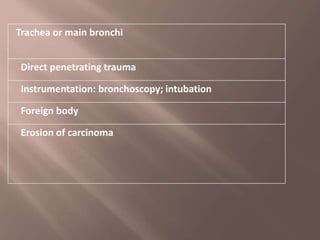
Trachea or main bronchi
Direct penetrating trauma
Instrumentation: bronchoscopy; intubation
Foreign body
Erosion of carcinoma
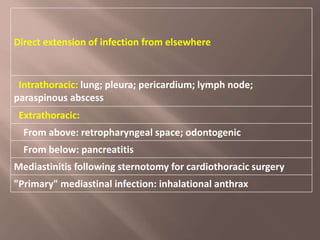
Direct extension of infection from elsewhere
Intrathoracic: lung; pleura; pericardium; lymph node;
paraspinous abscess
Extrathoracic:
From above: retropharyngeal space; odontogenic
From below: pancreatitis
Mediastinitis following sternotomy for cardiothoracic surgery
"Primary" mediastinal infection: inhalational anthrax
1 : Mediastinitis Resulting from Visceral
Perforation
:
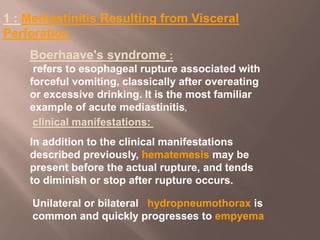
Boerhaave's syndrome
refers to esophageal rupture associated with
forceful vomiting, classically after overeating
or excessive drinking. It is the most familiar
example of acute mediastinitis,
In addition to the clinical manifestations
described previously, hematemesis may be
present before the actual rupture, and tends
to diminish or stop after rupture occurs.
clinical manifestations:
Unilateral or bilateral hydropneumothorax is
common and quickly progresses to empyema
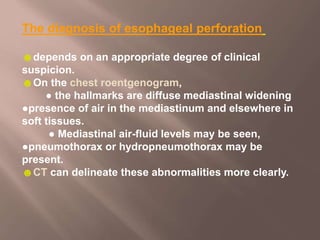
The diagnosis of esophageal perforation
☻depends on an appropriate degree of clinical
suspicion.
☻On the chest roentgenogram,
● the hallmarks are diffuse mediastinal widening
●presence of air in the mediastinum and elsewhere in
soft tissues.
● Mediastinal air-fluid levels may be seen,
●pneumothorax or hydropneumothorax may be
present.
☻CT can delineate these abnormalities more clearly.
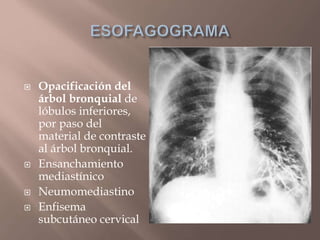
 Opacificación del
árbol bronquial de
lóbulos inferiores,
por paso del
material de contraste
al árbol bronquial.
 Ensanchamiento
mediastínico
 Neumomediastino
 Enfisema
subcutáneo cervical
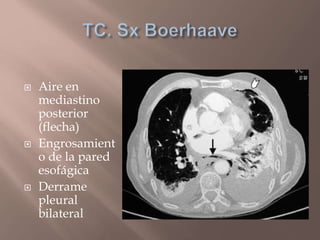
 Aire en
mediastino
posterior
(flecha)
 Engrosamient
o de la pared
esofágica
 Derrame
pleural
bilateral
The diagnosis is usually established by contrast
studies, endoscopic examination,
although percutaneous mediastinal aspiration, using
a subxiphoid approach, is advocated by some as a
means of earlier diagnosis
☻Successful management of frank,
uncontained esophageal perforation :
● early surgical repair, drainage of the
mediastinum and often the pleural space,
● administration of appropriate antibiotics,
● Percutaneous catheter aspiration of
mediastinal abscesses, under CT guidance, IF
infection is localized and the clinical setting is
less urgent
☻Complications of acute mediastinitis after
:
esophageal rupture
● localized abscess formation,
● extensive pleural empyema,
● and persistent esophagocutaneous fistulas.
● Mortality reported due to acute mediastinitis
after esophageal rupture has ranged from 10% to
20%to as high as 40% to 50%
□Timing of surgical drainage has been of prime
importance in determining the clinical outcome
☻Other potential iatrogenic causes of
mediastinitis include:
● bronchoscopic perforation and migration of indwelling
central venous catheters.
● use of laser and mechanical endobronchial
procedures, in the setting of malignancy with chronic
airway colonization or postobstructive pneumonia, add
to the likelihood of potential mediastinal complications.
● Intravascular catheters may be another source of
acute mediastinitis when the catheter tip erodes through
the vessel wall into the mediastinum. Instillation of
hyperosmotic, vesicant, or vasoactive substances via
these catheters may induce a chemical, rather than an
infectious, inflammation
secondary to :
oropharyngeal infection
Infection originating in periodontal tissues
in the tonsillar region,
or after pharyngeal perforation
extend via the prevertebral, visceral, or pretracheal
spaces or in the carotid sheaths although the usual
route is via the retropharyngeal space to the posterior
mediastinum,
• also named descending necrotizing mediastinitis, is
perhaps the most clinically devastating form of the
disorder.
• Odontogenic infection is consistently the most
common source of descending necrotizing mediastinitis
clinical signs : described before
Radiological signs :
widening of the retropharyngeal space,
with or without associated air-fluid levels,
anterior displacement of the tracheal air column,
and loss of the normal cervical spine lordosis on
lateral films of the neck.
 La principal infección es la angina de Ludwig
 infección del segundo o tercer molar inferior que
involucra a los espacios sublingual y submaxilar.
 Puede diseminarse por el espacio faríngeo
lateral >>> al espacio retrofaríngeo o vaina
carotídea >>>> el mediastino.
Treatment of descending necrotizing mediastinitis
requires aggressive surgical drainage, usually via a
cervical approach.
thoracic exploration be reserved for cases in which the
infection extends below the level of the fourth vertebral
body or the tracheal bifurcation.
Routine serial postoperative cervicothoracic CT
imaging and aggressive reexploration and drainage
guided by these imaging findings appear to reduce
the mortality of this condition
Although thoracoscopic and other percutaneous
drainage procedures have been described and may
be appropriate in selected patients, thorough open
drainage and irrigation remain the standard
approach.
Rare cause of acute mediastinitis:
with eroding neoplasms.
Extension from anterior chest wall and neck infections
has been described in injection drug users
and acute purulent mediastinitis has also been
reported after closed-chest cardiopulmonary
resuscitation
as a complication of vertebral or costal tuberculous
Both gastric and esophageal ulcers have been reported as
causes of mediastinitis, sometimes eroding directly into
the pericardium.
bacterial mediastinitis after median sternotomy for
coronary artery bypass,
valve replacement,
correction of congenital heart disease
after heart and heart-lung transplantation.
as a complication of endoscopy,
Preoperative risk factors include
advanced age and male gender,
diabetes mellitus, obesity, the need for
immunosuppressive therapy, smoking,
obstructive lung disease, a history of previous
sternotomy or mediastinal irradiation,
and poorer preoperative cardiac dysfunction
Perioperative risk factors include
shaving rather than clipping for hair removal,
the use of bilateral internal mammary artery grafts,
a longer duration of the surgical procedure and of perfusion
time,
greater use of cautery or bone wax,
accompanies coronary artery bypass, or if the
patient requires more than 48 hours of
mechanical ventilation postoperatively
The pathogenesis of mediastinitis following
sternotomy is debated, although most cases appear to
result from direct contamination of the mediastinum at
the time of operation.
In the acute stages, the mediastinal structures are
involved with pliable fibrinous exudates, and
osteomyelitis, if present, is confined to the wound
margins.
Subacute infections are characterized by
increasingly dense adhesions entrapping the
visceral organs, sinus tract formation, and more
extensive sternal bone involvement.
infection control and careful asepsis in the
operating room remain the most effective means
of prevention
prophylactic antibiotics are widely used in the

perioperative management of cardiac surgery
patients.
The prophylactic intranasal application of mupirocin
ointment has been shown to reduce by 50% the rate of
Staphylococcus aureus nosocomial infections
Mediastinitis may occur as early as 3 days or as long as
6 months after surgery
although most cases occur within 2 weeks.
The bacteriology of postoperative mediastinitis
In early prosthetic valve endocarditis. Staphylococcus
epidermidis and S. aureus have been the most frequent
organisms
Anaerobes and gram-negative bacilli are rare,
Candida species and atypical mycobacteria (especially
Mycobacterium chelonae and Mycobacterium fortuitum)
are infrequently reported.
Infection with the last two groups tends to be more
indolent
the clinical course consists of fever and systemic
signs, followed by bacteremia and local signs of
wound infection
The diagnosis
is usually made at the time of reexploration
of the sternotomy wound and rests on a heightened
clinical suspicion in the appropriate setting.
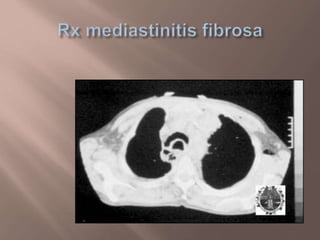
diagnostic tests
gallium scanning, CT, and ultrasonography. CT is
particularly helpful in identifying and discerning soft-tissue
swelling, fluid collections, and sternal erosion or
dehiscence.
Patients with fever, positive blood cultures, and
wound abnormalities in the post-sternotomy

period should probably be explored.
therapy for post-sternotomy mediastinitis consists of
early surgical exploration, débridement and drainage,
irrigation, and prolonged administration of systemic
antibiotics.
Anthrax, caused by infection with Bacillus anthracis, is
primarily a disease of cattle, sheep, and goats and
is most prevalent in the Middle East, although it is

now recognized as an important disease of
bioterrorism
inhalational anthrax, or woolsorter's disease, is contracted
by inhaling B. anthracis spores from animal sources.
Inhalation of anthrax spores into the distal air spaces is
followed by ingestion by alveolar macrophages and
transport to the mediastinal lymph nodes. A hemorrhagic
mediastinitis rapidly evolves, followed by bacteremia,
overwhelming sepsis, and usually death.
Clinically
patients typically experience a biphasic illness with an
initial insidious flulike illness lasting 2 to 4 days and
characterized by fever, malaise, myalgia, and
nonproductive cough. This is followed by
a fulminant phase of acute mediastinitis, with
respiratory distress, chest pain, cyanosis, and
prostration.
The chest radiograph and CT scan typically show
mediastinal widening and pleural effusions
The diagnosis
is established by demonstration of gram-positive,
boxcar-shaped bacilli in tissue or body fluid
specimens or in the blood buffy coat
A direct fluorescent antibody test,
polymerase chain reaction, and serologic tests are
available for confirmation.
High-dose intravenous penicillin has traditionally been
the treatment of choice,although penicillin-resistant
strains have been reported ,Cephalosporin resistance
is typical, and most patients in the bioterrorism
outbreak were treated with multiple agents,
including a fluoroquinolone.
Inhalational anthrax has historically been a devastating
disease even with appropriate treatment
in the bioterrorism outbreak, prompt diagnosis and
initiation of antibiotic therapy plus aggressive drainage of
mediastinal and pleural collections resulted in survival of
6 of the 10 patients.
%D9%85%d8%af%d9%8a%d8%a7%d8%b3%d8%aa%d9%8a%d9%86%d9%8a%d8%aa

%D9%85%d8%af%d9%8a%d8%a7%d8%b3%d8%aa%d9%8a%d9%86%d9%8a%d8%aa

  • 2.
    ACUTE MEDIASTINITIS: Typical ClinicalFeatures of Acute Mediastinitis Clinical Classification of Acute Mediastinitis Etiologies and Clinical Settings diagnosis management Complications of acute mediastinitis
  • 3.
    ACUTE MEDIASTINITIS Acute mediastinitisis rare and dramatic condition of a fulminating and usually fatal course Typical Clinical Features of Acute Mediastinitis . sudden and dramatic onset , with chills, high fever, and prostration. Patients are restless and irritable, Tachycardia, tachypnea, . severe substernal chest pain, worsened by breathing or coughing, and unrelieved by opiates. The pain may be referred into the neck and ear if the process involves the superior mediastinum , whereas posterior or inferior mediastinal involvement may cause radicular pain radiating around the chest and pain between the scapulae.
  • 4.
    Signs: supraclavicular fullness andtenderness over the sternum or sternoclavicular joints, crepitus and other signs of mediastinal and subcutaneous emphysema may be prominent. Hamman's sign (a crunching sound synchronous with cardiac systole, heard over the anterior thorax) is characteristic but not always present. Later, tracheal deviation, jugular venous distention, and other signs of compression of mediastinal structures may appear.
  • 5.
    Clinical Classification ofAcute Mediastinitis Involvement of different mediastinal regions tends to have typical causes: infection in the superior mediastinum is most often the result of direct extension from neck infection; anterior mediastinal infection is typical after surgery or penetrating wounds to the anterior thorax; and posterior mediastinal abscesses are characteristic for tuberculous or pyogenic spinal infections.
  • 6.
    Acute Mediastinitis: Etiologiesand Clinical Settings Perforation of a thoracic viscus Esophagus "Spontaneous": forceful vomiting (Boerhaave's syndrome); pneumatic trauma Direct penetrating trauma Impacted foreign body Instrumentation: esophagoscopy; sclerotherapy; esophageal obturator airway Erosion: carcinoma; necrotizing infection
  • 7.
    Trachea or mainbronchi Direct penetrating trauma Instrumentation: bronchoscopy; intubation Foreign body Erosion of carcinoma
  • 8.
    Direct extension ofinfection from elsewhere Intrathoracic: lung; pleura; pericardium; lymph node; paraspinous abscess Extrathoracic: From above: retropharyngeal space; odontogenic From below: pancreatitis Mediastinitis following sternotomy for cardiothoracic surgery "Primary" mediastinal infection: inhalational anthrax
  • 9.
    1 : MediastinitisResulting from Visceral Perforation : Boerhaave's syndrome refers to esophageal rupture associated with forceful vomiting, classically after overeating or excessive drinking. It is the most familiar example of acute mediastinitis, In addition to the clinical manifestations described previously, hematemesis may be present before the actual rupture, and tends to diminish or stop after rupture occurs. clinical manifestations: Unilateral or bilateral hydropneumothorax is common and quickly progresses to empyema
  • 10.
    The diagnosis ofesophageal perforation ☻depends on an appropriate degree of clinical suspicion. ☻On the chest roentgenogram, ● the hallmarks are diffuse mediastinal widening ●presence of air in the mediastinum and elsewhere in soft tissues. ● Mediastinal air-fluid levels may be seen, ●pneumothorax or hydropneumothorax may be present. ☻CT can delineate these abnormalities more clearly.
  • 11.
     Opacificación del árbolbronquial de lóbulos inferiores, por paso del material de contraste al árbol bronquial.  Ensanchamiento mediastínico  Neumomediastino  Enfisema subcutáneo cervical
  • 12.
     Aire en mediastino posterior (flecha) Engrosamient o de la pared esofágica  Derrame pleural bilateral
  • 13.
    The diagnosis isusually established by contrast studies, endoscopic examination, although percutaneous mediastinal aspiration, using a subxiphoid approach, is advocated by some as a means of earlier diagnosis ☻Successful management of frank, uncontained esophageal perforation : ● early surgical repair, drainage of the mediastinum and often the pleural space, ● administration of appropriate antibiotics, ● Percutaneous catheter aspiration of mediastinal abscesses, under CT guidance, IF infection is localized and the clinical setting is less urgent
  • 14.
    ☻Complications of acutemediastinitis after : esophageal rupture ● localized abscess formation, ● extensive pleural empyema, ● and persistent esophagocutaneous fistulas. ● Mortality reported due to acute mediastinitis after esophageal rupture has ranged from 10% to 20%to as high as 40% to 50% □Timing of surgical drainage has been of prime importance in determining the clinical outcome
  • 15.
    ☻Other potential iatrogeniccauses of mediastinitis include: ● bronchoscopic perforation and migration of indwelling central venous catheters. ● use of laser and mechanical endobronchial procedures, in the setting of malignancy with chronic airway colonization or postobstructive pneumonia, add to the likelihood of potential mediastinal complications. ● Intravascular catheters may be another source of acute mediastinitis when the catheter tip erodes through the vessel wall into the mediastinum. Instillation of hyperosmotic, vesicant, or vasoactive substances via these catheters may induce a chemical, rather than an infectious, inflammation
  • 16.
    secondary to : oropharyngealinfection Infection originating in periodontal tissues in the tonsillar region, or after pharyngeal perforation extend via the prevertebral, visceral, or pretracheal spaces or in the carotid sheaths although the usual route is via the retropharyngeal space to the posterior mediastinum, • also named descending necrotizing mediastinitis, is perhaps the most clinically devastating form of the disorder. • Odontogenic infection is consistently the most common source of descending necrotizing mediastinitis
  • 17.
    clinical signs :described before Radiological signs : widening of the retropharyngeal space, with or without associated air-fluid levels, anterior displacement of the tracheal air column, and loss of the normal cervical spine lordosis on lateral films of the neck.
  • 18.
     La principalinfección es la angina de Ludwig  infección del segundo o tercer molar inferior que involucra a los espacios sublingual y submaxilar.  Puede diseminarse por el espacio faríngeo lateral >>> al espacio retrofaríngeo o vaina carotídea >>>> el mediastino.
  • 19.
    Treatment of descendingnecrotizing mediastinitis requires aggressive surgical drainage, usually via a cervical approach. thoracic exploration be reserved for cases in which the infection extends below the level of the fourth vertebral body or the tracheal bifurcation. Routine serial postoperative cervicothoracic CT imaging and aggressive reexploration and drainage guided by these imaging findings appear to reduce the mortality of this condition Although thoracoscopic and other percutaneous drainage procedures have been described and may be appropriate in selected patients, thorough open drainage and irrigation remain the standard approach.
  • 20.
    Rare cause ofacute mediastinitis: with eroding neoplasms. Extension from anterior chest wall and neck infections has been described in injection drug users and acute purulent mediastinitis has also been reported after closed-chest cardiopulmonary resuscitation as a complication of vertebral or costal tuberculous Both gastric and esophageal ulcers have been reported as causes of mediastinitis, sometimes eroding directly into the pericardium.
  • 21.
    bacterial mediastinitis aftermedian sternotomy for coronary artery bypass, valve replacement, correction of congenital heart disease after heart and heart-lung transplantation. as a complication of endoscopy,
  • 22.
    Preoperative risk factorsinclude advanced age and male gender, diabetes mellitus, obesity, the need for immunosuppressive therapy, smoking, obstructive lung disease, a history of previous sternotomy or mediastinal irradiation, and poorer preoperative cardiac dysfunction Perioperative risk factors include shaving rather than clipping for hair removal, the use of bilateral internal mammary artery grafts, a longer duration of the surgical procedure and of perfusion time, greater use of cautery or bone wax,
  • 23.
    accompanies coronary arterybypass, or if the patient requires more than 48 hours of mechanical ventilation postoperatively The pathogenesis of mediastinitis following sternotomy is debated, although most cases appear to result from direct contamination of the mediastinum at the time of operation.
  • 24.
    In the acutestages, the mediastinal structures are involved with pliable fibrinous exudates, and osteomyelitis, if present, is confined to the wound margins. Subacute infections are characterized by increasingly dense adhesions entrapping the visceral organs, sinus tract formation, and more extensive sternal bone involvement.
  • 25.
    infection control andcareful asepsis in the operating room remain the most effective means of prevention prophylactic antibiotics are widely used in the perioperative management of cardiac surgery patients. The prophylactic intranasal application of mupirocin ointment has been shown to reduce by 50% the rate of Staphylococcus aureus nosocomial infections
  • 26.
    Mediastinitis may occuras early as 3 days or as long as 6 months after surgery although most cases occur within 2 weeks. The bacteriology of postoperative mediastinitis In early prosthetic valve endocarditis. Staphylococcus epidermidis and S. aureus have been the most frequent organisms Anaerobes and gram-negative bacilli are rare, Candida species and atypical mycobacteria (especially Mycobacterium chelonae and Mycobacterium fortuitum) are infrequently reported. Infection with the last two groups tends to be more indolent
  • 27.
    the clinical courseconsists of fever and systemic signs, followed by bacteremia and local signs of wound infection The diagnosis is usually made at the time of reexploration of the sternotomy wound and rests on a heightened clinical suspicion in the appropriate setting. diagnostic tests gallium scanning, CT, and ultrasonography. CT is particularly helpful in identifying and discerning soft-tissue swelling, fluid collections, and sternal erosion or dehiscence.
  • 28.
    Patients with fever,positive blood cultures, and wound abnormalities in the post-sternotomy period should probably be explored. therapy for post-sternotomy mediastinitis consists of early surgical exploration, débridement and drainage, irrigation, and prolonged administration of systemic antibiotics.
  • 29.
    Anthrax, caused byinfection with Bacillus anthracis, is primarily a disease of cattle, sheep, and goats and is most prevalent in the Middle East, although it is now recognized as an important disease of bioterrorism inhalational anthrax, or woolsorter's disease, is contracted by inhaling B. anthracis spores from animal sources. Inhalation of anthrax spores into the distal air spaces is followed by ingestion by alveolar macrophages and transport to the mediastinal lymph nodes. A hemorrhagic mediastinitis rapidly evolves, followed by bacteremia, overwhelming sepsis, and usually death.
  • 30.
    Clinically patients typically experiencea biphasic illness with an initial insidious flulike illness lasting 2 to 4 days and characterized by fever, malaise, myalgia, and nonproductive cough. This is followed by a fulminant phase of acute mediastinitis, with respiratory distress, chest pain, cyanosis, and prostration. The chest radiograph and CT scan typically show mediastinal widening and pleural effusions
  • 31.
    The diagnosis is establishedby demonstration of gram-positive, boxcar-shaped bacilli in tissue or body fluid specimens or in the blood buffy coat A direct fluorescent antibody test, polymerase chain reaction, and serologic tests are available for confirmation.
  • 32.
    High-dose intravenous penicillinhas traditionally been the treatment of choice,although penicillin-resistant strains have been reported ,Cephalosporin resistance is typical, and most patients in the bioterrorism outbreak were treated with multiple agents, including a fluoroquinolone. Inhalational anthrax has historically been a devastating disease even with appropriate treatment in the bioterrorism outbreak, prompt diagnosis and initiation of antibiotic therapy plus aggressive drainage of mediastinal and pleural collections resulted in survival of 6 of the 10 patients.