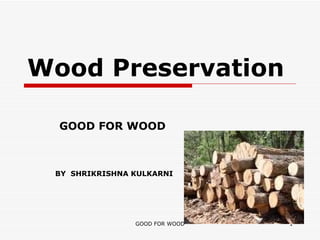
Wood Preservation GOOD FOR WOOD BY  SHRIKRISHNA KULKARNI
INTRODUCTION WOOD IS PRECIOUS. SAVE IT Composition of wood Properties Of wood Enemies of wood Environment and insects Why preservation of wood Types of wood preservation Types of wood preservatives Features of wood preservative Major manufacturers
Wood can’t be manufactured synthetically Wood is rare and precious Wood is eco friendly Save wood- save earth
Composition of wood Wood is composed of minute, hollow fibers Some wood is composed of short, hollow brick shaped cells Zone of lighter wood is called sapwood Zone of darker wood is called heartwood Through the fibers the tree transports water and nutrients vertically within the tree Wood is composed of a complex mixture of substances but the main constituent of  all wood is a complex sugar called cellulose
Properties of wood Wood may be destroyed and damaged by fungi, insects and marine borers Under proper use conditions, wood can give centuries of good service Under unfavorable conditions wood can be crushed in powder Wood is affected by environment factors such as temperature,moisture,winds,salty air, water etc Wood can be cut,mould,bend,chip,stick etc
Wood enemies Water,moisture,wind,salts,chemicals Wood- inhabiting fungi- feed on living or dead wood and produce spores (microscopic seeds) Spores can infect moist wood Fungi need favorable temperature and moisture content Types of fungi- wood decay fungi sap staining fungi decay fungi grows in interiors of wood Fungi break down the cellulose component of wood
Wood enemies- contd. Wood decay fungi types Brown rots White rots Soft rots Effects of fungi Excessive wood shrinkage Cross grain cracking Powder Chemical stains – chemical changes in wood during processing or seasoning of wood
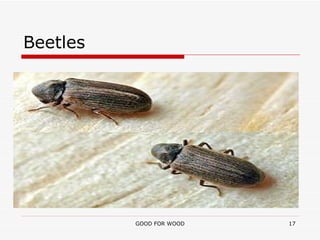
Wood enemies contd.- Insects Termites, carpenter ants and beetles Beetles Powder post beetles  Anobiid beetles Bostrichid borers  Carpenter ants Round headed and flat headed beetles Marine borers
Why wood preservation To overcome environmental effects and insect control To increase life span of wood To preserve and protect wood To maintain natural resources of wood
Types of wood preservation Moisture control and temperature control- Basic preservation Drying - kiln drying and air drying Chemical control vacuum pressure treatment Mixing with glue Dipping Spray application Brush application impregnation
Types of wood preservative Solvent borne Creosote base Copper base- c uNAP,ACQ,HDO,AZOLE,ACC,CN SL WATER BORNE Copper chrome arsenic Copper chrome boron Acid cupric chrome Zinc base Oxine copper Copper naphthenate Silicates Glycol base
Characteristics of wood preservative Effectiveness  Toxicity Broad spectrum Eco friendly Marine pollutant Aquatic poisonous Fixation capacity Penetration capacity Leaching in soil and water Retention capacity Distribution in the wood Availability Economical
Wood Preservative Associations and Institutes American wood preserver’s association AWPA Wood protection association European wood preservative manufacturer's association Wood preservative science council WPSC Institute of wood sciences and technology,Bangloe Leonard wood Institute, USA Wood Institute of California Forest Research Institute, Dehradun South African wood preserver’s association
Major manufacturers Merichem Ltd.USA Valhalla Wood Preservatives Ltd. USA Wolman,USA Solignum, UK TWP, USA Otter Ind. Malaysia Rockwood, Germany Dattashri Enterprises, India Lada organics, India Pidilite Industries, India Ascu hickson, India
Termites and borers
Carpenter ants
Beetles
Fungi Decay
Dry Rot Fungi
Brown rot fungi
Blue stain fungi
Wood preservation plant
Thank you

Wp

  • 1.
    Wood Preservation GOODFOR WOOD BY SHRIKRISHNA KULKARNI
  • 2.
    INTRODUCTION WOOD ISPRECIOUS. SAVE IT Composition of wood Properties Of wood Enemies of wood Environment and insects Why preservation of wood Types of wood preservation Types of wood preservatives Features of wood preservative Major manufacturers
  • 3.
    Wood can’t bemanufactured synthetically Wood is rare and precious Wood is eco friendly Save wood- save earth
  • 4.
    Composition of woodWood is composed of minute, hollow fibers Some wood is composed of short, hollow brick shaped cells Zone of lighter wood is called sapwood Zone of darker wood is called heartwood Through the fibers the tree transports water and nutrients vertically within the tree Wood is composed of a complex mixture of substances but the main constituent of all wood is a complex sugar called cellulose
  • 5.
    Properties of woodWood may be destroyed and damaged by fungi, insects and marine borers Under proper use conditions, wood can give centuries of good service Under unfavorable conditions wood can be crushed in powder Wood is affected by environment factors such as temperature,moisture,winds,salty air, water etc Wood can be cut,mould,bend,chip,stick etc
  • 6.
    Wood enemies Water,moisture,wind,salts,chemicalsWood- inhabiting fungi- feed on living or dead wood and produce spores (microscopic seeds) Spores can infect moist wood Fungi need favorable temperature and moisture content Types of fungi- wood decay fungi sap staining fungi decay fungi grows in interiors of wood Fungi break down the cellulose component of wood
  • 7.
    Wood enemies- contd.Wood decay fungi types Brown rots White rots Soft rots Effects of fungi Excessive wood shrinkage Cross grain cracking Powder Chemical stains – chemical changes in wood during processing or seasoning of wood
  • 8.
    Wood enemies contd.-Insects Termites, carpenter ants and beetles Beetles Powder post beetles Anobiid beetles Bostrichid borers Carpenter ants Round headed and flat headed beetles Marine borers
  • 9.
    Why wood preservationTo overcome environmental effects and insect control To increase life span of wood To preserve and protect wood To maintain natural resources of wood
  • 10.
    Types of woodpreservation Moisture control and temperature control- Basic preservation Drying - kiln drying and air drying Chemical control vacuum pressure treatment Mixing with glue Dipping Spray application Brush application impregnation
  • 11.
    Types of woodpreservative Solvent borne Creosote base Copper base- c uNAP,ACQ,HDO,AZOLE,ACC,CN SL WATER BORNE Copper chrome arsenic Copper chrome boron Acid cupric chrome Zinc base Oxine copper Copper naphthenate Silicates Glycol base
  • 12.
    Characteristics of woodpreservative Effectiveness Toxicity Broad spectrum Eco friendly Marine pollutant Aquatic poisonous Fixation capacity Penetration capacity Leaching in soil and water Retention capacity Distribution in the wood Availability Economical
  • 13.
    Wood Preservative Associationsand Institutes American wood preserver’s association AWPA Wood protection association European wood preservative manufacturer's association Wood preservative science council WPSC Institute of wood sciences and technology,Bangloe Leonard wood Institute, USA Wood Institute of California Forest Research Institute, Dehradun South African wood preserver’s association
  • 14.
    Major manufacturers MerichemLtd.USA Valhalla Wood Preservatives Ltd. USA Wolman,USA Solignum, UK TWP, USA Otter Ind. Malaysia Rockwood, Germany Dattashri Enterprises, India Lada organics, India Pidilite Industries, India Ascu hickson, India
  • 15.
  • 16.
  • 17.
  • 18.
  • 19.
  • 20.
  • 21.
  • 22.
  • 23.