Wood
Macrostructure & Microstructure


             Praveen P
    Department of Materials Science
         Mangalore University
           Karnataka, India

                                      1
Wood….


 Most widely used engineering construction material

 Naturally occurring composite material

 Consists complex array of cellulose cells reinforced by a
polymeric substance, lignin and other organic compounds.

 Wood is a heterogeneous, hygroscopic, cellular and
anisotropic material. It is composed of cells, and the cell
walls are composed of micro-fibrils of cellulose (40% – 50%)
and hemicellulose (15% – 25%) impregnated with lignin
(15% – 30%)

                                                              2
Wood….


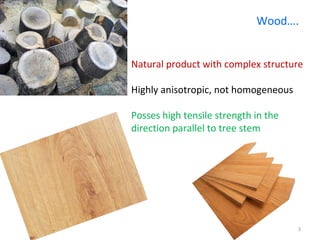
Natural product with complex structure

Highly anisotropic, not homogeneous

Posses high tensile strength in the
direction parallel to tree stem


                                      3
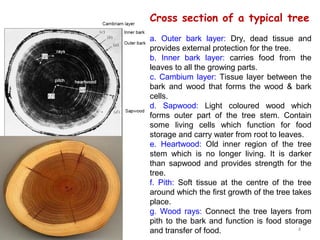
Cross section of a typical tree
a. Outer bark layer: Dry, dead tissue and
provides external protection for the tree.
b. Inner bark layer: carries food from the
leaves to all the growing parts.
c. Cambium layer: Tissue layer between the
bark and wood that forms the wood & bark
cells.
d. Sapwood: Light coloured wood which
forms outer part of the tree stem. Contain
some living cells which function for food
storage and carry water from root to leaves.
e. Heartwood: Old inner region of the tree
stem which is no longer living. It is darker
than sapwood and provides strength for the
tree.
f. Pith: Soft tissue at the centre of the tree
around which the first growth of the tree takes
place.
g. Wood rays: Connect the tree layers from
pith to the bark and function is food storage
and transfer of food.                       4
Classification

                Trees are classified in to two major groups
         Softwoods (Gymnosperms) and Hardwoods (Angiosperms)

Softwood                                 Hardwood

Tree seed is exposed                     Seed is covered

Retains its leaves throughout the year   Sheds its leaves annually

Evergreen trees                          Deciduous trees

Physically soft                          Physically hard

Light colour                             Dark coloured

Examples: pine, spruce etc               Examples: Mahogany, Oak, Teak
                                         etc

                                                                     5
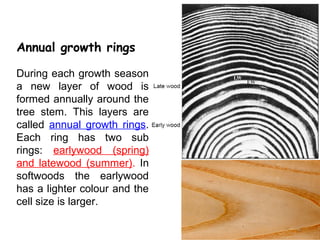
Annual growth rings

During each growth season
a new layer of wood is
formed annually around the
tree stem. This layers are
called annual growth rings.
Each ring has two sub
rings: earlywood (spring)
and latewood (summer). In
softwoods the earlywood
has a lighter colour and the
cell size is larger.

                               6
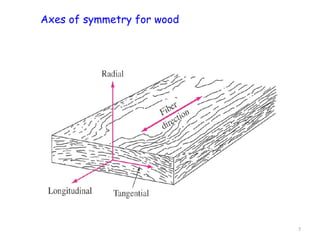
Axes of symmetry for wood


                            7
Microstructure of wood
Explain the microstructure of wood? Explain the effect of water absorption on the properties of
wood?


                                                                                                  8
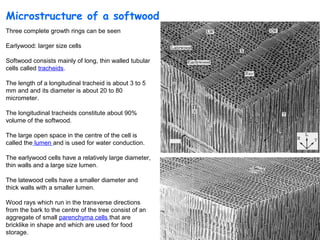
Microstructure of a softwood
Three complete growth rings can be seen

Earlywood: larger size cells

Softwood consists mainly of long, thin walled tubular
cells called tracheids.

The length of a longitudinal tracheid is about 3 to 5
mm and and its diameter is about 20 to 80
micrometer.

The longitudinal tracheids constitute about 90%
volume of the softwood.

The large open space in the centre of the cell is
called the lumen and is used for water conduction.

The earlywood cells have a relatively large diameter,
thin walls and a large size lumen.

The latewood cells have a smaller diameter and
thick walls with a smaller lumen.

Wood rays which run in the transverse directions
from the bark to the centre of the tree consist of an
aggregate of small parenchyma cells that are
bricklike in shape and which are used for food
                                                        9
storage.
Microstructure of Hardwood
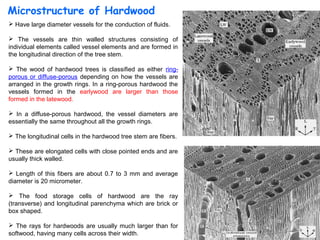
 Have large diameter vessels for the conduction of fluids.

 The vessels are thin walled structures consisting of
individual elements called vessel elements and are formed in
the longitudinal direction of the tree stem.

 The wood of hardwood trees is classified as either ring-
porous or diffuse-porous depending on how the vessels are
arranged in the growth rings. In a ring-porous hardwood the
vessels formed in the earlywood are larger than those
formed in the latewood.

 In a diffuse-porous hardwood, the vessel diameters are
essentially the same throughout all the growth rings.

 The longitudinal cells in the hardwood tree stem are fibers.

 These are elongated cells with close pointed ends and are
usually thick walled.

 Length of this fibers are about 0.7 to 3 mm and average
diameter is 20 micrometer.

 The food storage cells of hardwood are the ray
(transverse) and longitudinal parenchyma which are brick or
box shaped.

 The rays for hardwoods are usually much larger than for
                                                                 10
softwood, having many cells across their width.
Wood-Moisture Relations
Moisture content: Wood is a hygroscopic
material, i.e., it will absorb water vapor
from the atmosphere.
                                             Water may be held in wood in two ways:
Moisture content in wood is expressed as a
percentage of ovendry weight. A moisture     (1) bound water, & (2) free water.
content of 50% means that there are 50       • Bound water is held within the cell walls
parts of water to 100 parts of dry wood      by adsorption force.
substance by weight.                         – It is generally believed that bound water
                                             is not in the crystalline regions of the cell
                                             wall, but is adsorbed in the amorphous
                                             regions.
                                             – This has important implications for the
                                             volume changes associated with moisture
                                             changes.
                                             • Free water is not held by any forces and
                                             is situated in the cell cavities know as
                                             lumen.                                   11
Fiber saturation point
The moisture content at which the cell wall is saturated with bound
water & at which no free water is present is called the fiber
saturation point, (FSP).

• The FSP varies from species to species, but it averages about
28% moisture content.

• Addition or removal of water below the FSP has a pronounced
effect on practically all wood properties.

• Addition or removal of water above the FSP has a almost no effect
on any wood properties.


                                                                      12
Shrinkage and swelling

• The variation of shrinkage between
different directions can be attributed
to the microstructure of wood.

• The latewood cells dominate
shrinkage since they absorb much
more water and in the tangential
direction there is an unbroken
alignment of latewood.


                      The greater shrinkage in the tangential
                      direction causes distortion in lumber with
                      different orientations.


                                                                   13
Effects of Moisture on the Strength of Wood

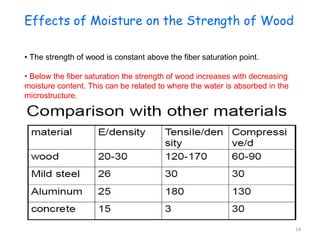
• The strength of wood is constant above the fiber saturation point.

• Below the fiber saturation the strength of wood increases with decreasing
moisture content. This can be related to where the water is absorbed in the
microstructure.


                                                                              14
Mechanical Properties of Wood

                                            Effects of Moisture on the Strength
                                            of Wood

                                                     The strength of wood
                                            is constant above the fibre
                                            saturation point.

                                                     Below      the     fibre
The strength of wood is highly              saturation the strength of wood
dependent upon direction:                   increases    with     decreasing
         Tensile strength values in         moisture content. This can be
longitudinal:radial:tangential directions   related to where the water is
on average are in the ratio of 20:1.5:1     absorbed in the microstructure.
         The variation of strength
between different directions can be
attributed to the fine structure of the
wood cells.
                                                                             15
16

Wood (Microstructure)

  • 1.
    Wood Macrostructure & Microstructure Praveen P Department of Materials Science Mangalore University Karnataka, India 1
  • 2.
    Wood….  Most widelyused engineering construction material  Naturally occurring composite material  Consists complex array of cellulose cells reinforced by a polymeric substance, lignin and other organic compounds.  Wood is a heterogeneous, hygroscopic, cellular and anisotropic material. It is composed of cells, and the cell walls are composed of micro-fibrils of cellulose (40% – 50%) and hemicellulose (15% – 25%) impregnated with lignin (15% – 30%) 2
  • 3.
    Wood…. Natural product withcomplex structure Highly anisotropic, not homogeneous Posses high tensile strength in the direction parallel to tree stem 3
  • 4.
    Cross section ofa typical tree a. Outer bark layer: Dry, dead tissue and provides external protection for the tree. b. Inner bark layer: carries food from the leaves to all the growing parts. c. Cambium layer: Tissue layer between the bark and wood that forms the wood & bark cells. d. Sapwood: Light coloured wood which forms outer part of the tree stem. Contain some living cells which function for food storage and carry water from root to leaves. e. Heartwood: Old inner region of the tree stem which is no longer living. It is darker than sapwood and provides strength for the tree. f. Pith: Soft tissue at the centre of the tree around which the first growth of the tree takes place. g. Wood rays: Connect the tree layers from pith to the bark and function is food storage and transfer of food. 4
  • 5.
    Classification Trees are classified in to two major groups Softwoods (Gymnosperms) and Hardwoods (Angiosperms) Softwood Hardwood Tree seed is exposed Seed is covered Retains its leaves throughout the year Sheds its leaves annually Evergreen trees Deciduous trees Physically soft Physically hard Light colour Dark coloured Examples: pine, spruce etc Examples: Mahogany, Oak, Teak etc 5
  • 6.
    Annual growth rings Duringeach growth season a new layer of wood is formed annually around the tree stem. This layers are called annual growth rings. Each ring has two sub rings: earlywood (spring) and latewood (summer). In softwoods the earlywood has a lighter colour and the cell size is larger. 6
  • 7.
    Axes of symmetryfor wood 7
  • 8.
    Microstructure of wood Explainthe microstructure of wood? Explain the effect of water absorption on the properties of wood? 8
  • 9.
    Microstructure of asoftwood Three complete growth rings can be seen Earlywood: larger size cells Softwood consists mainly of long, thin walled tubular cells called tracheids. The length of a longitudinal tracheid is about 3 to 5 mm and and its diameter is about 20 to 80 micrometer. The longitudinal tracheids constitute about 90% volume of the softwood. The large open space in the centre of the cell is called the lumen and is used for water conduction. The earlywood cells have a relatively large diameter, thin walls and a large size lumen. The latewood cells have a smaller diameter and thick walls with a smaller lumen. Wood rays which run in the transverse directions from the bark to the centre of the tree consist of an aggregate of small parenchyma cells that are bricklike in shape and which are used for food 9 storage.
  • 10.
    Microstructure of Hardwood Have large diameter vessels for the conduction of fluids.  The vessels are thin walled structures consisting of individual elements called vessel elements and are formed in the longitudinal direction of the tree stem.  The wood of hardwood trees is classified as either ring- porous or diffuse-porous depending on how the vessels are arranged in the growth rings. In a ring-porous hardwood the vessels formed in the earlywood are larger than those formed in the latewood.  In a diffuse-porous hardwood, the vessel diameters are essentially the same throughout all the growth rings.  The longitudinal cells in the hardwood tree stem are fibers.  These are elongated cells with close pointed ends and are usually thick walled.  Length of this fibers are about 0.7 to 3 mm and average diameter is 20 micrometer.  The food storage cells of hardwood are the ray (transverse) and longitudinal parenchyma which are brick or box shaped.  The rays for hardwoods are usually much larger than for 10 softwood, having many cells across their width.
  • 11.
    Wood-Moisture Relations Moisture content:Wood is a hygroscopic material, i.e., it will absorb water vapor from the atmosphere. Water may be held in wood in two ways: Moisture content in wood is expressed as a percentage of ovendry weight. A moisture (1) bound water, & (2) free water. content of 50% means that there are 50 • Bound water is held within the cell walls parts of water to 100 parts of dry wood by adsorption force. substance by weight. – It is generally believed that bound water is not in the crystalline regions of the cell wall, but is adsorbed in the amorphous regions. – This has important implications for the volume changes associated with moisture changes. • Free water is not held by any forces and is situated in the cell cavities know as lumen. 11
  • 12.
    Fiber saturation point Themoisture content at which the cell wall is saturated with bound water & at which no free water is present is called the fiber saturation point, (FSP). • The FSP varies from species to species, but it averages about 28% moisture content. • Addition or removal of water below the FSP has a pronounced effect on practically all wood properties. • Addition or removal of water above the FSP has a almost no effect on any wood properties. 12
  • 13.
    Shrinkage and swelling •The variation of shrinkage between different directions can be attributed to the microstructure of wood. • The latewood cells dominate shrinkage since they absorb much more water and in the tangential direction there is an unbroken alignment of latewood. The greater shrinkage in the tangential direction causes distortion in lumber with different orientations. 13
  • 14.
    Effects of Moistureon the Strength of Wood • The strength of wood is constant above the fiber saturation point. • Below the fiber saturation the strength of wood increases with decreasing moisture content. This can be related to where the water is absorbed in the microstructure. 14
  • 15.
    Mechanical Properties ofWood Effects of Moisture on the Strength of Wood The strength of wood is constant above the fibre saturation point. Below the fibre The strength of wood is highly saturation the strength of wood dependent upon direction: increases with decreasing Tensile strength values in moisture content. This can be longitudinal:radial:tangential directions related to where the water is on average are in the ratio of 20:1.5:1 absorbed in the microstructure. The variation of strength between different directions can be attributed to the fine structure of the wood cells. 15
  • 16.