Introduction to validity
and soundness
1
Review: arguments
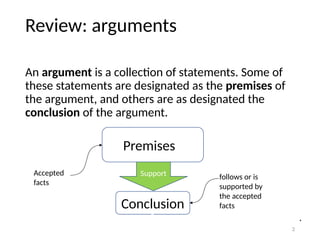
An argument is a collection of statements. Some of
these statements are designated as the premises of
the argument, and others are as designated the
conclusion of the argument.
2
Premises P
Support
Conclusion
P
Accepted
facts
follows or is
supported by
the accepted
facts
Review: Quiz
Q5. Which of the following best captures the distinction between system 1
and system 2 reasoning?
a. System 1 is slow, while system 2 is fast.
b. System 1 is fast, while system 2 is slow.
c. System 1 is fast, intuitive, and effortless, while system 2 is slow,
conscious, and effortful
d. System 1 is slow, conscious, and effortful, while system 2 is fast,
intuitive, and effortless
3
Review: Quiz
Q6. What is the difference between an argument
and a non-argument?
An argument is a set of statements, some of which
are premises and one of which is a conclusion,
which we do not already believe, where the
premises support or provide evidence for the
conclusion.
4
Review: Quiz
Q7. Does the following passage contain an
argument? Why or why not? If you think it
contains an argument, what is the
conclusion?
"Some mushrooms that look like that are deadly
poisonous. You shouldn’t eat that, unless you’re sure
what it is."
5
Review: Quiz
Q8. Does the following passage contain an
argument? Why or why not? If you think it
contains an argument, what is the
conclusion?
"If you keep driving like this, you’re going to
get into an accident. And anyway, it’s very
hard on the car. You should slow down and
quit driving like such a jerk."
6
Review: Quiz
Q9. Does the following passage contain an
argument? Why or why not? If you think it
contains an argument, what is the
conclusion?
"We stayed at the party until 4 A.M. And I
drank way too much. That’s why I slept in
until noon."
7
Review: Quiz
Q10. Which of the following sentences express statements? Select
all that apply. (Hint: the test we learned in class might be
useful...)
a. If you want to pass this class, you should complete every quiz.
b. Stop procrastinating and do your homework!
c. Do you think the moon is made of cheese?
d. You're a fool if you invest in crypto.
e. Either the moon is made of cheese, or I'm a monkey's uncle.
f. If you're a fool for investing in crypto, then I'm a genius for putting all my
money in penny stocks.
g. What did you think of the game?
h. My dog is the cutest, and anyone who sees her will agree with me.
8
Review: Quiz
Q11. Consider the following argument:
Just being unemployed can be very
debilitating. If people don’t have some sense
of purpose in their daily lives, they often can’t
keep it together.
True or false: the conclusion of this argument
is most likely "if people don't have some
sense of purpose in their daily lives, they
often can't keep it together."
9
Review: Quiz
Q12. Consider the following argument:
You can keep trying if you want, but the lawnmower isn’t
going to start. It’s out of gas.
Choose the best option for filling in a missing premise.
a. It is futile to pull a cord again and again, if it never starts the engine.
b. Kicking the lawnmower won't help.
c. Mowers need gas to start
d. Mowers need fuel to start.
10
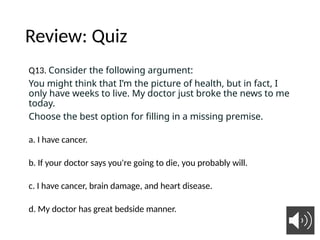
Review: Quiz
Q13. Consider the following argument:
You might think that I’m the picture of health, but in fact, I
only have weeks to live. My doctor just broke the news to me
today.
Choose the best option for filling in a missing premise.
a. I have cancer.
b. If your doctor says you're going to die, you probably will.
c. I have cancer, brain damage, and heart disease.
d. My doctor has great bedside manner.
11
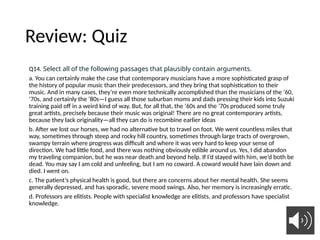
Review: Quiz
Q14. Select all of the following passages that plausibly contain arguments.
a. You can certainly make the case that contemporary musicians have a more sophisticated grasp of
the history of popular music than their predecessors, and they bring that sophistication to their
music. And in many cases, they’re even more technically accomplished than the musicians of the ’60,
’70s, and certainly the ’80s—I guess all those suburban moms and dads pressing their kids into Suzuki
training paid off in a weird kind of way. But, for all that, the ’60s and the ’70s produced some truly
great artists, precisely because their music was original! There are no great contemporary artists,
because they lack originality—all they can do is recombine earlier ideas
b. After we lost our horses, we had no alternative but to travel on foot. We went countless miles that
way, sometimes through steep and rocky hill country, sometimes through large tracts of overgrown,
swampy terrain where progress was difficult and where it was very hard to keep your sense of
direction. We had little food, and there was nothing obviously edible around us. Yes, I did abandon
my traveling companion, but he was near death and beyond help. If I’d stayed with him, we’d both be
dead. You may say I am cold and unfeeling, but I am no coward. A coward would have lain down and
died. I went on.
c. The patient’s physical health is good, but there are concerns about her mental health. She seems
generally depressed, and has sporadic, severe mood swings. Also, her memory is increasingly erratic.
d. Professors are elitists. People with specialist knowledge are elitists, and professors have specialist
knowledge.
12
Readings
http://philosophy.hku.hk/think/arg/
A01 - A04 (skip section 3 of A03)
13
Outcomes
By the end of this class you will be able to...
1. Explain the distinction between validity and
invalidity.
2. Identify basic invalid arguments.
3. Understanding the difference between validity
and soundness.
14
Standards of evaluation
Different arguments can provide different levels of
support.
• In deductive arguments, the premises guarantee the
truth of the conclusion.
• In inductive arguments, the premises make the
conclusion likely (but do not guarantee it).
When we evaluate arguments, we can use different
standards. Which standards we use depends on the aim
of the argument.
For now, we focus on deductive arguments. Inductive
arguments come later.
Warmup #1
P1. All dogs have lungs
P2. Clifford is a dog
C. Therefore, Clifford has lungs.
Do these premises support the conclusion? Why or
why not?
Warmup #2
P1. All dogs have lungs
P2. Clifford has lungs
C. Therefore, Clifford is a dog.
Do these premises support the conclusion? Why or
why not?
What's the difference?
The first argument doesn't have any gaps. If the premises are
all true, the conclusion must be true as well. It's impossible
for the premises to be true and the conclusion to be false.
The second argument has a 'gap' or a 'hole'. The truth of the
premises doesn't guarantee that the conclusion will be true.
It's possible for the premises to be true and the conclusion
false
In other words, it doesn't rule out the following possibility:
Clifford has lungs, but isn’t a dog.
18
Validity
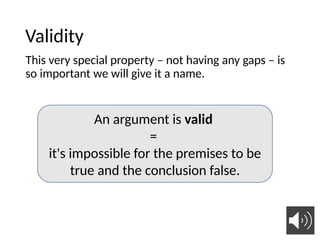
This very special property – not having any gaps – is
so important we will give it a name.
An argument is valid
=
it's impossible for the premises to be
true and the conclusion false.
Invalidity
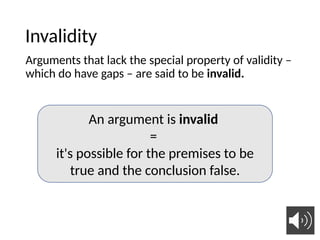
Arguments that lack the special property of validity –
which do have gaps – are said to be invalid.
An argument is invalid
=
it's possible for the premises to be
true and the conclusion false.
Practice
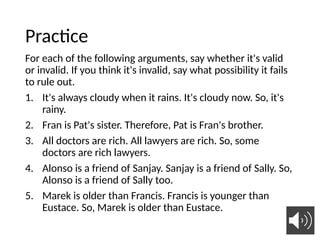
For each of the following arguments, say whether it's valid
or invalid. If you think it's invalid, say what possibility it fails
to rule out.
1. It's always cloudy when it rains. It's cloudy now. So, it's
rainy.
2. Fran is Pat's sister. Therefore, Pat is Fran's brother.
3. All doctors are rich. All lawyers are rich. So, some
doctors are rich lawyers.
4. Alonso is a friend of Sanjay. Sanjay is a friend of Sally. So,
Alonso is a friend of Sally too.
5. Marek is older than Francis. Francis is younger than
Eustace. So, Marek is older than Eustace.
21
Validity and belief
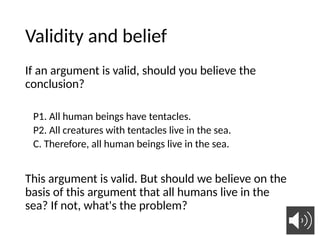
If an argument is valid, should you believe the
conclusion?
P1. All human beings have tentacles.
P2. All creatures with tentacles live in the sea.
C. Therefore, all human beings live in the sea.
This argument is valid. But should we believe on the
basis of this argument that all humans live in the
sea? If not, what's the problem?
22
Validity and belief
No!!!!!
Validity identifies conditional support between premises
and a conclusion: if the premises are true, then the
conclusion is true.
If the premises aren't all true, all bets are off!!
Valid reasoning from false premises doesn't provide a
reason to believe some conclusion.
23
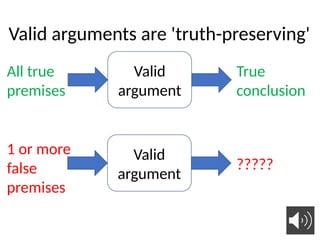
Valid arguments are 'truth-preserving'
24
Valid
argument
All true
premises
True
conclusion
Valid
argument
1 or more
false
premises
?????
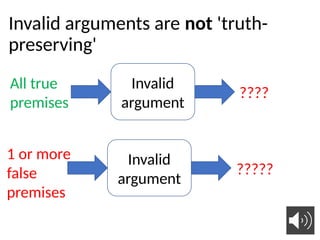
Invalid arguments are not 'truth-
preserving'
25
Invalid
argument
All true
premises
????
Invalid
argument
1 or more
false
premises
?????
Another example
P1. Either dogs do not bark, or David has a million
dollars in his pocket.
P2. Dogs bark.
C. Therefore, David has a million dollars in his pocket.
Should you believe the conclusion?
Validity vs the actual truth of the
premises/conclusion
The single most important thing to understand is that
the validity of an argument and the actual truth-value
of its premises and conclusion have NOTHING to do
with each other.
This is so important, I will say it again:
VALIDITY AND THE ACTUAL TRUTH-VALUES OF
THE PREMISES AND CONCLUSION ARE TOTALLY
UNRELATED!!!!
27
Validity vs the actual truth of the
premises/conclusion
Here is an example of an invalid argument with true
premises and a true conclusion:
P1. Beethoven's music is excellent.
P2. If someone's music is well-known centuries after their death,
then their music must be excellent.
C. Therefore, Beethoven's music is well-known centuries after
his death.
Plausibly, all of these claims are true. But the argument is
invalid. (What possibility do the premises fail to rule out?)
Soundness
Valid arguments with true premises are said to be
sound.
An argument is sound
=
(1) it's valid AND (2) all of its premises
are true
As a formula: soundness = validity + true premises
Unsoundness
An argument is unsound
=
(1) it's invalid, OR (2) at least one
premise is false
Practice
For each of the following arguments, evaluate it for
validity and soundness. (Appeal to the appropriate
definitions to justify your answer.)
1. The Eiffel tower is in Paris. Paris is in France. So,
the Eiffel tower is in France.
31
Practice
For each of the following arguments, evaluate it for
validity and soundness. (Appeal to the appropriate
definitions to justify your answer.)
1. The Eiffel tower is in Paris. Paris is in France. So,
the Eiffel tower is in France.
2. The Eiffel tower is in Berlin. Berlin is in Germany.
So, the Eiffel tower is in Germany.
32
Practice
For each of the following arguments, evaluate it for
validity and soundness. (Appeal to the appropriate
definitions to justify your answer.)
1. The Eiffel tower is in Paris. Paris is in France. So,
the Eiffel tower is in France.
2. The Eiffel tower is in Berlin. Berlin is in Germany.
So, the Eiffel tower is in Germany.
3. All birds have wings. All things with wings can fly.
So, all birds can fly.
33
Practice
For each of the following arguments, evaluate it for validity
and soundness. (Appeal to the appropriate definitions to
justify your answer.)
1. The Eiffel tower is in Paris. Paris is in France. So, the
Eiffel tower is in France.
2. The Eiffel tower is in Berlin. Berlin is in Germany. So,
the Eiffel tower is in Germany.
3. All birds have wings. All things with wings can fly. So, all
birds can fly.
4. India is the most populous country in Asia. China is the
most populous country in the world. The world
includes Asia. So, China is not in Asia.
34
Practice
For each of the following arguments, evaluate it for validity and
soundness. (Appeal to the appropriate definitions to justify your
answer.)
1. The Eiffel tower is in Paris. Paris is in France. So, the Eiffel tower is
in France.
2. The Eiffel tower is in Berlin. Berlin is in Germany. So, the Eiffel
tower is in Germany.
3. All birds have wings. All things with wings can fly. So, all birds can
fly.
4. India is the most populous country in Asia. China is the most
populous country in the world. The world includes Asia. So, China
is not in Asia.
5. Some dogs are pets. Some pets have four tails and a leg. So, all
dogs have four tails and a leg.
35
Challenge questions
Which of the following are possible? If impossible
explain why. If possible, given an argument to illustrate
your answer.
1. An argument that is sound and invalid.
2. An argument that is valid and has a false conclusion.
3. An invalid argument with a true conclusion.
4. An argument that is valid but unsound.
5. An unsound argument with true premises and a
true conclusion.
Exercises
Everyone go to Moodle and open Exercises 2.
37

3. Introduction to validity and soundness2.pptx

  • 1.
  • 2.
    Review: arguments An argumentis a collection of statements. Some of these statements are designated as the premises of the argument, and others are as designated the conclusion of the argument. 2 Premises P Support Conclusion P Accepted facts follows or is supported by the accepted facts
  • 3.
    Review: Quiz Q5. Whichof the following best captures the distinction between system 1 and system 2 reasoning? a. System 1 is slow, while system 2 is fast. b. System 1 is fast, while system 2 is slow. c. System 1 is fast, intuitive, and effortless, while system 2 is slow, conscious, and effortful d. System 1 is slow, conscious, and effortful, while system 2 is fast, intuitive, and effortless 3
  • 4.
    Review: Quiz Q6. Whatis the difference between an argument and a non-argument? An argument is a set of statements, some of which are premises and one of which is a conclusion, which we do not already believe, where the premises support or provide evidence for the conclusion. 4
  • 5.
    Review: Quiz Q7. Doesthe following passage contain an argument? Why or why not? If you think it contains an argument, what is the conclusion? "Some mushrooms that look like that are deadly poisonous. You shouldn’t eat that, unless you’re sure what it is." 5
  • 6.
    Review: Quiz Q8. Doesthe following passage contain an argument? Why or why not? If you think it contains an argument, what is the conclusion? "If you keep driving like this, you’re going to get into an accident. And anyway, it’s very hard on the car. You should slow down and quit driving like such a jerk." 6
  • 7.
    Review: Quiz Q9. Doesthe following passage contain an argument? Why or why not? If you think it contains an argument, what is the conclusion? "We stayed at the party until 4 A.M. And I drank way too much. That’s why I slept in until noon." 7
  • 8.
    Review: Quiz Q10. Whichof the following sentences express statements? Select all that apply. (Hint: the test we learned in class might be useful...) a. If you want to pass this class, you should complete every quiz. b. Stop procrastinating and do your homework! c. Do you think the moon is made of cheese? d. You're a fool if you invest in crypto. e. Either the moon is made of cheese, or I'm a monkey's uncle. f. If you're a fool for investing in crypto, then I'm a genius for putting all my money in penny stocks. g. What did you think of the game? h. My dog is the cutest, and anyone who sees her will agree with me. 8
  • 9.
    Review: Quiz Q11. Considerthe following argument: Just being unemployed can be very debilitating. If people don’t have some sense of purpose in their daily lives, they often can’t keep it together. True or false: the conclusion of this argument is most likely "if people don't have some sense of purpose in their daily lives, they often can't keep it together." 9
  • 10.
    Review: Quiz Q12. Considerthe following argument: You can keep trying if you want, but the lawnmower isn’t going to start. It’s out of gas. Choose the best option for filling in a missing premise. a. It is futile to pull a cord again and again, if it never starts the engine. b. Kicking the lawnmower won't help. c. Mowers need gas to start d. Mowers need fuel to start. 10
  • 11.
    Review: Quiz Q13. Considerthe following argument: You might think that I’m the picture of health, but in fact, I only have weeks to live. My doctor just broke the news to me today. Choose the best option for filling in a missing premise. a. I have cancer. b. If your doctor says you're going to die, you probably will. c. I have cancer, brain damage, and heart disease. d. My doctor has great bedside manner. 11
  • 12.
    Review: Quiz Q14. Selectall of the following passages that plausibly contain arguments. a. You can certainly make the case that contemporary musicians have a more sophisticated grasp of the history of popular music than their predecessors, and they bring that sophistication to their music. And in many cases, they’re even more technically accomplished than the musicians of the ’60, ’70s, and certainly the ’80s—I guess all those suburban moms and dads pressing their kids into Suzuki training paid off in a weird kind of way. But, for all that, the ’60s and the ’70s produced some truly great artists, precisely because their music was original! There are no great contemporary artists, because they lack originality—all they can do is recombine earlier ideas b. After we lost our horses, we had no alternative but to travel on foot. We went countless miles that way, sometimes through steep and rocky hill country, sometimes through large tracts of overgrown, swampy terrain where progress was difficult and where it was very hard to keep your sense of direction. We had little food, and there was nothing obviously edible around us. Yes, I did abandon my traveling companion, but he was near death and beyond help. If I’d stayed with him, we’d both be dead. You may say I am cold and unfeeling, but I am no coward. A coward would have lain down and died. I went on. c. The patient’s physical health is good, but there are concerns about her mental health. She seems generally depressed, and has sporadic, severe mood swings. Also, her memory is increasingly erratic. d. Professors are elitists. People with specialist knowledge are elitists, and professors have specialist knowledge. 12
  • 13.
  • 14.
    Outcomes By the endof this class you will be able to... 1. Explain the distinction between validity and invalidity. 2. Identify basic invalid arguments. 3. Understanding the difference between validity and soundness. 14
  • 15.
    Standards of evaluation Differentarguments can provide different levels of support. • In deductive arguments, the premises guarantee the truth of the conclusion. • In inductive arguments, the premises make the conclusion likely (but do not guarantee it). When we evaluate arguments, we can use different standards. Which standards we use depends on the aim of the argument. For now, we focus on deductive arguments. Inductive arguments come later.
  • 16.
    Warmup #1 P1. Alldogs have lungs P2. Clifford is a dog C. Therefore, Clifford has lungs. Do these premises support the conclusion? Why or why not?
  • 17.
    Warmup #2 P1. Alldogs have lungs P2. Clifford has lungs C. Therefore, Clifford is a dog. Do these premises support the conclusion? Why or why not?
  • 18.
    What's the difference? Thefirst argument doesn't have any gaps. If the premises are all true, the conclusion must be true as well. It's impossible for the premises to be true and the conclusion to be false. The second argument has a 'gap' or a 'hole'. The truth of the premises doesn't guarantee that the conclusion will be true. It's possible for the premises to be true and the conclusion false In other words, it doesn't rule out the following possibility: Clifford has lungs, but isn’t a dog. 18
  • 19.
    Validity This very specialproperty – not having any gaps – is so important we will give it a name. An argument is valid = it's impossible for the premises to be true and the conclusion false.
  • 20.
    Invalidity Arguments that lackthe special property of validity – which do have gaps – are said to be invalid. An argument is invalid = it's possible for the premises to be true and the conclusion false.
  • 21.
    Practice For each ofthe following arguments, say whether it's valid or invalid. If you think it's invalid, say what possibility it fails to rule out. 1. It's always cloudy when it rains. It's cloudy now. So, it's rainy. 2. Fran is Pat's sister. Therefore, Pat is Fran's brother. 3. All doctors are rich. All lawyers are rich. So, some doctors are rich lawyers. 4. Alonso is a friend of Sanjay. Sanjay is a friend of Sally. So, Alonso is a friend of Sally too. 5. Marek is older than Francis. Francis is younger than Eustace. So, Marek is older than Eustace. 21
  • 22.
    Validity and belief Ifan argument is valid, should you believe the conclusion? P1. All human beings have tentacles. P2. All creatures with tentacles live in the sea. C. Therefore, all human beings live in the sea. This argument is valid. But should we believe on the basis of this argument that all humans live in the sea? If not, what's the problem? 22
  • 23.
    Validity and belief No!!!!! Validityidentifies conditional support between premises and a conclusion: if the premises are true, then the conclusion is true. If the premises aren't all true, all bets are off!! Valid reasoning from false premises doesn't provide a reason to believe some conclusion. 23
  • 24.
    Valid arguments are'truth-preserving' 24 Valid argument All true premises True conclusion Valid argument 1 or more false premises ?????
  • 25.
    Invalid arguments arenot 'truth- preserving' 25 Invalid argument All true premises ???? Invalid argument 1 or more false premises ?????
  • 26.
    Another example P1. Eitherdogs do not bark, or David has a million dollars in his pocket. P2. Dogs bark. C. Therefore, David has a million dollars in his pocket. Should you believe the conclusion?
  • 27.
    Validity vs theactual truth of the premises/conclusion The single most important thing to understand is that the validity of an argument and the actual truth-value of its premises and conclusion have NOTHING to do with each other. This is so important, I will say it again: VALIDITY AND THE ACTUAL TRUTH-VALUES OF THE PREMISES AND CONCLUSION ARE TOTALLY UNRELATED!!!! 27
  • 28.
    Validity vs theactual truth of the premises/conclusion Here is an example of an invalid argument with true premises and a true conclusion: P1. Beethoven's music is excellent. P2. If someone's music is well-known centuries after their death, then their music must be excellent. C. Therefore, Beethoven's music is well-known centuries after his death. Plausibly, all of these claims are true. But the argument is invalid. (What possibility do the premises fail to rule out?)
  • 29.
    Soundness Valid arguments withtrue premises are said to be sound. An argument is sound = (1) it's valid AND (2) all of its premises are true As a formula: soundness = validity + true premises
  • 30.
    Unsoundness An argument isunsound = (1) it's invalid, OR (2) at least one premise is false
  • 31.
    Practice For each ofthe following arguments, evaluate it for validity and soundness. (Appeal to the appropriate definitions to justify your answer.) 1. The Eiffel tower is in Paris. Paris is in France. So, the Eiffel tower is in France. 31
  • 32.
    Practice For each ofthe following arguments, evaluate it for validity and soundness. (Appeal to the appropriate definitions to justify your answer.) 1. The Eiffel tower is in Paris. Paris is in France. So, the Eiffel tower is in France. 2. The Eiffel tower is in Berlin. Berlin is in Germany. So, the Eiffel tower is in Germany. 32
  • 33.
    Practice For each ofthe following arguments, evaluate it for validity and soundness. (Appeal to the appropriate definitions to justify your answer.) 1. The Eiffel tower is in Paris. Paris is in France. So, the Eiffel tower is in France. 2. The Eiffel tower is in Berlin. Berlin is in Germany. So, the Eiffel tower is in Germany. 3. All birds have wings. All things with wings can fly. So, all birds can fly. 33
  • 34.
    Practice For each ofthe following arguments, evaluate it for validity and soundness. (Appeal to the appropriate definitions to justify your answer.) 1. The Eiffel tower is in Paris. Paris is in France. So, the Eiffel tower is in France. 2. The Eiffel tower is in Berlin. Berlin is in Germany. So, the Eiffel tower is in Germany. 3. All birds have wings. All things with wings can fly. So, all birds can fly. 4. India is the most populous country in Asia. China is the most populous country in the world. The world includes Asia. So, China is not in Asia. 34
  • 35.
    Practice For each ofthe following arguments, evaluate it for validity and soundness. (Appeal to the appropriate definitions to justify your answer.) 1. The Eiffel tower is in Paris. Paris is in France. So, the Eiffel tower is in France. 2. The Eiffel tower is in Berlin. Berlin is in Germany. So, the Eiffel tower is in Germany. 3. All birds have wings. All things with wings can fly. So, all birds can fly. 4. India is the most populous country in Asia. China is the most populous country in the world. The world includes Asia. So, China is not in Asia. 5. Some dogs are pets. Some pets have four tails and a leg. So, all dogs have four tails and a leg. 35
  • 36.
    Challenge questions Which ofthe following are possible? If impossible explain why. If possible, given an argument to illustrate your answer. 1. An argument that is sound and invalid. 2. An argument that is valid and has a false conclusion. 3. An invalid argument with a true conclusion. 4. An argument that is valid but unsound. 5. An unsound argument with true premises and a true conclusion.
  • 37.
    Exercises Everyone go toMoodle and open Exercises 2. 37

Editor's Notes

  • #1 Hello everyone! Today we will be talking about validity and soundness, two good properties of arguments, properties we want arguments to have.
  • #2 Let’s review what we learned last week about arguments. [Read] Remember, statements are things where you can say ‘It is true that’ in front of them, and you get a grammatical sentence. And remember, premises are statements—so they state facts about the world. They actually need not be accepted outside the argument, but for evaluating the argument for validity they will be considered accepted. The key is the connection between the premises and the conclusion. The premises have to support, or give evidence for, the conclusion. Finally, the conclusion has to be something whose truth we are not sure of. These things all together make an argument.
  • #3 Let’s review the quiz questions. [Read everything] The correct answer is c: System 1 is fast, intuitive, and effortless, while system 2 is slow, conscious, and effortful.
  • #4 [Read]
  • #5 [Read] Well, let’s consider. Remember an argument has premises that support the conclusion. Is there an argument here? What are the premises? What is the conclusion? [Discuss] This is not an argument because it contains an imperative: you shouldn't eat that. Since arguments contain only statements, this is not an argument.
  • #6 [Read] Who thought this was an argument? [Choose someone] Again what are the premises? What’s the conclusion? [Discuss] This also has an imperative: you should slow down. It also says that the driver should quit driving like a jerk. This is also not an argument.
  • #7 [Read] Who thought this was an argument? [Choose someone] What are the premises? What’s the conclusion? [Discuss] This is not an argument either: this is an explanation. The set of sentences explains why the speaker slept until noon. For an argument, we want the conclusion to be something we do not already believe.
  • #8 [Read] The statements can be found by adding ‘it is true that...’ before each sentence and checking to see if it is grammatical. The statements are A, D, E, F, and H
  • #9 [Read] False. The likeliest conclusion is that being unemployed can be very debilitating. The reason it is debilitating is that someone who is unemployed does not have some purpose in their daily lives. Wihtout that purpose, they can’t keep it together. If you cannot keep it together, then you are debilitated. Therefore, just being unemployed can be very debilitating.
  • #10 [Read] The correct answer is c. If the lawn mower is out of gas, and mowers need gas to start, then the lawnmower is not going to start.
  • #11 [Read] The best option for a missing premise is b. The reason is that while a and c are good reasons to to think you only have weeks to live, they do not connect to what is in the set of sentences. The best option is b.
  • #12 [Read] The passages that plausibly contain arguments are A and D. B is not an argument because it is just a series of sentences describing a scenario. There is no conclusion. Similarly, C is just a description. There are no sentences that are offered as conclusions. I will say that I think there may be an argument in C. Who can tell me waht I see? Ok! If people have questions about the quiz, please email me.
  • #13 Here is the reading you should have done for today.
  • #14 [Read] Validity refers to a special property of arguments, sets of sentences. When an argument is valid, it’s a good argument, because you know that if the sentences are true, then the conclusion must be true. That’s the gold standard for arguments. Identifying basic invalid arguments is a super important skill for critical thinking. You don’t want your beliefs to be determined by bad arguments! So you have to develop the skill to identify bad arguments and one basic type of bad argument are basic invalid arguments. Finally, there are many important properties of sets of sentences that make up arguments. Validity is one of them, and it’s a really good thing—but another one bears on whether or not the argument is not only valid, but true. While valid arguments help us know if an argument form is good, soundness is about truth, and that let’s us know if we can learn something about the world from the argument.
  • #15 Let’s turn now to investigate how the premises can support the conclusion. As the quiz examples reveal, there are different ways that some statements can support a conclusion. [Read slide] Deduction is the highest form of logical argumentation. If you can find a true, valid, deductive argument, then you have found an eternal truth about the world. Mathematics operates on deduction, and so do some areas of science. Importantly, computer science—the science behind our computers and AI—also operates using deductive arguments. By the method of deduction, we can arrive at sure knowledge about the world. Science, in contrast, uses inductive arguments. Science relies on past evidence to tell us something about the way the world is at all times. So, science goes beyond what is the in premises, and makes inductive arguments instead of deductive ones. We will talk more about inductive arguments later in the semester.
  • #16 Here is our first example deductive argument. [Read] What do people think? [Choose someone] Here, the premises do support the conclusion. So we imagine a world where the premises are true. In that world, all dogs have lungs. And, we take one of those dogs, named Clifford. Then we turn to the conclusion and we ask, does Clifford have lungs? Well, the premises told us that clifford is a dog. And, they told us that all dogs have lungs. So, because Clifford is the sort of thing that is talked about in the first premise, we can see that the first premise applies to Clifford. And so, the first premise supports the conclusion, which is that Clifford has lungs.
  • #17 Here is a second example. Notice this is a bit different; the second premise now says that Clifford has lungs, not that Clifford is a dog. [Read] What do people think of this one? This is actually a bad argument. Again, we put ourselves in our imagination in a world where the two premises are true. In that world, all dogs have lungs, and clifford has lungs. Now, we turn to the conclusion, that cliffford is a dog. Do those premises support that conclusion? We can see that they do not, because what the premises fail to point out, is that only dogs have lungs. In fact, many other things have lungs. Clifford might be a cat, for example, and all cats have lungs; so Clifford in that world where he is a cat, would have lungs. But in that world, Clifford is not a dog. So here we have an argument where the premises do not support the conclusion.
  • #18 What’s the diference between these two arguments? [Read] Holes in arguments are really bad, and that is why we are learning about validity. When an argument is invalid, there has been a jump in the reasoning. But jumps in reasoning are where we go wrong in reasoning. That’s where we can’t be sure we are right; we can’t be sure that we are tracking what’s true or what follows from our premises. If we believed bad arguments, we would believe Clifford is a dog—but in reality, he isn’t—he’s a cat.
  • #19 [Read] What does this mean? Remember that an argument is a set of sentences, all but one of which are statements or premises, and the last one of which is the conclusion. And, there’s a special connection between the premises and conclusion: the premises support or are evidence for the conclusion. When an argument is valid, that support or evidence is top notch: it guarantees that if the premises are true, if we have gotten our evidence right, then the conclusion is true. Another way of saying it is as shown here—it is not possible for the premises to be true and the conclusion false.
  • #20 [Read] The flipside of validity is invalidity. Invalidity is a very bad thing. When an argument is invalid, that means that if the premises are true, the conclusion could still be false. So we could believe the premises, and we could believe the conclusion because of the premises, and we would be wrong. We would have made a mistake in our thinking. And that’s bad, because we want our thinking to be good—we want to insure that if we believe the premises and then believe the conclusion because we believe the premises, that we aren’t making a mistake. But when we do, thats because the argument is invalid.
  • #21 Let’s go over some practice. This time, lets break into groups and discuss each of these. So break up into groups-pairs or whatever-and discuss these five arguments for the next 10 minutes. Decide if it is valid or invalid and if it is invalid, say why. [Wait 5 minutes. Then go over each] 1. Invalid. It could be cloudy without rain. The first premise says that if it is raining, then it is cloudy--but we need the other way around. So this is invalid. 2. Invalid. We are missing a premise--the defintion of brother or the biconditional on brother and sister. 3. Invalid. The set of doctors and the set of lawyers could be non-overlapping. 4. Invalid. We are missing a statement that says that friendship is transitive. 5. Invalid. We can imagine a world where Marek is older than Francis but younger than Eustace--here's one: Franic is 12, Marek is 15, and Eustace is 18.
  • #22 What’s the relationship between that special property that some arguments have, validity, and belief? [Read] The argument is valid because if the premises were true, then the conclusion would have to be true. Imagine you take a random human in this world where the first premise is true. Then that human would have tentacles. Now, because the second premise is also true in this world, then that random human we chose, who has tentacles, would live in the sea, because all creatures with tentacles live in the sea. The human is a creature, so it would live in the sea. But now, that human was not special—we chose that human randomly. So it could have been any human. So all humans live in the sea. But should we believe the argument?
  • #23 You definitely should not believe that argument. [Read] What valid reasoning does is give us a guide if the premises are true. If the premises are false, such as in the case of the humans with tentacles, then we should not believe what might follow from those premises. Valid reasoning gives us a structure for creating good arguments. But it is just a structure; it needs to be connected to the world in order for us to be able to believe the conclusion. If the premises are not connected to the world, then it doesn’t matter what follows from the premises, they won’t guarantee the truth, which is what we want.
  • #24 There are two cases here. [Read] For a valid argument, if the premises are all true, then we are guaranteed that the conclusion is true. But if there are one or more false premises, then not even a valid argument can guarantee their truth. The conclusion of the argument might still be true; but we aren’t guaranteed that it is true if the premises are true. And that is the key difference. We want to have a guarantee that we can believe what follows from the premises and in order to get that guarantee, none of the premises can be false. Otherwise, we can’t be certain that the conclusion is true. It might be true but it might be false.
  • #25 In contrast to valid argument, invalid arguments are not truth preserving. [Read] Even if all the premises are true in an invalid argument, we are still not guaranteed that the conclusion is true. And if some of those premises are false we also aren’t guaranteed that the conclusion is true. In fact, we have no guarantees. Invalid arguments simply do not guarantee that the conclusion is true, regardless of if the premises are true. And that’s what we are looking for; we are looking for a guarantee. We want to reason well by looking at sentences and seeing what follows from them by their structure and their truth. But an invalid argument doesn’t have that structure. So it doesn’t matter if the premises are true or not; there’s no guarantee of the truth of the conclusion.
  • #26 Let’s consider another example. [Read] This seems like a pretty good argument. What we do here is we look at the premises and we imagine a world where the premises are true. Suppose that I have made a bet with a very rich friend. In that world, I bet one million dollars that dogs bark. This is a stupid friend, because they bet a million dollars that dogs do not bark. Now, in this world, because of the bet, the first premise is true. Let’s further imagine in this world that dogs bark, just like they do in our world. They are mammals and they emit loud canine noises when things happen around them that they find alarming or noteworthy or whatever. So, in this world I am describing, it is true that dogs bark. Because it is true that dogs bark, because this is that sort of dogs-barking-world, and it is true that either dogs do not bark or David has a million dollars in his pocket, because I made a bet last week with my stupid rich friend, it must also be true that I have a million dollars in my pocket. So yes, we should believe the conclusion.
  • #27 [Read] This is super important. Validity is a feature of sets of sentences in virtue of their logical properties, not what they say. It is like structural feature. This building has four walls, and that is true regardless of whether it is sunny outside or stormy outside. The four walls are a structural feature of the builiding. Similarly, logical properties are structural features of sentences, regardless of what they say about the world, regardless of whether they are true. But, because they have those logical properties regardless of whether they are true and logical properties determine the validity of arguments, then validity and truth values are independent. They are unrelated.
  • #28 [Read] [Discuss] The possibility the premises fail to rule out is where Beethoven’s music is not well-known centuries after their death. That is, there is a possible world where the premises are true, but the conclusion does not follow, that Beethoven’s music not well-known. In the actual world, of course, Beethoven’s music is well known. But with our logical arguments, the conclusion will be true regardless of what happens in the actual world. so, we can consider situations that are not like the actual world. Suppose, for example, that Beethoven was forgotten about soon after his death. In that situation, his music is not well-known after his death. But his music is still excellent in that situation. So, the first premise is true. But, the second premise is also still true—if someone’s music is well-known centuries after their death, then their music must be excellent. The only way that this premise could be false is if someone’s music is well-known centuries after their death, but their music not excellent. And the case we are considering is not like that; we are supposing that Beethoven was forgotten about after his death. So we have here a case where both premises are true but the conclusion, in that situation, is false. In other words, we have an invalid argument but with all the premises and conclusion true.
  • #29 Here's another important property of arguments. [Read] This is straightforward. Validity is all about the logical properties of sentences, and those properties don’t care about what the sentences say. So, there must be another property of sets of sentences that takes into account what the sentences say about that world. What sentences say about the world can be true or false. So, there must be another property of arguments, sets of premises and a conclusion, that have to do with that property of being true or false. Soundness is meant to cover that case. Often soundness is just about the truth or falsity of the premises and conclusion; in this class, soundness is about being valid AND the truth or falsity of the premises and conclusion. So soundness captures that other aspect of sets of sentences, their truth and falsity.
  • #30 Here's another, similar concept that is important. [Read] Unsoundness, as you can imagine, regards either being invalid or having a false premise. The argument above about my having a million dollars was certainly a valid argument. To illustrate how it is valid, I told you a story about making a bet with a rich and stupid friend. In that world, it was true that I had made that bet and so I had a million dollars. But in the real world, the actual world, this world that we live in, I did not make that bet—I don’t have a rich and stupid friend who would bet a million dollars that dogs do not bark. So, in this world, that first premise is false. Because the premise is false, even though the argument is valid, the entire argument is unsound—because at least one premise is false. The argument could also have been unsound if it was invalid.
  • #31 [Read] This argument is valid. Can someone tell me why? It is valid because of the meaning or definition of x is in y. Something that follows if x is in y and y is in z is that x is in z. This is called transitivity. if x is in y and y is in z, then x is in z. However, all the premises are true. That is just what it means for something to be in another thing. And, that applies to the Eiffel tower and to Paris and France. Since being in is transitive and the Eiffel tower is in paris and paris is in france, the eiffel tower is in france.
  • #32 [Read] Is this argument valid? Sound? Can someone tell me why? This argument has the same form as the first one. Since the first one was valid, this one is valid too. Now, this is tricky, because the premises are false. The Eiffel tower is not in Berlin. But remember whether the sentences are true does not matter for validity. It only matters for soundness. So, this argument is unsound, because even though it is valid, the premises are false. So this argument is valid but unsound.
  • #33 [Read] What about this one? Is it valid? Is it sound? Can someone tell me why? This is a valid but unsound argument. Can someone tell me why? Remember, to be sound, it has to be valid, which it is, but it also has to be true. And while it is true that all birds have wings—at least I think so—not all things with wings can fly. For example, ostriches or penguins are birds with wings but they do not fly. So that premise is false, and the conclusion is also false. But this does not impact the validity! It does not impact the validity because validity does not require the premises to be true; it only requires the conclusion to be true if the premises are true. So, this argument is valid but unsound.
  • #34 [Read] Is this argument valid or sound? Who can tell me why? This is a valid but unsound argument. It is unsound because China is not the most populous country in the world; India is. Because one of the premises is not true, the argument is not sound. But is it valid? It is valid. The definition of the word 'includes' implies that Asia is in the world, and the relation of being in is transitive. So India, which is in Asia, is in the world because Asia is in the world. Now, the definition of the ‘most populous’ means there is one country with the most people. So, even though India is the most populous in Asia, since in this set of sentences China is the most populous in the world, which means it is bigger than India, and India is the biggest in Asia, it must be that China is not in Asia. That preserves the truth of the premise. So the argument is valid but unsound.
  • #35 [Read] Is this argument valid or sound? Why or why not? This argument is both invalid and so unsound. Remember, to be sound it has to be valid, but the argument is not valid, so it is not sound. The argument is not valid because we can imagine the premises being true and yet the conclusion false. We could imagine that there is some dog that is not a pet, and so it might not have four tails and a leg. Or, even if some dog is a pet, the second premise only says that some pets have four tails and a leg. So we might have a pet dog that does not have four tails and a leg. This argument is both invalid and unsound. Good! So that’s the practice. Let’s do some more.
  • #36 Let’s try and do these in small groups. Break up into small groups and work on these problems (10 Minutes--then go over their answers)
  • #37 With the rest of time today, we will practice some problems.