Evaluation of Training
B.V.L.Narayana
SPTM/RSC BRC
DEFINITION
 Training
 Provision aimed at creating intentional learning processes
To bring about semi permanent change in individuals –
Knowledge, attitudes. Skills and habits (KASH)—behaviors
With an intention To enhance performance on the job
 Evaluation of training
 Systematic collection of descriptive and judgmental
information necessary to make effective training decisions
 Is affected by
 Need analysis, participation, other antecedent conditions,
design and delivery and transfer of training
Evaluation of training
 Antecedent conditions
 Are what trainees bring to training
 Design and delivery
 Structuring and methods of delivering content
 Transfer of training
 Transfer of training is defined as the degree to
which trainees apply the knowledge, skills , and
attitudes gained in training to their job ( Ford and
weissbein 1997; Tannebaum and Yulk 1992;
Wexley and latham 1991)
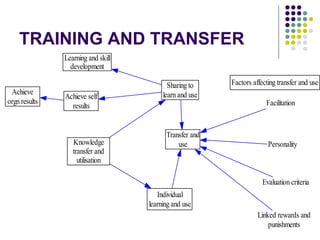
TRAINING AND TRANSFER
Knowledge
transfer and
utilisation
Sharing to
learn and use
Individual
learning and use
Facilitation
Personality
Evaluation criteria
Linked rewards and
punishments
Transfer and
use
Factors affecting transfer and use
Learning and skill
development
Achieve self
results
Achieve
orgn results
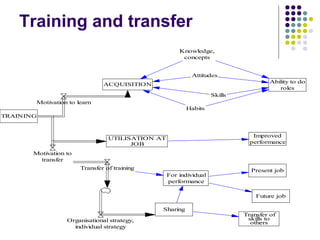
Training and transfer
TRAINING
ACQUISITION
UTILISATION AT
JOB
Motivation to learn
Motivation to
transfer
Skills
Knowledge,
concepts
Attitudes
Habits
Ability to do
roles
Improved
performance
Transfer of training
For individual
performance
Sharing
Present job
Future job
Organisational strategy,
individual strategy
Transfer of
skills to
others
Participation
 Factors influencing participation
 Organizational
 Alignment with organizational strategy
 Change, innovative work practices
 High performance work systems
 In large organizations
 Economies of scale, work place recognition, union involvement,
specialized skills
 Showing greater support for training and development
 At job level
 Highly skilled jobs
 At individual level
 More motivated to learn, continuous learning
 More committed
Antecedent conditions
 Are
 What trainees bring to training
 High cognitive ability
 High motivation to learn-desire to learn
 High training and performance goal orientation
 Work environment factors-facilitating trainee participation
and learning
 Enablers of use of training at work place
 Rewards, recognition, support, resources
 Organizational direction and support
 How training is prepared
 Content has to be relevant, interesting, appropriate and
have opportunities for practice, enable mental
conceptualization of material
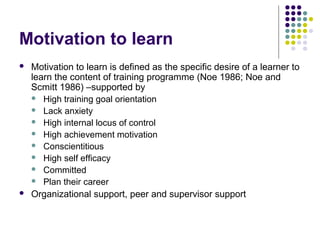
Motivation to learn
 Motivation to learn is defined as the specific desire of a learner to
learn the content of training programme (Noe 1986; Noe and
Scmitt 1986) –supported by
 High training goal orientation
 Lack anxiety
 High internal locus of control
 High achievement motivation
 Conscientitious
 High self efficacy
 Committed
 Plan their career
 Organizational support, peer and supervisor support
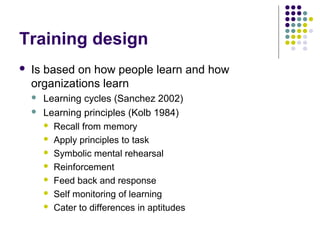
Training design
 Is based on how people learn and how
organizations learn
 Learning cycles (Sanchez 2002)
 Learning principles (Kolb 1984)
 Recall from memory
 Apply principles to task
 Symbolic mental rehearsal
 Reinforcement
 Feed back and response
 Self monitoring of learning
 Cater to differences in aptitudes
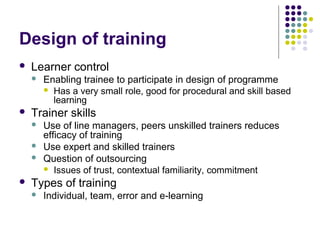
Design of training
 Learner control
 Enabling trainee to participate in design of programme
 Has a very small role, good for procedural and skill based
learning
 Trainer skills
 Use of line managers, peers unskilled trainers reduces
efficacy of training
 Use expert and skilled trainers
 Question of outsourcing
 Issues of trust, contextual familiarity, commitment
 Types of training
 Individual, team, error and e-learning
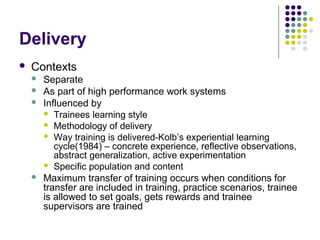
Delivery
 Contexts
 Separate
 As part of high performance work systems
 Influenced by
 Trainees learning style
 Methodology of delivery
 Way training is delivered-Kolb’s experiential learning
cycle(1984) – concrete experience, reflective observations,
abstract generalization, active experimentation
 Specific population and content
 Maximum transfer of training occurs when conditions for
transfer are included in training, practice scenarios, trainee
is allowed to set goals, gets rewards and trainee
supervisors are trained
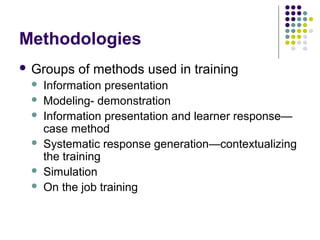
Methodologies
 Groups of methods used in training
 Information presentation
 Modeling- demonstration
 Information presentation and learner response—
case method
 Systematic response generation—contextualizing
the training
 Simulation
 On the job training
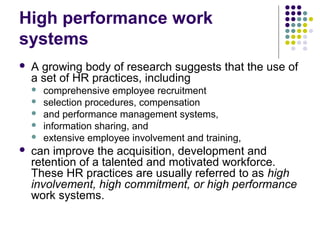
High performance work
systems
 A growing body of research suggests that the use of
a set of HR practices, including
 comprehensive employee recruitment
 selection procedures, compensation
 and performance management systems,
 information sharing, and
 extensive employee involvement and training,
 can improve the acquisition, development and
retention of a talented and motivated workforce.
These HR practices are usually referred to as high
involvement, high commitment, or high performance
work systems.
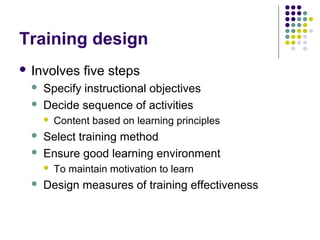
Training design
 Involves five steps
 Specify instructional objectives
 Decide sequence of activities
 Content based on learning principles
 Select training method
 Ensure good learning environment
 To maintain motivation to learn
 Design measures of training effectiveness
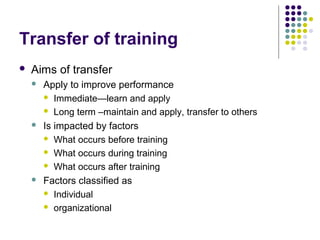
Transfer of training
 Aims of transfer
 Apply to improve performance
 Immediate—learn and apply
 Long term –maintain and apply, transfer to others
 Is impacted by factors
 What occurs before training
 What occurs during training
 What occurs after training
 Factors classified as
 Individual
 organizational
Transfer of training
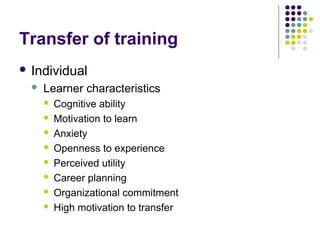
 Individual
 Learner characteristics
 Cognitive ability
 Motivation to learn
 Anxiety
 Openness to experience
 Perceived utility
 Career planning
 Organizational commitment
 High motivation to transfer
Transfer of training
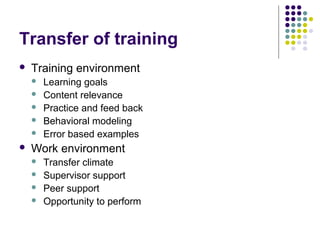
 Training environment
 Learning goals
 Content relevance
 Practice and feed back
 Behavioral modeling
 Error based examples
 Work environment
 Transfer climate
 Supervisor support
 Peer support
 Opportunity to perform
Evaluation of training
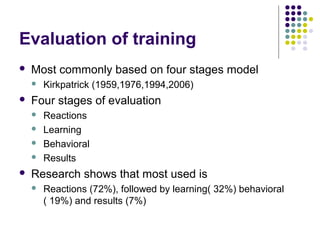
 Most commonly based on four stages model
 Kirkpatrick (1959,1976,1994,2006)
 Four stages of evaluation
 Reactions
 Learning
 Behavioral
 Results
 Research shows that most used is
 Reactions (72%), followed by learning( 32%) behavioral
( 19%) and results (7%)
Evaluation of training
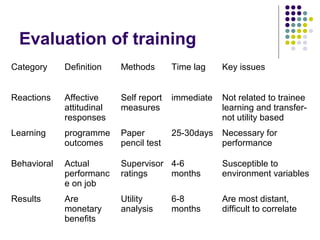
Category Definition Methods Time lag Key issues
Reactions Affective
attitudinal
responses
Self report
measures
immediate Not related to trainee
learning and transfer-
not utility based
Learning programme
outcomes
Paper
pencil test
25-30days Necessary for
performance
Behavioral Actual
performanc
e on job
Supervisor
ratings
4-6
months
Susceptible to
environment variables
Results Are
monetary
benefits
Utility
analysis
6-8
months
Are most distant,
difficult to correlate
Evaluation of training
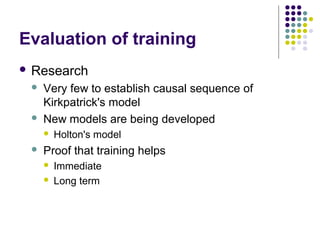
 Research
 Very few to establish causal sequence of
Kirkpatrick's model
 New models are being developed
 Holton's model
 Proof that training helps
 Immediate
 Long term
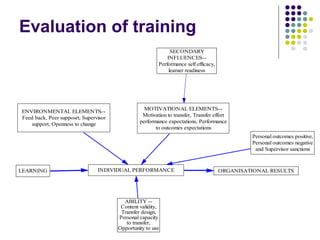
Evaluation of training
SECONDARY
INFLUENCES--
Performance self efficacy,
learner readiness
MOTIVATIONAL ELEMENTS--
Motivation to transfer, Transfer effort
performance expectations, Performance
to outcomes expectations
ENVIRONMENTAL ELEMENTS--
Feed back, Peer supposrt, Supervisor
support, Openness to change
LEARNING INDIVIDUAL PERFORMANCE ORGANISATIONAL RESULTS
ABILITY --
Content validity,
Transfer design,
Personal capacity
to transfer,
Opportunity to use
Personal outcomes positive,
Personal outcomes negative
and Supervisor sanctions
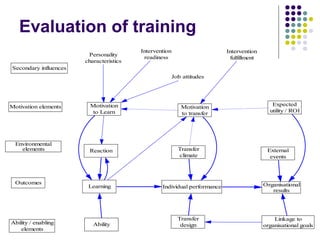
Evaluation of training
Secondary influences
Motivation elements
Environmental
elements
Outcomes
Ability / enabling
elements
Personality
characteristics
Intervention
readiness
Job attitudes
Intervention
fulfillment
Motivation
to Learn
Motivation
to transfer
Expected
utility / ROI
Reaction Transfer
climate
External
events
Learning Individual performance Organisational
results
Ability
Transfer
design
Linkage to
organisational goals
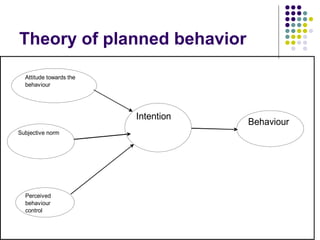
Behaviour
Intention
Subjective norm
Perceived
behaviour
control
Attitude towards the
behaviour
Theory of planned behavior
 The theory of planned behaviour states that the most important
determinant of a persons behaviour
 is behaviour intent ( Ajzen 1991; Ajzen and Fishbien 1980;
Fishbien and Ajzen 1975) and
 that this intent is dependent upon His attitude, the pervailing
norms and perceived behaviour controls.
 Peoples attitudes towards their behaviour refers to the degree to
which they are made favourable or unfavourable evaluations of
behaviour in question.
 subjective norms are perceived social pressures from significant
others to perform or not to perform.
 Perceived behavioral controls are the perceived ease or difficulty
of performing a beaviour. more favourable the norms and
attitudes, more favourable is te perceived beavioural controls and
stronger the individual intention to perform the behaviour under
consideration
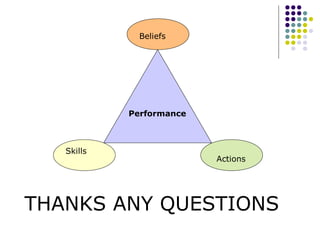
Skills
Performance
Beliefs
Actions
THANKS ANY QUESTIONS

1307517296577 evaluation of training

  • 1.
  • 2.
    DEFINITION  Training  Provisionaimed at creating intentional learning processes To bring about semi permanent change in individuals – Knowledge, attitudes. Skills and habits (KASH)—behaviors With an intention To enhance performance on the job  Evaluation of training  Systematic collection of descriptive and judgmental information necessary to make effective training decisions  Is affected by  Need analysis, participation, other antecedent conditions, design and delivery and transfer of training
  • 3.
    Evaluation of training Antecedent conditions  Are what trainees bring to training  Design and delivery  Structuring and methods of delivering content  Transfer of training  Transfer of training is defined as the degree to which trainees apply the knowledge, skills , and attitudes gained in training to their job ( Ford and weissbein 1997; Tannebaum and Yulk 1992; Wexley and latham 1991)
  • 4.
    TRAINING AND TRANSFER Knowledge transferand utilisation Sharing to learn and use Individual learning and use Facilitation Personality Evaluation criteria Linked rewards and punishments Transfer and use Factors affecting transfer and use Learning and skill development Achieve self results Achieve orgn results
  • 5.
    Training and transfer TRAINING ACQUISITION UTILISATIONAT JOB Motivation to learn Motivation to transfer Skills Knowledge, concepts Attitudes Habits Ability to do roles Improved performance Transfer of training For individual performance Sharing Present job Future job Organisational strategy, individual strategy Transfer of skills to others
  • 6.
    Participation  Factors influencingparticipation  Organizational  Alignment with organizational strategy  Change, innovative work practices  High performance work systems  In large organizations  Economies of scale, work place recognition, union involvement, specialized skills  Showing greater support for training and development  At job level  Highly skilled jobs  At individual level  More motivated to learn, continuous learning  More committed
  • 7.
    Antecedent conditions  Are What trainees bring to training  High cognitive ability  High motivation to learn-desire to learn  High training and performance goal orientation  Work environment factors-facilitating trainee participation and learning  Enablers of use of training at work place  Rewards, recognition, support, resources  Organizational direction and support  How training is prepared  Content has to be relevant, interesting, appropriate and have opportunities for practice, enable mental conceptualization of material
  • 8.
    Motivation to learn Motivation to learn is defined as the specific desire of a learner to learn the content of training programme (Noe 1986; Noe and Scmitt 1986) –supported by  High training goal orientation  Lack anxiety  High internal locus of control  High achievement motivation  Conscientitious  High self efficacy  Committed  Plan their career  Organizational support, peer and supervisor support
  • 9.
    Training design  Isbased on how people learn and how organizations learn  Learning cycles (Sanchez 2002)  Learning principles (Kolb 1984)  Recall from memory  Apply principles to task  Symbolic mental rehearsal  Reinforcement  Feed back and response  Self monitoring of learning  Cater to differences in aptitudes
  • 10.
    Design of training Learner control  Enabling trainee to participate in design of programme  Has a very small role, good for procedural and skill based learning  Trainer skills  Use of line managers, peers unskilled trainers reduces efficacy of training  Use expert and skilled trainers  Question of outsourcing  Issues of trust, contextual familiarity, commitment  Types of training  Individual, team, error and e-learning
  • 11.
    Delivery  Contexts  Separate As part of high performance work systems  Influenced by  Trainees learning style  Methodology of delivery  Way training is delivered-Kolb’s experiential learning cycle(1984) – concrete experience, reflective observations, abstract generalization, active experimentation  Specific population and content  Maximum transfer of training occurs when conditions for transfer are included in training, practice scenarios, trainee is allowed to set goals, gets rewards and trainee supervisors are trained
  • 12.
    Methodologies  Groups ofmethods used in training  Information presentation  Modeling- demonstration  Information presentation and learner response— case method  Systematic response generation—contextualizing the training  Simulation  On the job training
  • 13.
    High performance work systems A growing body of research suggests that the use of a set of HR practices, including  comprehensive employee recruitment  selection procedures, compensation  and performance management systems,  information sharing, and  extensive employee involvement and training,  can improve the acquisition, development and retention of a talented and motivated workforce. These HR practices are usually referred to as high involvement, high commitment, or high performance work systems.
  • 14.
    Training design  Involvesfive steps  Specify instructional objectives  Decide sequence of activities  Content based on learning principles  Select training method  Ensure good learning environment  To maintain motivation to learn  Design measures of training effectiveness
  • 15.
    Transfer of training Aims of transfer  Apply to improve performance  Immediate—learn and apply  Long term –maintain and apply, transfer to others  Is impacted by factors  What occurs before training  What occurs during training  What occurs after training  Factors classified as  Individual  organizational
  • 16.
    Transfer of training Individual  Learner characteristics  Cognitive ability  Motivation to learn  Anxiety  Openness to experience  Perceived utility  Career planning  Organizational commitment  High motivation to transfer
  • 17.
    Transfer of training Training environment  Learning goals  Content relevance  Practice and feed back  Behavioral modeling  Error based examples  Work environment  Transfer climate  Supervisor support  Peer support  Opportunity to perform
  • 18.
    Evaluation of training Most commonly based on four stages model  Kirkpatrick (1959,1976,1994,2006)  Four stages of evaluation  Reactions  Learning  Behavioral  Results  Research shows that most used is  Reactions (72%), followed by learning( 32%) behavioral ( 19%) and results (7%)
  • 19.
    Evaluation of training CategoryDefinition Methods Time lag Key issues Reactions Affective attitudinal responses Self report measures immediate Not related to trainee learning and transfer- not utility based Learning programme outcomes Paper pencil test 25-30days Necessary for performance Behavioral Actual performanc e on job Supervisor ratings 4-6 months Susceptible to environment variables Results Are monetary benefits Utility analysis 6-8 months Are most distant, difficult to correlate
  • 20.
    Evaluation of training Research  Very few to establish causal sequence of Kirkpatrick's model  New models are being developed  Holton's model  Proof that training helps  Immediate  Long term
  • 21.
    Evaluation of training SECONDARY INFLUENCES-- Performanceself efficacy, learner readiness MOTIVATIONAL ELEMENTS-- Motivation to transfer, Transfer effort performance expectations, Performance to outcomes expectations ENVIRONMENTAL ELEMENTS-- Feed back, Peer supposrt, Supervisor support, Openness to change LEARNING INDIVIDUAL PERFORMANCE ORGANISATIONAL RESULTS ABILITY -- Content validity, Transfer design, Personal capacity to transfer, Opportunity to use Personal outcomes positive, Personal outcomes negative and Supervisor sanctions
  • 22.
    Evaluation of training Secondaryinfluences Motivation elements Environmental elements Outcomes Ability / enabling elements Personality characteristics Intervention readiness Job attitudes Intervention fulfillment Motivation to Learn Motivation to transfer Expected utility / ROI Reaction Transfer climate External events Learning Individual performance Organisational results Ability Transfer design Linkage to organisational goals
  • 23.
  • 24.
    Theory of plannedbehavior  The theory of planned behaviour states that the most important determinant of a persons behaviour  is behaviour intent ( Ajzen 1991; Ajzen and Fishbien 1980; Fishbien and Ajzen 1975) and  that this intent is dependent upon His attitude, the pervailing norms and perceived behaviour controls.  Peoples attitudes towards their behaviour refers to the degree to which they are made favourable or unfavourable evaluations of behaviour in question.  subjective norms are perceived social pressures from significant others to perform or not to perform.  Perceived behavioral controls are the perceived ease or difficulty of performing a beaviour. more favourable the norms and attitudes, more favourable is te perceived beavioural controls and stronger the individual intention to perform the behaviour under consideration
  • 25.