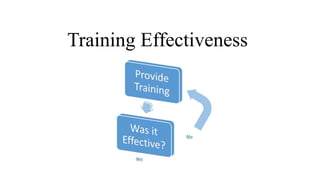
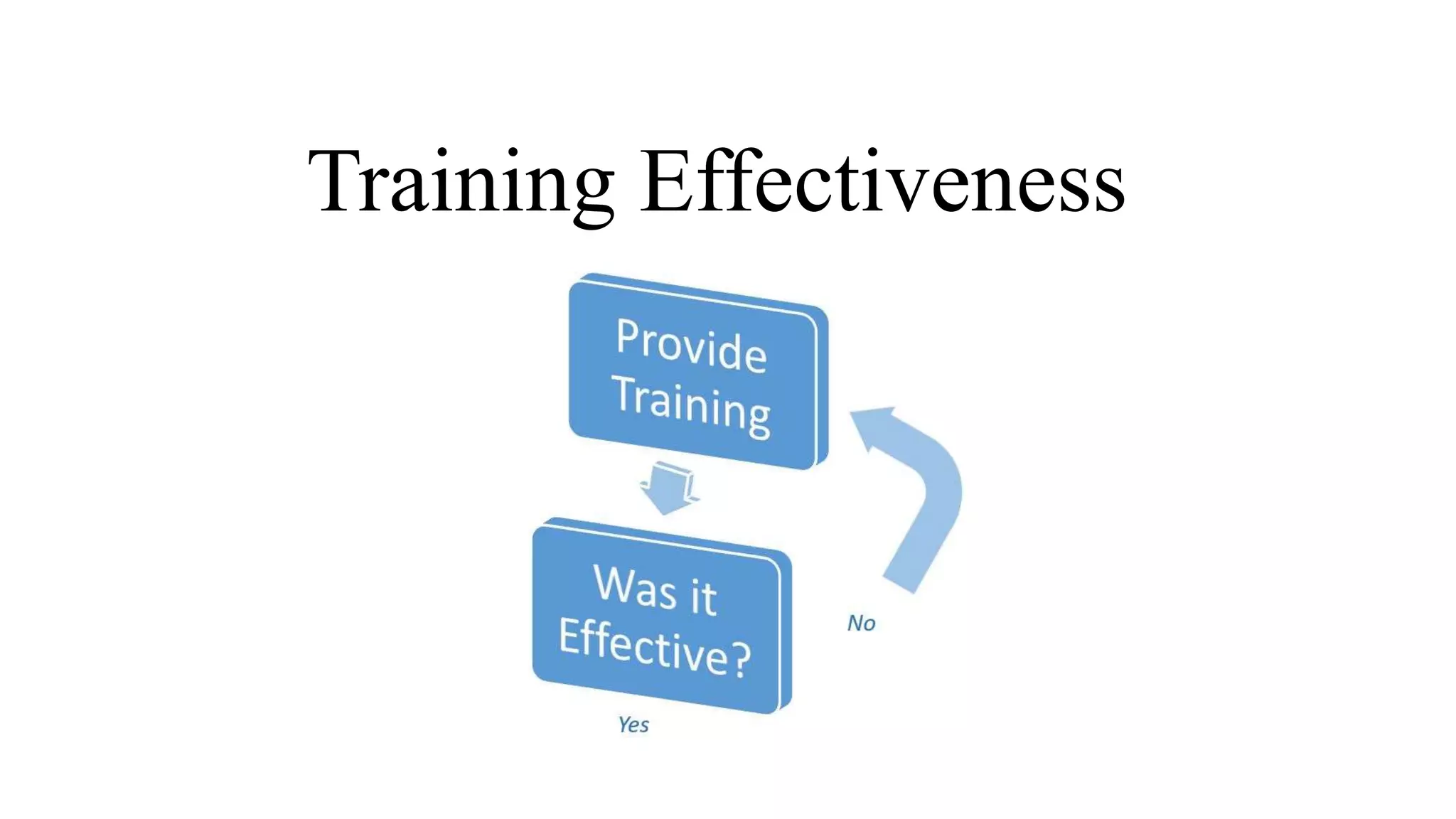
Training Effectiveness
Training effectiveness is essentially a measure that examines the degree
to which training improved the employee’s knowledge, skill, and
behavioral pattern within the organization as a result of the training.
 Did the training do what it was supposed to do?
 Did employees learn what they were supposed to learn?
 Were the employees who attended training able to do what they should
be able to do once they left the “classroom?”
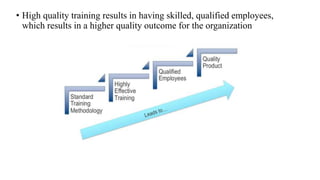
• High quality training results in having skilled, qualified employees,
which results in a higher quality outcome for the organization
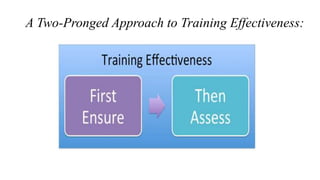
A Two-Pronged Approach to Training Effectiveness:
• 1. Ensure Training Effectiveness – An organization can ensure
training effectiveness through key activities in its best practices
training design, development, and delivery methodology.
• Quality by Design approach - happens before any employee
participates in the training.
How is it done? An organization embeds best practices in learning
and training design, development, and delivery into its standard
training methodology enabling the organization to achieve the goal of
“Right Training delivered by the Right Trainers to the Right Persons
at the Right Time to achieve the Right Outcomes.”
2. Assess Training Effectiveness – An organization can assess training
effectiveness through periodic review of current trainings after the
trainings have been completed.
What does it look like?
• Audit a selected number of
training sessions
• Document the review
results
• Continuously improve and
feed in to ensure training
effectiveness
Evaluation of training
effectiveness
• Training effectiveness refers to the benefits that the company and the
trainees receive from training
• Training outcomes or criteria refer to measures that the trainer and the
company use to evaluate training programs
• Training evaluation refers to the process of collecting the outcomes
needed to determine if training is effective
• Evaluation design refers to from whom, what, when, and how information
needed for determining the effectiveness of the training program will be
collected
Evaluation
• Formative evaluation – evaluation
conducted to improve the training
process
Helps to ensure that:
• the training program is well organized
and runs smoothly
• Provides information about how to make
the program better
Summative
Evaluation
Summative evaluation – evaluation
conducted to determine the extent to
which trainees have changed as a result
of participating in the training program
May also measure the return on
investment (ROI) that the company
receives from the training program
What can be evaluated
3 Ps
• The Plan
• The Process
• The Product – The training
How to evaluate the Plan
• Course Objectives
• Appropriate selection of participants
• Timeframe
• Teaching Methods
How to Evaluate the Process
• Planning Vs. Implementation
• Appropriate participants
• Appropriate time
• Effective use of time
• Imparting training according to set objectives
How to Evaluate the Product
Change in effectiveness
• Impact Analysis
• Achieving Targets
• Satisfying Interested
Parties
Various evaluation models for training
effectiveness
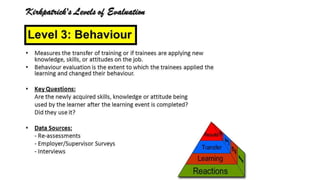
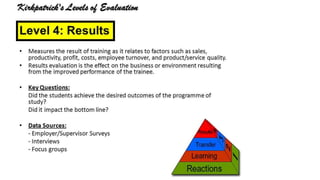
• Kirkpatrick’s Model
• Hamblin’s Model
• Kaufman’s Five level
• Warr’s Framework of Evaluation
Kirk Patrick’s model
• The model was created by Donald Kirkpatrick in 1959.
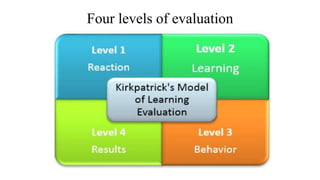
• It is a four level training evaluation model.
• It helps trainers to measure the effectiveness of their training in an
objective way.
• Kirkpatrick’s model is a worldwide standard for evaluating the
effectiveness of training.
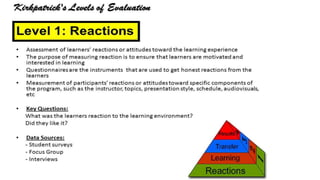
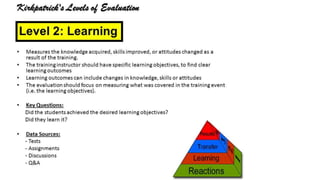
Four levels of evaluation
Hamblin’s Model
• Reaction Level: It measures the reactions of the trainees to the
content and methods of the training, not the trainer, and to any other
factors perceived as relevant. It determines what the trainee thought
about the training.
• Learning Level: It measures the learning attitude of the trainees
during the learning period. It collects information that did the trainees
learn what was intended.
• Job Behavior Level: The job behavior of the trainees in the work
environment at the end of the training period i.e. did the training got
transferred to the job?
• Effect on the Department: Has the training helped the trainees in
improving the department’s performance?
• The Ultimate Level: It measures that has the training affected the
ultimate well being of the organization in terms of the business
objectives.
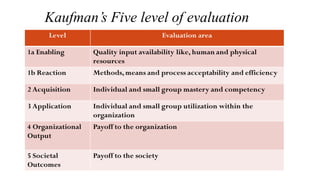
Kaufman’s Five level of evaluation
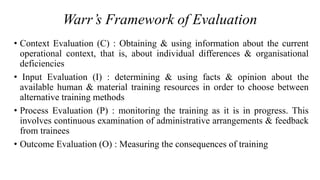
Warr’s Framework of Evaluation
• Context Evaluation (C) : Obtaining & using information about the current
operational context, that is, about individual differences & organisational
deficiencies
• Input Evaluation (I) : determining & using facts & opinion about the
available human & material training resources in order to choose between
alternative training methods
• Process Evaluation (P) : monitoring the training as it is in progress. This
involves continuous examination of administrative arrangements & feedback
from trainees
• Outcome Evaluation (O) : Measuring the consequences of training
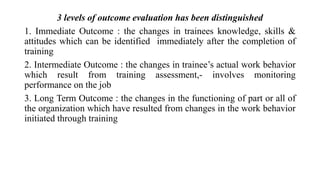
3 levels of outcome evaluation has been distinguished
1. Immediate Outcome : the changes in trainees knowledge, skills &
attitudes which can be identified immediately after the completion of
training
2. Intermediate Outcome : the changes in trainee’s actual work behavior
which result from training assessment,- involves monitoring
performance on the job
3. Long Term Outcome : the changes in the functioning of part or all of
the organization which have resulted from changes in the work behavior
initiated through training
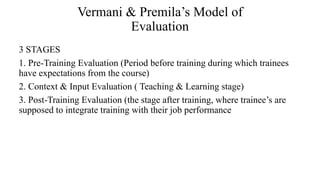
Vermani & Premila’s Model of
Evaluation
3 STAGES
1. Pre-Training Evaluation (Period before training during which trainees
have expectations from the course)
2. Context & Input Evaluation ( Teaching & Learning stage)
3. Post-Training Evaluation (the stage after training, where trainee’s are
supposed to integrate training with their job performance
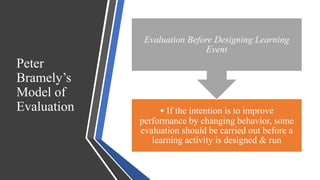
Peter
Bramely’s
Model of
Evaluation • If the intention is to improve
performance by changing behavior, some
evaluation should be carried out before a
learning activity is designed & run
Evaluation Before Designing Learning
Event
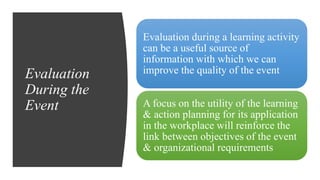
Evaluation
During the
Event
Evaluation during a learning activity
can be a useful source of
information with which we can
improve the quality of the event
A focus on the utility of the learning
& action planning for its application
in the workplace will reinforce the
link between objectives of the event
& organizational requirements
Evaluation
After the
Event
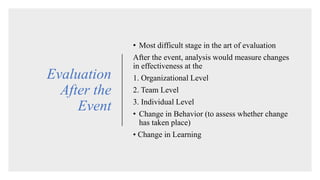
• Most difficult stage in the art of evaluation
After the event, analysis would measure changes
in effectiveness at the
1. Organizational Level
2. Team Level
3. Individual Level
• Change in Behavior (to assess whether change
has taken place)
• Change in Learning
David Reay’s
Approach to
Evaluation
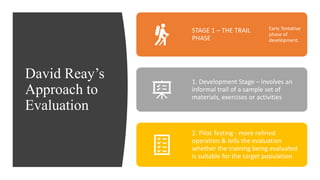
STAGE 1 – THE TRAIL
PHASE
Early Tentative
phase of
development.
1. Development Stage – involves an
informal trail of a sample set of
materials, exercises or activities
2. Pilot Testing - more refined
operation & tells the evaluation
whether the training being evaluated
is suitable for the target population
STAGE 2 – THE
ONGOING PHASE
Validation is used to measure the
effectiveness of a whole training
design. Formative evaluation is
the monitoring of the
effectiveness of different aspects
of training on a continuous basis
with a view to modification
STAGE 3 – THE FINAL PHASE
Seeks answers to the following questions
1. Were the training needs properly identified
2. Were the learning objectives relevant
3. Were the performance standards identified
4. Were the right priorities established
5. Did the training meet the objectives set for it
6. How did the learners feel about the training
7. Were people prepared for training
8. Was the training pitched at the right level
9. Was the trainee able to transfer the training to do the job
10. Did the training result in some benefit to the organization
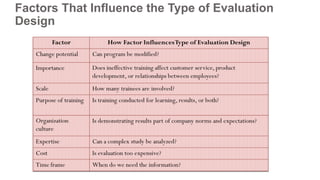
Factors That Influence the Type of Evaluation
Design
Evaluation of the effectiveness
of Training
• Modify training to meet learner’s needs by altering exercises,
changing training methods & reorganizing the sequence of topics
• Document any changes you make & explain these changes to the
instructional designers
• Use the end of course evaluation to generate ideas for making the
training better
The key lies in developing a Training Plan
Training plan sets the platform for evaluating training
programs and thereby increasing the training effectiveness.

Training effectiveness

  • 1.
  • 2.
    Training effectiveness isessentially a measure that examines the degree to which training improved the employee’s knowledge, skill, and behavioral pattern within the organization as a result of the training.  Did the training do what it was supposed to do?  Did employees learn what they were supposed to learn?  Were the employees who attended training able to do what they should be able to do once they left the “classroom?”
  • 3.
    • High qualitytraining results in having skilled, qualified employees, which results in a higher quality outcome for the organization
  • 4.
    A Two-Pronged Approachto Training Effectiveness:
  • 5.
    • 1. EnsureTraining Effectiveness – An organization can ensure training effectiveness through key activities in its best practices training design, development, and delivery methodology. • Quality by Design approach - happens before any employee participates in the training. How is it done? An organization embeds best practices in learning and training design, development, and delivery into its standard training methodology enabling the organization to achieve the goal of “Right Training delivered by the Right Trainers to the Right Persons at the Right Time to achieve the Right Outcomes.”
  • 6.
    2. Assess TrainingEffectiveness – An organization can assess training effectiveness through periodic review of current trainings after the trainings have been completed.
  • 7.
    What does itlook like? • Audit a selected number of training sessions • Document the review results • Continuously improve and feed in to ensure training effectiveness
  • 8.
  • 9.
    • Training effectivenessrefers to the benefits that the company and the trainees receive from training • Training outcomes or criteria refer to measures that the trainer and the company use to evaluate training programs • Training evaluation refers to the process of collecting the outcomes needed to determine if training is effective • Evaluation design refers to from whom, what, when, and how information needed for determining the effectiveness of the training program will be collected
  • 10.
    Evaluation • Formative evaluation– evaluation conducted to improve the training process Helps to ensure that: • the training program is well organized and runs smoothly • Provides information about how to make the program better
  • 11.
    Summative Evaluation Summative evaluation –evaluation conducted to determine the extent to which trainees have changed as a result of participating in the training program May also measure the return on investment (ROI) that the company receives from the training program
  • 12.
    What can beevaluated 3 Ps • The Plan • The Process • The Product – The training
  • 13.
    How to evaluatethe Plan • Course Objectives • Appropriate selection of participants • Timeframe • Teaching Methods
  • 14.
    How to Evaluatethe Process • Planning Vs. Implementation • Appropriate participants • Appropriate time • Effective use of time • Imparting training according to set objectives
  • 15.
    How to Evaluatethe Product Change in effectiveness • Impact Analysis • Achieving Targets • Satisfying Interested Parties
  • 16.
    Various evaluation modelsfor training effectiveness • Kirkpatrick’s Model • Hamblin’s Model • Kaufman’s Five level • Warr’s Framework of Evaluation
  • 17.
    Kirk Patrick’s model •The model was created by Donald Kirkpatrick in 1959. • It is a four level training evaluation model. • It helps trainers to measure the effectiveness of their training in an objective way. • Kirkpatrick’s model is a worldwide standard for evaluating the effectiveness of training.
  • 18.
    Four levels ofevaluation
  • 23.
    Hamblin’s Model • ReactionLevel: It measures the reactions of the trainees to the content and methods of the training, not the trainer, and to any other factors perceived as relevant. It determines what the trainee thought about the training. • Learning Level: It measures the learning attitude of the trainees during the learning period. It collects information that did the trainees learn what was intended.
  • 24.
    • Job BehaviorLevel: The job behavior of the trainees in the work environment at the end of the training period i.e. did the training got transferred to the job? • Effect on the Department: Has the training helped the trainees in improving the department’s performance? • The Ultimate Level: It measures that has the training affected the ultimate well being of the organization in terms of the business objectives.
  • 25.
  • 28.
    Warr’s Framework ofEvaluation • Context Evaluation (C) : Obtaining & using information about the current operational context, that is, about individual differences & organisational deficiencies • Input Evaluation (I) : determining & using facts & opinion about the available human & material training resources in order to choose between alternative training methods • Process Evaluation (P) : monitoring the training as it is in progress. This involves continuous examination of administrative arrangements & feedback from trainees • Outcome Evaluation (O) : Measuring the consequences of training
  • 29.
    3 levels ofoutcome evaluation has been distinguished 1. Immediate Outcome : the changes in trainees knowledge, skills & attitudes which can be identified immediately after the completion of training 2. Intermediate Outcome : the changes in trainee’s actual work behavior which result from training assessment,- involves monitoring performance on the job 3. Long Term Outcome : the changes in the functioning of part or all of the organization which have resulted from changes in the work behavior initiated through training
  • 30.
    Vermani & Premila’sModel of Evaluation 3 STAGES 1. Pre-Training Evaluation (Period before training during which trainees have expectations from the course) 2. Context & Input Evaluation ( Teaching & Learning stage) 3. Post-Training Evaluation (the stage after training, where trainee’s are supposed to integrate training with their job performance
  • 31.
    Peter Bramely’s Model of Evaluation •If the intention is to improve performance by changing behavior, some evaluation should be carried out before a learning activity is designed & run Evaluation Before Designing Learning Event
  • 32.
    Evaluation During the Event Evaluation duringa learning activity can be a useful source of information with which we can improve the quality of the event A focus on the utility of the learning & action planning for its application in the workplace will reinforce the link between objectives of the event & organizational requirements
  • 33.
    Evaluation After the Event • Mostdifficult stage in the art of evaluation After the event, analysis would measure changes in effectiveness at the 1. Organizational Level 2. Team Level 3. Individual Level • Change in Behavior (to assess whether change has taken place) • Change in Learning
  • 34.
    David Reay’s Approach to Evaluation STAGE1 – THE TRAIL PHASE Early Tentative phase of development. 1. Development Stage – involves an informal trail of a sample set of materials, exercises or activities 2. Pilot Testing - more refined operation & tells the evaluation whether the training being evaluated is suitable for the target population
  • 35.
    STAGE 2 –THE ONGOING PHASE Validation is used to measure the effectiveness of a whole training design. Formative evaluation is the monitoring of the effectiveness of different aspects of training on a continuous basis with a view to modification
  • 36.
    STAGE 3 –THE FINAL PHASE Seeks answers to the following questions 1. Were the training needs properly identified 2. Were the learning objectives relevant 3. Were the performance standards identified 4. Were the right priorities established 5. Did the training meet the objectives set for it 6. How did the learners feel about the training 7. Were people prepared for training 8. Was the training pitched at the right level 9. Was the trainee able to transfer the training to do the job 10. Did the training result in some benefit to the organization
  • 37.
    Factors That Influencethe Type of Evaluation Design
  • 38.
    Evaluation of theeffectiveness of Training • Modify training to meet learner’s needs by altering exercises, changing training methods & reorganizing the sequence of topics • Document any changes you make & explain these changes to the instructional designers • Use the end of course evaluation to generate ideas for making the training better
  • 39.
    The key liesin developing a Training Plan Training plan sets the platform for evaluating training programs and thereby increasing the training effectiveness.