TABANIDS
CHAPTER TWELVE
Acknowledgement
 Addis Ababa university
 Jimma university
 Haramaya university
 University of Gondar
 American society of clinical pathology
 Centre for disease prevention and control- Ethiopia
Outline
 Introduction
 Morphology
 Life cycle
 Medical importance
 Control
Learning objective
 At the end of this chapter, students will be able to:
 List some of the best known species of Tabanids
 Describe the morphology of Tabanids
 Discuss the medical importance of Tabanids
 Explain the life cycle of Tabanids
 Describe the control mechanisms of Tabanids
Introduction
 Family Tabanidae
 Large biting flies generally.
 Three most important generas:
 Stouts, Clegs (Haematopota)
 Green heads, Horse flies (Tabanus)
 Deer flies (Chrysops)
 They can be pests to cattle, horses, and humans.
Morphology
• Medium to very large in size
• Varieties of colors
• Abdomen & thorax with stripes or patches of contrasting colors
• Head:
• Large semicircular in outline (semilunar)
• A pair of compound eyes of different colors (dichoptic in
female & holoptic in males)
• Antennae small & stout (3 segments): no antennal arista
(unlike muscidae & Glossinidae)
• Size & shape of antennae for distinction of generas
Chrysops
Tabanus
Haematopota
• Mouth parts stout & adapted for biting (female) & point
downwards (do not project forward unlike Tse tse,
mosquitoes)
• Thorax: stout & bear a pair of wings (when at rest like a pair
of open scissors)
• Abdomen; broad & stout of different colors
• Males feed on only sugary secretions. Females also feed on
sugary substances but in addition to biting a wide variety of
mammals such as domestic animals (esp. Horses, cattles...)
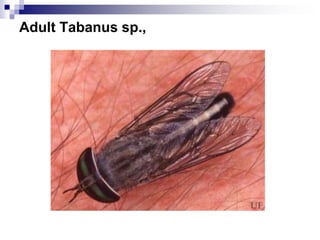
Adult Tabanus sp.,
• Eggs: creamy white, or blackish
• Curved, approximately cigar shaped
• Firmly glued in an upright position in a large mass to
the substrate (water proofed)
• Larva: cylinderical and pointed at both ends
• Darkish pigmentation near the borders of the
segments
• Very small black head (can be retracted in to the
thorax)
• 11 segments (prominent raised tyre – like rings)
• 4th – 10th segments have a pair of lateral & 2 pairs of
ventral pseudopods
• Last abdominal segment bears a siphon which can be
retracted to the abdomen
• The last abdominal segement also bears a pyriform structure
called Graber’s organ (sensory function???)
HORSE FLY LARVA
Graber’s organ
Very small head
Pseudopods (4th – 10th segments
Tyre - like rings
Siphon
HORSE FLY LARVA
• Pupa: brown colored, rounded anteriorly, tapering
posteriorly
• Has leg & wing cases attached to the body
• A row of spines encircling each abdominal segment
• Six pointed projections at the apex of the abdomen
• Head & thorax combine to cephalothorax
Life cycle
 Tabanids are holometabolous insects.
 They go through the following life stages: egg, larva,
pupa and adult.
 Though the life histories of the members of this fairly
large family of flies differ, they can be generalized as
follows.
 Eggs are usually laid in large, layered clusters of 100-
1000 on vegetation or other objects overlying water or
moist soil.
Life cycle
 The larva undergoes several molts as it grows and
depending on the species, the larval stage may last a
several months or as long as two to three years.
 Once the larva is fully developed it moves into drier soil
to pupate. Depending on the species, the pupal stage
lasts approximately 5-21 days, and then the adult flies
emerge from the soil.
 Mating occurs shortly after the adults emerge. Females
then lay in wait in vegetation until a host for a blood
meal wanders into range.
Medical importance
 Anthrax, tularaemia, lyme disease
 Nuisance or painful biting
 Severe allergic reaction to saliva
 Only females blood feeders (diurnal biters)
 Loiasis (by chrysops)
Control
 Native beneficial insects that target tabanids (some
hymenopteras), wasps, ...
 Drainage to remove standing water or muddy areas
 Traps around cattles
 Repellents
Summary
 Haematopota, Tabanus and Chrysops are the three most
important generas of Tabanids
 Have curved, cigar shaped eggs glued in mass to the
substrate
 Larvae has 11 segments
 Tabanids are holometabolous
 Act as vectors for some parasitic, bacterial and viral
pathogens
References
1. Horse fly/deer fly– Wikipedia, the free encyclopedia. htm
2. A. Ibrahim, U. Geme, T. Melaku and G. Jigssa, Lecture
note on vector biology for Medical Laboratory Technology
students, AAU, 2004
3. Sean Strother, Tabanids (horseflies), Dermatology Online
Journal 5(2): 6
4. Courtesy to pictures: James Castner and University of
Florida, Jason M. Squitier and University of Florida,
5. R. L. Guerrant et al. Tropical infectious diseases:
Principles, pathogens and practice. 2nd ed. 2006.

12_Tabanids.ppt

  • 1.
  • 2.
    Acknowledgement  Addis Ababauniversity  Jimma university  Haramaya university  University of Gondar  American society of clinical pathology  Centre for disease prevention and control- Ethiopia
  • 3.
    Outline  Introduction  Morphology Life cycle  Medical importance  Control
  • 4.
    Learning objective  Atthe end of this chapter, students will be able to:  List some of the best known species of Tabanids  Describe the morphology of Tabanids  Discuss the medical importance of Tabanids  Explain the life cycle of Tabanids  Describe the control mechanisms of Tabanids
  • 5.
    Introduction  Family Tabanidae Large biting flies generally.  Three most important generas:  Stouts, Clegs (Haematopota)  Green heads, Horse flies (Tabanus)  Deer flies (Chrysops)  They can be pests to cattle, horses, and humans.
  • 6.
    Morphology • Medium tovery large in size • Varieties of colors • Abdomen & thorax with stripes or patches of contrasting colors • Head: • Large semicircular in outline (semilunar) • A pair of compound eyes of different colors (dichoptic in female & holoptic in males) • Antennae small & stout (3 segments): no antennal arista (unlike muscidae & Glossinidae) • Size & shape of antennae for distinction of generas
  • 7.
  • 8.
    • Mouth partsstout & adapted for biting (female) & point downwards (do not project forward unlike Tse tse, mosquitoes) • Thorax: stout & bear a pair of wings (when at rest like a pair of open scissors) • Abdomen; broad & stout of different colors • Males feed on only sugary secretions. Females also feed on sugary substances but in addition to biting a wide variety of mammals such as domestic animals (esp. Horses, cattles...)
  • 9.
  • 10.
    • Eggs: creamywhite, or blackish • Curved, approximately cigar shaped • Firmly glued in an upright position in a large mass to the substrate (water proofed) • Larva: cylinderical and pointed at both ends • Darkish pigmentation near the borders of the segments • Very small black head (can be retracted in to the thorax)
  • 11.
    • 11 segments(prominent raised tyre – like rings) • 4th – 10th segments have a pair of lateral & 2 pairs of ventral pseudopods • Last abdominal segment bears a siphon which can be retracted to the abdomen • The last abdominal segement also bears a pyriform structure called Graber’s organ (sensory function???)
  • 12.
    HORSE FLY LARVA Graber’sorgan Very small head Pseudopods (4th – 10th segments Tyre - like rings Siphon
  • 13.
  • 14.
    • Pupa: browncolored, rounded anteriorly, tapering posteriorly • Has leg & wing cases attached to the body • A row of spines encircling each abdominal segment • Six pointed projections at the apex of the abdomen • Head & thorax combine to cephalothorax
  • 15.
    Life cycle  Tabanidsare holometabolous insects.  They go through the following life stages: egg, larva, pupa and adult.  Though the life histories of the members of this fairly large family of flies differ, they can be generalized as follows.  Eggs are usually laid in large, layered clusters of 100- 1000 on vegetation or other objects overlying water or moist soil.
  • 16.
    Life cycle  Thelarva undergoes several molts as it grows and depending on the species, the larval stage may last a several months or as long as two to three years.  Once the larva is fully developed it moves into drier soil to pupate. Depending on the species, the pupal stage lasts approximately 5-21 days, and then the adult flies emerge from the soil.  Mating occurs shortly after the adults emerge. Females then lay in wait in vegetation until a host for a blood meal wanders into range.
  • 17.
    Medical importance  Anthrax,tularaemia, lyme disease  Nuisance or painful biting  Severe allergic reaction to saliva  Only females blood feeders (diurnal biters)  Loiasis (by chrysops)
  • 18.
    Control  Native beneficialinsects that target tabanids (some hymenopteras), wasps, ...  Drainage to remove standing water or muddy areas  Traps around cattles  Repellents
  • 19.
    Summary  Haematopota, Tabanusand Chrysops are the three most important generas of Tabanids  Have curved, cigar shaped eggs glued in mass to the substrate  Larvae has 11 segments  Tabanids are holometabolous  Act as vectors for some parasitic, bacterial and viral pathogens
  • 20.
    References 1. Horse fly/deerfly– Wikipedia, the free encyclopedia. htm 2. A. Ibrahim, U. Geme, T. Melaku and G. Jigssa, Lecture note on vector biology for Medical Laboratory Technology students, AAU, 2004 3. Sean Strother, Tabanids (horseflies), Dermatology Online Journal 5(2): 6 4. Courtesy to pictures: James Castner and University of Florida, Jason M. Squitier and University of Florida, 5. R. L. Guerrant et al. Tropical infectious diseases: Principles, pathogens and practice. 2nd ed. 2006.

Editor's Notes

  • #16 The larvae, which are aquatic, semi-aquatic, or terrestrial, hatch from the eggs and drop to the water or soil below where they become voracious predators of other invertebrates or small vertebrates.
  • #17 Females are attracted to large, dark, moving objects and to CO2.