Pairs of Angles
Objectives:
The student will be able to (I can):
Identify
• linear pairs
• vertical angles
• complementary angles
• supplementary angles
and use these relationships to set up and solve equations.
adjacent anglesadjacent anglesadjacent anglesadjacent angles – two angles in the same plane with a
common vertex and a common side, but no common
interior points.
Example:
∠1 and ∠2 are adjacent angles.
linear pairlinear pairlinear pairlinear pair – two adjacent angles whose noncommon sides
are opposite rays. (They form a line.)
Example:
1
2
vertical anglesvertical anglesvertical anglesvertical angles – two nonadjacent angles formed by two
intersecting lines. They are always congruent.They are always congruent.They are always congruent.They are always congruent.
Example:
∠1 and ∠4 are vertical angles
∠2 and ∠3 are vertical angles
1
2
3
4
complementary anglescomplementary anglescomplementary anglescomplementary angles – two angles whose measures have
the sum of 90°.
supplementary anglessupplementary anglessupplementary anglessupplementary angles – two angles whose measures have the
sum of 180°.
∠A and ∠B are complementary. (55+35)
∠A and ∠C are supplementary. (55+125)
A
55°
B
35°
C
125°
Practice 1. What is m∠1?
2. What is m∠2?
3. What is m∠3?
1 60˚
51˚ 2
105˚
3
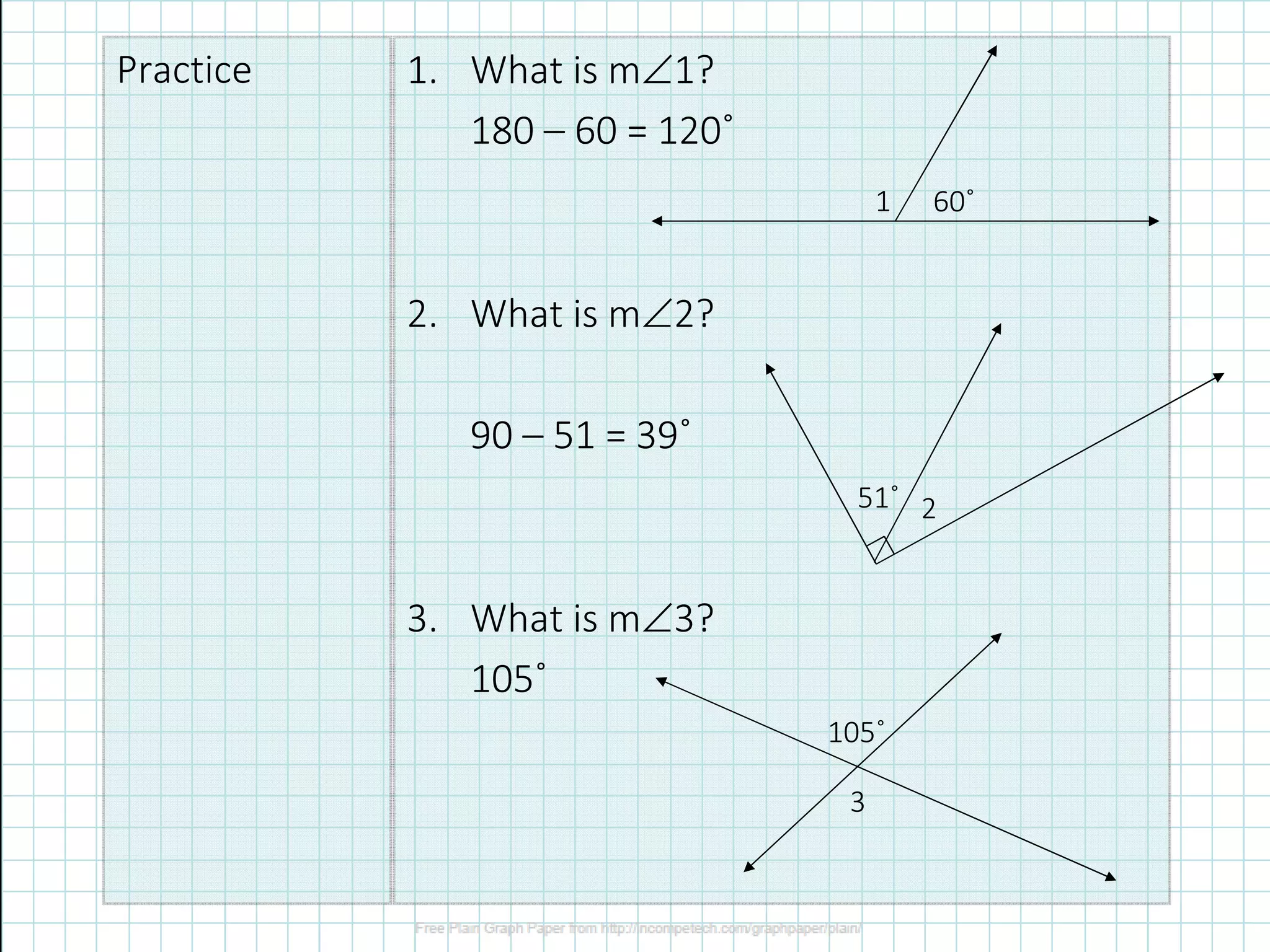
Practice 1. What is m∠1?
180 – 60 = 120˚
2. What is m∠2?
90 – 51 = 39˚
3. What is m∠3?
105˚
1 60˚
51˚ 2
105˚
3

1.2.2 Pairs of Angles

  • 1.
    Pairs of Angles Objectives: Thestudent will be able to (I can): Identify • linear pairs • vertical angles • complementary angles • supplementary angles and use these relationships to set up and solve equations.
  • 2.
    adjacent anglesadjacent anglesadjacentanglesadjacent angles – two angles in the same plane with a common vertex and a common side, but no common interior points. Example: ∠1 and ∠2 are adjacent angles. linear pairlinear pairlinear pairlinear pair – two adjacent angles whose noncommon sides are opposite rays. (They form a line.) Example: 1 2
  • 3.
    vertical anglesvertical anglesverticalanglesvertical angles – two nonadjacent angles formed by two intersecting lines. They are always congruent.They are always congruent.They are always congruent.They are always congruent. Example: ∠1 and ∠4 are vertical angles ∠2 and ∠3 are vertical angles 1 2 3 4
  • 4.
    complementary anglescomplementary anglescomplementaryanglescomplementary angles – two angles whose measures have the sum of 90°. supplementary anglessupplementary anglessupplementary anglessupplementary angles – two angles whose measures have the sum of 180°. ∠A and ∠B are complementary. (55+35) ∠A and ∠C are supplementary. (55+125) A 55° B 35° C 125°
  • 5.
    Practice 1. Whatis m∠1? 2. What is m∠2? 3. What is m∠3? 1 60˚ 51˚ 2 105˚ 3
  • 6.
    Practice 1. Whatis m∠1? 180 – 60 = 120˚ 2. What is m∠2? 90 – 51 = 39˚ 3. What is m∠3? 105˚ 1 60˚ 51˚ 2 105˚ 3