Physical Training, 
Planning and 
Implementation 
AS 91329: Demonstrate 
understanding of the application 
of biophysical principles to 
training for physical activity
1. Strength 
2. Speed 
3. Power 
4. Balance 
5. Flexibility 
6. Reaction Time 
7. Agility 
8. Endurance – CV 
9. Endurance – 
Muscular 
10. Co-ordination 
11. Body Composition 
Components of 
Fitness
Strength 
 The force that muscles or a group of muscles 
can exert in one maximal exertion/effort or 
contraction
Speed 
 The ability to move the body quickly or at 
speed, over a given distance e.g.
Power 
 The ability to generate maximum force 
quickly.
Balance 
 The ability to maintain a position in space
Flexibility 
 The flexibility or Range of motion around a 
joint
Reaction Time 
 The time it takes to process and initiate action
Agility 
 The ability to change direction suddenly when 
moving at speed.
Endurance - CV 
 Ability of the Heart, lungs and blood vessels 
to take up and deliver oxygen to the working 
muscles for long periods of time.
Endurance - Muscular 
 The ability of a muscle or group of muscles to 
contract repeatedly over a long period of time
Co-ordination 
 The ability to use different parts of the body 
together smoothly and efficiently
Body Composition 
 The percentages of fat, bone, muscle and 
water in the human body.
Principles of 
Training
Frequency 
 How often you should train: 
 Training Frequency is dependent on the type 
of training 
 Endurance (aerobic) – 4-6 days / week 
 Non-endurance (lactic acid) – 3-4 days /week 
 Non-endurance (ATP-PC) 2-3 days/week
What happens if Frequency of 
training is too high? 
 Injury 
 Burnout 
 Fatigue – leading to poor 
technique/performance 
 Boredom
Intensity 
 How hard you should train: 
 What is the correct intensity? 
 In order to make improvements you need to 
train at the intensity that replicates your 
sport/performance
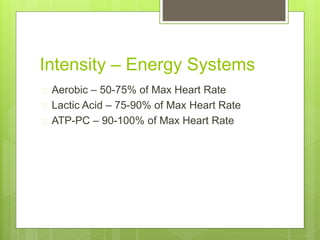
Intensity – Energy Systems 
 Aerobic – 50-75% of Max Heart Rate 
 Lactic Acid – 75-90% of Max Heart Rate 
 ATP-PC – 90-100% of Max Heart Rate
What happens if you train too 
hard or not hard enough? 
Too Hard: 
 Injury 
 Poor performance 
 Burnout 
Too Little: 
 Make no 
improvement 
 Poor improvement 
 Lack of motivation 
from poor 
improvement
Duration (Time) 
 Length of time you train or apply stimuli 
 Over the course of a training session you 
should apply intensity, 
 If you do not apply intensity during sessions 
gains are minimised.
Duration – Session Length 
 Aerobic – 30-60mins, intensity ranging 
between 50-75% of Max HR 
 Lactic Acid – 30-45min, intensity ranging 
between 75-90% of Max HR 
 ATP-PC – 20-30min, intensity ranging 
between 90-100% of Max HR
Duration of activities within each 
training session 
 Aerobic activities – any cardiovascular activity, like 
running, that is continuous. Working at 50-75% of 
Max HR. Activities can go beyond 2 hours 
depending on the sport/activity athlete is training 
for. 
 Lactic Acid – intermittent exercises that last up to 
2mins of work at intensity ranging between 75- 
90% of Max HR. 
 ATP-PC – short, high intensity bursts of energy 
performing activities that last no-longer than 
15sec at 90-100% of Max HR.
Implications for athletes 
regarding duration and intensity 
 Because as you gain, make improvements, 
you need to apply intensity for longer to 
maintain or continue to improve what has 
been gained. 
 This means increased devotion of time to 
training.
Continuous 
 Training non-stop, constant pace or speed 
throughout the session
Overload 
 Overloading the body with more that it can 
handle 
 Overload leads to training gains. This is 
required to make physiological 
gains/adaptations
How does frequency, intensity 
and duration affect Overload? 
 By manipulating frequency, intensity and 
duration of training you can apply overload 
 E.g. train more frequently increases overload
Specificity 
 Training the specific energy systems and 
muscle groups specific to the sport/activity
Reversibility 
 Loss of gains due to injury or no training
Diminishing Return 
 Adaptations made tend to occur very early on 
in training. As time progresses gains made 
tend to become smaller – this is referred to as 
Diminishing Return.
Fartlek 
 Speed play – combines continuous and 
interval training – running at varying 
intensities over a distance e.g. 4km of running 
at both high, medium, and low intensities 
throughout the run, like, run 200m at 50%, 
100m at 75%, 50m at 95%, and 50m at 
walking pace (30-40%) – repeat over 
distance. 
 This type of training stresses both the aerobic 
and anaerobic energy systems
Resistance 
 Physical training that utilises Isotonic, 
Isometric and Isokinetic exercises to 
strengthen muscles 
 Isotonic – same tension 
 Isometric – same distance/not moving 
 Isokinetic – same speed
Resistance – Strength Training 
 Strength Training consists of performing 
exercises at maximal effort of compound 
movements e.g. deadlifts. 
 Repetition Range: 1-8 reps 
 Sets: 4-10 
 Rest Ratios: 1:3-5 
 E.g. 1min of work, followed by 3-5min of rest
Flexibility 
 The ROM of joints or ability of your joints to 
move freely 
 Training: 
 Static stretching: 20-30sec 
 Repetitions: 2-3 times per muscle group
Plyometrics, Power, & Speed 
Training 
 Rapid and repeated stretching and contracting of 
muscles to increase power and strength 
 High impact exercises that focus on maximising 
the stretch reflex of the muscles 
 High intensity ranging between 90-100% effort. 
 Repetition Range: 4-10 
 Rest Ratio 1:3-5, box jumps 1 sec to jump, 
followed by 5 sec rest; Set of 5 reps take 30 sec, 
rest up to 150sec (2min 30sec) between sets.
Rest 
 Rest is required in order for the body to 
recover from the training and to allow 
adaptations to take place 
 Knowing rest ratios for the type of training you 
perform is vital in making gains and 
preventing Injury/Reversibility.

12SPS Physical training, planning and implementation

  • 1.
    Physical Training, Planningand Implementation AS 91329: Demonstrate understanding of the application of biophysical principles to training for physical activity
  • 2.
    1. Strength 2.Speed 3. Power 4. Balance 5. Flexibility 6. Reaction Time 7. Agility 8. Endurance – CV 9. Endurance – Muscular 10. Co-ordination 11. Body Composition Components of Fitness
  • 3.
    Strength  Theforce that muscles or a group of muscles can exert in one maximal exertion/effort or contraction
  • 4.
    Speed  Theability to move the body quickly or at speed, over a given distance e.g.
  • 5.
    Power  Theability to generate maximum force quickly.
  • 6.
    Balance  Theability to maintain a position in space
  • 7.
    Flexibility  Theflexibility or Range of motion around a joint
  • 8.
    Reaction Time The time it takes to process and initiate action
  • 9.
    Agility  Theability to change direction suddenly when moving at speed.
  • 10.
    Endurance - CV  Ability of the Heart, lungs and blood vessels to take up and deliver oxygen to the working muscles for long periods of time.
  • 11.
    Endurance - Muscular  The ability of a muscle or group of muscles to contract repeatedly over a long period of time
  • 12.
    Co-ordination  Theability to use different parts of the body together smoothly and efficiently
  • 13.
    Body Composition The percentages of fat, bone, muscle and water in the human body.
  • 14.
  • 15.
    Frequency  Howoften you should train:  Training Frequency is dependent on the type of training  Endurance (aerobic) – 4-6 days / week  Non-endurance (lactic acid) – 3-4 days /week  Non-endurance (ATP-PC) 2-3 days/week
  • 16.
    What happens ifFrequency of training is too high?  Injury  Burnout  Fatigue – leading to poor technique/performance  Boredom
  • 17.
    Intensity  Howhard you should train:  What is the correct intensity?  In order to make improvements you need to train at the intensity that replicates your sport/performance
  • 18.
    Intensity – EnergySystems  Aerobic – 50-75% of Max Heart Rate  Lactic Acid – 75-90% of Max Heart Rate  ATP-PC – 90-100% of Max Heart Rate
  • 19.
    What happens ifyou train too hard or not hard enough? Too Hard:  Injury  Poor performance  Burnout Too Little:  Make no improvement  Poor improvement  Lack of motivation from poor improvement
  • 20.
    Duration (Time) Length of time you train or apply stimuli  Over the course of a training session you should apply intensity,  If you do not apply intensity during sessions gains are minimised.
  • 21.
    Duration – SessionLength  Aerobic – 30-60mins, intensity ranging between 50-75% of Max HR  Lactic Acid – 30-45min, intensity ranging between 75-90% of Max HR  ATP-PC – 20-30min, intensity ranging between 90-100% of Max HR
  • 22.
    Duration of activitieswithin each training session  Aerobic activities – any cardiovascular activity, like running, that is continuous. Working at 50-75% of Max HR. Activities can go beyond 2 hours depending on the sport/activity athlete is training for.  Lactic Acid – intermittent exercises that last up to 2mins of work at intensity ranging between 75- 90% of Max HR.  ATP-PC – short, high intensity bursts of energy performing activities that last no-longer than 15sec at 90-100% of Max HR.
  • 23.
    Implications for athletes regarding duration and intensity  Because as you gain, make improvements, you need to apply intensity for longer to maintain or continue to improve what has been gained.  This means increased devotion of time to training.
  • 24.
    Continuous  Trainingnon-stop, constant pace or speed throughout the session
  • 25.
    Overload  Overloadingthe body with more that it can handle  Overload leads to training gains. This is required to make physiological gains/adaptations
  • 26.
    How does frequency,intensity and duration affect Overload?  By manipulating frequency, intensity and duration of training you can apply overload  E.g. train more frequently increases overload
  • 27.
    Specificity  Trainingthe specific energy systems and muscle groups specific to the sport/activity
  • 28.
    Reversibility  Lossof gains due to injury or no training
  • 29.
    Diminishing Return Adaptations made tend to occur very early on in training. As time progresses gains made tend to become smaller – this is referred to as Diminishing Return.
  • 30.
    Fartlek  Speedplay – combines continuous and interval training – running at varying intensities over a distance e.g. 4km of running at both high, medium, and low intensities throughout the run, like, run 200m at 50%, 100m at 75%, 50m at 95%, and 50m at walking pace (30-40%) – repeat over distance.  This type of training stresses both the aerobic and anaerobic energy systems
  • 31.
    Resistance  Physicaltraining that utilises Isotonic, Isometric and Isokinetic exercises to strengthen muscles  Isotonic – same tension  Isometric – same distance/not moving  Isokinetic – same speed
  • 32.
    Resistance – StrengthTraining  Strength Training consists of performing exercises at maximal effort of compound movements e.g. deadlifts.  Repetition Range: 1-8 reps  Sets: 4-10  Rest Ratios: 1:3-5  E.g. 1min of work, followed by 3-5min of rest
  • 33.
    Flexibility  TheROM of joints or ability of your joints to move freely  Training:  Static stretching: 20-30sec  Repetitions: 2-3 times per muscle group
  • 34.
    Plyometrics, Power, &Speed Training  Rapid and repeated stretching and contracting of muscles to increase power and strength  High impact exercises that focus on maximising the stretch reflex of the muscles  High intensity ranging between 90-100% effort.  Repetition Range: 4-10  Rest Ratio 1:3-5, box jumps 1 sec to jump, followed by 5 sec rest; Set of 5 reps take 30 sec, rest up to 150sec (2min 30sec) between sets.
  • 35.
    Rest  Restis required in order for the body to recover from the training and to allow adaptations to take place  Knowing rest ratios for the type of training you perform is vital in making gains and preventing Injury/Reversibility.