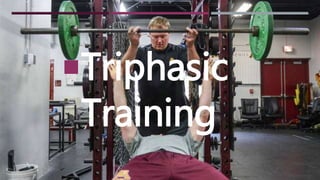
Triphasic
Training
TRIPHASIC NATURE OF MUSCLE ACTION
 All muscle action has 3 phases or is Triphasic
 Eccentric
 The muscle lengthens
 Each and every dynamic movement begins with and eccentric muscle action
 Hip dip before jumping
 Stores kinetic energy
 Trains the stretch reflex and stretch shortening cycle (SSC)
 Stretch Reflex
 Stretch Shortening Cycle
 Most effective over 80% of 1RM
 Always follow with explosive, concentric movement
 Neural pathways
TRIPHASIC NATURE OF MUSCLE ACTION
 All muscle action has 3 phases or is Triphasic
 Isometric
 Muscle length/joint angle does not change
 Transfer station
 Sand to concrete
 Actual maximal isometric force takes 0.3-0.7 seconds to accumulate
 Benefits to the stretch reflex and SSC
 Peformance rules
 Hit the ground like a brick
 Squeeze
 Spot
 Finish with explosive concentric movement
TRIPHASIC NATURE OF MUSCLE ACTION
 All muscle action has 3 phases or is Triphasic
 Concentric
 Rate of force development (RFD)
 Inhibition/Disinhibition or Agonist/Antagonist
 Synchronization – Recruitment of motor units is optimized. Produces efficient, powerful movement
 GTO
 Stretch Reflex
 SSC
 Rate Coupling
 Motor Unit Recruitment
 Rate Coding
 Reactive Ability
 TRAIN FAST!!
 Speed generally drops off after 3 or 4 reps
DEVELOPING STRENGTH & REACTIVE ABILITY WITH LOADS
ABOVE 80%
1. French Contrast
 Potentiation
2. Clustering
 Keeps Quality High
3. Oscillatory
FRENCH CONTRAST
 Combination of complex and contrast training
Four Exercises
1. Compound exercise > 80%
2. Plyo Jump
3. Weighted Jump > 30%
4. Plyo or Accelerated Plyo
TRIPHASIC UNDULATING BLOCK MODEL
 Good programs are laid out with an end goal in mind (periodization)
 Each phase builds on the last
 Stress is the foundation
 Stress the body
 Stress it often
 Stress it differently each time
 How? Undulating model in a block periodization system
 The strength coach’s job is to use a method of periodization that pursues an optimal level of
stress for the athlete
SEQUENCING OF PARAMETERS (PHASES/BLOCKS)
1. General Fitness (GPP or General Physical
Preparedness)
2. Maximal Strength
3. Strength Endurance and Power
4. Maximal Speed
 When different parameters are targeted in
the same workout they must be seen as
having a deleterious effect on one another
 Stress would be too little or too great
 Long term delayed training effect (LTDE) or
residuals
5 KEY FACTORS
1. High Volume
2. High Intensity
3. High Frequency
4. High Expectations
5. Overreaching
 Each session combines 2 or 3 of these qualities
BLOCK SYSTEM
1. Concentrated Loads
2. Specificity
3. Systematic Implementation of Training Means
CONCENTRATED LOADS
 The highest levels of adaptation are achieved through highly concentrated stress
 This allows only one parameter to be trained at a time
 Mixed training results in mixed results
 Only allows for one to three peaks per year
 Differing neurological signals interpreted by the athlete’s body cause confusion in the homeostatic response
 Mixed training doesn’t provide sufficient stimuli for high level athletes
SPECIFICITY
 Stress leads to positive adaptation
 Adaptations take place for limited time (diminished returns)
SYSTEMATIC IMPLEMENTATION OF TRAINING MEANS
 Only 1 parameter is used at a time
 Parameter:
 Application of training means must be well thought out (periodization)
 Take advantage of LTDE or residuals by peaking close to competition
LOADING PARAMETERS
 When developing strength and power, QUALITY is your goal. NOT quantity
 Monday
 Medium Intensity 82-87%, Medium Volume
 Wednesday
 High Intensity 90-97%, Low Volume
 Friday
 Lower Intensity,75-80% High Volume
 Use a less stressful exercise than used on Monday
 Single Leg, Leg Press, Box Squat, Front Squat
UNDULATION
0
1
2
3
4
5
6
7
8
Monday Wednesday Friday
M/W/F Undulation
Volume Intensity
PRILEPIN’S CHART

Triphasic Training pp

  • 1.
  • 2.
    TRIPHASIC NATURE OFMUSCLE ACTION  All muscle action has 3 phases or is Triphasic  Eccentric  The muscle lengthens  Each and every dynamic movement begins with and eccentric muscle action  Hip dip before jumping  Stores kinetic energy  Trains the stretch reflex and stretch shortening cycle (SSC)  Stretch Reflex  Stretch Shortening Cycle  Most effective over 80% of 1RM  Always follow with explosive, concentric movement  Neural pathways
  • 3.
    TRIPHASIC NATURE OFMUSCLE ACTION  All muscle action has 3 phases or is Triphasic  Isometric  Muscle length/joint angle does not change  Transfer station  Sand to concrete  Actual maximal isometric force takes 0.3-0.7 seconds to accumulate  Benefits to the stretch reflex and SSC  Peformance rules  Hit the ground like a brick  Squeeze  Spot  Finish with explosive concentric movement
  • 4.
    TRIPHASIC NATURE OFMUSCLE ACTION  All muscle action has 3 phases or is Triphasic  Concentric  Rate of force development (RFD)  Inhibition/Disinhibition or Agonist/Antagonist  Synchronization – Recruitment of motor units is optimized. Produces efficient, powerful movement  GTO  Stretch Reflex  SSC  Rate Coupling  Motor Unit Recruitment  Rate Coding  Reactive Ability  TRAIN FAST!!  Speed generally drops off after 3 or 4 reps
  • 5.
    DEVELOPING STRENGTH &REACTIVE ABILITY WITH LOADS ABOVE 80% 1. French Contrast  Potentiation 2. Clustering  Keeps Quality High 3. Oscillatory
  • 6.
    FRENCH CONTRAST  Combinationof complex and contrast training Four Exercises 1. Compound exercise > 80% 2. Plyo Jump 3. Weighted Jump > 30% 4. Plyo or Accelerated Plyo
  • 7.
    TRIPHASIC UNDULATING BLOCKMODEL  Good programs are laid out with an end goal in mind (periodization)  Each phase builds on the last  Stress is the foundation  Stress the body  Stress it often  Stress it differently each time  How? Undulating model in a block periodization system  The strength coach’s job is to use a method of periodization that pursues an optimal level of stress for the athlete
  • 8.
    SEQUENCING OF PARAMETERS(PHASES/BLOCKS) 1. General Fitness (GPP or General Physical Preparedness) 2. Maximal Strength 3. Strength Endurance and Power 4. Maximal Speed  When different parameters are targeted in the same workout they must be seen as having a deleterious effect on one another  Stress would be too little or too great  Long term delayed training effect (LTDE) or residuals
  • 9.
    5 KEY FACTORS 1.High Volume 2. High Intensity 3. High Frequency 4. High Expectations 5. Overreaching  Each session combines 2 or 3 of these qualities
  • 10.
    BLOCK SYSTEM 1. ConcentratedLoads 2. Specificity 3. Systematic Implementation of Training Means
  • 11.
    CONCENTRATED LOADS  Thehighest levels of adaptation are achieved through highly concentrated stress  This allows only one parameter to be trained at a time  Mixed training results in mixed results  Only allows for one to three peaks per year  Differing neurological signals interpreted by the athlete’s body cause confusion in the homeostatic response  Mixed training doesn’t provide sufficient stimuli for high level athletes
  • 12.
    SPECIFICITY  Stress leadsto positive adaptation  Adaptations take place for limited time (diminished returns)
  • 13.
    SYSTEMATIC IMPLEMENTATION OFTRAINING MEANS  Only 1 parameter is used at a time  Parameter:  Application of training means must be well thought out (periodization)  Take advantage of LTDE or residuals by peaking close to competition
  • 14.
    LOADING PARAMETERS  Whendeveloping strength and power, QUALITY is your goal. NOT quantity  Monday  Medium Intensity 82-87%, Medium Volume  Wednesday  High Intensity 90-97%, Low Volume  Friday  Lower Intensity,75-80% High Volume  Use a less stressful exercise than used on Monday  Single Leg, Leg Press, Box Squat, Front Squat
  • 15.
  • 16.

Editor's Notes

  • #5 Cal refers to a study in 1998 that found there weren't any significant enhancement of maximal concentric force when training with only an accentuated eccentric resistance. World class athletes don’t contract faster, they relax faster. The antagonist is eccentrically contracting to protect the joint. This is much like the GTO and needs to be detrained to increase RFD Rate Coupling: myosin heads attach, pull, and detach Rate coding: the discharge frequency of motor neurons Motor unit recruitment: the maximum number of motor units are recruited
  • #9 Too little stress = no adaptation; too much stress = overtraining Long term delayed training effect or residuals – a coach can systematically train all components without sacrificing the potential development of any within a training year and ensure that all these qualities peak at the same time