Nerd, Geek, and Gear
Herding: Technical
Management Techniques for
Managers v 2.0
#12NTCNERD

Grant Howe
Stacy Dyer


             1
Evaluate This Session!
Each entry is a chance to win an NTEN engraved iPad!


          or Online at www.nten.org/ntc/eval
INTRODUCTION


           3
Your Partner in Dialogue


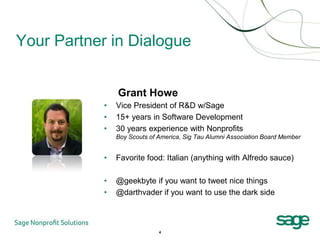
                Grant Howe
            •   Vice President of R&D w/Sage
            •   15+ years in Software Development
            •   30 years experience with Nonprofits
                Boy Scouts of America, Sig Tau Alumni Association Board Member


            •   Favorite food: Italian (anything with Alfredo sauce)

            •   @geekbyte if you want to tweet nice things
            •   @darthvader if you want to use the dark side


                              4
Your Partner in Dialogue


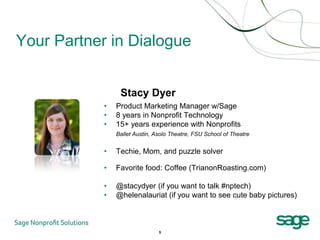
                 Stacy Dyer
            •   Product Marketing Manager w/Sage
            •   8 years in Nonprofit Technology
            •   15+ years experience with Nonprofits
                Ballet Austin, Asolo Theatre, FSU School of Theatre


            •   Techie, Mom, and puzzle solver

            •   Favorite food: Coffee (TrianonRoasting.com)

            •   @stacydyer (if you want to talk #nptech)
            •   @helenalauriat (if you want to see cute baby pictures)


                                5
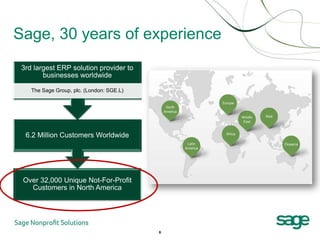
Sage, 30 years of experience
 3rd largest ERP solution provider to
        businesses worldwide

    The Sage Group, plc. (London: SGE.L)


  6.2 Million Customers Worldwide


 Over 32,000 Unique Not-For-Profit
   Customers in North America


                                           6
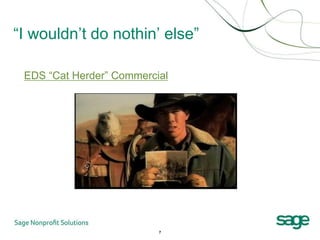
“I wouldn’t do nothin’ else”

 EDS “Cat Herder” Commercial


                          7
What are we talking about today?
Best Practices for:


           Managing technology selection

           Managing emergencies

           Growing and rewarding technologists

           “Crowd Source” your current technical
             management issues


                              8
Q&A Experiment
at the end of the session


  • Note cards on the tables.

  • Jot down your real word Nerd / Tech herding
    issues or best practices to share.

  • Or tweet w/ #12NTCNERD

  • We will collectively “crowd source”
    suggestions and best practices.


                                9
“Paging Dr. Nerd”

MANAGING TECHNOLOGY
SELECTION

                    10
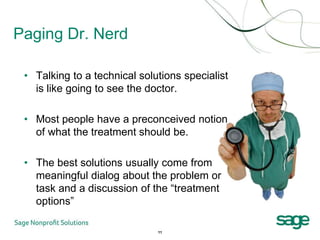
Paging Dr. Nerd

 • Talking to a technical solutions specialist
   is like going to see the doctor.

 • Most people have a preconceived notion
   of what the treatment should be.

 • The best solutions usually come from
   meaningful dialog about the problem or
   task and a discussion of the “treatment
   options”

                              11
Tip: When to
                                call the doctor
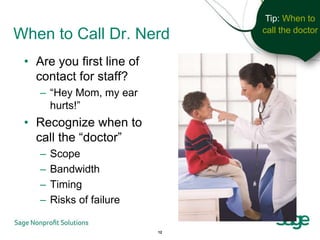
When to Call Dr. Nerd
 • Are you first line of

   contact for staff?
    – “Hey Mom, my ear
      hurts!”
 • Recognize when to
   call the “doctor”
    –   Scope
    –   Bandwidth
    –   Timing
    –   Risks of failure

                           12
A successful office visit agenda

                 • Tell me where it hurts.

                 • Tell me what your desired results
                   are post treatment.

                 • Discuss and choose a treatment.

                 • Take your medicine.


                      13
Tell me where it hurts
                 • Focus your initial discussion on the
Tip: Prepare a     symptoms of your problem.
  list so you
 don’t forget    • Do your best to help me understand your
   anything!       current state.

                                     Examples:
                 • Performance of technical assets? How slow?
                   When did you start noticing this?

                 • A capability you do not have in your environment?
                   Tell me about the business processes and
                   workflow and how this should fit in.


                                    14
What are your desired results
 • “I want to play tennis three times a week
   without knee pain.”
                                                        Tip: Think big!
                                                        Dr. can’t help
                                                          if you don’t
                                                            ask for it.
                      Examples:
  • I need a collaboration tool for 20 users that are
    both on premise and remote.

  • I don’t want to buy / manage servers anymore.

  • I want users to be able to boot and login to the
    network in under 5 minutes.


                                    15
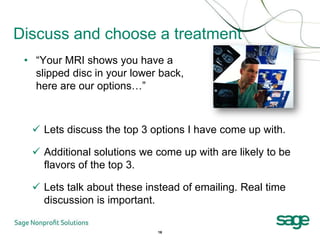
Discuss and choose a treatment
 • “Your MRI shows you have a
   slipped disc in your lower back,
   here are our options…”


   Lets discuss the top 3 options I have come up with.

   Additional solutions we come up with are likely to be
    flavors of the top 3.

   Lets talk about these instead of emailing. Real time
    discussion is important.

                             16
Ask questions about each solution
                 • What will this cost (in time, resources and
Tip: There are     money)?
  NO stupid
  questions!
                 • How does this solution compare to my original
Ask, Ask, Ask      desired end state?
                 • What other “side effects” can I expect from the
                   solution, good or bad?
                 • What is the risk of something going wrong or
                   causing damage? Is there a mitigation?
                 • What skills are required to implement and
                   have you done this before? How many times?


                                 17
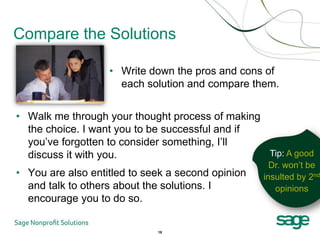
Compare the Solutions
                   • Write down the pros and cons of
                     each solution and compare them.


• Walk me through your thought process of making
  the choice. I want you to be successful and if
  you’ve forgotten to consider something, I’ll
  discuss it with you.                           Tip: A good
                                                     Dr. won’t be
• You are also entitled to seek a second opinion   insulted by 2nd
  and talk to others about the solutions. I           opinions
  encourage you to do so.

                             18
Take your Medicine
                  • “Take these, 3 times a day…”

  Tip: This is
    YOUR
responsibility!   • Many people go through all this effort to make
                    but don’t follow the prescribed treatment.

                  • These people usually don’t get results and
                    neither will you if we don’t follow the plan.

                  • Solutions are holistic; often we see poor results
                    from not following the full plan.


                                     19
Most poorly performing organizations do
not suffer from lack of plans or strategy.

        They suffer from lack of
         consistent execution.


                   20
“The House is on Fire!”

LEADERSHIP DURING
EMERGENCIES

                          21
Tip: DON’T
                                                       PANIC
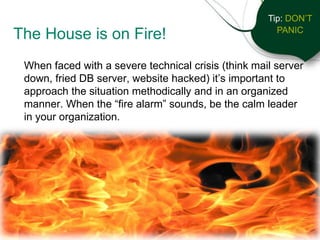
The House is on Fire!
 When faced with a severe technical crisis (think mail server
 down, fried DB server, website hacked) it’s important to
 approach the situation methodically and in an organized
 manner. When the “fire alarm” sounds, be the calm leader
 in your organization.


                             22
The House is on Fire!

       Survey the Situation

       Assemble the Team

       Act Now!


                        23
Survey the situation
               • What is impacted and what is the current risk?

               • What’s the possibility of it getting worse?
Tip: Reality
  check!
               • What skill sets are needed for recovery?

               • What level of alarm should be raised and
                 to who?


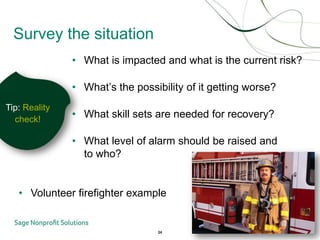
   • Volunteer firefighter example


                                 24
Assemble the Team
 • Assemble the team. You’ll need the right resources to
   investigate more thoroughly and come up with possible
   solutions.

 • What skill sets are needed for recovery?

 • Where can you get them?                       Tip: Not the
                                                time for OJT!


                            25
Act Now
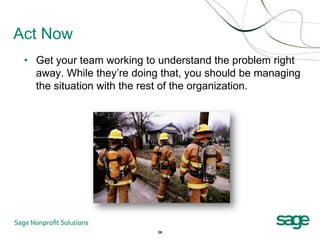
 • Get your team working to understand the problem right
   away. While they’re doing that, you should be managing
   the situation with the rest of the organization.


                            26
Been asked these questions before?

             “How could this happen?”

               “Who is responsible?”

   “What do we need to do to make sure this never
                 happens again?”

     “Who do we need to fire because of this?”


                        27
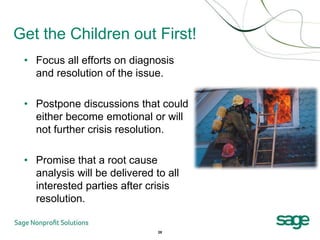
Get the Children out First!
 • Focus all efforts on diagnosis
   and resolution of the issue.

 • Postpone discussions that could
   either become emotional or will
   not further crisis resolution.

 • Promise that a root cause
   analysis will be delivered to all
   interested parties after crisis
   resolution.

                               28
Arson investigations are
performed on cold ashes
 • Debrief the team post-crisis, documenting how the
   situation began.

 • Investigate and define operational changes that could
   prevent the crisis from reoccurring.

 • Compile a report detailing the crisis, resolution, root
   cause, and recommended preventive measures.

 • Insist that the preventive measures be
   implemented. Accidents happen, but
   shame on you if they happen twice.                Tip: An ounce
                                                     of prevention
                              29
How can you win?

MOTIVATING AND REWARDING
TECHS

                   30
The IT Situation
It feels like you just can’t win…
                 • IT infrastructure and Software isn’t
                   thought of much unless its not working.

                 • When its not working, staff in general
                   have a low opinion of those who build /
                   maintain it.

                 • When the issue is fixed, few will consider
                   the effort successful because they were
                   impacted.

                 • Few staffers call the         Tip: IT is like a
                   support desk to report that     box of kitty
                   “things are working great,         litter...
                   keep it up!”
                            31
Best Practice - Scoreboards
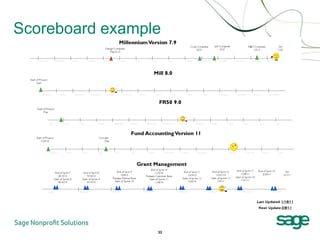
 • Setup a public scoreboard in a highly
   trafficked location.
                                                       Tip:
 • Track meaningful metrics:                        Everyone
    – System uptimes                              loves a gold
    – Project milestones                          star on their
                                                     paper!
 • Make it clear whether the team is winning or
   losing to the reader in 5 seconds.

 • Update weekly or monthly.

                            32
Scoreboard example


                 33
Best Practice – Celebrate Winning
 • Make success visible:
   –   Mail server uptime cookie celebration
   –   Project Milestone completion happy hour
   –   Public congratulations from executives
   –   High internet availability pizza party

 Place more focus and visibility on consistently
       winning than on occasional failures


                            34
Best Practice –
 “Motivation” for the cash poor
   • Say thank-you often – Do not underestimate the value of
     these two words.

   • Spend more time talking about “did well’s” and less on
     “next times”

                • Give paid time to learn between projects.
Tip: Nurture
your team –     • Provide career growth advice and
 help them        mentoring.
learn to fly!
                • “Best Companies to Work for” example.

                               35
Best Practice – Coaching
 • 30-45 minute special 1:1 meeting every 8 weeks.

 • Staffers submit two “did wells” and one “next time” 24 hrs to
   manager prior to the meeting. Manager may add to the list during the
   meeting..

 • Staffer to discuss each “did well” and what the key factors were in
   creating success.

 • Staffer to discuss each “next time” and what should be key factors
   for creating success next time are.

 • Spend more time talking about “did well’s” and less on “next times”

   The point is to have dialog with staffers about what they
              think is important and listen intently!

                                   36
Lets make it happen

Q&A CROWDSOURCE
EXPERIMENT

                      37
Q&A Experiment


 • Note cards on the tables.

 • Jot down your real word Nerd / Tech herding
   issues or best practices to share.

 • Or tweet w/ #12NTCNERD

 • We will collectively “crowd source”
   suggestions and best practices.


                               38
Thank You!

      Grant Howe
grant.howe@sage.com
      @geekbyte

      Stacy Dyer
stacy.dyer@sage.com
     @stacydyer


         39
Evaluate This Session!
Each entry is a chance to win an NTEN engraved iPad!


          or Online at www.nten.org/ntc/eval

Nerd, Geek, and Gear Herding: Technical Management Techniques for Managers v 2.0

  • 1.
    Nerd, Geek, andGear Herding: Technical Management Techniques for Managers v 2.0 #12NTCNERD Grant Howe Stacy Dyer 1
  • 2.
    Evaluate This Session! Eachentry is a chance to win an NTEN engraved iPad! or Online at www.nten.org/ntc/eval
  • 3.
  • 4.
    Your Partner inDialogue Grant Howe • Vice President of R&D w/Sage • 15+ years in Software Development • 30 years experience with Nonprofits Boy Scouts of America, Sig Tau Alumni Association Board Member • Favorite food: Italian (anything with Alfredo sauce) • @geekbyte if you want to tweet nice things • @darthvader if you want to use the dark side 4
  • 5.
    Your Partner inDialogue Stacy Dyer • Product Marketing Manager w/Sage • 8 years in Nonprofit Technology • 15+ years experience with Nonprofits Ballet Austin, Asolo Theatre, FSU School of Theatre • Techie, Mom, and puzzle solver • Favorite food: Coffee (TrianonRoasting.com) • @stacydyer (if you want to talk #nptech) • @helenalauriat (if you want to see cute baby pictures) 5
  • 6.
    Sage, 30 yearsof experience 3rd largest ERP solution provider to businesses worldwide The Sage Group, plc. (London: SGE.L) 6.2 Million Customers Worldwide Over 32,000 Unique Not-For-Profit Customers in North America 6
  • 7.
    “I wouldn’t donothin’ else” EDS “Cat Herder” Commercial 7
  • 8.
    What are wetalking about today? Best Practices for: Managing technology selection Managing emergencies Growing and rewarding technologists “Crowd Source” your current technical management issues 8
  • 9.
    Q&A Experiment at theend of the session • Note cards on the tables. • Jot down your real word Nerd / Tech herding issues or best practices to share. • Or tweet w/ #12NTCNERD • We will collectively “crowd source” suggestions and best practices. 9
  • 10.
    “Paging Dr. Nerd” MANAGINGTECHNOLOGY SELECTION 10
  • 11.
    Paging Dr. Nerd • Talking to a technical solutions specialist is like going to see the doctor. • Most people have a preconceived notion of what the treatment should be. • The best solutions usually come from meaningful dialog about the problem or task and a discussion of the “treatment options” 11
  • 12.
    Tip: When to call the doctor When to Call Dr. Nerd • Are you first line of contact for staff? – “Hey Mom, my ear hurts!” • Recognize when to call the “doctor” – Scope – Bandwidth – Timing – Risks of failure 12
  • 13.
    A successful officevisit agenda • Tell me where it hurts. • Tell me what your desired results are post treatment. • Discuss and choose a treatment. • Take your medicine. 13
  • 14.
    Tell me whereit hurts • Focus your initial discussion on the Tip: Prepare a symptoms of your problem. list so you don’t forget • Do your best to help me understand your anything! current state. Examples: • Performance of technical assets? How slow? When did you start noticing this? • A capability you do not have in your environment? Tell me about the business processes and workflow and how this should fit in. 14
  • 15.
    What are yourdesired results • “I want to play tennis three times a week without knee pain.” Tip: Think big! Dr. can’t help if you don’t ask for it. Examples: • I need a collaboration tool for 20 users that are both on premise and remote. • I don’t want to buy / manage servers anymore. • I want users to be able to boot and login to the network in under 5 minutes. 15
  • 16.
    Discuss and choosea treatment • “Your MRI shows you have a slipped disc in your lower back, here are our options…”  Lets discuss the top 3 options I have come up with.  Additional solutions we come up with are likely to be flavors of the top 3.  Lets talk about these instead of emailing. Real time discussion is important. 16
  • 17.
    Ask questions abouteach solution • What will this cost (in time, resources and Tip: There are money)? NO stupid questions! • How does this solution compare to my original Ask, Ask, Ask desired end state? • What other “side effects” can I expect from the solution, good or bad? • What is the risk of something going wrong or causing damage? Is there a mitigation? • What skills are required to implement and have you done this before? How many times? 17
  • 18.
    Compare the Solutions • Write down the pros and cons of each solution and compare them. • Walk me through your thought process of making the choice. I want you to be successful and if you’ve forgotten to consider something, I’ll discuss it with you. Tip: A good Dr. won’t be • You are also entitled to seek a second opinion insulted by 2nd and talk to others about the solutions. I opinions encourage you to do so. 18
  • 19.
    Take your Medicine • “Take these, 3 times a day…” Tip: This is YOUR responsibility! • Many people go through all this effort to make but don’t follow the prescribed treatment. • These people usually don’t get results and neither will you if we don’t follow the plan. • Solutions are holistic; often we see poor results from not following the full plan. 19
  • 20.
    Most poorly performingorganizations do not suffer from lack of plans or strategy. They suffer from lack of consistent execution. 20
  • 21.
    “The House ison Fire!” LEADERSHIP DURING EMERGENCIES 21
  • 22.
    Tip: DON’T PANIC The House is on Fire! When faced with a severe technical crisis (think mail server down, fried DB server, website hacked) it’s important to approach the situation methodically and in an organized manner. When the “fire alarm” sounds, be the calm leader in your organization. 22
  • 23.
    The House ison Fire! Survey the Situation Assemble the Team Act Now! 23
  • 24.
    Survey the situation • What is impacted and what is the current risk? • What’s the possibility of it getting worse? Tip: Reality check! • What skill sets are needed for recovery? • What level of alarm should be raised and to who? • Volunteer firefighter example 24
  • 25.
    Assemble the Team • Assemble the team. You’ll need the right resources to investigate more thoroughly and come up with possible solutions. • What skill sets are needed for recovery? • Where can you get them? Tip: Not the time for OJT! 25
  • 26.
    Act Now •Get your team working to understand the problem right away. While they’re doing that, you should be managing the situation with the rest of the organization. 26
  • 27.
    Been asked thesequestions before? “How could this happen?” “Who is responsible?” “What do we need to do to make sure this never happens again?” “Who do we need to fire because of this?” 27
  • 28.
    Get the Childrenout First! • Focus all efforts on diagnosis and resolution of the issue. • Postpone discussions that could either become emotional or will not further crisis resolution. • Promise that a root cause analysis will be delivered to all interested parties after crisis resolution. 28
  • 29.
    Arson investigations are performedon cold ashes • Debrief the team post-crisis, documenting how the situation began. • Investigate and define operational changes that could prevent the crisis from reoccurring. • Compile a report detailing the crisis, resolution, root cause, and recommended preventive measures. • Insist that the preventive measures be implemented. Accidents happen, but shame on you if they happen twice. Tip: An ounce of prevention 29
  • 30.
    How can youwin? MOTIVATING AND REWARDING TECHS 30
  • 31.
    The IT Situation Itfeels like you just can’t win… • IT infrastructure and Software isn’t thought of much unless its not working. • When its not working, staff in general have a low opinion of those who build / maintain it. • When the issue is fixed, few will consider the effort successful because they were impacted. • Few staffers call the Tip: IT is like a support desk to report that box of kitty “things are working great, litter... keep it up!” 31
  • 32.
    Best Practice -Scoreboards • Setup a public scoreboard in a highly trafficked location. Tip: • Track meaningful metrics: Everyone – System uptimes loves a gold – Project milestones star on their paper! • Make it clear whether the team is winning or losing to the reader in 5 seconds. • Update weekly or monthly. 32
  • 33.
  • 34.
    Best Practice –Celebrate Winning • Make success visible: – Mail server uptime cookie celebration – Project Milestone completion happy hour – Public congratulations from executives – High internet availability pizza party Place more focus and visibility on consistently winning than on occasional failures 34
  • 35.
    Best Practice – “Motivation” for the cash poor • Say thank-you often – Do not underestimate the value of these two words. • Spend more time talking about “did well’s” and less on “next times” • Give paid time to learn between projects. Tip: Nurture your team – • Provide career growth advice and help them mentoring. learn to fly! • “Best Companies to Work for” example. 35
  • 36.
    Best Practice –Coaching • 30-45 minute special 1:1 meeting every 8 weeks. • Staffers submit two “did wells” and one “next time” 24 hrs to manager prior to the meeting. Manager may add to the list during the meeting.. • Staffer to discuss each “did well” and what the key factors were in creating success. • Staffer to discuss each “next time” and what should be key factors for creating success next time are. • Spend more time talking about “did well’s” and less on “next times” The point is to have dialog with staffers about what they think is important and listen intently! 36
  • 37.
    Lets make ithappen Q&A CROWDSOURCE EXPERIMENT 37
  • 38.
    Q&A Experiment •Note cards on the tables. • Jot down your real word Nerd / Tech herding issues or best practices to share. • Or tweet w/ #12NTCNERD • We will collectively “crowd source” suggestions and best practices. 38
  • 39.
    Thank You! Grant Howe grant.howe@sage.com @geekbyte Stacy Dyer stacy.dyer@sage.com @stacydyer 39
  • 40.
    Evaluate This Session! Eachentry is a chance to win an NTEN engraved iPad! or Online at www.nten.org/ntc/eval