















Don’t Just Fix It,
Learn From it
The Importance of Incident Management When Something Breaks
Something’s broken, something’s broken
It’s your fault, It’s your fault
Are you gonna fix it? Are you gonna fix it?
Right away, Right away
― Ethan (5 years old)
Maybe 10 minutes
Maybe 1 day
Maybe a year
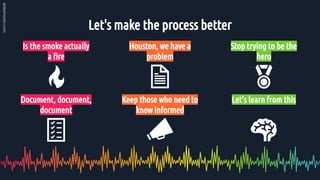
Let's make the process better
Is the smoke actually
a fire
Houston, we have a
problem
Document, document,
document
Keep those who need to
know informed
Stop trying to be the
hero
Let’s learn from this
I’m Rick Clymer
QR Lead @ RocketReach
Sev 1, High Priority, Drop Everything and Fix Survivor
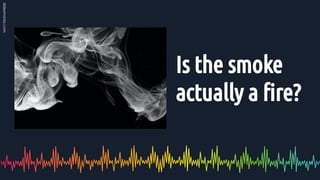
Is the smoke
actually a fire?
Let’s figure out if it’s smoke or fire
Does an issue
actually exist?
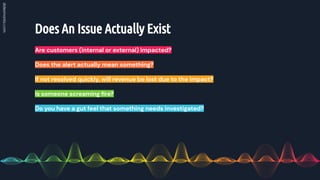
Does An Issue Actually Exist
Are customers (internal or external) impacted?
Does the alert actually mean something?
If not resolved quickly, will revenue be lost due to the impact?
Is someone screaming fire?
Do you have a gut feel that something needs investigated?
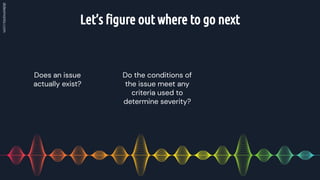
Let’s figure out where to go next
Do the conditions of
the issue meet any
criteria used to
determine severity?
Does an issue
actually exist?
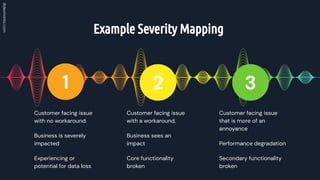
Example Severity Mapping
Customer facing issue
with no workaround.
Business is severely
impacted
Experiencing or
potential for data loss
Customer facing issue
with a workaround.
Business sees an
impact
Core functionality
broken
Customer facing issue
that is more of an
annoyance
Performance degradation
Secondary functionality
broken
1 2 3
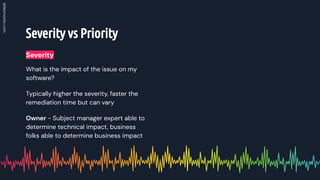
Severity vs Priority
What is the impact of the issue on my
software?
Typically higher the severity, faster the
remediation time but can vary
Owner - Subject manager expert able to
determine technical impact, business
folks able to determine business impact
Severity
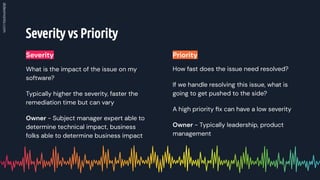
Severity vs Priority
How fast does the issue need resolved?
If we handle resolving this issue, what is
going to get pushed to the side?
A high priority fix can have a low severity
Owner - Typically leadership, product
management
What is the impact of the issue on my
software?
Typically higher the severity, faster the
remediation time but can vary
Owner - Subject manager expert able to
determine technical impact, business
folks able to determine business impact
Severity Priority
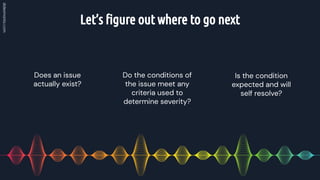
Let’s figure out where to go next
Do the conditions of
the issue meet any
criteria used to
determine severity?
Does an issue
actually exist?
Is the condition
expected and will
self resolve?
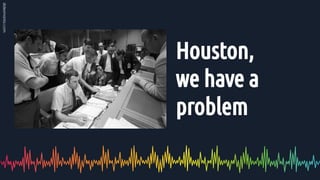
Houston,
we have a
problem
Initiate Fire Fighting mode
Have a communication process in place to inform others an incident exists
Use your alerting system to initiate a new incident
Setup integrations for things like your messaging tool (Slack, Teams, etc…), monitoring systems, virtual meetings, etc..
Setup a central meeting point that anyone can join
Initiate Fire Fighting mode
Have a communication process in place to inform others an incident exists
Did something get deployed to production and cause the issue?
Did someone or something start using the system in a way that hasn’t happened previously?
Do the monitors show any infrastructure related issues?
Is there anything in the error logs indicating a new system issue that hasn't been seen before?
What changed between 10 minutes ago and now?
Use your alerting system to initiate a new incident
Setup integrations for things like your messaging tool (Slack, Teams, etc…), monitoring systems, virtual meetings, etc..
Setup a central meeting point that anyone can join
Initiate Fire Fighting mode
Have a communication process in place to inform others an incident exists
Did something get deployed to production and cause the issue?
Did someone or something start using the system in a way that hasn’t happened previously?
Do the monitors show any infrastructure related issues?
Is there anything in the error logs indicating a new system issue that hasn't been seen before?
What changed between 10 minutes ago and now?
As you have ideas of what’s going on, make sure to get them out of your head and somewhere others can access
Make it easy for others to join in the fire fighting
Use your alerting system to initiate a new incident
Setup integrations for things like your messaging tool (Slack, Teams, etc…), monitoring systems, virtual meetings, etc..
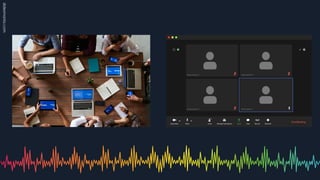
Setup a central meeting point that anyone can join
Trust your hunches… Hunches are
usually based on facts filed away just
below the conscious level.
― Joyce Brothers, American psychologist
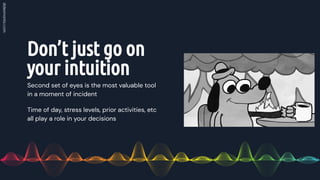
Don’t just go on
your intuition
Second set of eyes is the most valuable tool
in a moment of incident
Time of day, stress levels, prior activities, etc
all play a role in your decisions
Stop trying to
be the hero
No individual can win a
game by himself
― Pele, international soccer star
Stop the bleeding, keep your company’s reputation with your
customers, get things back to normal
Resolve your issue
Fool me once, shame on you. Fool me twice, shame on me.
Don’t let this bite you
again
Innovation comes only from readily and seamlessly sharing
information rather than hoarding it - Tom Peters
Stop creating silos
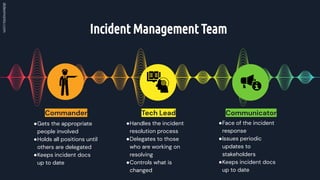
Incident Management Team
Commander Tech Lead Communicator
●Gets the appropriate
people involved
●Holds all positions until
others are delegated
●Keeps incident docs
up to date
●Handles the incident
resolution process
●Delegates to those
who are working on
resolving
●Controls what is
changed
●Face of the incident
response
●Issues periodic
updates to
stakeholders
●Keeps incident docs
up to date
Additional Roles You Might Consider
Customer Support Lead
Subject Matter Experts
External Communication Lead
Dedicated Scribe
Root Cause Analyst
Be prepared to
have backups
for any role
Document
Document
Document
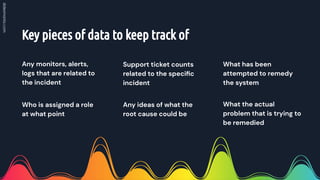
Key pieces of data to keep track of
Any monitors, alerts,
logs that are related to
the incident
Who is assigned a role
at what point
What has been
attempted to remedy
the system
Support ticket counts
related to the specific
incident
Any ideas of what the
root cause could be
What the actual
problem that is trying to
be remedied
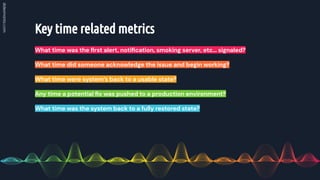
Key time related metrics
What time was the first alert, notification, smoking server, etc… signaled?
What time did someone acknowledge the issue and begin working?
What time were system’s back to a usable state?
Any time a potential fix was pushed to a production environment?
What time was the system back to a fully restored state?
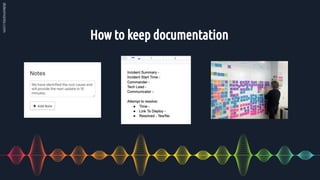
How to keep documentation
Keep those
who need to
know informed
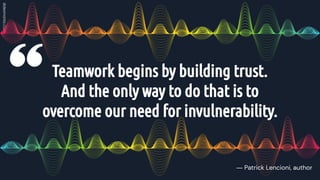
Teamwork begins by building trust.
And the only way to do that is to
overcome our need for invulnerability.
― Patrick Lencioni, author
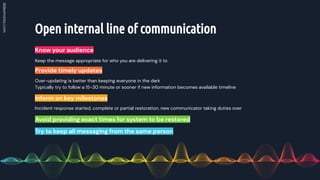
Open internal line of communication
Know your audience
Over-updating is better than keeping everyone in the dark
Typically try to follow a 15-30 minute or sooner if new information becomes available timeline
Provide timely updates
Incident response started, complete or partial restoration, new communicator taking duties over
Inform on key milestones
Keep the message appropriate for who you are delivering it to
Avoid providing exact times for system to be restored
Try to keep all messaging from the same person
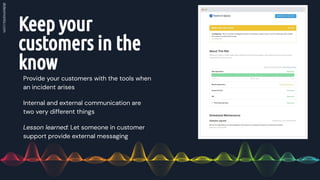
Keep your
customers in the
know
Provide your customers with the tools when
an incident arises
Internal and external communication are
two very different things
Lesson learned: Let someone in customer
support provide external messaging
Let’s learn
from this
Most important part of
incident response:
Most important part of
incident response:
Post Mortems
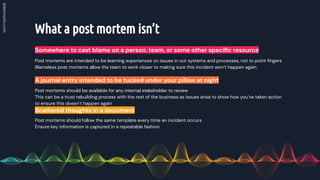
What a post mortem isn’t
Somewhere to cast blame on a person, team, or some other specific resource
Post mortems should be available for any internal stakeholder to review
This can be a trust rebuilding process with the rest of the business as issues arise to show how you’ve taken action
to ensure this doesn’t happen again
A journal entry intended to be tucked under your pillow at night
Post mortems should follow the same template every time an incident occurs
Ensure key information is captured in a repeatable fashion
Scattered thoughts in a document
Post mortems are intended to be learning experiences on issues in our systems and processes, not to point fingers
Blameless post mortems allow the team to work closer to making sure this incident won’t happen again
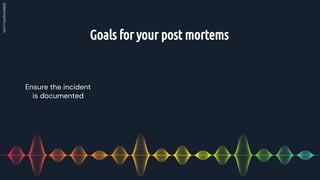
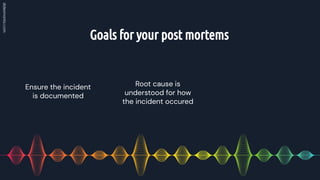
Goals for your post mortems
Ensure the incident
is documented
Goals for your post mortems
Root cause is
understood for how
the incident occured
Ensure the incident
is documented
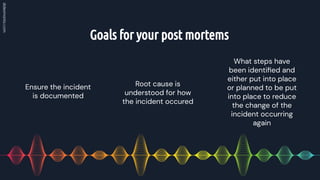
Goals for your post mortems
Root cause is
understood for how
the incident occured
Ensure the incident
is documented
What steps have
been identified and
either put into place
or planned to be put
into place to reduce
the change of the
incident occurring
again
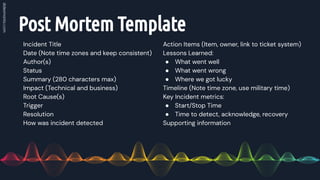
Post Mortem Template
Incident Title
Date (Note time zones and keep consistent)
Author(s)
Status
Summary (280 characters max)
Impact (Technical and business)
Root Cause(s)
Trigger
Resolution
How was incident detected
Action Items (Item, owner, link to ticket system)
Lessons Learned:
● What went well
● What went wrong
● Where we got lucky
Timeline (Note time zone, use military time)
Key Incident metrics:
● Start/Stop Time
● Time to detect, acknowledge, recovery
Supporting information
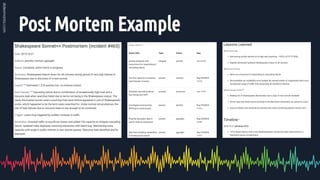
Post Mortem Example
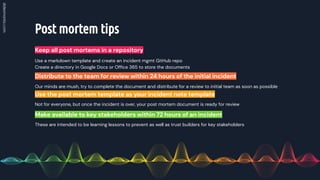
Post mortem tips
Keep all post mortems in a repository
Our minds are mush, try to complete the document and distribute for a review to initial team as soon as possible
Distribute to the team for review within 24 hours of the initial incident
Not for everyone, but once the incident is over, your post mortem document is ready for review
Use the post mortem template as your incident note template
Use a markdown template and create an incident mgmt GitHub repo
Create a directory in Google Docs or Office 365 to store the documents
These are intended to be learning lessons to prevent as well as trust builders for key stakeholders
Make available to key stakeholders within 72 hours of an incident
No matter what happens, or how bad it
seems today, life does go on, and it
will be better tomorrow.
― Maya Angelou
Thank you!
clymerrm
https://bit.ly/IncidentMgmtQAOTHW2023
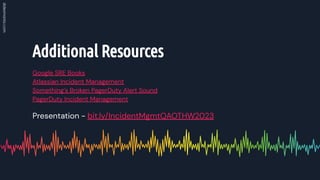
Additional Resources
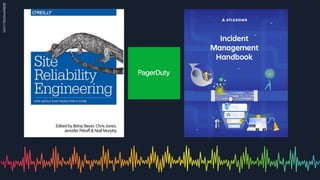
Google SRE Books
Atlassian Incident Management
Something’s Broken PagerDuty Alert Sound
PagerDuty Incident Management
Presentation - bit.ly/IncidentMgmtQAOTHW2023

Rick Clymer - Incident Management.pdf

  • 1.
    Don’t Just FixIt, Learn From it The Importance of Incident Management When Something Breaks
  • 2.
    Something’s broken, something’sbroken It’s your fault, It’s your fault Are you gonna fix it? Are you gonna fix it? Right away, Right away ― Ethan (5 years old)
  • 6.
    Maybe 10 minutes Maybe1 day Maybe a year
  • 7.
    Let's make theprocess better Is the smoke actually a fire Houston, we have a problem Document, document, document Keep those who need to know informed Stop trying to be the hero Let’s learn from this
  • 8.
    I’m Rick Clymer QRLead @ RocketReach Sev 1, High Priority, Drop Everything and Fix Survivor
  • 9.
  • 10.
    Let’s figure outif it’s smoke or fire Does an issue actually exist?
  • 11.
    Does An IssueActually Exist Are customers (internal or external) impacted? Does the alert actually mean something? If not resolved quickly, will revenue be lost due to the impact? Is someone screaming fire? Do you have a gut feel that something needs investigated?
  • 12.
    Let’s figure outwhere to go next Do the conditions of the issue meet any criteria used to determine severity? Does an issue actually exist?
  • 13.
    Example Severity Mapping Customerfacing issue with no workaround. Business is severely impacted Experiencing or potential for data loss Customer facing issue with a workaround. Business sees an impact Core functionality broken Customer facing issue that is more of an annoyance Performance degradation Secondary functionality broken 1 2 3
  • 14.
    Severity vs Priority Whatis the impact of the issue on my software? Typically higher the severity, faster the remediation time but can vary Owner - Subject manager expert able to determine technical impact, business folks able to determine business impact Severity
  • 15.
    Severity vs Priority Howfast does the issue need resolved? If we handle resolving this issue, what is going to get pushed to the side? A high priority fix can have a low severity Owner - Typically leadership, product management What is the impact of the issue on my software? Typically higher the severity, faster the remediation time but can vary Owner - Subject manager expert able to determine technical impact, business folks able to determine business impact Severity Priority
  • 16.
    Let’s figure outwhere to go next Do the conditions of the issue meet any criteria used to determine severity? Does an issue actually exist? Is the condition expected and will self resolve?
  • 17.
  • 18.
    Initiate Fire Fightingmode Have a communication process in place to inform others an incident exists Use your alerting system to initiate a new incident Setup integrations for things like your messaging tool (Slack, Teams, etc…), monitoring systems, virtual meetings, etc.. Setup a central meeting point that anyone can join
  • 19.
    Initiate Fire Fightingmode Have a communication process in place to inform others an incident exists Did something get deployed to production and cause the issue? Did someone or something start using the system in a way that hasn’t happened previously? Do the monitors show any infrastructure related issues? Is there anything in the error logs indicating a new system issue that hasn't been seen before? What changed between 10 minutes ago and now? Use your alerting system to initiate a new incident Setup integrations for things like your messaging tool (Slack, Teams, etc…), monitoring systems, virtual meetings, etc.. Setup a central meeting point that anyone can join
  • 20.
    Initiate Fire Fightingmode Have a communication process in place to inform others an incident exists Did something get deployed to production and cause the issue? Did someone or something start using the system in a way that hasn’t happened previously? Do the monitors show any infrastructure related issues? Is there anything in the error logs indicating a new system issue that hasn't been seen before? What changed between 10 minutes ago and now? As you have ideas of what’s going on, make sure to get them out of your head and somewhere others can access Make it easy for others to join in the fire fighting Use your alerting system to initiate a new incident Setup integrations for things like your messaging tool (Slack, Teams, etc…), monitoring systems, virtual meetings, etc.. Setup a central meeting point that anyone can join
  • 22.
    Trust your hunches…Hunches are usually based on facts filed away just below the conscious level. ― Joyce Brothers, American psychologist
  • 23.
    Don’t just goon your intuition Second set of eyes is the most valuable tool in a moment of incident Time of day, stress levels, prior activities, etc all play a role in your decisions
  • 24.
  • 25.
    No individual canwin a game by himself ― Pele, international soccer star
  • 26.
    Stop the bleeding,keep your company’s reputation with your customers, get things back to normal Resolve your issue
  • 27.
    Fool me once,shame on you. Fool me twice, shame on me. Don’t let this bite you again
  • 28.
    Innovation comes onlyfrom readily and seamlessly sharing information rather than hoarding it - Tom Peters Stop creating silos
  • 29.
    Incident Management Team CommanderTech Lead Communicator ●Gets the appropriate people involved ●Holds all positions until others are delegated ●Keeps incident docs up to date ●Handles the incident resolution process ●Delegates to those who are working on resolving ●Controls what is changed ●Face of the incident response ●Issues periodic updates to stakeholders ●Keeps incident docs up to date
  • 30.
    Additional Roles YouMight Consider Customer Support Lead Subject Matter Experts External Communication Lead Dedicated Scribe Root Cause Analyst
  • 31.
    Be prepared to havebackups for any role
  • 32.
  • 33.
    Key pieces ofdata to keep track of Any monitors, alerts, logs that are related to the incident Who is assigned a role at what point What has been attempted to remedy the system Support ticket counts related to the specific incident Any ideas of what the root cause could be What the actual problem that is trying to be remedied
  • 34.
    Key time relatedmetrics What time was the first alert, notification, smoking server, etc… signaled? What time did someone acknowledge the issue and begin working? What time were system’s back to a usable state? Any time a potential fix was pushed to a production environment? What time was the system back to a fully restored state?
  • 35.
    How to keepdocumentation
  • 36.
    Keep those who needto know informed
  • 37.
    Teamwork begins bybuilding trust. And the only way to do that is to overcome our need for invulnerability. ― Patrick Lencioni, author
  • 38.
    Open internal lineof communication Know your audience Over-updating is better than keeping everyone in the dark Typically try to follow a 15-30 minute or sooner if new information becomes available timeline Provide timely updates Incident response started, complete or partial restoration, new communicator taking duties over Inform on key milestones Keep the message appropriate for who you are delivering it to Avoid providing exact times for system to be restored Try to keep all messaging from the same person
  • 39.
    Keep your customers inthe know Provide your customers with the tools when an incident arises Internal and external communication are two very different things Lesson learned: Let someone in customer support provide external messaging
  • 40.
  • 41.
    Most important partof incident response:
  • 42.
    Most important partof incident response: Post Mortems
  • 43.
    What a postmortem isn’t Somewhere to cast blame on a person, team, or some other specific resource Post mortems should be available for any internal stakeholder to review This can be a trust rebuilding process with the rest of the business as issues arise to show how you’ve taken action to ensure this doesn’t happen again A journal entry intended to be tucked under your pillow at night Post mortems should follow the same template every time an incident occurs Ensure key information is captured in a repeatable fashion Scattered thoughts in a document Post mortems are intended to be learning experiences on issues in our systems and processes, not to point fingers Blameless post mortems allow the team to work closer to making sure this incident won’t happen again
  • 44.
    Goals for yourpost mortems Ensure the incident is documented
  • 45.
    Goals for yourpost mortems Root cause is understood for how the incident occured Ensure the incident is documented
  • 46.
    Goals for yourpost mortems Root cause is understood for how the incident occured Ensure the incident is documented What steps have been identified and either put into place or planned to be put into place to reduce the change of the incident occurring again
  • 47.
    Post Mortem Template IncidentTitle Date (Note time zones and keep consistent) Author(s) Status Summary (280 characters max) Impact (Technical and business) Root Cause(s) Trigger Resolution How was incident detected Action Items (Item, owner, link to ticket system) Lessons Learned: ● What went well ● What went wrong ● Where we got lucky Timeline (Note time zone, use military time) Key Incident metrics: ● Start/Stop Time ● Time to detect, acknowledge, recovery Supporting information
  • 48.
  • 49.
    Post mortem tips Keepall post mortems in a repository Our minds are mush, try to complete the document and distribute for a review to initial team as soon as possible Distribute to the team for review within 24 hours of the initial incident Not for everyone, but once the incident is over, your post mortem document is ready for review Use the post mortem template as your incident note template Use a markdown template and create an incident mgmt GitHub repo Create a directory in Google Docs or Office 365 to store the documents These are intended to be learning lessons to prevent as well as trust builders for key stakeholders Make available to key stakeholders within 72 hours of an incident
  • 50.
    No matter whathappens, or how bad it seems today, life does go on, and it will be better tomorrow. ― Maya Angelou
  • 55.
  • 56.
    Additional Resources Google SREBooks Atlassian Incident Management Something’s Broken PagerDuty Alert Sound PagerDuty Incident Management Presentation - bit.ly/IncidentMgmtQAOTHW2023