Productive Problem Solving	James Wixson, CVS, CMfgEPresident, Wixson Value Associates, Inc.(208) 520-2296jrwixson@wvasolutions.comhttp://wvasolutions.com1
What you will LearnWhat is productive problem solving?What are some of the impediments to successful problem solving?What essential things are needed for productive problem solving?What are some of the methods of productive problem solving?What works best?2
PRODUCTIVE PROBLEM SOLVINGIt’s the Problem, NOT the process that’s King
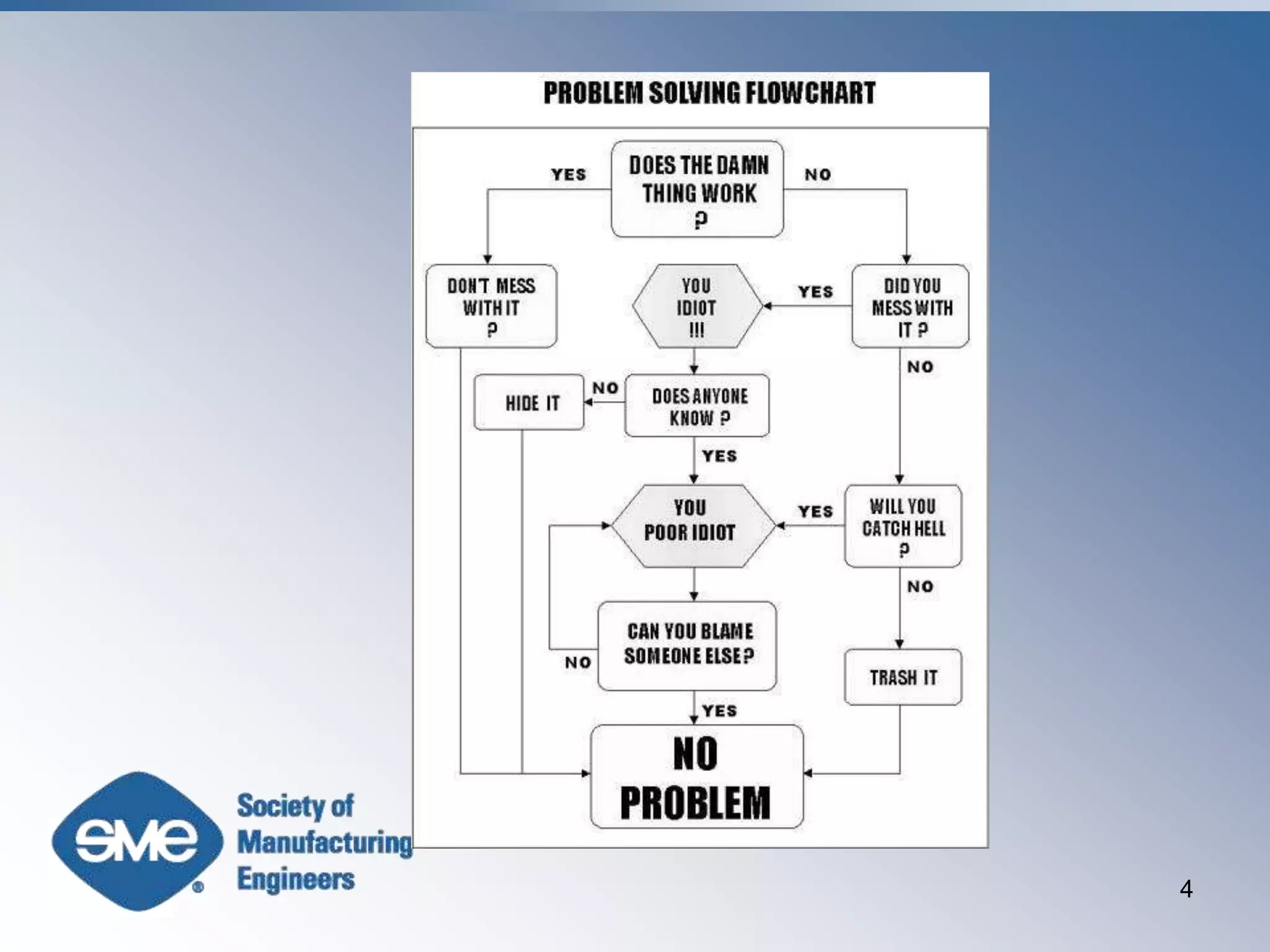
4
Apollo XIII5IntroHouston, we have a problem Part 1Houston we have a problem  Part 2Houston, we have a problem Part 3Getting Them BackCO2 Filter ProblemSuccess!!!!
15 Minute Apollo 13 Problem Solving ExerciseBreak into teams of 3-4 peopleList your observations of what you saw. (10 min)How would your team go about solving the problems presented? (10 min)Pick a spokesperson.Present your findings to the group.(5 min)6
Some Famous Quotes about ProblemsHenry FordThere are no big problems, there are just a lot of little problems. Theodore RubinThe problem is not that there are problems. The problem is expecting otherwise and thinking that having problems is a problem. Albert EinsteinIt's not that I'm so smart, it's just that I stay with problems longer. Billy GrahamHot heads and cold hearts never solved anything. Denis WaitleyDon't dwell on what went wrong. Instead, focus on what to do next. Spend your energies on moving forward toward finding the answer. Unknown AuthorWorry is like a rocking chair - it gives you something to do but won't get you anywhere. John DeweyA problem well stated is a problem half solved. Norman Vincent PealeHow you think about a problem is more important than the problem itself - so always think positively. 7
John Dewey once said, "A problem well-stated is half solved.“8Problem Solving
“A good problem statement often includes: (a) what is known, (b) what is unknown, and (c) what is sought.” - Edward Hodnett9Problem Solving
©James R. Wixson, CVS, CMfgEPROBLEM SOLVINGAn organized effort for developingUNIQUE and RELEVANTresolutions for opportunitiesorundesirable situations
Productive Problem SolvingProductive Problem Solving (PPS) is usually applied to larger problems involving significant resources, but, can be tailored to fit smaller problems.PPS follows a structured methodology that leads to root cause solutions and corrective actions.PPS works best with an interdisciplinary team lead by a skilled facilitator.PPS minimizes the impediments to problem solving.PPS can be used in Kaisen workshops to solve difficult problems with the process. 11
Impediments to Problem SolvingPoor communicationPoor understanding of the problem“Jump to solution” without analyzing the problemFear of reprisalA "Yes, but'' attitudeIntellectual defensiveness closed to new ideasFear of being perceived as being incompetentFear of one's ideas being unacceptedInability to be objective about the problem12
Impediments to Problem SolvingInability to be creative, imaginative or "off the wall'' in developing alternative solutionsBeing inflexible or too serious to have fun while problem solvingBeing so chronically immersed or emotionally "stuck'' in problems that no feelings or emotions can be elicitedResentment about having to solve the problem; blaming others for causing the problem; no desire to own up to the problem yourselfBelieving that problems are the concerns of others, not me; therefore, why waste my time in trying to solving them13
Essential things needed for productive problem solvingA clear description of the problem.A description of the limiting (or negative) factors involved in the problem.A description of the constructive (or positive) factors involved in the problem.Sufficient data regarding the scope, location, size and seriousness of the problem.A clear delineation of the "ownership'' of the problem. Whose problem is it: mine, yours, the other guy's, my boss', my spouse's, my child's, my parents', my teacher's?A clear description of the scope of the problem: How extensive a problem is it? How long has this problem existed? How many people are affected? What else is affected by this problem?A clear description of the consequences if the problem were not solved: What is the possible impact on my family, job, marriage, school performance, life in this community, company etc., if this problem isn't solved? What is the worst possible thing that could happen if this problem isn't solved?14
Essential things needed for productive problem solvingA list of brainstormed solutions to the problem, with each alternative analyzed as to its reality, its benefits and the consequences for following each one.A system of ranking each solution to finalize the decision-making process. A rating system for analyzing each solution is developed, e.g., 100 percent chance of success, 75 percent chance of success, 50 percent chance of success.Determination to follow through on the solution decided upon jointly. This involves full motivation to "take the risk'' and pursue the solution to its fullestManagement support and buy-inEmpowerment to solve problems and confidence in the solutionAdequate allocation of resources (time and people)15
Nine Key Steps to Productive Problem SolvingUnderstand the problem environmentDefine the problemIdentify what’s requiredIdentify what’s available (resources)Isolate functions/activities needing improvementIdentify success criteriaGenerate alternative solutions given the resources at hand, and what resources may be needed.Analyze risks, hidden assumptions, and unexpected impactsSelect the best solution16
Tips for productive problem solvingFive-dimensional thinking or looking at a problem from five different dimensions:1. What is the size or extent of the problem?2. How would really be affected if the problem was left unattended or unsolved?3. How are you functioning in handling the problem-solving process?4. What do your five senses tell about the problem, i.e., what you see, hear, touch, smell and taste?5. What does the world of reality look like from within the problem?17
Some Problem Solving MethodologiesDrill Down methodStraw Man Approach (Trial and Error)Heuristic method (Rules of Thumb)5 WhysKepner-Tregoe Situation Analysis, Problem and Decision Making methods (Is, Is-Not method)Deming's PDCA, or PDSA methodSix Sigma’s DMAIC methodValue Analysis/Value Engineering18
Don’t forget: The Scientific MethodMake ObservationsCollect data Define problem Hypothesize Test with experimentAnalyze Results and Draw ConclusionApply solutions 	19
Brainstorming TipsExpress all ideas.Deem no idea too wild to be considered.Quantity is important; every idea that comes to mind should be included.Getting together with others to brainstorm is desirable.Criticism or negative evaluation regarding any idea is forbidden until brainstorming is completed.20
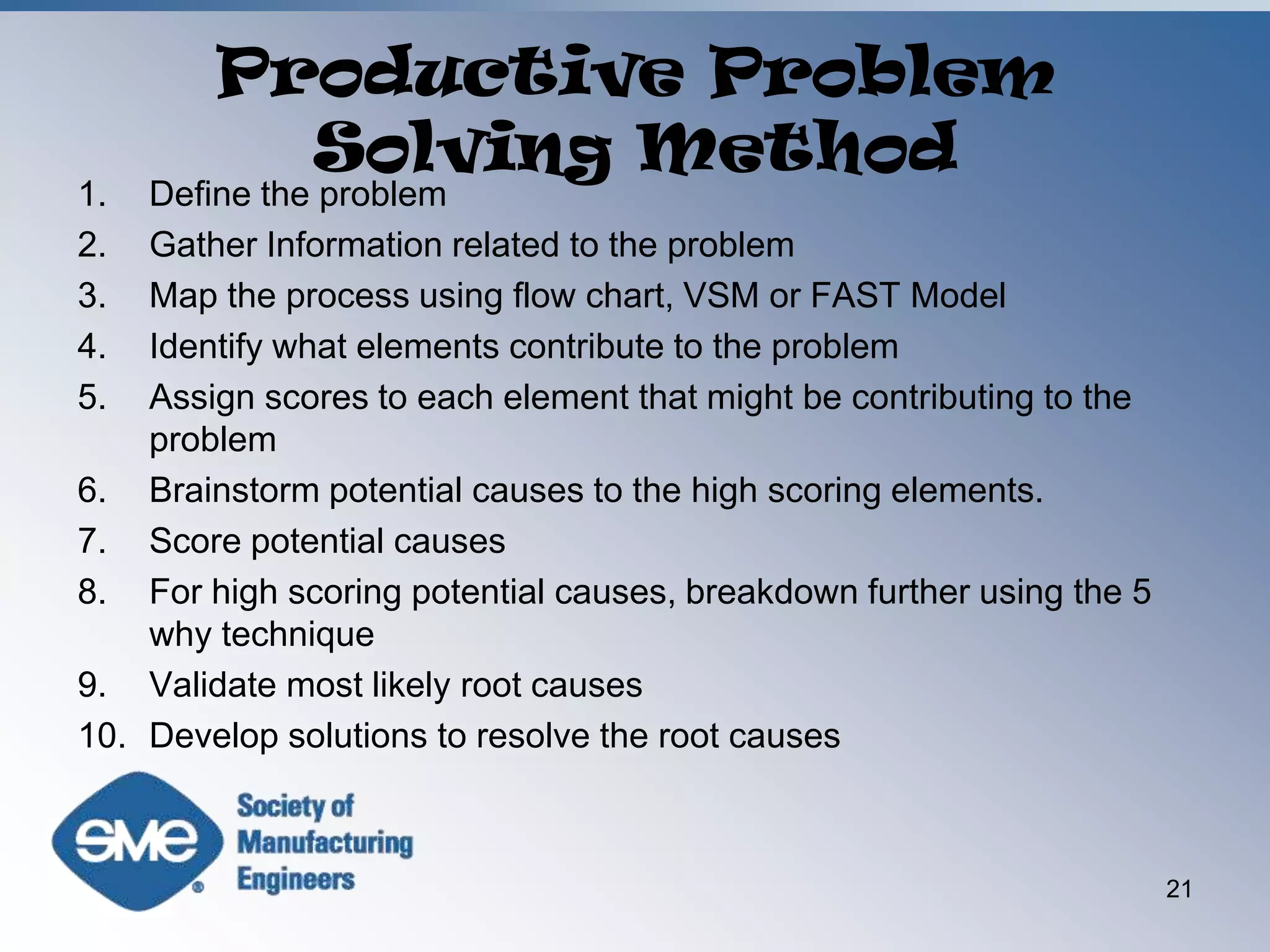
Productive Problem Solving MethodDefine the problemGather Information related to the problemMap the process using flow chart, VSM or FAST ModelIdentify what elements contribute to the problemAssign scores to each element that might be contributing to the problemBrainstorm potential causes to the high scoring elements.Score potential causesFor high scoring potential causes, breakdown further using the 5 why techniqueValidate most likely root causesDevelop solutions to resolve the root causes21
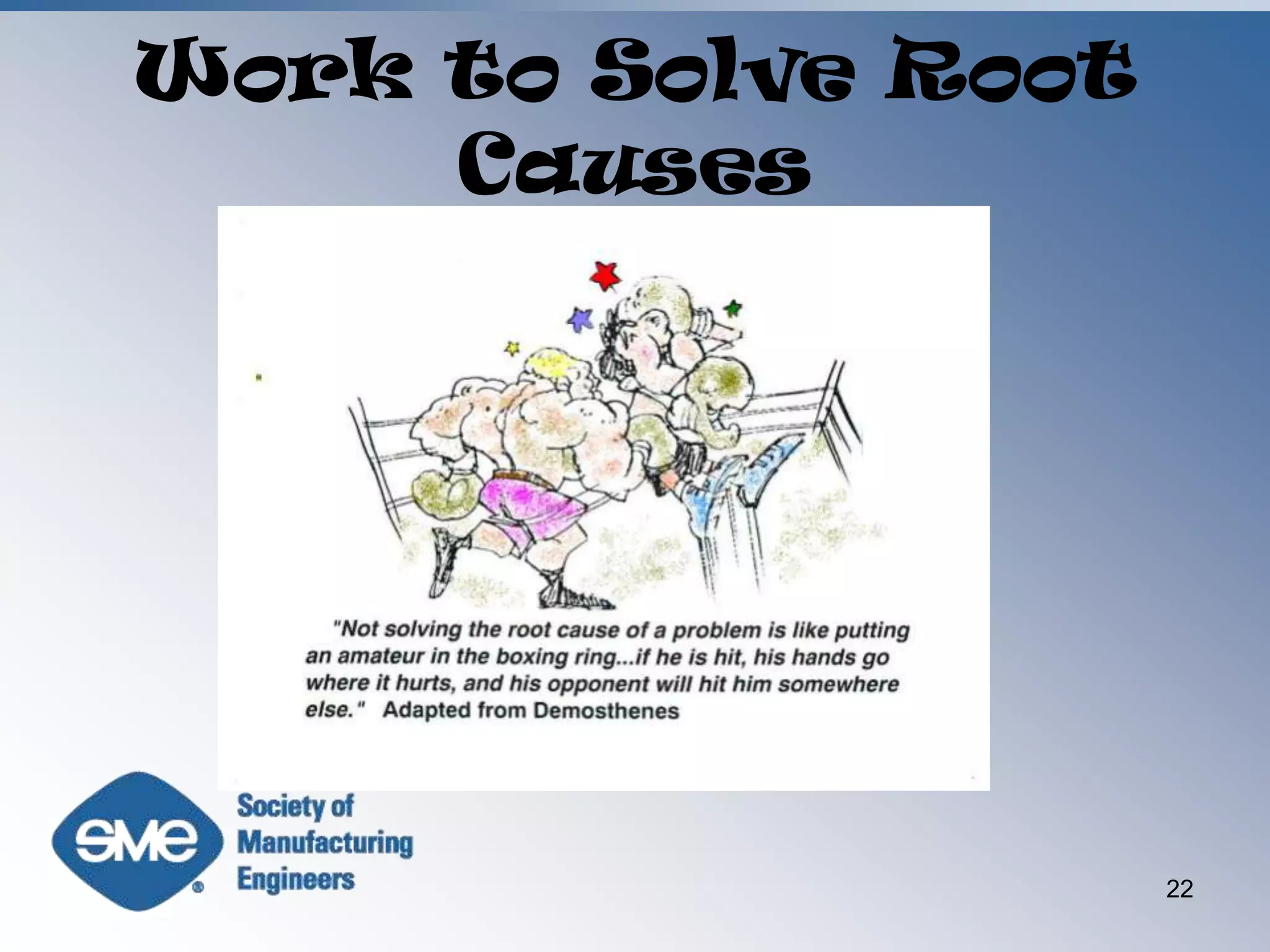
Work to Solve Root Causes22
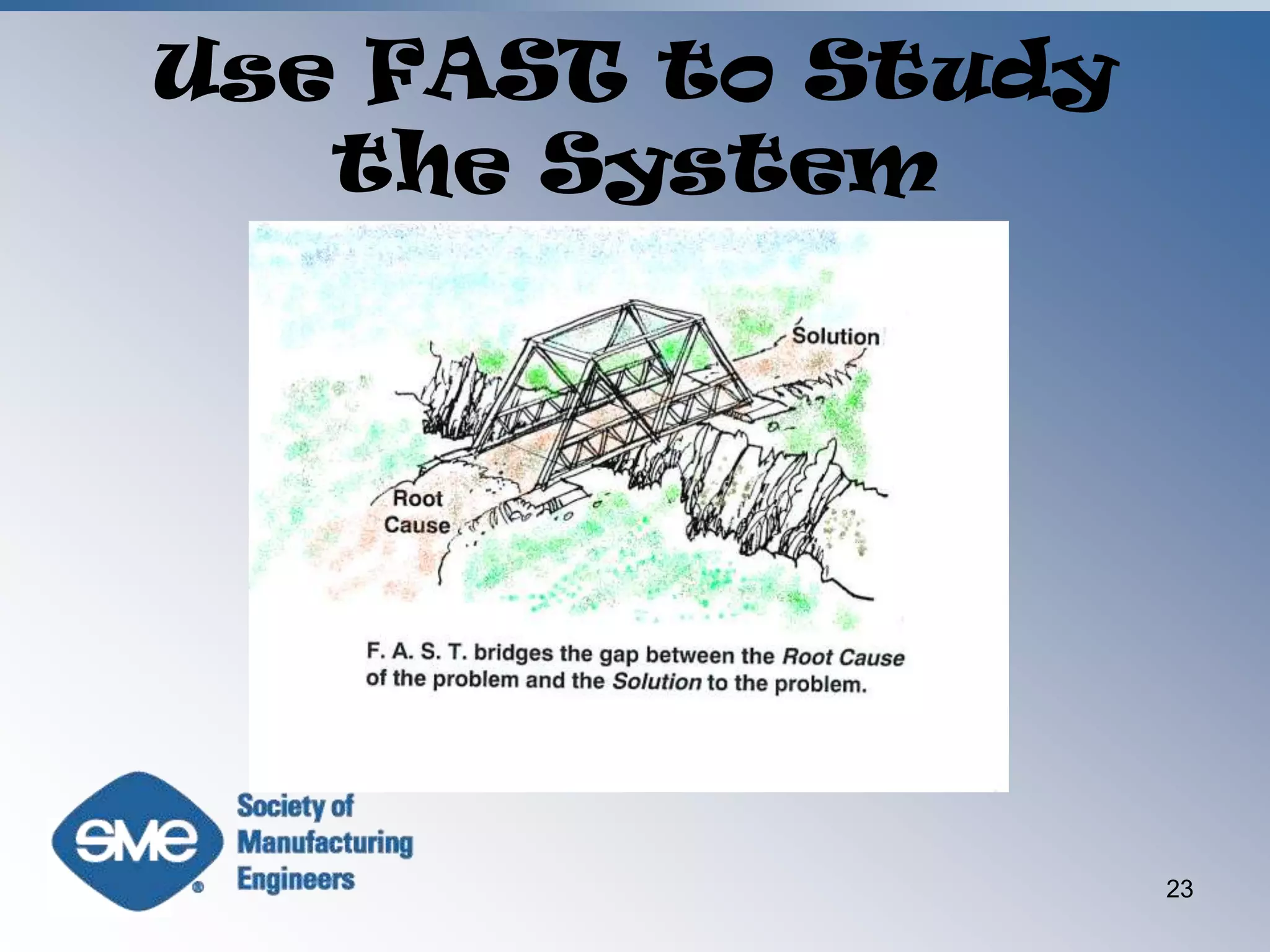
Use FAST to Study the System23
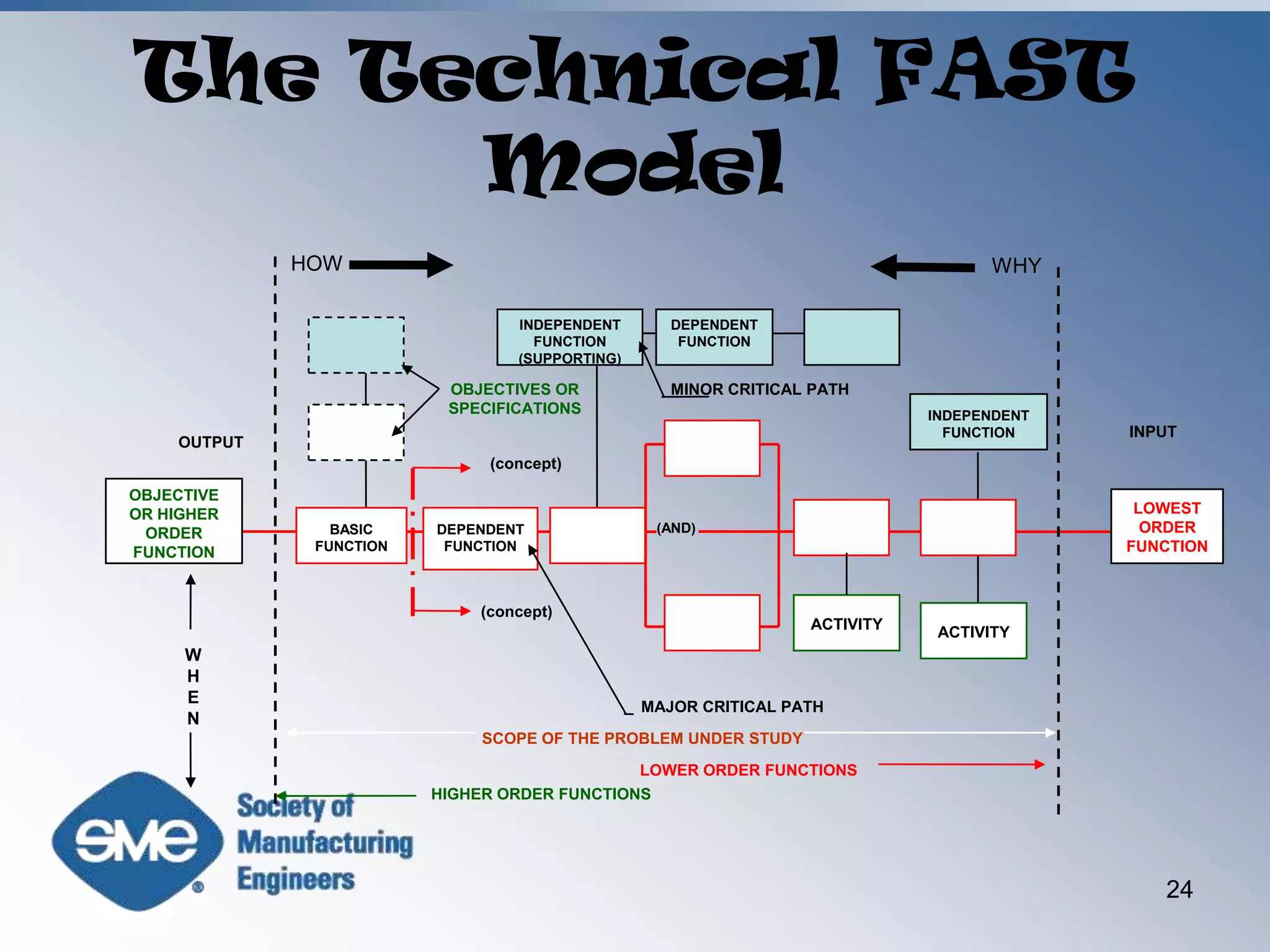
The Technical FAST ModelHOWWHYINDEPENDENT FUNCTION (SUPPORTING)DEPENDENT FUNCTIONOBJECTIVES OR SPECIFICATIONSMINOR CRITICAL PATHINDEPENDENT FUNCTIONINPUTOUTPUT(concept)OBJECTIVE OR HIGHER ORDER FUNCTIONLOWEST ORDER FUNCTIONBASIC FUNCTIONDEPENDENT FUNCTION(AND)ACTIVITY(concept)ACTIVITYWHENMAJOR CRITICAL PATHSCOPE OF THE PROBLEM UNDER STUDYLOWER ORDER FUNCTIONSHIGHER ORDER FUNCTIONS24
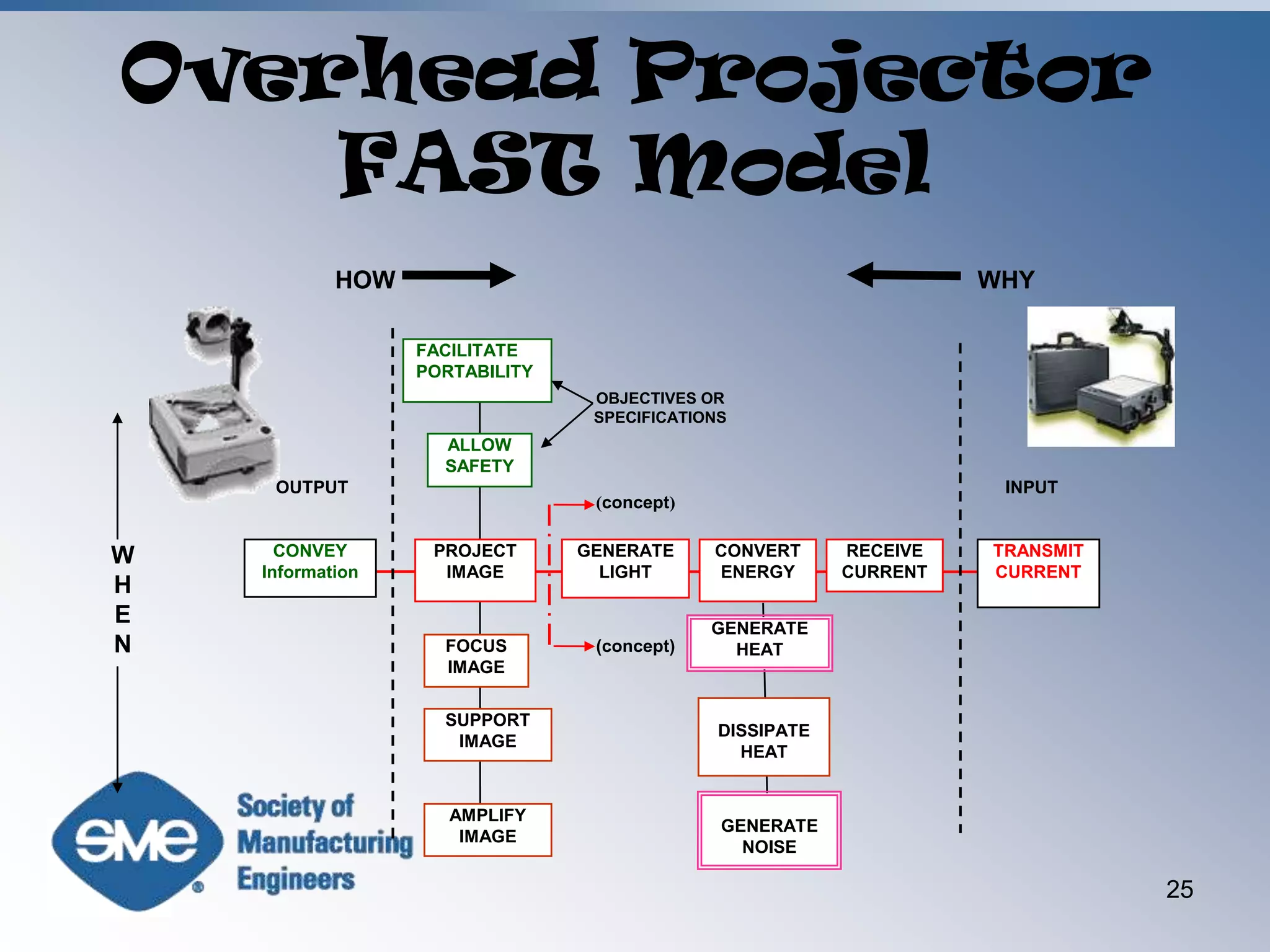
Overhead Projector FAST ModelHOWWHY(concept)WHEN(concept)OBJECTIVES OR SPECIFICATIONSFACILITATE PORTABILITYALLOW SAFETYOUTPUTINPUTCONVEY InformationPROJECT IMAGEGENERATE LIGHTRECEIVE CURRENTTRANSMIT CURRENTCONVERT ENERGYGENERATE HEATFOCUS IMAGEDISSIPATE HEATSUPPORT IMAGEGENERATE NOISEAMPLIFY IMAGE25
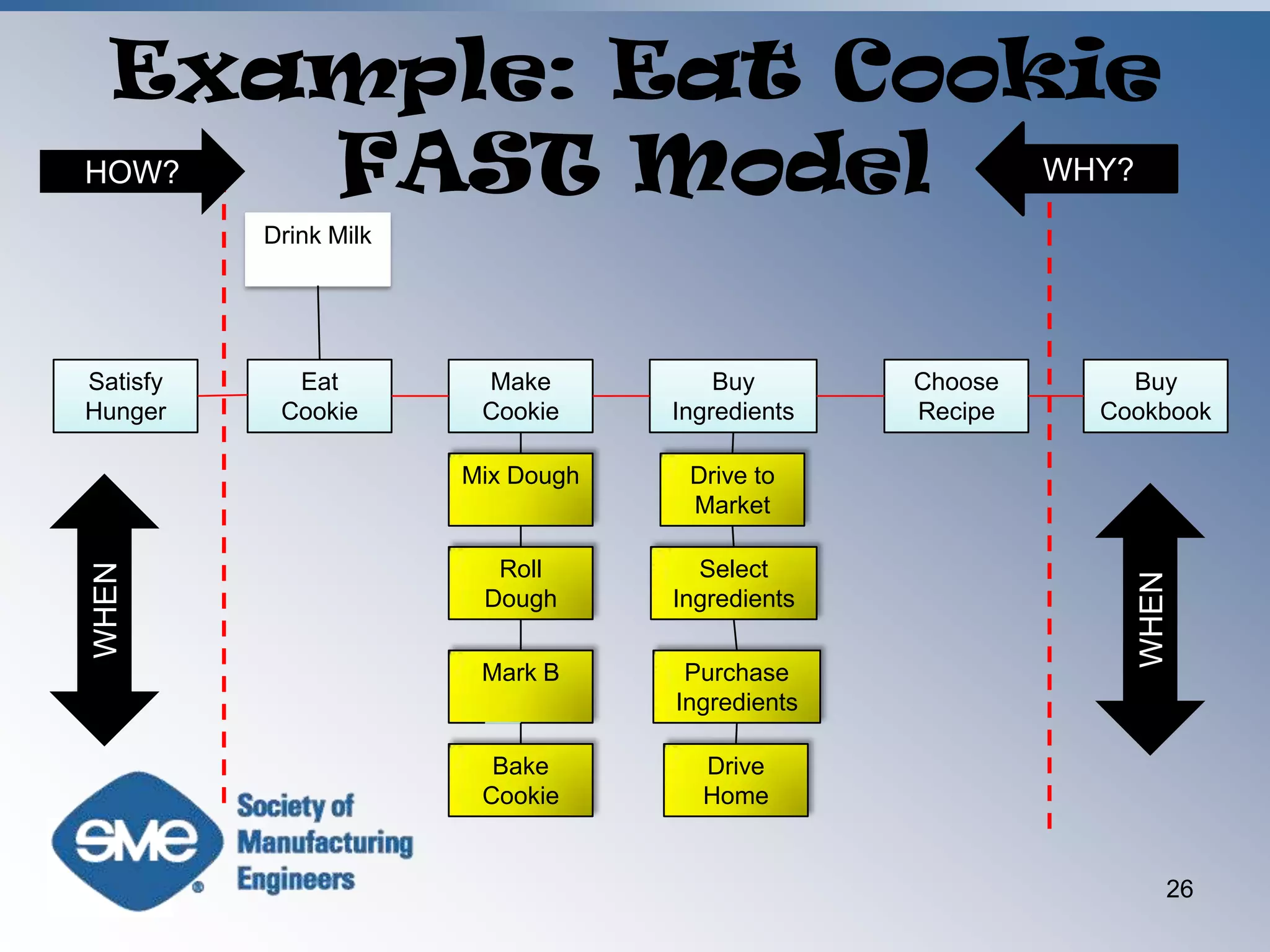
Example: Eat Cookie FAST Model26WHY?HOW?Drink MilkSatisfy HungerEat CookieMake CookieBuy IngredientsChoose RecipeBuy CookbookMix DoughDrive to MarketWHENWHENRoll DoughSelect IngredientsMark BPurchase IngredientsBake CookieDrive Home
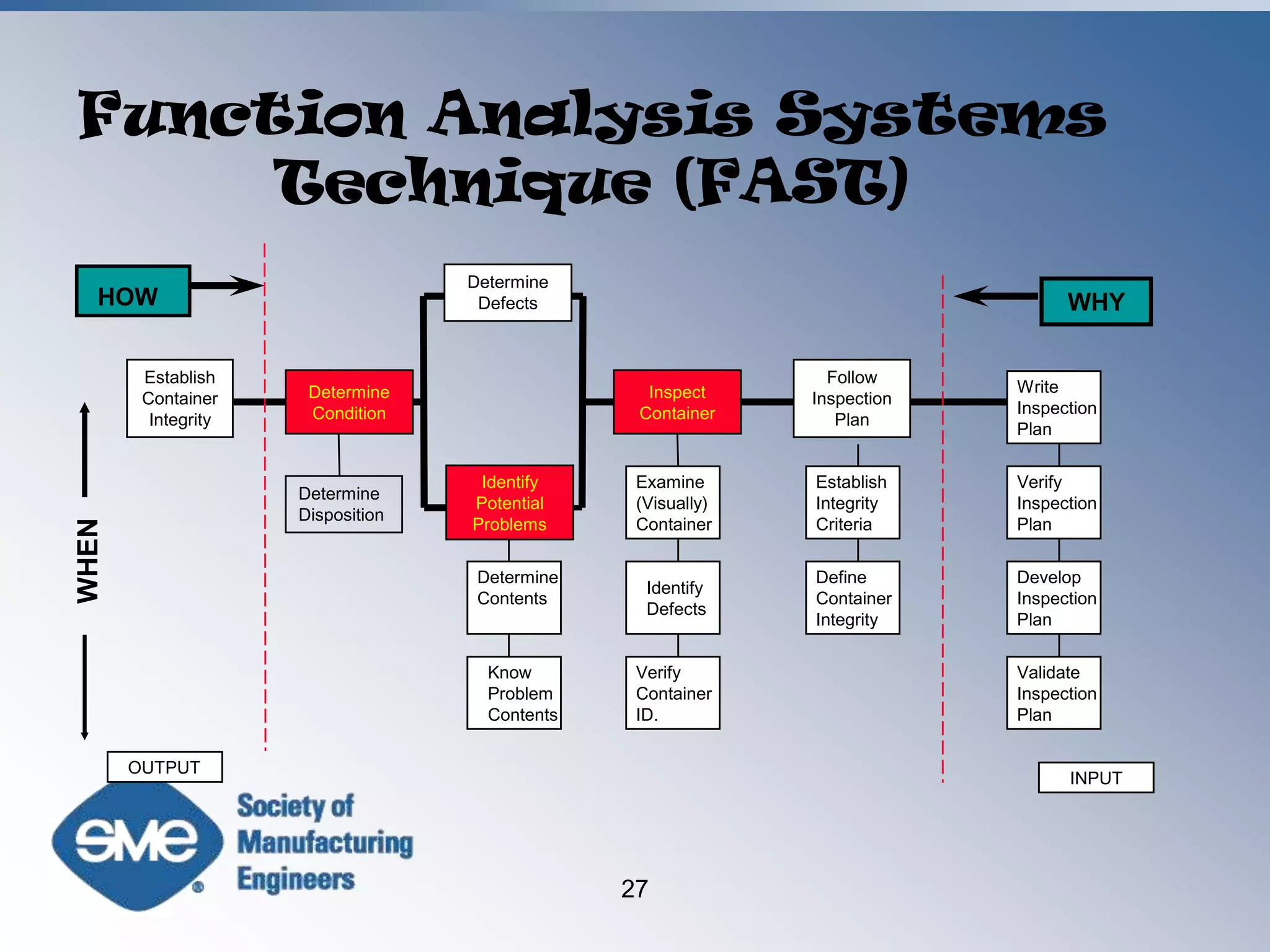
Determine DefectsHOWWHYEstablish Container IntegrityFollow Inspection PlanWriteInspectionPlanDetermine ConditionInspect ContainerExamine(Visually)ContainerEstablishIntegrityCriteriaVerifyInspectionPlanIdentify Potential ProblemsDetermine DispositionWHENDetermineContentsDefineContainerIntegrityDevelopInspectionPlanIdentifyDefectsKnowProblemContentsVerifyContainerID.ValidateInspectionPlanOUTPUTINPUTFunction Analysis Systems Technique (FAST)27
Identifying Areas for ImprovementIdentify key functions/activities where performance may be undesirable
For the functions where performance is undesirable, brainstorm likely causes of failure.
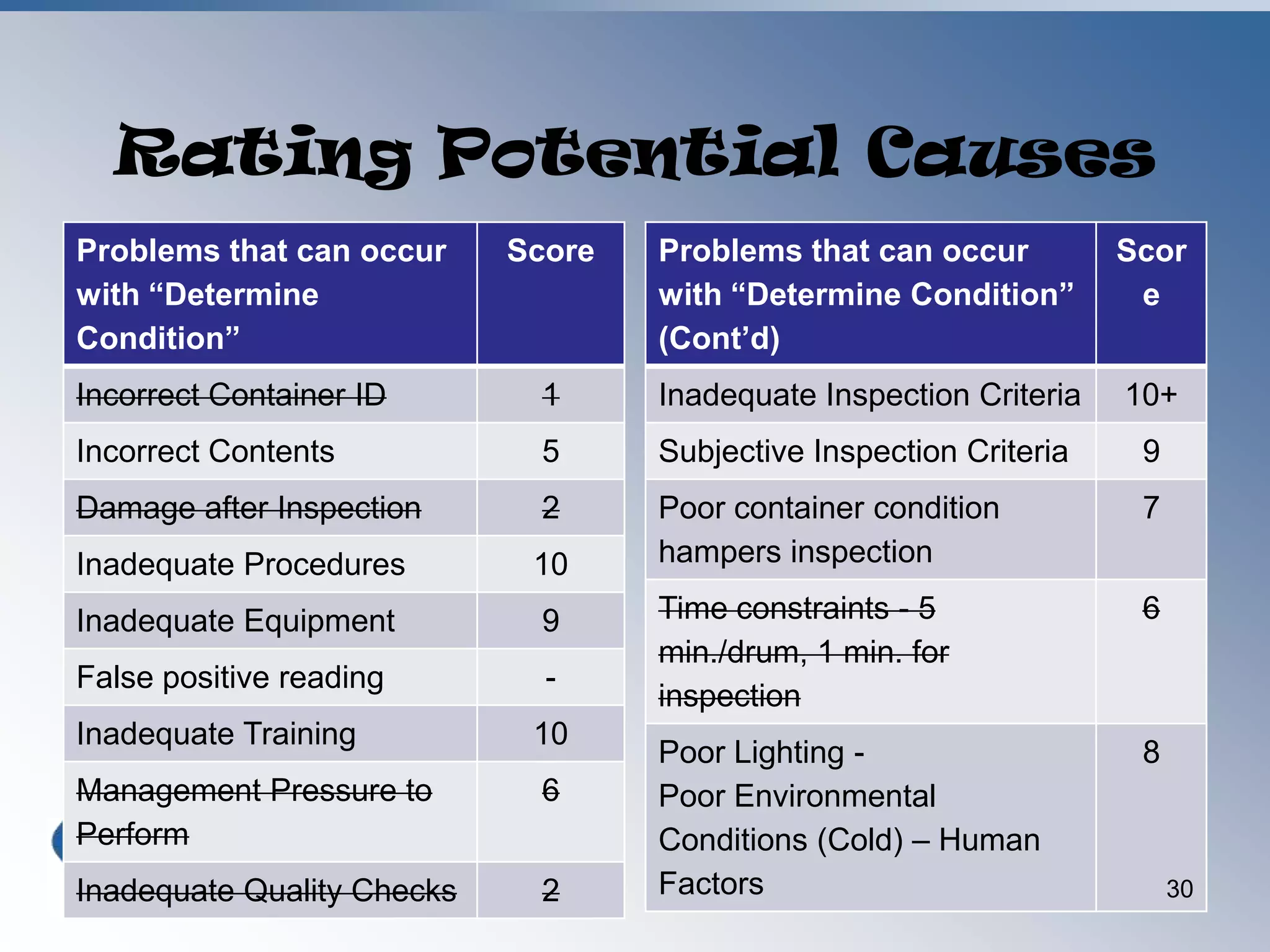
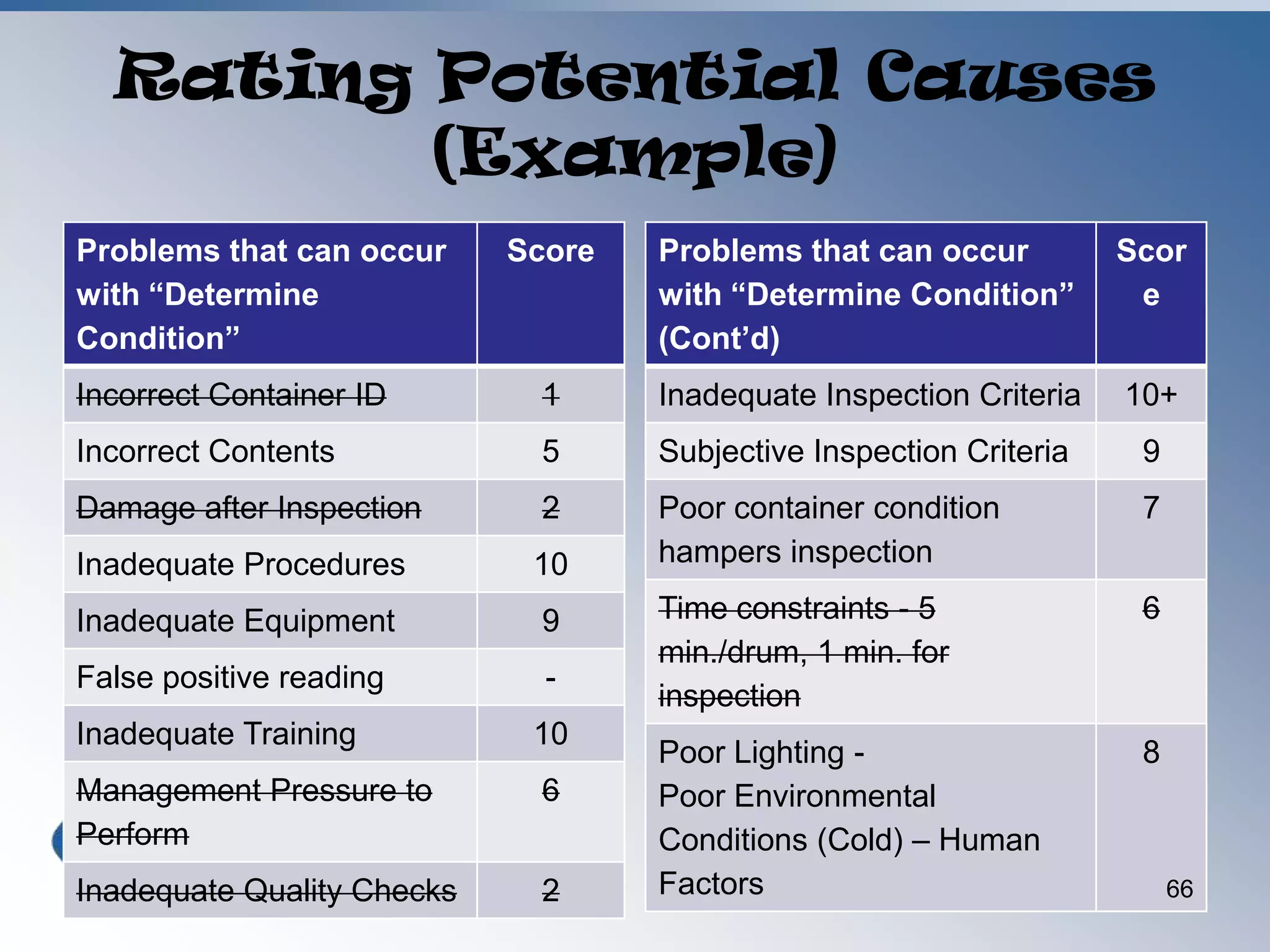
Next, rate these causes on a scale of 1-10 as to which are the most likely causes of the problem(s).28
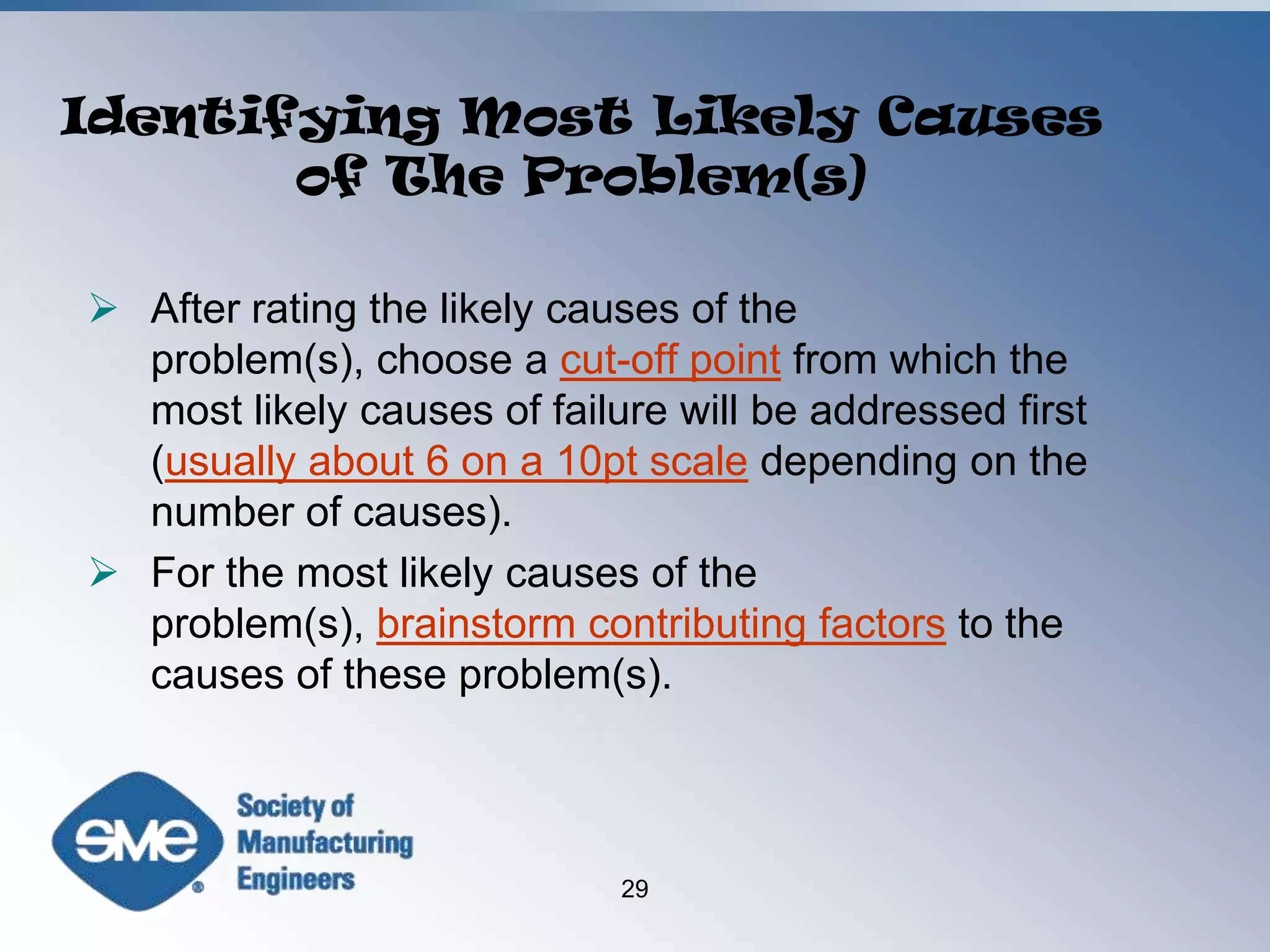
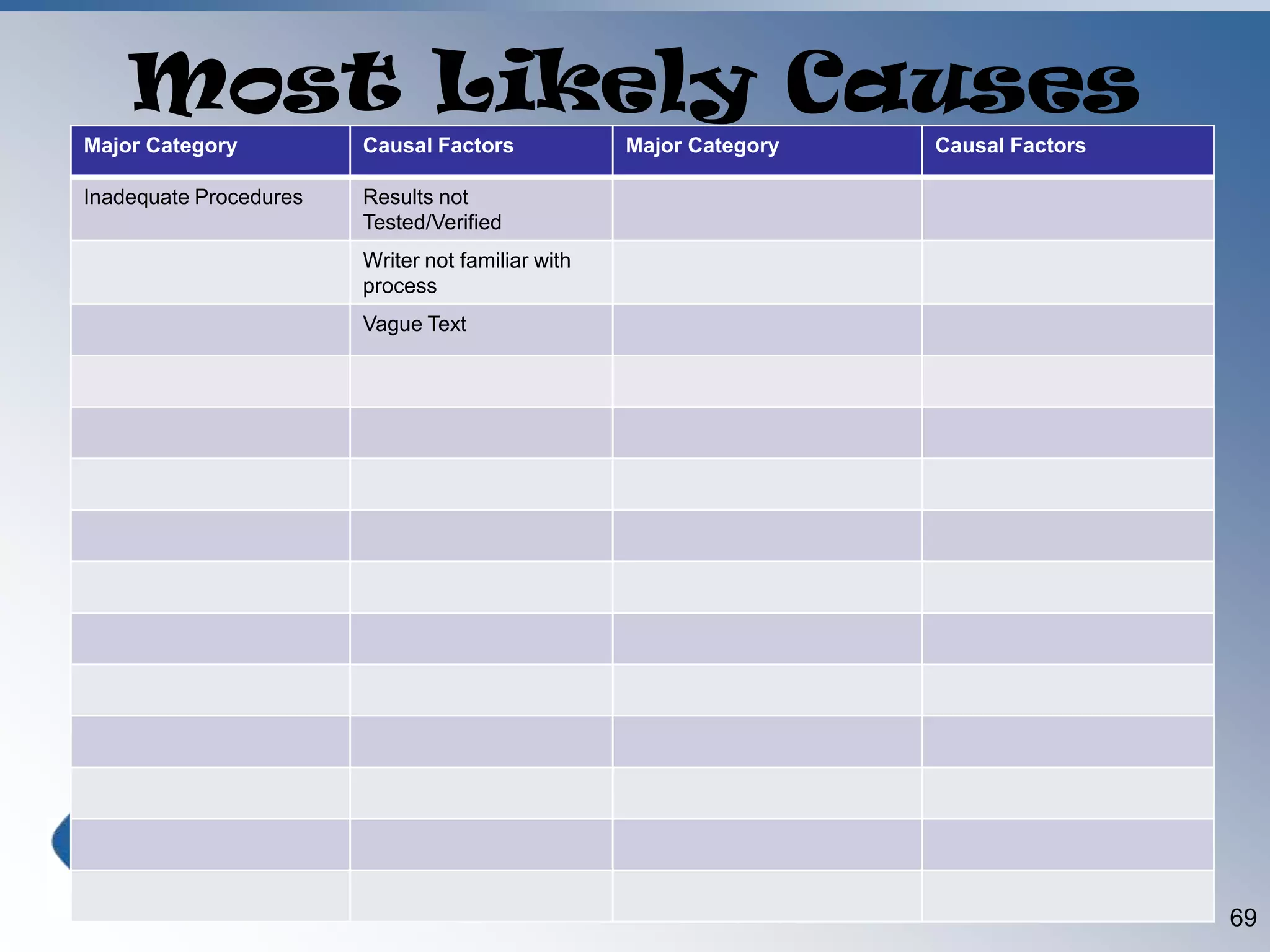
Identifying Most Likely Causes of The Problem(s)After rating the likely causes of the problem(s), choose a cut-off point from which the most likely causes of failure will be addressed first (usually about 6 on a 10pt scale depending on the number of causes).
For the most likely causes of the problem(s), brainstorm contributing factors to the causes of these problem(s).29
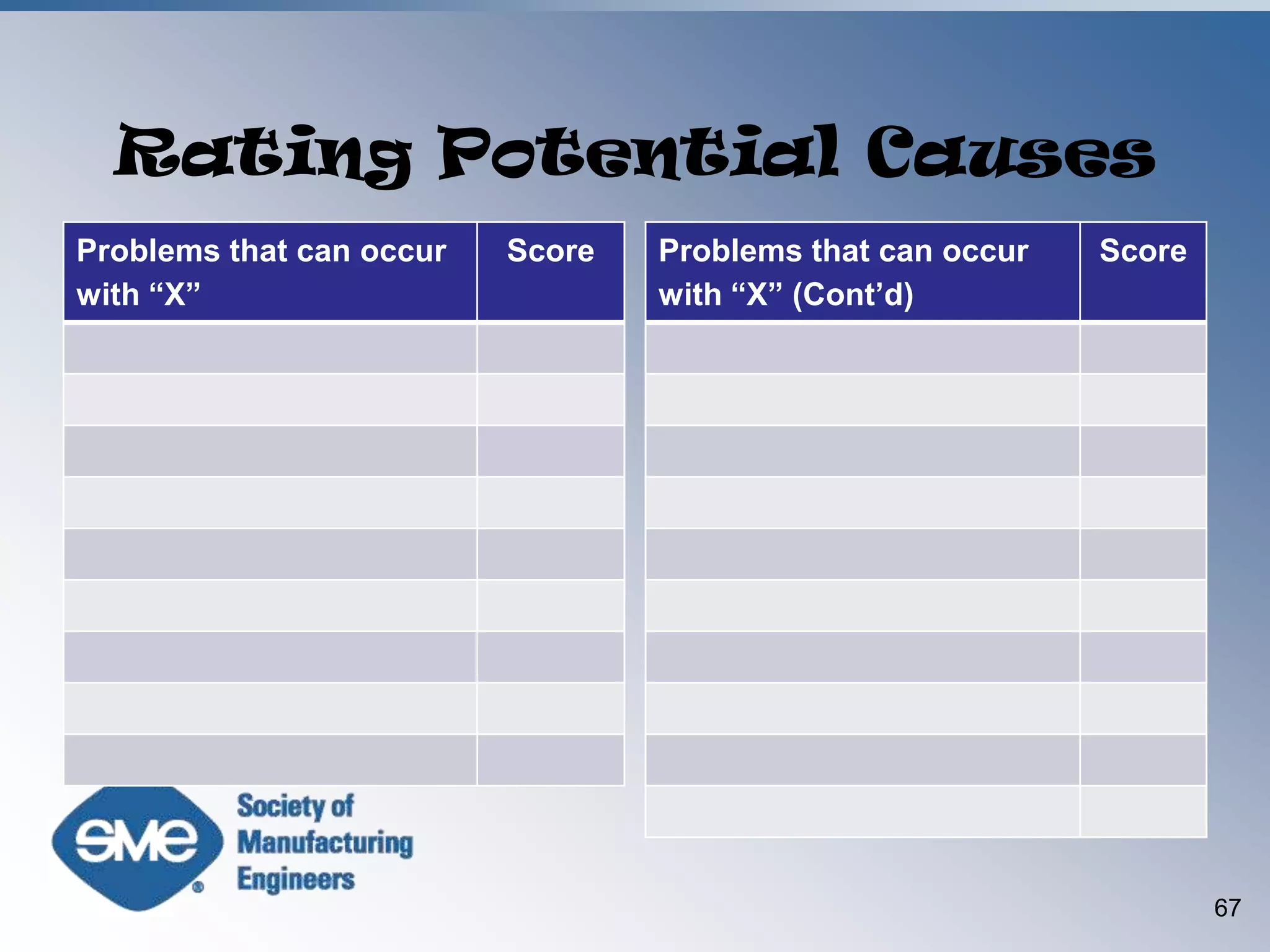
Rating Potential Causes30
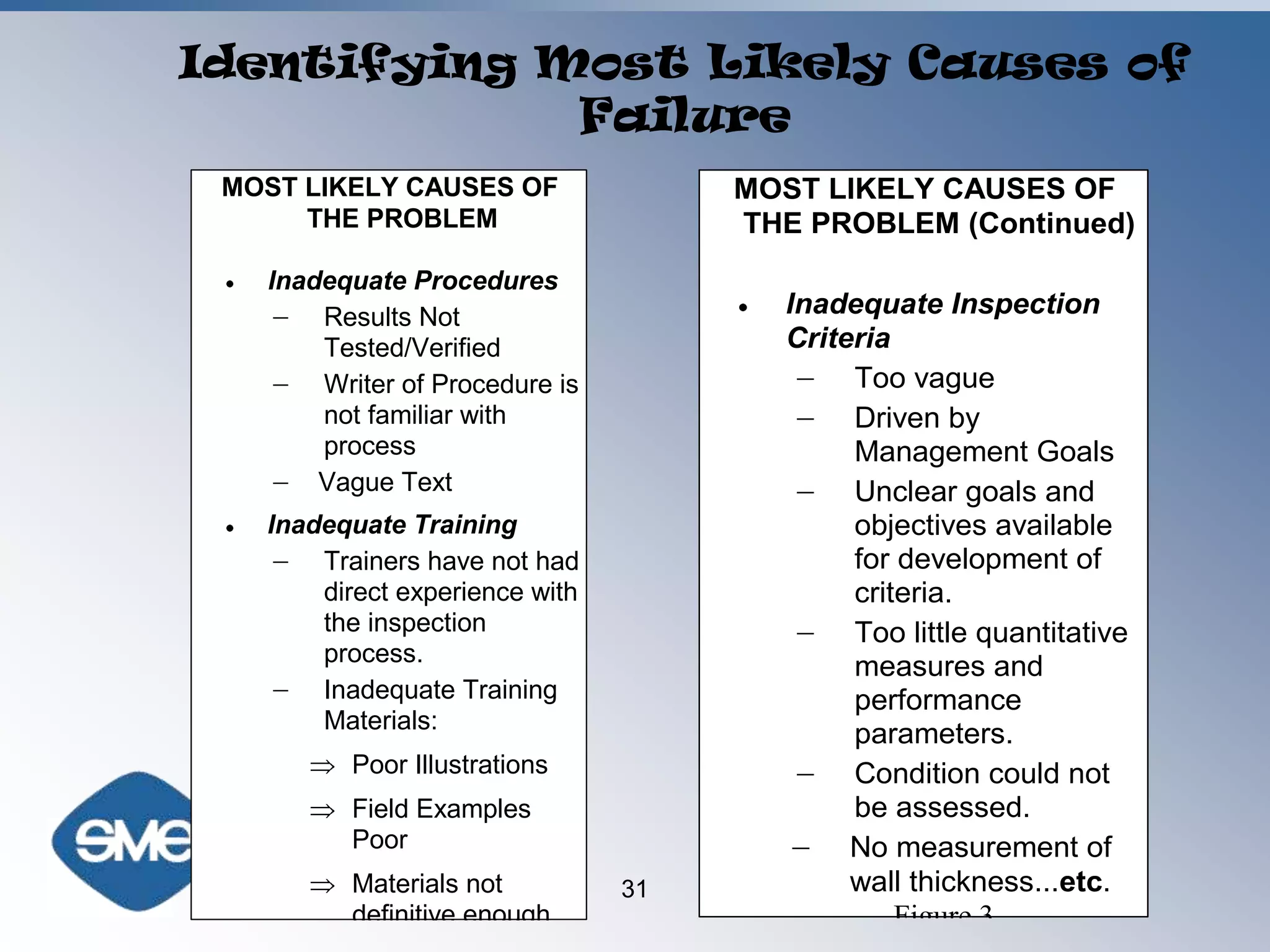
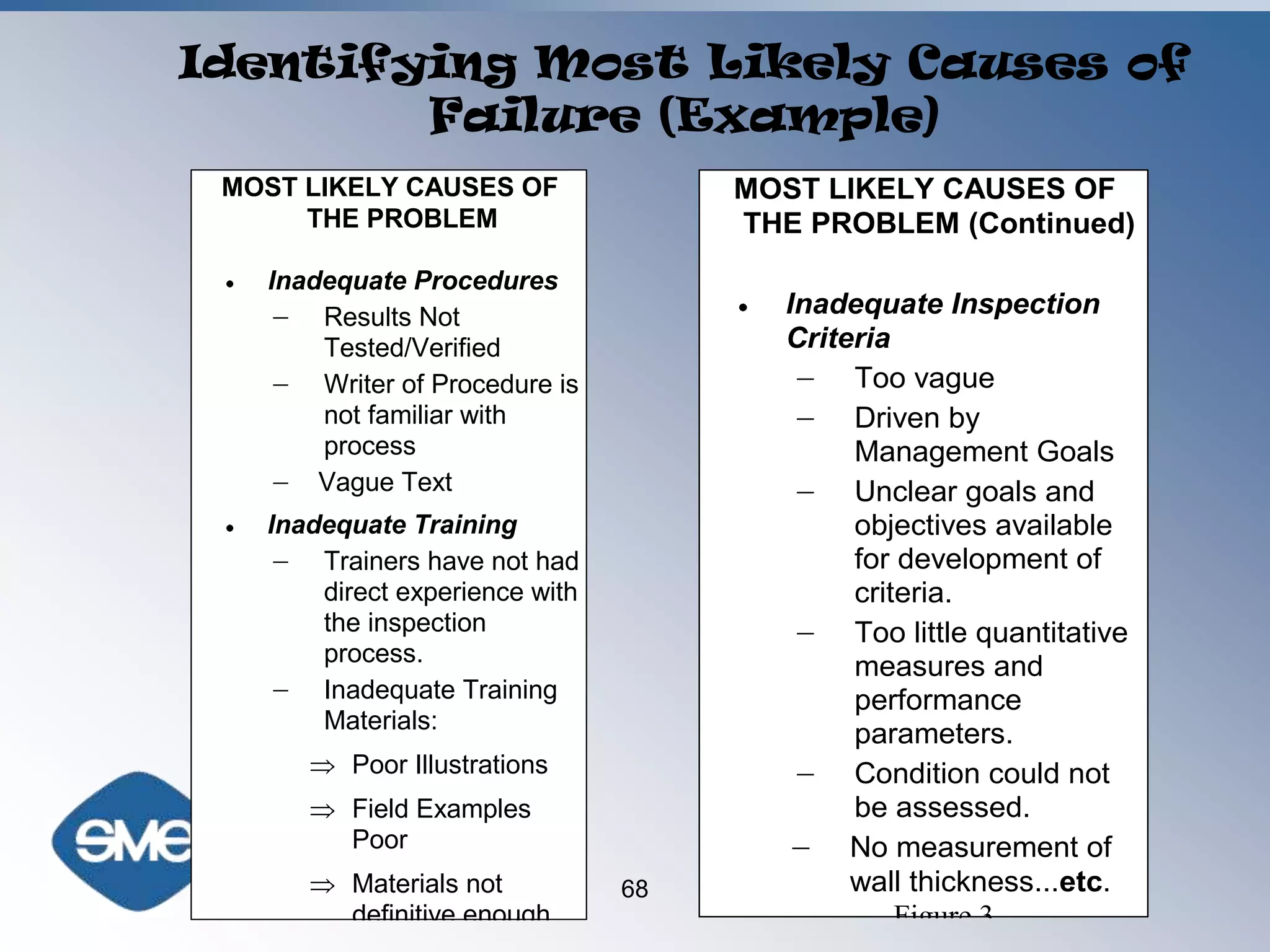
Identifying Most Likely Causes of Failure31
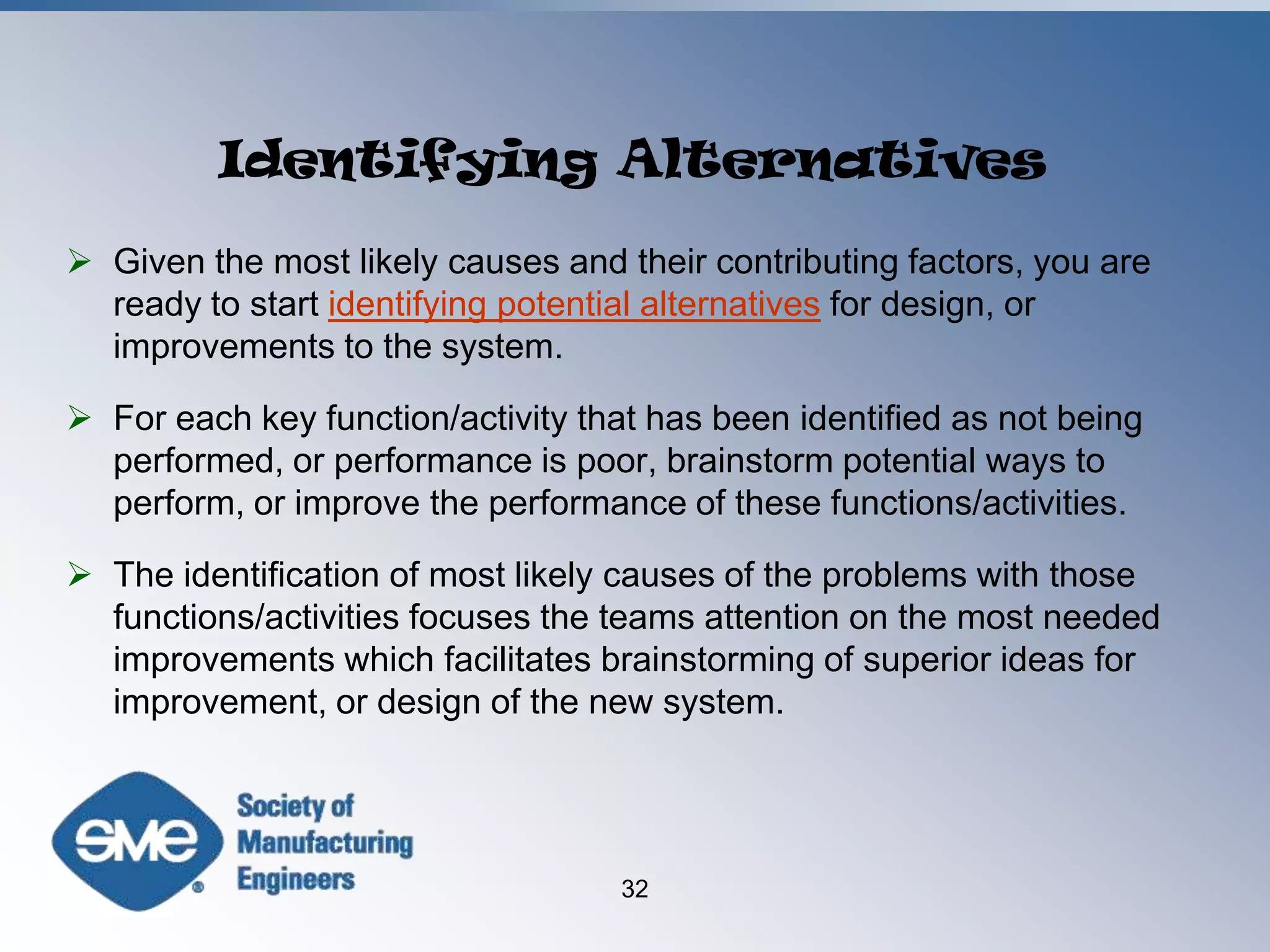
Identifying AlternativesGiven the most likely causes and their contributing factors, you are ready to start identifying potential alternatives for design, or improvements to the system.
For each key function/activity that has been identified as not being performed, or performance is poor, brainstorm potential ways to perform, or improve the performance of these functions/activities.
The identification of most likely causes of the problems with those functions/activities focuses the teams attention on the most needed improvements which facilitates brainstorming of superior ideas for improvement, or design of the new system.32
©James R. Wixson, CVS, CMfgECreativity
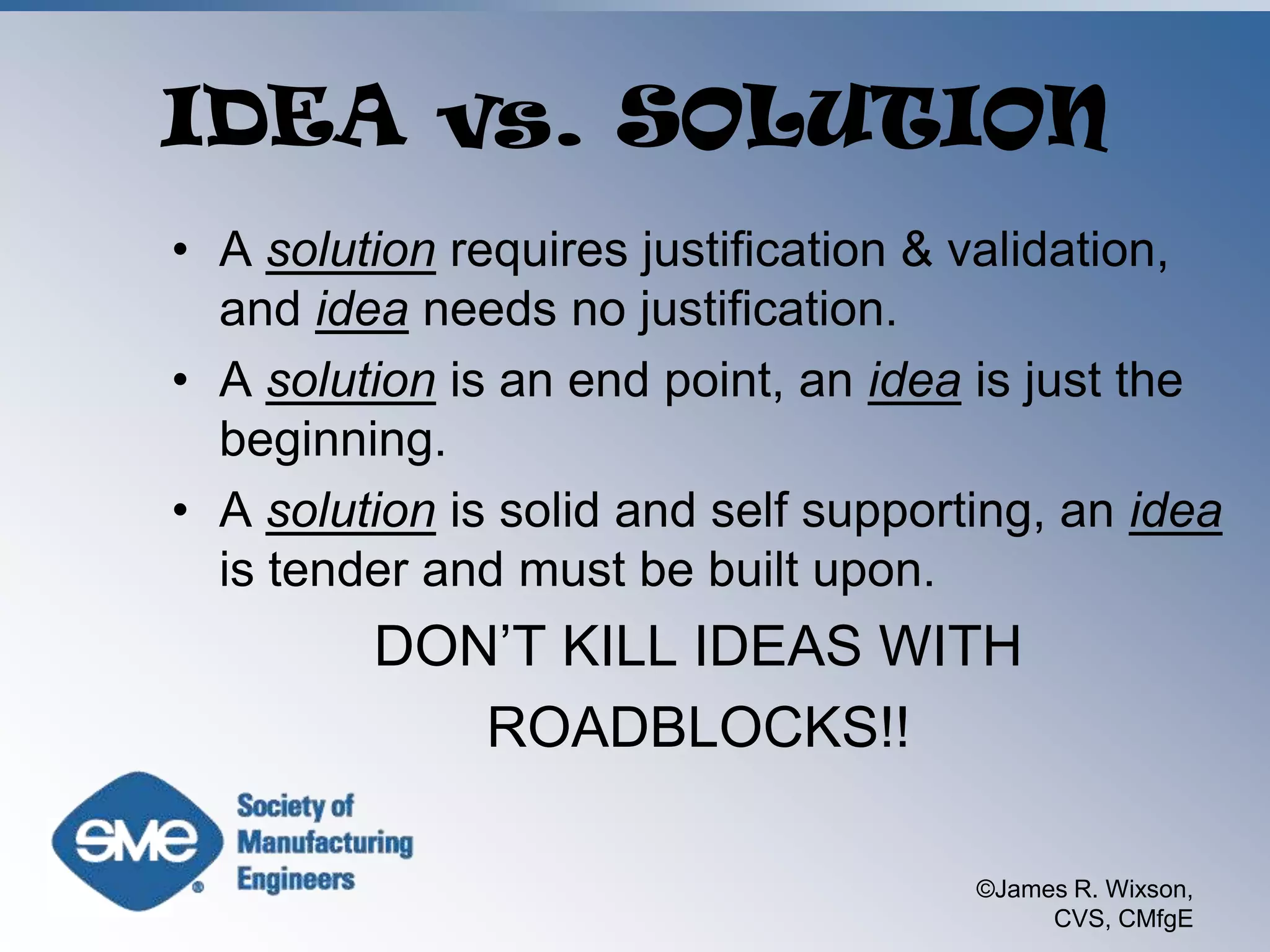
©James R. Wixson, CVS, CMfgEIDEA vs. SOLUTIONA solution requires justification & validation, and idea needs no justification.A solution is an end point, an idea is just the beginning.A solution is solid and self supporting, an idea is tender and must be built upon.DON’T KILL IDEAS WITHROADBLOCKS!!
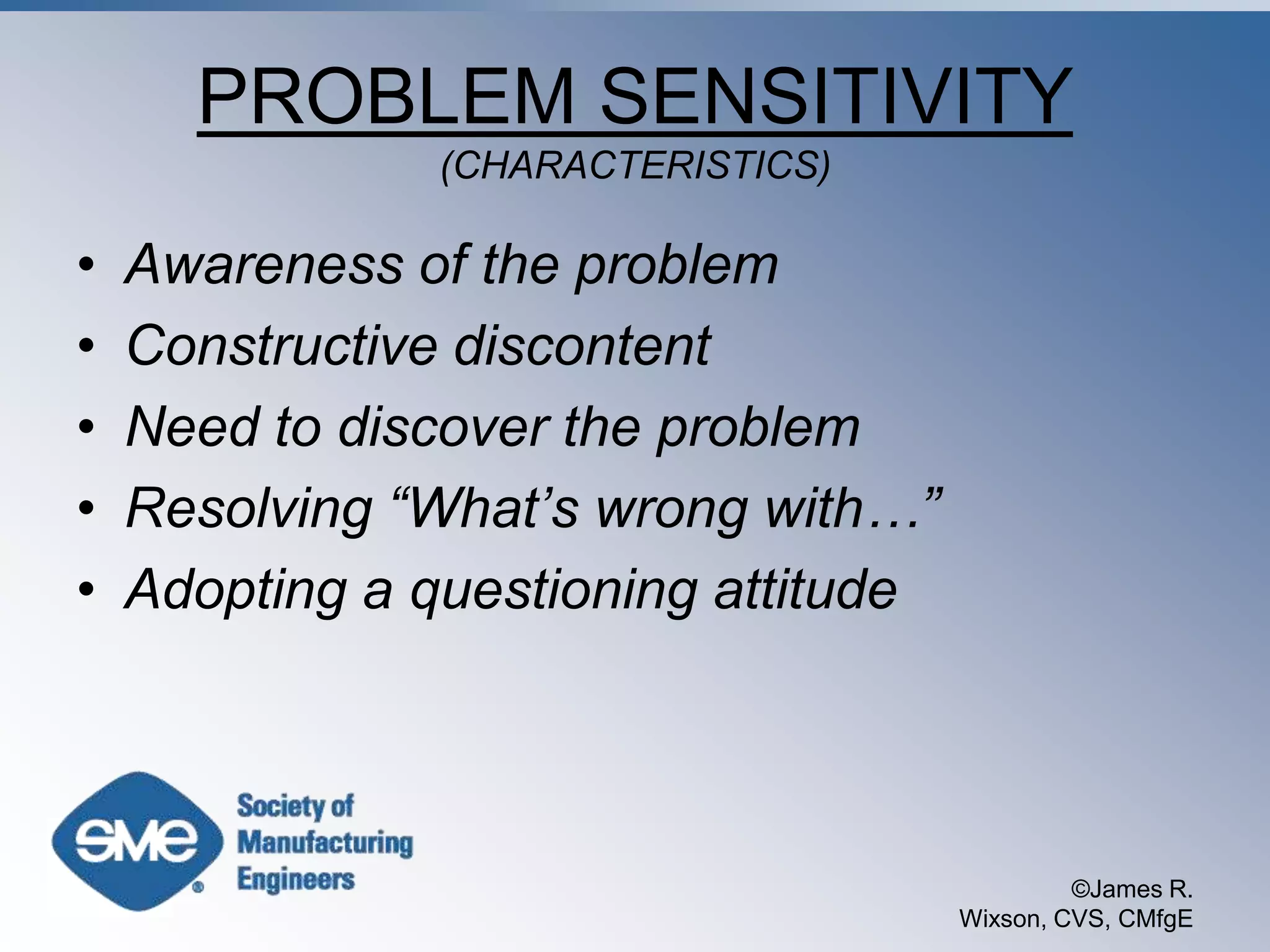
©James R. Wixson, CVS, CMfgEPROBLEM SENSITIVITY(CHARACTERISTICS)Awareness of the problemConstructive discontentNeed to discover the problemResolving “What’s wrong with…”Adopting a questioning attitude
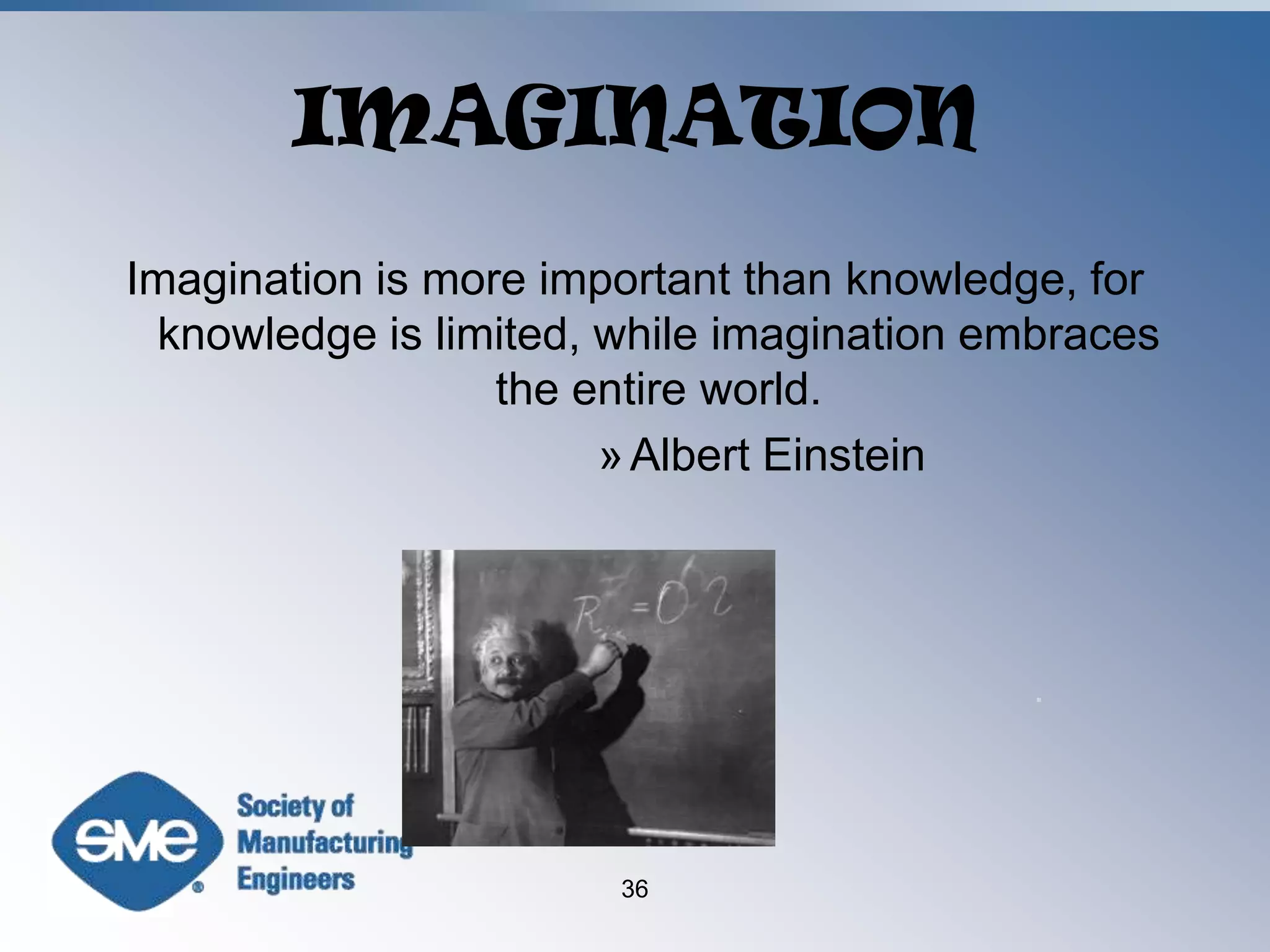
36IMAGINATIONImagination is more important than knowledge, for knowledge is limited, while imagination embraces the entire world.Albert Einstein
37Thought for the day:When you always do what you have always done - you always get what you have always gotten.Socrates
38IDEA vs. SOLUTIONA solution requires justification & validation, and idea needs no justification.
A solution is an end point, an idea is just the beginning.
A solution is solid and self supporting, an idea is tender and must be built upon.DON’T KILL IDEAS WITHROADBLOCKS!!
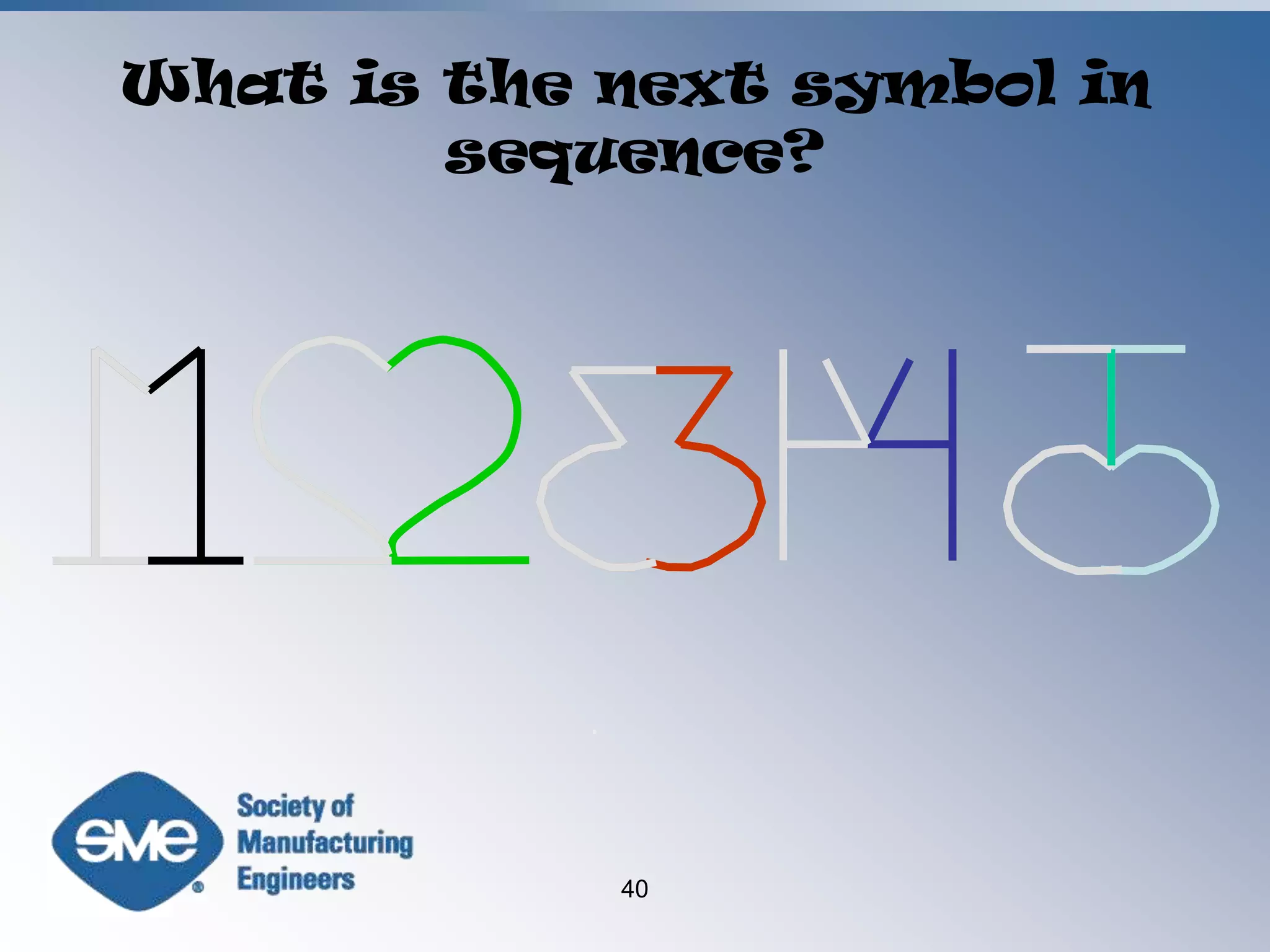
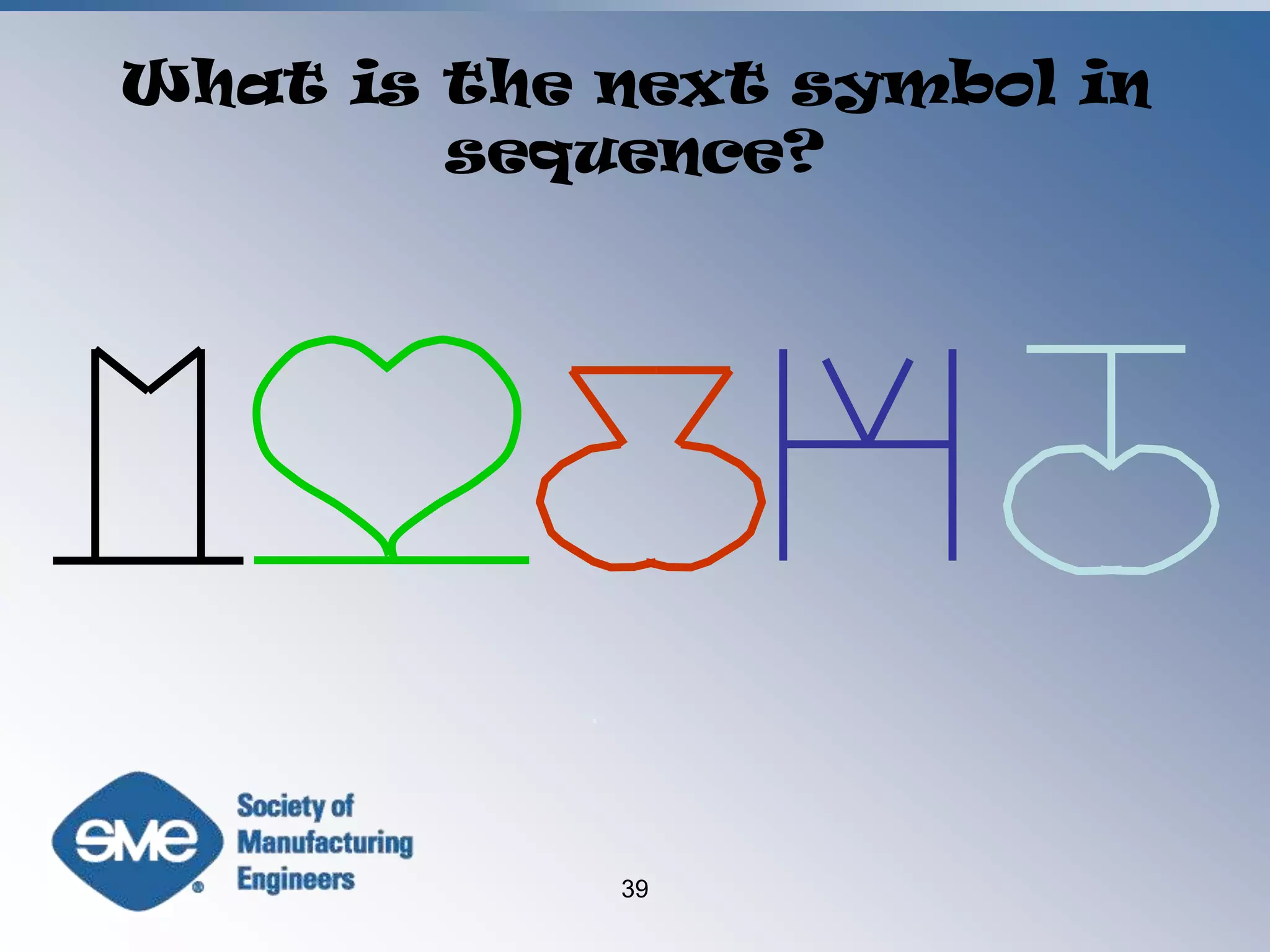
39What is the next symbol in sequence?
40What is the next symbol in sequence?
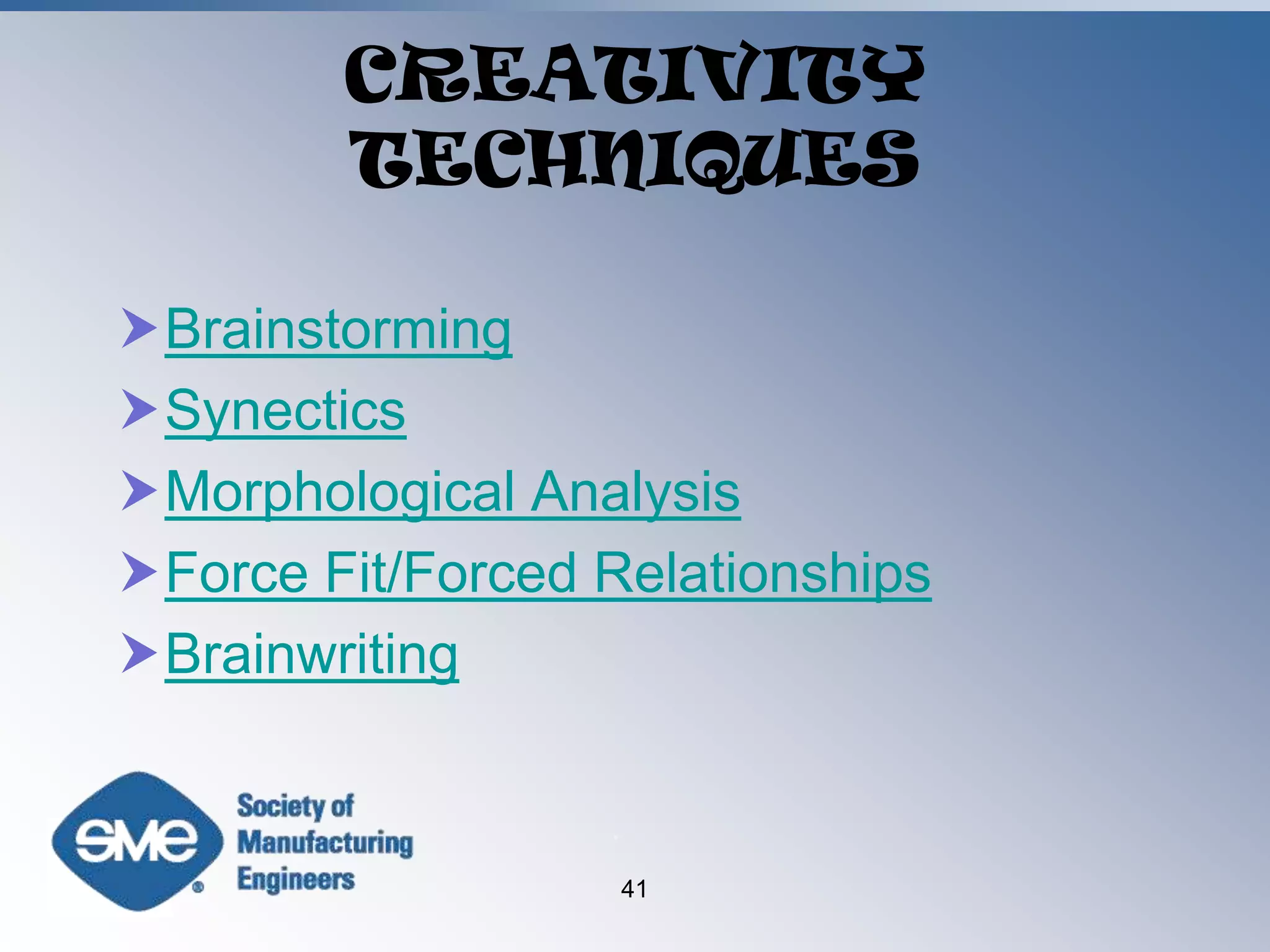
41CREATIVITY TECHNIQUESBrainstorming
Synectics
Morphological Analysis
Force Fit/Forced Relationships
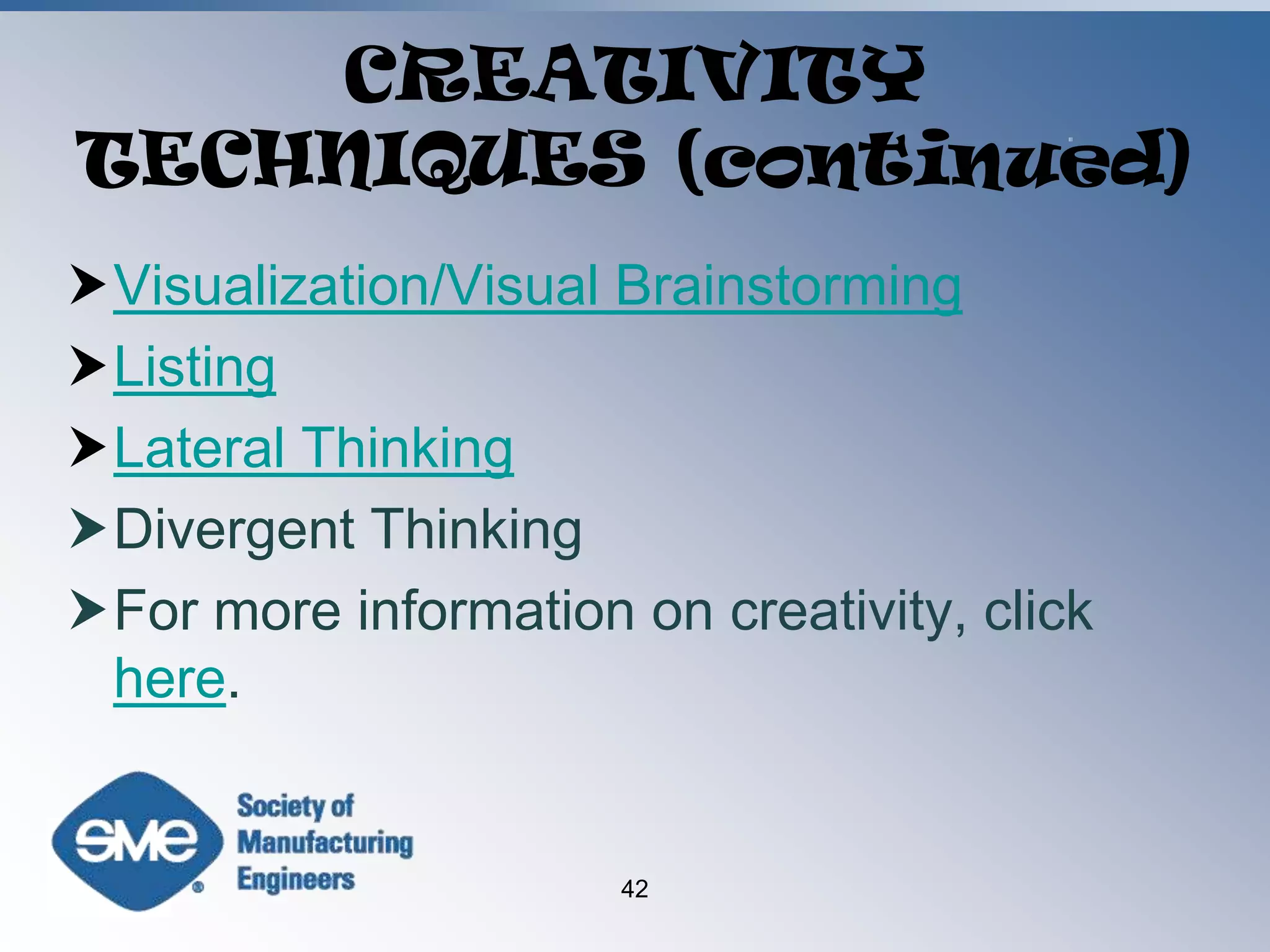
Brainwriting42CREATIVITY TECHNIQUES (continued)Visualization/Visual Brainstorming
Listing
Lateral Thinking
Divergent Thinking
For more information on creativity, click here.©James R. Wixson, CVS, CMfgEWhat do you see?
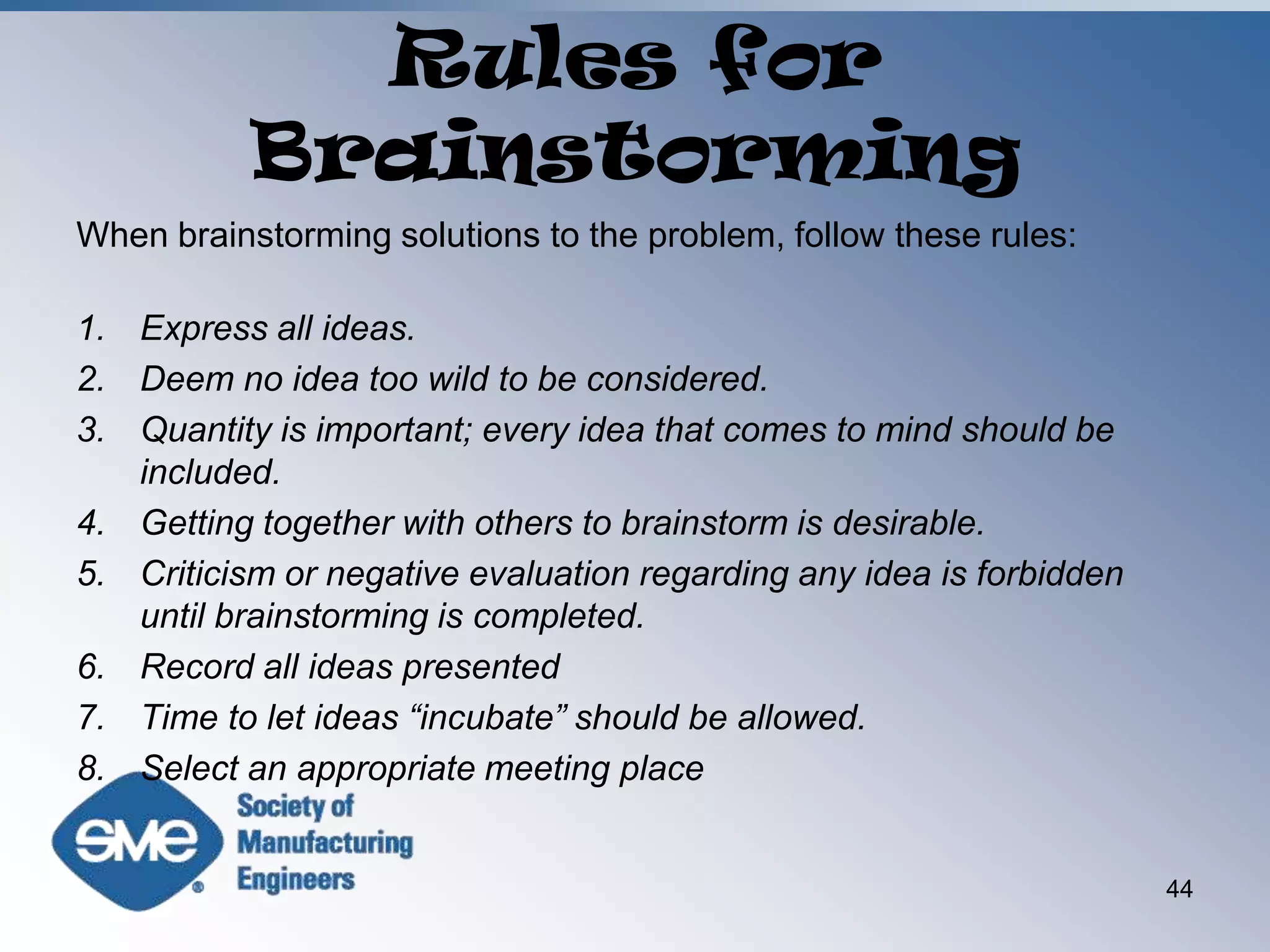
Rules for BrainstormingWhen brainstorming solutions to the problem, follow these rules:Express all ideas.Deem no idea too wild to be considered.Quantity is important; every idea that comes to mind should be included.Getting together with others to brainstorm is desirable.Criticism or negative evaluation regarding any idea is forbidden until brainstorming is completed.Record all ideas presentedTime to let ideas “incubate” should be allowed.Select an appropriate meeting place44
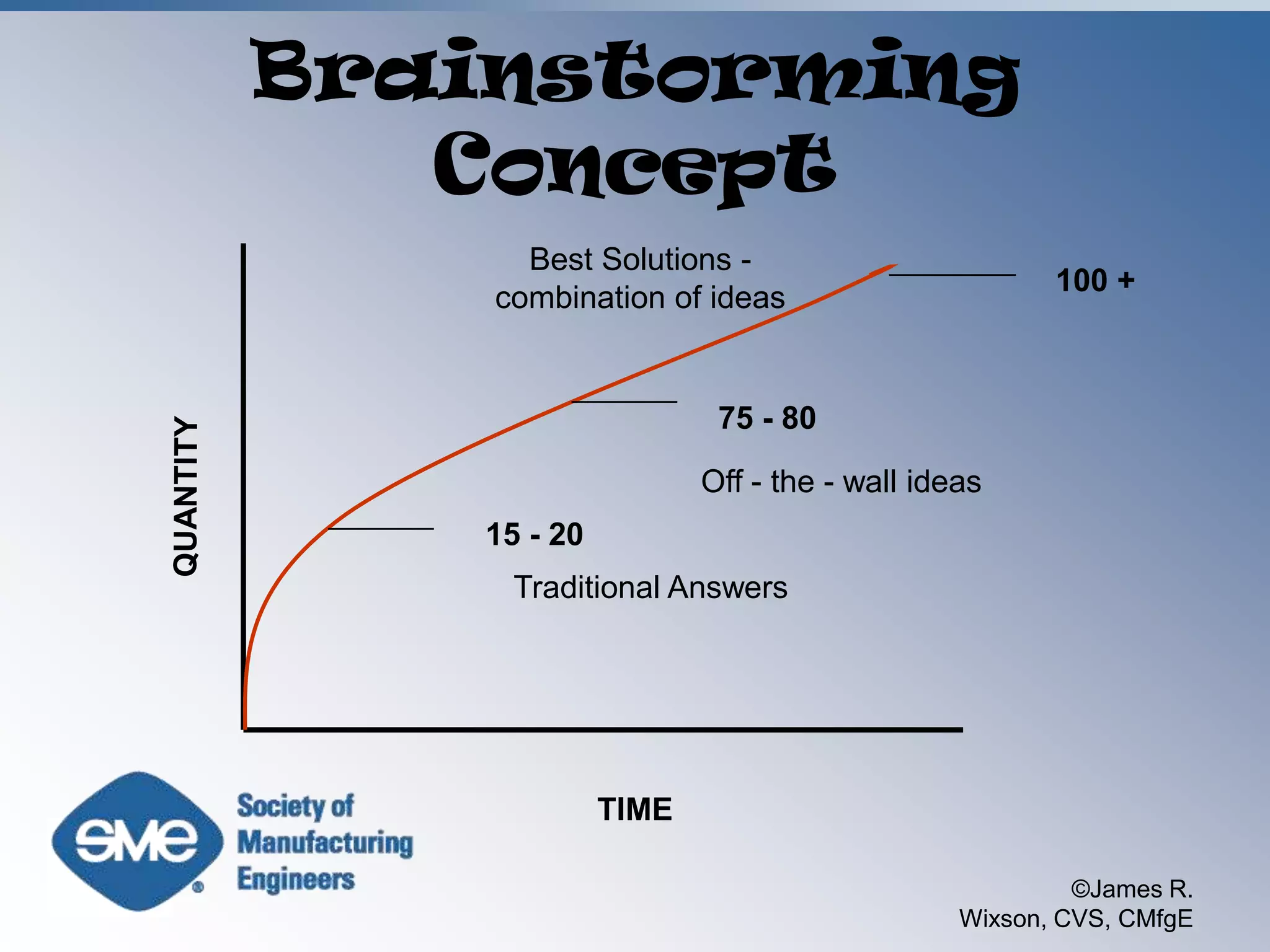
©James R. Wixson, CVS, CMfgEBrainstorming ConceptBest Solutions - combination of ideas100 +75 - 80Off - the - wall ideas15 - 20Traditional AnswersQUANTITYTIME
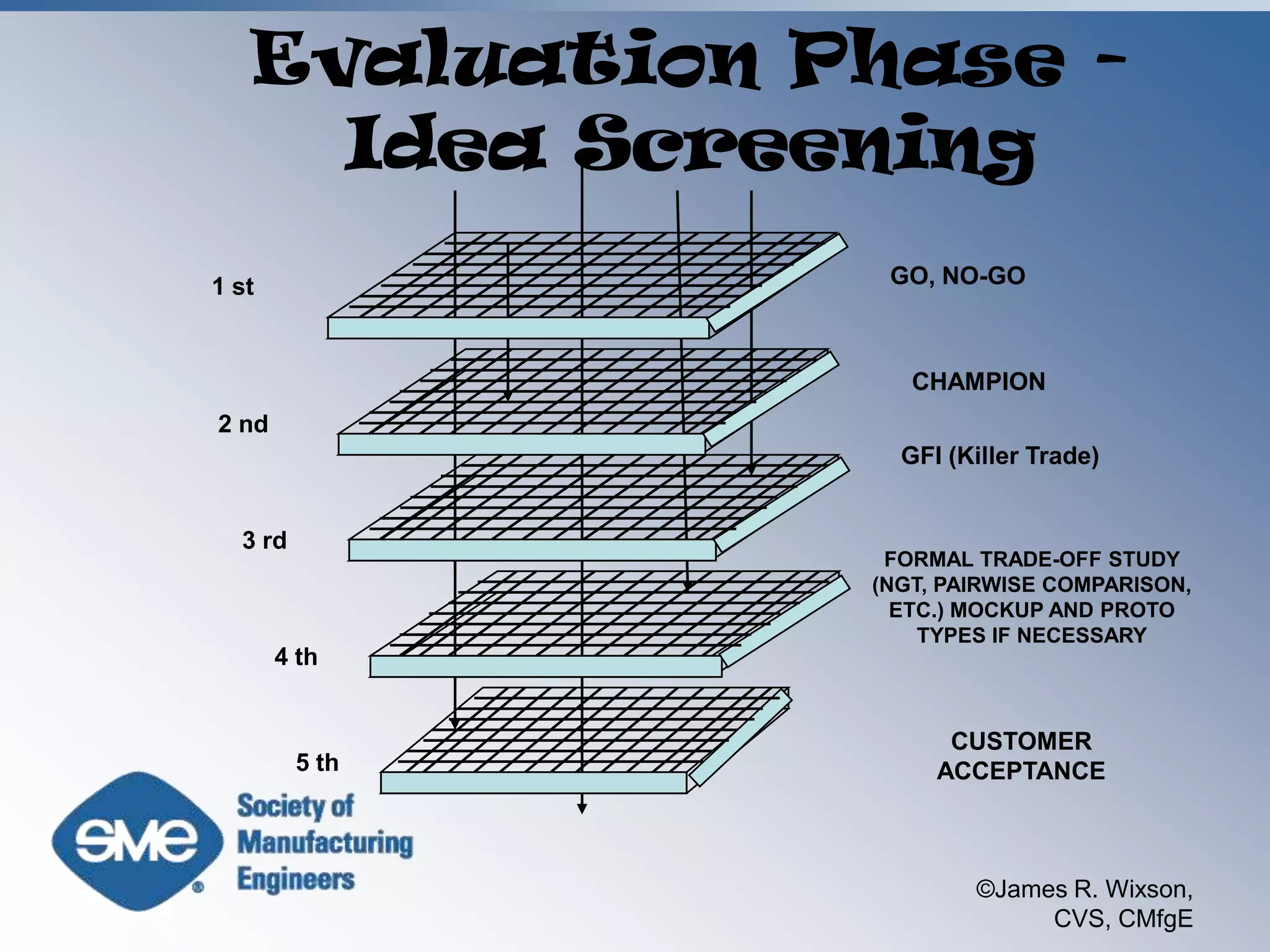
©James R. Wixson, CVS, CMfgE1 st2 nd3 rd4 th5 thEvaluation Phase - Idea ScreeningGO, NO-GOCHAMPIONGFI (Killer Trade)FORMAL TRADE-OFF STUDY (NGT, PAIRWISE COMPARISON, ETC.) MOCKUP AND PROTO TYPES IF NECESSARYCUSTOMER ACCEPTANCE
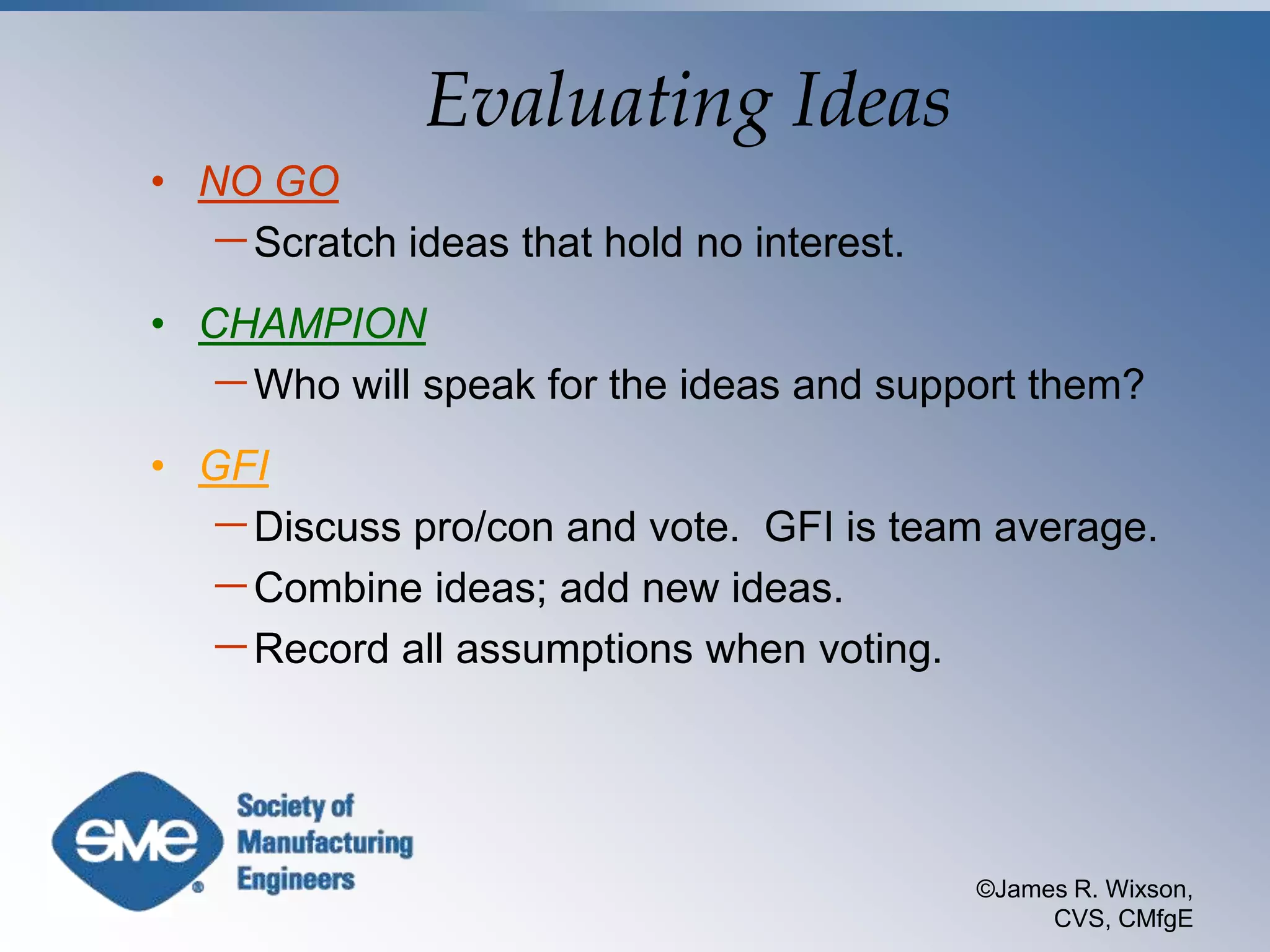
©James R. Wixson, CVS, CMfgEEvaluating IdeasNO GOScratch ideas that hold no interest.CHAMPIONWho will speak for the ideas and support them?GFIDiscuss pro/con and vote.  GFI is team average.
Combine ideas; add new ideas.
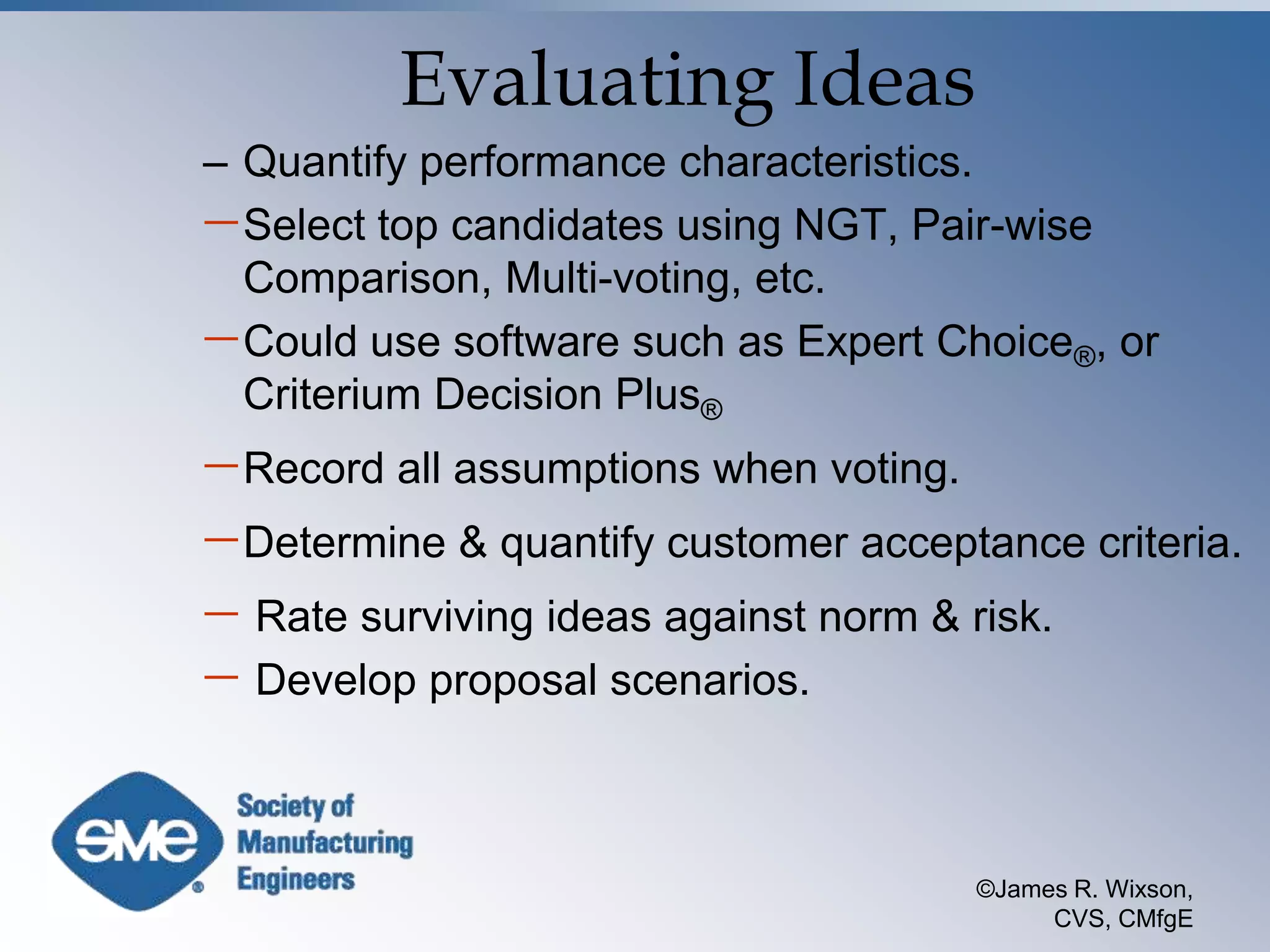
Record all assumptions when voting.©James R. Wixson, CVS, CMfgEEvaluating IdeasQuantify performance characteristics.Select top candidates using NGT, Pair-wise Comparison, Multi-voting, etc.
Could use software such as Expert Choice®, or Criterium Decision Plus®
Record all assumptions when voting.
Determine & quantify customer acceptance criteria.
 Rate surviving ideas against norm & risk.
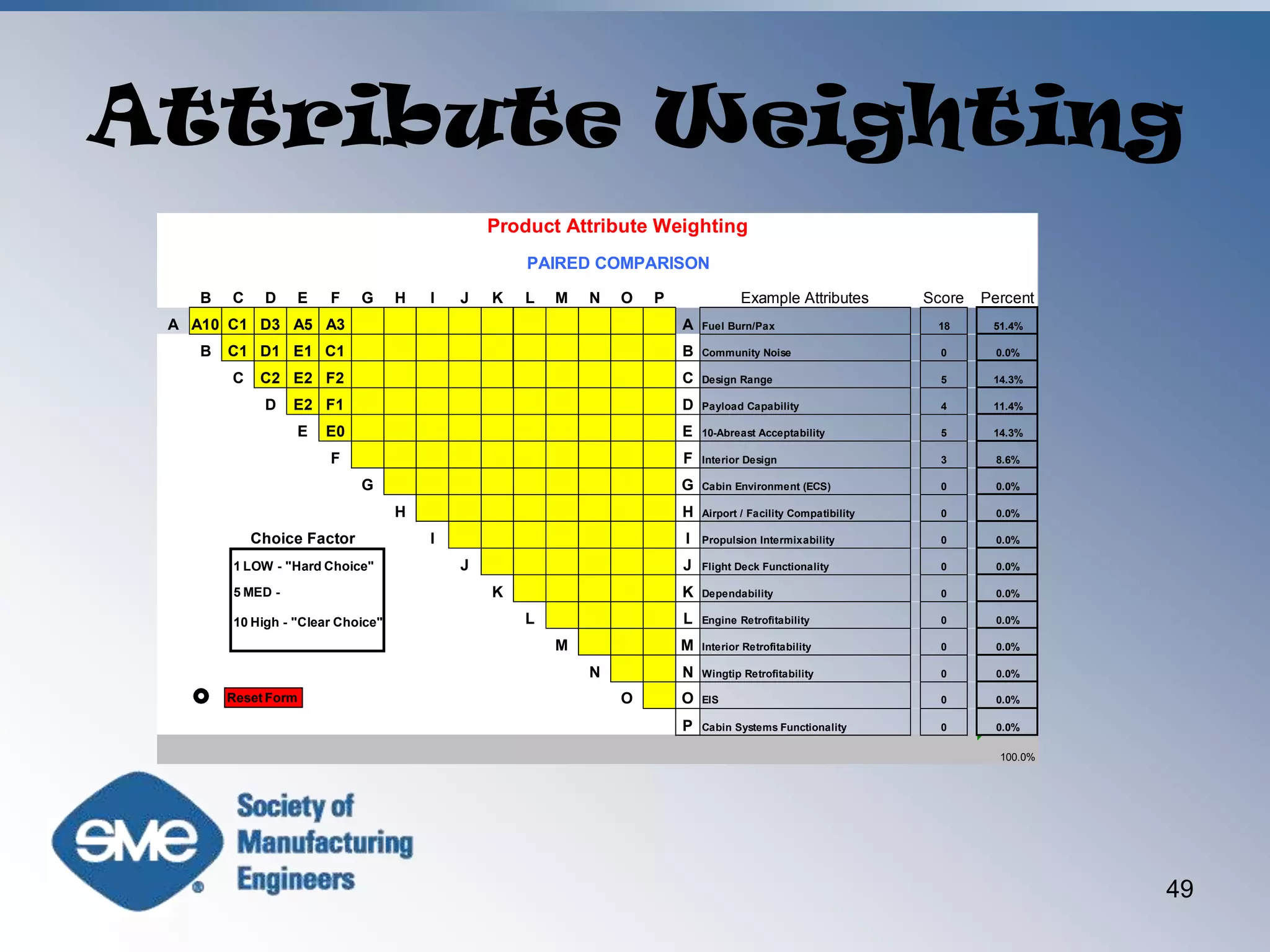
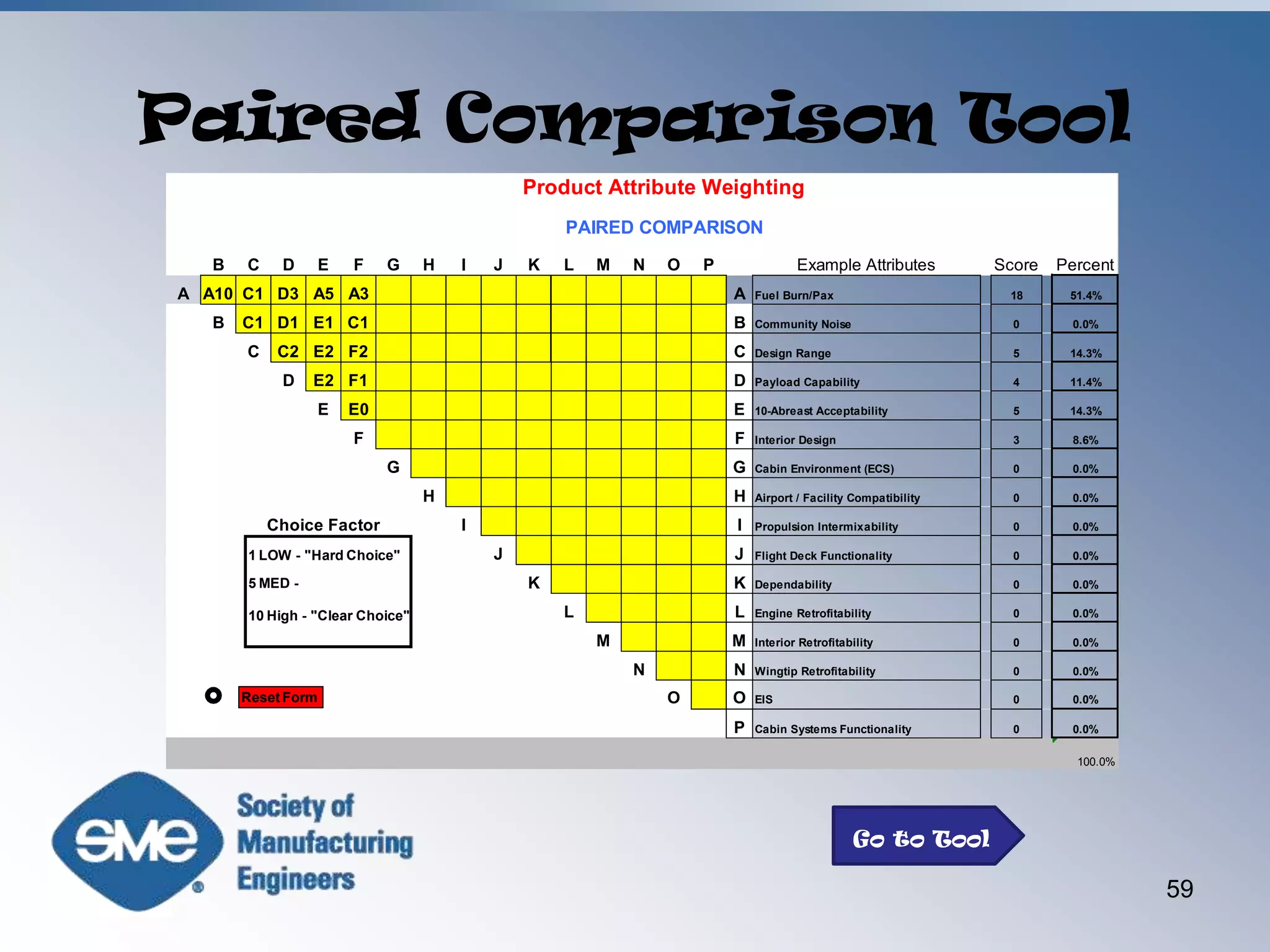
 Develop proposal scenarios.Attribute Weighting49
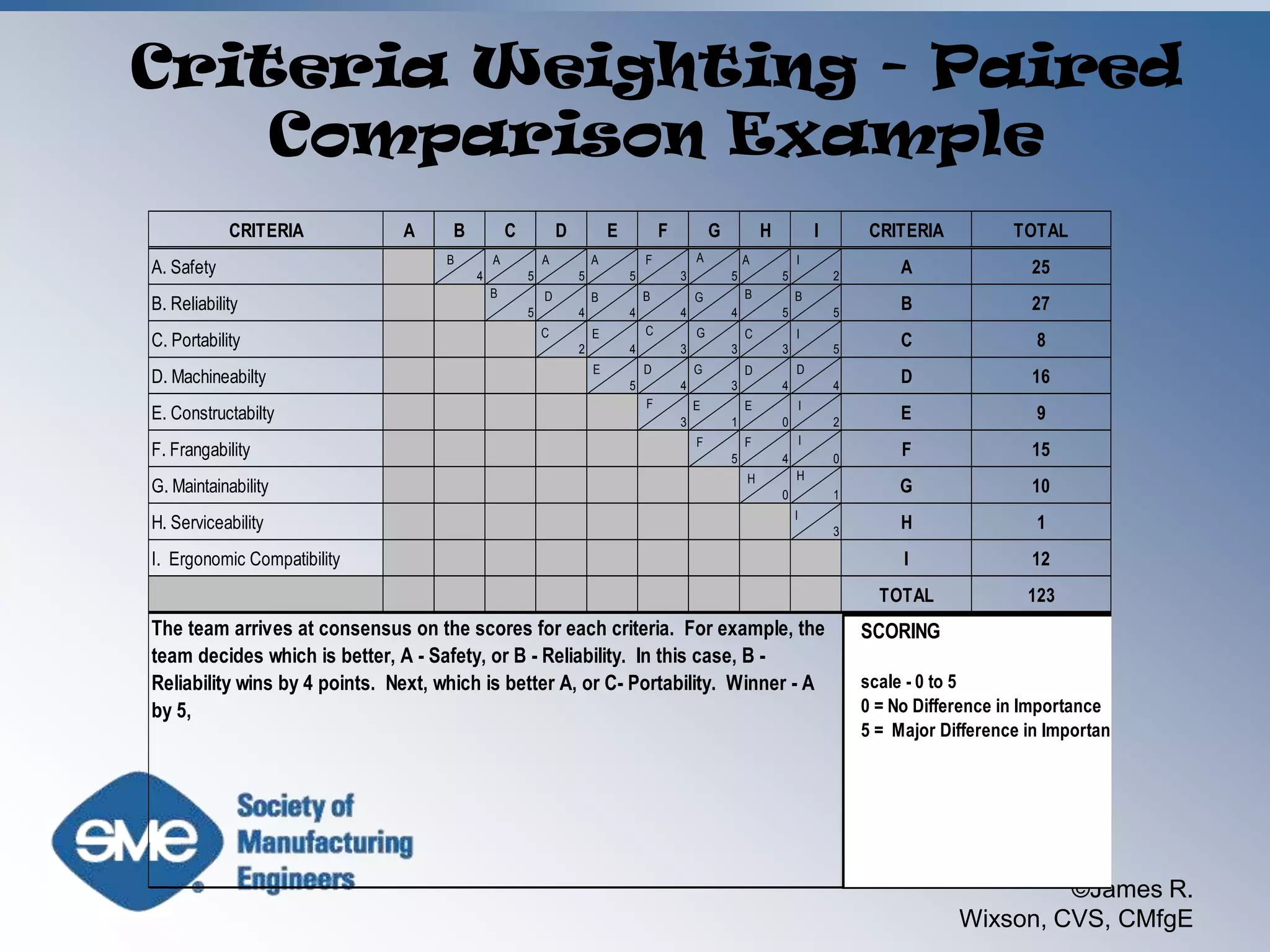
©James R. Wixson, CVS, CMfgECriteria Weighting - Paired Comparison Example
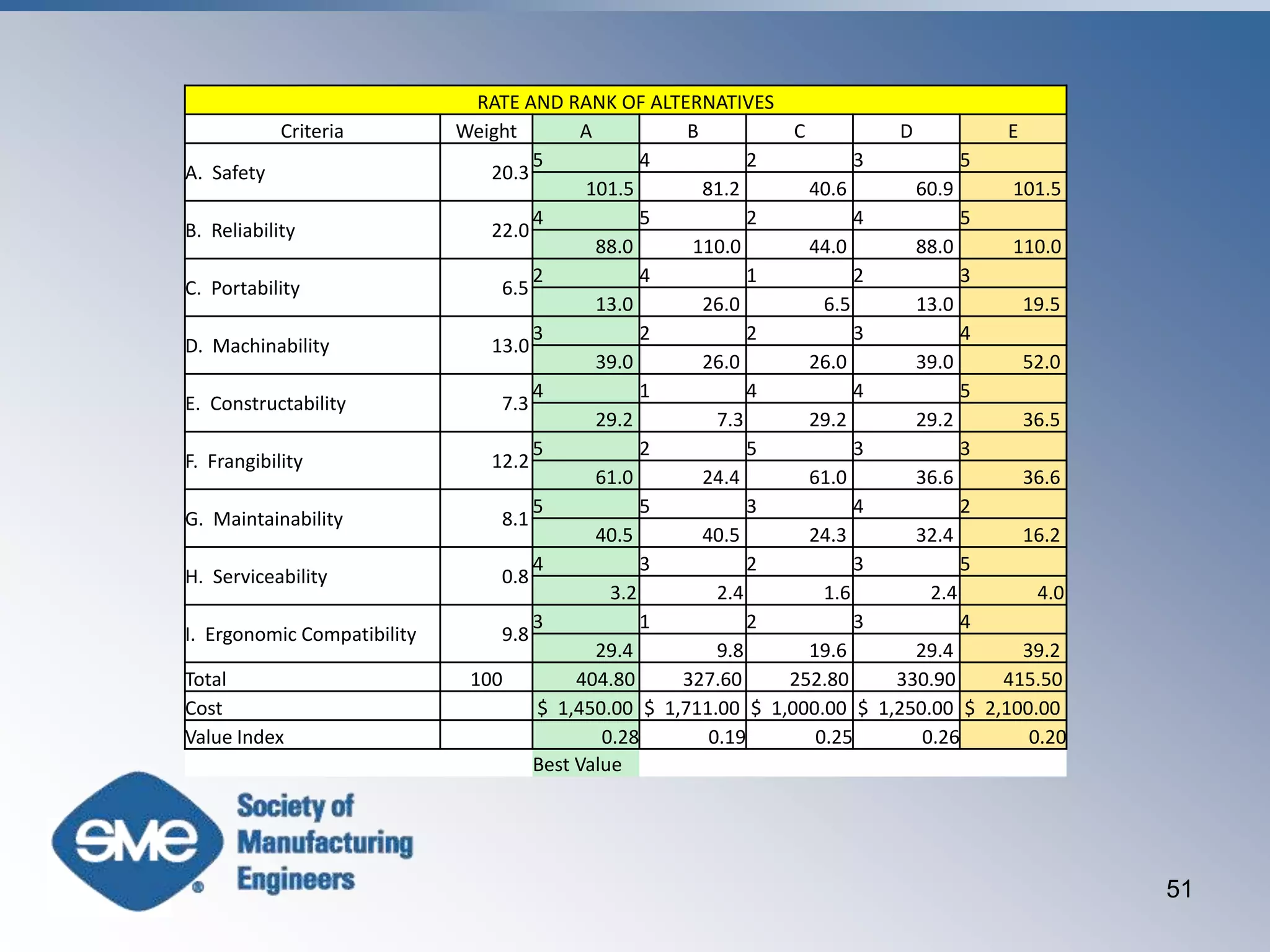
51
Problem Solving Templates52

Problem Solving J Wixson

  • 1.
    Productive Problem Solving JamesWixson, CVS, CMfgEPresident, Wixson Value Associates, Inc.(208) 520-2296jrwixson@wvasolutions.comhttp://wvasolutions.com1
  • 2.
    What you willLearnWhat is productive problem solving?What are some of the impediments to successful problem solving?What essential things are needed for productive problem solving?What are some of the methods of productive problem solving?What works best?2
  • 3.
    PRODUCTIVE PROBLEM SOLVINGIt’sthe Problem, NOT the process that’s King
  • 4.
  • 5.
    Apollo XIII5IntroHouston, wehave a problem Part 1Houston we have a problem Part 2Houston, we have a problem Part 3Getting Them BackCO2 Filter ProblemSuccess!!!!
  • 6.
    15 Minute Apollo13 Problem Solving ExerciseBreak into teams of 3-4 peopleList your observations of what you saw. (10 min)How would your team go about solving the problems presented? (10 min)Pick a spokesperson.Present your findings to the group.(5 min)6
  • 7.
    Some Famous Quotesabout ProblemsHenry FordThere are no big problems, there are just a lot of little problems. Theodore RubinThe problem is not that there are problems. The problem is expecting otherwise and thinking that having problems is a problem. Albert EinsteinIt's not that I'm so smart, it's just that I stay with problems longer. Billy GrahamHot heads and cold hearts never solved anything. Denis WaitleyDon't dwell on what went wrong. Instead, focus on what to do next. Spend your energies on moving forward toward finding the answer. Unknown AuthorWorry is like a rocking chair - it gives you something to do but won't get you anywhere. John DeweyA problem well stated is a problem half solved. Norman Vincent PealeHow you think about a problem is more important than the problem itself - so always think positively. 7
  • 8.
    John Dewey oncesaid, "A problem well-stated is half solved.“8Problem Solving
  • 9.
    “A good problemstatement often includes: (a) what is known, (b) what is unknown, and (c) what is sought.” - Edward Hodnett9Problem Solving
  • 10.
    ©James R. Wixson,CVS, CMfgEPROBLEM SOLVINGAn organized effort for developingUNIQUE and RELEVANTresolutions for opportunitiesorundesirable situations
  • 11.
    Productive Problem SolvingProductiveProblem Solving (PPS) is usually applied to larger problems involving significant resources, but, can be tailored to fit smaller problems.PPS follows a structured methodology that leads to root cause solutions and corrective actions.PPS works best with an interdisciplinary team lead by a skilled facilitator.PPS minimizes the impediments to problem solving.PPS can be used in Kaisen workshops to solve difficult problems with the process. 11
  • 12.
    Impediments to ProblemSolvingPoor communicationPoor understanding of the problem“Jump to solution” without analyzing the problemFear of reprisalA "Yes, but'' attitudeIntellectual defensiveness closed to new ideasFear of being perceived as being incompetentFear of one's ideas being unacceptedInability to be objective about the problem12
  • 13.
    Impediments to ProblemSolvingInability to be creative, imaginative or "off the wall'' in developing alternative solutionsBeing inflexible or too serious to have fun while problem solvingBeing so chronically immersed or emotionally "stuck'' in problems that no feelings or emotions can be elicitedResentment about having to solve the problem; blaming others for causing the problem; no desire to own up to the problem yourselfBelieving that problems are the concerns of others, not me; therefore, why waste my time in trying to solving them13
  • 14.
    Essential things neededfor productive problem solvingA clear description of the problem.A description of the limiting (or negative) factors involved in the problem.A description of the constructive (or positive) factors involved in the problem.Sufficient data regarding the scope, location, size and seriousness of the problem.A clear delineation of the "ownership'' of the problem. Whose problem is it: mine, yours, the other guy's, my boss', my spouse's, my child's, my parents', my teacher's?A clear description of the scope of the problem: How extensive a problem is it? How long has this problem existed? How many people are affected? What else is affected by this problem?A clear description of the consequences if the problem were not solved: What is the possible impact on my family, job, marriage, school performance, life in this community, company etc., if this problem isn't solved? What is the worst possible thing that could happen if this problem isn't solved?14
  • 15.
    Essential things neededfor productive problem solvingA list of brainstormed solutions to the problem, with each alternative analyzed as to its reality, its benefits and the consequences for following each one.A system of ranking each solution to finalize the decision-making process. A rating system for analyzing each solution is developed, e.g., 100 percent chance of success, 75 percent chance of success, 50 percent chance of success.Determination to follow through on the solution decided upon jointly. This involves full motivation to "take the risk'' and pursue the solution to its fullestManagement support and buy-inEmpowerment to solve problems and confidence in the solutionAdequate allocation of resources (time and people)15
  • 16.
    Nine Key Stepsto Productive Problem SolvingUnderstand the problem environmentDefine the problemIdentify what’s requiredIdentify what’s available (resources)Isolate functions/activities needing improvementIdentify success criteriaGenerate alternative solutions given the resources at hand, and what resources may be needed.Analyze risks, hidden assumptions, and unexpected impactsSelect the best solution16
  • 17.
    Tips for productiveproblem solvingFive-dimensional thinking or looking at a problem from five different dimensions:1. What is the size or extent of the problem?2. How would really be affected if the problem was left unattended or unsolved?3. How are you functioning in handling the problem-solving process?4. What do your five senses tell about the problem, i.e., what you see, hear, touch, smell and taste?5. What does the world of reality look like from within the problem?17
  • 18.
    Some Problem SolvingMethodologiesDrill Down methodStraw Man Approach (Trial and Error)Heuristic method (Rules of Thumb)5 WhysKepner-Tregoe Situation Analysis, Problem and Decision Making methods (Is, Is-Not method)Deming's PDCA, or PDSA methodSix Sigma’s DMAIC methodValue Analysis/Value Engineering18
  • 19.
    Don’t forget: TheScientific MethodMake ObservationsCollect data Define problem Hypothesize Test with experimentAnalyze Results and Draw ConclusionApply solutions 19
  • 20.
    Brainstorming TipsExpress allideas.Deem no idea too wild to be considered.Quantity is important; every idea that comes to mind should be included.Getting together with others to brainstorm is desirable.Criticism or negative evaluation regarding any idea is forbidden until brainstorming is completed.20
  • 21.
    Productive Problem SolvingMethodDefine the problemGather Information related to the problemMap the process using flow chart, VSM or FAST ModelIdentify what elements contribute to the problemAssign scores to each element that might be contributing to the problemBrainstorm potential causes to the high scoring elements.Score potential causesFor high scoring potential causes, breakdown further using the 5 why techniqueValidate most likely root causesDevelop solutions to resolve the root causes21
  • 22.
    Work to SolveRoot Causes22
  • 23.
    Use FAST toStudy the System23
  • 24.
    The Technical FASTModelHOWWHYINDEPENDENT FUNCTION (SUPPORTING)DEPENDENT FUNCTIONOBJECTIVES OR SPECIFICATIONSMINOR CRITICAL PATHINDEPENDENT FUNCTIONINPUTOUTPUT(concept)OBJECTIVE OR HIGHER ORDER FUNCTIONLOWEST ORDER FUNCTIONBASIC FUNCTIONDEPENDENT FUNCTION(AND)ACTIVITY(concept)ACTIVITYWHENMAJOR CRITICAL PATHSCOPE OF THE PROBLEM UNDER STUDYLOWER ORDER FUNCTIONSHIGHER ORDER FUNCTIONS24
  • 25.
    Overhead Projector FASTModelHOWWHY(concept)WHEN(concept)OBJECTIVES OR SPECIFICATIONSFACILITATE PORTABILITYALLOW SAFETYOUTPUTINPUTCONVEY InformationPROJECT IMAGEGENERATE LIGHTRECEIVE CURRENTTRANSMIT CURRENTCONVERT ENERGYGENERATE HEATFOCUS IMAGEDISSIPATE HEATSUPPORT IMAGEGENERATE NOISEAMPLIFY IMAGE25
  • 26.
    Example: Eat CookieFAST Model26WHY?HOW?Drink MilkSatisfy HungerEat CookieMake CookieBuy IngredientsChoose RecipeBuy CookbookMix DoughDrive to MarketWHENWHENRoll DoughSelect IngredientsMark BPurchase IngredientsBake CookieDrive Home
  • 27.
    Determine DefectsHOWWHYEstablish ContainerIntegrityFollow Inspection PlanWriteInspectionPlanDetermine ConditionInspect ContainerExamine(Visually)ContainerEstablishIntegrityCriteriaVerifyInspectionPlanIdentify Potential ProblemsDetermine DispositionWHENDetermineContentsDefineContainerIntegrityDevelopInspectionPlanIdentifyDefectsKnowProblemContentsVerifyContainerID.ValidateInspectionPlanOUTPUTINPUTFunction Analysis Systems Technique (FAST)27
  • 28.
    Identifying Areas forImprovementIdentify key functions/activities where performance may be undesirable
  • 29.
    For the functionswhere performance is undesirable, brainstorm likely causes of failure.
  • 30.
    Next, rate thesecauses on a scale of 1-10 as to which are the most likely causes of the problem(s).28
  • 31.
    Identifying Most LikelyCauses of The Problem(s)After rating the likely causes of the problem(s), choose a cut-off point from which the most likely causes of failure will be addressed first (usually about 6 on a 10pt scale depending on the number of causes).
  • 32.
    For the mostlikely causes of the problem(s), brainstorm contributing factors to the causes of these problem(s).29
  • 33.
  • 34.
    Identifying Most LikelyCauses of Failure31
  • 35.
    Identifying AlternativesGiven themost likely causes and their contributing factors, you are ready to start identifying potential alternatives for design, or improvements to the system.
  • 36.
    For each keyfunction/activity that has been identified as not being performed, or performance is poor, brainstorm potential ways to perform, or improve the performance of these functions/activities.
  • 37.
    The identification ofmost likely causes of the problems with those functions/activities focuses the teams attention on the most needed improvements which facilitates brainstorming of superior ideas for improvement, or design of the new system.32
  • 38.
    ©James R. Wixson,CVS, CMfgECreativity
  • 39.
    ©James R. Wixson,CVS, CMfgEIDEA vs. SOLUTIONA solution requires justification & validation, and idea needs no justification.A solution is an end point, an idea is just the beginning.A solution is solid and self supporting, an idea is tender and must be built upon.DON’T KILL IDEAS WITHROADBLOCKS!!
  • 40.
    ©James R. Wixson,CVS, CMfgEPROBLEM SENSITIVITY(CHARACTERISTICS)Awareness of the problemConstructive discontentNeed to discover the problemResolving “What’s wrong with…”Adopting a questioning attitude
  • 41.
    36IMAGINATIONImagination is moreimportant than knowledge, for knowledge is limited, while imagination embraces the entire world.Albert Einstein
  • 42.
    37Thought for theday:When you always do what you have always done - you always get what you have always gotten.Socrates
  • 43.
    38IDEA vs. SOLUTIONAsolution requires justification & validation, and idea needs no justification.
  • 44.
    A solution isan end point, an idea is just the beginning.
  • 45.
    A solution issolid and self supporting, an idea is tender and must be built upon.DON’T KILL IDEAS WITHROADBLOCKS!!
  • 46.
    39What is thenext symbol in sequence?
  • 47.
    40What is thenext symbol in sequence?
  • 48.
  • 49.
  • 50.
  • 51.
  • 52.
  • 53.
  • 54.
  • 55.
  • 56.
    For more informationon creativity, click here.©James R. Wixson, CVS, CMfgEWhat do you see?
  • 57.
    Rules for BrainstormingWhenbrainstorming solutions to the problem, follow these rules:Express all ideas.Deem no idea too wild to be considered.Quantity is important; every idea that comes to mind should be included.Getting together with others to brainstorm is desirable.Criticism or negative evaluation regarding any idea is forbidden until brainstorming is completed.Record all ideas presentedTime to let ideas “incubate” should be allowed.Select an appropriate meeting place44
  • 58.
    ©James R. Wixson,CVS, CMfgEBrainstorming ConceptBest Solutions - combination of ideas100 +75 - 80Off - the - wall ideas15 - 20Traditional AnswersQUANTITYTIME
  • 59.
    ©James R. Wixson,CVS, CMfgE1 st2 nd3 rd4 th5 thEvaluation Phase - Idea ScreeningGO, NO-GOCHAMPIONGFI (Killer Trade)FORMAL TRADE-OFF STUDY (NGT, PAIRWISE COMPARISON, ETC.) MOCKUP AND PROTO TYPES IF NECESSARYCUSTOMER ACCEPTANCE
  • 60.
    ©James R. Wixson,CVS, CMfgEEvaluating IdeasNO GOScratch ideas that hold no interest.CHAMPIONWho will speak for the ideas and support them?GFIDiscuss pro/con and vote. GFI is team average.
  • 61.
  • 62.
    Record all assumptionswhen voting.©James R. Wixson, CVS, CMfgEEvaluating IdeasQuantify performance characteristics.Select top candidates using NGT, Pair-wise Comparison, Multi-voting, etc.
  • 63.
    Could use softwaresuch as Expert Choice®, or Criterium Decision Plus®
  • 64.
  • 65.
    Determine & quantifycustomer acceptance criteria.
  • 66.
    Rate survivingideas against norm & risk.
  • 67.
    Develop proposalscenarios.Attribute Weighting49
  • 68.
    ©James R. Wixson,CVS, CMfgECriteria Weighting - Paired Comparison Example
  • 69.
  • 70.
  • 71.
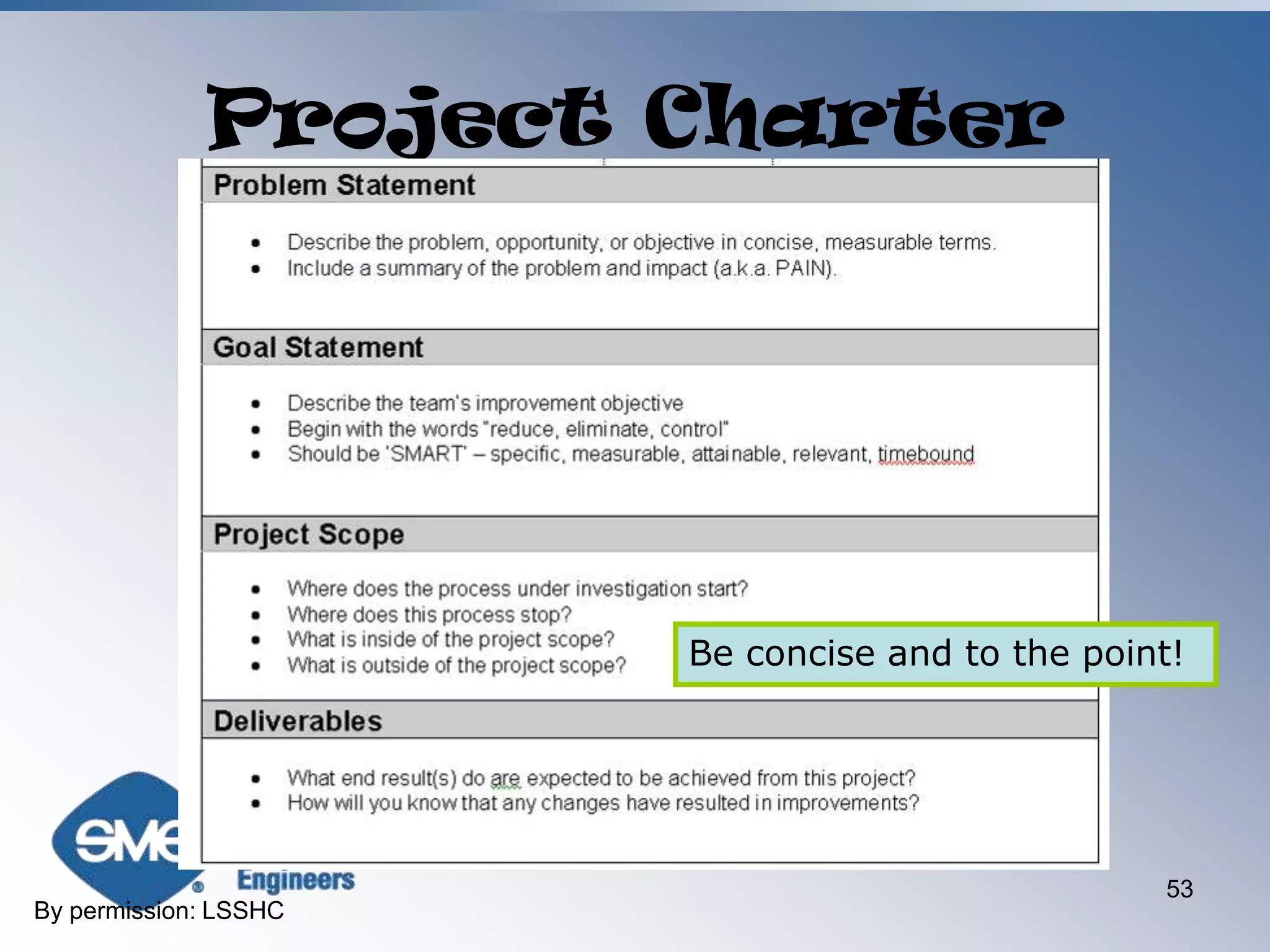
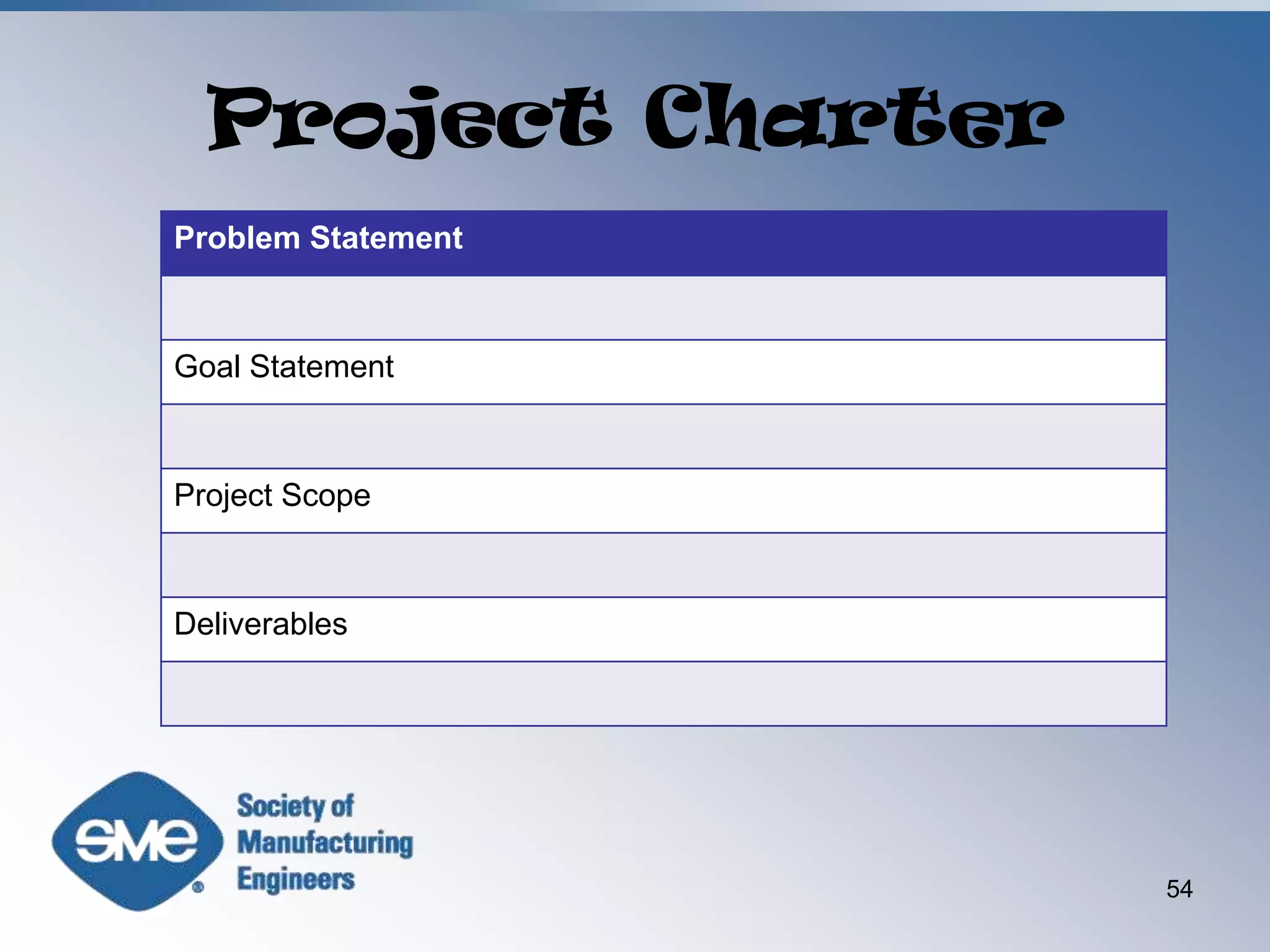
    Project CharterBe conciseand to the point! By permission: LSSHC53
  • 72.
  • 73.
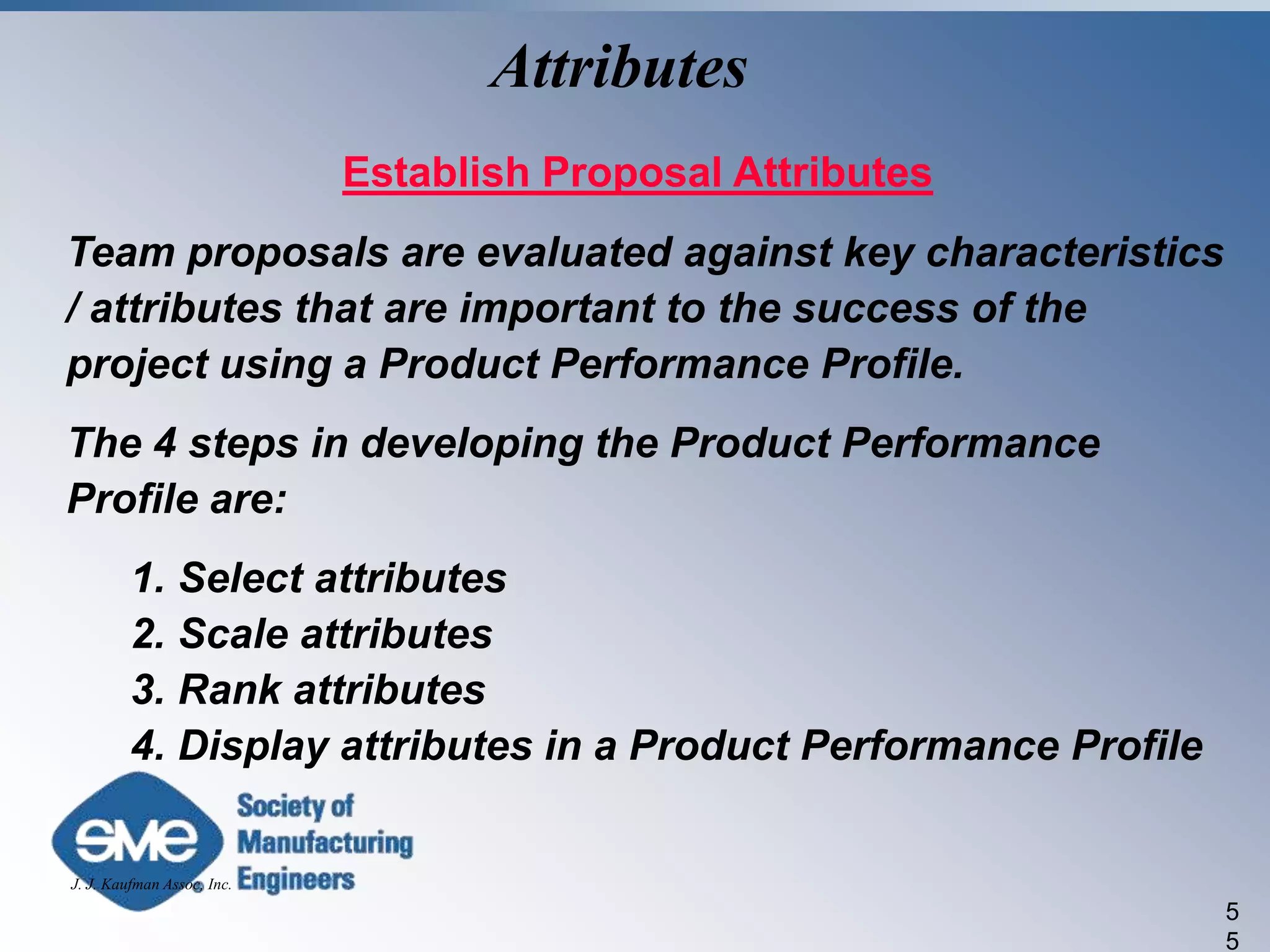
    AttributesEstablish Proposal AttributesTeamproposals are evaluated against key characteristics / attributes that are important to the success of the project using a Product Performance Profile. The 4 steps in developing the Product Performance Profile are:1. Select attributes2. Scale attributes3. Rank attributes4. Display attributes in a Product Performance ProfileJ. J. Kaufman Assoc, Inc.55
  • 74.
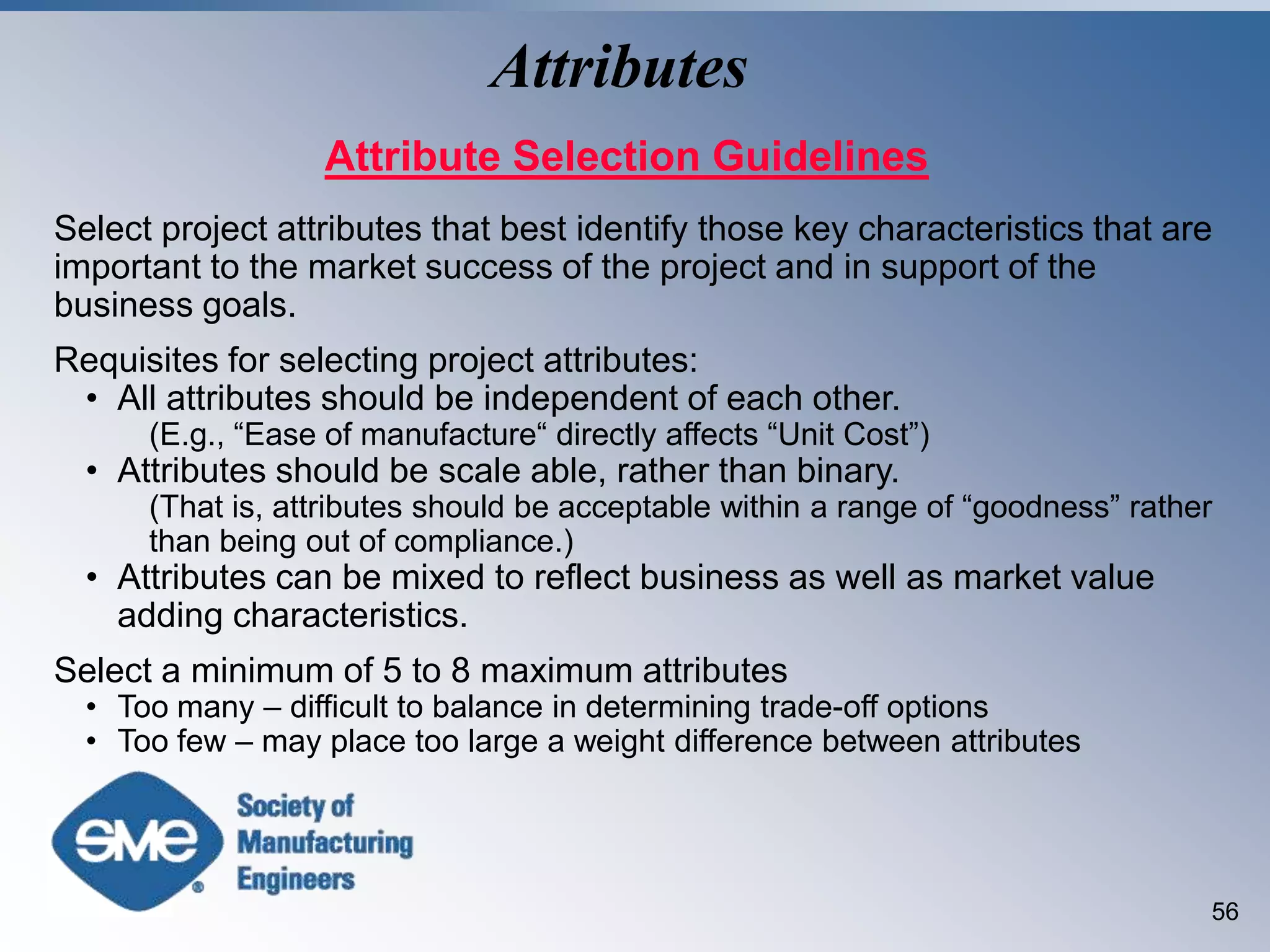
    AttributesAttribute Selection GuidelinesSelectproject attributes that best identify those key characteristics that are important to the market success of the project and in support of the business goals.Requisites for selecting project attributes:All attributes should be independent of each other. (E.g., “Ease of manufacture“ directly affects “Unit Cost”)Attributes should be scale able, rather than binary.(That is, attributes should be acceptable within a range of “goodness” rather than being out of compliance.)Attributes can be mixed to reflect business as well as market value adding characteristics.Select a minimum of 5 to 8 maximum attributesToo many – difficult to balance in determining trade-off options
  • 75.
    Too few –may place too large a weight difference between attributes56
  • 76.
  • 77.
    Attribute Rating GuidelinesA“Paired Comparison” process is used to determine the relative importance of the selected attributes and assign a percentage (weight) value to the attributes.Attributes are evaluated in pairs asking “Given a snapshot of the current condition of the project, which is more important of the two attributes being evaluated?” Or, “If you are given a sum of money to invest in improving one of the attributes which one would you use the funds to improve?”Determine the degree of importance by asking “Is the degree of importance separating these attributes low, medium or high?”When the weighting is calculated, validate the ranking by ask “Does the ranking seem reasonable?” If not, reconcile concerns.J. J. Kaufman Assoc, Inc.58
  • 78.
  • 79.
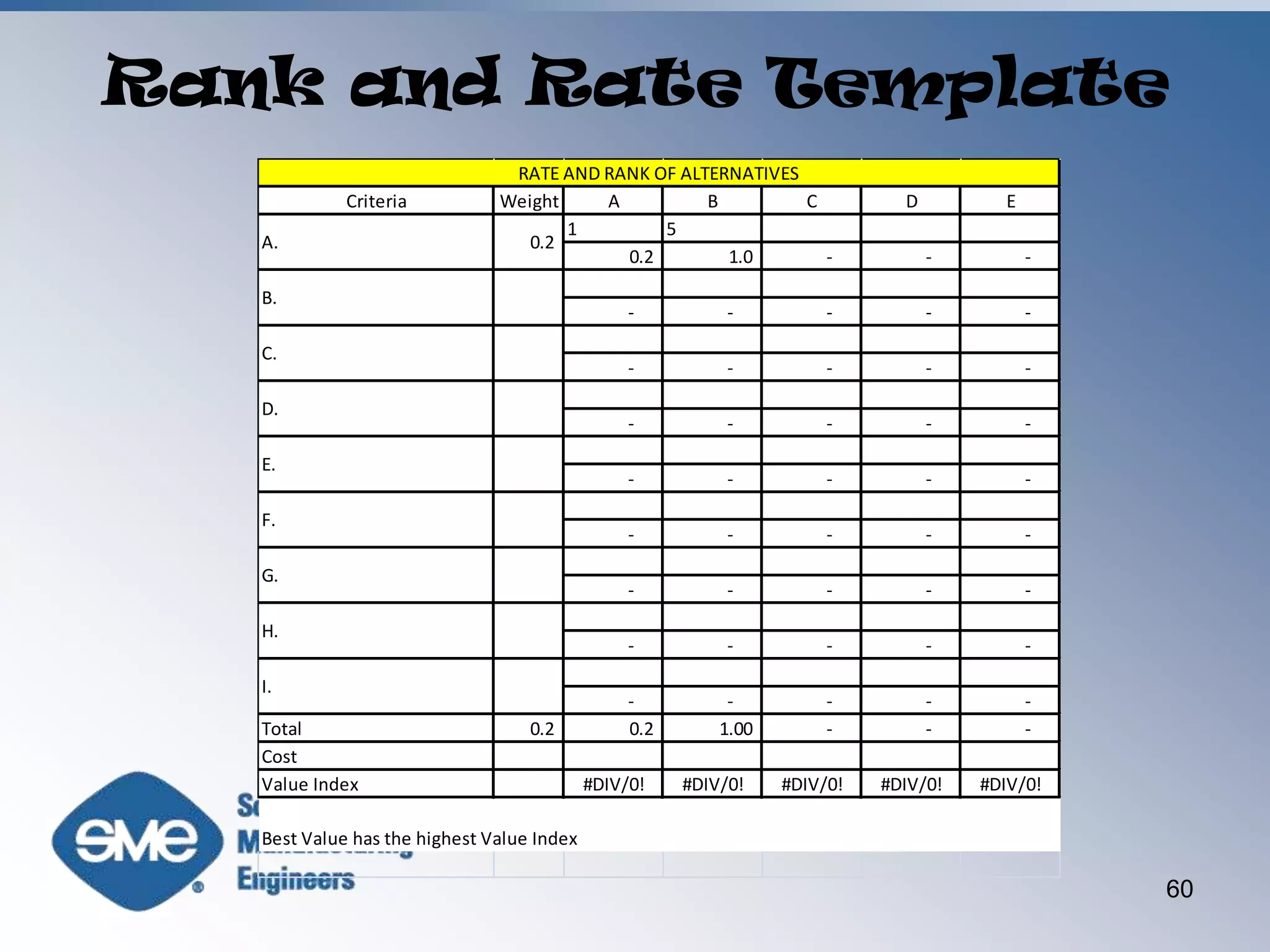
    Rank and RateTemplate60
  • 80.
  • 81.
  • 82.
  • 83.
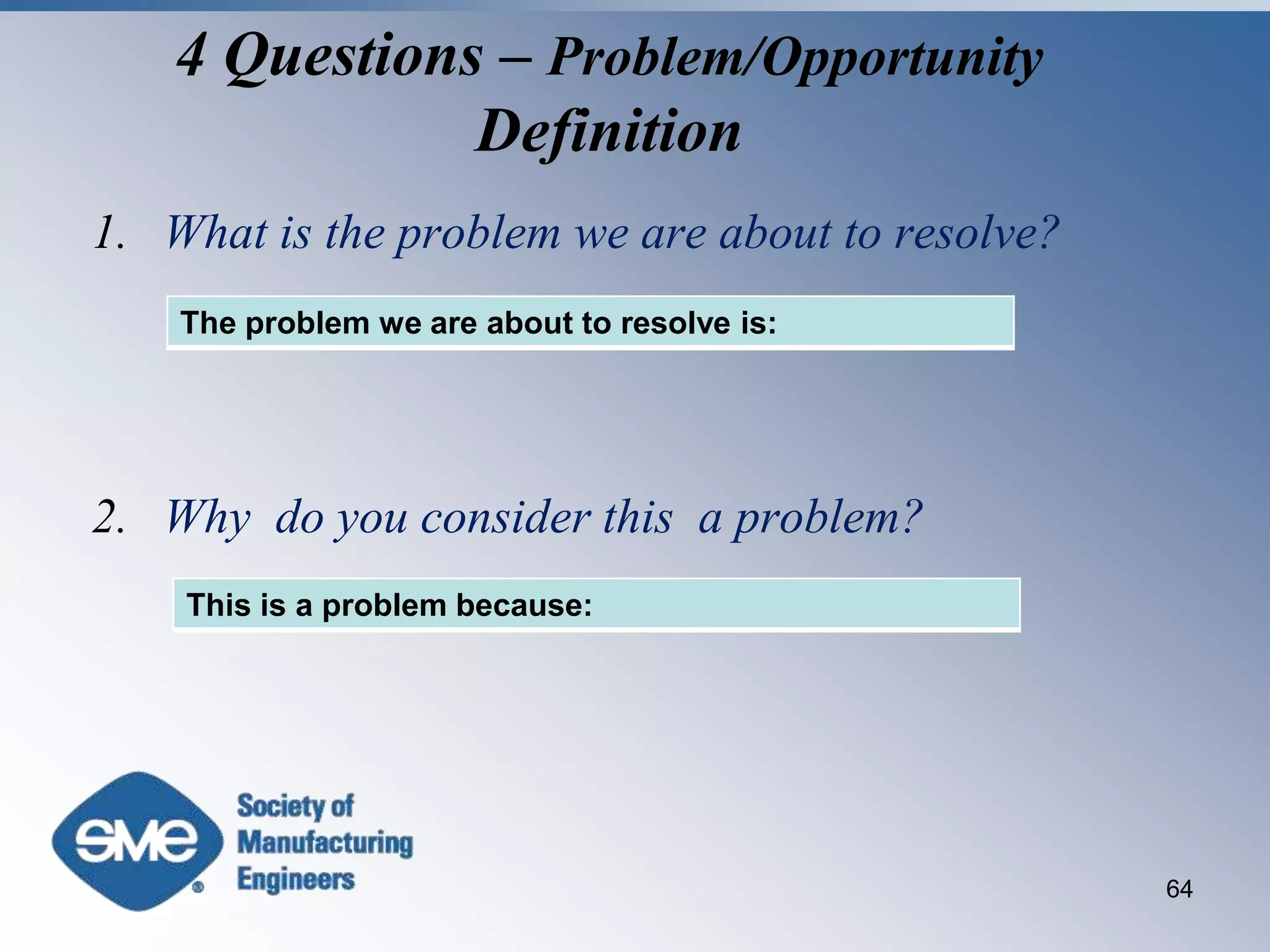
    4 Questions –Problem/Opportunity DefinitionWhat is the problem we are about to resolve?Why do you consider this a problem?64
  • 84.
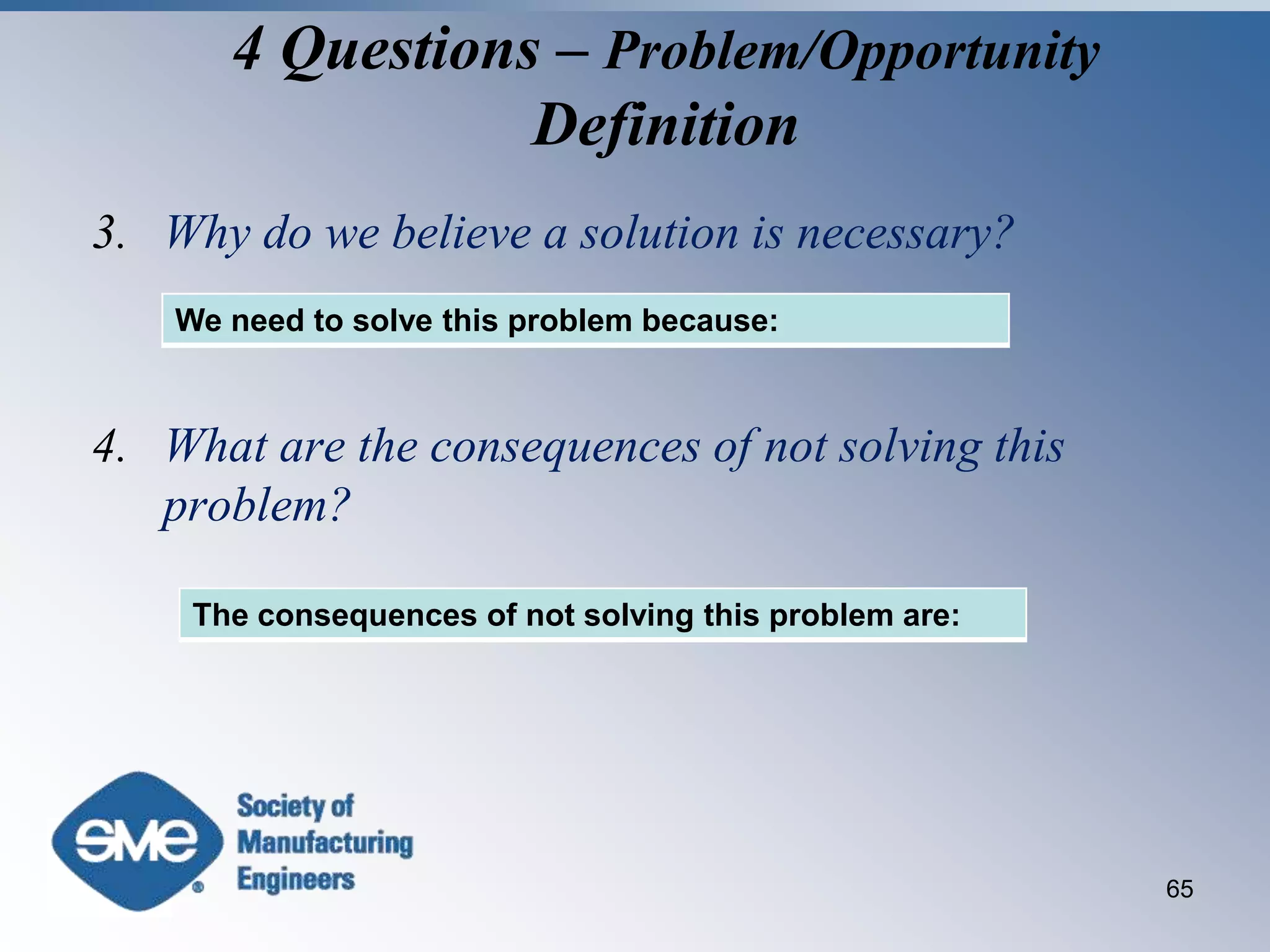
    4 Questions –Problem/Opportunity DefinitionWhy do we believe a solution is necessary? What are the consequences of not solving this problem?65
  • 85.
  • 86.
  • 87.
    Identifying Most LikelyCauses of Failure (Example)68
  • 88.
  • 89.
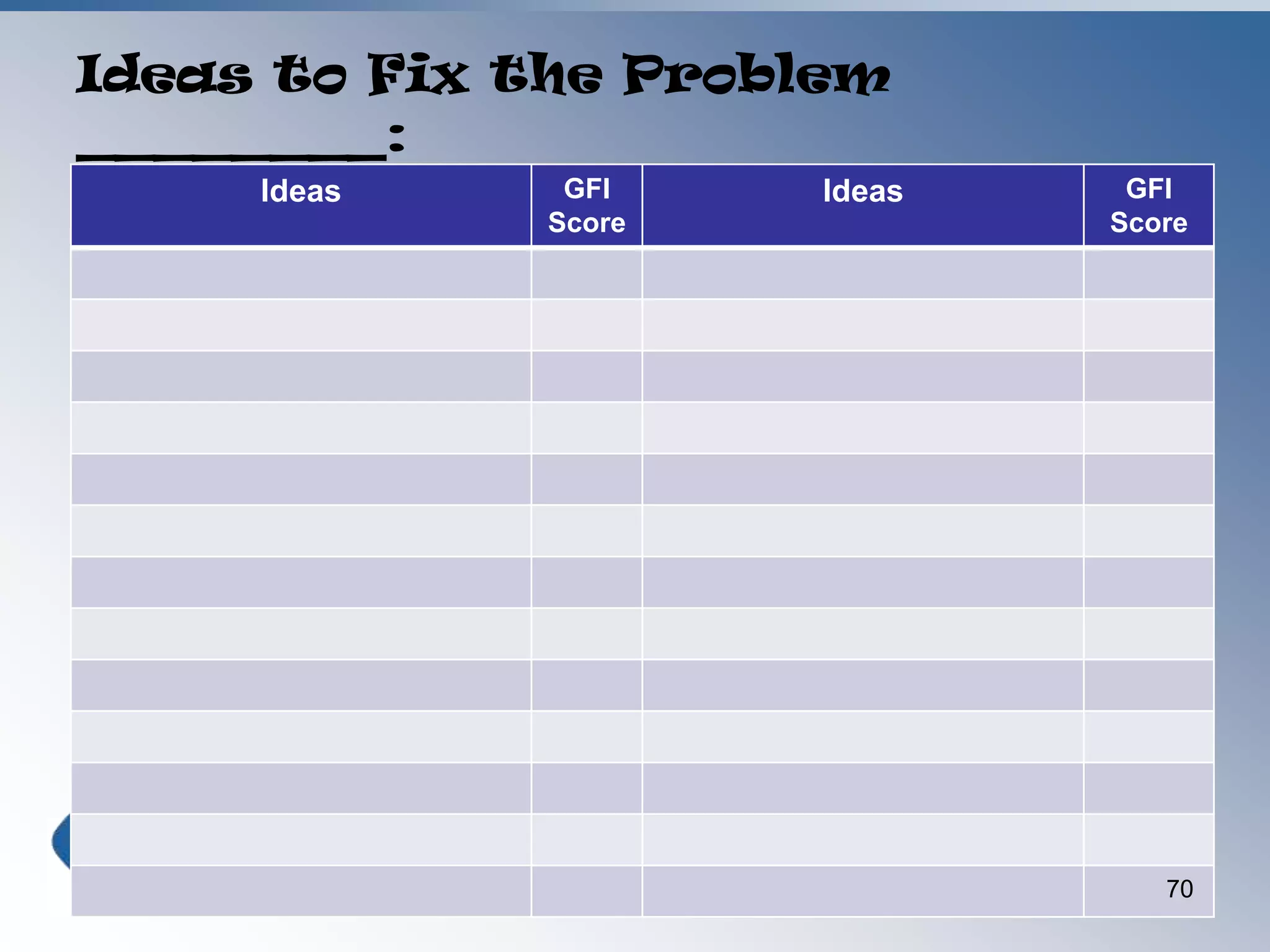
    Ideas to Fixthe Problem ________:70