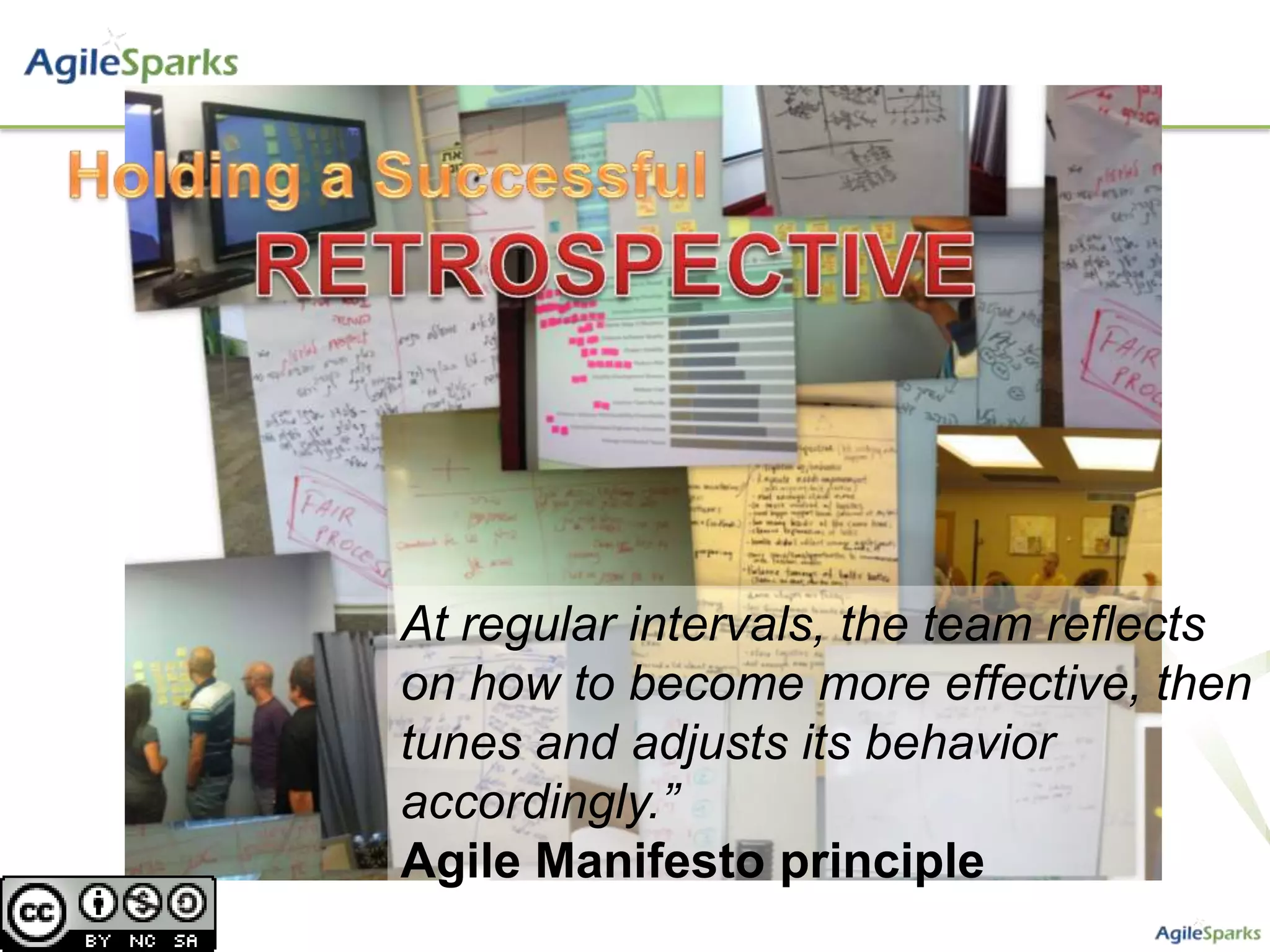
At regular intervals, the team reflects
on how to become more effective, then
tunes and adjusts its behavior
accordingly.”
Agile Manifesto principle
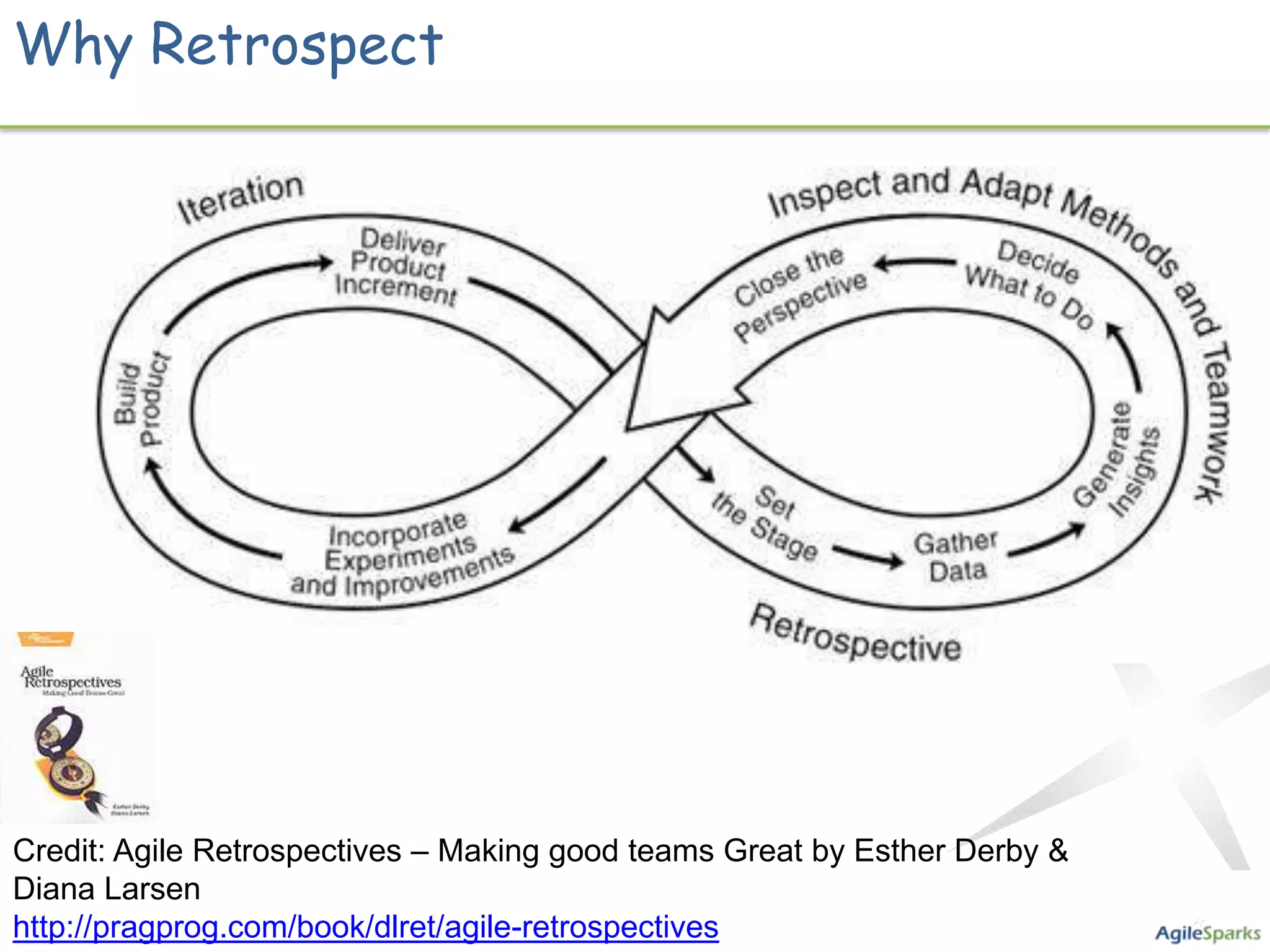
Why Retrospect


Credit: Agile Retrospectives – Making good teams Great by Esther Derby &
Diana Larsen
http://pragprog.com/book/dlret/agile-retrospectives
Why Retrospect


    Learning
      Reflection is a key step in learning from
      experience
    Ownership
      Gives a team a way to adapt process to
      their context
    Communication
      Each member of the project team has
      different experience and when we share
      these perspectives we understand each
      other better
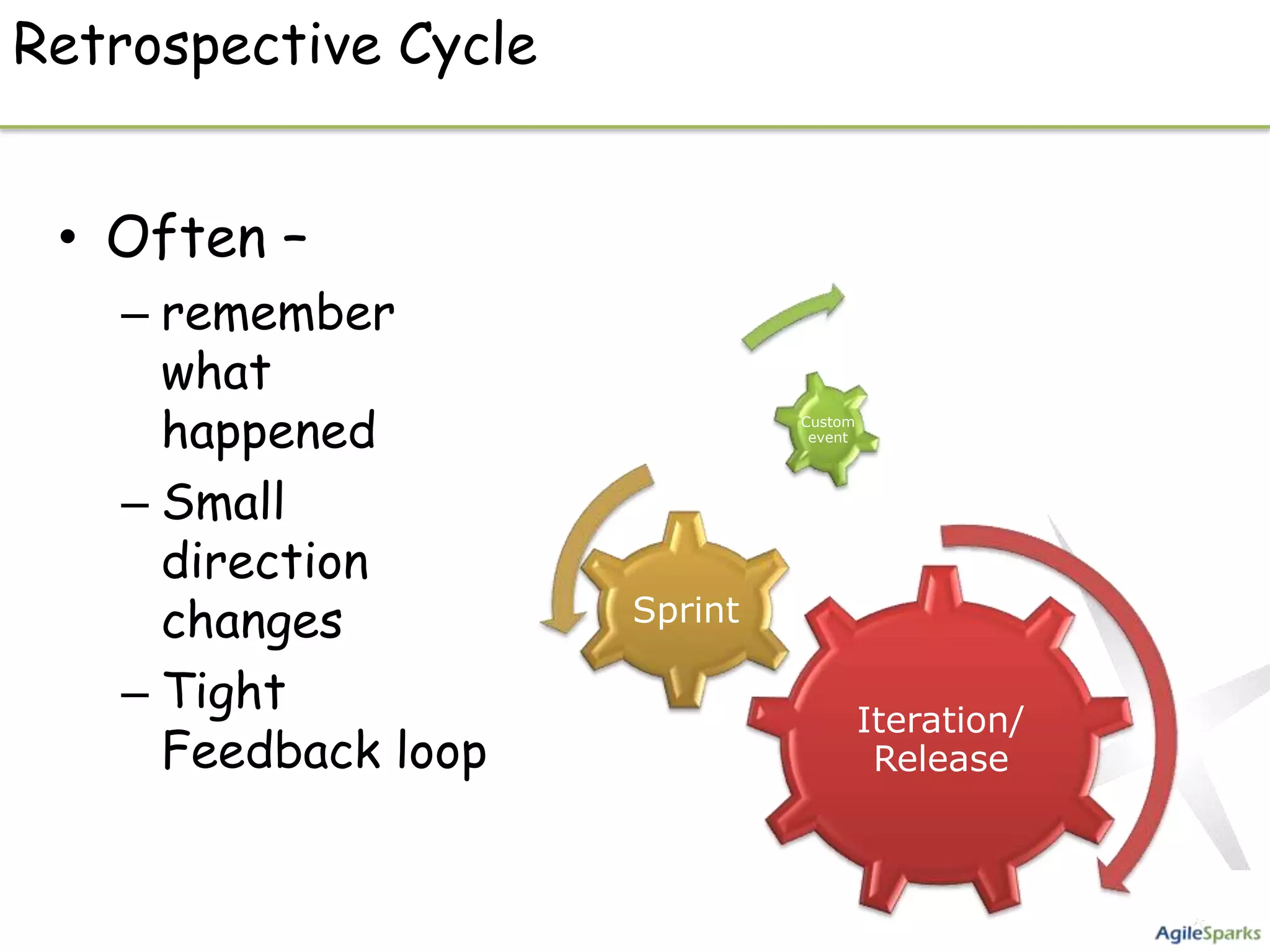
Retrospective Cycle


 • Often –
   – remember
     what
     happened                  Custom
                                event


   – Small
     direction
     changes          Sprint

   – Tight                              Iteration/
     Feedback loop                       Release
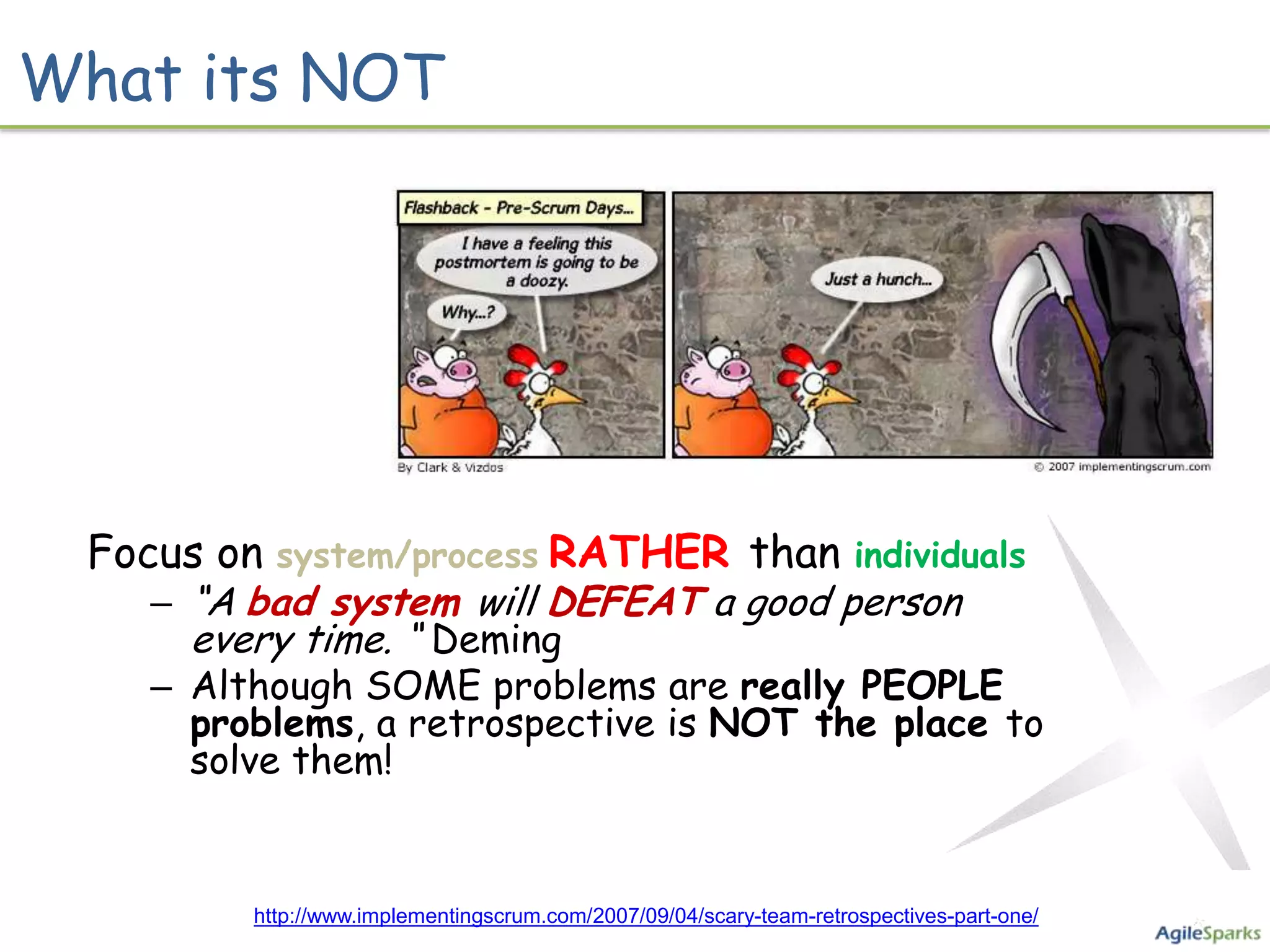
What its NOT


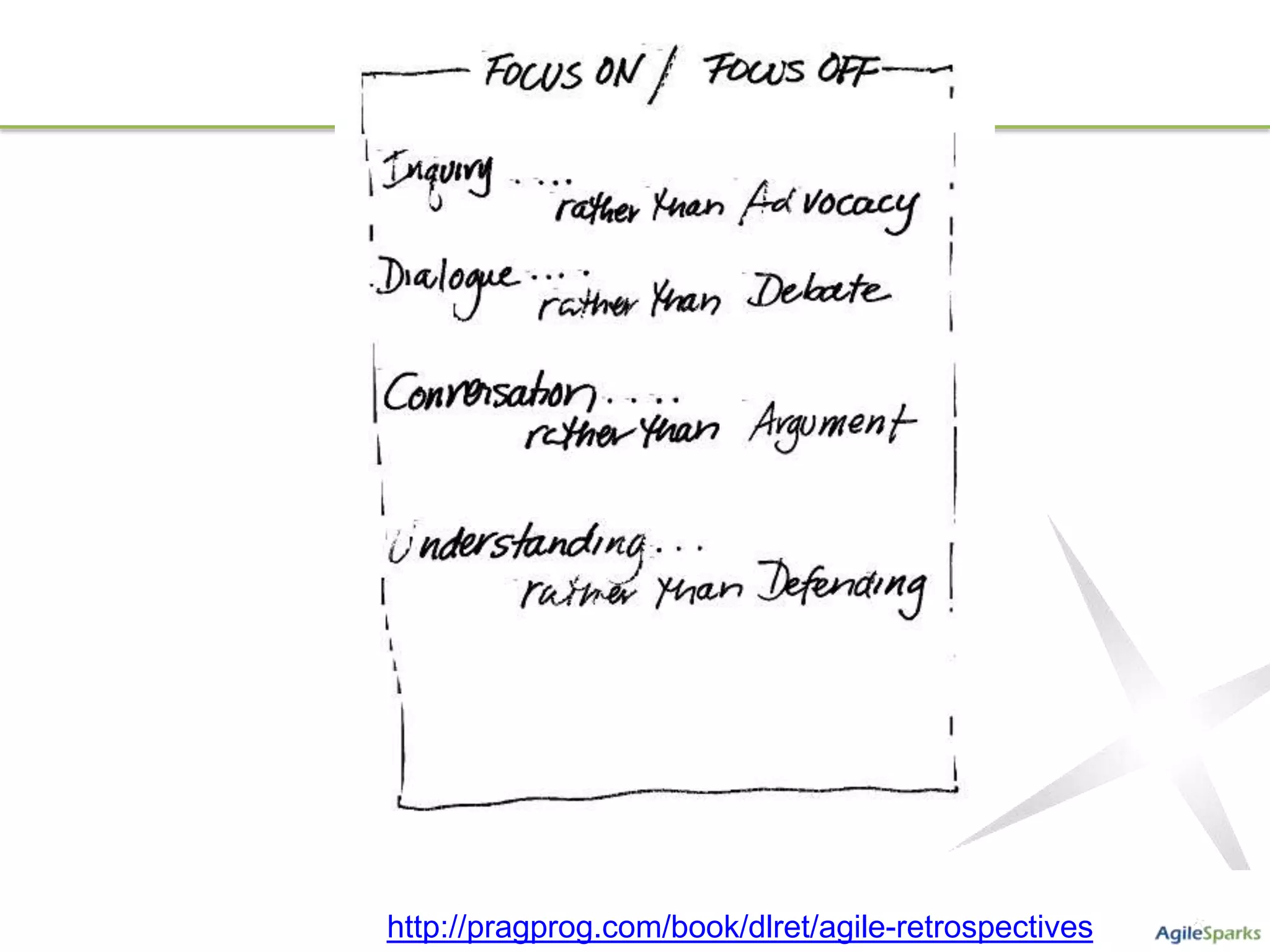
       Focus on system/process RATHER than individuals
              – “A bad system will DEFEAT a good person
                every time. “ Deming
              – Although SOME problems are really PEOPLE
                problems, a retrospective is NOT the place to
                solve them!


Photo credit: Mike Vidzos http://www.implementingscrum.com/2007/09/04/scary-team-retrospectives-part-one/
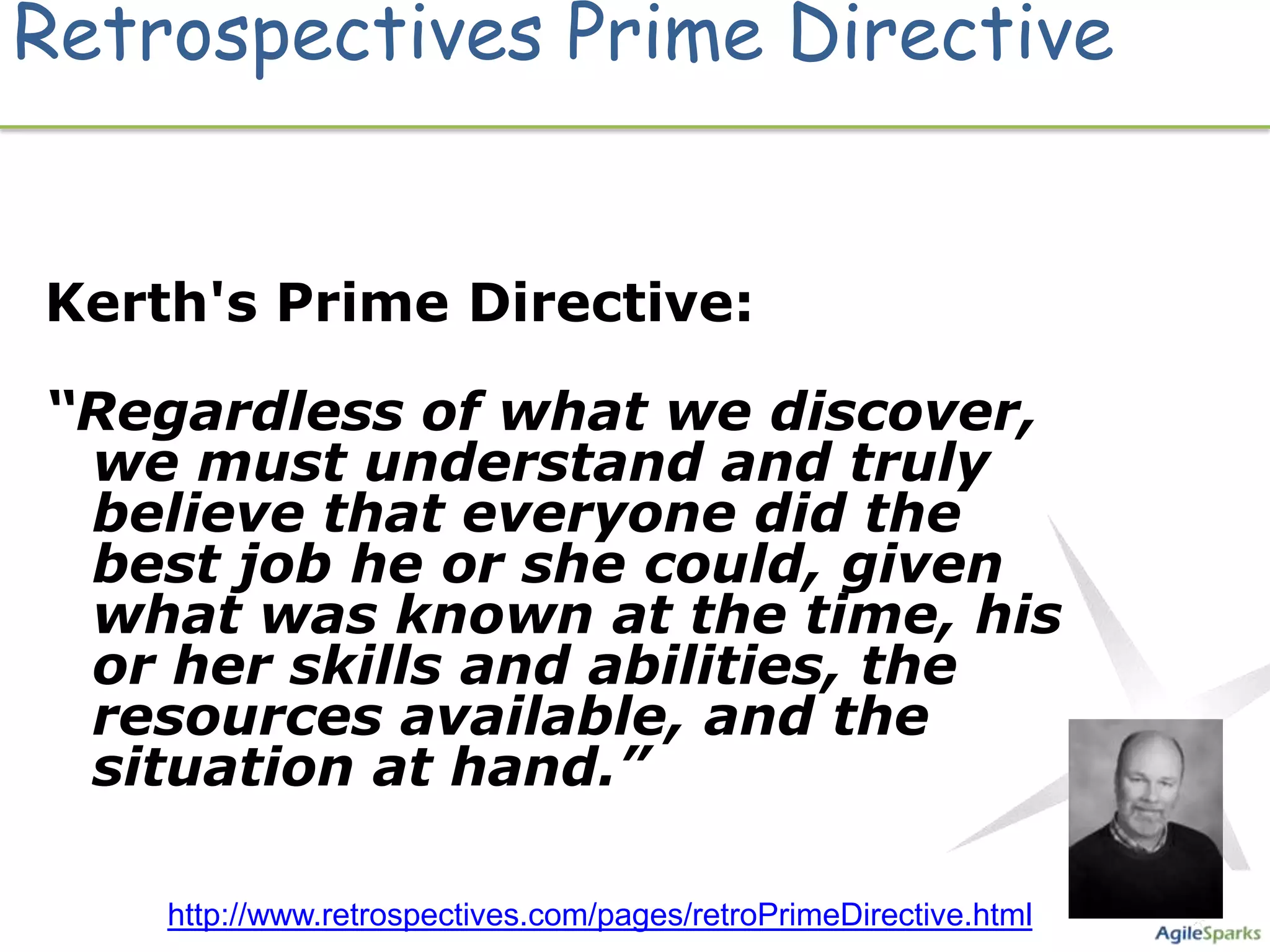
Retrospectives Prime Directive


Kerth's Prime Directive:

“Regardless of what we discover,
 we must understand and truly
 believe that everyone did the
 best job he or she could, given
 what was known at the time, his
 or her skills and abilities, the
 resources available, and the
 situation at hand.”

    http://www.retrospectives.com/pages/retroPrimeDirective.html
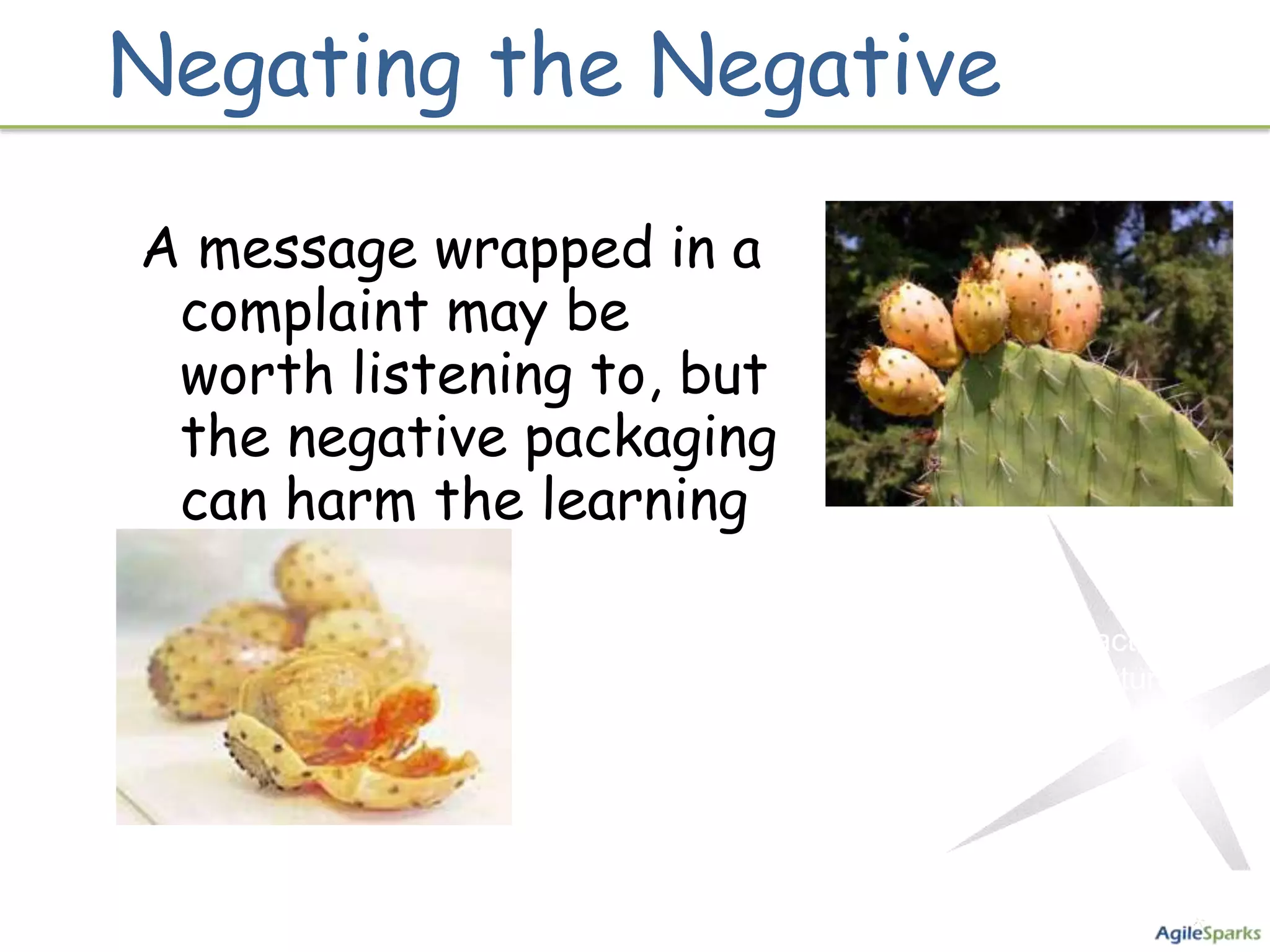
Negating the Negative

A message wrapped in a
 complaint may be
 worth listening to, but
 the negative packaging
 can harm the learning
 process
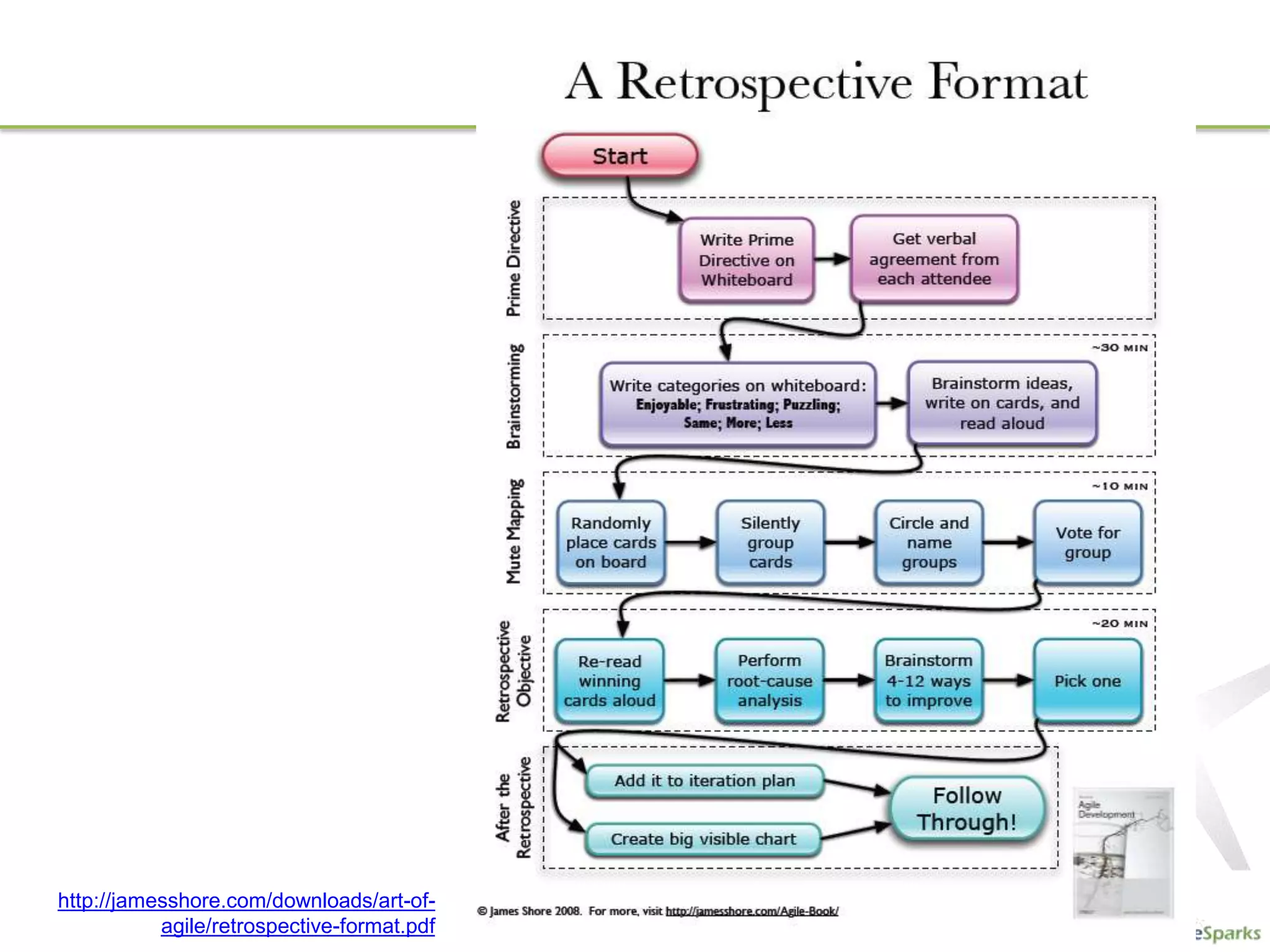
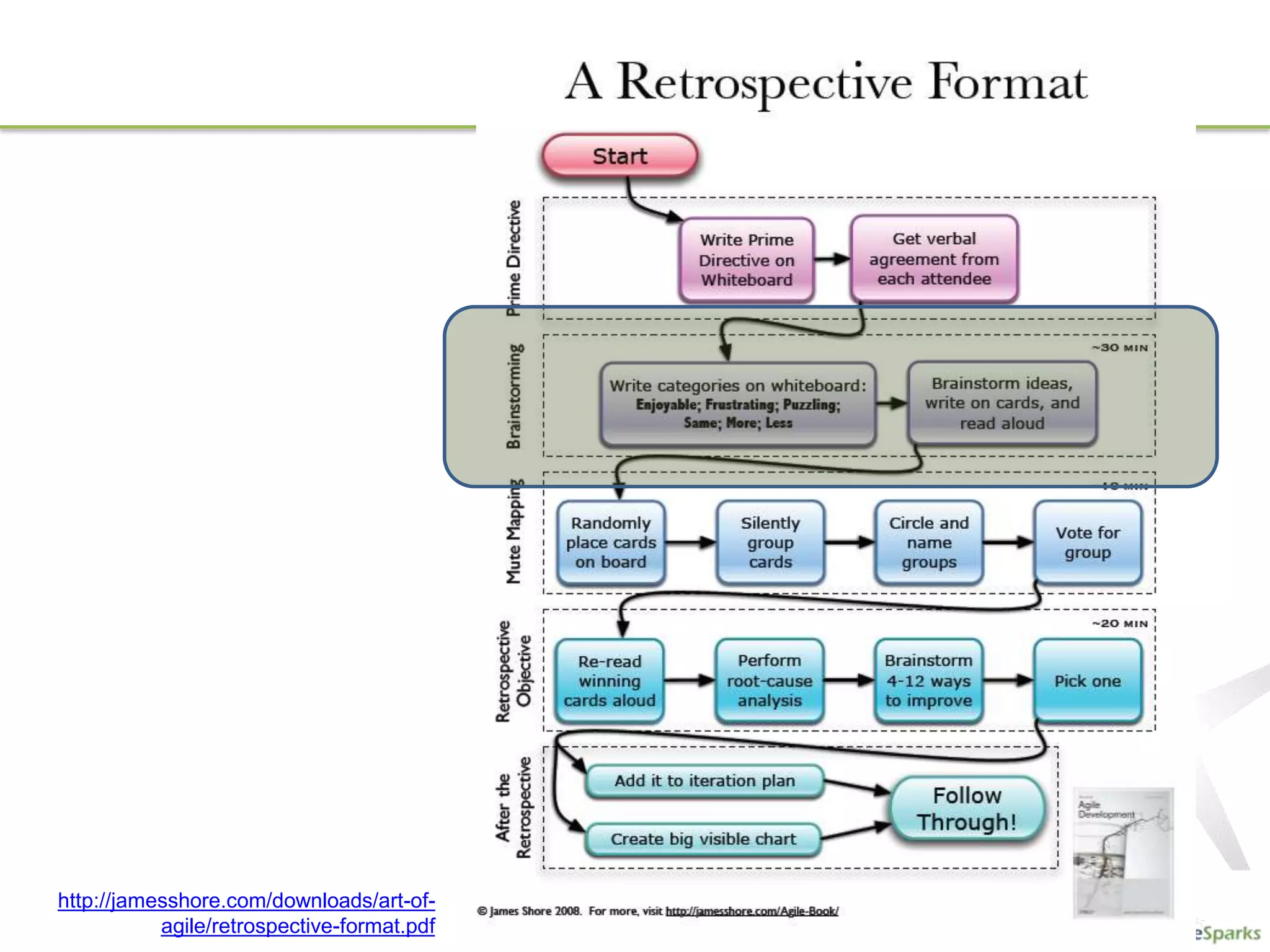
                  Retrospective format should use activities
                  which try to diffuse the negative nature
                                           of complaints ..
http://jamesshore.com/downloads/art-of-
           agile/retrospective-format.pdf
Credit: Agile Retrospectives – Making good teams Great by Esther Derby &
                                                                Diana Larsen
                          http://pragprog.com/book/dlret/agile-retrospectives
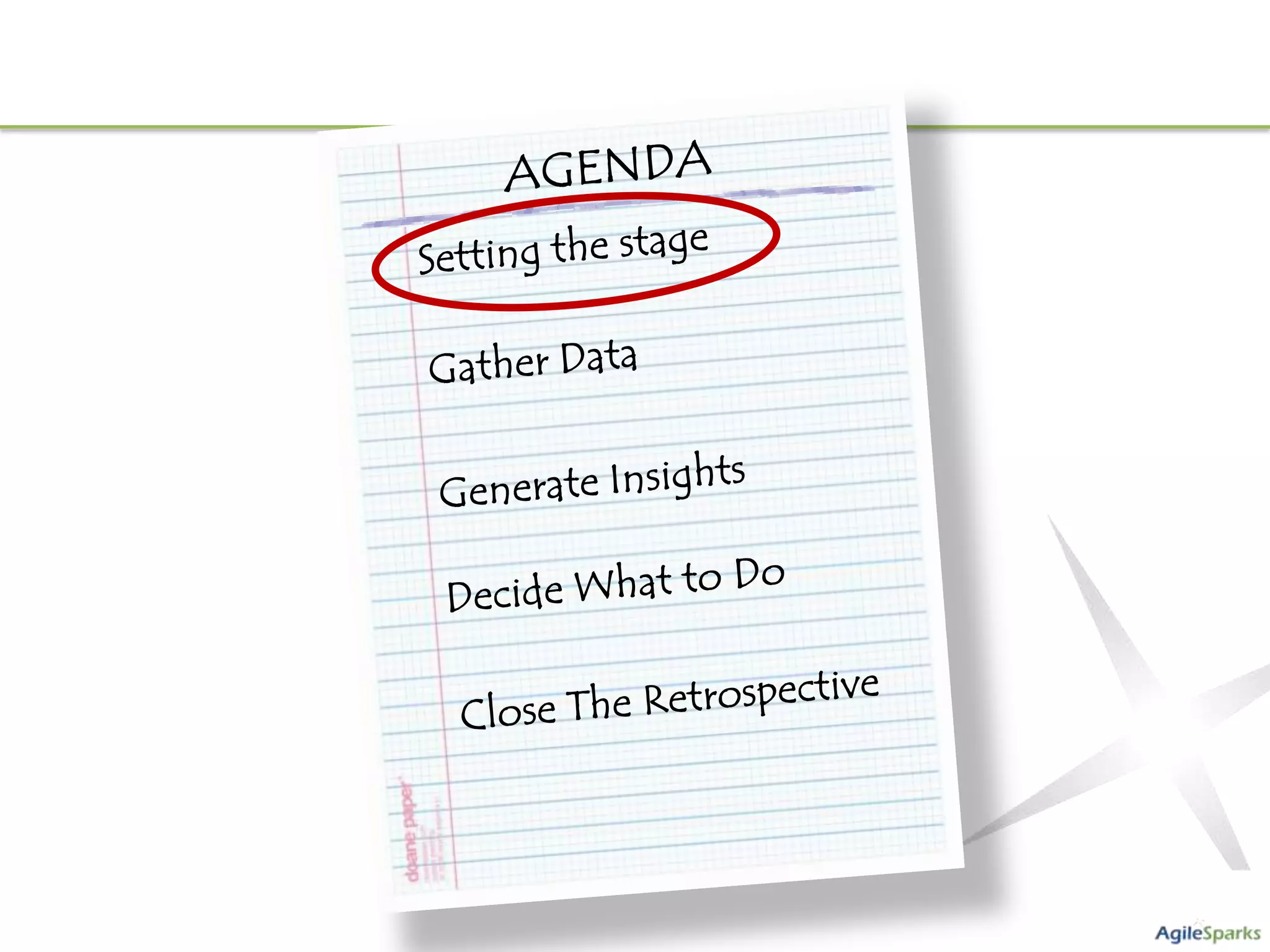
Positive/Appreciative Goal


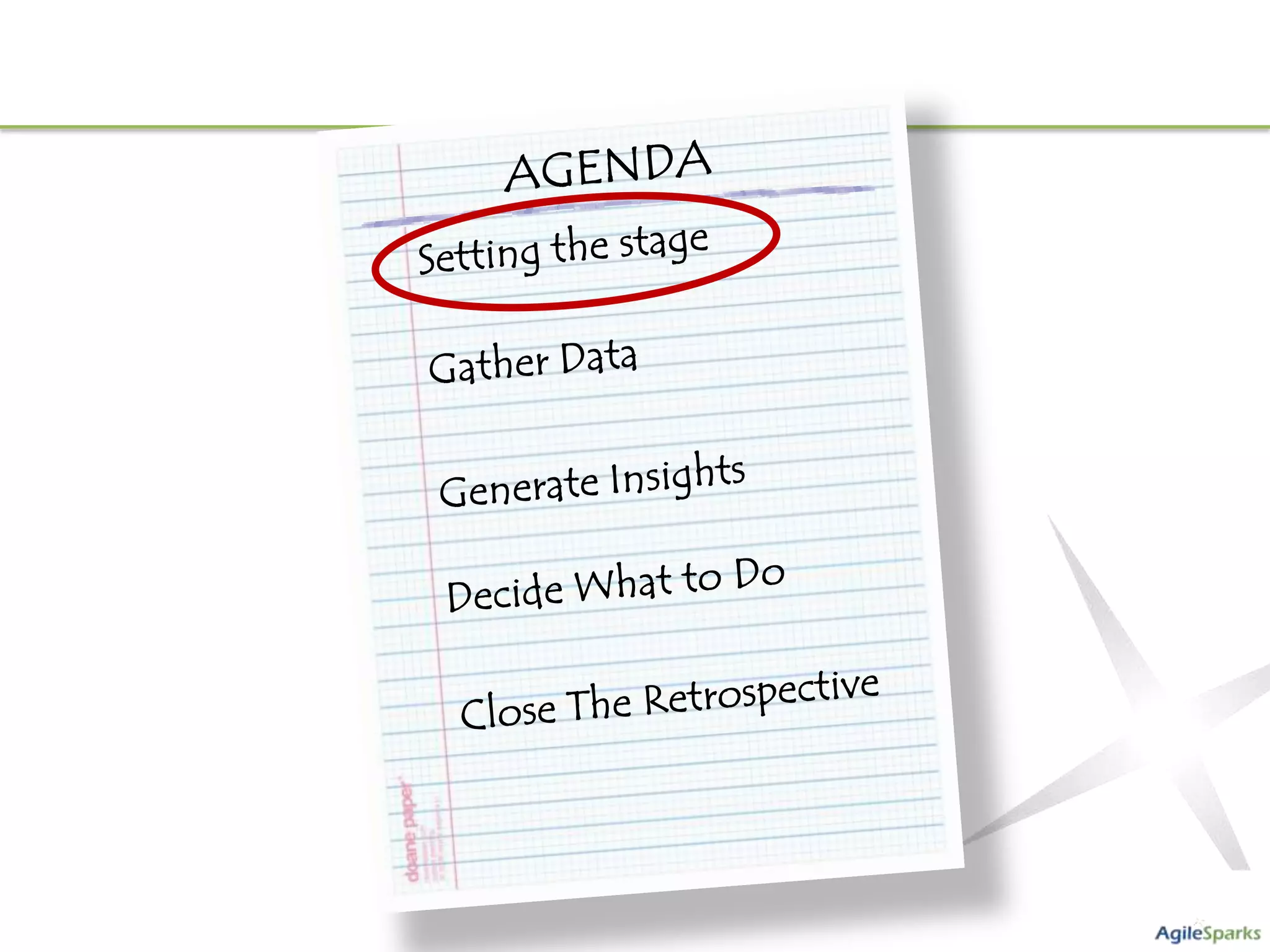
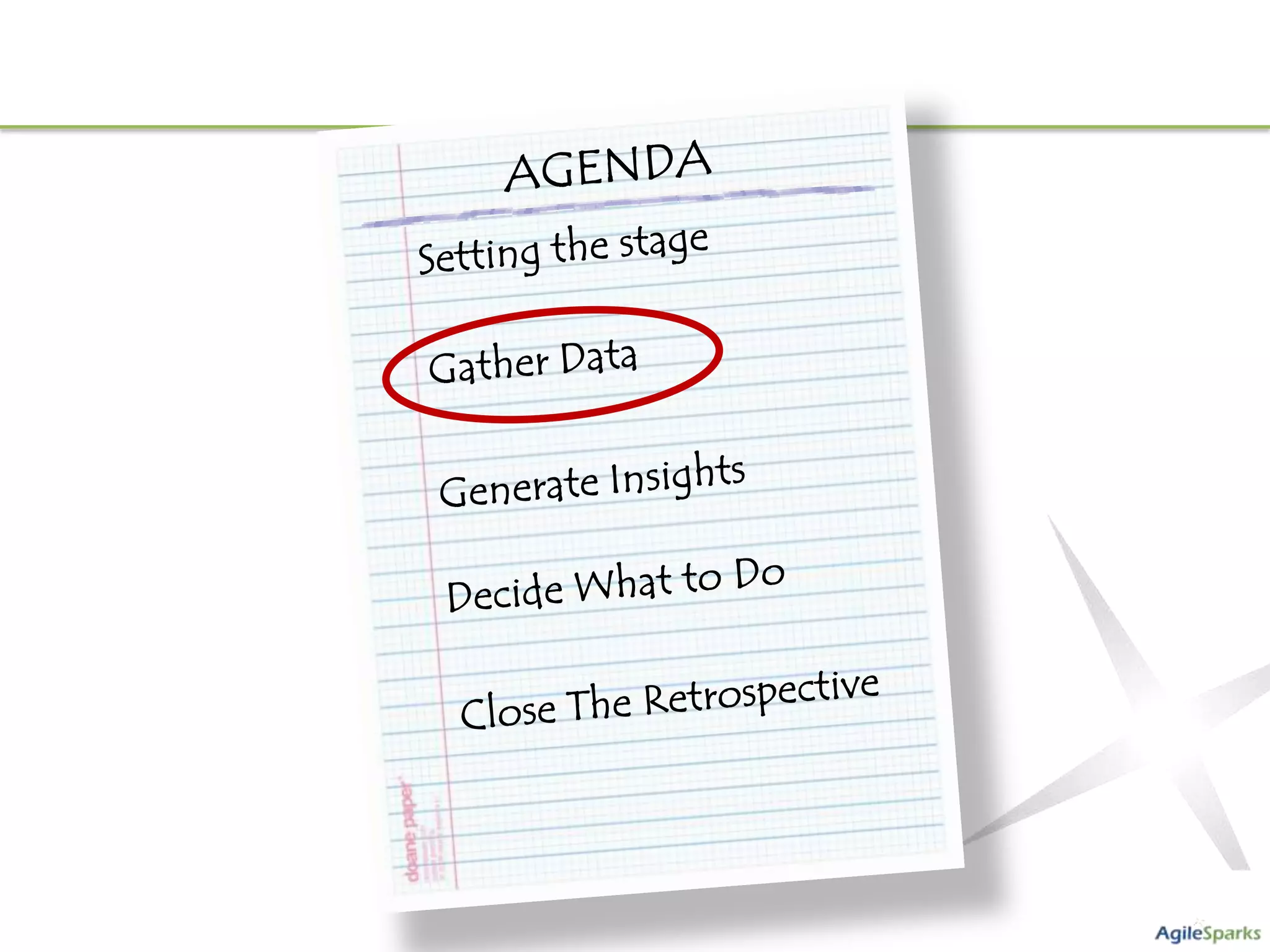
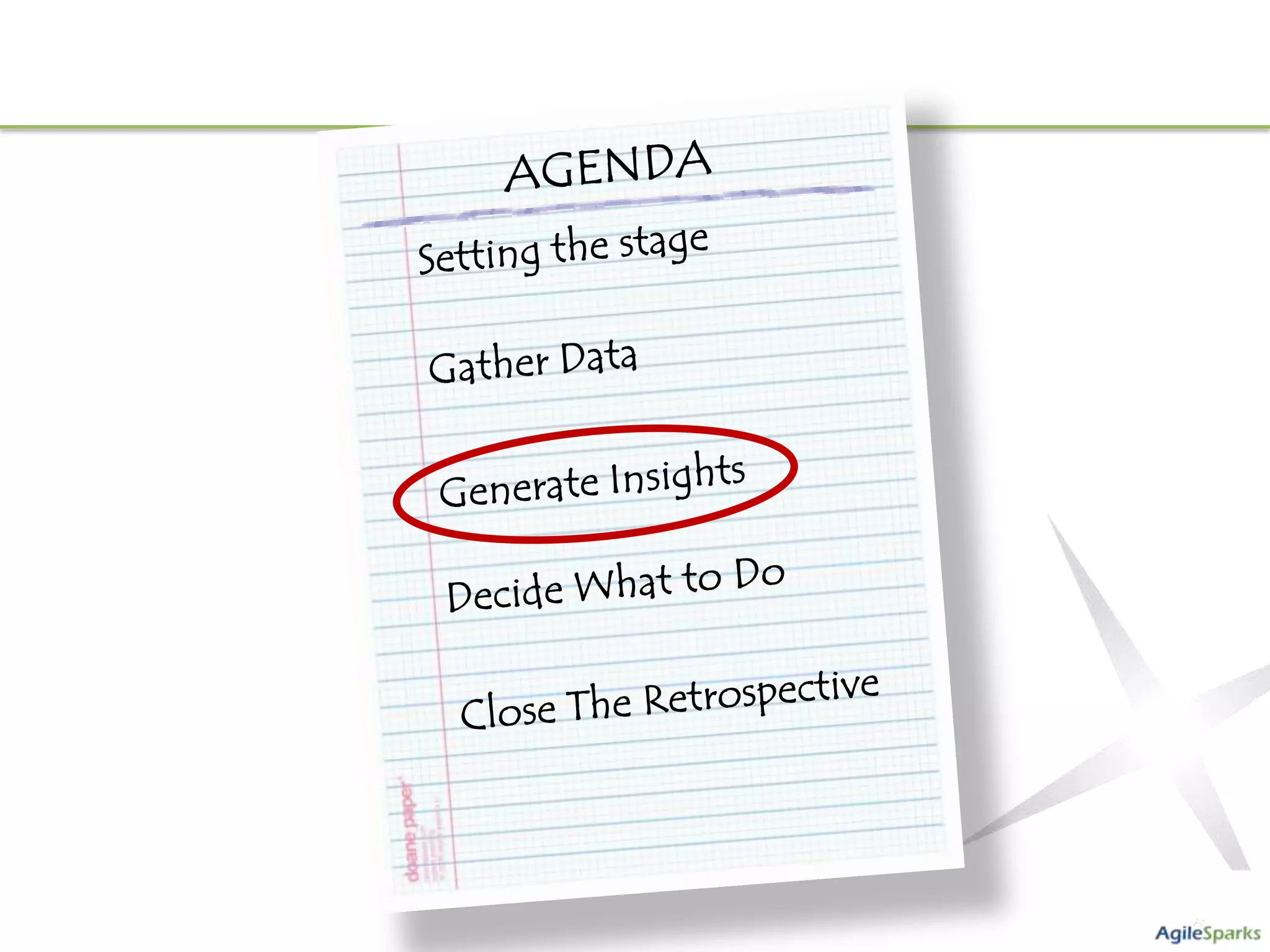
  • Set the Stage:
    State an affirmative goal for the session. Choose among
    goals like:
  • During this retrospective, we’ll find ways to amplify our
    strengths in process and teamwork.
  • In this session, we’ll discover where we added the most
    value during our last iteration and plan for increasing
    the value we add during the next iteration.
  • The goal for today’s retrospective is building on our
    best uses of engineering practices and methods.
  • We’re going to seek out our highest quality working
    relationships and find ways to expand on the
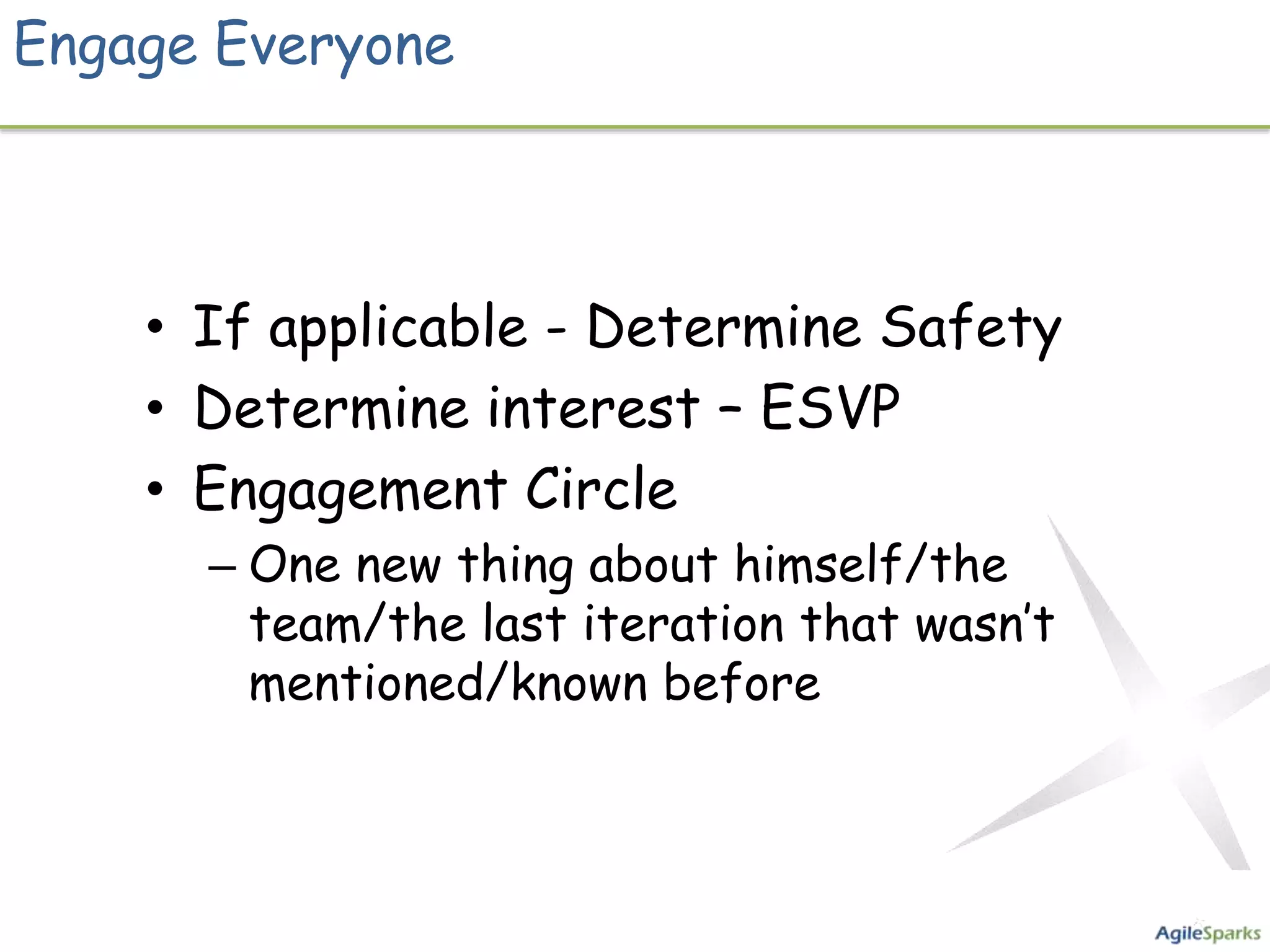
Engage Everyone


    • If applicable - Determine Safety
    • Determine interest – ESVP
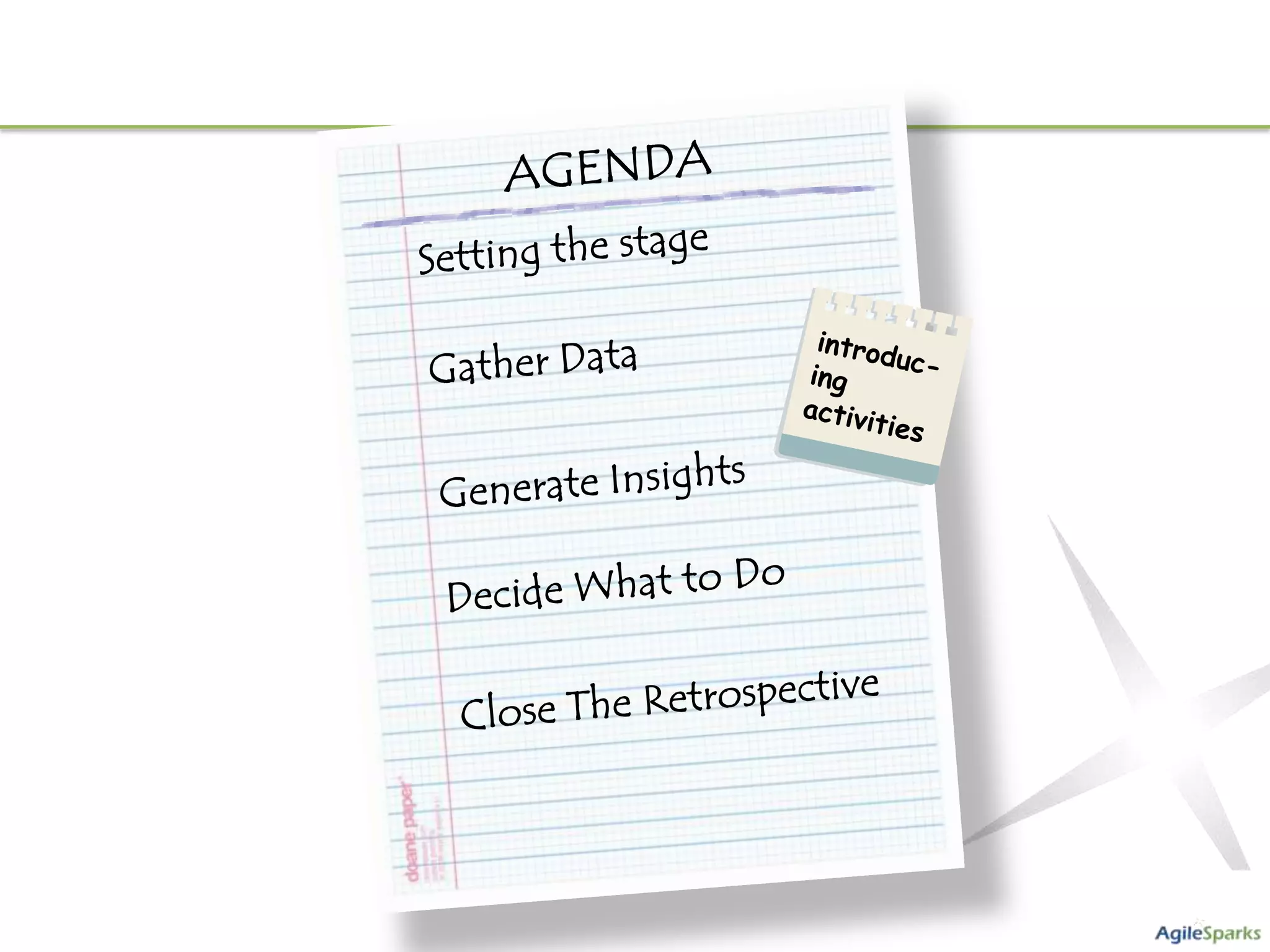
    • Engagement Circle
      – One new thing about himself/the
        team/the last iteration that wasn’t
        mentioned/known before
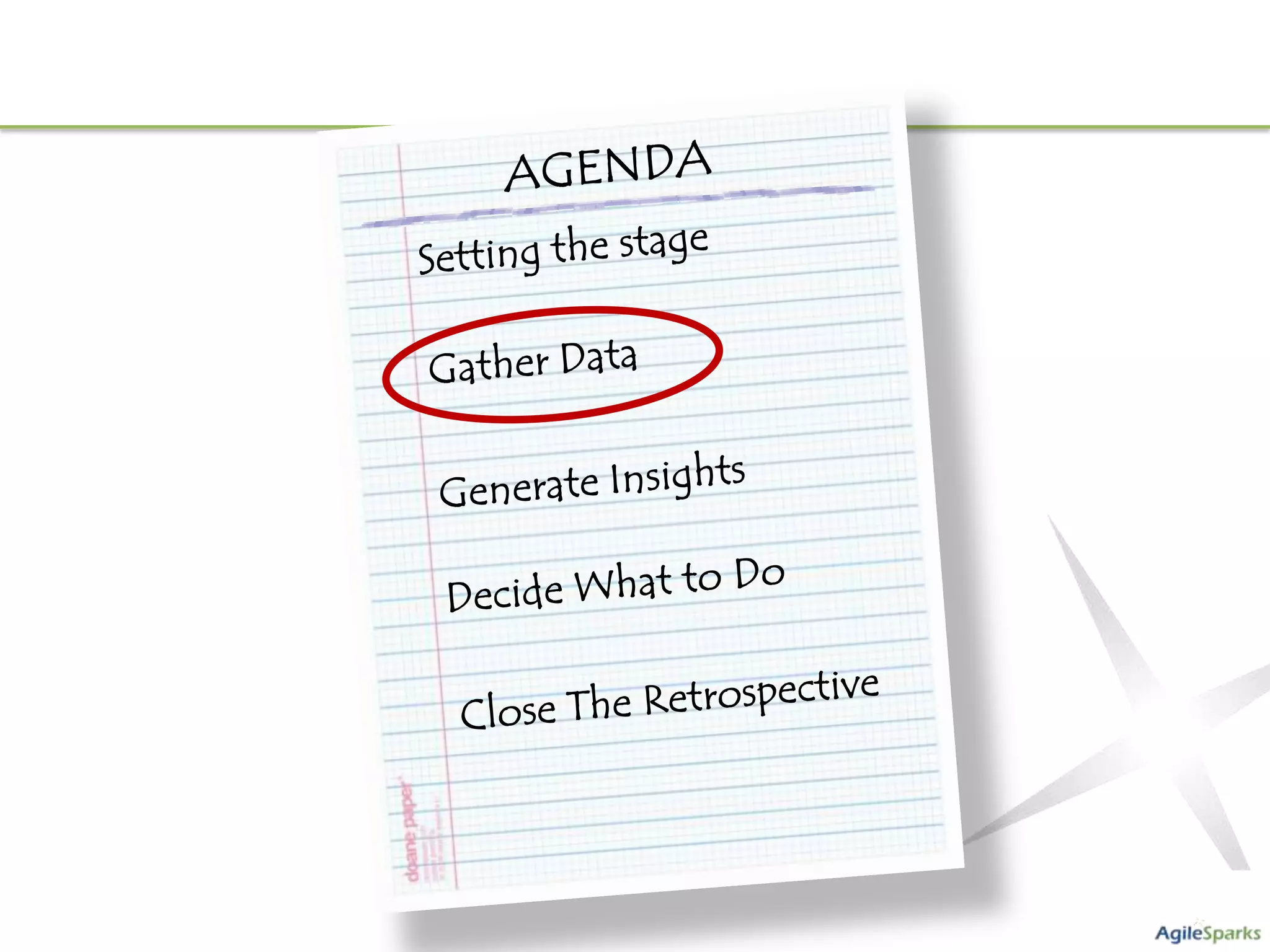
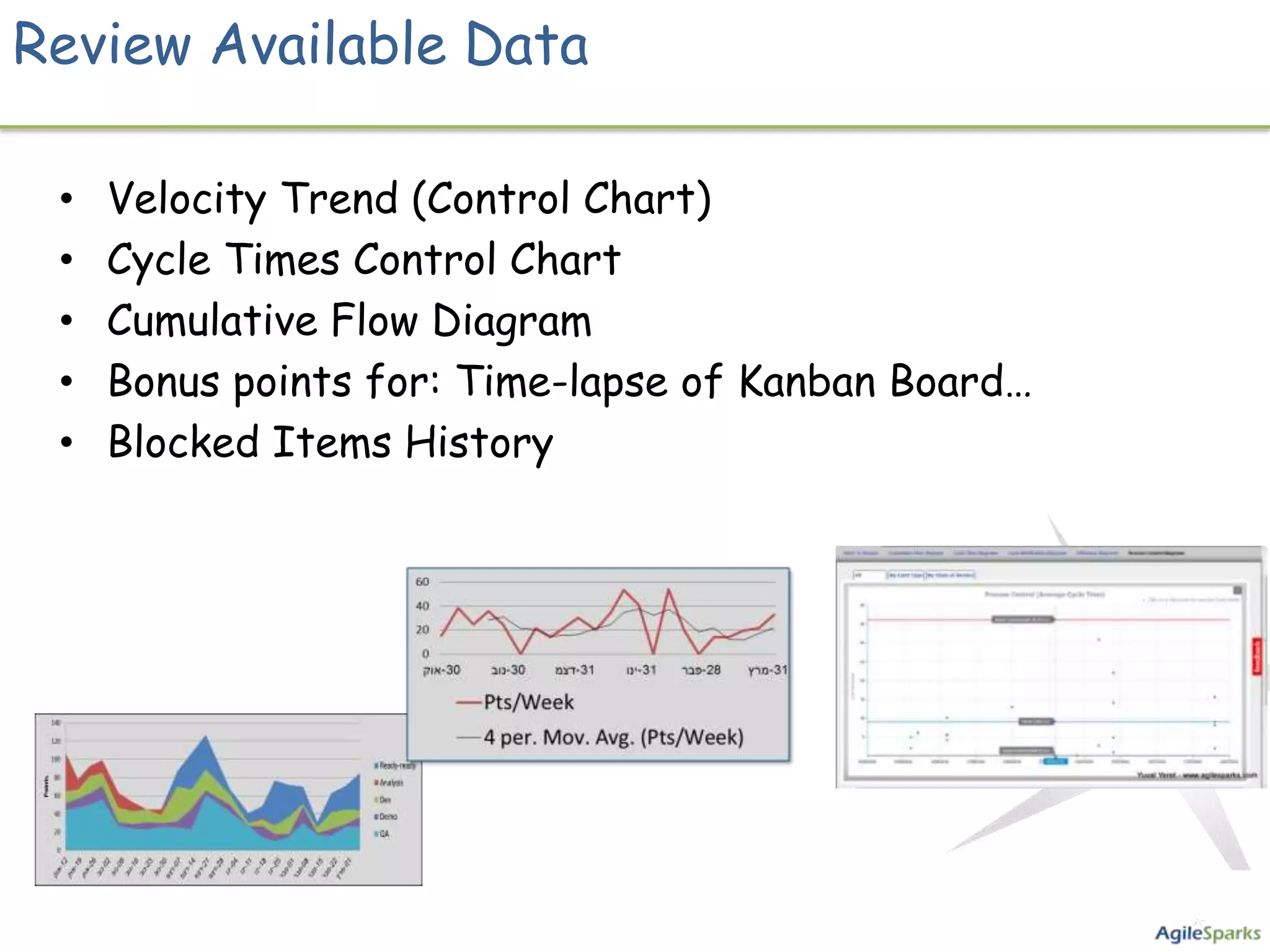
Review Available Data

 •   Velocity Trend (Control Chart)
 •   Cycle Times Control Chart
 •   Cumulative Flow Diagram
 •   Bonus points for: Time-lapse of Kanban Board…
 •   Blocked Items History
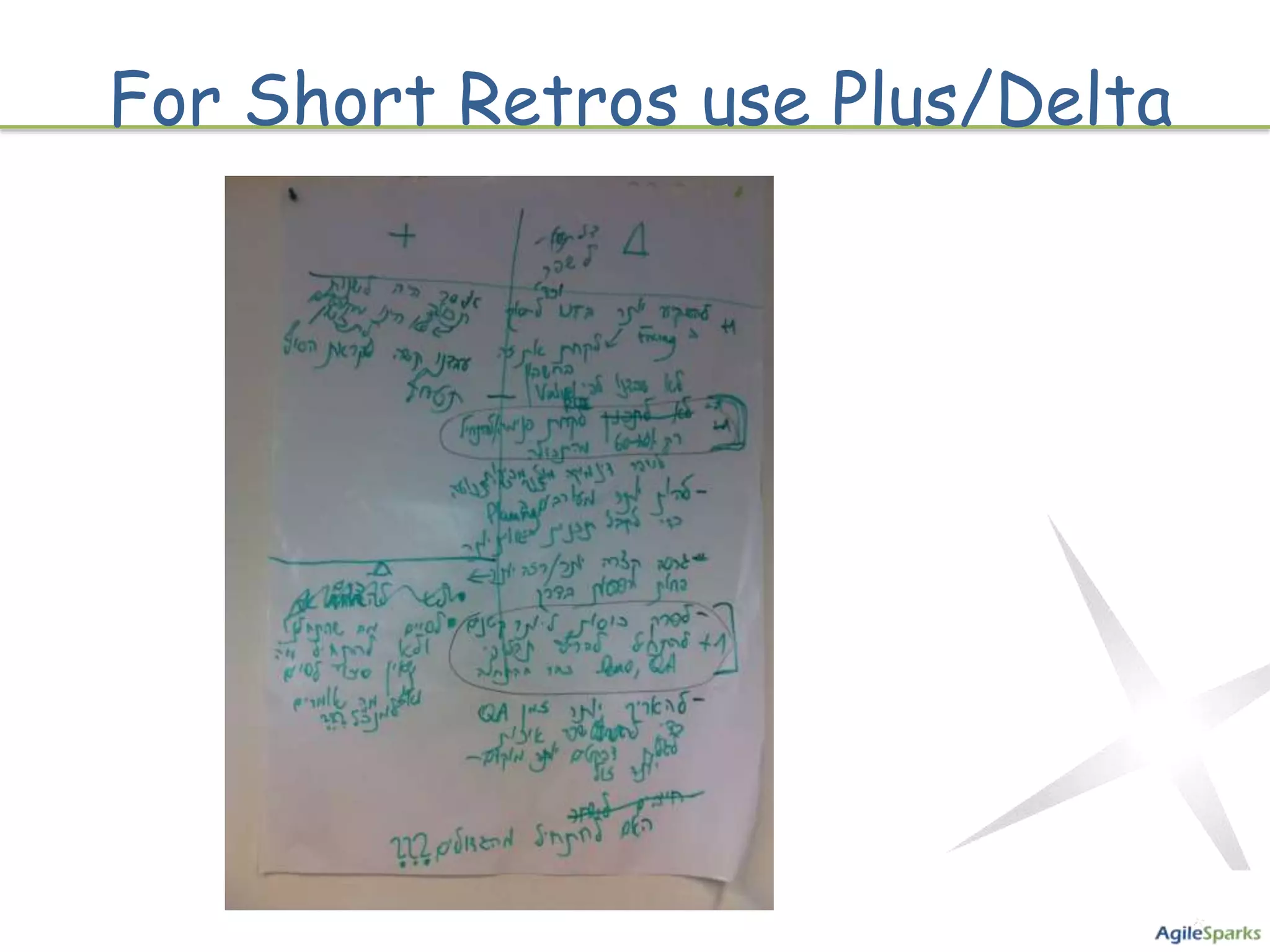
For Short Retros use Plus/Delta
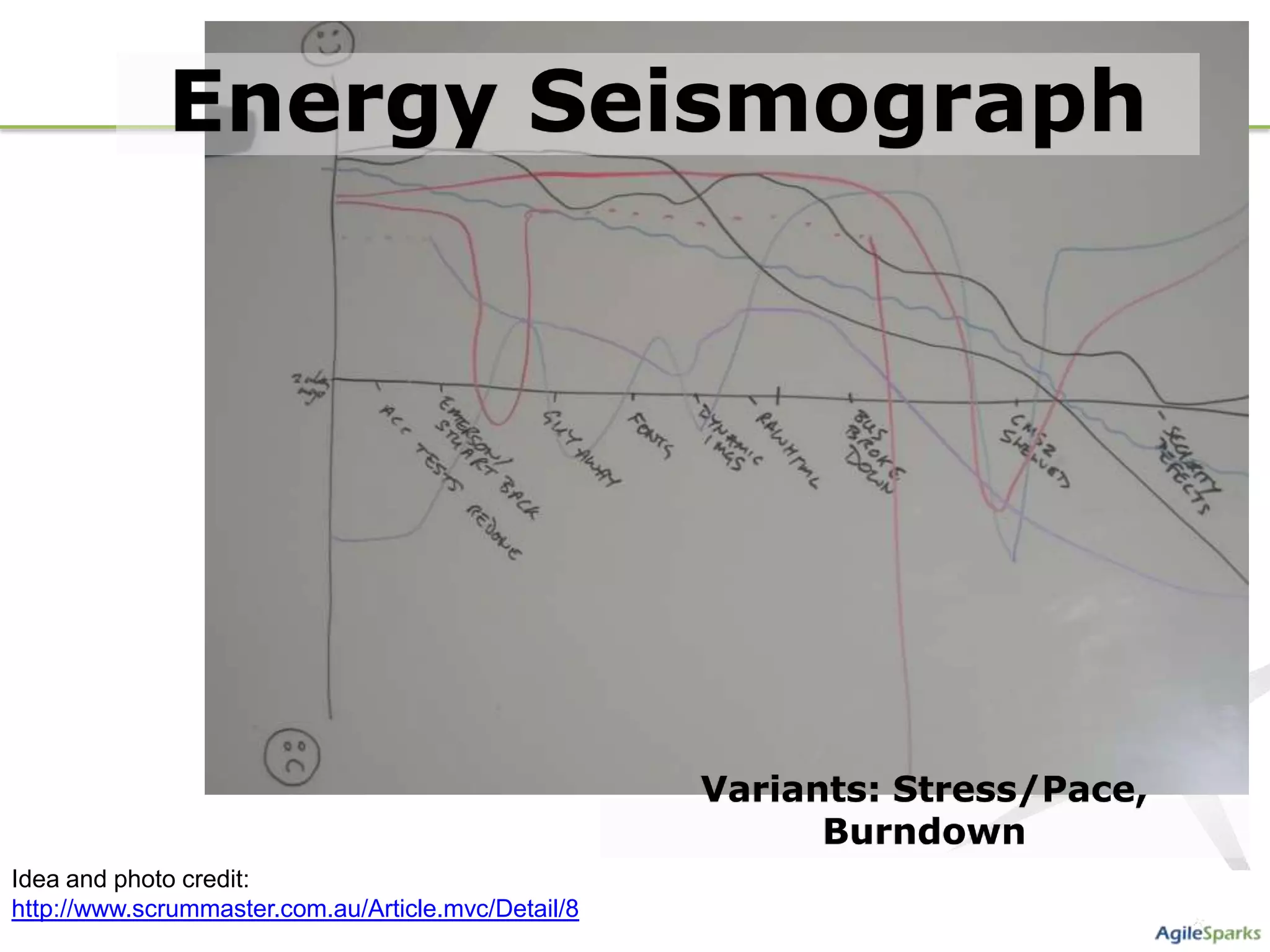
Energy Seismograph


                                                     Variants: Stress/Pace,
                                                           Burndown
Idea and photo credit:
http://www.scrummaster.com.au/Article.mvc/Detail/8
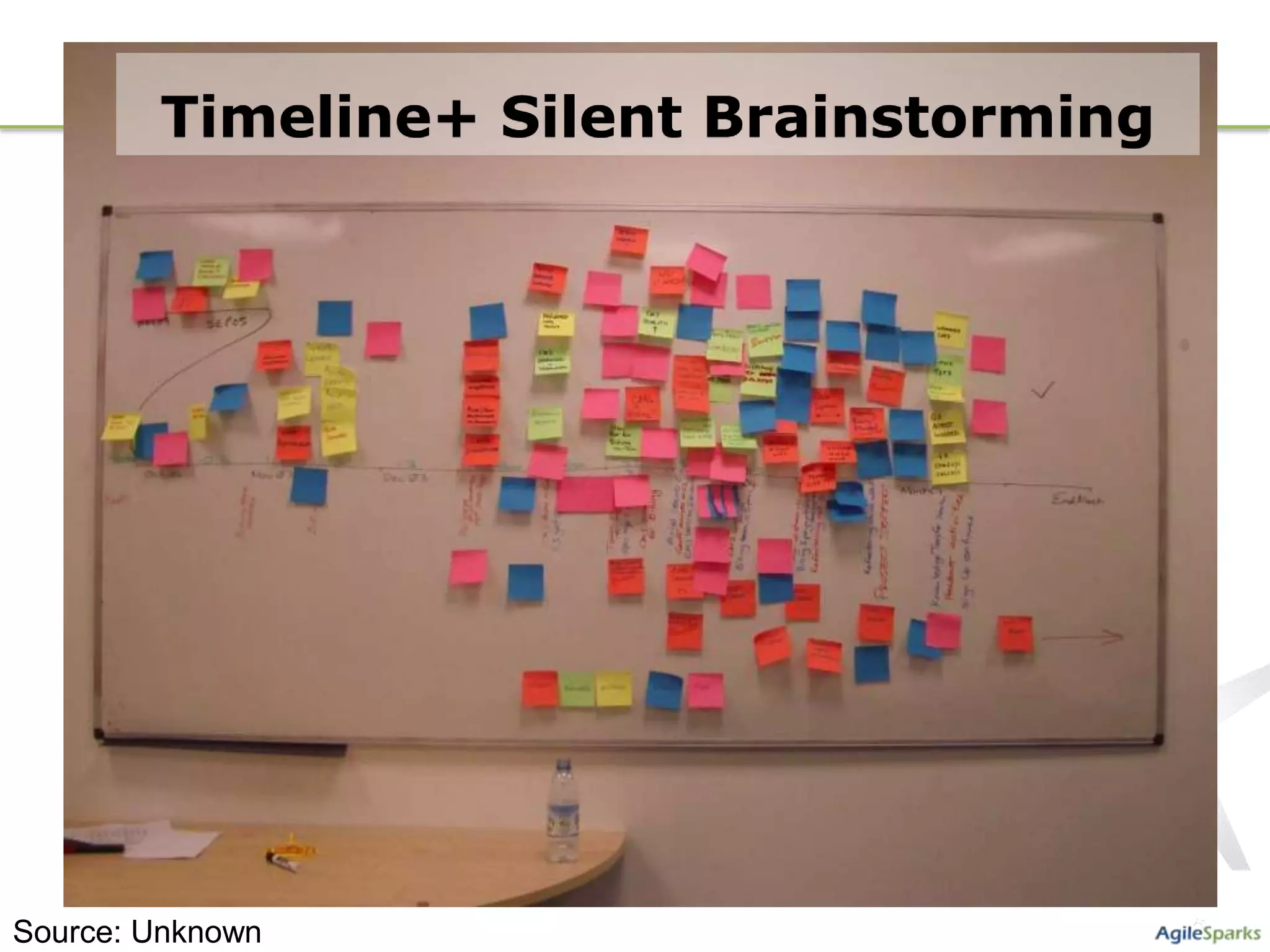
Timeline+ Silent Brainstorming


Source: Unknown
http://jamesshore.com/downloads/art-of-
           agile/retrospective-format.pdf
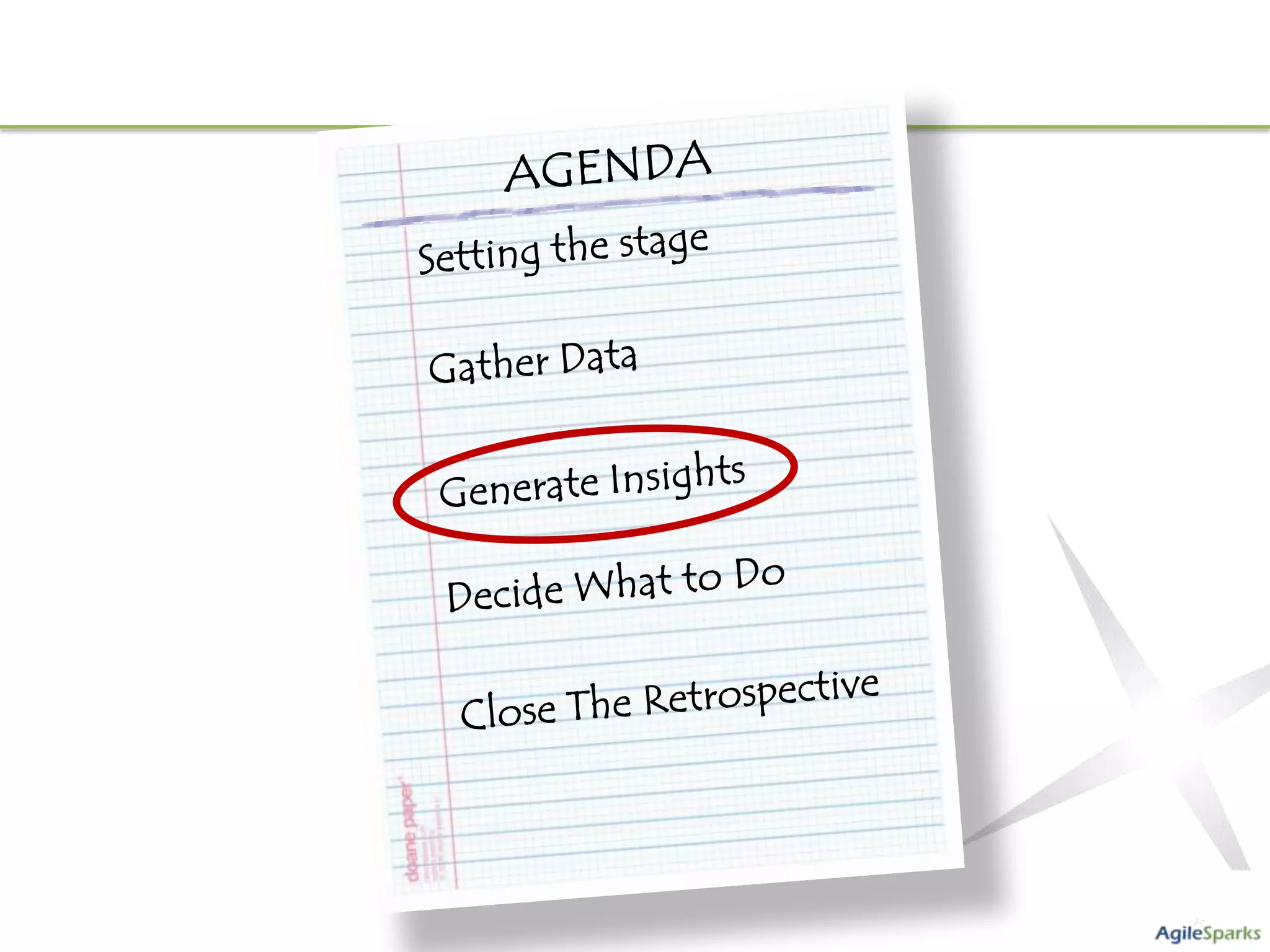
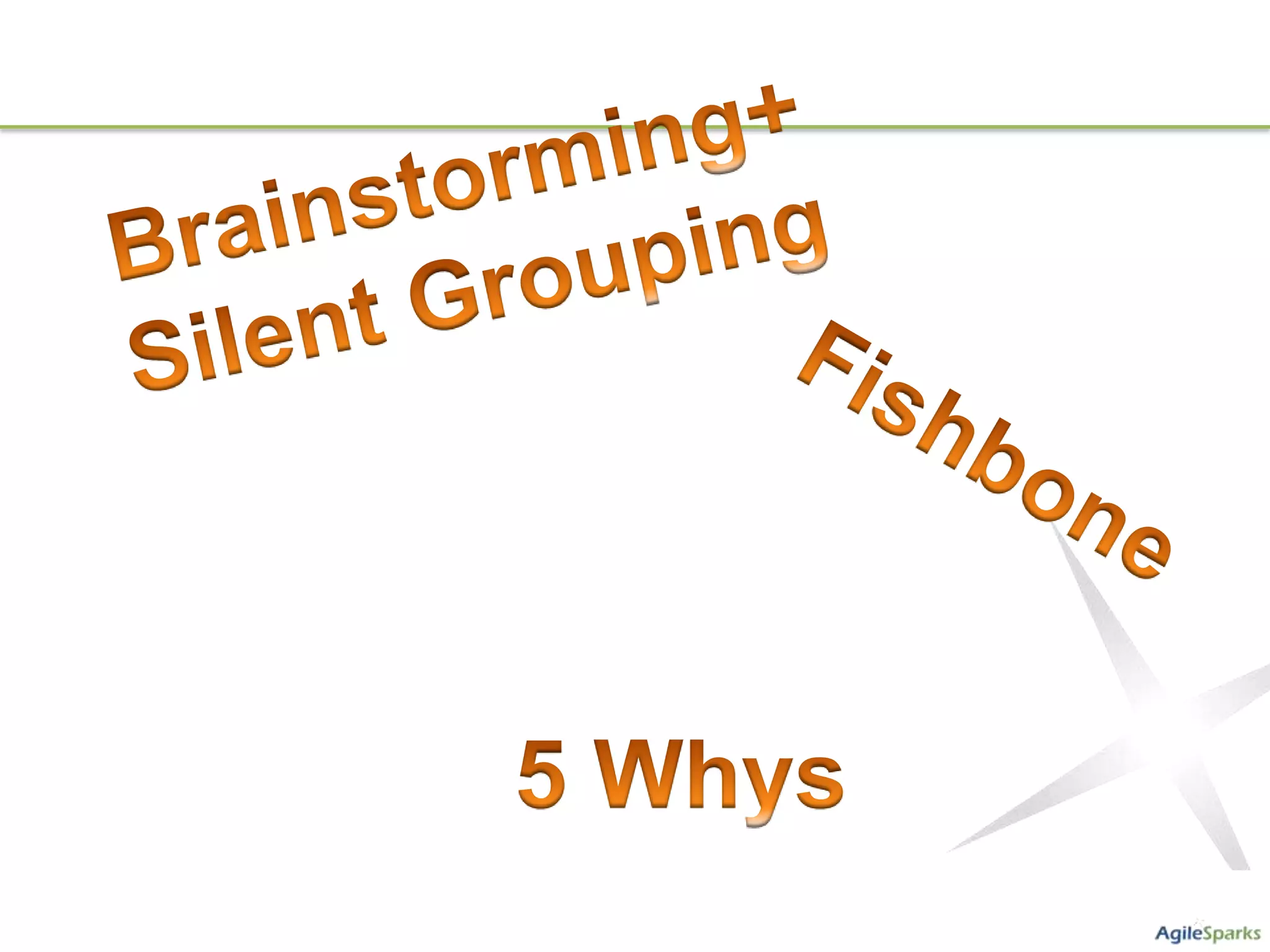
Brainstorm + Silent Grouping
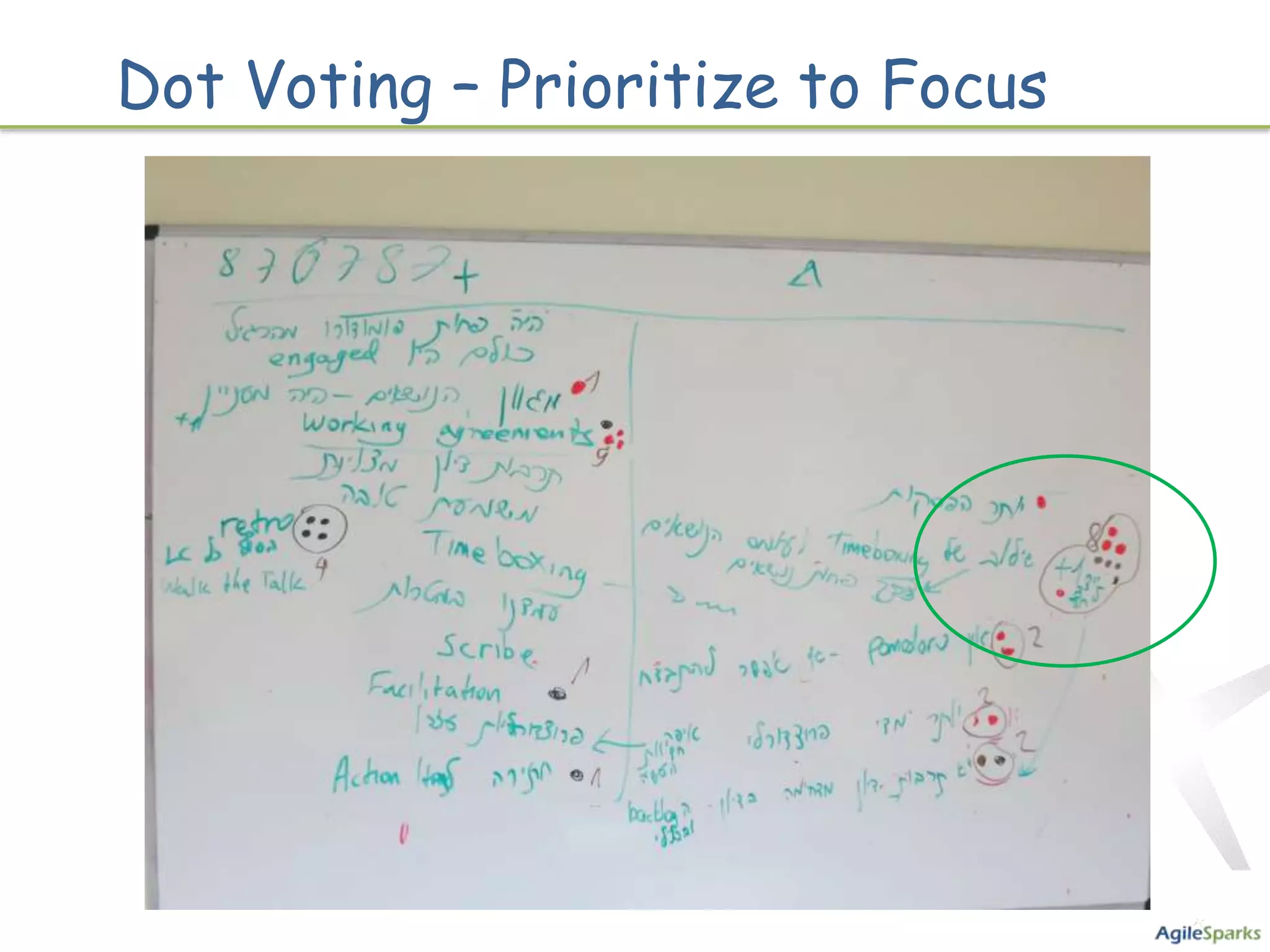
Dot Voting – Prioritize to Focus
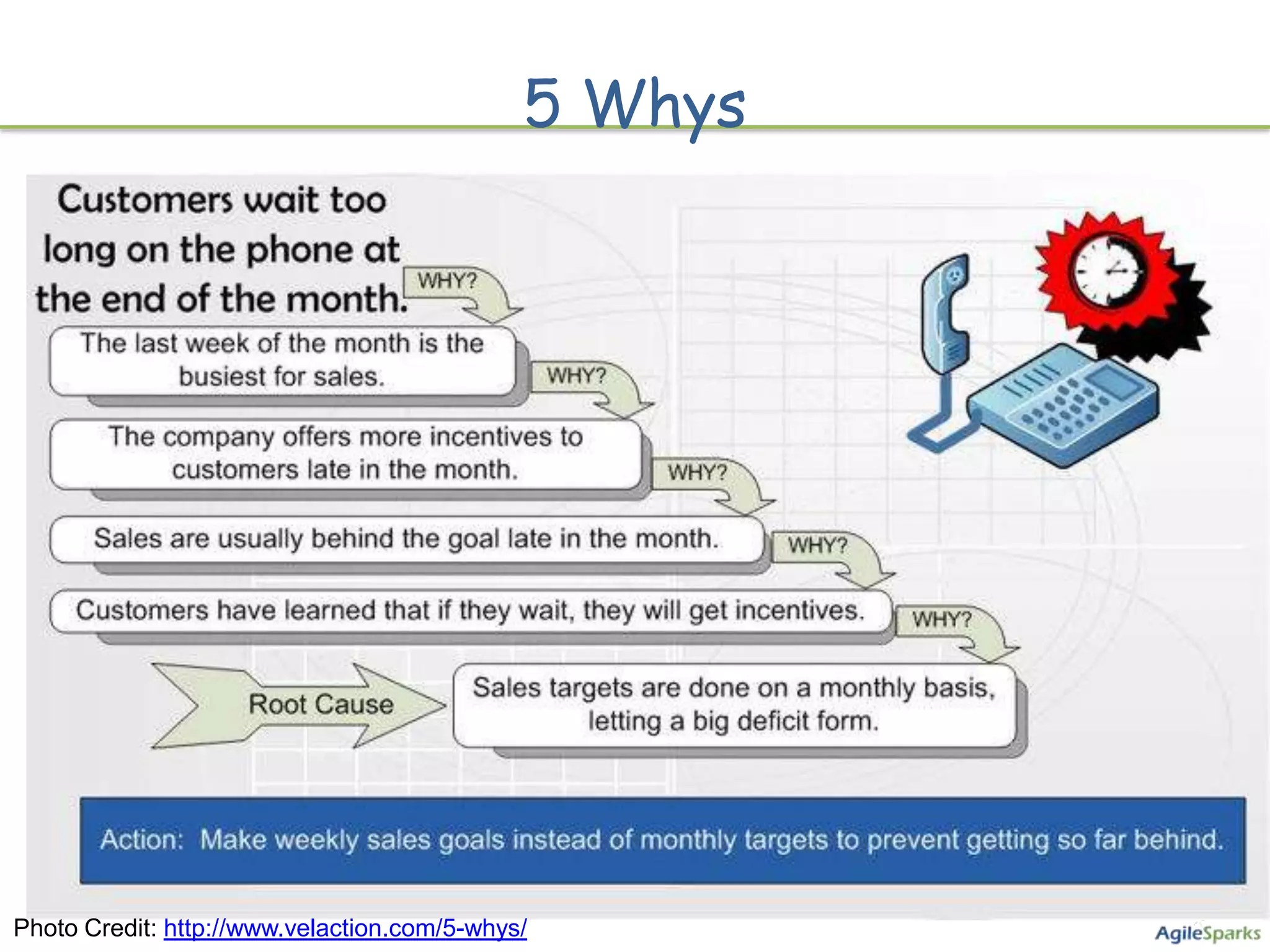
5 Whys


Photo Credit: http://www.velaction.com/5-whys/
Appreciative Futurespective


   • Imagine we could time travel to the end of the
     next release. When we arrive there and converse
     with our future selves, we hear that it was the
     most productive, most satisfying effort we’ve
     ever worked on. What do you see and hear in
     that future time?
   • Wait 2 or 3 minutes for team members to connect
     with this vision. Then ask: “What changes did we
     implement now that resulted in such productive and
     satisfying work in the future?”
   • Write down all the answers / Silent Brainstorming
   • [Silent] Grouping
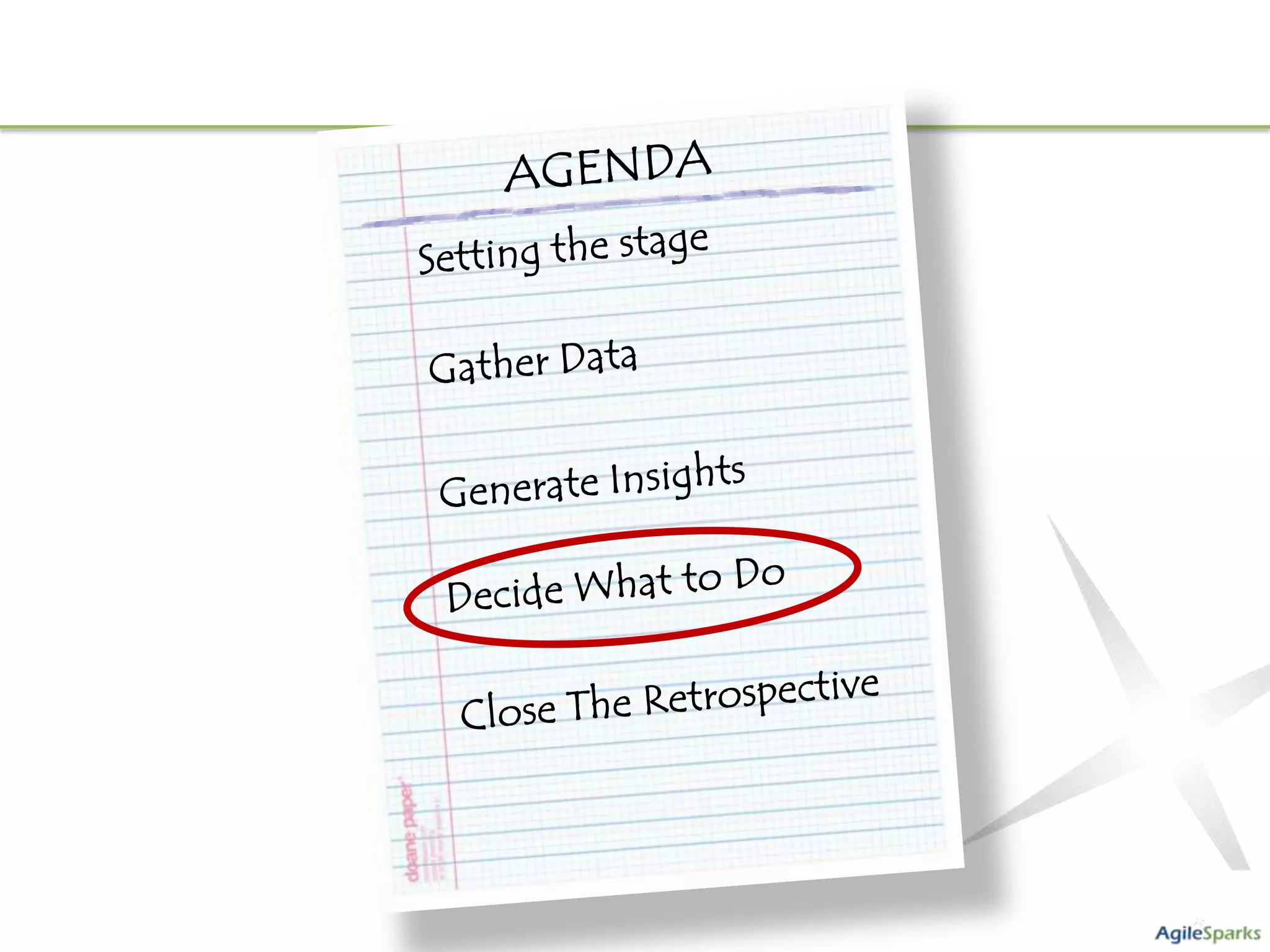
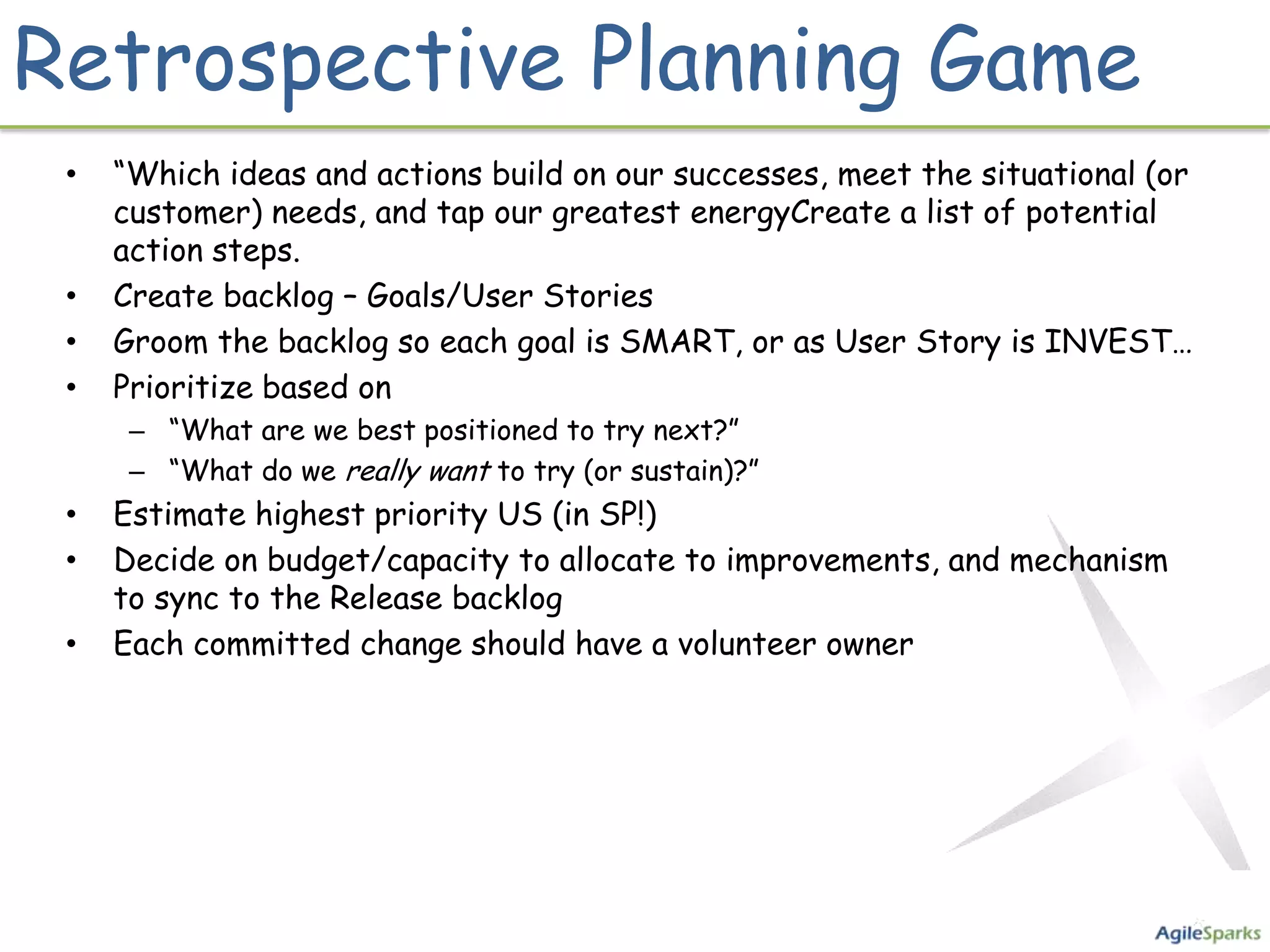
Retrospective Planning Game
 •   “Which ideas and actions build on our successes, meet the situational (or
     customer) needs, and tap our greatest energyCreate a list of potential
     action steps.
 •   Create backlog – Goals/User Stories
 •   Groom the backlog so each goal is SMART, or as User Story is INVEST…
 •   Prioritize based on
      – “What are we best positioned to try next?”
      – “What do we really want to try (or sustain)?”
 •   Estimate highest priority US (in SP!)
 •   Decide on budget/capacity to allocate to improvements, and mechanism
     to sync to the Release backlog
 •   Each committed change should have a volunteer owner
Retrospective Anti-Patterns/Smells


    • Hijack
    • Facilitator too engaged in content
    • Replaces ad-hoc problem solving
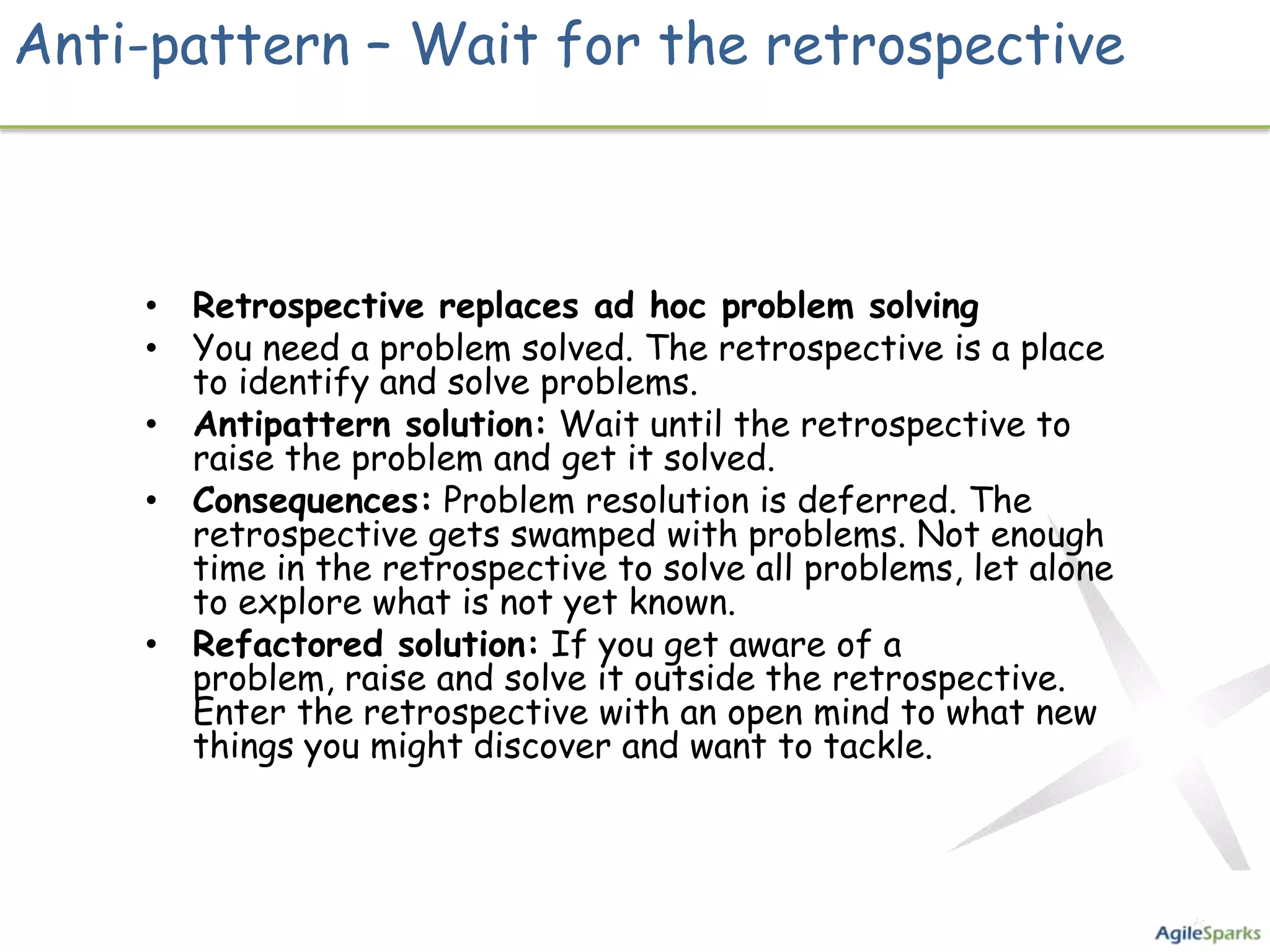
Anti-pattern – Wait for the retrospective


    • Retrospective replaces ad hoc problem solving
    • You need a problem solved. The retrospective is a place
      to identify and solve problems.
    • Antipattern solution: Wait until the retrospective to
      raise the problem and get it solved.
    • Consequences: Problem resolution is deferred. The
      retrospective gets swamped with problems. Not enough
      time in the retrospective to solve all problems, let alone
      to explore what is not yet known.
    • Refactored solution: If you get aware of a
      problem, raise and solve it outside the retrospective.
      Enter the retrospective with an open mind to what new
      things you might discover and want to tackle.
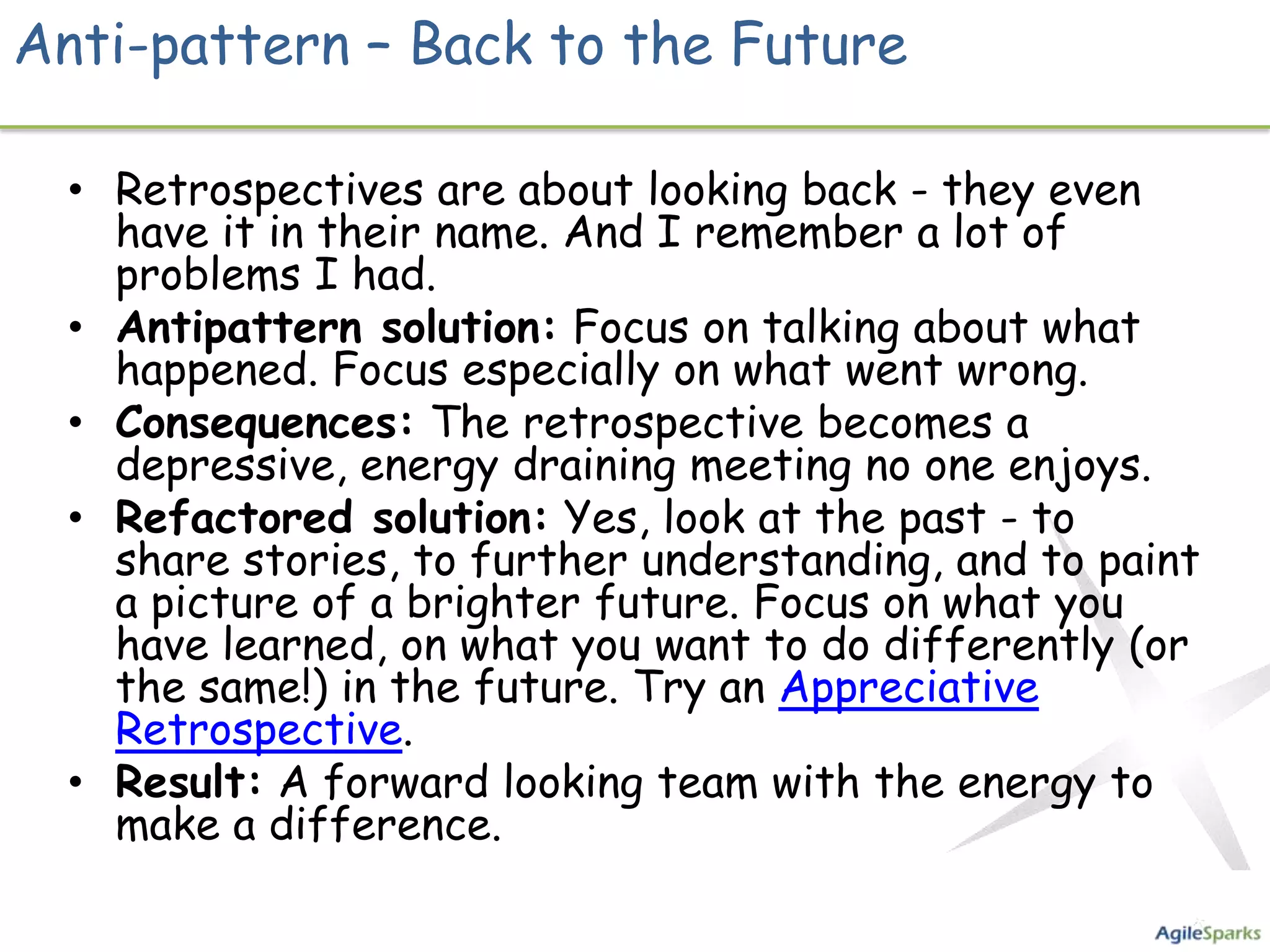
Anti-pattern – Back to the Future

  • Retrospectives are about looking back - they even
    have it in their name. And I remember a lot of
    problems I had.
  • Antipattern solution: Focus on talking about what
    happened. Focus especially on what went wrong.
  • Consequences: The retrospective becomes a
    depressive, energy draining meeting no one enjoys.
  • Refactored solution: Yes, look at the past - to
    share stories, to further understanding, and to paint
    a picture of a brighter future. Focus on what you
    have learned, on what you want to do differently (or
    the same!) in the future. Try an Appreciative
    Retrospective.
  • Result: A forward looking team with the energy to
    make a difference.
Anti-pattern – retrospective as
reporting/complaining to management

 •   Retrospectives as reporting to management
 •   A problem is perceived to be only solvable with management
     involvement/approval.
 •   Antipattern solution: Create actions that need management involvement
     or approval.
 •   Consequences: Problem resolution is dependent on management taking
     action. If management has different priorities, nothing happens.
     Retrospectives degenerate into complain sessions, where you don't even
     expect to be able to make a difference.
 •   Refactored solution: For every problem, come up with at least one action
     that doesn't need management involvement or approval, and will improve
     the situation at least a bit.
 •   Result: Continuous improvement, however small. Team members get a
     better feel for the power they actually have. Managers see team members
     take initiative. They might even get interested in getting involved in the
     ongoing change.
Facilitating a retrospective


     • Preparing
     • Leading the session
     • Closure & Follow-up
Preparing
 • Schedule/Length - Rachel Davies suggests
   30 minutes for each week (1:30 hours for
   3w sprint, whole day for iteration)
   – Face to Face >= Video Conf >= Telephone
 • Location – Offsite for iteration, Good
   meeting room for sprint
   – White boards (More than one / Flip chart)
   – Supplies (Markers, Sharpies, Stickies, Dots)
 • Decide which exercises (various
   alternatives for each stage – mix it up
   from time to time)
 • Prepare the room
Leading the retrospective


 • Facilitator vs team member role
 • Handle different personalities
   – Quiet
   – Overbearing
   – Passive Aggressive
 • Handle different cultures

 • Attitude
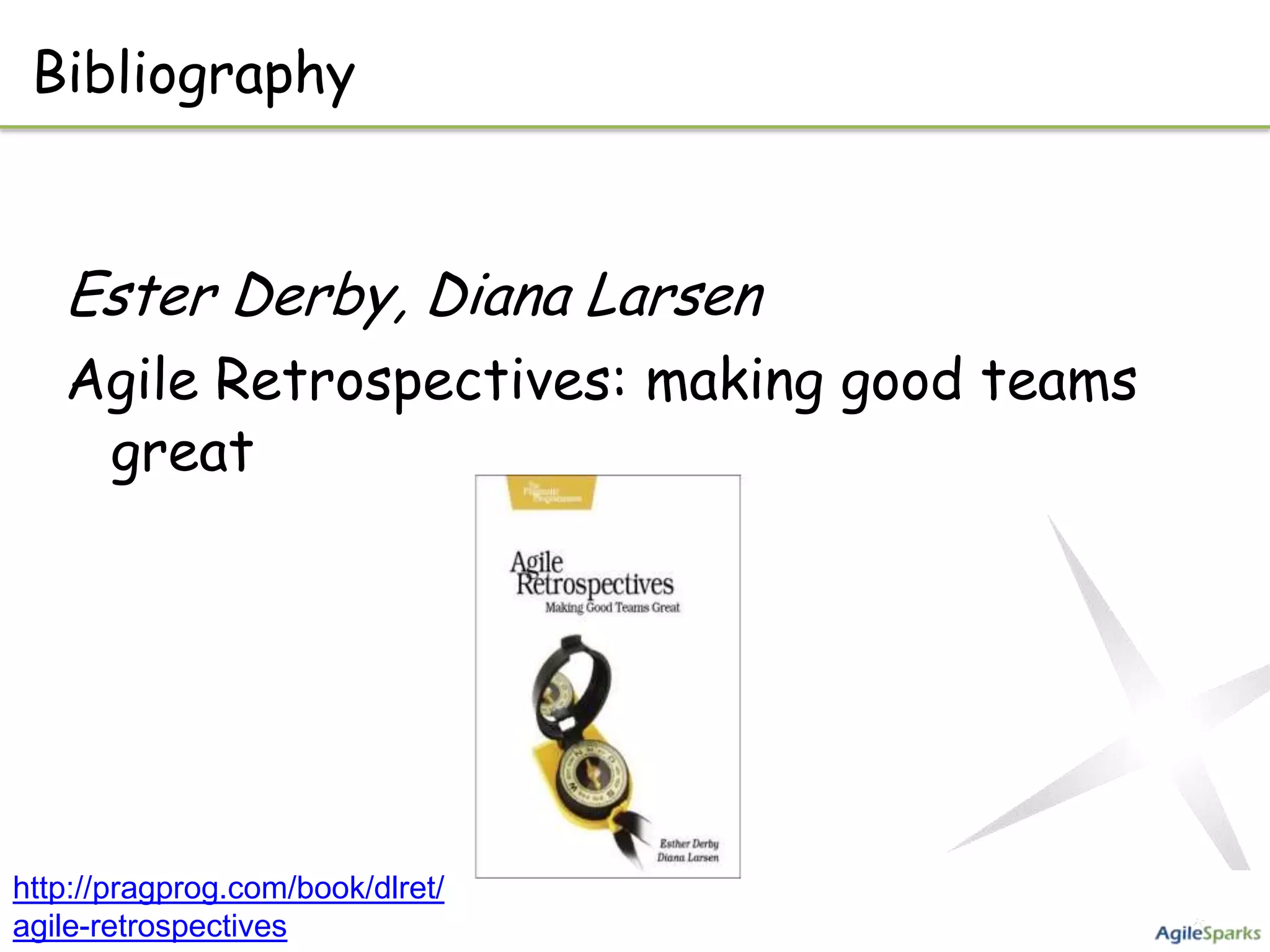
Bibliography


   Ester Derby, Diana Larsen
   Agile Retrospectives: making good teams
    great


http://pragprog.com/book/dlret/
agile-retrospectives
Bibliography

   Norman Kerth
   Project Retrospectives: A handbook for
     team reviews


http://www.dorsethouse.com/books/pr.html
Tips
•Split into small groups to narrow down actions (helps with large teams
or with quiet members)
•Use a space without a table
•Write the output on a flip chart and stick it up in the workspace where
all can see
•Location, location, location - find a good spaces and mix it up so not
always in same place
•Food (especially nice food like cakes & biscuits) is an excellent way to
make the session more appealing and is a great leveller.
•Use a facilitator from outside the team (e.g. another team's scrum
master)
•Swap the facilitation role within the team: don't let it fall to the same
person (coach, scrum master) each time
•Plan your retrospectives - don't just turn up and run it the same way
each time.
•Throw away everything from the retrospective except the retrospective
actions. Focus on outcomes, not problems.
More References/Credits


    • Appreciative Retrospectives -
      http://www.ayeconference.com/appreciativeretrospecti
      ve/
    • http://retrospectivewiki.org
    • http://groups.yahoo.com/group/retrospectives
    • http://www.clearlearning.ca/pdf/ADA.pdf
    • http://www.diigo.com/user/yyeret/retrospectives
    • http://jamesshore.com/Agile-Book/retrospectives.html

    • This presentation was created and evolved by the
      AgileSparks Coaching team. Feel free to use/remix for
      non-commercial purposes.
      We appreciate the credit though…

Effective Agile Retrospectives

  • 1.
    At regular intervals,the team reflects on how to become more effective, then tunes and adjusts its behavior accordingly.” Agile Manifesto principle
  • 2.
    Why Retrospect Credit: AgileRetrospectives – Making good teams Great by Esther Derby & Diana Larsen http://pragprog.com/book/dlret/agile-retrospectives
  • 3.
    Why Retrospect Learning Reflection is a key step in learning from experience Ownership Gives a team a way to adapt process to their context Communication Each member of the project team has different experience and when we share these perspectives we understand each other better
  • 4.
    Retrospective Cycle •Often – – remember what happened Custom event – Small direction changes Sprint – Tight Iteration/ Feedback loop Release
  • 5.
    What its NOT Focus on system/process RATHER than individuals – “A bad system will DEFEAT a good person every time. “ Deming – Although SOME problems are really PEOPLE problems, a retrospective is NOT the place to solve them! Photo credit: Mike Vidzos http://www.implementingscrum.com/2007/09/04/scary-team-retrospectives-part-one/
  • 6.
    Retrospectives Prime Directive Kerth'sPrime Directive: “Regardless of what we discover, we must understand and truly believe that everyone did the best job he or she could, given what was known at the time, his or her skills and abilities, the resources available, and the situation at hand.” http://www.retrospectives.com/pages/retroPrimeDirective.html
  • 7.
    Negating the Negative Amessage wrapped in a complaint may be worth listening to, but the negative packaging can harm the learning process Retrospective format should use activities which try to diffuse the negative nature of complaints ..
  • 8.
    http://jamesshore.com/downloads/art-of- agile/retrospective-format.pdf
  • 11.
    Credit: Agile Retrospectives– Making good teams Great by Esther Derby & Diana Larsen http://pragprog.com/book/dlret/agile-retrospectives
  • 12.
    Positive/Appreciative Goal • Set the Stage: State an affirmative goal for the session. Choose among goals like: • During this retrospective, we’ll find ways to amplify our strengths in process and teamwork. • In this session, we’ll discover where we added the most value during our last iteration and plan for increasing the value we add during the next iteration. • The goal for today’s retrospective is building on our best uses of engineering practices and methods. • We’re going to seek out our highest quality working relationships and find ways to expand on the
  • 13.
    Engage Everyone • If applicable - Determine Safety • Determine interest – ESVP • Engagement Circle – One new thing about himself/the team/the last iteration that wasn’t mentioned/known before
  • 17.
    Review Available Data • Velocity Trend (Control Chart) • Cycle Times Control Chart • Cumulative Flow Diagram • Bonus points for: Time-lapse of Kanban Board… • Blocked Items History
  • 18.
    For Short Retrosuse Plus/Delta
  • 19.
    Energy Seismograph Variants: Stress/Pace, Burndown Idea and photo credit: http://www.scrummaster.com.au/Article.mvc/Detail/8
  • 20.
  • 21.
    http://jamesshore.com/downloads/art-of- agile/retrospective-format.pdf
  • 25.
  • 26.
    Dot Voting –Prioritize to Focus
  • 27.
    5 Whys Photo Credit:http://www.velaction.com/5-whys/
  • 28.
    Appreciative Futurespective • Imagine we could time travel to the end of the next release. When we arrive there and converse with our future selves, we hear that it was the most productive, most satisfying effort we’ve ever worked on. What do you see and hear in that future time? • Wait 2 or 3 minutes for team members to connect with this vision. Then ask: “What changes did we implement now that resulted in such productive and satisfying work in the future?” • Write down all the answers / Silent Brainstorming • [Silent] Grouping
  • 32.
    Retrospective Planning Game • “Which ideas and actions build on our successes, meet the situational (or customer) needs, and tap our greatest energyCreate a list of potential action steps. • Create backlog – Goals/User Stories • Groom the backlog so each goal is SMART, or as User Story is INVEST… • Prioritize based on – “What are we best positioned to try next?” – “What do we really want to try (or sustain)?” • Estimate highest priority US (in SP!) • Decide on budget/capacity to allocate to improvements, and mechanism to sync to the Release backlog • Each committed change should have a volunteer owner
  • 36.
    Retrospective Anti-Patterns/Smells • Hijack • Facilitator too engaged in content • Replaces ad-hoc problem solving
  • 37.
    Anti-pattern – Waitfor the retrospective • Retrospective replaces ad hoc problem solving • You need a problem solved. The retrospective is a place to identify and solve problems. • Antipattern solution: Wait until the retrospective to raise the problem and get it solved. • Consequences: Problem resolution is deferred. The retrospective gets swamped with problems. Not enough time in the retrospective to solve all problems, let alone to explore what is not yet known. • Refactored solution: If you get aware of a problem, raise and solve it outside the retrospective. Enter the retrospective with an open mind to what new things you might discover and want to tackle.
  • 38.
    Anti-pattern – Backto the Future • Retrospectives are about looking back - they even have it in their name. And I remember a lot of problems I had. • Antipattern solution: Focus on talking about what happened. Focus especially on what went wrong. • Consequences: The retrospective becomes a depressive, energy draining meeting no one enjoys. • Refactored solution: Yes, look at the past - to share stories, to further understanding, and to paint a picture of a brighter future. Focus on what you have learned, on what you want to do differently (or the same!) in the future. Try an Appreciative Retrospective. • Result: A forward looking team with the energy to make a difference.
  • 39.
    Anti-pattern – retrospectiveas reporting/complaining to management • Retrospectives as reporting to management • A problem is perceived to be only solvable with management involvement/approval. • Antipattern solution: Create actions that need management involvement or approval. • Consequences: Problem resolution is dependent on management taking action. If management has different priorities, nothing happens. Retrospectives degenerate into complain sessions, where you don't even expect to be able to make a difference. • Refactored solution: For every problem, come up with at least one action that doesn't need management involvement or approval, and will improve the situation at least a bit. • Result: Continuous improvement, however small. Team members get a better feel for the power they actually have. Managers see team members take initiative. They might even get interested in getting involved in the ongoing change.
  • 40.
    Facilitating a retrospective • Preparing • Leading the session • Closure & Follow-up
  • 41.
    Preparing • Schedule/Length- Rachel Davies suggests 30 minutes for each week (1:30 hours for 3w sprint, whole day for iteration) – Face to Face >= Video Conf >= Telephone • Location – Offsite for iteration, Good meeting room for sprint – White boards (More than one / Flip chart) – Supplies (Markers, Sharpies, Stickies, Dots) • Decide which exercises (various alternatives for each stage – mix it up from time to time) • Prepare the room
  • 42.
    Leading the retrospective • Facilitator vs team member role • Handle different personalities – Quiet – Overbearing – Passive Aggressive • Handle different cultures • Attitude
  • 43.
    Bibliography Ester Derby, Diana Larsen Agile Retrospectives: making good teams great http://pragprog.com/book/dlret/ agile-retrospectives
  • 44.
    Bibliography Norman Kerth Project Retrospectives: A handbook for team reviews http://www.dorsethouse.com/books/pr.html
  • 45.
    Tips •Split into smallgroups to narrow down actions (helps with large teams or with quiet members) •Use a space without a table •Write the output on a flip chart and stick it up in the workspace where all can see •Location, location, location - find a good spaces and mix it up so not always in same place •Food (especially nice food like cakes & biscuits) is an excellent way to make the session more appealing and is a great leveller. •Use a facilitator from outside the team (e.g. another team's scrum master) •Swap the facilitation role within the team: don't let it fall to the same person (coach, scrum master) each time •Plan your retrospectives - don't just turn up and run it the same way each time. •Throw away everything from the retrospective except the retrospective actions. Focus on outcomes, not problems.
  • 46.
    More References/Credits • Appreciative Retrospectives - http://www.ayeconference.com/appreciativeretrospecti ve/ • http://retrospectivewiki.org • http://groups.yahoo.com/group/retrospectives • http://www.clearlearning.ca/pdf/ADA.pdf • http://www.diigo.com/user/yyeret/retrospectives • http://jamesshore.com/Agile-Book/retrospectives.html • This presentation was created and evolved by the AgileSparks Coaching team. Feel free to use/remix for non-commercial purposes. We appreciate the credit though…

Editor's Notes

  • #43 A rough guide to timings is a team need 30 minutes retrospective time per week under review so using this formula allow 2 hours for a monthly retrospective and a whole day for a retrospective of a several months work.