





Cycles
The simplest,	proven	way	
to build your business.
Build !
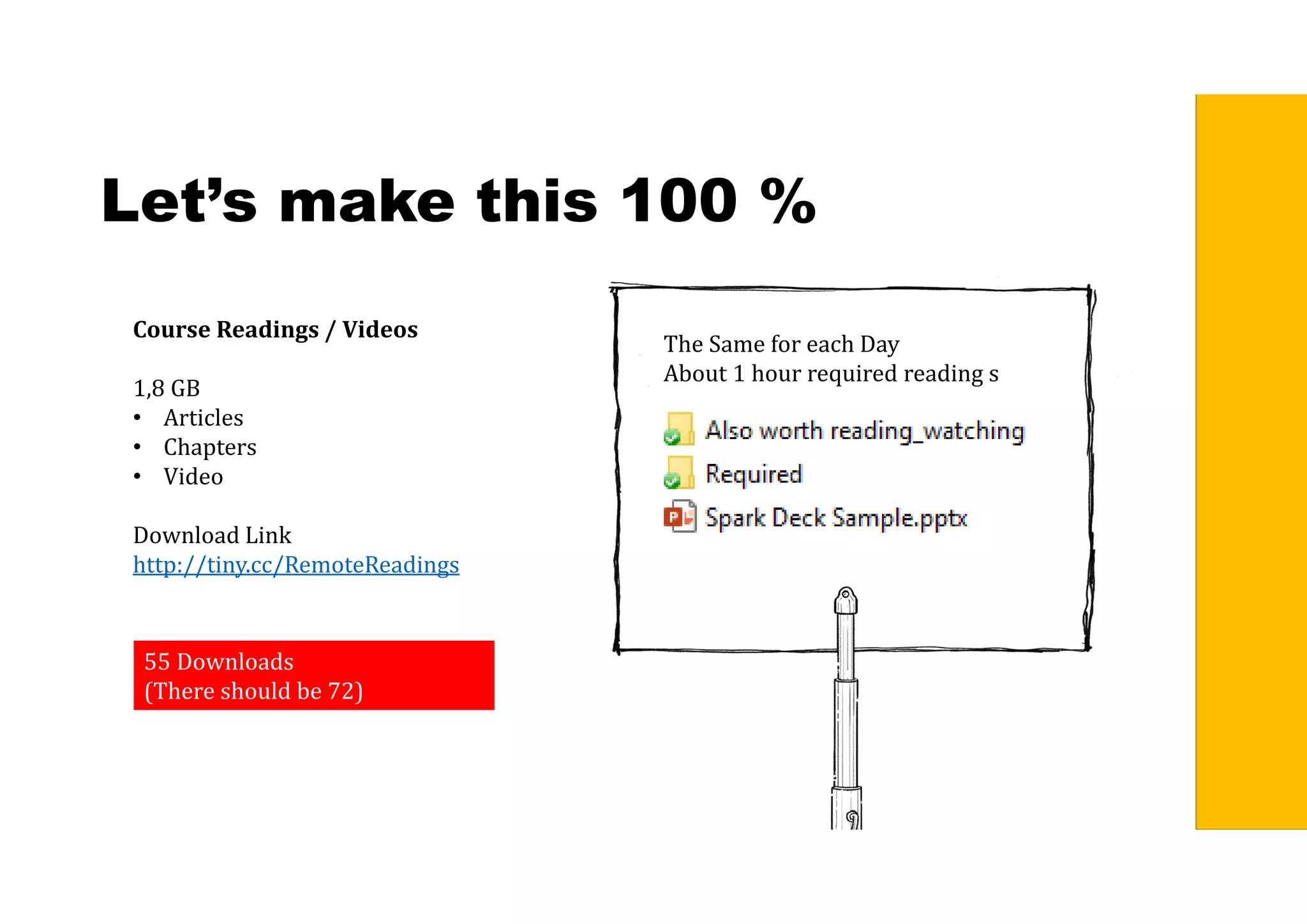
Let’s make this 100 %
Course	Readings	/	Videos	
1,8 GB
• Articles
• Chapters
• Video
Download Link
http://tiny.cc/RemoteReadings
The Same for each Day
About 1 hour required reading s
55 Downloads
(There should be 72)
If you want feedback
• Send your work from yesterday to me in a personal message
by slack
Content today..
What is really known about Idea Building
A proven 7-step process to build more ideas
Deliverable
7	Step	Idea	building
Morning	work	(11:00‐12:30)
1. Familiarize yourself with the objectives and challenge
2. Challenge the problem definition
3. Effectuation
4. Stimulus Mining== > spark decks (11:30-12:30) – 3	slides	per	person	!
Meet Mentor – Ask questions + break time
Afternoon work (14:00 – 17:00)
1. Review spark deck (write ideas) 60 min –(18 slides @ 3 min per slide =54 min)
2. Individual brain writing + Improvements -60 in pairs
3. Group Work – 30 min
4. Re-work – 30 (individual)
DONE for the day. You will vote tomorrow morning
Building Ideas
Question.
What is a Spark Deck ?
Why Useful ?
My Personal Views
We dramatically overrate	the	value	of	ideas
You shouldn’t	worry	about	people	stealing	your ideas
It is not the easiest	step	to	outsource
 Alignment takes strategic insight
 Communication and checking usually requires domain
expertise
 Systems thinking takes time
Idea	Building	is	easy….	and	the	easiest	to	outsource
2 similar views
 It is the process	of	building
 It is the execution	that	counts
 It is not about what you have, but
what	you	make	out	of	it
Steve	Jobs	Interview
Steve Jobs on idea building Build_media1.mp4
https://youtu.be/E1muuId9A7g
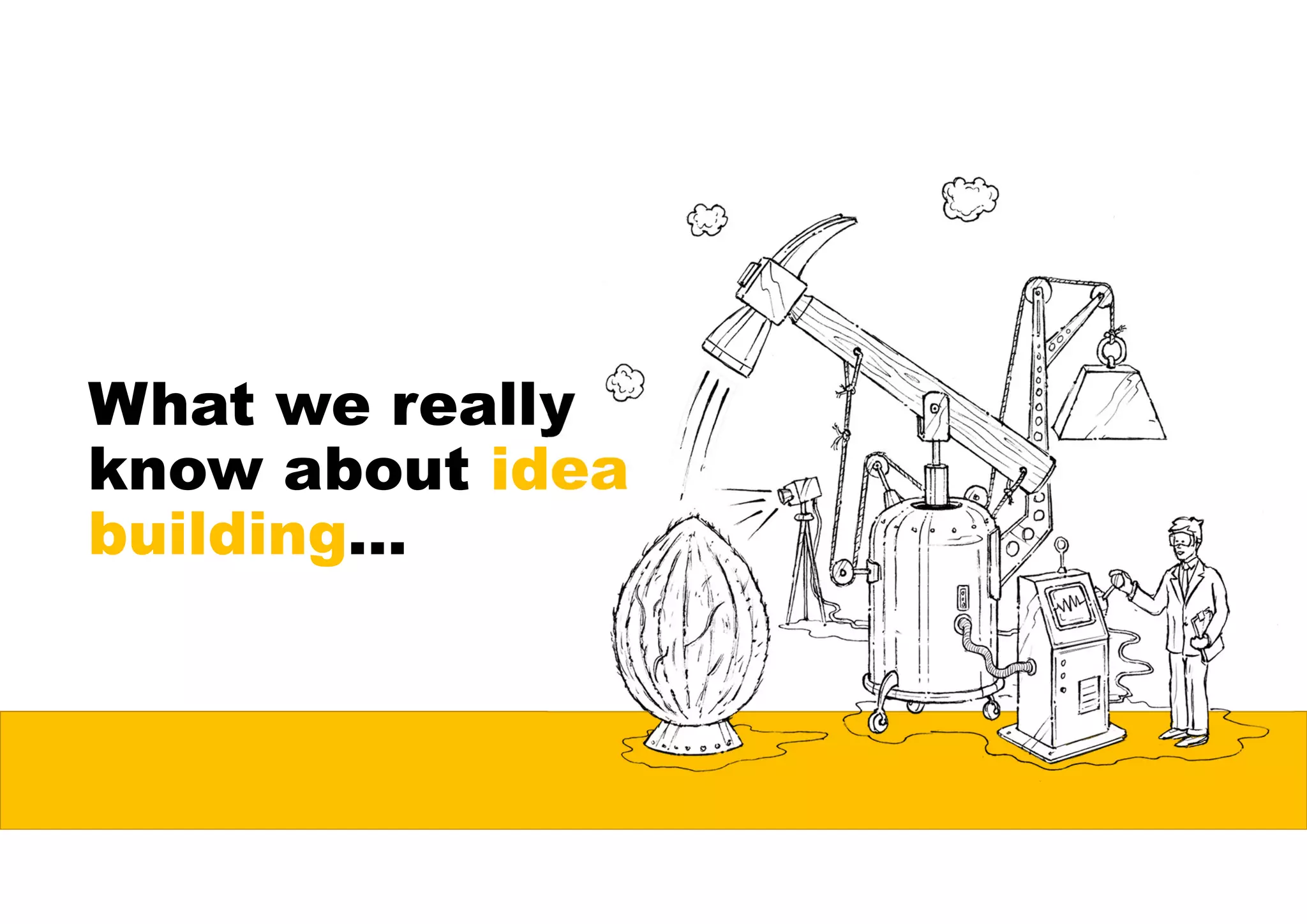
What we really
know about idea
building…
“Inventions Are
Ideas That Have
Sex”
Some say everything has already
been invented. We are just looking
for new combinations
MU =
S
F
D
Meaningfully
Unique Ideas!
Leverage
Diversity
Drive out Fear
=
Explore Stimulus
Ways to build
better ideas
7 + 1 because you’re smart
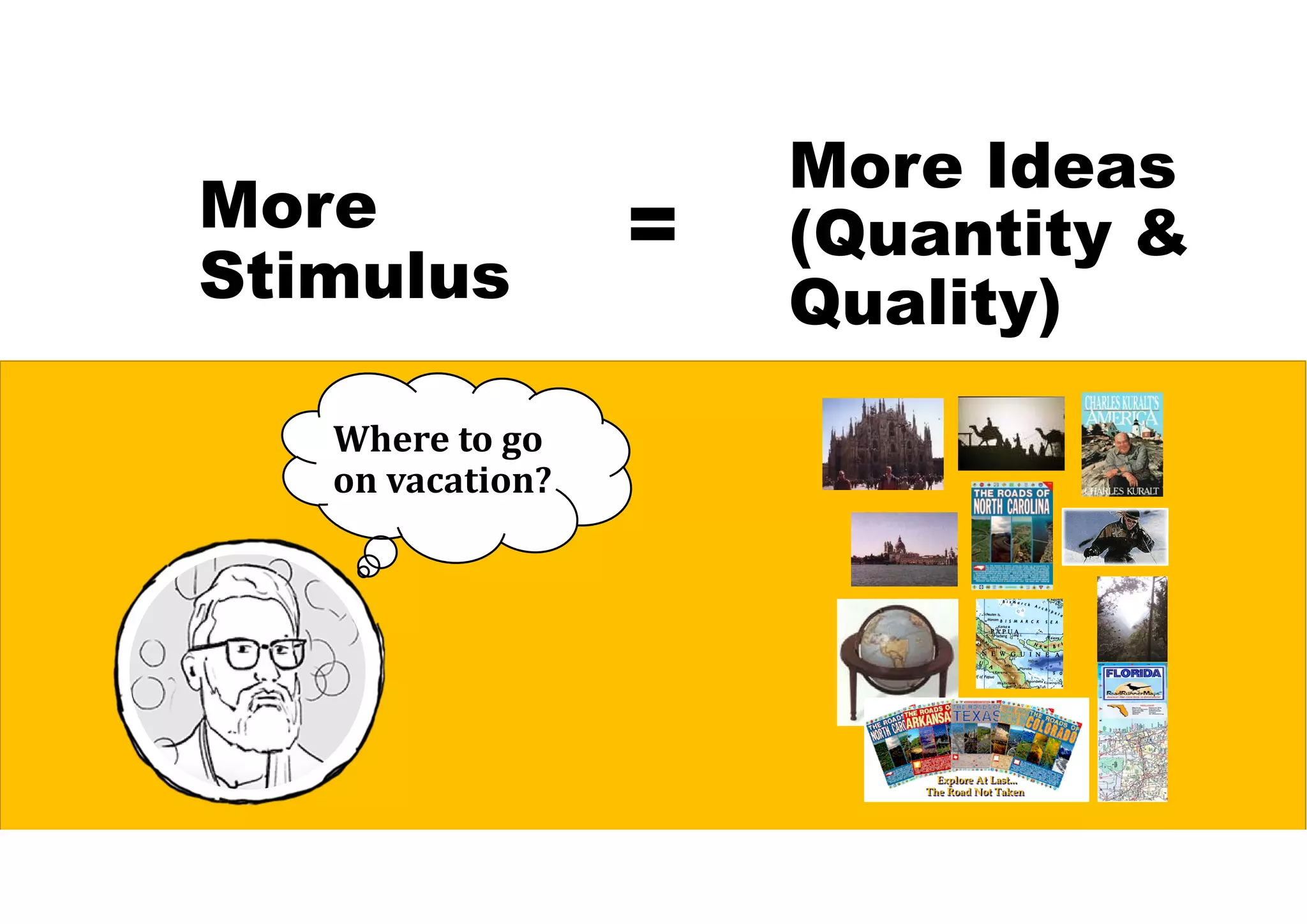
More
Stimulus
=
More Ideas
(Quantity &
Quality)
Where	to	go	
on	vacation?
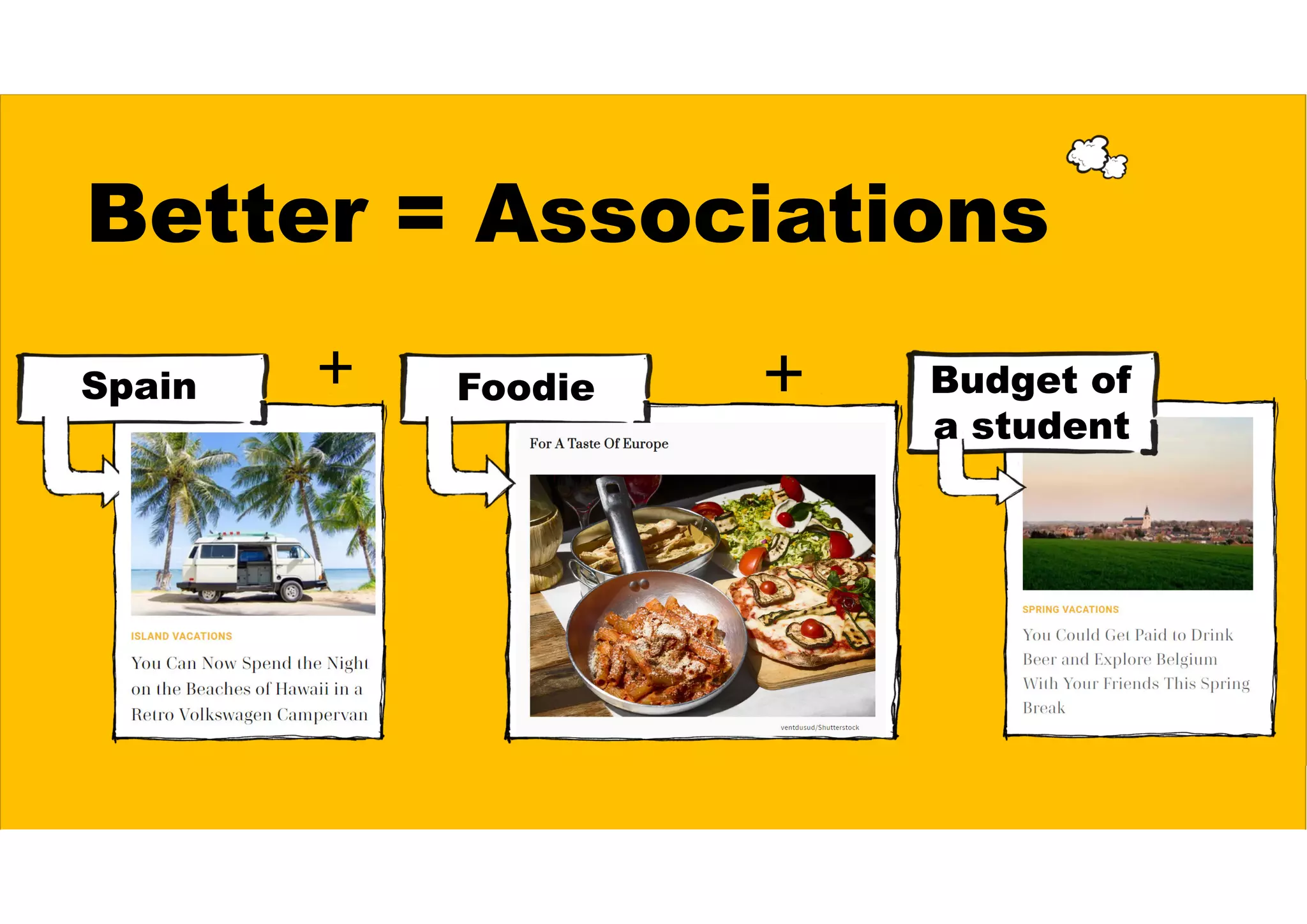
Better = Associations
Spain Foodie Budget of
a student
+ +
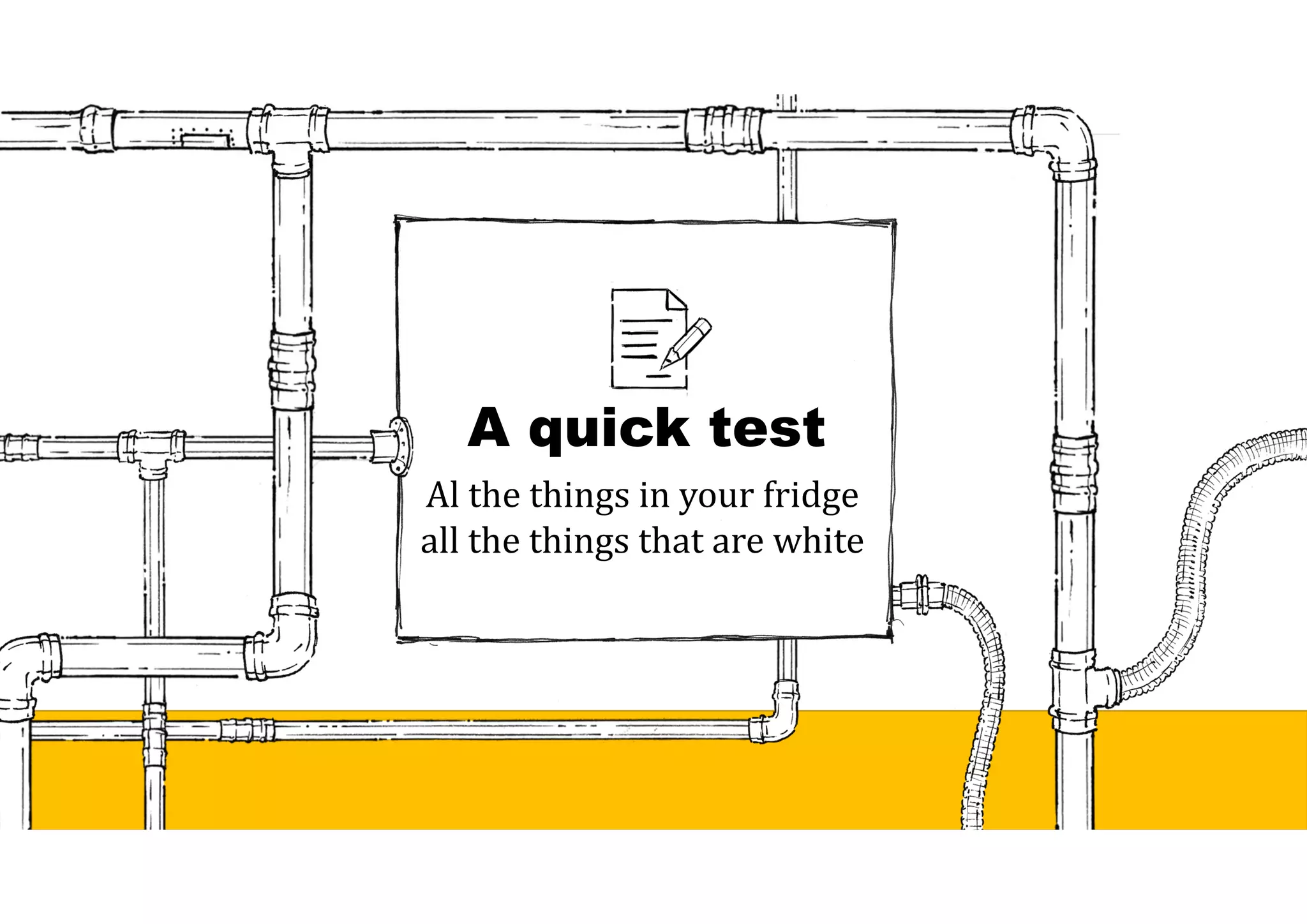
A quick test
Al the things in your fridge
all the things that are white
9	out	of	10	people	identify	
more	white	things	than	
things	in	their	refrigerator
Spain Foodie Budget of
a student
+ +
Best = HARD Associations
“How	could	
you	do	it	for	
free”
“How	could	
you	get	paid”
Build_media2.mp4
https://youtu.be/REk9afFvsh8
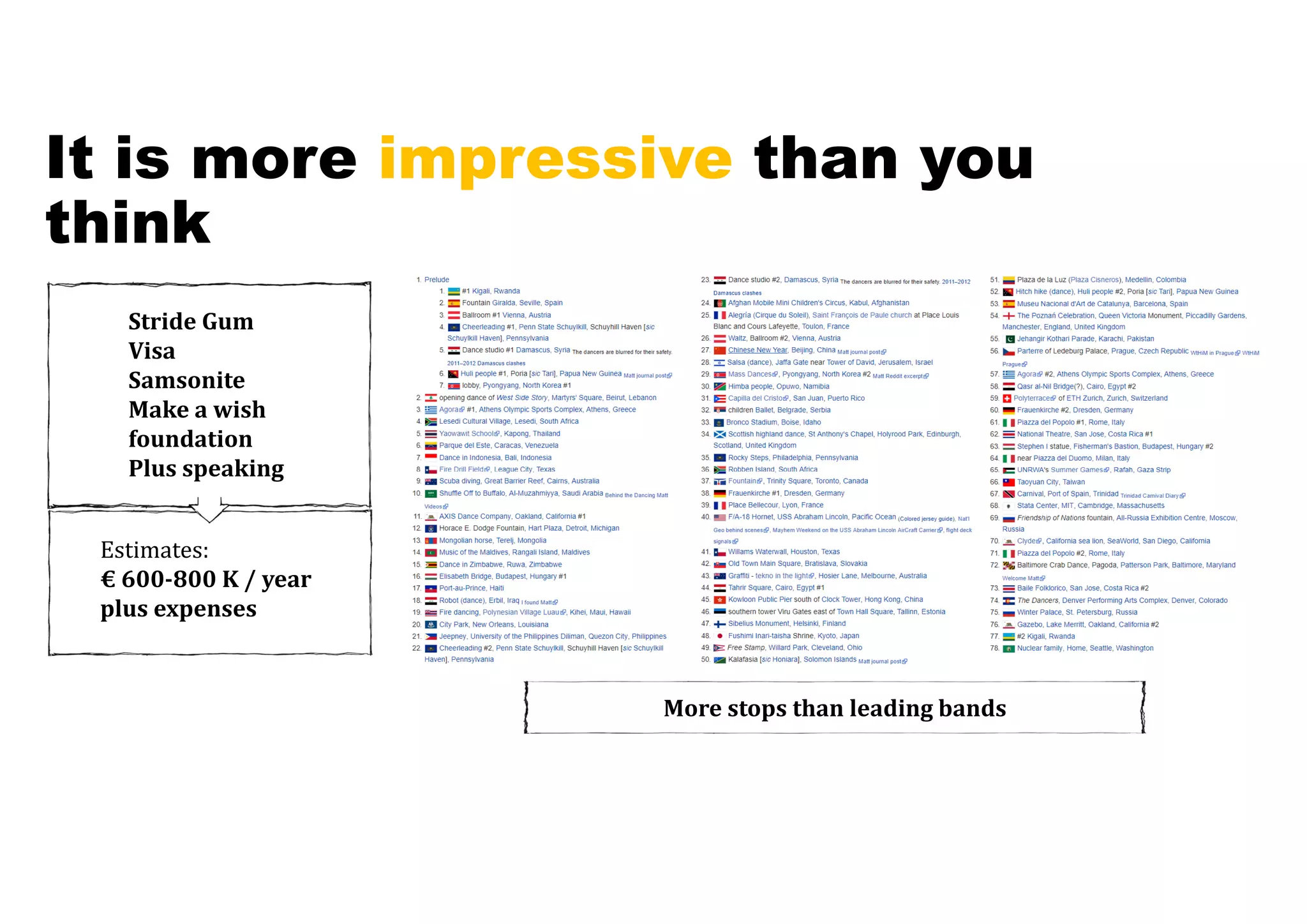
It is more impressive than you
think
More	stops	than	leading	bands
Stride	Gum
Visa
Samsonite
Make	a	wish	
foundation
Plus	speaking
Estimates:
€	600‐800	K	/	year
plus	expenses
Imagine this…
BMW has some of the best
designers in the world and sells
their designers by the day
below	cost
Why?
To build creativity…
The world’s biggest ideas
are built around needs
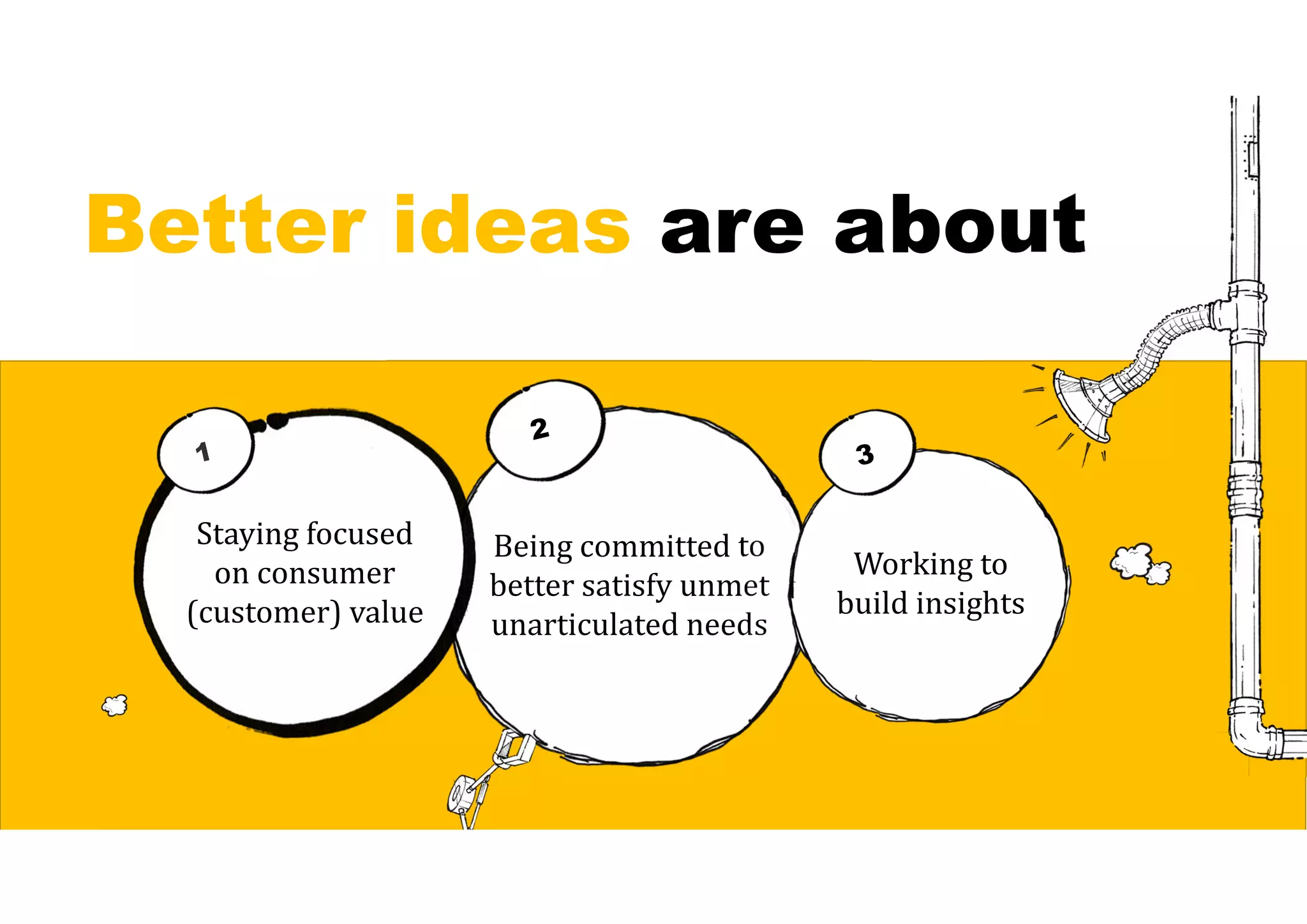
Better ideas are about
Staying focused
on consumer
(customer) value
Being committed to
better satisfy unmet
unarticulated needs
Working to
build insights
Why?… Needs first, not ideas
first !
Develop
a	solution
Find
a	need
Find
a	need
Develop
a	solution
Find
a	market
IDEAS first
NEEDS first
5 - 10%
Find
a	market
70%
Success	rate	*
*	According	to	Strategyn	research	on	outcome	driven	innovation…
JTBD: Create a mood with
music
1984
Optical
2001
Hard	Drive
2007
Cellular
2015
Streaming
Better	Mood	/	lists	 All	in	one	place	 Simpler
It is more
than talking to
consumers
Many times the
consumer can NOT know
today’s	
business
unexploited
opportunities
unexploited
opportunities
unexploited
opportunitiesArticulated
needs
Mobile	
phone
Computers
Internet…
It is about hard questioning…
You can't just ask consumers what they want
and then try to give that to them.
Sometimes (actually often)
they don’t know what they want.
It is often about
“golden	questions”.
Example Cat food
I was running a data company with data on 8 million household in the UK
Analysed socio-demo
Psychographic
Nothing worked !
One	questions	to	identify	to	Sheba	buyers
Hint: Think of the role of the cat in the family
JTBD : Part of the family
What	is	the	question	?
Do	you	buy	you	cat	a	
Christmas	present	
worth	more	than	€20
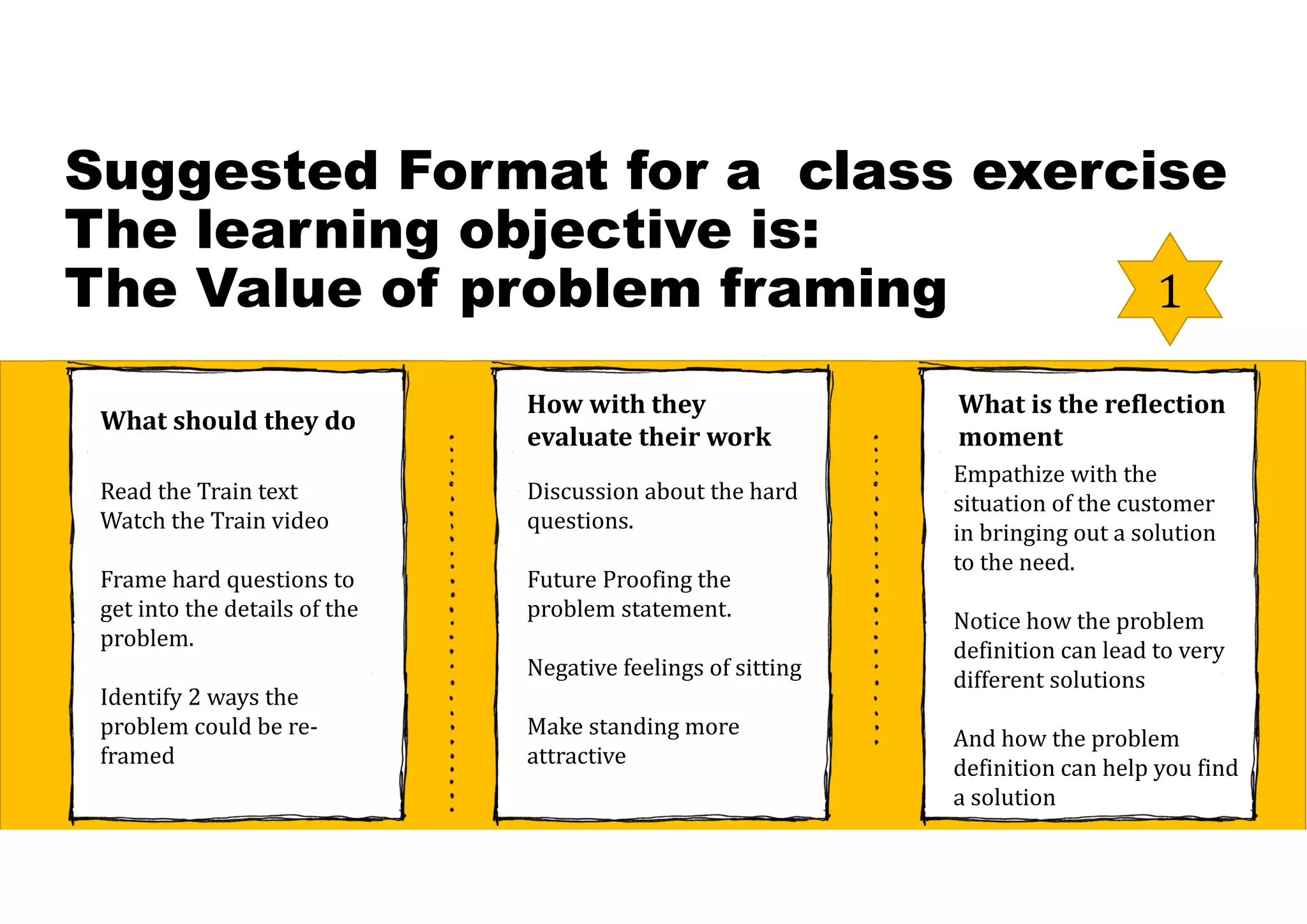
Suggested Format for a class exercise
The learning objective is:
The Value of problem framing
Read the Train text
Watch the Train video
Frame hard questions to
get into the details of the
problem.
Identify 2 ways the
problem could be re-
framed
What	should	they	do
Discussion about the hard
questions.
Future Proofing the
problem statement.
Negative feelings of sitting
Make standing more
attractive
How	with	they	
evaluate	their	work	
Empathize with the
situation of the customer
in bringing out a solution
to the need.
Notice how the problem
definition can lead to very
different solutions
And how the problem
definition can help you find
a solution
What	is	the	reflection	
moment
1
Bad and / or unoriginal
ideas are as important as
good ideas
The big innovation Paradox
Whoever Makes the
Most Mistakes Wins
Richard	Farson &	Ralph	Keyes
Suggested Format for a class exercise
The learning objective is:
Identifying potentials from failed business ideas
Read the case handouts on
failed business ventures
Come out with possible
reasons for failure.
One big idea that would’ve
made it a success.
What	should	they	do
Discuss probable reasons
for failure.
Present your idea of
revamping business to
others
Take a vote on potential to
succeed for the idea.
How	with	they	
evaluate	their	work	
Lessons from failure
What could go wrong when
not understanding the
need.
The problem with
communicating the
solution.
What	is	the	reflection	
moment
Breakfast	Cola
Even big businesses make mistakes, and DailyFinance lists Pepsi A.M. as one of the biggest product flops of all time. Why did Pepsi think
people would want cola for breakfast? Well, it does have caffeine, so why not assume it can replace coffee? Yeah, right. By the way, Crystal
Pepsi, a clear cola, flopped as well.
One possible lesson: Base your products on market testing rather than assumptions.
Colgate	Frozen	Meals
Selling	to	the	Masses	says Colgate heavily marketed their line of frozen meals, but to no avail. The big Colgate logo on the boxes made people
associate the food with the flavor of toothpaste, which apparently isn’t what they want their meals to taste like.
One possible lesson: Like Ben-Gay Aspirin, be careful about the associations attached to your label.
3
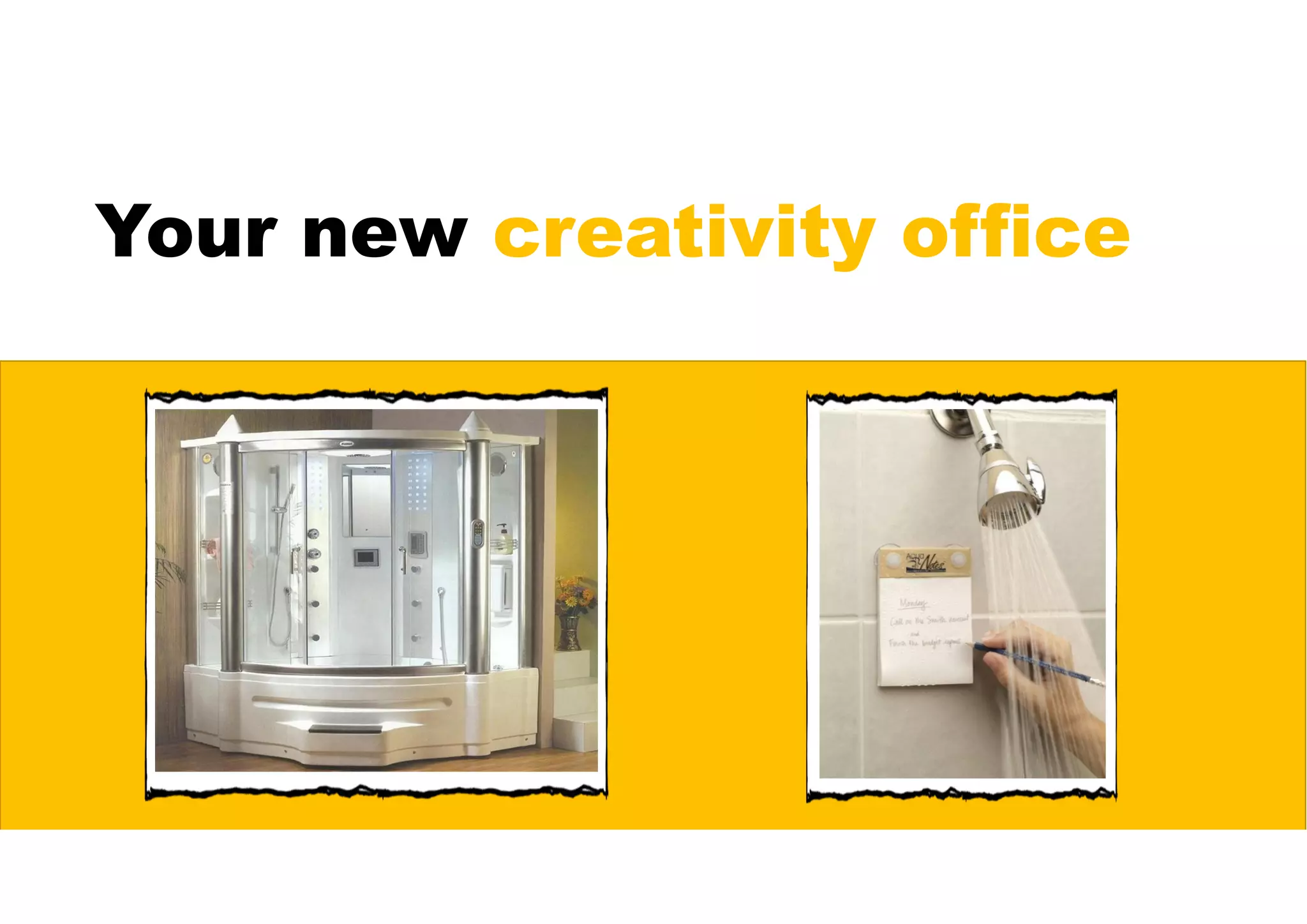
Ideas come
when you have time to
think…
Your new creativity office
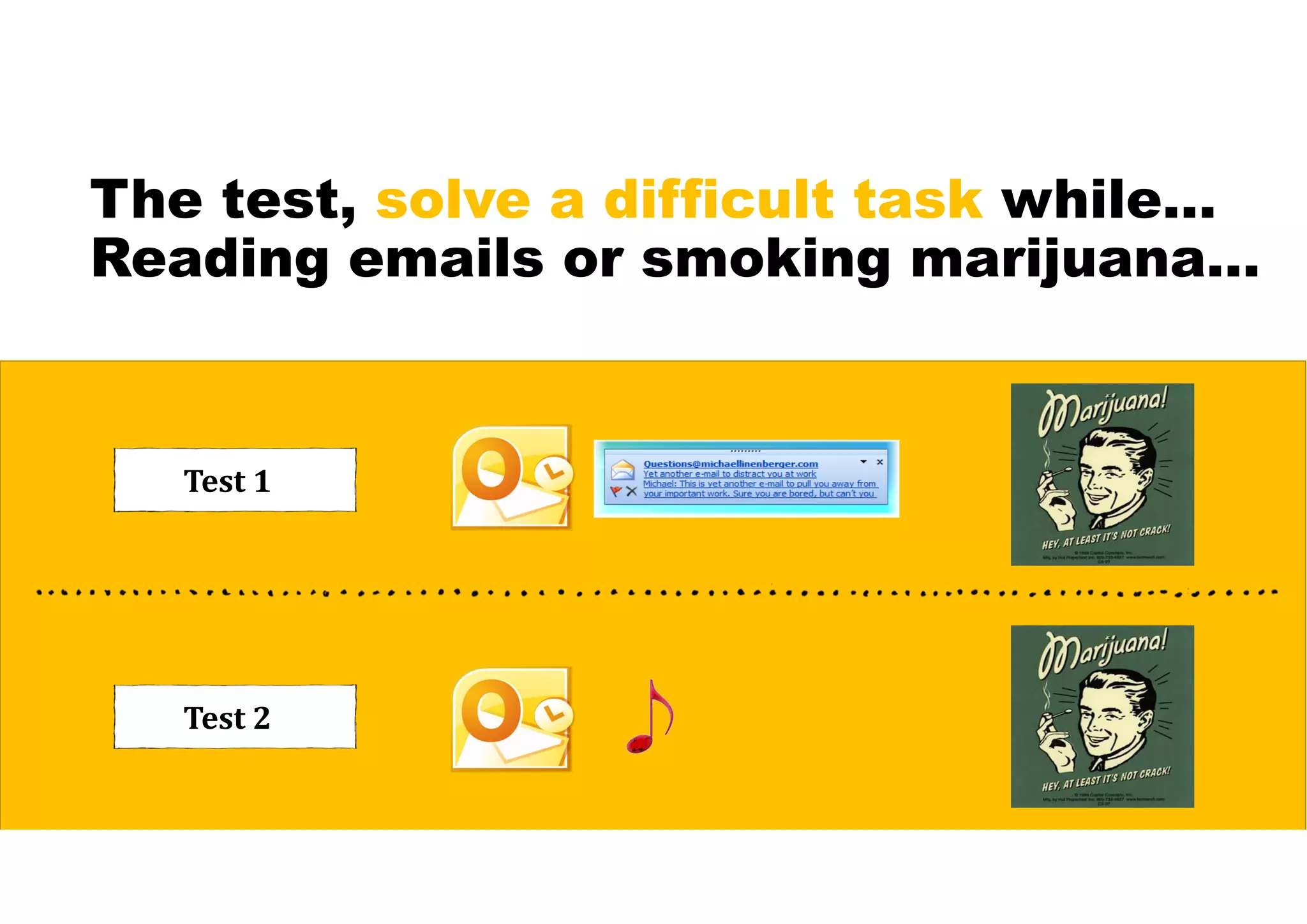
The test, solve a difficult task while…
Reading emails or smoking marijuana…
Test	1
Test	2
A few simple
ideas
 Stop the email notifications
 No internal email Fridays
 5,10,20% time like 3M, Google
 Get people to block (and keep) time for
creativity in their agendas
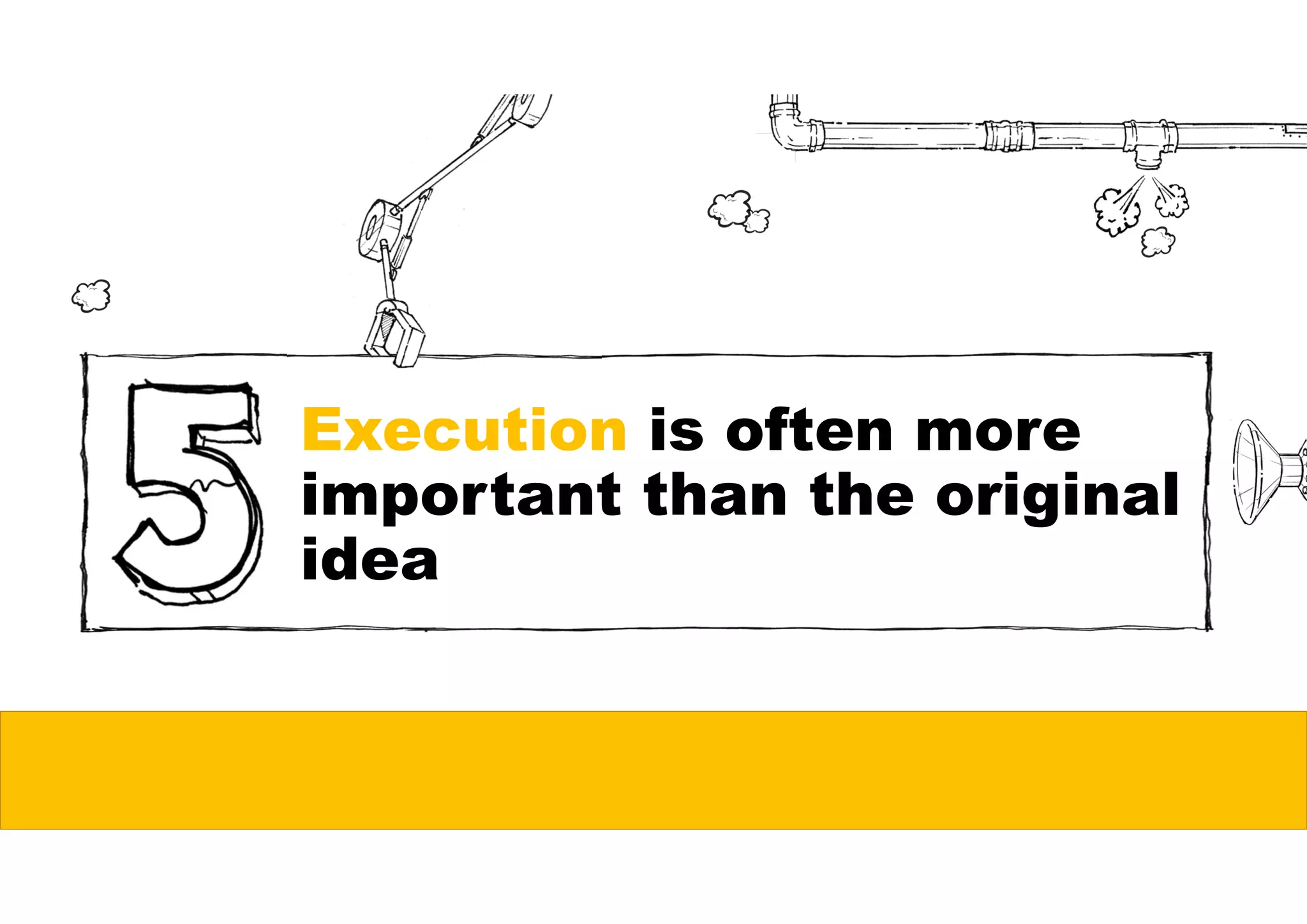
Execution is often more
important than the original
idea
The danger of Internet
A	big	
IDEA
Look	it	up	on	
the	Internet
Someone	has	
done	it	already
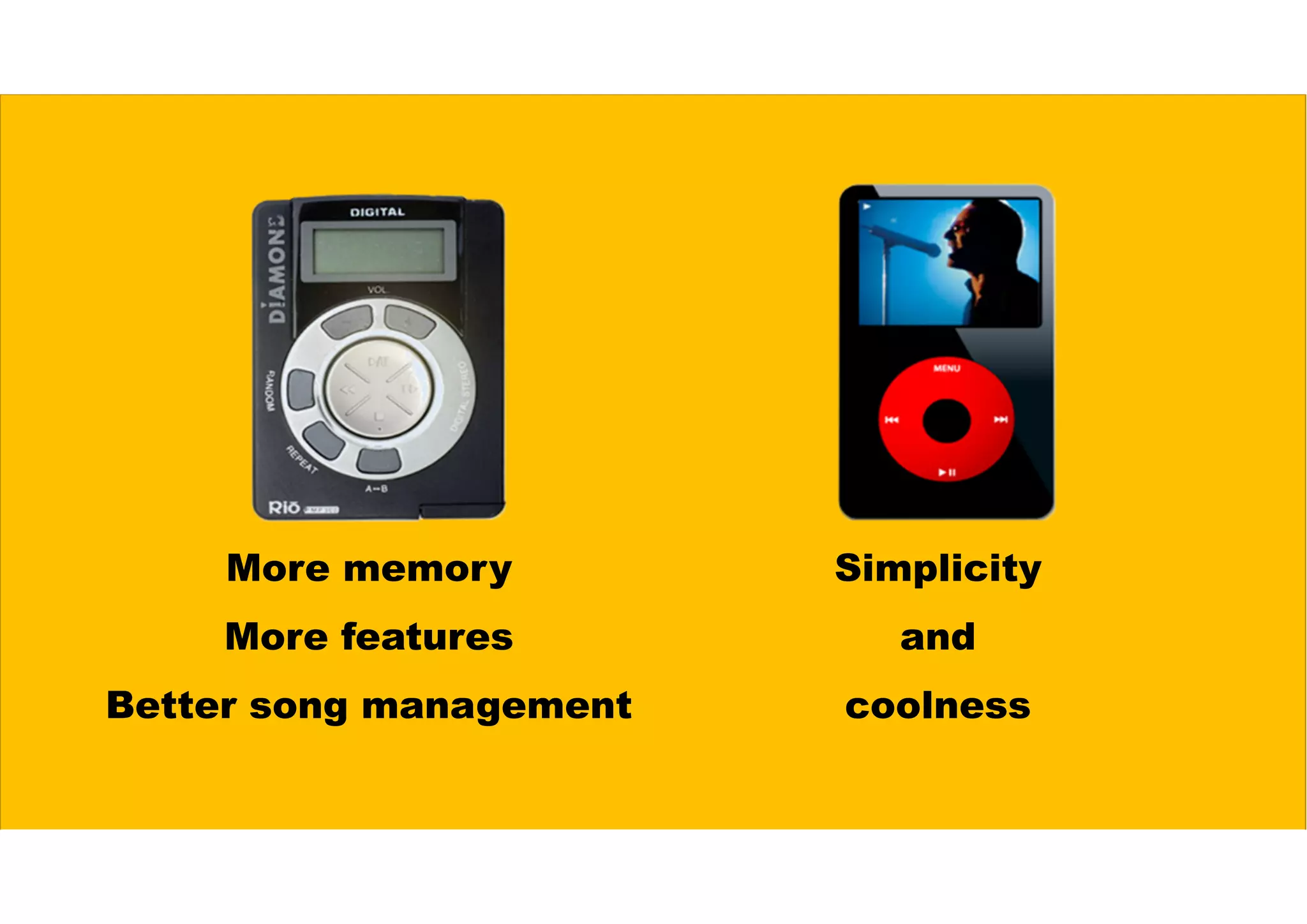
How many people
think Apple invented
the MP3 player?
Almost
of US consumers
More memory
More features
Better song management
Simplicity
and
coolness
More examples
Diversity Drives
Creativity
 Have each group work collectively
 When one agent gets stuck at a point,
another agent tries to find a further
improvement.
 Group stops when no one can find a
better solution.
BEST
20	agents
RANDOM
20	agents
1 2
The IQ View
Alpha	Group
121
132 155
139
135
137
Diverse	Group
121 84 111
105 135 95
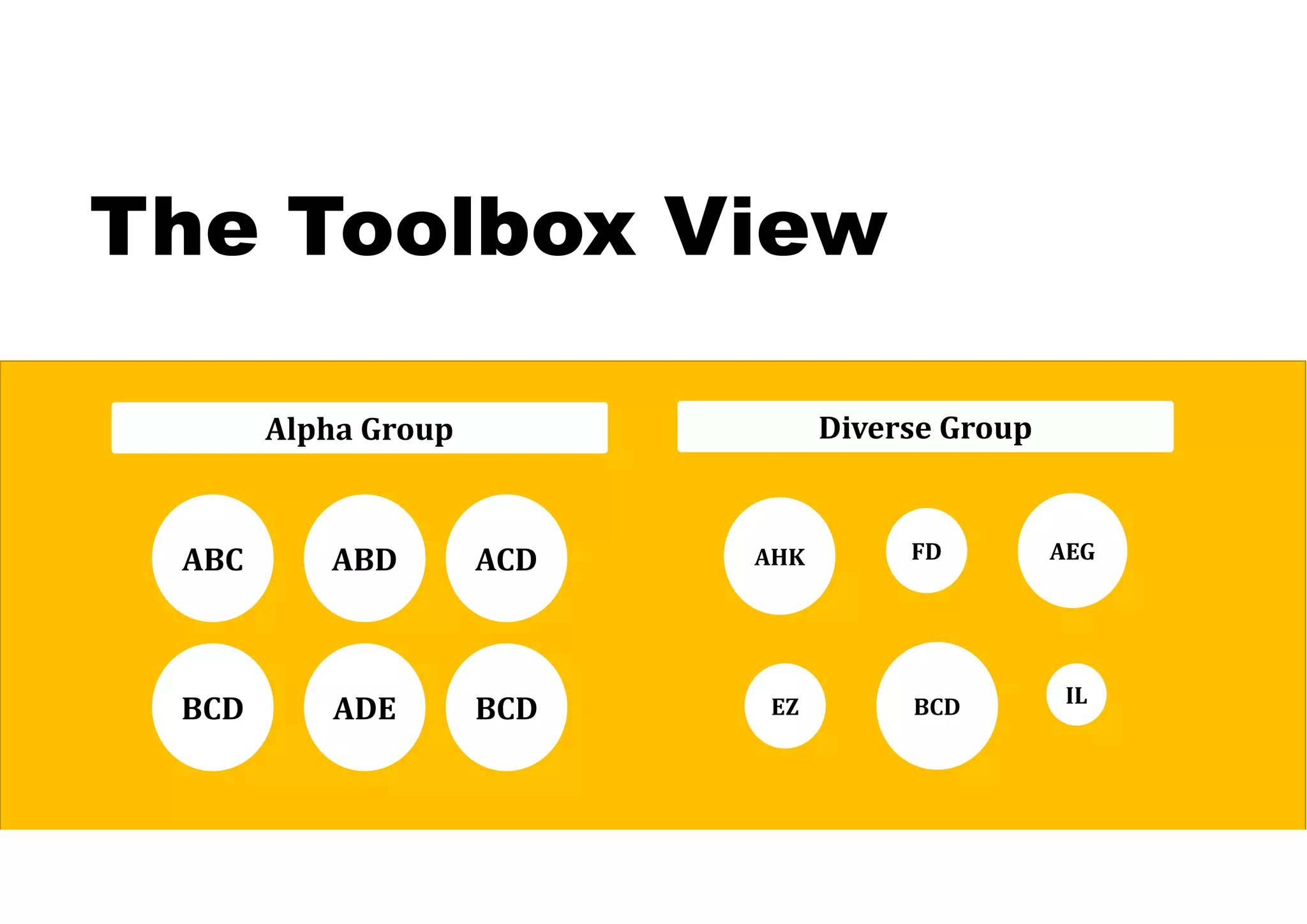
The Toolbox View
Alpha	Group
ABD
ADE BCD
ABC
BCD
ACD
Diverse	Group
AHK FD AEG
EZ BCD IL
“Bringing	new	members	into	the	organization,	even	if	
they’re	less	experienced	and	less	capable,	actually	
makes	the	group	smarter	simply	because	what	little	
the	new	members	do	know	is	not	redundant	with	what	
everyone	else	knows.”	
James	Surowiecki
author	Wisdom	of	crowds..
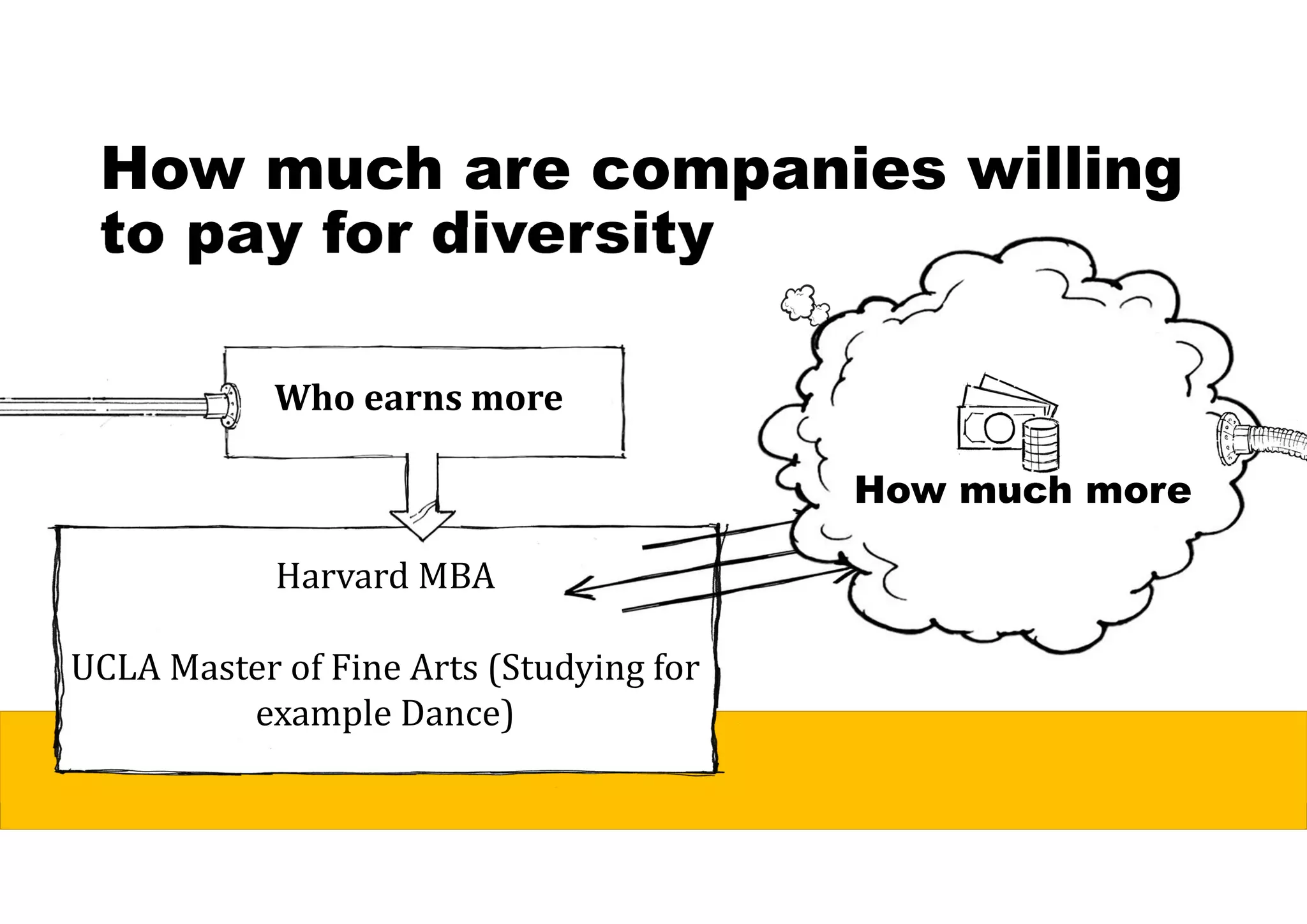
How much are companies willing
to pay for diversity
Who	earns	more
Harvard MBA
UCLA Master of Fine Arts (Studying for
example Dance)
How much more
* MFA = Masters of Fine Arts
A	UCLA	MFA	3	X	
harder	to	get	into	
than	Harvard	MBA
The	bigger	surprise…
Average	starting	
salaries	for	MFAs	are	
now	higher	than	MBAs
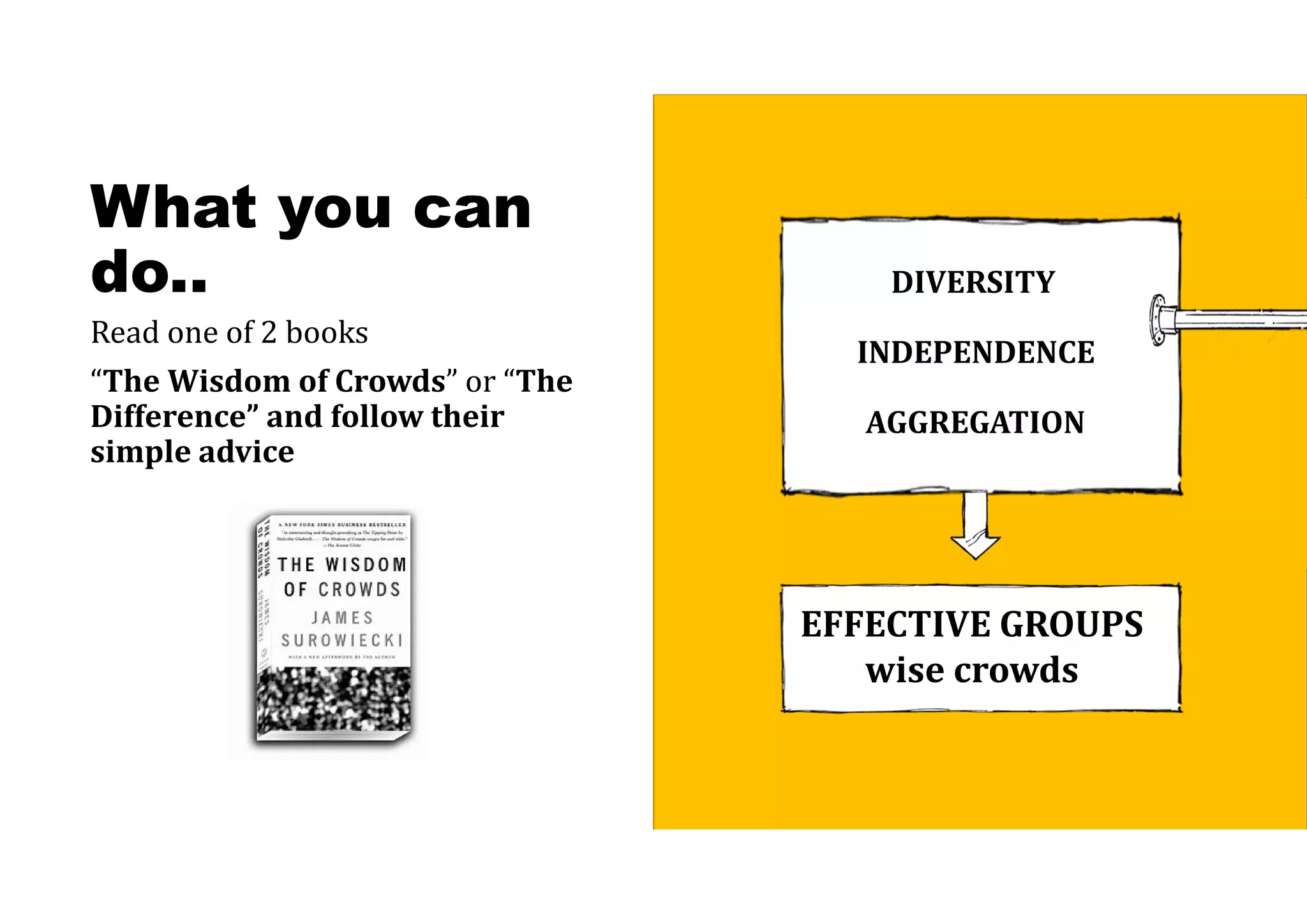
What you can
do..
Read one of 2 books
“The	Wisdom	of	Crowds” or “The
Difference”	and	follow	their	
simple	advice
DIVERSITY
INDEPENDENCE
AGGREGATION
EFFECTIVE	GROUPS
wise	crowds
DIVERSITY
INDEPENDENCE
AGGREGATION
EFFECTIVE	GROUPS
wise	crowds
A sideline on brainstorming
1+1= 5
With individual first
1+1 = 3
What	else	…
learn	to	be
and	enjoy	being	different
Persistence
Counts
Why Persistence
 80% of the big ideas are after day 1
 Ideas need time
 Ideas need to grow
 Quantity is the best predictor of quality
Pottery (Students graded by weight vs. best 3)
90% of the top 3 in the weight group
 Persistence is what makes less	creative	people	
usually better idea builders
What is Persistence?
 Modify expectations short-cut to long haul
 Learn to love NO’s and failures
 Think in terms of progress not perfection
 Focused, relentless idea building
 Act until Echo
Then repeat
What	do	you	think	is	the	
biggest	difference	between	
highly	creative	people and	
others	?
Problem finding
instead of solution
finding…
Different Mindsets
Average Idea builders
 Let’s get started
 Where have I seen similar
problems
 What solutions come to
mind
Pattern	Seekers
Solution	Addicts
Expert Idea builders
 Why is this a problem?
 Do we understand this
issue correctly?
 Are there other ways of
looking at it?
Pattern	Breakers
Problem	Finders
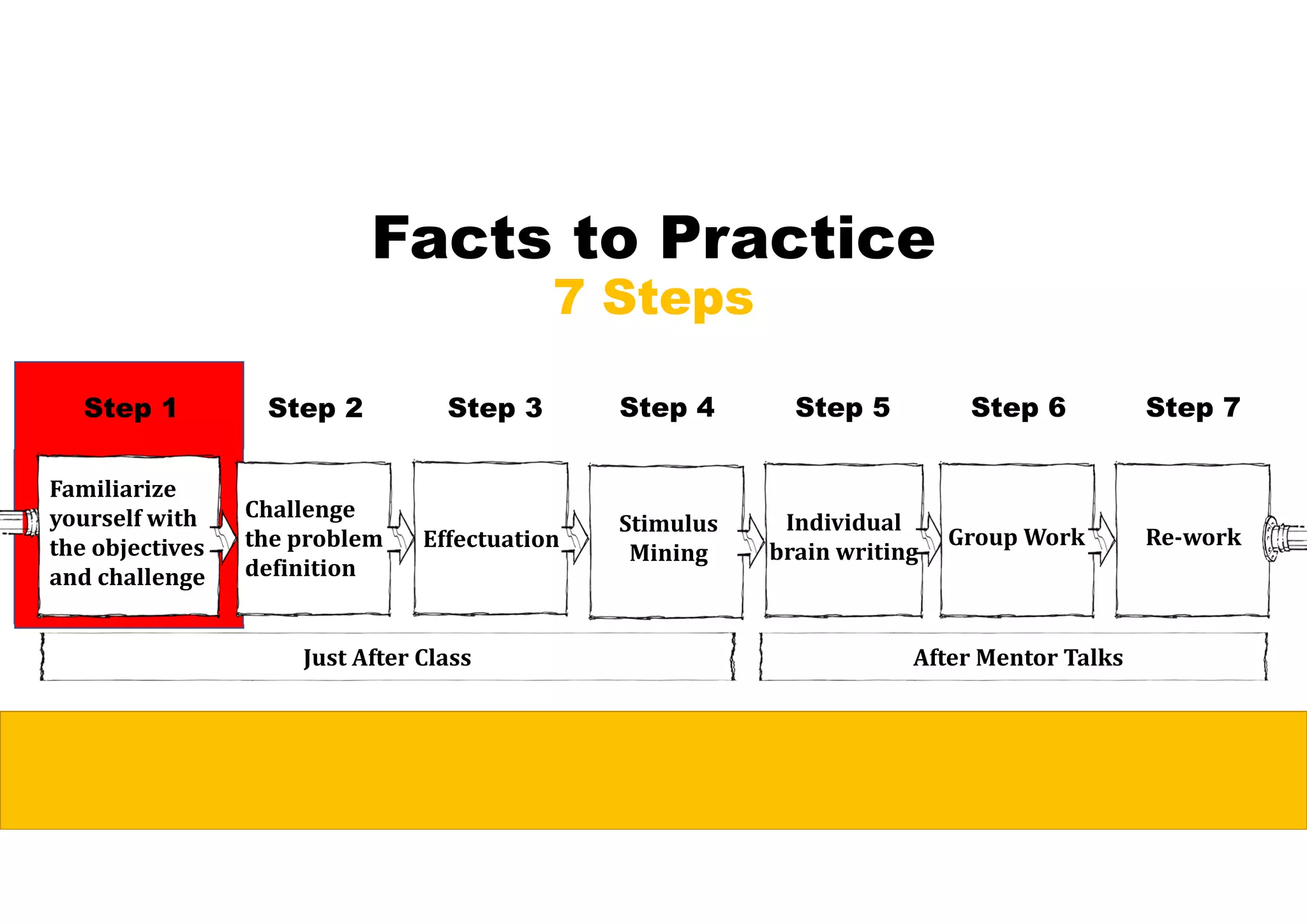
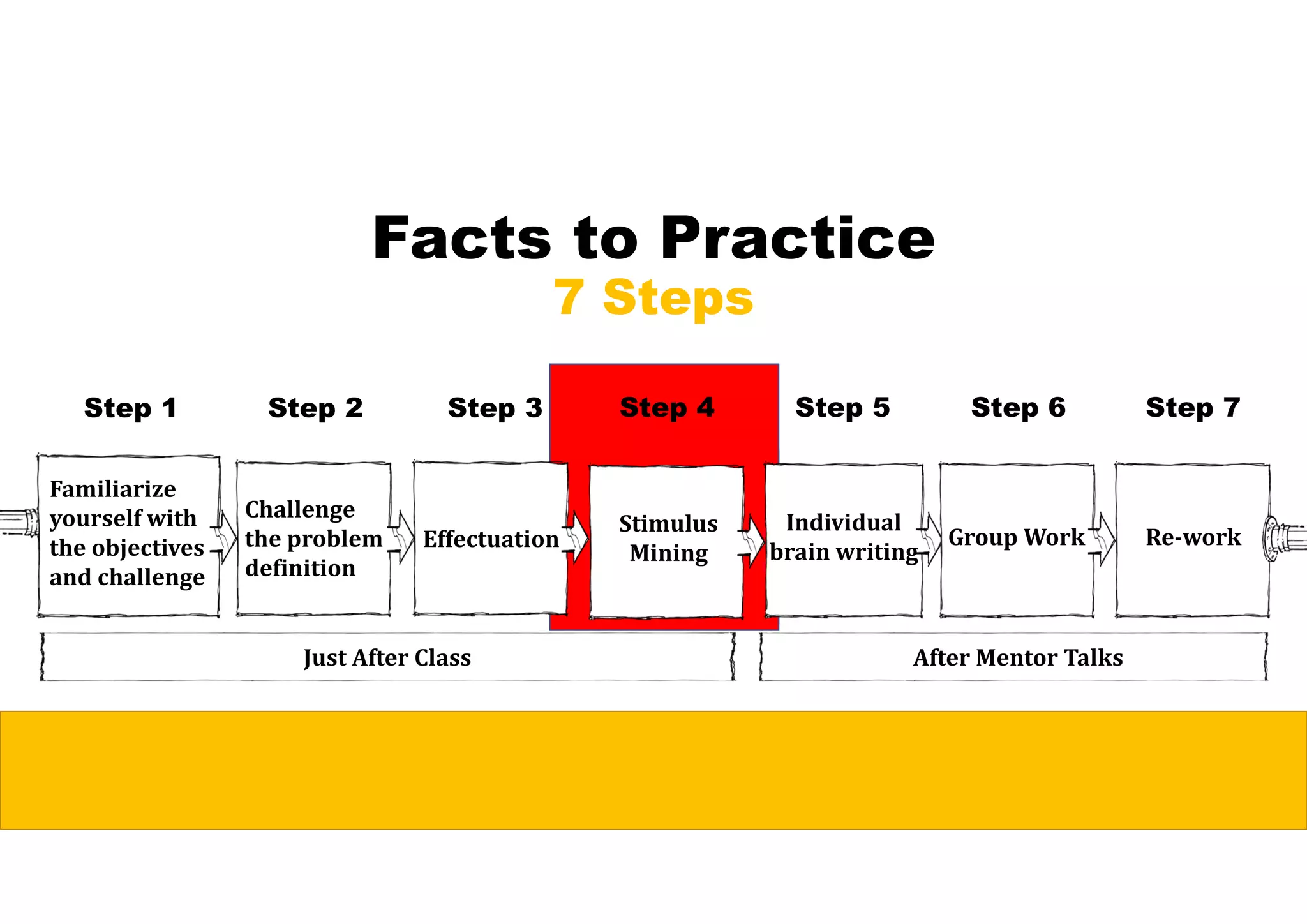
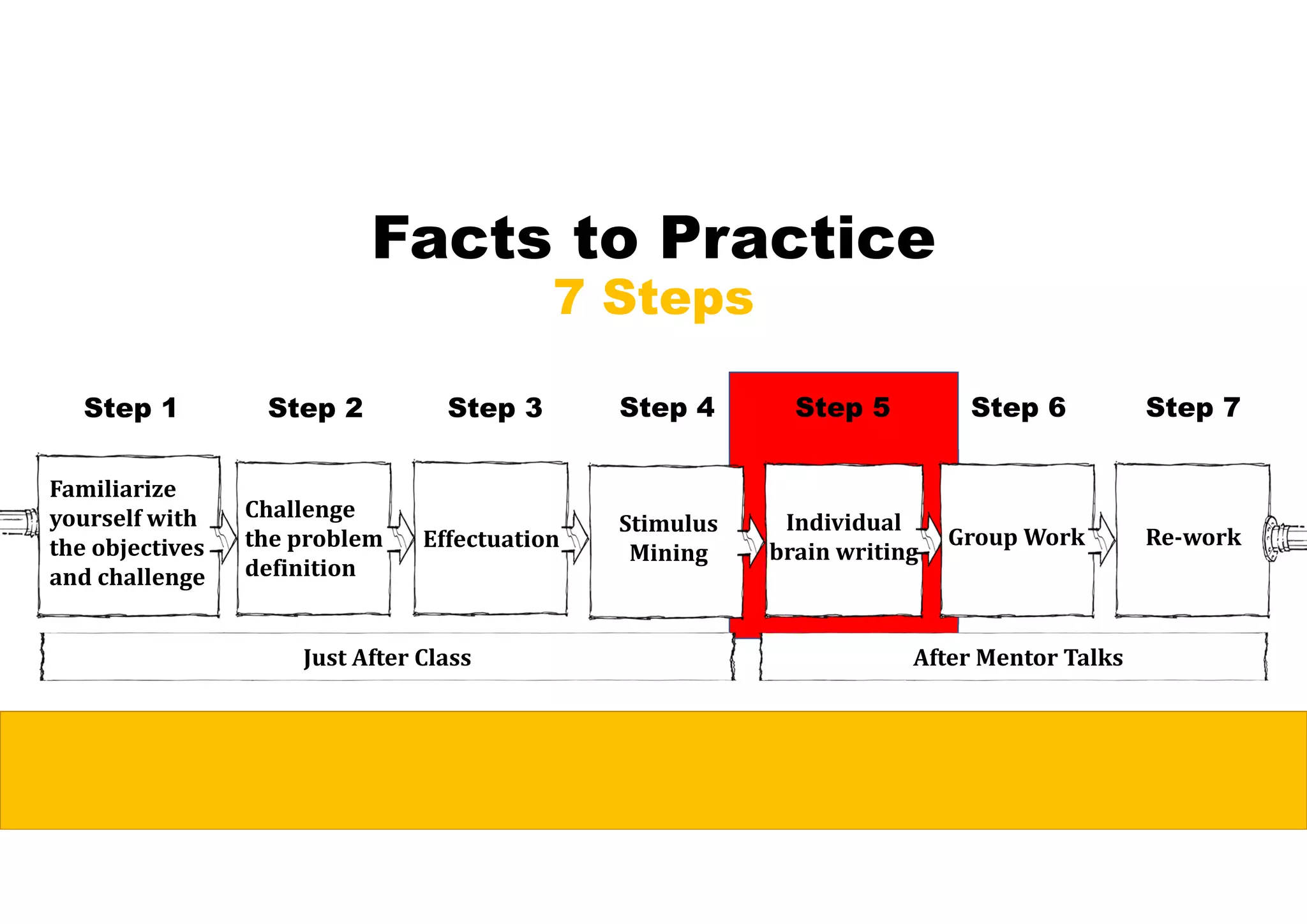
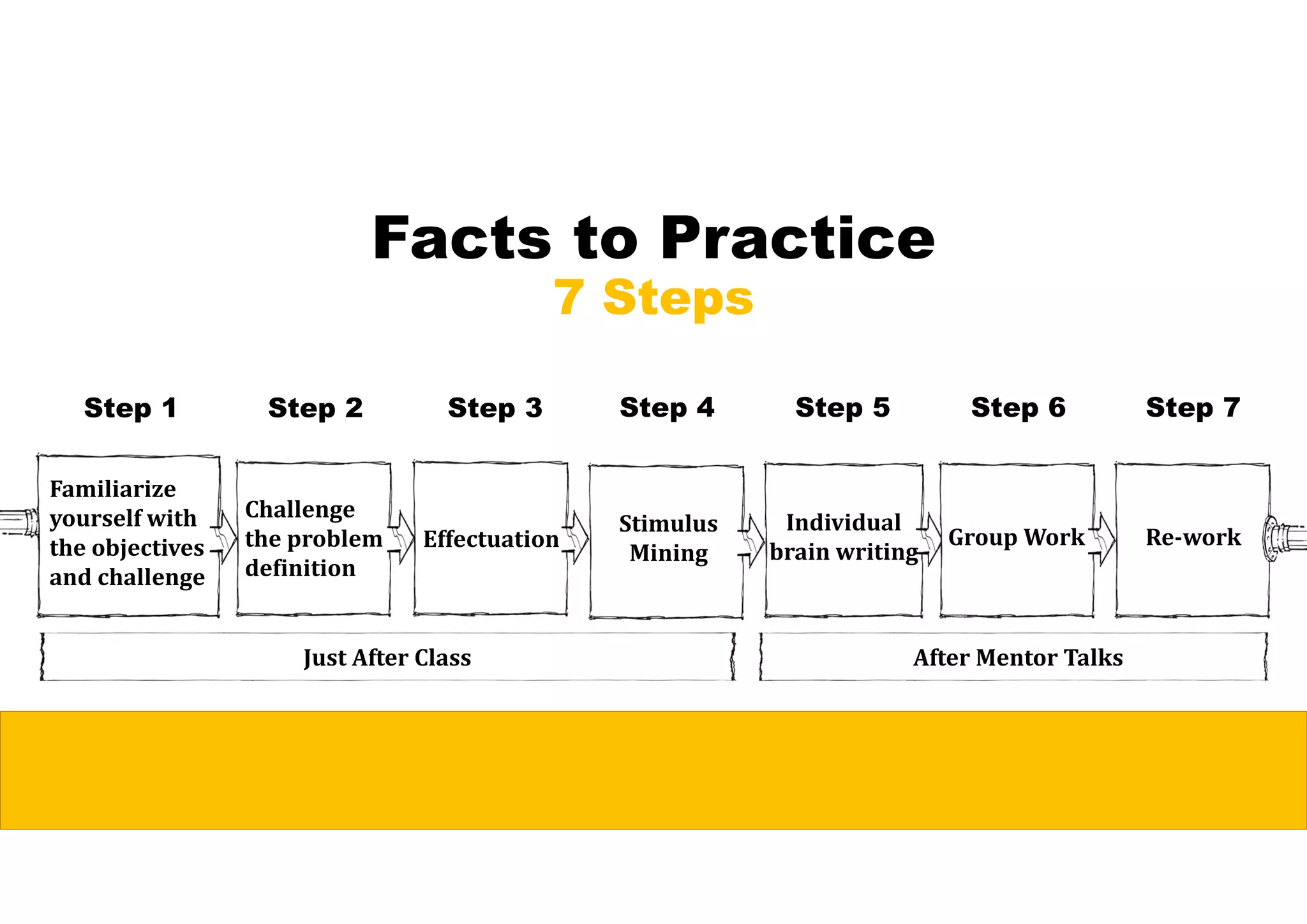
Facts to Practice
7 Steps
Familiarize	
yourself	with	
the	objectives	
and	challenge
Challenge	
the	problem	
definition
Effectuation
Stimulus	
Mining
Individual	
brain	writing
Group	Work Re‐work
Step 1 Step 2 Step 3 Step 4 Step 5 Step 6 Step 7
Just	After	Class	 After	Mentor	Talks
Break 15 Minutes
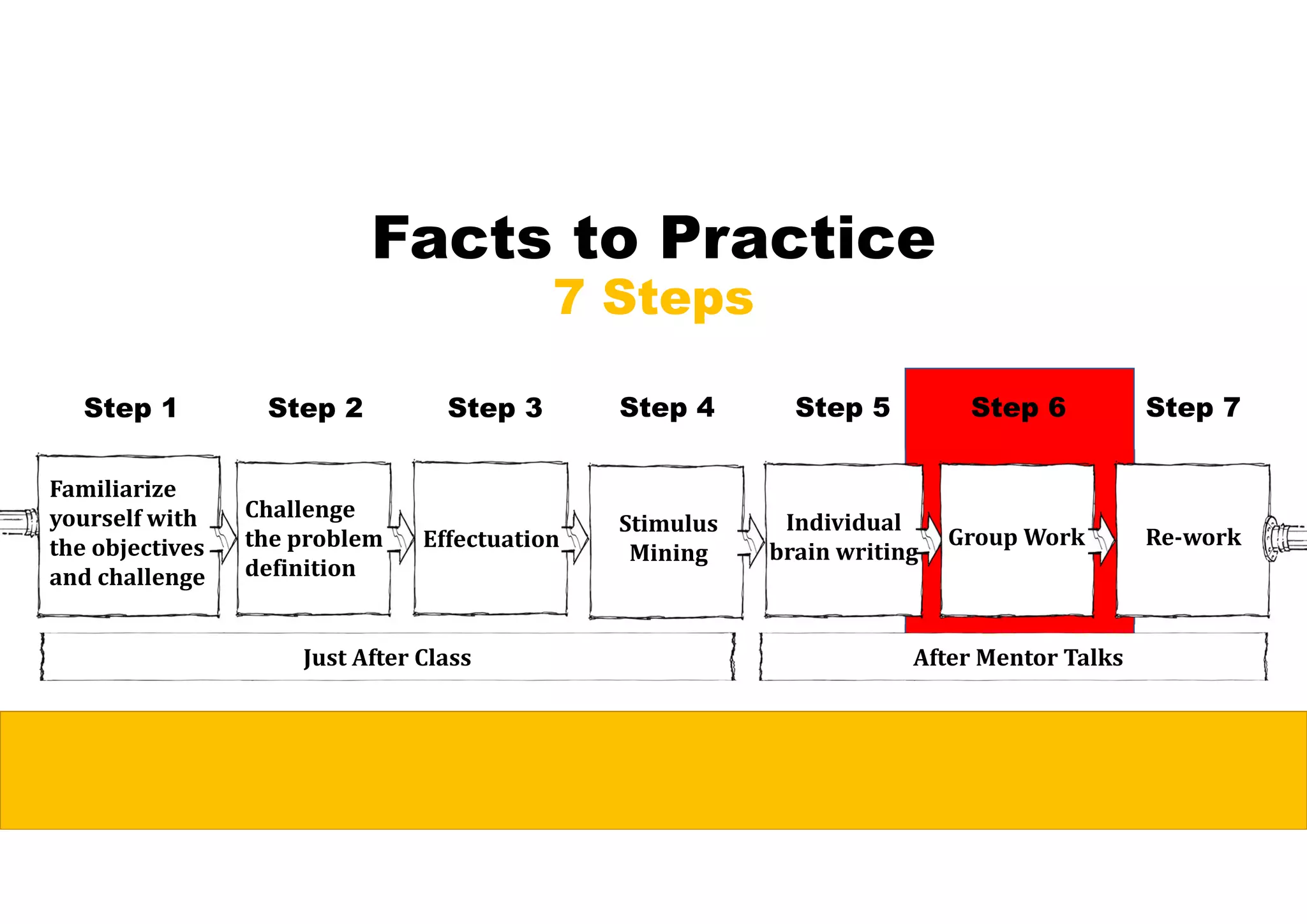
Facts to Practice
7 Steps
Familiarize	
yourself	with	
the	objectives	
and	challenge
Challenge	
the	problem	
definition
Effectuation
Stimulus	
Mining
Individual	
brain	writing
Group	Work Re‐work
Step 1 Step 2 Step 3 Step 4 Step 5 Step 6 Step 7
Just	After	Class	 After	Mentor	Talks
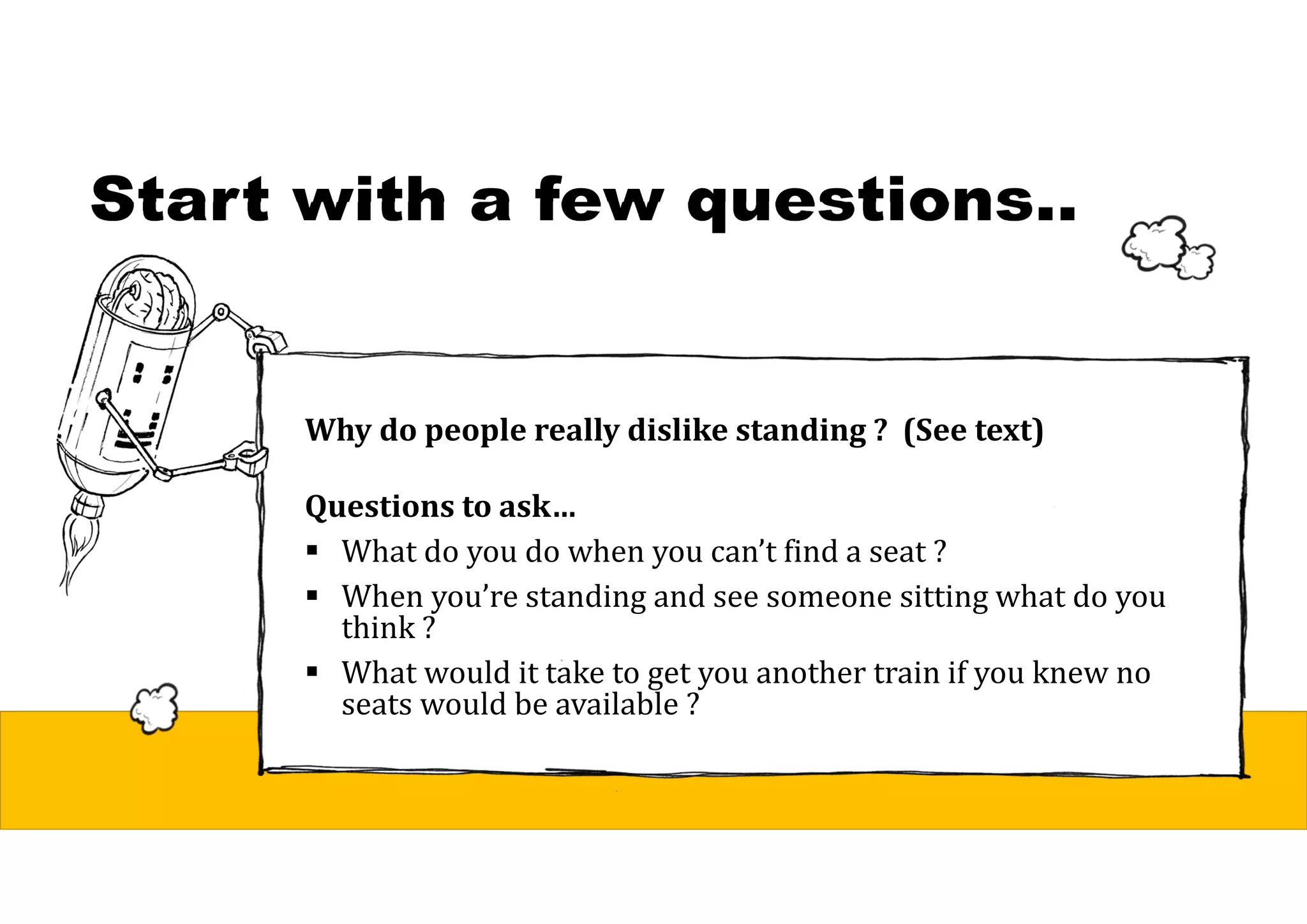
Start with a few questions..
Why	do	people	really	dislike	standing	? (See	text)
Questions	to	ask…
 What do you do when you can’t find a seat ?
 When you’re standing and see someone sitting what do you
think ?
 What would it take to get you another train if you knew no
seats would be available ?
Sutherland, Rory. Alchemy (Kindle Locations 732-757). William Morrow. Kindle Edition.
Why	don’t	people	like	being	made	to	stand	on	overcrowded	trains?
I once asked this question in a meeting with a rail company. Everyone looked nonplussed; I mean, it’s obvious that standing has to be worse
than sitting, right? Maybe so. But why? And if standing is always worse than sitting, why do people standing on trains regularly continue to
stand after seats become available?
There could be a whole variety of reasons but, fascinatingly, passengers themselves do not really know, even if they are able to supply plausible
post-rationalisations. But asking this question more broadly might lead to interesting new railway carriage designs that nobody has yet
thought of, or it might be solved by differential pricing. We don’t know yet.
So let’s ask again – why might people hate standing on trains? Is it about feeling cheated? After all, you’ve paid for a seat on the train, and the
rail company has taken your money and not given you a seat. Is that it? In which case, might you try offering standing-only carriages for
shorter rail and tube journeys? People using them could be refunded part of their fare, or rewarded with points towards free journeys. Would
they feel happy then? We could find out. Or perhaps it’s because it is tiring; it’s not just about having to stand, it’s also about having to keep
your balance. Or that, once you have to hold on to a pole to stay upright, you can no longer use a mobile phone, read a book or newspaper or
drink a coffee, so the journey becomes boring.
If these are the reasons, then a series of bum-rests might help. Perhaps it’s because they have nowhere to put their bags or they are paranoid
about people stealing from their backpack. Maybe though, it’s more a question of status; the people who have a seat have a view, control of
their personal space and space for their bags – while the people who stand get nothing. There is no story they can tell themselves about their
predicament that puts it in a better light. But this raises an interesting question: what if there were some benefits to standing? In other words,
is there a role for alchemy?
Imagine if commuter rail carriages were designed with the seats down the middle, with places for passengers to stand down each side, next to
the windows. People sitting might have cup-holders but nothing else; people standing would have a view out of the window, a cushion to rest
against and a shelf for a bag or a laptop, with two USB charging sockets.
Now there would be some clear advantages to standing over sitting, to a point where standing could be perceived – by others and by oneself –
as a choice rather than a compromise. Plans such as this only emerge when people ask a dumb question with an open mind. The commuter
knows he hates standing, but he does not really know why; if you ask him, he will demand more seats, but the only way to provide them is
through the huge expense of running more trains. The reason we do not ask basic questions is because, once our brain provides a logical
answer, we stop looking for better ones; with a little alchemy, better answers can be found.
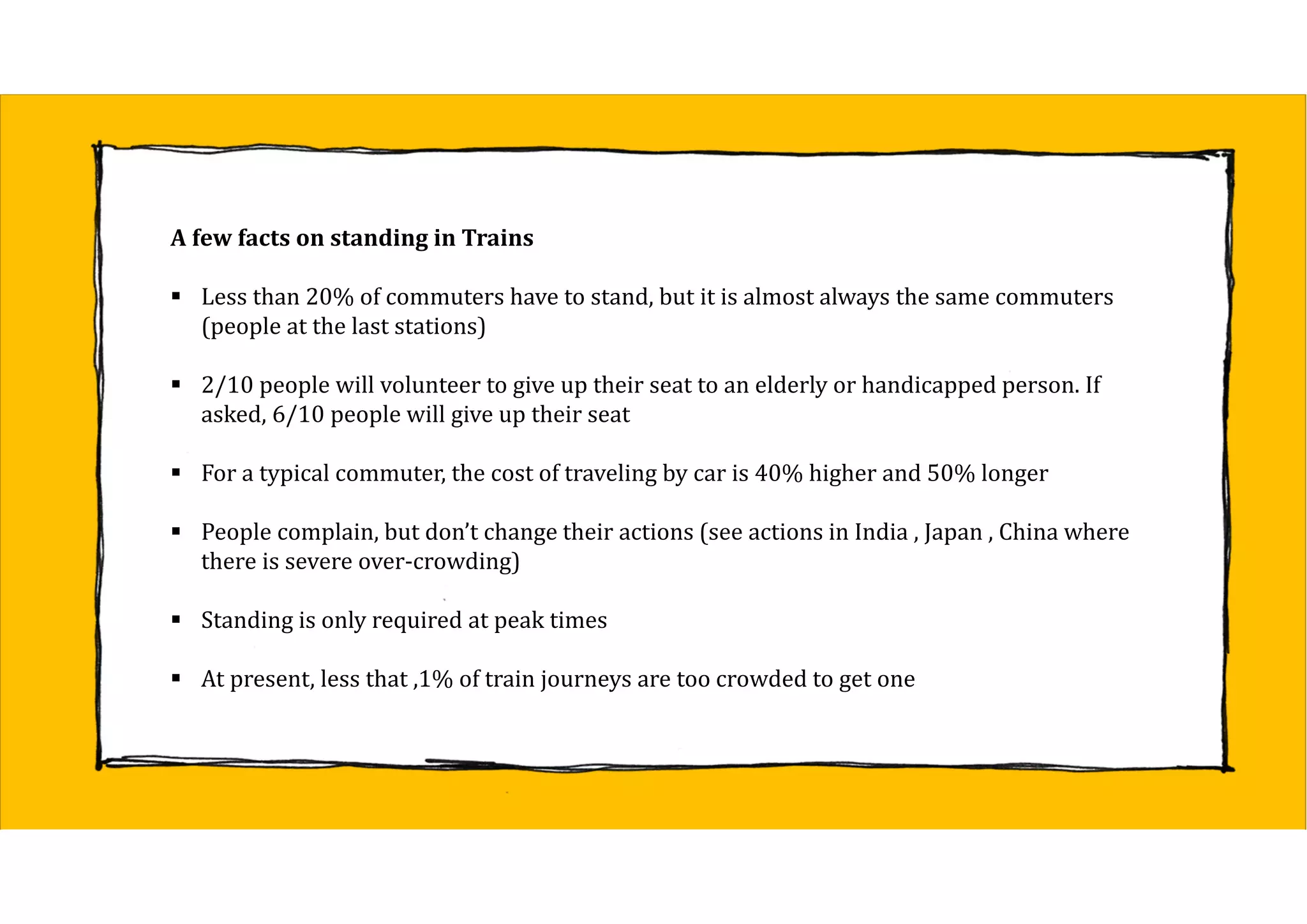
A	few	facts	on	standing	in	Trains
 Less than 20% of commuters have to stand, but it is almost always the same commuters
(people at the last stations)
 2/10 people will volunteer to give up their seat to an elderly or handicapped person. If
asked, 6/10 people will give up their seat
 For a typical commuter, the cost of traveling by car is 40% higher and 50% longer
 People complain, but don’t change their actions (see actions in India , Japan , China where
there is severe over-crowding)
 Standing is only required at peak times
 At present, less that ,1% of train journeys are too crowded to get one
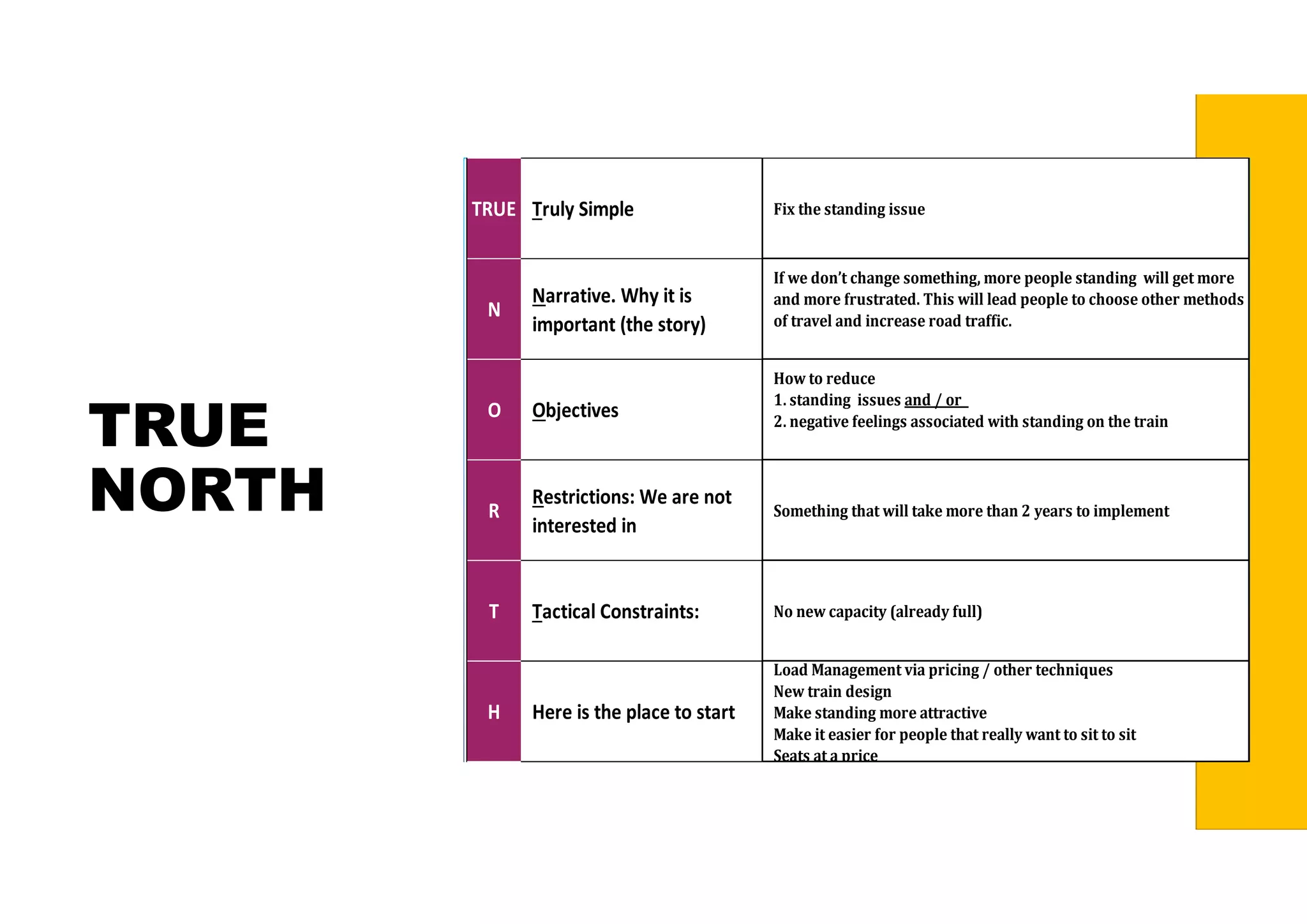
TRUE
NORTH
TRUE Truly Simple Fix	the	standing	issue
N
Narrative. Why it is 
important (the story)
If	we	don’t	change	something,	more	people	standing		will	get	more	
and	more	frustrated.	This	will	lead	people	to	choose	other	methods	
of	travel	and	increase	road	traffic.
O Objectives
How	to	reduce	
1.	standing		issues	and	/	or		
2.	negative	feelings	associated	with	standing	on	the	train	
R
Restrictions: We are not 
interested in
Something	that	will	take	more	than	2	years	to	implement
T Tactical Constraints: No	new	capacity	(already	full)
H Here is the place to start
Load	Management	via	pricing	/	other	techniques
New	train	design
Make	standing	more	attractive
Make	it	easier	for	people	that	really	want	to	sit	to	sit
Seats	at	a	price
Facts to Practice
7 Steps
Familiarize	
yourself	with	
the	objectives	
and	challenge
Challenge	
the	problem	
definition
Effectuation
Stimulus	
Mining
Individual	
brain	writing
Group	Work Re‐work
Step 1 Step 2 Step 3 Step 4 Step 5 Step 6 Step 7
Just	After	Class	 After	Mentor	Talks
Elevator Example
A	big	NYC	apartment	building	with	slow	elevators.	
People	complaining.
Solutions
1. New faster elevator
2. Second set of elevators
3. Ask people to take the stairs
A	psychologist	found	another	solution	by	
re‐framing	the	problem
How	?
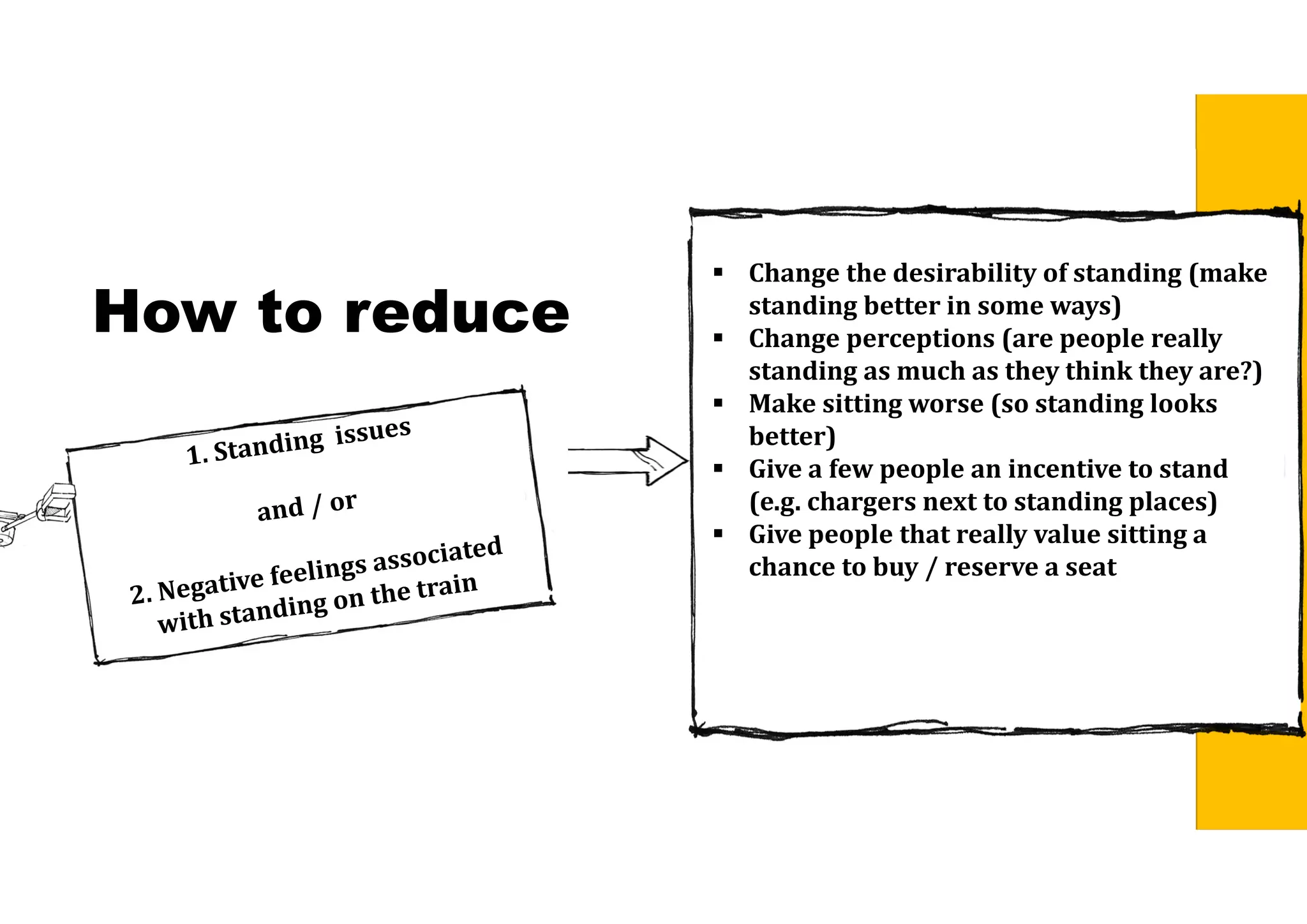
How to reduce
How to reduce
 Change	the	desirability	of	standing	(make	
standing	better	in	some	ways)
 Change	perceptions	(are	people	really	
standing	as	much	as	they	think	they	are?)
 Make	sitting	worse	(so	standing	looks	
better)
 Give	a	few	people	an	incentive	to	stand	
(e.g.	chargers	next	to	standing	places)
 Give	people	that	really	value	sitting	a	
chance	to	buy	/	reserve	a	seat
Facts to Practice
7 Steps
Familiarize	
yourself	with	
the	objectives	
and	challenge
Challenge	
the	problem	
definition
Effectuation
Stimulus	
Mining
Individual	
brain	writing
Group	Work Re‐work
Step 1 Step 2 Step 3 Step 4 Step 5 Step 6 Step 7
Just	After	Class	 After	Mentor	Talks
CAUSAL vs EFFECTUAL REASONING
FIRST FIRST
GIVEN GOAL GIVEN MEANS
M1
M2
M5M4M3
M1
M2
M5
M4
M3
MANAGERIAL THINKING (causal)
Accumulate means necessary to achieve a
pre-determined goal.
THEN ACCUMULATE
MEANS
ENTREPRENEURAL THINKING (effectual)
Imagine many possible new ends using a given
set of means.
THEN IMAGINE ENDS
CAUSAL vs EFFECTUAL REASONING
Making a meal
Traditional
 Who	is	coming
 What	will	they	like
 Plan	a	menu
 Go	Shopping
 Make	the	meal
 Enjoy	(Average)
Effectual
 What	is	in	the	Fridge	?
 What	can	we	do	with	that
 Guess	what	is	for	dinner	
?
 Enjoy	?	(Variation)
4 Concepts of Effectuation
Bird	in	the	Hand:	What’s in the fridge
Affordable	loss:	Starting within budget
(knowing you can do it several times)
Make	Lemonade:	So pickles and peanut butter doesn’t
work, but sour and sweet seems to work together..
Crazy	quilt:	I have got a few friends downstairs maybe
they can help
How	can	we	leverage	our	
passenger	base
The coffee Train….
Facts to Practice
7 Steps
Familiarize	
yourself	with	
the	objectives	
and	challenge
Challenge	
the	problem	
definition
Effectuation
Stimulus	
Mining
Individual	
brain	writing
Group	Work Re‐work
Step 1 Step 2 Step 3 Step 4 Step 5 Step 6 Step 7
Just	After	Class	 After	Mentor	Talks
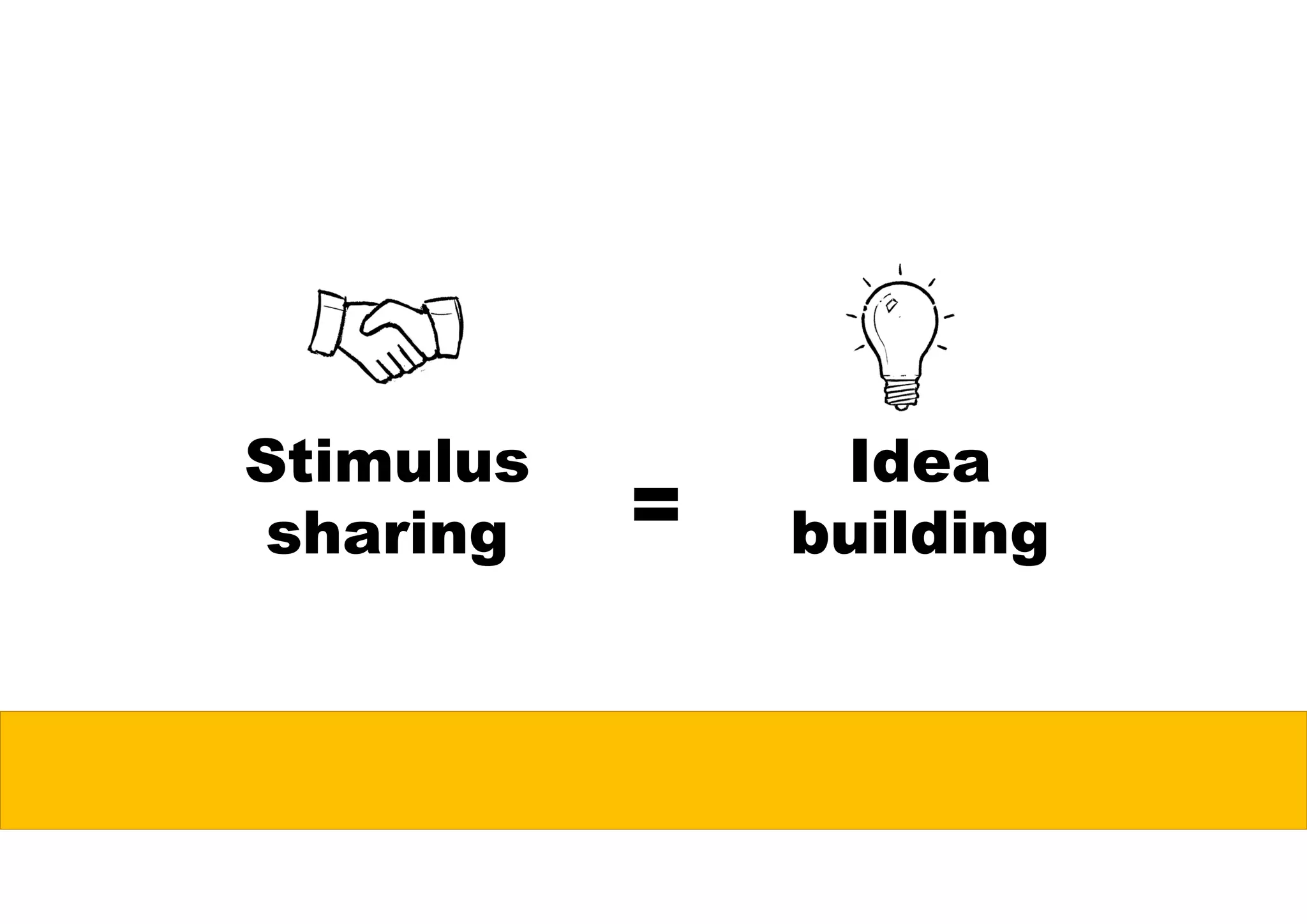
=
Stimulus
sharing
Idea
building
Work in
Groups
35 min
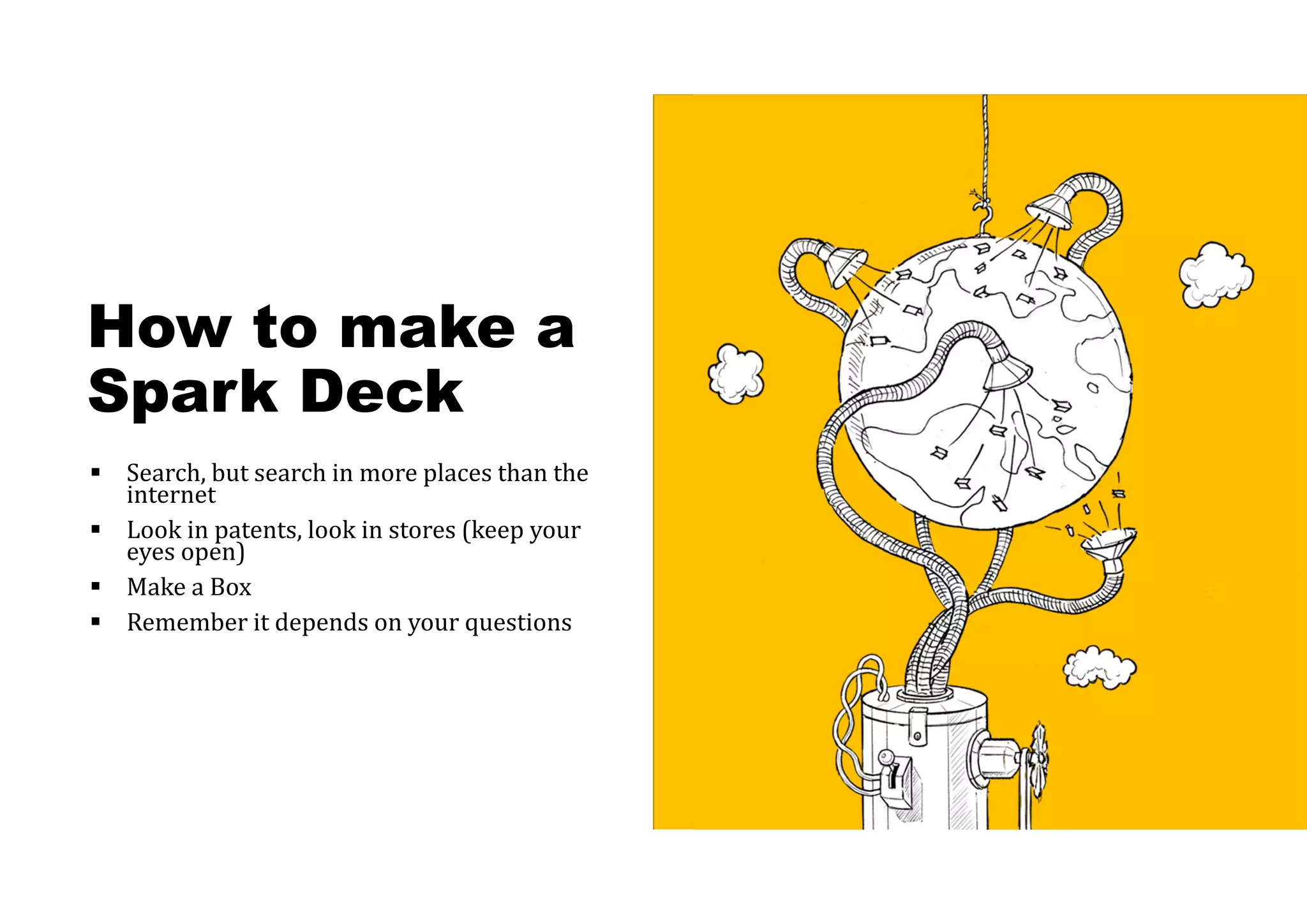
How to make a
Spark Deck
 Search, but search in more places than the
internet
 Look in patents, look in stores (keep your
eyes open)
 Make a Box
 Remember it depends on your questions
How to:
We identified a series of challenges / areas of investigation
Add 3 Sparks person What is a spark ?
On the right
• Questions
• Ideas raised
On the left
• Name
• Picture/QuoteTRUE Truly Simple Fix	the	standing	issue
N
Narrative. Why it is 
important (the story)
If	we	don’t	change	something,	more	people	standing		will	get	more	
and	more	frustrated.	This	will	lead	people	to	choose	other	methods	
of	travel	and	increase	road	traffic.
O Objectives
How	to	reduce	
1.	standing		issues	and	/	or		
2.	negative	feelings	associated	with	standing	on	the	train	
R
Restrictions: We are not 
interested in
Something	that	will	take	more	than	2	years	to	implement
T Tactical Constraints: No	new	capacity	(already	full)
H Here is the place to start
Load	Management	via	pricing	/	other	techniques
New	train	design
Make	standing	more	attractive
Make	it	easier	for	people	that	really	want	to	sit	to	sit
Seats	at	a	price
To get started
Make	a	copy	of	this	presentation	
Then	in	the	new	presentation,	follow	these	steps	to	
share
with	your	colleagues	(and	me)
http://tiny.cc/sparkexample
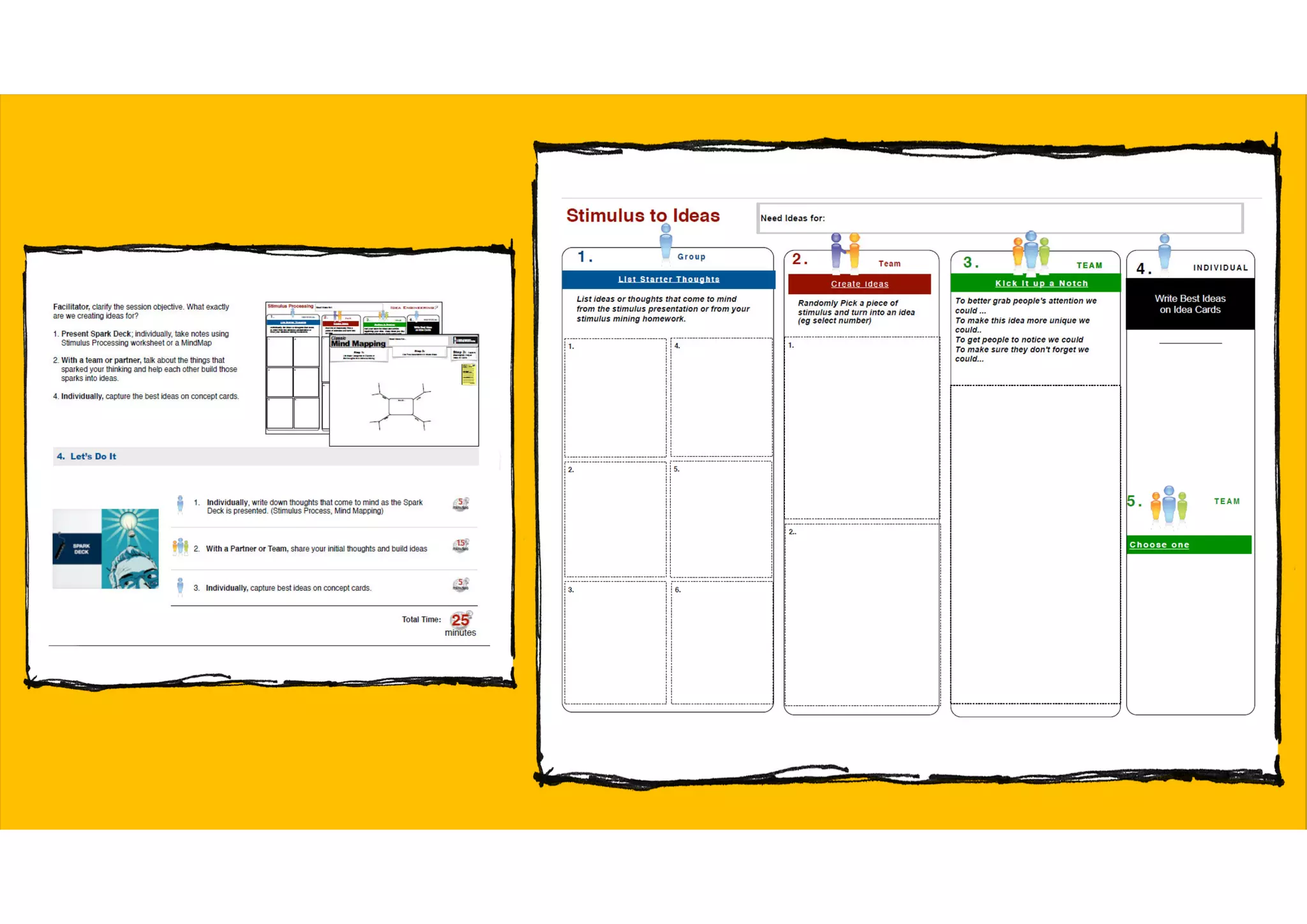
Instructions (35 min)
1. Clarify the session objective. What exactly are we creating ideas for? (re-
read the TRUE NORTH) (2	Min)
2. Individually pick 1 spark you like and ADD 1 new spark (10	min)
3. Present your sparks to your group (10	min)
4. Write up a couple ideas individually (5	min)
5. Discuss ideas together
Reflection more idea than when you started ? (8	min)
Facts to Practice
7 Steps
Familiarize	
yourself	with	
the	objectives	
and	challenge
Challenge	
the	problem	
definition
Effectuation
Stimulus	
Mining
Individual	
brain	writing
Group	Work Re‐work
Step 1 Step 2 Step 3 Step 4 Step 5 Step 6 Step 7
Just	After	Class	 After	Mentor	Talks
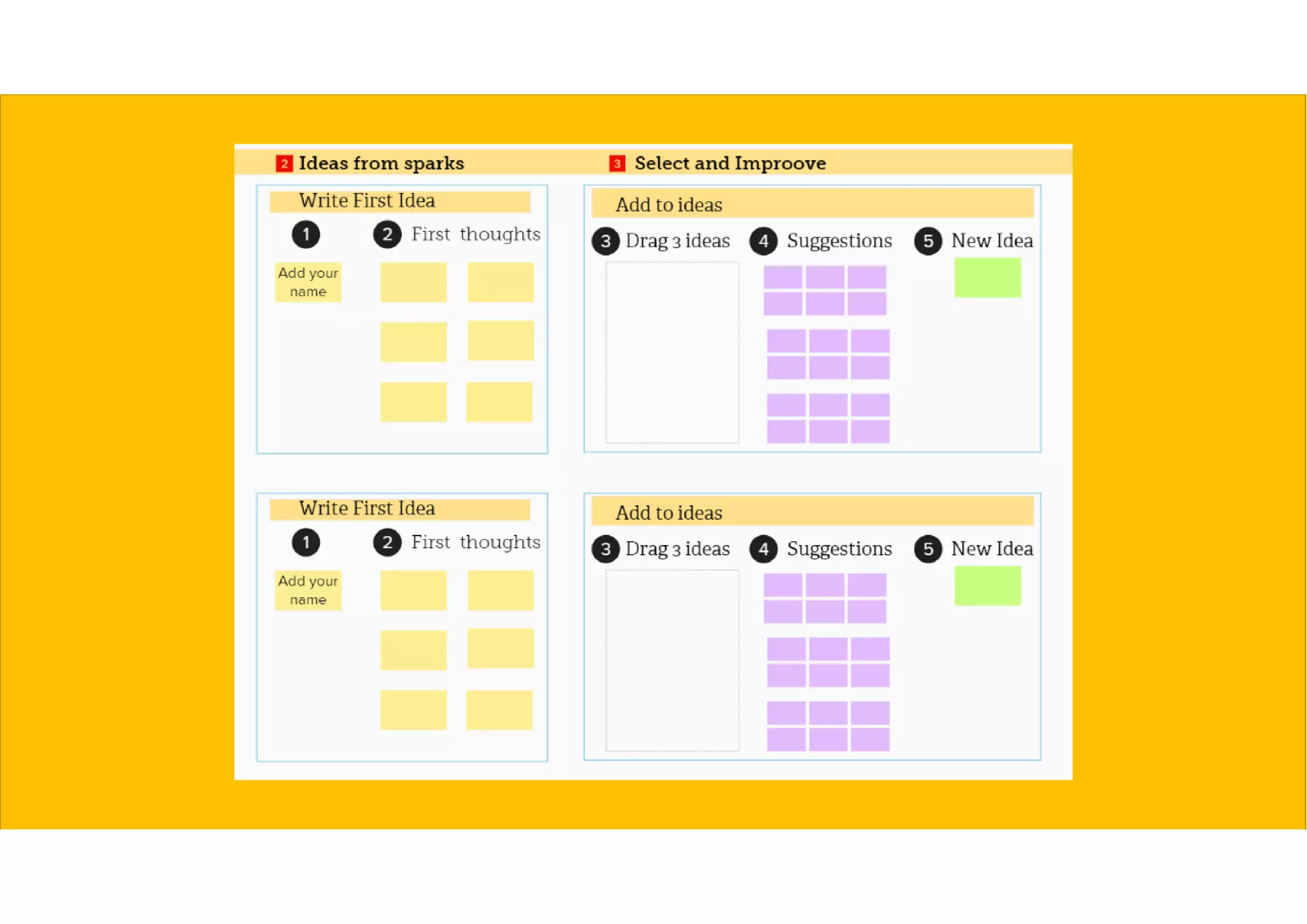
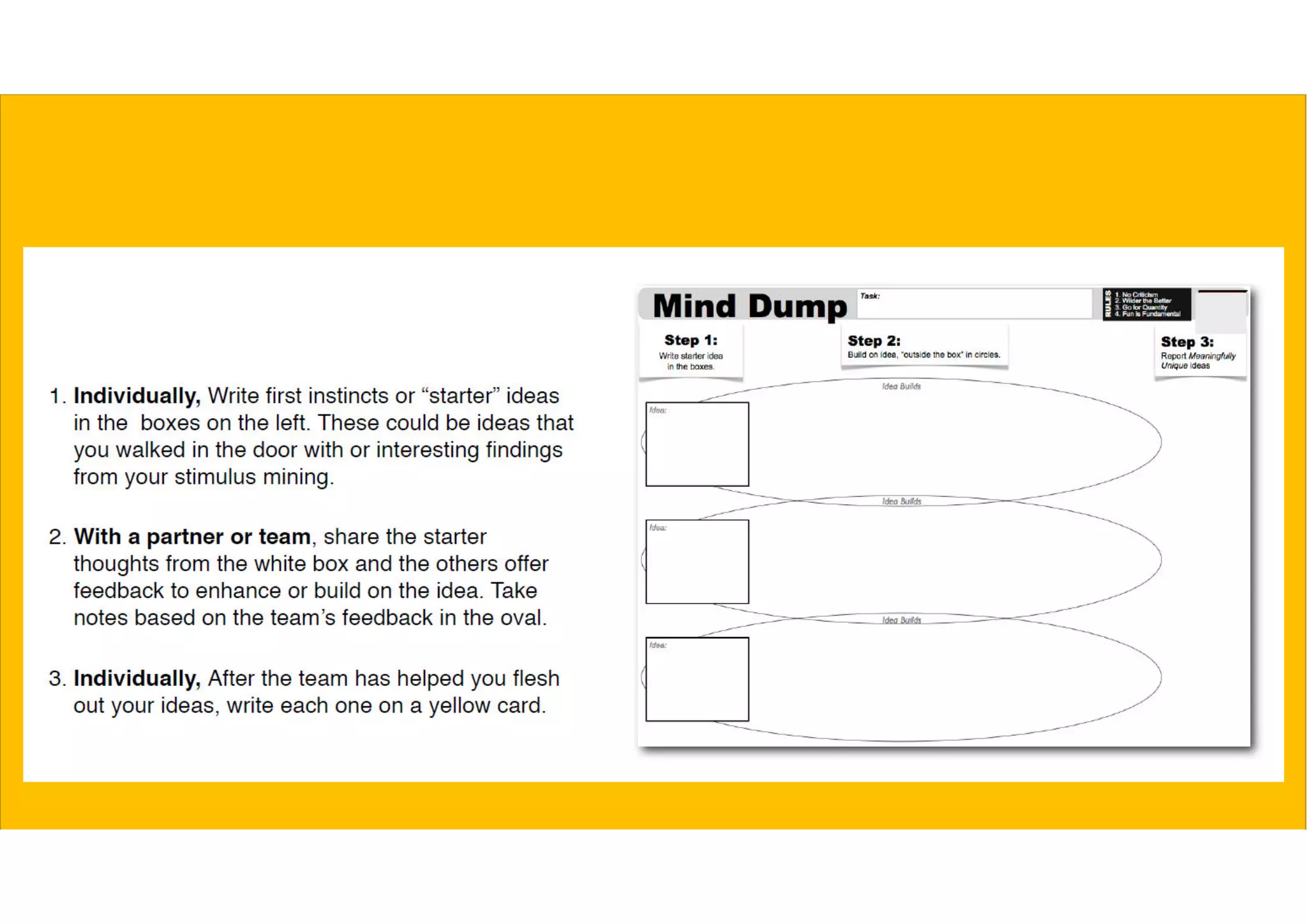
How
 Read out loud
 Only questions of clarification
 Fast
Source:
www.Innovationengineering.com
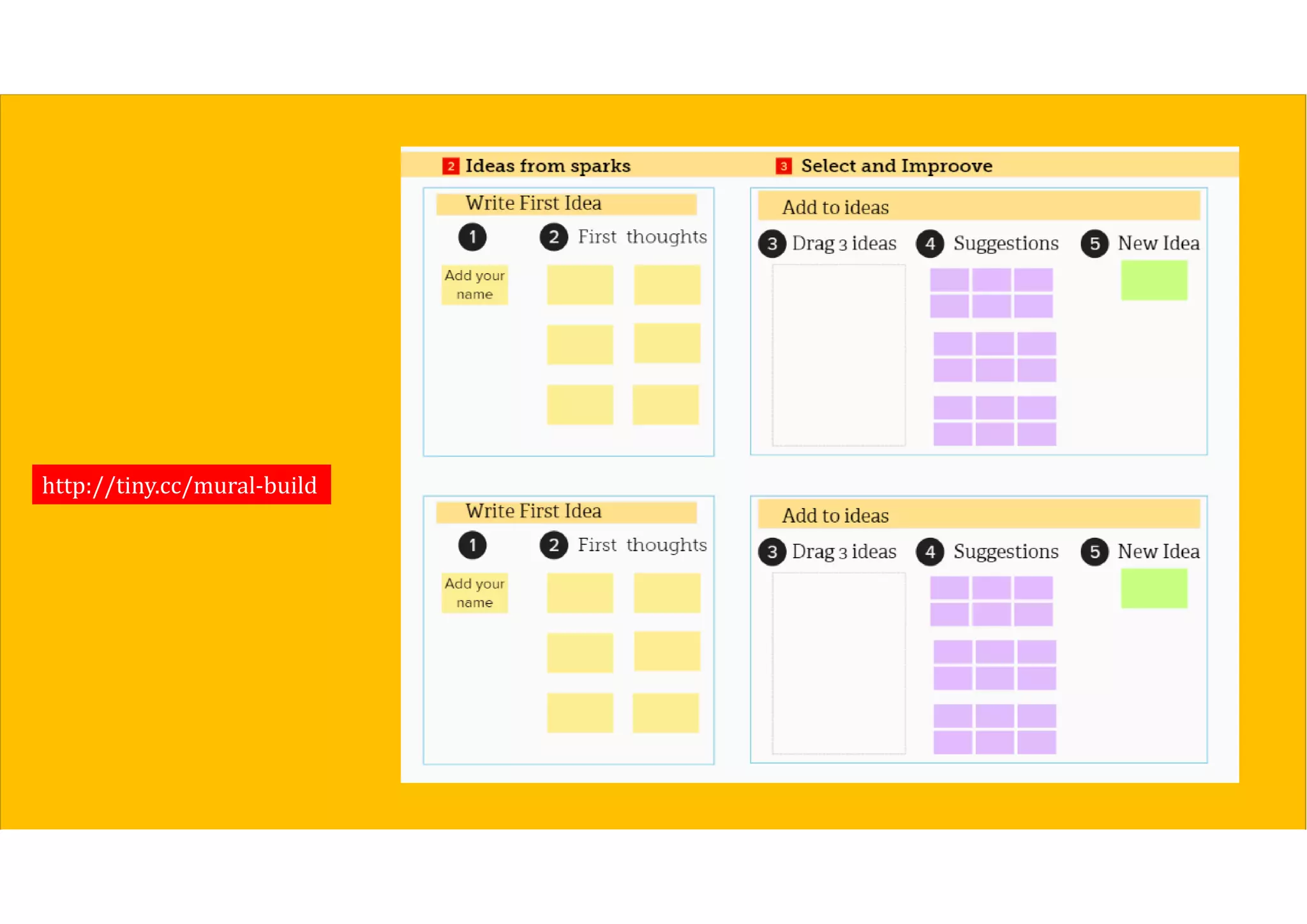
Use this or the Mural
Build Template
https://app.mural.co/te
mplate/77a9399f-b6aa-
4440-b543-
ecb3de1b1021/893b305
3-a243-409b-b4f6-
56082484e64d
Individual Brain Writing
Facts to Practice
7 Steps
Familiarize	
yourself	with	
the	objectives	
and	challenge
Challenge	
the	problem	
definition
Effectuation
Stimulus	
Mining
Individual	
brain	writing
Group	Work Re‐work
Step 1 Step 2 Step 3 Step 4 Step 5 Step 6 Step 7
Just	After	Class	 After	Mentor	Talks
Choose an activity
From this book
https://1lib.eu/book
/693467/a2fc20
GROUP	WORK
Choose an activity
From this book
https://1lib.eu/book/693467/a2fc20
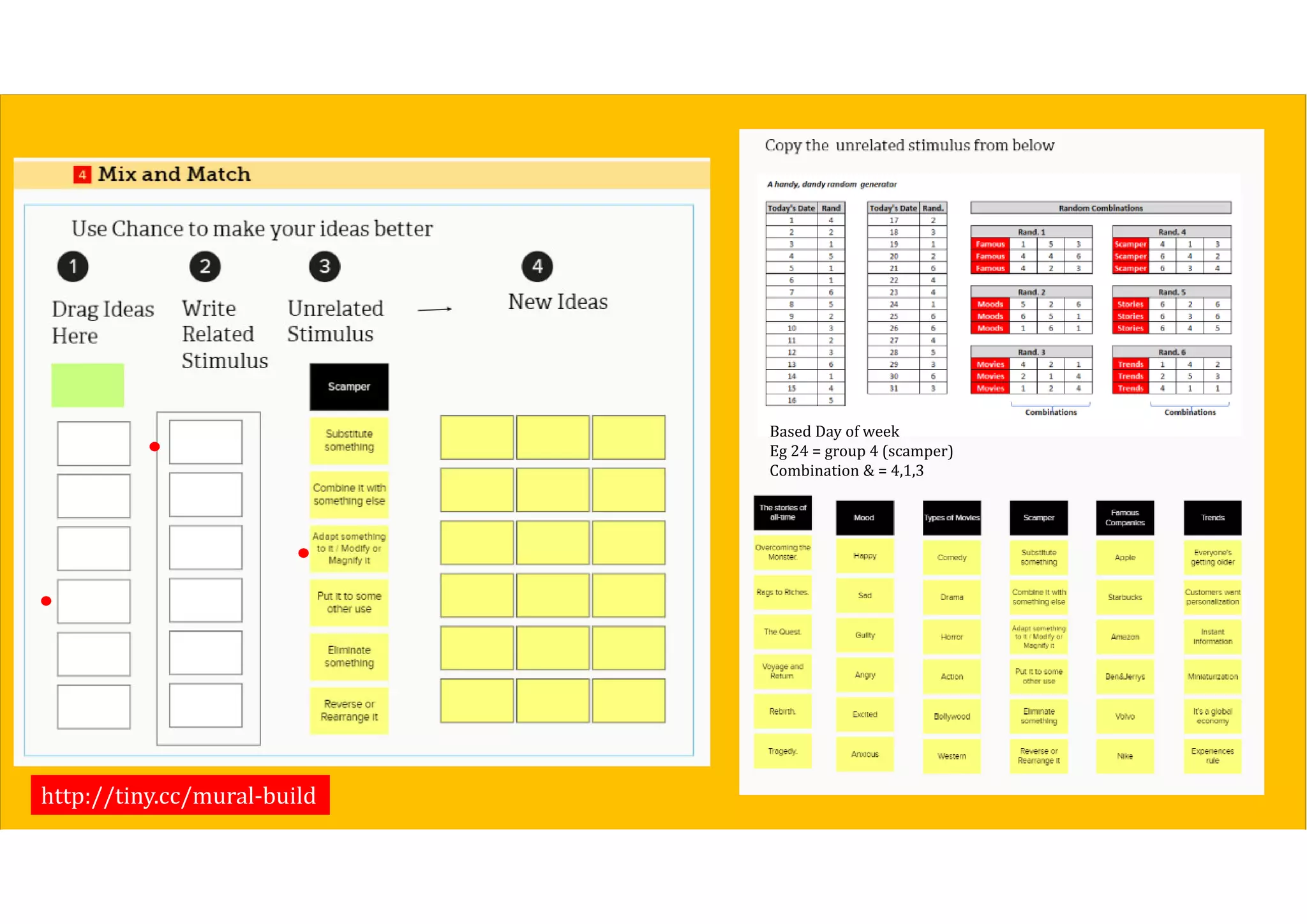
or the Mural Build Template
https://app.mural.co/template/77a9399f-b6aa-4440-b543-
ecb3de1b1021/893b3053-a243-409b-b4f6-56082484e64d
Based Day of week
Eg 24 = group 4 (scamper)
Combination & = 4,1,3
Facts to Practice
7 Steps
Familiarize	
yourself	with	
the	objectives	
and	challenge
Challenge	
the	problem	
definition
Effectuation
Stimulus	
Mining
Individual	
brain	writing
Group	Work Re‐work
Step 1 Step 2 Step 3 Step 4 Step 5 Step 6 Step 7
Just	After	Class	 After	Mentor	Talks
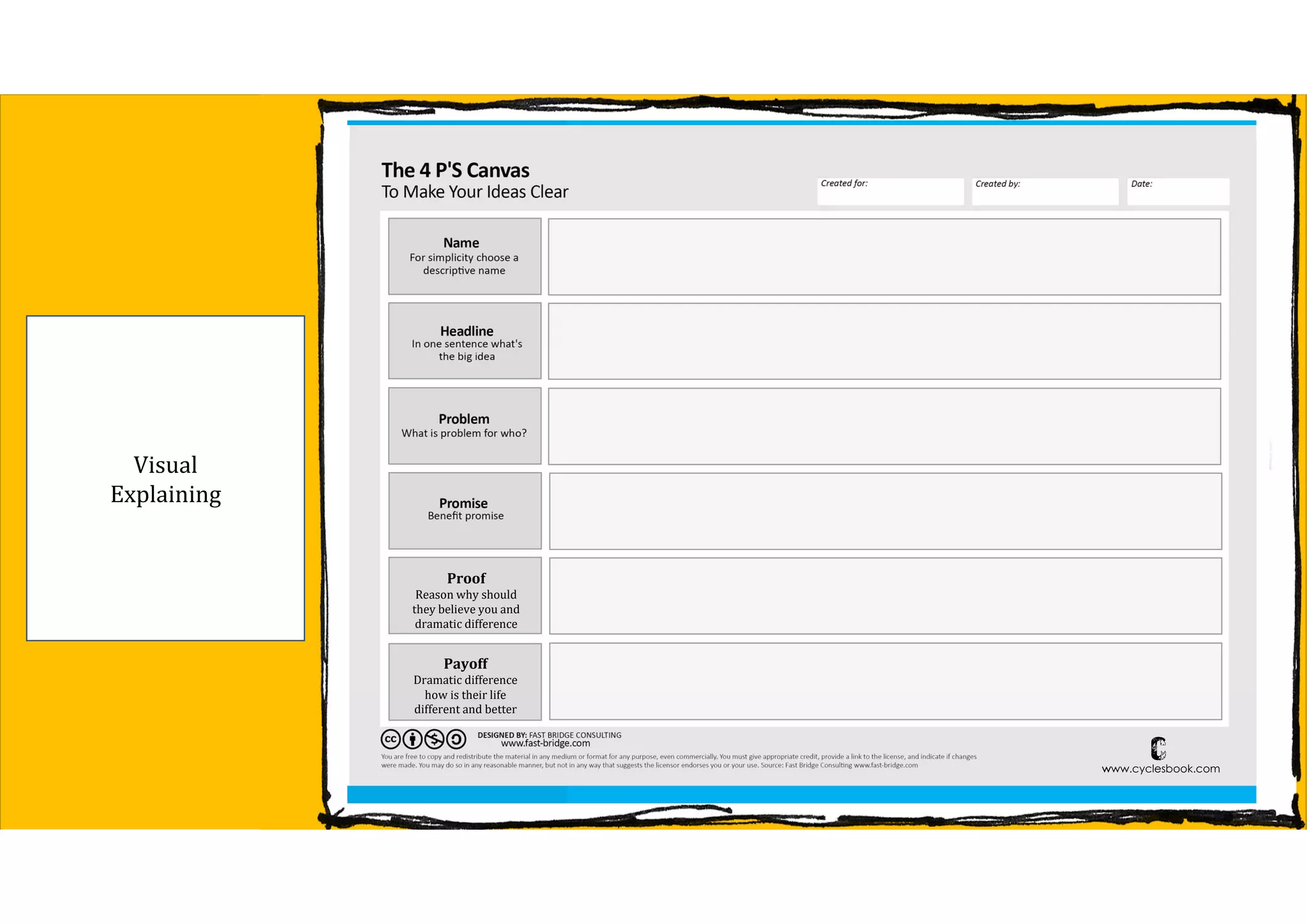
www.cyclesbook.com
Cwww.cyclesbook.com
C
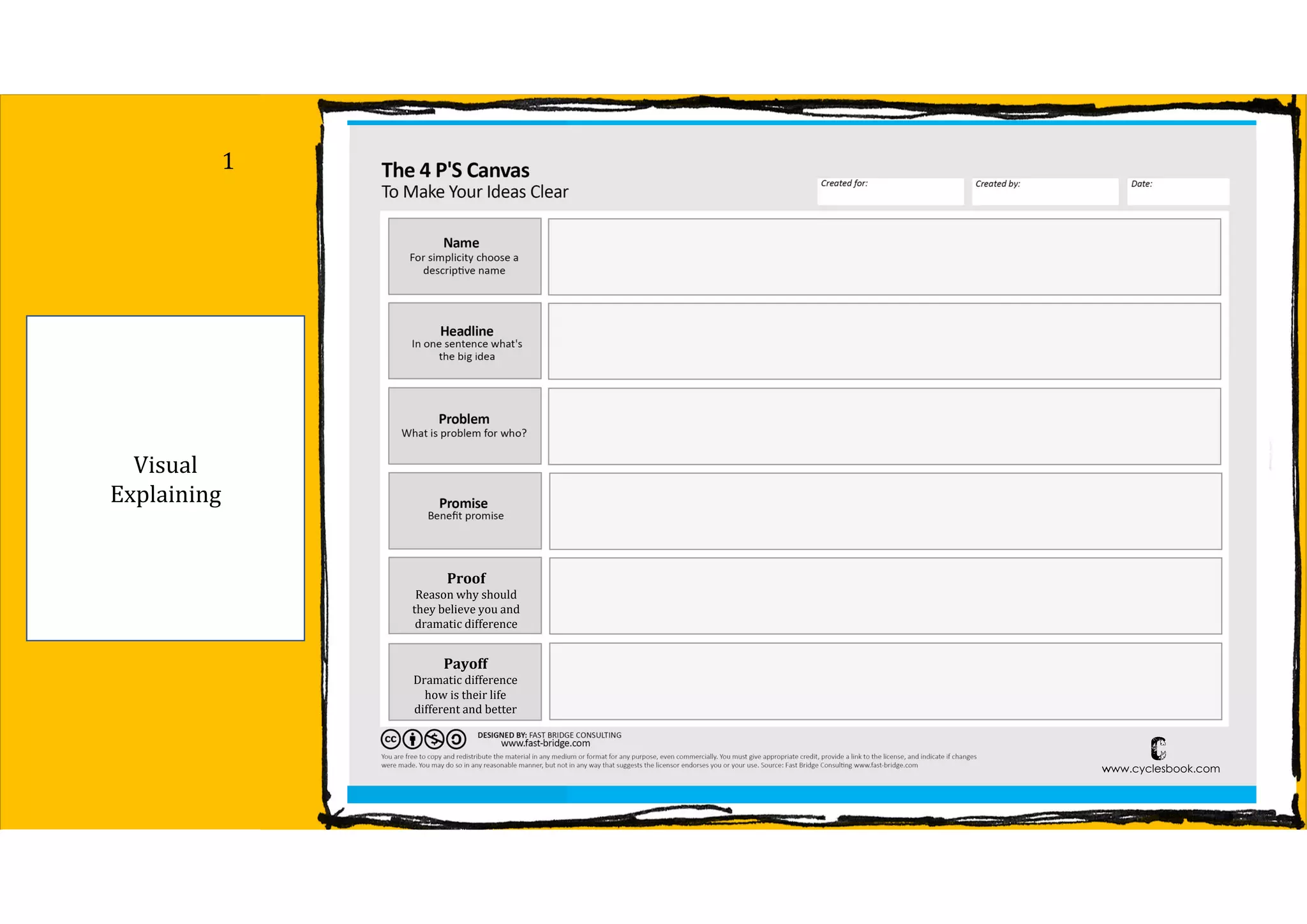
Payoff
Dramatic difference
how is their life
different and better
Proof
Reason why should
they believe you and
dramatic difference
Visual
Explaining
Bonus : how to run an idea
building event
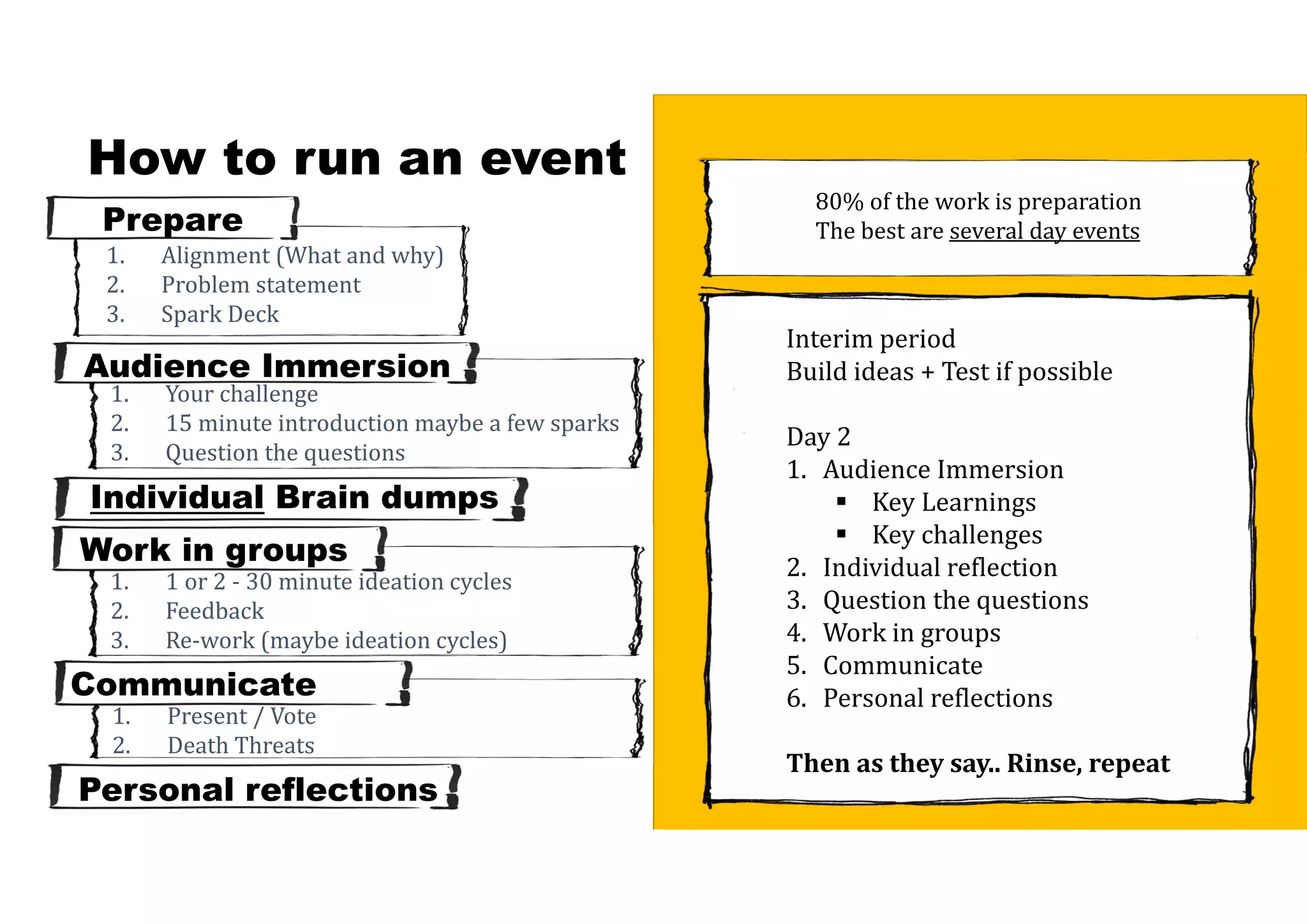
How to run an event
Prepare
1. Alignment (What and why)
2. Problem statement
3. Spark Deck
Audience Immersion
1. Your challenge
2. 15 minute introduction maybe a few sparks
3. Question the questions
Individual Brain dumps
Work in groups
1. 1 or 2 - 30 minute ideation cycles
2. Feedback
3. Re-work (maybe ideation cycles)
Communicate
1. Present / Vote
2. Death Threats
Personal reflections
80% of the work is preparation
The best are several day events
Interim period
Build ideas + Test if possible
Day 2
1. Audience Immersion
 Key Learnings
 Key challenges
2. Individual reflection
3. Question the questions
4. Work in groups
5. Communicate
6. Personal reflections
Then	as	they	say..	Rinse,	repeat
Your work today….
(the same process)
Your Work in
Groups
The keys to success
(Working alone together)
If I had asked you to simply build ideas together it would be
tough…
The better solution is
1. Ideas first individually
2. Then work together
Best practice 1+1 then as a group
7	Step	Idea	building
Morning	work	(11:00‐12:30)
1. Familiarize yourself with the objectives and challenge
2. Challenge the problem definition
3. Effectuation
4. Stimulus Mining== > spark decks (11:30-12:30) – 3	slides	per	
person	!
Meet Mentor – Ask questions + break time (30 minutes)
Afternoon work (14:00 – 17:00 or your choice)
1. Review spark deck (write ideas) 60 min –(18 slides @ 3 min per
slide =54 min)
2. Individual brain writing + Improvements -60 in pairs
3. Group Work – 30 min
4. Re-work – 30 (individual)
Target = 6 solutions
DONE for the day. You will vote tomorrow morning
Deliverables
Timetable
Day 2: Build
Once you know what you want to do it is time to build ideas that have a chance to deliver on your objectives. Contrary to the belief that the
ability to build ideas is limited to a select few, there are tools, techniques that can help any team build better ideas.
1. Better problem formulation
2. Effectuation (looking for ideas at home with the resources you have)
3. A Systematic search for stimulus and diversity
4. Techniques to continue building ideas
With these tools and techniques the process is clear, but clear does not mean easy. Removal of fear and an ongoing action focus is the “secret
sauce” that can pull everything together.
Deliverables:
New ideas that have a good chance of being on strategy; meaningful and unique
1 Idea + Visual per team member
Target
6 good solutions to vote
on tomorrow
www.cyclesbook.com
Cwww.cyclesbook.com
C
Payoff
Dramatic difference
how is their life
different and better
Proof
Reason why should
they believe you and
dramatic difference
Visual
Explaining
DOT VOTING
FINAL
Facts to Practice
7 Steps
Familiarize	
yourself	with	
the	objectives	
and	challenge
Challenge	
the	problem	
definition
Effectuation
Stimulus	
Mining
Individual	
brain	writing
Group	Work Re‐work
Step 1 Step 2 Step 3 Step 4 Step 5 Step 6 Step 7
Just	After	Class	 After	Mentor	Talks
3	Ways	to	restate	the	
problem	to	make	sure	
you’re	working	on	the	
right	problem
Resources: The Chapter ”Defining your innovation challenge”
Mural template: https://app.mural.co/template/87da7573-5e6d-48c6-8c5a-
5310320a4f3d/ab6080d5-bed9-4946-ae0e-5c9604d18e9b
PROBLEM	DEFINITION
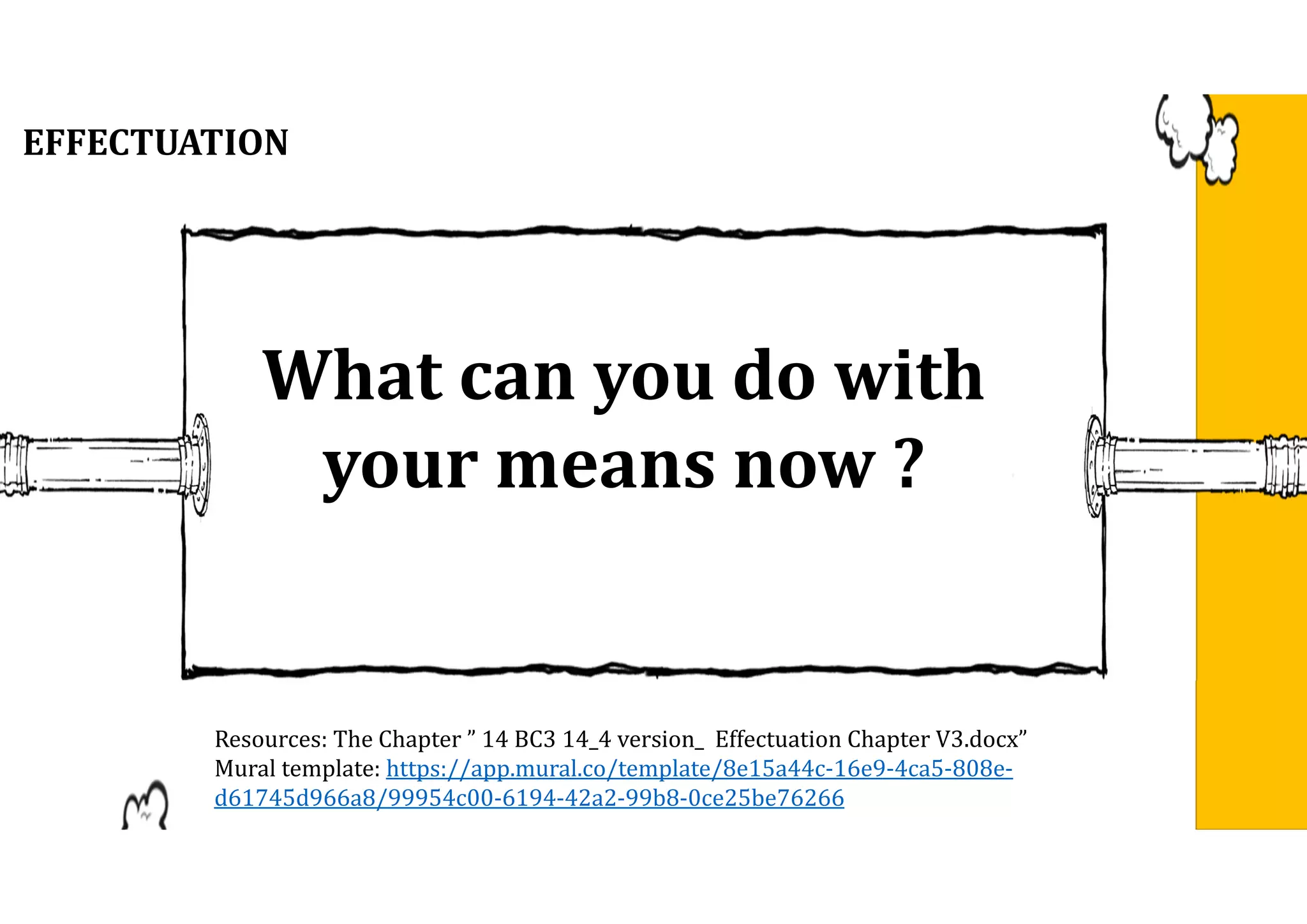
What	can	you	do	with	
your	means	now	?	
Resources: The Chapter ” 14 BC3 14_4 version_ Effectuation Chapter V3.docx”
Mural template: https://app.mural.co/template/8e15a44c-16e9-4ca5-808e-
d61745d966a8/99954c00-6194-42a2-99b8-0ce25be76266
EFFECTUATION
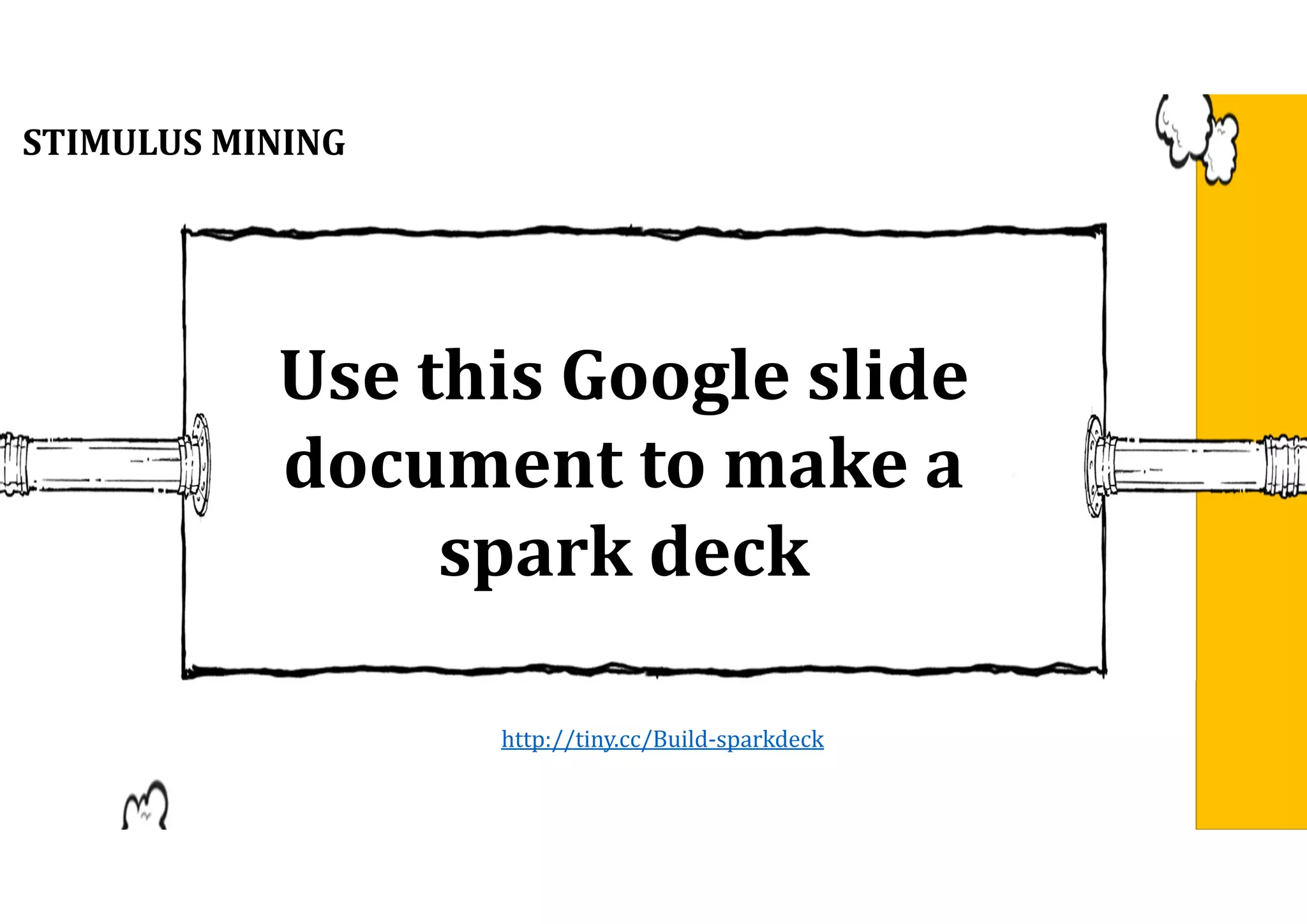
Use	this	Google	slide
document	to	make	a	
spark	deck
http://tiny.cc/Build-sparkdeck
STIMULUS	MINING
Source:
www.Innovationengineering.com
Use this or the Mural
Build Template
https://app.mural.co/te
mplate/77a9399f-b6aa-
4440-b543-
ecb3de1b1021/893b305
3-a243-409b-b4f6-
56082484e64d
Individual Brain Writing
http://tiny.cc/mural-build
Choose an activity
From this book
https://1lib.eu/book
/693467/a2fc20
GROUP	WORK
Based Day of week
Eg 24 = group 4 (scamper)
Combination & = 4,1,3
http://tiny.cc/mural-build
www.cyclesbook.com
Cwww.cyclesbook.com
C
Payoff
Dramatic difference
how is their life
different and better
Proof
Reason why should
they believe you and
dramatic difference
Visual
Explaining
1
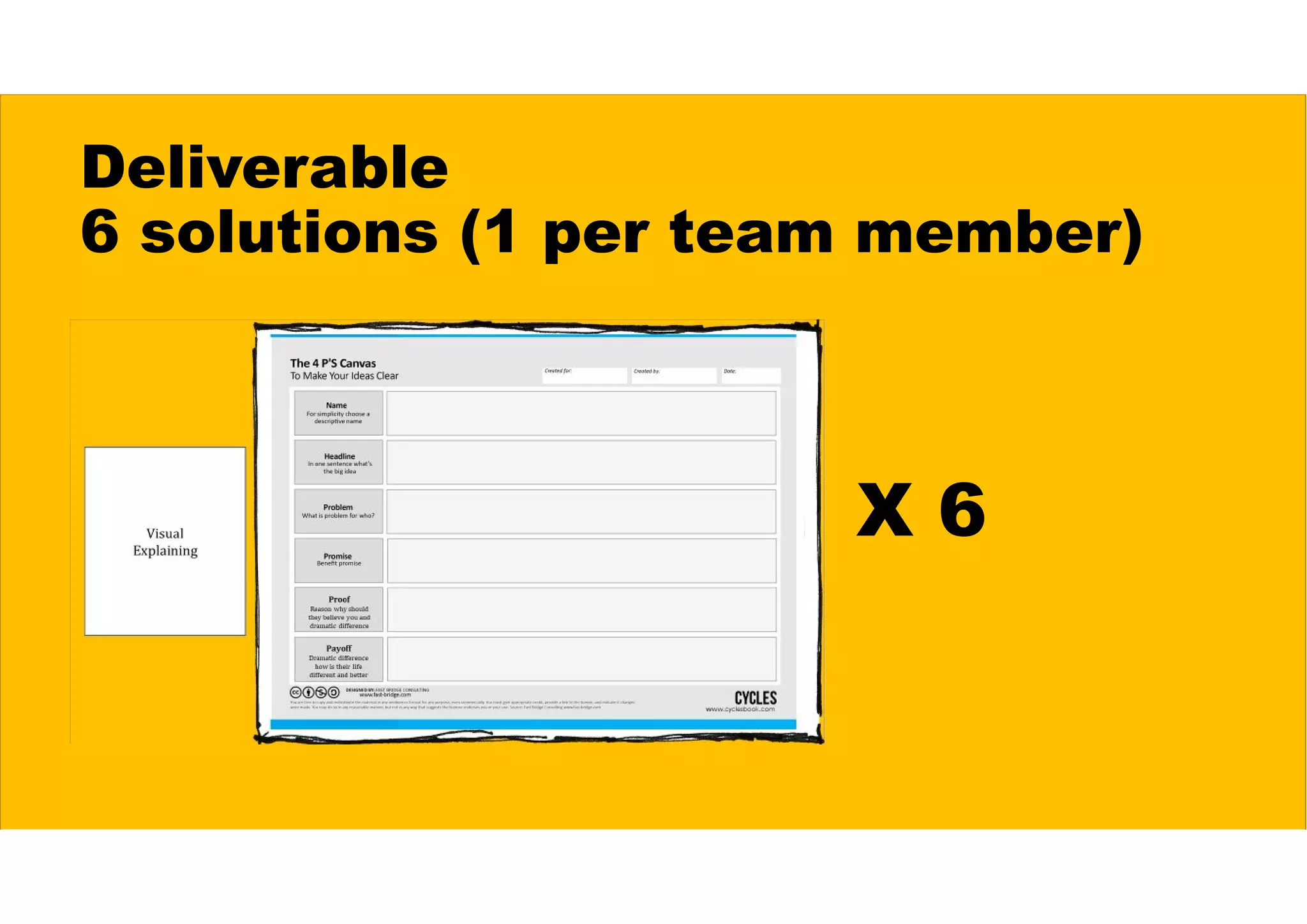
Deliverable
6 solutions (1 per team member)
X 6

3 Cycles Remote Innovation - Build

  • 1.
  • 2.
    Let’s make this100 % Course Readings / Videos 1,8 GB • Articles • Chapters • Video Download Link http://tiny.cc/RemoteReadings The Same for each Day About 1 hour required reading s 55 Downloads (There should be 72)
  • 3.
    If you wantfeedback • Send your work from yesterday to me in a personal message by slack
  • 6.
    Content today.. What isreally known about Idea Building A proven 7-step process to build more ideas
  • 7.
    Deliverable 7 Step Idea building Morning work (11:00‐12:30) 1. Familiarize yourselfwith the objectives and challenge 2. Challenge the problem definition 3. Effectuation 4. Stimulus Mining== > spark decks (11:30-12:30) – 3 slides per person ! Meet Mentor – Ask questions + break time Afternoon work (14:00 – 17:00) 1. Review spark deck (write ideas) 60 min –(18 slides @ 3 min per slide =54 min) 2. Individual brain writing + Improvements -60 in pairs 3. Group Work – 30 min 4. Re-work – 30 (individual) DONE for the day. You will vote tomorrow morning
  • 8.
  • 9.
    Question. What is aSpark Deck ? Why Useful ?
  • 10.
    My Personal Views Wedramatically overrate the value of ideas You shouldn’t worry about people stealing your ideas It is not the easiest step to outsource  Alignment takes strategic insight  Communication and checking usually requires domain expertise  Systems thinking takes time Idea Building is easy…. and the easiest to outsource
  • 11.
    2 similar views It is the process of building  It is the execution that counts  It is not about what you have, but what you make out of it Steve Jobs Interview
  • 12.
    Steve Jobs onidea building Build_media1.mp4 https://youtu.be/E1muuId9A7g
  • 13.
    What we really knowabout idea building…
  • 14.
    “Inventions Are Ideas ThatHave Sex” Some say everything has already been invented. We are just looking for new combinations
  • 15.
  • 16.
    Ways to build betterideas 7 + 1 because you’re smart
  • 18.
  • 19.
    Better = Associations SpainFoodie Budget of a student + +
  • 20.
    A quick test Althe things in your fridge all the things that are white
  • 21.
  • 22.
    Spain Foodie Budgetof a student + + Best = HARD Associations “How could you do it for free” “How could you get paid”
  • 23.
  • 24.
    It is moreimpressive than you think More stops than leading bands Stride Gum Visa Samsonite Make a wish foundation Plus speaking Estimates: € 600‐800 K / year plus expenses
  • 25.
    Imagine this… BMW hassome of the best designers in the world and sells their designers by the day below cost Why? To build creativity…
  • 26.
    The world’s biggestideas are built around needs
  • 27.
    Better ideas areabout Staying focused on consumer (customer) value Being committed to better satisfy unmet unarticulated needs Working to build insights
  • 28.
    Why?… Needs first,not ideas first ! Develop a solution Find a need Find a need Develop a solution Find a market IDEAS first NEEDS first 5 - 10% Find a market 70% Success rate * * According to Strategyn research on outcome driven innovation…
  • 29.
    JTBD: Create amood with music 1984 Optical 2001 Hard Drive 2007 Cellular 2015 Streaming Better Mood / lists All in one place Simpler
  • 30.
    It is more thantalking to consumers Many times the consumer can NOT know today’s business unexploited opportunities unexploited opportunities unexploited opportunitiesArticulated needs Mobile phone Computers Internet…
  • 31.
    It is abouthard questioning… You can't just ask consumers what they want and then try to give that to them. Sometimes (actually often) they don’t know what they want. It is often about “golden questions”.
  • 32.
    Example Cat food Iwas running a data company with data on 8 million household in the UK Analysed socio-demo Psychographic Nothing worked ! One questions to identify to Sheba buyers Hint: Think of the role of the cat in the family JTBD : Part of the family What is the question ?
  • 33.
  • 34.
    Suggested Format fora class exercise The learning objective is: The Value of problem framing Read the Train text Watch the Train video Frame hard questions to get into the details of the problem. Identify 2 ways the problem could be re- framed What should they do Discussion about the hard questions. Future Proofing the problem statement. Negative feelings of sitting Make standing more attractive How with they evaluate their work Empathize with the situation of the customer in bringing out a solution to the need. Notice how the problem definition can lead to very different solutions And how the problem definition can help you find a solution What is the reflection moment 1
  • 35.
    Bad and /or unoriginal ideas are as important as good ideas
  • 36.
    The big innovationParadox Whoever Makes the Most Mistakes Wins Richard Farson & Ralph Keyes
  • 40.
    Suggested Format fora class exercise The learning objective is: Identifying potentials from failed business ideas Read the case handouts on failed business ventures Come out with possible reasons for failure. One big idea that would’ve made it a success. What should they do Discuss probable reasons for failure. Present your idea of revamping business to others Take a vote on potential to succeed for the idea. How with they evaluate their work Lessons from failure What could go wrong when not understanding the need. The problem with communicating the solution. What is the reflection moment Breakfast Cola Even big businesses make mistakes, and DailyFinance lists Pepsi A.M. as one of the biggest product flops of all time. Why did Pepsi think people would want cola for breakfast? Well, it does have caffeine, so why not assume it can replace coffee? Yeah, right. By the way, Crystal Pepsi, a clear cola, flopped as well. One possible lesson: Base your products on market testing rather than assumptions. Colgate Frozen Meals Selling to the Masses says Colgate heavily marketed their line of frozen meals, but to no avail. The big Colgate logo on the boxes made people associate the food with the flavor of toothpaste, which apparently isn’t what they want their meals to taste like. One possible lesson: Like Ben-Gay Aspirin, be careful about the associations attached to your label. 3
  • 41.
    Ideas come when youhave time to think…
  • 43.
  • 44.
    The test, solvea difficult task while… Reading emails or smoking marijuana… Test 1 Test 2
  • 45.
    A few simple ideas Stop the email notifications  No internal email Fridays  5,10,20% time like 3M, Google  Get people to block (and keep) time for creativity in their agendas
  • 46.
    Execution is oftenmore important than the original idea
  • 47.
    The danger ofInternet A big IDEA Look it up on the Internet Someone has done it already
  • 48.
    How many people thinkApple invented the MP3 player? Almost of US consumers
  • 49.
    More memory More features Bettersong management Simplicity and coolness
  • 50.
  • 51.
  • 52.
     Have eachgroup work collectively  When one agent gets stuck at a point, another agent tries to find a further improvement.  Group stops when no one can find a better solution. BEST 20 agents RANDOM 20 agents 1 2
  • 53.
    The IQ View Alpha Group 121 132155 139 135 137 Diverse Group 121 84 111 105 135 95
  • 54.
    The Toolbox View Alpha Group ABD ADEBCD ABC BCD ACD Diverse Group AHK FD AEG EZ BCD IL
  • 55.
  • 56.
    How much arecompanies willing to pay for diversity Who earns more Harvard MBA UCLA Master of Fine Arts (Studying for example Dance) How much more
  • 57.
  • 58.
    What you can do.. Readone of 2 books “The Wisdom of Crowds” or “The Difference” and follow their simple advice DIVERSITY INDEPENDENCE AGGREGATION EFFECTIVE GROUPS wise crowds
  • 59.
  • 60.
  • 61.
  • 62.
    Why Persistence  80%of the big ideas are after day 1  Ideas need time  Ideas need to grow  Quantity is the best predictor of quality Pottery (Students graded by weight vs. best 3) 90% of the top 3 in the weight group  Persistence is what makes less creative people usually better idea builders
  • 63.
    What is Persistence? Modify expectations short-cut to long haul  Learn to love NO’s and failures  Think in terms of progress not perfection  Focused, relentless idea building  Act until Echo Then repeat
  • 64.
  • 65.
    Problem finding instead ofsolution finding…
  • 66.
    Different Mindsets Average Ideabuilders  Let’s get started  Where have I seen similar problems  What solutions come to mind Pattern Seekers Solution Addicts Expert Idea builders  Why is this a problem?  Do we understand this issue correctly?  Are there other ways of looking at it? Pattern Breakers Problem Finders
  • 67.
    Facts to Practice 7Steps Familiarize yourself with the objectives and challenge Challenge the problem definition Effectuation Stimulus Mining Individual brain writing Group Work Re‐work Step 1 Step 2 Step 3 Step 4 Step 5 Step 6 Step 7 Just After Class After Mentor Talks
  • 68.
  • 69.
    Facts to Practice 7Steps Familiarize yourself with the objectives and challenge Challenge the problem definition Effectuation Stimulus Mining Individual brain writing Group Work Re‐work Step 1 Step 2 Step 3 Step 4 Step 5 Step 6 Step 7 Just After Class After Mentor Talks
  • 70.
    Start with afew questions.. Why do people really dislike standing ? (See text) Questions to ask…  What do you do when you can’t find a seat ?  When you’re standing and see someone sitting what do you think ?  What would it take to get you another train if you knew no seats would be available ?
  • 71.
    Sutherland, Rory. Alchemy(Kindle Locations 732-757). William Morrow. Kindle Edition. Why don’t people like being made to stand on overcrowded trains? I once asked this question in a meeting with a rail company. Everyone looked nonplussed; I mean, it’s obvious that standing has to be worse than sitting, right? Maybe so. But why? And if standing is always worse than sitting, why do people standing on trains regularly continue to stand after seats become available? There could be a whole variety of reasons but, fascinatingly, passengers themselves do not really know, even if they are able to supply plausible post-rationalisations. But asking this question more broadly might lead to interesting new railway carriage designs that nobody has yet thought of, or it might be solved by differential pricing. We don’t know yet. So let’s ask again – why might people hate standing on trains? Is it about feeling cheated? After all, you’ve paid for a seat on the train, and the rail company has taken your money and not given you a seat. Is that it? In which case, might you try offering standing-only carriages for shorter rail and tube journeys? People using them could be refunded part of their fare, or rewarded with points towards free journeys. Would they feel happy then? We could find out. Or perhaps it’s because it is tiring; it’s not just about having to stand, it’s also about having to keep your balance. Or that, once you have to hold on to a pole to stay upright, you can no longer use a mobile phone, read a book or newspaper or drink a coffee, so the journey becomes boring. If these are the reasons, then a series of bum-rests might help. Perhaps it’s because they have nowhere to put their bags or they are paranoid about people stealing from their backpack. Maybe though, it’s more a question of status; the people who have a seat have a view, control of their personal space and space for their bags – while the people who stand get nothing. There is no story they can tell themselves about their predicament that puts it in a better light. But this raises an interesting question: what if there were some benefits to standing? In other words, is there a role for alchemy? Imagine if commuter rail carriages were designed with the seats down the middle, with places for passengers to stand down each side, next to the windows. People sitting might have cup-holders but nothing else; people standing would have a view out of the window, a cushion to rest against and a shelf for a bag or a laptop, with two USB charging sockets. Now there would be some clear advantages to standing over sitting, to a point where standing could be perceived – by others and by oneself – as a choice rather than a compromise. Plans such as this only emerge when people ask a dumb question with an open mind. The commuter knows he hates standing, but he does not really know why; if you ask him, he will demand more seats, but the only way to provide them is through the huge expense of running more trains. The reason we do not ask basic questions is because, once our brain provides a logical answer, we stop looking for better ones; with a little alchemy, better answers can be found.
  • 72.
    A few facts on standing in Trains  Less than20% of commuters have to stand, but it is almost always the same commuters (people at the last stations)  2/10 people will volunteer to give up their seat to an elderly or handicapped person. If asked, 6/10 people will give up their seat  For a typical commuter, the cost of traveling by car is 40% higher and 50% longer  People complain, but don’t change their actions (see actions in India , Japan , China where there is severe over-crowding)  Standing is only required at peak times  At present, less that ,1% of train journeys are too crowded to get one
  • 73.
    TRUE NORTH TRUE Truly Simple Fix the standing issue N Narrative. Why it is  important (the story) If we don’t change something, more people standing will get more and more frustrated. This will lead people to choose other methods of travel and increase road traffic. OObjectives How to reduce 1. standing issues and / or 2. negative feelings associated with standing on the train R Restrictions: We are not  interested in Something that will take more than 2 years to implement T Tactical Constraints: No new capacity (already full) H Here is the place to start Load Management via pricing / other techniques New train design Make standing more attractive Make it easier for people that really want to sit to sit Seats at a price
  • 74.
    Facts to Practice 7Steps Familiarize yourself with the objectives and challenge Challenge the problem definition Effectuation Stimulus Mining Individual brain writing Group Work Re‐work Step 1 Step 2 Step 3 Step 4 Step 5 Step 6 Step 7 Just After Class After Mentor Talks
  • 75.
    Elevator Example A big NYC apartment building with slow elevators. People complaining. Solutions 1. Newfaster elevator 2. Second set of elevators 3. Ask people to take the stairs A psychologist found another solution by re‐framing the problem How ?
  • 76.
  • 77.
    How to reduce Change the desirability of standing (make standing better in some ways)  Change perceptions (are people really standing as much as they think they are?)  Make sitting worse (so standing looks better)  Give a few people an incentive to stand (e.g. chargers next to standing places)  Give people that really value sitting a chance to buy / reserve a seat
  • 78.
    Facts to Practice 7Steps Familiarize yourself with the objectives and challenge Challenge the problem definition Effectuation Stimulus Mining Individual brain writing Group Work Re‐work Step 1 Step 2 Step 3 Step 4 Step 5 Step 6 Step 7 Just After Class After Mentor Talks
  • 79.
    CAUSAL vs EFFECTUALREASONING FIRST FIRST GIVEN GOAL GIVEN MEANS M1 M2 M5M4M3 M1 M2 M5 M4 M3 MANAGERIAL THINKING (causal) Accumulate means necessary to achieve a pre-determined goal. THEN ACCUMULATE MEANS ENTREPRENEURAL THINKING (effectual) Imagine many possible new ends using a given set of means. THEN IMAGINE ENDS CAUSAL vs EFFECTUAL REASONING
  • 80.
    Making a meal Traditional Who is coming  What will they like  Plan a menu  Go Shopping  Make the meal  Enjoy (Average) Effectual  What is in the Fridge ?  What can we do with that  Guess what is for dinner ?  Enjoy ? (Variation)
  • 81.
    4 Concepts ofEffectuation Bird in the Hand: What’s in the fridge Affordable loss: Starting within budget (knowing you can do it several times) Make Lemonade: So pickles and peanut butter doesn’t work, but sour and sweet seems to work together.. Crazy quilt: I have got a few friends downstairs maybe they can help
  • 82.
  • 83.
  • 84.
    Facts to Practice 7Steps Familiarize yourself with the objectives and challenge Challenge the problem definition Effectuation Stimulus Mining Individual brain writing Group Work Re‐work Step 1 Step 2 Step 3 Step 4 Step 5 Step 6 Step 7 Just After Class After Mentor Talks
  • 85.
  • 86.
  • 87.
    How to makea Spark Deck  Search, but search in more places than the internet  Look in patents, look in stores (keep your eyes open)  Make a Box  Remember it depends on your questions
  • 88.
    How to: We identifieda series of challenges / areas of investigation Add 3 Sparks person What is a spark ? On the right • Questions • Ideas raised On the left • Name • Picture/QuoteTRUE Truly Simple Fix the standing issue N Narrative. Why it is  important (the story) If we don’t change something, more people standing will get more and more frustrated. This will lead people to choose other methods of travel and increase road traffic. O Objectives How to reduce 1. standing issues and / or 2. negative feelings associated with standing on the train R Restrictions: We are not  interested in Something that will take more than 2 years to implement T Tactical Constraints: No new capacity (already full) H Here is the place to start Load Management via pricing / other techniques New train design Make standing more attractive Make it easier for people that really want to sit to sit Seats at a price
  • 89.
  • 90.
    Instructions (35 min) 1.Clarify the session objective. What exactly are we creating ideas for? (re- read the TRUE NORTH) (2 Min) 2. Individually pick 1 spark you like and ADD 1 new spark (10 min) 3. Present your sparks to your group (10 min) 4. Write up a couple ideas individually (5 min) 5. Discuss ideas together Reflection more idea than when you started ? (8 min)
  • 91.
    Facts to Practice 7Steps Familiarize yourself with the objectives and challenge Challenge the problem definition Effectuation Stimulus Mining Individual brain writing Group Work Re‐work Step 1 Step 2 Step 3 Step 4 Step 5 Step 6 Step 7 Just After Class After Mentor Talks
  • 92.
    How  Read outloud  Only questions of clarification  Fast
  • 93.
    Source: www.Innovationengineering.com Use this orthe Mural Build Template https://app.mural.co/te mplate/77a9399f-b6aa- 4440-b543- ecb3de1b1021/893b305 3-a243-409b-b4f6- 56082484e64d Individual Brain Writing
  • 96.
    Facts to Practice 7Steps Familiarize yourself with the objectives and challenge Challenge the problem definition Effectuation Stimulus Mining Individual brain writing Group Work Re‐work Step 1 Step 2 Step 3 Step 4 Step 5 Step 6 Step 7 Just After Class After Mentor Talks
  • 98.
    Choose an activity Fromthis book https://1lib.eu/book /693467/a2fc20 GROUP WORK Choose an activity From this book https://1lib.eu/book/693467/a2fc20 or the Mural Build Template https://app.mural.co/template/77a9399f-b6aa-4440-b543- ecb3de1b1021/893b3053-a243-409b-b4f6-56082484e64d
  • 99.
    Based Day ofweek Eg 24 = group 4 (scamper) Combination & = 4,1,3
  • 100.
    Facts to Practice 7Steps Familiarize yourself with the objectives and challenge Challenge the problem definition Effectuation Stimulus Mining Individual brain writing Group Work Re‐work Step 1 Step 2 Step 3 Step 4 Step 5 Step 6 Step 7 Just After Class After Mentor Talks
  • 101.
    www.cyclesbook.com Cwww.cyclesbook.com C Payoff Dramatic difference how istheir life different and better Proof Reason why should they believe you and dramatic difference Visual Explaining
  • 102.
    Bonus : howto run an idea building event
  • 103.
    How to runan event Prepare 1. Alignment (What and why) 2. Problem statement 3. Spark Deck Audience Immersion 1. Your challenge 2. 15 minute introduction maybe a few sparks 3. Question the questions Individual Brain dumps Work in groups 1. 1 or 2 - 30 minute ideation cycles 2. Feedback 3. Re-work (maybe ideation cycles) Communicate 1. Present / Vote 2. Death Threats Personal reflections 80% of the work is preparation The best are several day events Interim period Build ideas + Test if possible Day 2 1. Audience Immersion  Key Learnings  Key challenges 2. Individual reflection 3. Question the questions 4. Work in groups 5. Communicate 6. Personal reflections Then as they say.. Rinse, repeat
  • 104.
  • 105.
  • 106.
    The keys tosuccess (Working alone together) If I had asked you to simply build ideas together it would be tough… The better solution is 1. Ideas first individually 2. Then work together Best practice 1+1 then as a group
  • 107.
    7 Step Idea building Morning work (11:00‐12:30) 1. Familiarize yourselfwith the objectives and challenge 2. Challenge the problem definition 3. Effectuation 4. Stimulus Mining== > spark decks (11:30-12:30) – 3 slides per person ! Meet Mentor – Ask questions + break time (30 minutes) Afternoon work (14:00 – 17:00 or your choice) 1. Review spark deck (write ideas) 60 min –(18 slides @ 3 min per slide =54 min) 2. Individual brain writing + Improvements -60 in pairs 3. Group Work – 30 min 4. Re-work – 30 (individual) Target = 6 solutions DONE for the day. You will vote tomorrow morning Deliverables Timetable
  • 108.
    Day 2: Build Onceyou know what you want to do it is time to build ideas that have a chance to deliver on your objectives. Contrary to the belief that the ability to build ideas is limited to a select few, there are tools, techniques that can help any team build better ideas. 1. Better problem formulation 2. Effectuation (looking for ideas at home with the resources you have) 3. A Systematic search for stimulus and diversity 4. Techniques to continue building ideas With these tools and techniques the process is clear, but clear does not mean easy. Removal of fear and an ongoing action focus is the “secret sauce” that can pull everything together. Deliverables: New ideas that have a good chance of being on strategy; meaningful and unique 1 Idea + Visual per team member
  • 109.
    Target 6 good solutionsto vote on tomorrow
  • 110.
    www.cyclesbook.com Cwww.cyclesbook.com C Payoff Dramatic difference how istheir life different and better Proof Reason why should they believe you and dramatic difference Visual Explaining
  • 111.
  • 112.
    Facts to Practice 7Steps Familiarize yourself with the objectives and challenge Challenge the problem definition Effectuation Stimulus Mining Individual brain writing Group Work Re‐work Step 1 Step 2 Step 3 Step 4 Step 5 Step 6 Step 7 Just After Class After Mentor Talks
  • 113.
    3 Ways to restate the problem to make sure you’re working on the right problem Resources: The Chapter”Defining your innovation challenge” Mural template: https://app.mural.co/template/87da7573-5e6d-48c6-8c5a- 5310320a4f3d/ab6080d5-bed9-4946-ae0e-5c9604d18e9b PROBLEM DEFINITION
  • 114.
    What can you do with your means now ? Resources: The Chapter” 14 BC3 14_4 version_ Effectuation Chapter V3.docx” Mural template: https://app.mural.co/template/8e15a44c-16e9-4ca5-808e- d61745d966a8/99954c00-6194-42a2-99b8-0ce25be76266 EFFECTUATION
  • 115.
  • 116.
    Source: www.Innovationengineering.com Use this orthe Mural Build Template https://app.mural.co/te mplate/77a9399f-b6aa- 4440-b543- ecb3de1b1021/893b305 3-a243-409b-b4f6- 56082484e64d Individual Brain Writing
  • 117.
  • 118.
    Choose an activity Fromthis book https://1lib.eu/book /693467/a2fc20 GROUP WORK
  • 119.
    Based Day ofweek Eg 24 = group 4 (scamper) Combination & = 4,1,3 http://tiny.cc/mural-build
  • 120.
    www.cyclesbook.com Cwww.cyclesbook.com C Payoff Dramatic difference how istheir life different and better Proof Reason why should they believe you and dramatic difference Visual Explaining 1
  • 121.
    Deliverable 6 solutions (1per team member) X 6