
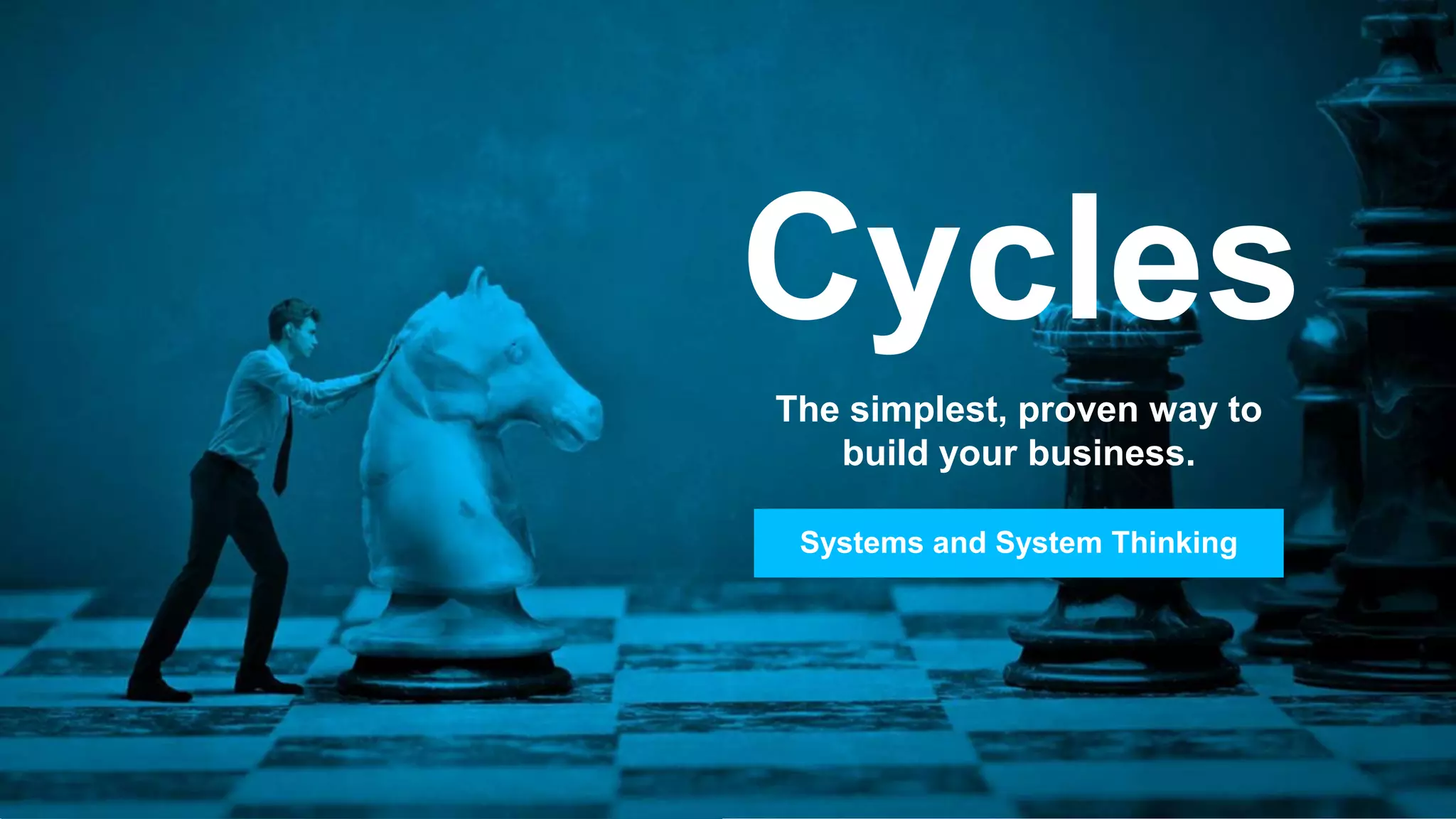




Cycles
The simplest, proven way to
build your business.
Systems and System Thinking
Systems
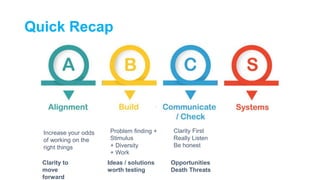
Quick Recap
Increase your odds
of working on the
right things
Problem finding +
Stimulus
+ Diversity
+ Work
Ideas / solutions
worth testing
Clarity to
move
forward
Clarity First
Really Listen
Be honest
Opportunities
Death Threats
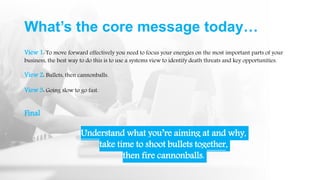
What’s the core message today…
View 1: To move forward effectively you need to focus your energies on the most important parts of your
business, the best way to do this is to use a systems view to identify death threats and key opportunities.
View 2: Bullets, then cannonballs.
View 3: Going slow to go fast.
Final
Understand what you’re aiming at and why,
take time to shoot bullets together,
then fire cannonballs.
The Theory
What is a system ?
2 or more independent parts working together to
achieve a common aim
A way of doing things
A good system = product of parts
6
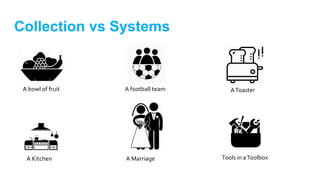
Collection vs Systems
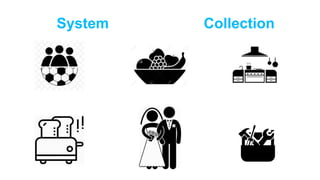
A bowl of fruit A football team AToaster
A Marriage Tools in aToolboxA Kitchen
System Collection
A system versus a process
a GOOD SYSTEM is
2 or more independent parts
working together to achieve a
common aim
a PROCESS is
A way of doing things (it
doesn’t mean people will work
together)
A good innovation system
• A holistic view, so you can be honest with yourself
• A momentum , a way to do things that stick
• Purpose
• Process
• Persistency
The big value of
systems
They keep you learning and they keep you thinking
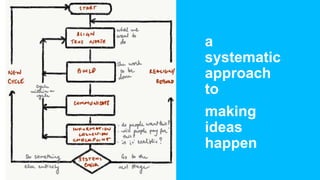
a
systematic
approach
to
making
ideas
happen
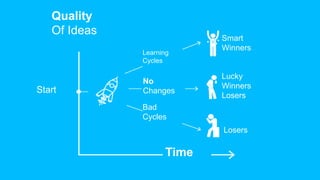
The Reality…
Quality
Of Ideas
Time
Start
Learning
Cycles
No
Changes
Bad
Cycles
Smart
Winners
Lucky
Winners
Losers
Losers
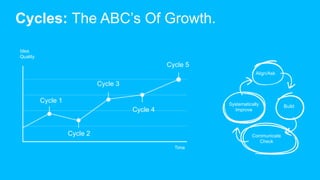
Cycles: The ABC’s Of Growth.
Cycle 1
Cycle 2
Cycle 3
Cycle 4
Cycle 5
Align/Ask
Build
Communicate
Check
Systematically
Improve
Idea
Quality
Time
‘Fire bullets, then cannonballs’
approach explains the success of
companies 10x better than big-leap
innovations and predictive genius
Jim Collins
Video :
https://vimeo.com/61581268
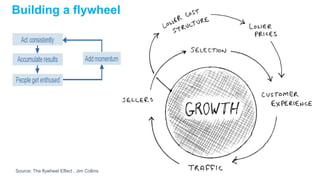
The flywheel effect
Crawl, Walk, Run
Change happens
slowly, but then it
happens all at one
Building a flywheel
Source: The flywheel Effect , Jim Collins
What an amazing idea !!
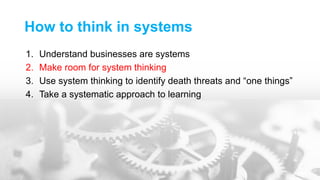
How to think in systems
1. Understand businesses are systems
2. Make room for system thinking
3. Use system thinking to identify death threats and “one things”
4. Take a systematic approach to learning
3 Guys and a Genie
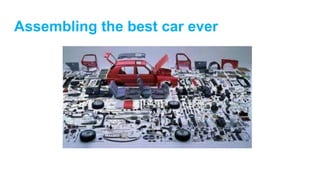
Assembling the best car ever
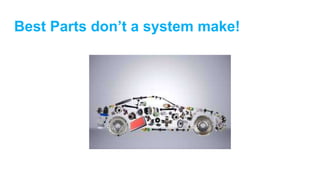
Best Parts don’t a system make!
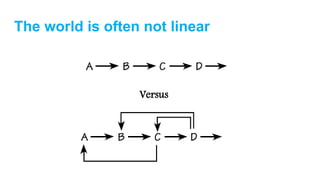
The world is often not linear
Versus
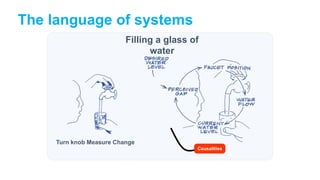
The language of systems
Turn knob Measure Change
Causalities
Filling a glass of
water
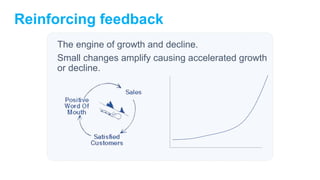
Reinforcing feedback
The engine of growth and decline.
Small changes amplify causing accelerated growth
or decline.
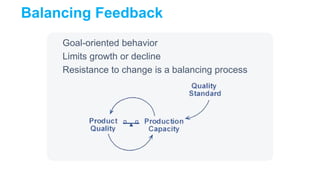
Balancing Feedback
Goal-oriented behavior
Limits growth or decline
Resistance to change is a balancing process
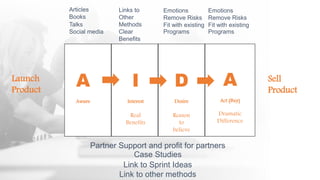
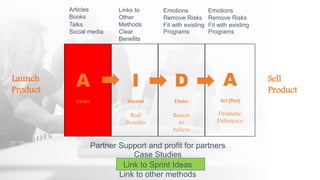
A simpler process
diagram for a new
product
(and your case study)
Launch
Product
Sell
Product
Partner Support and profit for partners
Case Studies
Link to Sprint Ideas
Link to other methods
I
Interest
Real
Benefits
Links to
Other
Methods
Clear
Benefits
A
Aware
Articles
Books
Talks
Social media
A
Act (Buy)
Dramatic
Difference
Emotions
Remove Risks
Fit with existing
Programs
D
Desire
Reason
to
believe
Emotions
Remove Risks
Fit with existing
Programs
How to think in systems
1. Understand businesses are systems
2. Make room for system thinking
3. Use system thinking to identify death threats and “one things”
4. Take a systematic approach to learning
We resist system
thinking
Because it is harder and usually more confrontational
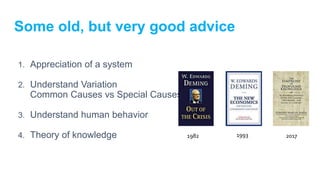
Some old, but very good advice
1. Appreciation of a system
2. Understand Variation
Common Causes vs Special Causes
3. Understand human behavior
4. Theory of knowledge 20171982 1993
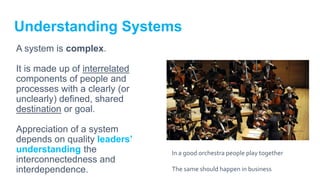
Understanding Systems
A system is complex.
It is made up of interrelated
components of people and
processes with a clearly (or
unclearly) defined, shared
destination or goal.
Appreciation of a system
depends on quality leaders’
understanding the
interconnectedness and
interdependence.
In a good orchestra people play together
The same should happen in business
Variation
Common Cause versus Special Cause
Common Cause
• Is inherent in the design of the
process
• Is due to regular, natural or
ordinary causes
• Affects all the outcomes of a
process
• Results in a “stable” process that is
predictable Also known as random
or unassignable variation
Special Cause
• Is due to irregular or unnatural
causes that are not inherent in the
design of the process
• Affect some, but not necessarily all
aspects of the process
• Results in an “unstable”” process
that is not predictable
• Also known as non-random o
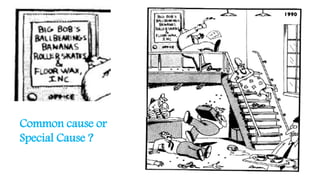
Common cause or
Special Cause ?
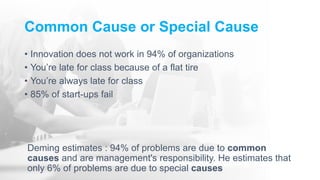
Common Cause or Special Cause
• Innovation does not work in 94% of organizations
• You’re late for class because of a flat tire
• You’re always late for class
• 85% of start-ups fail
Deming estimates : 94% of problems are due to common
causes and are management's responsibility. He estimates that
only 6% of problems are due to special causes
Understand human behavior
Most psychologists agree that humans have an innate
desire to perform well, to take pride in what they do.
Successful organizations harness this by ensuring that
systems allow workers to contribute towards
improvement.
Theory of knowledge
Improvement isn’t something you do once and forget
about, it isn’t a process with an end-point. Improvement
within an organization has to be continuous.
How to think in systems
1. Understand businesses are systems
2. Make room for system thinking
3. Use system thinking to identify death threats and “one things”
4. Take a systematic approach to learning
It’s Easy To Ignore What You Don’t Want
To Do.
The Stockdale Paradox (Named after Vietnam Prisoner of
War)
Retain faith that you will prevail in the end, regardless of the
difficulties. AND at the same time confront the most brutal
facts of your current reality, whatever they might be
++ +++ - +++
+ + + +
Failure
Success
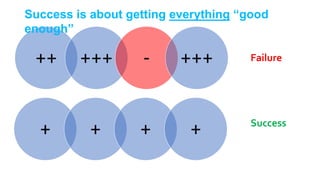
Success is about getting everything “good
enough”
++ +++ - +++ Failure
Success
++ +++ + +++
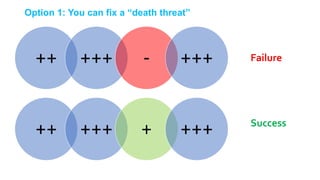
Option 1: You can fix a “death threat”
++ +++ - +++ Failure
Success
+++ ++++ + +++
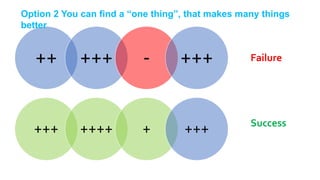
Option 2 You can find a “one thing”, that makes many things
better
Launch
Product
Sell
Product
I
Interest
Real
Benefits
Links to
Other
Methods
Clear
Benefits
A
Aware
Articles
Books
Talks
Social media
A
Act (Buy)
Dramatic
Difference
Emotions
Remove Risks
Fit with existing
Programs
D
Desire
Reason
to
believe
Emotions
Remove Risks
Fit with existing
Programs
Partner Support and profit for partners
Case Studies
Link to Sprint Ideas
Link to other methods
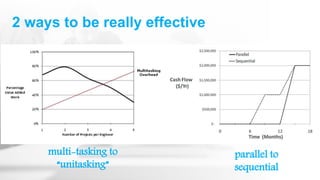
2 ways to be really effective
multi-tasking to
“unitasking”
parallel to
sequential
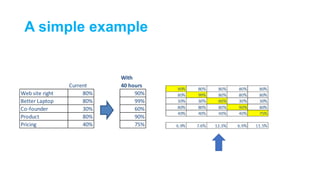
A simple example
With
Current 40 hours
Web site right 80% 90% 90% 80% 80% 80% 80%
Better Laptop 80% 99% 80% 99% 80% 80% 80%
Co-founder 30% 60% 30% 30% 60% 30% 30%
Product 80% 90% 80% 80% 80% 90% 80%
Pricing 40% 75% 40% 40% 40% 40% 75%
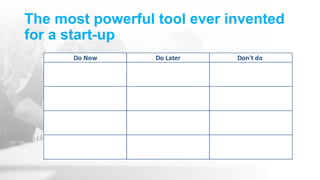
The most powerful tool ever invented
for a start-up
Do Now Do Later Don't do
Slower is faster !
A study by Economist intelligence with 312 companies split into
2 groups:
1. Go, go, go
2. Think, go , think, go (paused at strategic moments)
The companies with strategic pauses achieved:
40% higher sales and 52% higher profits
How to think in systems
1. Understand businesses are systems
2. Make room for system thinking
3. Use system thinking to identify death threats and “one things”
4. Take a systematic approach to learning
What does it mean to learn as you go?
Quite Simply…
1. Test
2. Learn
3. Take Action
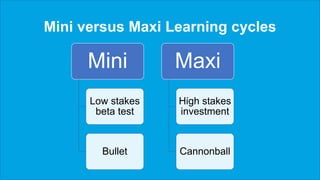
Mini versus Maxi Learning cycles
Mini
Low stakes
beta test
Bullet
Maxi
High stakes
investment
Cannonball
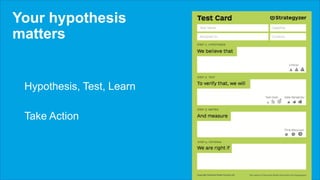
Your hypothesis
matters
Hypothesis, Test, Learn
Take Action
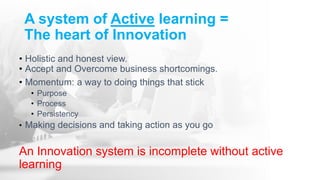
A system of Active learning =
The heart of Innovation
• Holistic and honest view.
• Accept and Overcome business shortcomings.
• Momentum: a way to doing things that stick
• Purpose
• Process
• Persistency
• Making decisions and taking action as you go
An Innovation system is incomplete without active
learning
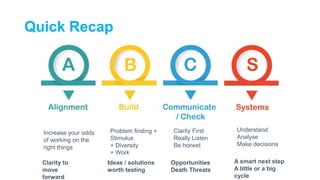
Quick Recap
Increase your odds
of working on the
right things
Problem finding +
Stimulus
+ Diversity
+ Work
Ideas / solutions
worth testing
Clarity to
move
forward
Clarity First
Really Listen
Be honest
Opportunities
Death Threats
Understand
Analyse
Make decisions
A smart next step
A little or a big
cycle
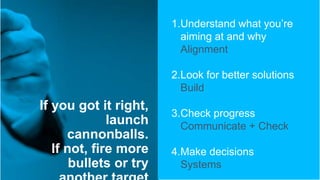
If you got it right,
launch
cannonballs.
If not, fire more
bullets or try
1.Understand what you’re
aiming at and why
Alignment
2.Look for better solutions
Build
3.Check progress
Communicate + Check
4.Make decisions
Systems

CYCLES course (5): Systems and System Thinking

  • 1.
    Cycles The simplest, provenway to build your business. Systems and System Thinking
  • 2.
  • 3.
    Quick Recap Increase yourodds of working on the right things Problem finding + Stimulus + Diversity + Work Ideas / solutions worth testing Clarity to move forward Clarity First Really Listen Be honest Opportunities Death Threats
  • 4.
    What’s the coremessage today… View 1: To move forward effectively you need to focus your energies on the most important parts of your business, the best way to do this is to use a systems view to identify death threats and key opportunities. View 2: Bullets, then cannonballs. View 3: Going slow to go fast. Final Understand what you’re aiming at and why, take time to shoot bullets together, then fire cannonballs.
  • 5.
  • 6.
    What is asystem ? 2 or more independent parts working together to achieve a common aim A way of doing things A good system = product of parts 6
  • 7.
    Collection vs Systems Abowl of fruit A football team AToaster A Marriage Tools in aToolboxA Kitchen
  • 8.
  • 9.
    A system versusa process a GOOD SYSTEM is 2 or more independent parts working together to achieve a common aim a PROCESS is A way of doing things (it doesn’t mean people will work together)
  • 10.
    A good innovationsystem • A holistic view, so you can be honest with yourself • A momentum , a way to do things that stick • Purpose • Process • Persistency
  • 11.
    The big valueof systems They keep you learning and they keep you thinking
  • 12.
  • 13.
  • 14.
    Cycles: The ABC’sOf Growth. Cycle 1 Cycle 2 Cycle 3 Cycle 4 Cycle 5 Align/Ask Build Communicate Check Systematically Improve Idea Quality Time
  • 15.
    ‘Fire bullets, thencannonballs’ approach explains the success of companies 10x better than big-leap innovations and predictive genius Jim Collins
  • 16.
  • 17.
    The flywheel effect Crawl,Walk, Run Change happens slowly, but then it happens all at one Building a flywheel Source: The flywheel Effect , Jim Collins
  • 19.
  • 20.
    How to thinkin systems 1. Understand businesses are systems 2. Make room for system thinking 3. Use system thinking to identify death threats and “one things” 4. Take a systematic approach to learning
  • 21.
    3 Guys anda Genie
  • 22.
  • 23.
    Best Parts don’ta system make!
  • 24.
    The world isoften not linear Versus
  • 25.
    The language ofsystems Turn knob Measure Change Causalities Filling a glass of water
  • 26.
    Reinforcing feedback The engineof growth and decline. Small changes amplify causing accelerated growth or decline.
  • 27.
    Balancing Feedback Goal-oriented behavior Limitsgrowth or decline Resistance to change is a balancing process
  • 29.
    A simpler process diagramfor a new product (and your case study)
  • 30.
    Launch Product Sell Product Partner Support andprofit for partners Case Studies Link to Sprint Ideas Link to other methods I Interest Real Benefits Links to Other Methods Clear Benefits A Aware Articles Books Talks Social media A Act (Buy) Dramatic Difference Emotions Remove Risks Fit with existing Programs D Desire Reason to believe Emotions Remove Risks Fit with existing Programs
  • 31.
    How to thinkin systems 1. Understand businesses are systems 2. Make room for system thinking 3. Use system thinking to identify death threats and “one things” 4. Take a systematic approach to learning
  • 32.
    We resist system thinking Becauseit is harder and usually more confrontational
  • 34.
    Some old, butvery good advice 1. Appreciation of a system 2. Understand Variation Common Causes vs Special Causes 3. Understand human behavior 4. Theory of knowledge 20171982 1993
  • 35.
    Understanding Systems A systemis complex. It is made up of interrelated components of people and processes with a clearly (or unclearly) defined, shared destination or goal. Appreciation of a system depends on quality leaders’ understanding the interconnectedness and interdependence. In a good orchestra people play together The same should happen in business
  • 36.
    Variation Common Cause versusSpecial Cause Common Cause • Is inherent in the design of the process • Is due to regular, natural or ordinary causes • Affects all the outcomes of a process • Results in a “stable” process that is predictable Also known as random or unassignable variation Special Cause • Is due to irregular or unnatural causes that are not inherent in the design of the process • Affect some, but not necessarily all aspects of the process • Results in an “unstable”” process that is not predictable • Also known as non-random o
  • 37.
  • 38.
    Common Cause orSpecial Cause • Innovation does not work in 94% of organizations • You’re late for class because of a flat tire • You’re always late for class • 85% of start-ups fail Deming estimates : 94% of problems are due to common causes and are management's responsibility. He estimates that only 6% of problems are due to special causes
  • 39.
    Understand human behavior Mostpsychologists agree that humans have an innate desire to perform well, to take pride in what they do. Successful organizations harness this by ensuring that systems allow workers to contribute towards improvement. Theory of knowledge Improvement isn’t something you do once and forget about, it isn’t a process with an end-point. Improvement within an organization has to be continuous.
  • 40.
    How to thinkin systems 1. Understand businesses are systems 2. Make room for system thinking 3. Use system thinking to identify death threats and “one things” 4. Take a systematic approach to learning
  • 41.
    It’s Easy ToIgnore What You Don’t Want To Do. The Stockdale Paradox (Named after Vietnam Prisoner of War) Retain faith that you will prevail in the end, regardless of the difficulties. AND at the same time confront the most brutal facts of your current reality, whatever they might be
  • 42.
    ++ +++ -+++ + + + + Failure Success Success is about getting everything “good enough”
  • 43.
    ++ +++ -+++ Failure Success ++ +++ + +++ Option 1: You can fix a “death threat”
  • 44.
    ++ +++ -+++ Failure Success +++ ++++ + +++ Option 2 You can find a “one thing”, that makes many things better
  • 45.
    Launch Product Sell Product I Interest Real Benefits Links to Other Methods Clear Benefits A Aware Articles Books Talks Social media A Act(Buy) Dramatic Difference Emotions Remove Risks Fit with existing Programs D Desire Reason to believe Emotions Remove Risks Fit with existing Programs Partner Support and profit for partners Case Studies Link to Sprint Ideas Link to other methods
  • 46.
    2 ways tobe really effective multi-tasking to “unitasking” parallel to sequential
  • 47.
    A simple example With Current40 hours Web site right 80% 90% 90% 80% 80% 80% 80% Better Laptop 80% 99% 80% 99% 80% 80% 80% Co-founder 30% 60% 30% 30% 60% 30% 30% Product 80% 90% 80% 80% 80% 90% 80% Pricing 40% 75% 40% 40% 40% 40% 75%
  • 48.
    The most powerfultool ever invented for a start-up Do Now Do Later Don't do
  • 49.
    Slower is faster! A study by Economist intelligence with 312 companies split into 2 groups: 1. Go, go, go 2. Think, go , think, go (paused at strategic moments) The companies with strategic pauses achieved: 40% higher sales and 52% higher profits
  • 50.
    How to thinkin systems 1. Understand businesses are systems 2. Make room for system thinking 3. Use system thinking to identify death threats and “one things” 4. Take a systematic approach to learning
  • 51.
    What does itmean to learn as you go? Quite Simply… 1. Test 2. Learn 3. Take Action
  • 52.
    Mini versus MaxiLearning cycles Mini Low stakes beta test Bullet Maxi High stakes investment Cannonball
  • 53.
  • 54.
    A system ofActive learning = The heart of Innovation • Holistic and honest view. • Accept and Overcome business shortcomings. • Momentum: a way to doing things that stick • Purpose • Process • Persistency • Making decisions and taking action as you go An Innovation system is incomplete without active learning
  • 55.
    Quick Recap Increase yourodds of working on the right things Problem finding + Stimulus + Diversity + Work Ideas / solutions worth testing Clarity to move forward Clarity First Really Listen Be honest Opportunities Death Threats Understand Analyse Make decisions A smart next step A little or a big cycle
  • 56.
    If you gotit right, launch cannonballs. If not, fire more bullets or try 1.Understand what you’re aiming at and why Alignment 2.Look for better solutions Build 3.Check progress Communicate + Check 4.Make decisions Systems