MACRO PHOTOGRAPHY
Basic Photography Class
MACRO PHOTOGRAPHY
! 

! 

! 

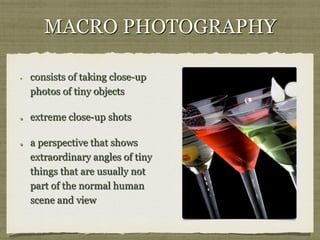
consists of taking close-up
photos of tiny objects
extreme close-up shots
a perspective that shows
extraordinary angles of tiny
things that are usually not
part of the normal human
scene and view
MACRO LENSES
! 

! 

! 

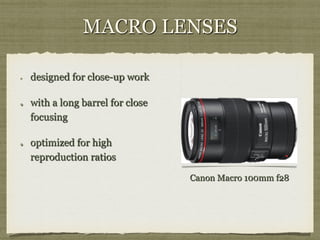
designed for close-up work
with a long barrel for close
focusing
optimized for high
reproduction ratios
Canon Macro 100mm f28
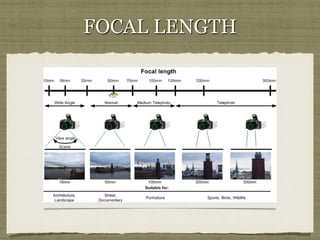
FOCAL LENGTH
! 

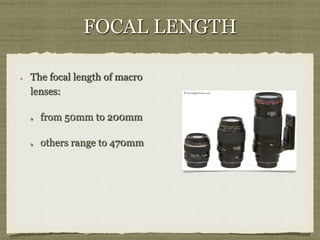
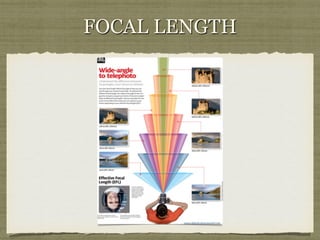
The focal length of macro
lenses:
! 

from 50mm to 200mm

! 

others range to 470mm
FOCAL LENGTH
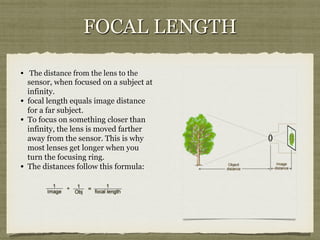
•  The distance from the lens to the

sensor, when focused on a subject at
infinity.
•  focal length equals image distance
for a far subject.
•  To focus on something closer than
infinity, the lens is moved farther
away from the sensor. This is why
most lenses get longer when you
turn the focusing ring.
•  The distances follow this formula:
TELEPHOTO
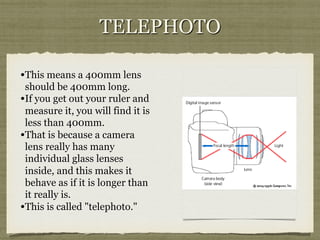
• This means a 400mm lens
should be 400mm long.
• If you get out your ruler and
measure it, you will find it is
less than 400mm.
• That is because a camera
lens really has many
individual glass lenses
inside, and this makes it
behave as if it is longer than
it really is.
• This is called "telephoto."
F/STOPS
F-stop is the focal length divided by the diameter of the lens.
For example, a 200mm f/4 lens will be 50mm wide.
Get out your ruler and measure it.
200mm/50mm = f/4.
That is why f-stop is typically written as F/4, meaning "focal-length over 4" or
"focal-length divided by four”.
Lenses are marked with a series of f-stops, each one lets in half as much light
as the previous one.
The light-gathering ability of a lens is determined by its area, and f-stops are
determined by diameter. Area is related to diameter squared. The progression
of f-stops, 1 - 1.4 - 2 - 2.8 - 4 - 5.6 - 8 - 11 - 16 - 22 - 32, are powers of the
square root of 2.
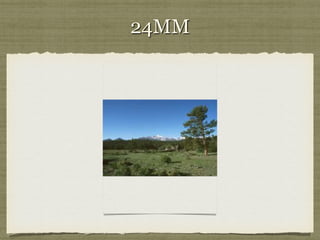
24MM
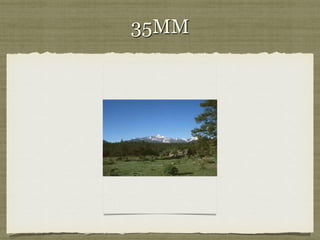
35MM
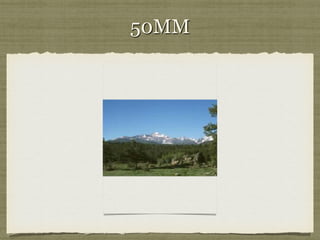
50MM
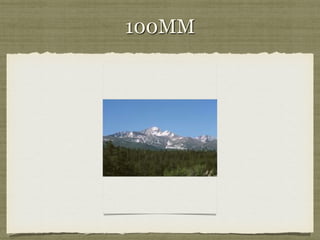
100MM
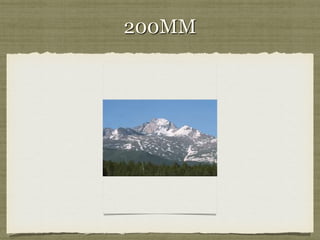
200MM
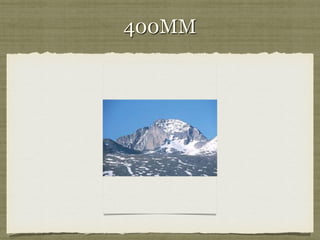
400MM
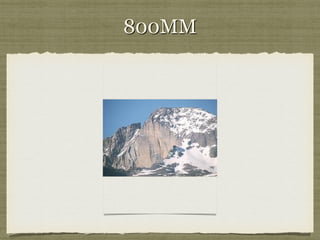
800MM
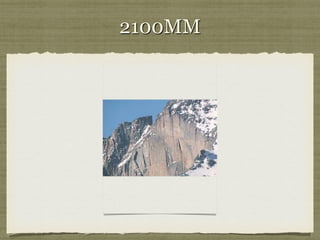
2100MM
FOCAL LENGTH
FOCAL LENGTH
FOCAL LENGTH
FOCAL LENGTH
FOCAL LENGTH
FOCAL LENGTH
MACRO LENSES
! 

! 

! 

! 

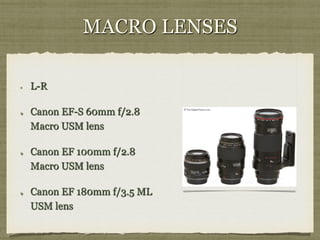
L-R
Canon EF-S 60mm f/2.8
Macro USM lens
Canon EF 100mm f/2.8
Macro USM lens
Canon EF 180mm f/3.5 ML
USM lens
MACRO LENSES
! 

! 

! 

! 

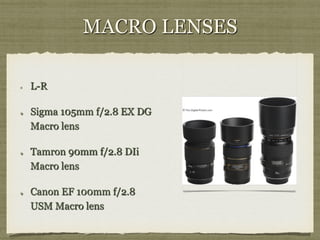
L-R
Sigma 105mm f/2.8 EX DG
Macro lens
Tamron 90mm f/2.8 DIi
Macro lens
Canon EF 100mm f/2.8
USM Macro lens
MACRO LENSES
! 

! 

! 

! 

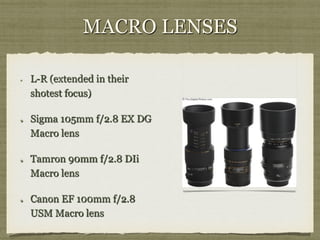
L-R (extended in their
shotest focus)
Sigma 105mm f/2.8 EX DG
Macro lens
Tamron 90mm f/2.8 DIi
Macro lens
Canon EF 100mm f/2.8
USM Macro lens
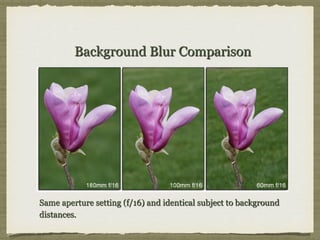
Background Blur Comparison

Same aperture setting (f/16) and identical subject to background
distances.
FOCAL LENGTH
! 

! 

! 

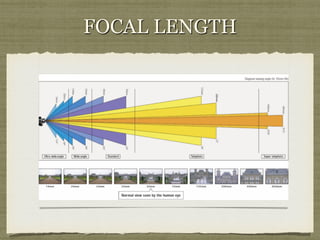
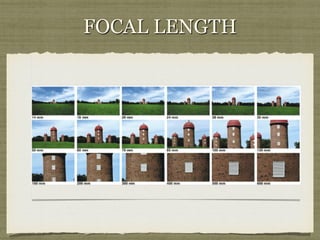
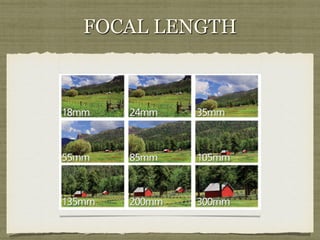
The focal length also affects other macro photography aspects.
Longer focal lengths require more distance to acquire the same
subject framing. The result is a change of perspective - the
telephotos compress/flatten the subject features more than
short focal lengths.
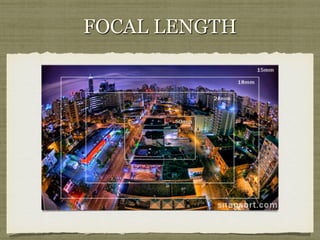
The wider angle of view of the short focal length macro lenses
mean that more of the background will be in the picture - and
that the background will be less-diffusely blurred.
Session 12 Macro photography

Session 12 Macro photography

  • 1.
  • 2.
    MACRO PHOTOGRAPHY !  !  !  consists oftaking close-up photos of tiny objects extreme close-up shots a perspective that shows extraordinary angles of tiny things that are usually not part of the normal human scene and view
  • 3.
    MACRO LENSES !  !  !  designed forclose-up work with a long barrel for close focusing optimized for high reproduction ratios Canon Macro 100mm f28
  • 4.
    FOCAL LENGTH !  The focallength of macro lenses: !  from 50mm to 200mm !  others range to 470mm
  • 5.
    FOCAL LENGTH •  Thedistance from the lens to the sensor, when focused on a subject at infinity. •  focal length equals image distance for a far subject. •  To focus on something closer than infinity, the lens is moved farther away from the sensor. This is why most lenses get longer when you turn the focusing ring. •  The distances follow this formula:
  • 6.
    TELEPHOTO • This means a400mm lens should be 400mm long. • If you get out your ruler and measure it, you will find it is less than 400mm. • That is because a camera lens really has many individual glass lenses inside, and this makes it behave as if it is longer than it really is. • This is called "telephoto."
  • 7.
    F/STOPS F-stop is thefocal length divided by the diameter of the lens. For example, a 200mm f/4 lens will be 50mm wide. Get out your ruler and measure it. 200mm/50mm = f/4. That is why f-stop is typically written as F/4, meaning "focal-length over 4" or "focal-length divided by four”. Lenses are marked with a series of f-stops, each one lets in half as much light as the previous one. The light-gathering ability of a lens is determined by its area, and f-stops are determined by diameter. Area is related to diameter squared. The progression of f-stops, 1 - 1.4 - 2 - 2.8 - 4 - 5.6 - 8 - 11 - 16 - 22 - 32, are powers of the square root of 2.
  • 8.
  • 9.
  • 10.
  • 11.
  • 12.
  • 13.
  • 14.
  • 15.
  • 16.
  • 17.
  • 18.
  • 19.
  • 20.
  • 21.
  • 22.
    MACRO LENSES !  !  !  !  L-R Canon EF-S60mm f/2.8 Macro USM lens Canon EF 100mm f/2.8 Macro USM lens Canon EF 180mm f/3.5 ML USM lens
  • 23.
    MACRO LENSES !  !  !  !  L-R Sigma 105mmf/2.8 EX DG Macro lens Tamron 90mm f/2.8 DIi Macro lens Canon EF 100mm f/2.8 USM Macro lens
  • 24.
    MACRO LENSES !  !  !  !  L-R (extendedin their shotest focus) Sigma 105mm f/2.8 EX DG Macro lens Tamron 90mm f/2.8 DIi Macro lens Canon EF 100mm f/2.8 USM Macro lens
  • 25.
    Background Blur Comparison Sameaperture setting (f/16) and identical subject to background distances.
  • 26.
    FOCAL LENGTH !  !  !  The focallength also affects other macro photography aspects. Longer focal lengths require more distance to acquire the same subject framing. The result is a change of perspective - the telephotos compress/flatten the subject features more than short focal lengths. The wider angle of view of the short focal length macro lenses mean that more of the background will be in the picture - and that the background will be less-diffusely blurred.