The Gaze
Humanities Division
Ateneo de Davao University
Bong S. Eliab
Look vs Gaze
▪ Look: a perceptual
mode open to all
▪ Gaze: a mode of
viewing reflecting a
gendered code of
desire.
3
The Gaze
▪ an act of looking
▪ began as the study
of the
objectification of
women in visual
texts
4
The Gaze
▪ Objectification of
women - women as
objects
▪ the commonality of
female nudity
▪ Nudity: implies
insubordination
5
The Gaze: Implication
▪ internalization of
the gaze
▪ changes women’s
perception of
themselves
▪ makes them think of
themselves as
objects to be desired
6
The Gaze: Shift
▪ shift to
objectification
▪ woman: as a
source of pleasure
(both for the
looker and the
looked-at)
▪ Men as dominant
7
Use of Psychoanalysis in Film
▪ Film reflects the
language of
patriarchy by being
bound up in the
same story of sexual
difference that all
patriarchy is
founded on
8
Women in Film
▪ Women seen as Other,
as an object not a
subject
▪ represents the
unconscious of the male
because she is always
the object he is looking
at
▪ never is able to speak
9
Phallocentrism
▪ a world view which
sees the penis
(symbolic and
otherwise) as the
defining center of
meaning
10
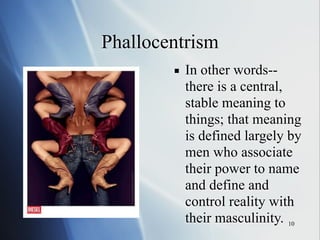
Phallocentrism
▪ In other words--
there is a central,
stable meaning to
things; that meaning
is defined largely by
men who associate
their power to name
and define and
control reality with
their masculinity.
11
Scopophilia
▪ the pleasure we get
from looking, in
seeing other people
as objects. We get a
sense of power from
being able to do
this. With John
Berger she believes
the one who looks
has the power
12
Voyeuristic Scopophilia
▪ looking at other
people as seeing
them as surrogates
for yourself
▪ We identify with
people in movies.
13
Voyeuristic Scopophilia
▪ tension between the
sense of power we
get from observing
others as separate
from ourselves and
the pleasure we get in
imagining that we are
the people we are
looking at
What is a Gaze?
▪ Viewing recorded images:
viewer’s gaze a voyeuristic
dimension
▪ to gaze: more than to look at
▪ Carries a psychological
relationship of power.
▪ The gazer is superior to the
object of gaze.
Forms of Gaze: 

“who is doing the looking”
▪ Spectator’s Gaze
▪ Intra-diegetic Gaze
▪ Direct (or extra-
diegetic) Gaze
▪ Look of the Camera
Other Forms of Gaze
▪ Gaze of the Bystander
▪ Averted Gaze
▪ Gaze of an audience
within the text
▪ Editorial Gaze
Direction of Gaze
▪ How a depicted person
gazes out of the frame
▪ Forms of attention
directed:
▪ towards other people
▪ To an object
▪ To oneself
▪ To the reader/ camera
▪ To middle distance (state of
reverie)
Intensity of Gaze
▪ Sharp: focusing on the
other person’s eyes
▪ Clear: focusing about
the other person’s head
and face
▪ Peripheral: having the
other person within the
field of vision
Proximity of Gaze
▪ Long Shot
▪ Extreme Long Shot
▪ Medium Long Shot
▪ Mid-Shot
▪ Medium Close Shot
▪ Close-Up
▪ Medium Close-Up
▪ Big Close-Up
Ranges of Formality
▪ Intimate: up to 18
inches
▪ Personal: 18 inches to
4 feet
▪ Social: 4 to 12 feet
▪ Public: 12 to 25 feet
21
Hollywood Film
▪ reflects the dominant
ideology of their culture.
▪ We get our pleasure from
films from this
presentation of the erotic.
▪ If we learn to make films
which do not encode
these ideologies, a lot of
people will lose their
pleasure in looking at
film
22
Pleasure in Film
▪ Film satisfies this
primal pleasure we
all get from looking
at other people.
23

Session 7 Gaze (2015)

  • 1.
    The Gaze Humanities Division Ateneode Davao University Bong S. Eliab
  • 2.
    Look vs Gaze ▪Look: a perceptual mode open to all ▪ Gaze: a mode of viewing reflecting a gendered code of desire.
  • 3.
    3 The Gaze ▪ anact of looking ▪ began as the study of the objectification of women in visual texts
  • 4.
    4 The Gaze ▪ Objectificationof women - women as objects ▪ the commonality of female nudity ▪ Nudity: implies insubordination
  • 5.
    5 The Gaze: Implication ▪internalization of the gaze ▪ changes women’s perception of themselves ▪ makes them think of themselves as objects to be desired
  • 6.
    6 The Gaze: Shift ▪shift to objectification ▪ woman: as a source of pleasure (both for the looker and the looked-at) ▪ Men as dominant
  • 7.
    7 Use of Psychoanalysisin Film ▪ Film reflects the language of patriarchy by being bound up in the same story of sexual difference that all patriarchy is founded on
  • 8.
    8 Women in Film ▪Women seen as Other, as an object not a subject ▪ represents the unconscious of the male because she is always the object he is looking at ▪ never is able to speak
  • 9.
    9 Phallocentrism ▪ a worldview which sees the penis (symbolic and otherwise) as the defining center of meaning
  • 10.
    10 Phallocentrism ▪ In otherwords-- there is a central, stable meaning to things; that meaning is defined largely by men who associate their power to name and define and control reality with their masculinity.
  • 11.
    11 Scopophilia ▪ the pleasurewe get from looking, in seeing other people as objects. We get a sense of power from being able to do this. With John Berger she believes the one who looks has the power
  • 12.
    12 Voyeuristic Scopophilia ▪ lookingat other people as seeing them as surrogates for yourself ▪ We identify with people in movies.
  • 13.
    13 Voyeuristic Scopophilia ▪ tensionbetween the sense of power we get from observing others as separate from ourselves and the pleasure we get in imagining that we are the people we are looking at
  • 14.
    What is aGaze? ▪ Viewing recorded images: viewer’s gaze a voyeuristic dimension ▪ to gaze: more than to look at ▪ Carries a psychological relationship of power. ▪ The gazer is superior to the object of gaze.
  • 15.
    Forms of Gaze:
 “who is doing the looking” ▪ Spectator’s Gaze ▪ Intra-diegetic Gaze ▪ Direct (or extra- diegetic) Gaze ▪ Look of the Camera
  • 16.
    Other Forms ofGaze ▪ Gaze of the Bystander ▪ Averted Gaze ▪ Gaze of an audience within the text ▪ Editorial Gaze
  • 17.
    Direction of Gaze ▪How a depicted person gazes out of the frame ▪ Forms of attention directed: ▪ towards other people ▪ To an object ▪ To oneself ▪ To the reader/ camera ▪ To middle distance (state of reverie)
  • 18.
    Intensity of Gaze ▪Sharp: focusing on the other person’s eyes ▪ Clear: focusing about the other person’s head and face ▪ Peripheral: having the other person within the field of vision
  • 19.
    Proximity of Gaze ▪Long Shot ▪ Extreme Long Shot ▪ Medium Long Shot ▪ Mid-Shot ▪ Medium Close Shot ▪ Close-Up ▪ Medium Close-Up ▪ Big Close-Up
  • 20.
    Ranges of Formality ▪Intimate: up to 18 inches ▪ Personal: 18 inches to 4 feet ▪ Social: 4 to 12 feet ▪ Public: 12 to 25 feet
  • 21.
    21 Hollywood Film ▪ reflectsthe dominant ideology of their culture. ▪ We get our pleasure from films from this presentation of the erotic. ▪ If we learn to make films which do not encode these ideologies, a lot of people will lose their pleasure in looking at film
  • 22.
    22 Pleasure in Film ▪Film satisfies this primal pleasure we all get from looking at other people.
  • 23.