

DIGITAL 
PHOT GRAPHY 
TOPIC: HDR PHOTOGRAPHY 
AMITY UNIVERSITY, UTTAR PRADESH 
BACHELORS IN JOURNALISM AND MASS 
COMMUNICATION 
A Amit Kumar Dash Presentation
What is HDR Photography? 
High dynamic range imaging (HDRI or HDR) is a set of 
methods used in imaging and photography to allow a greater 
dynamic range between the lightest and darkest areas of an 
image than current standard digital imaging methods or 
photographic methods. 
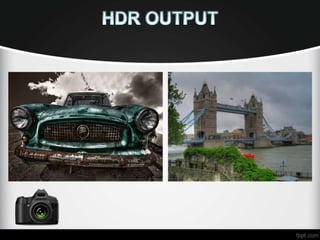
HDR images can represent more accurately the range of 
intensity levels found in real scenes, from direct sunlight to 
faint starlight, and is often captured by way of a plurality of 
differently exposed pictures of the same subject matter.
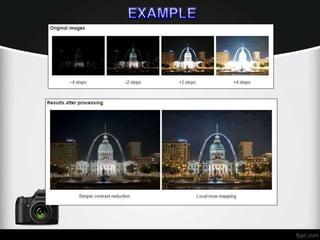
In simpler terms, HDR is a range of methods to provide higher 
dynamic range from the imaging process. Non-HDR cameras take 
pictures at one exposure level with a limited contrast range. This 
results in the loss of detail in bright or dark areas of a picture, 
depending on whether the camera had a low or high exposure 
setting. 
HDR compensates for this loss of detail by taking multiple 
pictures at different exposure levels and intelligently stitching 
them together to produce a picture that is representative in 
both dark and bright areas.
Non-HDR cameras take photographs with a limited exposure range, 
resulting in the loss of detail in bright or dark areas. HDR compensates for 
this loss of detail by capturing multiple photographs at different exposure 
levels and combining them to produce a photograph representative of a 
broader tonal range. HDR images are also acquired using special image 
sensors. 
The two primary types of HDR images are: 
1. Computer Renderings 
2. Resulting from Merging Multiple Low-Dynamic-Range
There are two broad rendering intents of HDR processing 
Photorealistic and Artistic 
• Photorealistic attempts to reveal what the scene looked like to the makers eye. 
• Artistic meant to be more like “Art” and not necessarily represent the actual 
scene. 
Some example scenes that are generally good for HDR: 
• Bright sunny day 
• Night scenes 
• Indoor scenes where bright sun is visible through windows 
• Outdoor scenes with highly reflective elements such as water falls.
General Workflow: 
• Initial capture - bracketed range or single image (some HDR processing 
on a single exposure is possible) 
• Minimal image prep in RAW development or pre-HDR processing of 
captured TIFFs 
• Save As TIFF files 
• HDR software tools to create a combined image of high dynamic range 
exposures (in 32 bit and then converted by software to16 bit) 
• Final image processing in Photo Shop 
• Save completed image ready for output
Major HDR Processing Software Suppliers: 
Commercial Software: 
1. HDR Soft - Photomatix Pro 
2. Nik Software - HDR Efex Pro 
3. Adobe - Photo Shop HDR Merge 
Free Software: 
1. HDR PhotoEngine 
2. Essential HDR 
3. FDRTools Basic 
4. Picturenaut
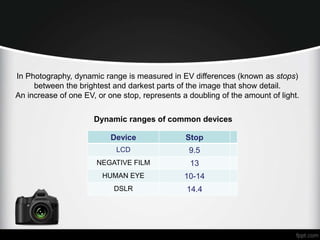
In Photography, dynamic range is measured in EV differences (known as stops) 
between the brightest and darkest parts of the image that show detail. 
An increase of one EV, or one stop, represents a doubling of the amount of light. 
Dynamic ranges of common devices 
Device Stop 
LCD 9.5 
NEGATIVE FILM 13 
HUMAN EYE 10-14 
DSLR 14.4
Mid-nineteenth century 
The idea of using several exposures to fix a too-extreme range 
of luminance was pioneered as early as the 1850s by Gustave Le Gray to 
render seascapes showing both the sky and the sea. 
Such rendering was impossible at the time using standard methods, the 
luminosity range being too extreme. Le Gray used one negative for the sky, 
and another one with a longer exposure for the sea, and combined the two 
into one picture in positive.
Mid- twentieth century 
Manual tone mapping was accomplished by dodging and burning – selectively increasing 
or decreasing the exposure of regions of the photograph to yield better tonality 
reproduction. This is effective because the dynamic range of the negative is significantly 
higher than would be available on the finished positive paper print when that is exposed via 
the negative in a uniform manner. 
An excellent example is the photograph Schweitzer at the Lamp by W. Eugene Smith, from 
his 1954 photo essay A Man of Mercy on Dr. Albert Schweitzer and his humanitarian work 
in French Equatorial Africa. 
The image took 5 days to reproduce the tonal range of the scene, which ranges from a 
bright lamp (relative to the scene) to a dark shadow.
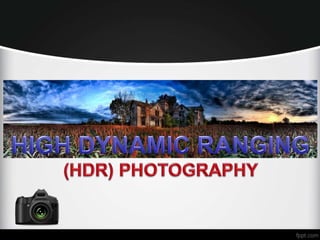
HDR Photography
HDR Photography
HDR Photography
HDR Photography

HDR Photography

  • 1.
    DIGITAL PHOT GRAPHY TOPIC: HDR PHOTOGRAPHY AMITY UNIVERSITY, UTTAR PRADESH BACHELORS IN JOURNALISM AND MASS COMMUNICATION A Amit Kumar Dash Presentation
  • 3.
    What is HDRPhotography? High dynamic range imaging (HDRI or HDR) is a set of methods used in imaging and photography to allow a greater dynamic range between the lightest and darkest areas of an image than current standard digital imaging methods or photographic methods. HDR images can represent more accurately the range of intensity levels found in real scenes, from direct sunlight to faint starlight, and is often captured by way of a plurality of differently exposed pictures of the same subject matter.
  • 4.
    In simpler terms,HDR is a range of methods to provide higher dynamic range from the imaging process. Non-HDR cameras take pictures at one exposure level with a limited contrast range. This results in the loss of detail in bright or dark areas of a picture, depending on whether the camera had a low or high exposure setting. HDR compensates for this loss of detail by taking multiple pictures at different exposure levels and intelligently stitching them together to produce a picture that is representative in both dark and bright areas.
  • 5.
    Non-HDR cameras takephotographs with a limited exposure range, resulting in the loss of detail in bright or dark areas. HDR compensates for this loss of detail by capturing multiple photographs at different exposure levels and combining them to produce a photograph representative of a broader tonal range. HDR images are also acquired using special image sensors. The two primary types of HDR images are: 1. Computer Renderings 2. Resulting from Merging Multiple Low-Dynamic-Range
  • 6.
    There are twobroad rendering intents of HDR processing Photorealistic and Artistic • Photorealistic attempts to reveal what the scene looked like to the makers eye. • Artistic meant to be more like “Art” and not necessarily represent the actual scene. Some example scenes that are generally good for HDR: • Bright sunny day • Night scenes • Indoor scenes where bright sun is visible through windows • Outdoor scenes with highly reflective elements such as water falls.
  • 7.
    General Workflow: •Initial capture - bracketed range or single image (some HDR processing on a single exposure is possible) • Minimal image prep in RAW development or pre-HDR processing of captured TIFFs • Save As TIFF files • HDR software tools to create a combined image of high dynamic range exposures (in 32 bit and then converted by software to16 bit) • Final image processing in Photo Shop • Save completed image ready for output
  • 8.
    Major HDR ProcessingSoftware Suppliers: Commercial Software: 1. HDR Soft - Photomatix Pro 2. Nik Software - HDR Efex Pro 3. Adobe - Photo Shop HDR Merge Free Software: 1. HDR PhotoEngine 2. Essential HDR 3. FDRTools Basic 4. Picturenaut
  • 9.
    In Photography, dynamicrange is measured in EV differences (known as stops) between the brightest and darkest parts of the image that show detail. An increase of one EV, or one stop, represents a doubling of the amount of light. Dynamic ranges of common devices Device Stop LCD 9.5 NEGATIVE FILM 13 HUMAN EYE 10-14 DSLR 14.4
  • 11.
    Mid-nineteenth century Theidea of using several exposures to fix a too-extreme range of luminance was pioneered as early as the 1850s by Gustave Le Gray to render seascapes showing both the sky and the sea. Such rendering was impossible at the time using standard methods, the luminosity range being too extreme. Le Gray used one negative for the sky, and another one with a longer exposure for the sea, and combined the two into one picture in positive.
  • 12.
    Mid- twentieth century Manual tone mapping was accomplished by dodging and burning – selectively increasing or decreasing the exposure of regions of the photograph to yield better tonality reproduction. This is effective because the dynamic range of the negative is significantly higher than would be available on the finished positive paper print when that is exposed via the negative in a uniform manner. An excellent example is the photograph Schweitzer at the Lamp by W. Eugene Smith, from his 1954 photo essay A Man of Mercy on Dr. Albert Schweitzer and his humanitarian work in French Equatorial Africa. The image took 5 days to reproduce the tonal range of the scene, which ranges from a bright lamp (relative to the scene) to a dark shadow.