Poses and Photography
MC310: Basic Photography
Mass Communication
Ateneo de Davao University
Poses
§ 
§ 
§ 
§ 
§ 
§ 
§ 

Introduction
Tips for Models
Choosing Models
Test Shots
Time for Prints
Photoshoot
Model Release
Tips for Models
§  The Photographer as an
artist
§  Photocomposition
§  Use of Lights and
Shadows
§  Use of Lines and
Shapes
§  Forms and Substance
Model of the Golden Mean
§  The Farmer and the
Rice Field
§  The Balance between
two extremes
§  Over-Confidence vs
Lack of Confidence
§  Golden Mean: finding
the center which is
your true self
Model as a Subject
§  a composed image of a
person in a still
position.
§  As an art form, it is a
stylized depiction of
the face or body with
the line and form of
the human figure as
the primary objective.
Models
Models
§  Most important element
in glamour photography
§  Need special talent:
projection, confidence,
mood and expression
§  Need to know different
types of models, their
strengths as
photographic subjects
Choosing a Model
§  First Model: TFP
(Time-for-Prints)
arrangement
§  Test Shots:
establishing a relaxed
working relationships;
shots not for use
Test Shots
§  Take note of
§  Successful poses
§  Visible defects
§  Remember model’s
best and worst features

§  Objective: make the
model feel relaxed and
confident
Assessing the Model: Front
§  Hair: shiny and
healthy
§  Watch for collarbones
§  Wait for pressure
marks from
underclothes to
disappear
Assessing the Model: Side
§  Makeup blends with body
color
§  Watch for creases around
armpits
§  No stomach bulge
§  Watch for veins in hands
§  Watch for dry skin on
knees
§  Watch for dry skin on feet
Assessing the Model: Behind
§  Back muscle should
not be to tense
§  Watch for dry skins on
elbows
§  Watch for veins in legs
Model/Photographer Relations
§  Photographer never
presses an unwilling
model;
§  Talk to your photographer,
establish as many meeting
points as possible;
§  Photographer usually
describes what he wants
you to do, why and what
he wants you to do.
Chaperones
§  Models may want to
be accompanied;
§  Try to discourage this
without actually
refusing the request;
§  If it is necessary, make
sure he is not within
eyeshot of the model
and is asked to keep
quiet.
Posing
§  Concentrate on the
models best attribute
§  Make mental notes on
where the hands are,
how the legs are
positioned, and what
will be shown to the
best advantage
Warning
§  Pay very close
attention to:
§ 
§ 
§ 
§ 

Knees
Elbows
Collarbones
Armpits

§  Over-prominence spoil
the photograph
Problem & Angle Solutions
§  Short legs: low angle shot
§  Low viewpoint:
photographer has to lie
down
§  Watch out for exposure
especially if background is
very bright (e.g. sky)
§  Make sure secondary
lighting (fill light) is
available
Problem & Angle Solutions
§  Calf Muscle
§  If model lies or
sits down and
raises her legs,
calf muscles will
relax downward.
§  Calf muscle
creates a
beautifully
smooth line.
Thin or Too Plump Legs
§  Let the model sit on
her legs or tuck them
under her.
§  By tucking one leg
under another and
leaning back, the
whole body is
stretched to produce
slim like look.
Heavy Hips

Heavy hips can be corrected by asking the
model to lean toward the camera
Heavy Hips
§  Heavy hips can
be corrected by
asking the model
to lean toward
the camera --
Wide Waist
§  Take a side view angle
while model is
positioned at a threequarter angle
§  Narrows the waist,
accentuate the chest,
bottom is emphasized
by curvature of back.
Lying Face Up

§  Lying up is not
particularly
flattering, since it
tends to flatten the
chest.
Background
§  Rule on Background:
§  It must not dominate the
model.
§  It is often the
background that creates
the contrast that works
best
Poses Standing Position
Side Poses
Side Poses
The Art of Makeup
§  Most vital tool in
glamour photography
§  Important: have a
clear idea of how you
want your model to
look
§  Need: basic
knowledge of
cosmetics
Makeup Kit
§  Cleansing cream
§  Skin tonic, freshener,
moisturizer
§  Eye makeup remover
§  Foundation and Face
powder
§  Eyedrops
§  Mascara and Blusher
§  Eyeshadow & eyeliner
§  Lipstick, lip gloss, lipliner
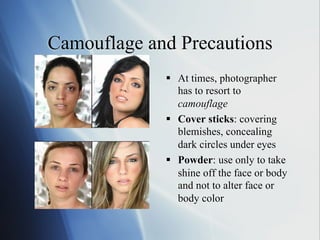
Camouflage and Precautions
§  At times, photographer
has to resort to
camouflage
§  Cover sticks: covering
blemishes, concealing
dark circles under eyes
§  Powder: use only to take
shine off the face or body
and not to alter face or
body color
Props and Accessories
§  Can create mood, enhance
feeling
§  Contextualizes the subject
§  Rule: “less is more”
§  Examples: sunglasses,
scarves, shoes, stockings,
soft translucent fabrics
and garments, umbrellas,
sunhats, caps, vizors
The Shoot
The Shoot
§  Important: Model is
relaxed and at ease to
obtain natural results.
§  Be courteous and
polite at all times.
§  Be positive in your
attitude.
§  Clarify instructions on
poses required.
The Shoot
§  Ask the photographer
to explain concisely
what he wants you to
do.
§  He can show you a
picture to demonstrate
the pose to you.
§  You may ask the
photographer to try out
your own ideas.
The Shoot
§  As a rule,
photographers do not
touch the model unless
absolutely necessary.
§  If they need to adjust a
garment or the model’s
hair, they explain their
intentions before they
do it.
The Shoot
§  Keep the conversations
going throughout the
shoot.
§  The model should know
what the photographer is
doing and why he is doing
it.
§  Appreciate the praise and
encouragement of the
photo crew all the time.
The Shoot
§  Tell her how a particular
pose look.
§  Have short breaks from
time to time and provide
cool refreshments.
§  Good idea: to have
background music to set
mood.
Post Shoot
§  Payment of
fees in cash (if
it requires
payment)
§  Print or contact
sheets for
model’s
portfolio
§  Model Release
Form

Session 9 Photo Poses (Basic Photography Class)

  • 1.
    Poses and Photography MC310:Basic Photography Mass Communication Ateneo de Davao University
  • 2.
  • 3.
    Tips for Models § The Photographer as an artist §  Photocomposition §  Use of Lights and Shadows §  Use of Lines and Shapes §  Forms and Substance
  • 4.
    Model of theGolden Mean §  The Farmer and the Rice Field §  The Balance between two extremes §  Over-Confidence vs Lack of Confidence §  Golden Mean: finding the center which is your true self
  • 5.
    Model as aSubject §  a composed image of a person in a still position. §  As an art form, it is a stylized depiction of the face or body with the line and form of the human figure as the primary objective.
  • 6.
  • 7.
    Models §  Most importantelement in glamour photography §  Need special talent: projection, confidence, mood and expression §  Need to know different types of models, their strengths as photographic subjects
  • 8.
    Choosing a Model § First Model: TFP (Time-for-Prints) arrangement §  Test Shots: establishing a relaxed working relationships; shots not for use
  • 9.
    Test Shots §  Takenote of §  Successful poses §  Visible defects §  Remember model’s best and worst features §  Objective: make the model feel relaxed and confident
  • 10.
    Assessing the Model:Front §  Hair: shiny and healthy §  Watch for collarbones §  Wait for pressure marks from underclothes to disappear
  • 11.
    Assessing the Model:Side §  Makeup blends with body color §  Watch for creases around armpits §  No stomach bulge §  Watch for veins in hands §  Watch for dry skin on knees §  Watch for dry skin on feet
  • 12.
    Assessing the Model:Behind §  Back muscle should not be to tense §  Watch for dry skins on elbows §  Watch for veins in legs
  • 13.
    Model/Photographer Relations §  Photographernever presses an unwilling model; §  Talk to your photographer, establish as many meeting points as possible; §  Photographer usually describes what he wants you to do, why and what he wants you to do.
  • 14.
    Chaperones §  Models maywant to be accompanied; §  Try to discourage this without actually refusing the request; §  If it is necessary, make sure he is not within eyeshot of the model and is asked to keep quiet.
  • 15.
    Posing §  Concentrate onthe models best attribute §  Make mental notes on where the hands are, how the legs are positioned, and what will be shown to the best advantage
  • 16.
    Warning §  Pay veryclose attention to: §  §  §  §  Knees Elbows Collarbones Armpits §  Over-prominence spoil the photograph
  • 17.
    Problem & AngleSolutions §  Short legs: low angle shot §  Low viewpoint: photographer has to lie down §  Watch out for exposure especially if background is very bright (e.g. sky) §  Make sure secondary lighting (fill light) is available
  • 18.
    Problem & AngleSolutions §  Calf Muscle §  If model lies or sits down and raises her legs, calf muscles will relax downward. §  Calf muscle creates a beautifully smooth line.
  • 19.
    Thin or TooPlump Legs §  Let the model sit on her legs or tuck them under her. §  By tucking one leg under another and leaning back, the whole body is stretched to produce slim like look.
  • 20.
    Heavy Hips Heavy hipscan be corrected by asking the model to lean toward the camera
  • 21.
    Heavy Hips §  Heavyhips can be corrected by asking the model to lean toward the camera --
  • 22.
    Wide Waist §  Takea side view angle while model is positioned at a threequarter angle §  Narrows the waist, accentuate the chest, bottom is emphasized by curvature of back.
  • 23.
    Lying Face Up § Lying up is not particularly flattering, since it tends to flatten the chest.
  • 24.
    Background §  Rule onBackground: §  It must not dominate the model. §  It is often the background that creates the contrast that works best
  • 25.
  • 26.
  • 27.
  • 28.
    The Art ofMakeup §  Most vital tool in glamour photography §  Important: have a clear idea of how you want your model to look §  Need: basic knowledge of cosmetics
  • 29.
    Makeup Kit §  Cleansingcream §  Skin tonic, freshener, moisturizer §  Eye makeup remover §  Foundation and Face powder §  Eyedrops §  Mascara and Blusher §  Eyeshadow & eyeliner §  Lipstick, lip gloss, lipliner
  • 30.
    Camouflage and Precautions § At times, photographer has to resort to camouflage §  Cover sticks: covering blemishes, concealing dark circles under eyes §  Powder: use only to take shine off the face or body and not to alter face or body color
  • 31.
    Props and Accessories § Can create mood, enhance feeling §  Contextualizes the subject §  Rule: “less is more” §  Examples: sunglasses, scarves, shoes, stockings, soft translucent fabrics and garments, umbrellas, sunhats, caps, vizors
  • 32.
  • 33.
    The Shoot §  Important:Model is relaxed and at ease to obtain natural results. §  Be courteous and polite at all times. §  Be positive in your attitude. §  Clarify instructions on poses required.
  • 34.
    The Shoot §  Askthe photographer to explain concisely what he wants you to do. §  He can show you a picture to demonstrate the pose to you. §  You may ask the photographer to try out your own ideas.
  • 35.
    The Shoot §  Asa rule, photographers do not touch the model unless absolutely necessary. §  If they need to adjust a garment or the model’s hair, they explain their intentions before they do it.
  • 36.
    The Shoot §  Keepthe conversations going throughout the shoot. §  The model should know what the photographer is doing and why he is doing it. §  Appreciate the praise and encouragement of the photo crew all the time.
  • 37.
    The Shoot §  Tellher how a particular pose look. §  Have short breaks from time to time and provide cool refreshments. §  Good idea: to have background music to set mood.
  • 38.
    Post Shoot §  Paymentof fees in cash (if it requires payment) §  Print or contact sheets for model’s portfolio §  Model Release Form