

+ 
Lesson # 3 
Types of Lens , Mega Pixel , Image Quality . 
Subject: 
Photography 
Faculty Name: 
Partha Pratim 
Samanta 
FY BA 
India’s premier Media -school 
Deviprasad Goenka Management College of Media Studies (dgmcms.org.in)
+ 
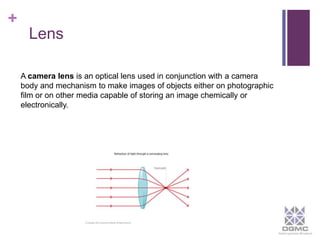
Lens 
A camera lens is an optical lens used in conjunction with a camera 
body and mechanism to make images of objects either on photographic 
film or on other media capable of storing an image chemically or 
electronically.
+ 
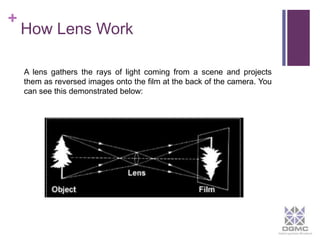
How Lens Work 
A lens gathers the rays of light coming from a scene and projects 
them as reversed images onto the film at the back of the camera. You 
can see this demonstrated below:
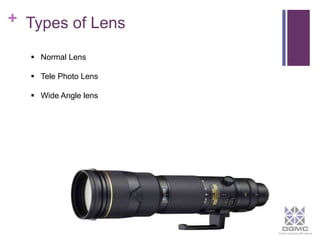
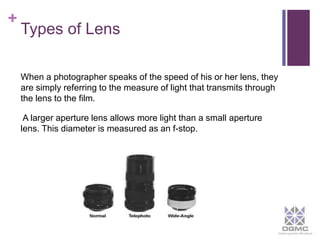
+ Types of Lens 
 Normal Lens 
 Tele Photo Lens 
 Wide Angle lens
+ 
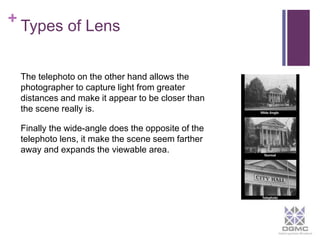
Types of Lens 
The telephoto on the other hand allows the 
photographer to capture light from greater 
distances and make it appear to be closer than 
the scene really is. 
Finally the wide-angle does the opposite of the 
telephoto lens, it make the scene seem farther 
away and expands the viewable area.
+ 
Types of Lens 
When a photographer speaks of the speed of his or her lens, they 
are simply referring to the measure of light that transmits through 
the lens to the film. 
A larger aperture lens allows more light than a small aperture 
lens. This diameter is measured as an f-stop.
+ 
Types of Lens 
EF-S zoom- EF- S 10-18mm, EF- S 10-22 mm, EF- S 15-85mm, EF- S 17- 
55mm, EF- S 17-85mm, EF- S 18-55mm, EF- S 18-135mm, EF- S 18-200mm, 
EF- S 55-250mm 
Ultra Wide Zoom EF-S 10–18mm, EF 16–35mm, EF-S 10–22mm, 
EF 17–40mm, EF-S 15–85mm. 
Standard Zoom- EF-S 17–55mm, EF 24–70mm, EF-S 17–85mm, 
EF 24–105mm, EF-S 18–55mm, EF 28–135mm, EF-S 18–135mm, 
EF 28–300mm, EF-S 18–200mm. 
Telephoto- EF-S 55–250mm, EF 70–200mm. 
Standard Prime EF 70–300mm EF 40mm, EF 100–400mm, 
EF 50mm, EF 200–400mm.
+ 
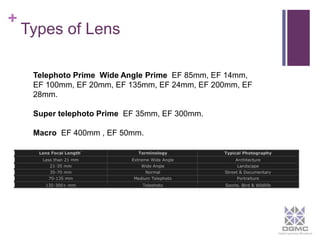
Types of Lens 
Telephoto Prime Wide Angle Prime EF 85mm, EF 14mm, 
EF 100mm, EF 20mm, EF 135mm, EF 24mm, EF 200mm, EF 
28mm. 
Super telephoto Prime EF 35mm, EF 300mm. 
Macro EF 400mm , EF 50mm.
+ 
Zoom Lenses & Prime Lenses 
 A zoom lens is one where the photographer can vary the focal 
length within a pre-defined range, whereas this cannot be 
changed with a "prime" or fixed focal length lens. The primary 
advantage of a zoom lens is that it is easier to achieve a variety 
of compositions or perspectives (since lens changes are not 
necessary). This advantage is often critical for dynamic subject 
matter, such as in photojournalism and children's photography. 
 An inexpensive prime lens can generally provide as good (or 
better) image quality as a high-end zoom lens.
+ 
Pixels & Megapixel 
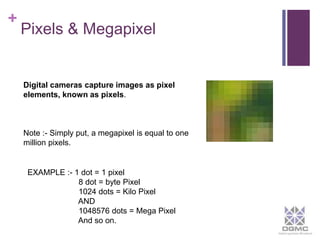
Digital cameras capture images as pixel 
elements, known as pixels. 
Note :- Simply put, a megapixel is equal to one 
million pixels. 
EXAMPLE :- 1 dot = 1 pixel 
8 dot = byte Pixel 
1024 dots = Kilo Pixel 
AND 
1048576 dots = Mega Pixel 
And so on.
+ 
Elements of picture quality 
The number of megapixels is only one aspect relating to the quality of a 
camera 
or 
Factors such as camera sensor and processor, and the optical quality 
of a lens, play equally important roles. 
Other elements determine the quality of photos and prints. They 
include: 
 Good lighting of a subject 
 Proper focus and exposure 
 Image clarity (lack of blur due to camera shake or incorrect shutter 
speed) 
 Shooting at the highest resolution and quality camera settings
+ 
F-Length 
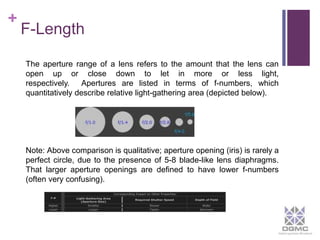
The aperture range of a lens refers to the amount that the lens can 
open up or close down to let in more or less light, 
respectively. Apertures are listed in terms of f-numbers, which 
quantitatively describe relative light-gathering area (depicted below). 
Note: Above comparison is qualitative; aperture opening (iris) is rarely a 
perfect circle, due to the presence of 5-8 blade-like lens diaphragms. 
That larger aperture openings are defined to have lower f-numbers 
(often very confusing).
+ 
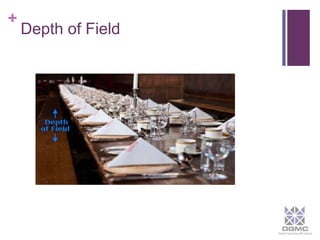
Depth of Field 
The depth of field (DOF) is the portion of a scene that appears 
sharp in the image. Although a lens can precisely focus at only one 
distance, the decrease in sharpness is gradual on either side of the 
focused distance, so that within the DOF, the unsharpness is 
imperceptible under normal viewing conditions.
+ 
Depth of Field
+ 
Take Away Tips 
Many cameras use interchangeable lenses. 
When a photographer speaks of the speed of his or her lens, they are simply 
referring to the measure of light that transmits through the lens to the film. 
 Think 
 Experiment 
 Move 
 Wait 
 Rule of Thirds

Photography lession 03

  • 1.
    + Lesson #3 Types of Lens , Mega Pixel , Image Quality . Subject: Photography Faculty Name: Partha Pratim Samanta FY BA India’s premier Media -school Deviprasad Goenka Management College of Media Studies (dgmcms.org.in)
  • 2.
    + Lens Acamera lens is an optical lens used in conjunction with a camera body and mechanism to make images of objects either on photographic film or on other media capable of storing an image chemically or electronically.
  • 3.
    + How LensWork A lens gathers the rays of light coming from a scene and projects them as reversed images onto the film at the back of the camera. You can see this demonstrated below:
  • 4.
    + Types ofLens  Normal Lens  Tele Photo Lens  Wide Angle lens
  • 5.
    + Types ofLens The telephoto on the other hand allows the photographer to capture light from greater distances and make it appear to be closer than the scene really is. Finally the wide-angle does the opposite of the telephoto lens, it make the scene seem farther away and expands the viewable area.
  • 6.
    + Types ofLens When a photographer speaks of the speed of his or her lens, they are simply referring to the measure of light that transmits through the lens to the film. A larger aperture lens allows more light than a small aperture lens. This diameter is measured as an f-stop.
  • 7.
    + Types ofLens EF-S zoom- EF- S 10-18mm, EF- S 10-22 mm, EF- S 15-85mm, EF- S 17- 55mm, EF- S 17-85mm, EF- S 18-55mm, EF- S 18-135mm, EF- S 18-200mm, EF- S 55-250mm Ultra Wide Zoom EF-S 10–18mm, EF 16–35mm, EF-S 10–22mm, EF 17–40mm, EF-S 15–85mm. Standard Zoom- EF-S 17–55mm, EF 24–70mm, EF-S 17–85mm, EF 24–105mm, EF-S 18–55mm, EF 28–135mm, EF-S 18–135mm, EF 28–300mm, EF-S 18–200mm. Telephoto- EF-S 55–250mm, EF 70–200mm. Standard Prime EF 70–300mm EF 40mm, EF 100–400mm, EF 50mm, EF 200–400mm.
  • 8.
    + Types ofLens Telephoto Prime Wide Angle Prime EF 85mm, EF 14mm, EF 100mm, EF 20mm, EF 135mm, EF 24mm, EF 200mm, EF 28mm. Super telephoto Prime EF 35mm, EF 300mm. Macro EF 400mm , EF 50mm.
  • 9.
    + Zoom Lenses& Prime Lenses  A zoom lens is one where the photographer can vary the focal length within a pre-defined range, whereas this cannot be changed with a "prime" or fixed focal length lens. The primary advantage of a zoom lens is that it is easier to achieve a variety of compositions or perspectives (since lens changes are not necessary). This advantage is often critical for dynamic subject matter, such as in photojournalism and children's photography.  An inexpensive prime lens can generally provide as good (or better) image quality as a high-end zoom lens.
  • 10.
    + Pixels &Megapixel Digital cameras capture images as pixel elements, known as pixels. Note :- Simply put, a megapixel is equal to one million pixels. EXAMPLE :- 1 dot = 1 pixel 8 dot = byte Pixel 1024 dots = Kilo Pixel AND 1048576 dots = Mega Pixel And so on.
  • 11.
    + Elements ofpicture quality The number of megapixels is only one aspect relating to the quality of a camera or Factors such as camera sensor and processor, and the optical quality of a lens, play equally important roles. Other elements determine the quality of photos and prints. They include:  Good lighting of a subject  Proper focus and exposure  Image clarity (lack of blur due to camera shake or incorrect shutter speed)  Shooting at the highest resolution and quality camera settings
  • 12.
    + F-Length Theaperture range of a lens refers to the amount that the lens can open up or close down to let in more or less light, respectively. Apertures are listed in terms of f-numbers, which quantitatively describe relative light-gathering area (depicted below). Note: Above comparison is qualitative; aperture opening (iris) is rarely a perfect circle, due to the presence of 5-8 blade-like lens diaphragms. That larger aperture openings are defined to have lower f-numbers (often very confusing).
  • 13.
    + Depth ofField The depth of field (DOF) is the portion of a scene that appears sharp in the image. Although a lens can precisely focus at only one distance, the decrease in sharpness is gradual on either side of the focused distance, so that within the DOF, the unsharpness is imperceptible under normal viewing conditions.
  • 14.
  • 15.
    + Take AwayTips Many cameras use interchangeable lenses. When a photographer speaks of the speed of his or her lens, they are simply referring to the measure of light that transmits through the lens to the film.  Think  Experiment  Move  Wait  Rule of Thirds