HHPC
Macro & Close-up
   Workshop
       2/2/13
     Ed Knepley
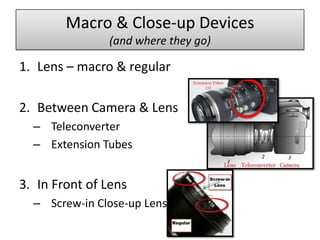
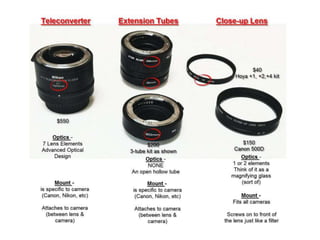
Macro & Close-up Devices
               (and where they go)

1. Lens – macro & regular

2. Between Camera & Lens
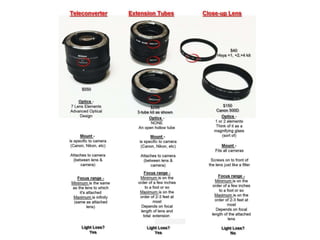
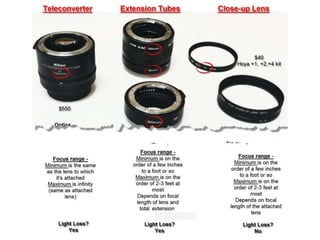
  – Teleconverter
  – Extension Tubes


3. In Front of Lens
  – Screw-in Close-up Lens
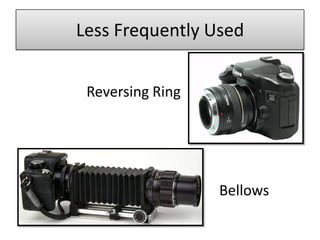
Less Frequently Used


 Reversing Ring


                  Bellows
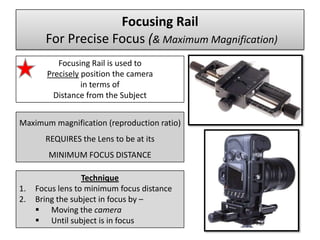
Focusing Rail
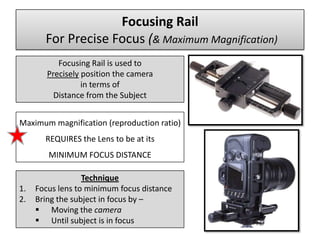
       For Precise Focus (& Maximum Magnification)
           Focusing Rail is used to
        Precisely position the camera
                  in terms of
          Distance from the Subject


Maximum magnification (reproduction ratio)
       REQUIRES the Lens to be at its
        MINIMUM FOCUS DISTANCE

                  Technique
1.   Focus lens to minimum focus distance
2.   Bring the subject in focus by –
      Moving the camera
      Until subject is in focus
Focusing Rail
       For Precise Focus (& Maximum Magnification)
           Focusing Rail is used to
        Precisely position the camera
                  in terms of
          Distance from the Subject


Maximum magnification (reproduction ratio)
       REQUIRES the Lens to be at its
        MINIMUM FOCUS DISTANCE

                  Technique
1.   Focus lens to minimum focus distance
2.   Bring the subject in focus by –
      Moving the camera
      Until subject is in focus
Focusing Rail
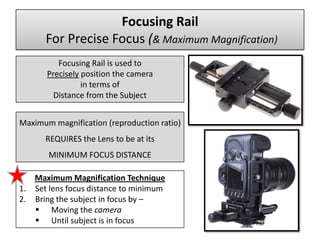
      For Precise Focus (& Maximum Magnification)
          Focusing Rail is used to
       Precisely position the camera
                 in terms of
         Distance from the Subject


Maximum magnification (reproduction ratio)
      REQUIRES the Lens to be at its
       MINIMUM FOCUS DISTANCE

   Maximum Magnification Technique
1. Set lens focus distance to minimum
2. Bring the subject in focus by –
    Moving the camera
    Until subject is in focus
Hands On Time
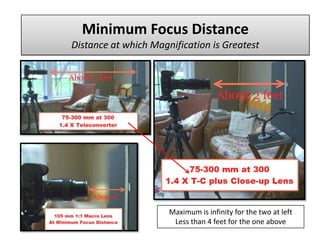
  Minimum Focus Distance
Distance at which Magnification is Greatest


                      Maximum is infinity for the two at left
                       Less than 4 feet for the one above
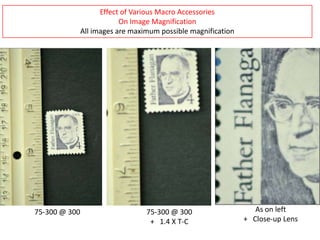
Effect of Various Macro Accessories
                           On Image Magnification
               All images are maximum possible magnification


75-300 @ 300                      75-300 @ 300                    As on left
                                   + 1.4 X T-C                 + Close-up Lens
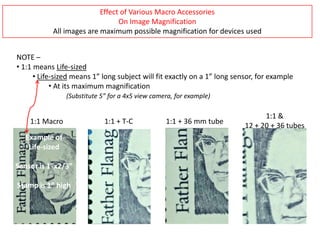
Effect of Various Macro Accessories
                                On Image Magnification
           All images are maximum possible magnification for devices used


NOTE –
• 1:1 means Life-sized
      • Life-sized means 1” long subject will fit exactly on a 1” long sensor, for example
            • At its maximum magnification
                 (Substitute 5” for a 4x5 view camera, for example)

                                                                                1:1 &
    1:1 Macro                 1:1 + T-C            1:1 + 36 mm tube
                                                                          12 + 20 + 36 tubes
   Example of
    Life-sized

Sensor is 1”x2/3”

Stamp is 1” high
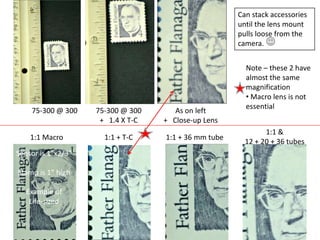
Can stack accessories
                                                      until the lens mount
                                                      pulls loose from the
                                                      camera.


                                                        Note – these 2 have
                                                        almost the same
                                                        magnification
                                                        • Macro lens is not
                                                        essential
    75-300 @ 300    75-300 @ 300      As on left
                     + 1.4 X T-C   + Close-up Lens
                                                              1:1 &
    1:1 Macro         1:1 + T-C    1:1 + 36 mm tube
                                                        12 + 20 + 36 tubes
Sensor is 1”x2/3”

Stamp is 1” high

   Example of
    Life-sized
Basic Macro Techniques


 1.Stable Platform
 2. Manual Focus
 3.Depth of Field
Basic Macro Techniques


 1.Stable Platform
  2.Manual Focus
 3.Depth of Field
Basic Macro Techniques


 1.Stable Platform
  2.Manual Focus
 3.Depth of Field
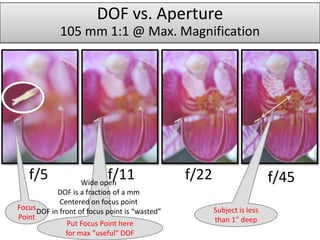
DOF vs. Aperture
             105 mm 1:1 @ Max. Magnification


   f/5                    f/11
                   Wide open
                                                f/22                     f/45
            DOF is a fraction of a mm
             Centered on focus point
Focus DOF in front of focus point is “wasted”          Subject is less
Point                                                  than 1” deep
               Put Focus Point here
               for max “useful” DOF
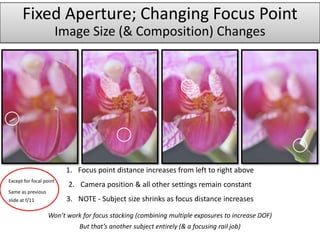
Fixed Aperture; Changing Focus Point
                         Image Size (& Composition) Changes


                          1. Focus point distance increases from left to right above
Except for focal point
                           2. Camera position & all other settings remain constant
Same as previous
slide at f/11             3. NOTE - Subject size shrinks as focus distance increases

                   Won’t work for focus stacking (combining multiple exposures to increase DOF)
                              But that’s another subject entirely (& a focusing rail job)
Hands On Time
                 Hands-on Time

• Stations –
     •   Canon
     •   Nikon
     •   4/3 & Mirrorless
     •   Download & Review
• Try your hand using the available accessories
     • Ask lots of questions
     • Have lots of fun

Hhpc macro workshop

  • 1.
    HHPC Macro & Close-up Workshop 2/2/13 Ed Knepley
  • 2.
    Macro & Close-upDevices (and where they go) 1. Lens – macro & regular 2. Between Camera & Lens – Teleconverter – Extension Tubes 3. In Front of Lens – Screw-in Close-up Lens
  • 6.
    Less Frequently Used Reversing Ring Bellows
  • 7.
    Focusing Rail For Precise Focus (& Maximum Magnification) Focusing Rail is used to Precisely position the camera in terms of Distance from the Subject Maximum magnification (reproduction ratio) REQUIRES the Lens to be at its MINIMUM FOCUS DISTANCE Technique 1. Focus lens to minimum focus distance 2. Bring the subject in focus by –  Moving the camera  Until subject is in focus
  • 8.
    Focusing Rail For Precise Focus (& Maximum Magnification) Focusing Rail is used to Precisely position the camera in terms of Distance from the Subject Maximum magnification (reproduction ratio) REQUIRES the Lens to be at its MINIMUM FOCUS DISTANCE Technique 1. Focus lens to minimum focus distance 2. Bring the subject in focus by –  Moving the camera  Until subject is in focus
  • 9.
    Focusing Rail For Precise Focus (& Maximum Magnification) Focusing Rail is used to Precisely position the camera in terms of Distance from the Subject Maximum magnification (reproduction ratio) REQUIRES the Lens to be at its MINIMUM FOCUS DISTANCE Maximum Magnification Technique 1. Set lens focus distance to minimum 2. Bring the subject in focus by –  Moving the camera  Until subject is in focus
  • 10.
    Hands On Time Minimum Focus Distance Distance at which Magnification is Greatest Maximum is infinity for the two at left Less than 4 feet for the one above
  • 11.
    Effect of VariousMacro Accessories On Image Magnification All images are maximum possible magnification 75-300 @ 300 75-300 @ 300 As on left + 1.4 X T-C + Close-up Lens
  • 12.
    Effect of VariousMacro Accessories On Image Magnification All images are maximum possible magnification for devices used NOTE – • 1:1 means Life-sized • Life-sized means 1” long subject will fit exactly on a 1” long sensor, for example • At its maximum magnification (Substitute 5” for a 4x5 view camera, for example) 1:1 & 1:1 Macro 1:1 + T-C 1:1 + 36 mm tube 12 + 20 + 36 tubes Example of Life-sized Sensor is 1”x2/3” Stamp is 1” high
  • 13.
    Can stack accessories until the lens mount pulls loose from the camera. Note – these 2 have almost the same magnification • Macro lens is not essential 75-300 @ 300 75-300 @ 300 As on left + 1.4 X T-C + Close-up Lens 1:1 & 1:1 Macro 1:1 + T-C 1:1 + 36 mm tube 12 + 20 + 36 tubes Sensor is 1”x2/3” Stamp is 1” high Example of Life-sized
  • 14.
    Basic Macro Techniques 1.Stable Platform 2. Manual Focus 3.Depth of Field
  • 15.
    Basic Macro Techniques 1.Stable Platform 2.Manual Focus 3.Depth of Field
  • 16.
    Basic Macro Techniques 1.Stable Platform 2.Manual Focus 3.Depth of Field
  • 18.
    DOF vs. Aperture 105 mm 1:1 @ Max. Magnification f/5 f/11 Wide open f/22 f/45 DOF is a fraction of a mm Centered on focus point Focus DOF in front of focus point is “wasted” Subject is less Point than 1” deep Put Focus Point here for max “useful” DOF
  • 19.
    Fixed Aperture; ChangingFocus Point Image Size (& Composition) Changes 1. Focus point distance increases from left to right above Except for focal point 2. Camera position & all other settings remain constant Same as previous slide at f/11 3. NOTE - Subject size shrinks as focus distance increases Won’t work for focus stacking (combining multiple exposures to increase DOF) But that’s another subject entirely (& a focusing rail job)
  • 20.
    Hands On Time Hands-on Time • Stations – • Canon • Nikon • 4/3 & Mirrorless • Download & Review • Try your hand using the available accessories • Ask lots of questions • Have lots of fun