Copyright © 2013 Pearson Education, Inc.
publishing as Prentice Hall
7-1
Chapter 7
Governmental
Influence on Trade
Copyright © 2013 Pearson Education, Inc.
publishing as Prentice Hall
7-2
Learning Objectives
 To explain the rationales for governmental
policies that enhance and restrict trade
 To show the effects of pressure groups on trade
policies
 To describe the potential and actual effects of
governmental intervention on the free flow of
trade
 To illustrate the major means by which trade is
restricted and regulated
 To demonstrate the business uncertainties and
business opportunities created by governmental
trade policies
Copyright © 2013 Pearson Education, Inc.
publishing as Prentice Hall
7-3
Introduction
 Protectionism - policies that
 affect the ability of foreign producers to
compete in your home market
 limit or enhance your company’s ability to sell
abroad or acquire needed foreign supplies
Copyright © 2013 Pearson Education, Inc.
publishing as Prentice Hall
7-4
Introduction
Physical and Social Factors Affecting the Flow of Goods and Services
Copyright © 2013 Pearson Education, Inc.
publishing as Prentice Hall
7-5
Conflicting Results
of Trade Policies
 Governments intervene in trade to achieve
economic, social, and political goals
 Policymakers are challenged by
 conflicting objectives
 interest groups
Copyright © 2013 Pearson Education, Inc.
publishing as Prentice Hall
7-6
The Role of Stakeholders
 Proposed policies on trade spark debate
 Stakeholders include
 Workers
 Owners
 Suppliers
 Local politicians
 Consumers usually don’t care
Copyright © 2013 Pearson Education, Inc.
publishing as Prentice Hall
7-7
Economic Rationales for
Government Intervention
Learning Objective 1:
To explain the rationales for governmental
policies that enhance and restrict trade
Copyright © 2013 Pearson Education, Inc.
publishing as Prentice Hall
7-8
Economic Rationales for
Government Intervention
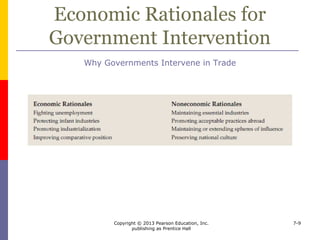
Why Governments Intervene in Trade
Copyright © 2013 Pearson Education, Inc.
publishing as Prentice Hall
7-9
Fighting Unemployment
Learning Objective 2:
To show the effects of pressure groups on
trade policies
Copyright © 2013 Pearson Education, Inc.
publishing as Prentice Hall
7-10
Fighting Unemployment
 The unemployed are the most effective pressure
group
 But, import restrictions
 can lead to retaliation by other countries
 are less likely retaliated against effectively by small
economies
 are less likely to be met with retaliation if implemented
by small economies
 may decrease export jobs because of price increases for
components
 may decrease export jobs because of lower incomes
abroad
Copyright © 2013 Pearson Education, Inc.
publishing as Prentice Hall
7-11
Protecting ‘Infant Industries’
Learning Objective 3:
To describe the potential and actual
effects of governmental intervention on
the free flow of trade
Copyright © 2013 Pearson Education, Inc.
publishing as Prentice Hall
7-12
Protecting ‘Infant Industries’
 The infant industry argument
 government protection of import competition is
necessary to help certain industries evolve
from high-cost to low-cost production
 Used by developing countries
Copyright © 2013 Pearson Education, Inc.
publishing as Prentice Hall
7-13
Developing an Industrial Base
 Countries promote industrialization
because it
 brings faster growth than agriculture
 brings in investment funds
 diversifies the economy
 brings more income than primary products do
 reduces imports and promotes exports
 helps the nation-building process
Copyright © 2013 Pearson Education, Inc.
publishing as Prentice Hall
7-14
Developing an Industrial Base
 The industrialization argument
 unregulated imports of lower priced products
prevents the development of a domestic
industry
 Assumptions
 Surplus Workers
 Investment Inflows
 Diversification
 Growth in Manufactured Goods
 Import Substitution and Export-Led
Development
 Nation Building
Copyright © 2013 Pearson Education, Inc.
publishing as Prentice Hall
7-15
Economic Relationships
With Other Countries
 Trade controls can be used
 to improve the balance of payments
 to gain fair access to foreign markets
 comparable access argument
 as a bargaining tool
 believability and importance
 to control prices
 dumping
 optimum-tariff theory
Copyright © 2013 Pearson Education, Inc.
publishing as Prentice Hall
7-16
Noneconomic Rationales for
Government Intervention
 Noneconomic rationales include
 Maintaining essential industries
 Promoting acceptable practices abroad
 Maintaining or extending spheres of influence
 Preserving national culture
Copyright © 2013 Pearson Education, Inc.
publishing as Prentice Hall
7-17
Maintaining Essential Industries
 The essential industry argument
 protect essential industries so the country is
not dependent on foreign supplies during war
 Countries must
 determine which industries are essential
 consider costs and alternatives
 consider political consequences
Copyright © 2013 Pearson Education, Inc.
publishing as Prentice Hall
7-18
Promoting Acceptable
Practices Abroad
 Import trade controls can be used
 to promote changes in foreign countries’
political policies or capabilities
 as a foreign policy weapon
 to pressure governments to alter their stances
on a variety of issues
 human rights
 environmental protection
Copyright © 2013 Pearson Education, Inc.
publishing as Prentice Hall
7-19
Maintaining or Extending
Spheres of Influence
 Governments provide assistance and
encourage imports from countries that join
a political alliance or vote a preferred way
within international bodies
 Cotonou Agreement
 A country’s trade restrictions may coerce
governments to follow certain political
actions or punish companies whose
governments do not
Copyright © 2013 Pearson Education, Inc.
publishing as Prentice Hall
7-20
Preserving National Culture
 In order to preserve national culture,
countries
 limit foreign products and services in certain
sectors
 Canada’s cultural sovereignty
 prohibit exports of art and historical items
deemed important to national heritage
Copyright © 2013 Pearson Education, Inc.
publishing as Prentice Hall
7-21
Instruments of Trade Control
Learning Objective 4:
To illustrate the major means by which
trade is restricted and regulated
Copyright © 2013 Pearson Education, Inc.
publishing as Prentice Hall
7-22
Instruments of Trade Control
 Two types of trade controls
 those that indirectly affect the amount traded
by directly influencing prices of exports or
imports
 those that directly limit the amount of a good
that can be traded
Copyright © 2013 Pearson Education, Inc.
publishing as Prentice Hall
7-23
Tariffs
 Tariffs are also known as duties
 refer to a government levied tax on goods
shipped internationally
 Tariffs may be levied
 on goods entering, leaving, or passing through
a country
 for protection or revenue
 on a per unit basis or a value basis
 export tariffs
 transit tariffs
 import tariffs
Copyright © 2013 Pearson Education, Inc.
publishing as Prentice Hall
7-24
Nontariff Barriers:
Direct Price Influencers
 Subsidies
 direct assistance to companies to make them
more competitive
 agricultural subsidies
 overcoming market imperfections
 valuation problems
Copyright © 2013 Pearson Education, Inc.
publishing as Prentice Hall
7-25
Nontariff Barriers:
Direct Price Influencers
 Aid and loans
 tied
 untied
 Customs valuation
 Other direct-price influences
 special fees and requirements
Copyright © 2013 Pearson Education, Inc.
publishing as Prentice Hall
7-26
Nontariff Barriers:
Quantity Controls
 Quotas
 limit the quantity of a product that can
be imported or exported in a given time
frame
Voluntary export restraint (VER)
Embargoes
Copyright © 2013 Pearson Education, Inc.
publishing as Prentice Hall
7-27
Nontariff Barriers:
Quantity Controls
 “Buy local” legislation
 Standards and labels
 Specific permission requirements
 import or export license
 Administrative delays
 Reciprocal requirements
 Restrictions on services
Copyright © 2013 Pearson Education, Inc.
publishing as Prentice Hall
7-28
Dealing with Governmental
Trade Influencers
Learning Objective 5:
To demonstrate the business uncertainties
and business opportunities created by
governmental trade policies
Copyright © 2013 Pearson Education, Inc.
publishing as Prentice Hall
7-29
Dealing with Governmental
Trade Influencers
 Companies facing import competition can
 Move abroad
 Seek other market niches
 Make domestic output competitive
 Try to get protection
Copyright © 2013 Pearson Education, Inc.
publishing as Prentice Hall
7-30
Tactics For Dealing
With Import Competition
 Convince decision makers of the merits of
particular policies
 Involve the industry and stakeholders
 Prepare for changes in the competitive
environment
Copyright © 2013 Pearson Education, Inc.
publishing as Prentice Hall
7-31
Dynamics and Complexity
 Trade restriction changes bring about
winners and losers among countries,
companies, and workers
 Gains to consumers from freer trade may
come at the expense of companies and
workers
 The international regulatory situation is
becoming more complex
Copyright © 2013 Pearson Education, Inc.
publishing as Prentice Hall
7-32
All rights reserved. No part of this publication may be reproduced, stored in
a retrieval system, or transmitted, in any form or by any means, electronic,
mechanical, photocopying, recording, or otherwise, without the prior
written permission of the publisher. Printed in the United States of America.

07 Governmental Influence on Trade

  • 1.
    Copyright © 2013Pearson Education, Inc. publishing as Prentice Hall 7-1 Chapter 7 Governmental Influence on Trade
  • 2.
    Copyright © 2013Pearson Education, Inc. publishing as Prentice Hall 7-2 Learning Objectives  To explain the rationales for governmental policies that enhance and restrict trade  To show the effects of pressure groups on trade policies  To describe the potential and actual effects of governmental intervention on the free flow of trade  To illustrate the major means by which trade is restricted and regulated  To demonstrate the business uncertainties and business opportunities created by governmental trade policies
  • 3.
    Copyright © 2013Pearson Education, Inc. publishing as Prentice Hall 7-3 Introduction  Protectionism - policies that  affect the ability of foreign producers to compete in your home market  limit or enhance your company’s ability to sell abroad or acquire needed foreign supplies
  • 4.
    Copyright © 2013Pearson Education, Inc. publishing as Prentice Hall 7-4 Introduction Physical and Social Factors Affecting the Flow of Goods and Services
  • 5.
    Copyright © 2013Pearson Education, Inc. publishing as Prentice Hall 7-5 Conflicting Results of Trade Policies  Governments intervene in trade to achieve economic, social, and political goals  Policymakers are challenged by  conflicting objectives  interest groups
  • 6.
    Copyright © 2013Pearson Education, Inc. publishing as Prentice Hall 7-6 The Role of Stakeholders  Proposed policies on trade spark debate  Stakeholders include  Workers  Owners  Suppliers  Local politicians  Consumers usually don’t care
  • 7.
    Copyright © 2013Pearson Education, Inc. publishing as Prentice Hall 7-7 Economic Rationales for Government Intervention Learning Objective 1: To explain the rationales for governmental policies that enhance and restrict trade
  • 8.
    Copyright © 2013Pearson Education, Inc. publishing as Prentice Hall 7-8 Economic Rationales for Government Intervention Why Governments Intervene in Trade
  • 9.
    Copyright © 2013Pearson Education, Inc. publishing as Prentice Hall 7-9 Fighting Unemployment Learning Objective 2: To show the effects of pressure groups on trade policies
  • 10.
    Copyright © 2013Pearson Education, Inc. publishing as Prentice Hall 7-10 Fighting Unemployment  The unemployed are the most effective pressure group  But, import restrictions  can lead to retaliation by other countries  are less likely retaliated against effectively by small economies  are less likely to be met with retaliation if implemented by small economies  may decrease export jobs because of price increases for components  may decrease export jobs because of lower incomes abroad
  • 11.
    Copyright © 2013Pearson Education, Inc. publishing as Prentice Hall 7-11 Protecting ‘Infant Industries’ Learning Objective 3: To describe the potential and actual effects of governmental intervention on the free flow of trade
  • 12.
    Copyright © 2013Pearson Education, Inc. publishing as Prentice Hall 7-12 Protecting ‘Infant Industries’  The infant industry argument  government protection of import competition is necessary to help certain industries evolve from high-cost to low-cost production  Used by developing countries
  • 13.
    Copyright © 2013Pearson Education, Inc. publishing as Prentice Hall 7-13 Developing an Industrial Base  Countries promote industrialization because it  brings faster growth than agriculture  brings in investment funds  diversifies the economy  brings more income than primary products do  reduces imports and promotes exports  helps the nation-building process
  • 14.
    Copyright © 2013Pearson Education, Inc. publishing as Prentice Hall 7-14 Developing an Industrial Base  The industrialization argument  unregulated imports of lower priced products prevents the development of a domestic industry  Assumptions  Surplus Workers  Investment Inflows  Diversification  Growth in Manufactured Goods  Import Substitution and Export-Led Development  Nation Building
  • 15.
    Copyright © 2013Pearson Education, Inc. publishing as Prentice Hall 7-15 Economic Relationships With Other Countries  Trade controls can be used  to improve the balance of payments  to gain fair access to foreign markets  comparable access argument  as a bargaining tool  believability and importance  to control prices  dumping  optimum-tariff theory
  • 16.
    Copyright © 2013Pearson Education, Inc. publishing as Prentice Hall 7-16 Noneconomic Rationales for Government Intervention  Noneconomic rationales include  Maintaining essential industries  Promoting acceptable practices abroad  Maintaining or extending spheres of influence  Preserving national culture
  • 17.
    Copyright © 2013Pearson Education, Inc. publishing as Prentice Hall 7-17 Maintaining Essential Industries  The essential industry argument  protect essential industries so the country is not dependent on foreign supplies during war  Countries must  determine which industries are essential  consider costs and alternatives  consider political consequences
  • 18.
    Copyright © 2013Pearson Education, Inc. publishing as Prentice Hall 7-18 Promoting Acceptable Practices Abroad  Import trade controls can be used  to promote changes in foreign countries’ political policies or capabilities  as a foreign policy weapon  to pressure governments to alter their stances on a variety of issues  human rights  environmental protection
  • 19.
    Copyright © 2013Pearson Education, Inc. publishing as Prentice Hall 7-19 Maintaining or Extending Spheres of Influence  Governments provide assistance and encourage imports from countries that join a political alliance or vote a preferred way within international bodies  Cotonou Agreement  A country’s trade restrictions may coerce governments to follow certain political actions or punish companies whose governments do not
  • 20.
    Copyright © 2013Pearson Education, Inc. publishing as Prentice Hall 7-20 Preserving National Culture  In order to preserve national culture, countries  limit foreign products and services in certain sectors  Canada’s cultural sovereignty  prohibit exports of art and historical items deemed important to national heritage
  • 21.
    Copyright © 2013Pearson Education, Inc. publishing as Prentice Hall 7-21 Instruments of Trade Control Learning Objective 4: To illustrate the major means by which trade is restricted and regulated
  • 22.
    Copyright © 2013Pearson Education, Inc. publishing as Prentice Hall 7-22 Instruments of Trade Control  Two types of trade controls  those that indirectly affect the amount traded by directly influencing prices of exports or imports  those that directly limit the amount of a good that can be traded
  • 23.
    Copyright © 2013Pearson Education, Inc. publishing as Prentice Hall 7-23 Tariffs  Tariffs are also known as duties  refer to a government levied tax on goods shipped internationally  Tariffs may be levied  on goods entering, leaving, or passing through a country  for protection or revenue  on a per unit basis or a value basis  export tariffs  transit tariffs  import tariffs
  • 24.
    Copyright © 2013Pearson Education, Inc. publishing as Prentice Hall 7-24 Nontariff Barriers: Direct Price Influencers  Subsidies  direct assistance to companies to make them more competitive  agricultural subsidies  overcoming market imperfections  valuation problems
  • 25.
    Copyright © 2013Pearson Education, Inc. publishing as Prentice Hall 7-25 Nontariff Barriers: Direct Price Influencers  Aid and loans  tied  untied  Customs valuation  Other direct-price influences  special fees and requirements
  • 26.
    Copyright © 2013Pearson Education, Inc. publishing as Prentice Hall 7-26 Nontariff Barriers: Quantity Controls  Quotas  limit the quantity of a product that can be imported or exported in a given time frame Voluntary export restraint (VER) Embargoes
  • 27.
    Copyright © 2013Pearson Education, Inc. publishing as Prentice Hall 7-27 Nontariff Barriers: Quantity Controls  “Buy local” legislation  Standards and labels  Specific permission requirements  import or export license  Administrative delays  Reciprocal requirements  Restrictions on services
  • 28.
    Copyright © 2013Pearson Education, Inc. publishing as Prentice Hall 7-28 Dealing with Governmental Trade Influencers Learning Objective 5: To demonstrate the business uncertainties and business opportunities created by governmental trade policies
  • 29.
    Copyright © 2013Pearson Education, Inc. publishing as Prentice Hall 7-29 Dealing with Governmental Trade Influencers  Companies facing import competition can  Move abroad  Seek other market niches  Make domestic output competitive  Try to get protection
  • 30.
    Copyright © 2013Pearson Education, Inc. publishing as Prentice Hall 7-30 Tactics For Dealing With Import Competition  Convince decision makers of the merits of particular policies  Involve the industry and stakeholders  Prepare for changes in the competitive environment
  • 31.
    Copyright © 2013Pearson Education, Inc. publishing as Prentice Hall 7-31 Dynamics and Complexity  Trade restriction changes bring about winners and losers among countries, companies, and workers  Gains to consumers from freer trade may come at the expense of companies and workers  The international regulatory situation is becoming more complex
  • 32.
    Copyright © 2013Pearson Education, Inc. publishing as Prentice Hall 7-32 All rights reserved. No part of this publication may be reproduced, stored in a retrieval system, or transmitted, in any form or by any means, electronic, mechanical, photocopying, recording, or otherwise, without the prior written permission of the publisher. Printed in the United States of America.

Editor's Notes

  • #2 Chapter 7: Governmental Influence on Trade
  • #3 The Learning Objectives for this chapter are To explain the rationales for governmental policies that enhance and restrict trade To show the effects of pressure groups on trade policies To describe the potential and actual effects of governmental intervention on the free flow of trade To illustrate the major means by which trade is restricted and regulated To demonstrate the business uncertainties and business opportunities created by governmental trade policies
  • #4 While free trade is beneficial, in reality all countries regulate the flow of goods and services across their borders. Governments want to help companies that are struggling, but it’s difficult to do so without hurting those that are doing well.
  • #5 This Figure shows the physical and social factors that affect the flow of goods and services.
  • #6 Government officials use trade policy to try to achieve economic, social, and political goals. However, their efforts are hampered by uncertain and conflicting policy outcomes, as well as the goals of special interest groups.
  • #7 Proposed government policies often spark fierce debate among those who could be affected. Those who are most directly affected tend to be loudest in voicing their concerns.
  • #8 Learning Objective 1: To explain the rationales for governmental policies that enhance and restrict trade.
  • #9 This Table shows the reasons for government intervention in trade. Notice that there are both economic and noneconomic reasons for intervention.
  • #10 Learning Objective 2: To show the effects of pressure groups on trade policies.
  • #11 Unemployed people are one of the most effective pressure groups for restrictions on imports. But, trying to fix employment problems using trade policy can create new challenges. Costs that are often associated with import restrictions include higher prices and higher taxes. Governments must balance the potential for these costs with the benefits of creating new jobs. Fiscal and monetary policies may be more effective at correcting unemployment problems.
  • #12 Learning Objective 3: To describe the potential and actual effects of governmental intervention on the free flow of trade.
  • #13 According to the infant industry argument, production becomes more competitive over time because of increased economies of scale and greater work efficiency. Therefore, if an emerging industry is protected during its infancy it has a greater chance for success. Many developing countries use this argument as a rationale for implementing protectionist policies. Keep in mind though that production costs may never fall far enough to make an industry competitive making it important to clearly identify those industries with the greatest chance for success. Even then, because of the costs involved, protectionism may not be automatic.
  • #14 Generally, countries with higher per capita GDP have larger manufacturing bases. So, countries that are trying to develop an industrial base may intervene in trade flows. The United States for example, has restricted imports to grow its manufacturing base.
  • #15 According to the industrialization argument, the development of a domestic industry is hampered by unregulated imports of lower-priced products. This argument is based on several assumptions. Many people can shift out of agriculture without much effect on total output. However, it’s important to keep in mind that when this type of shift occurs, not only does demand on social and political services in cities increase, development possibilities in the agricultural sector could also be overlooked. Inward investment could occur if import restrictions keep out foreign-made goods. Moreover, developing an industrialization basis is an important step in diversifying an economy. Countries may also seek to develop their industrial base in order to improve their terms of trade – the prices of agricultural commodities and raw materials has historically grown more slowly than prices of manufactured goods. Finally, countries like Taiwan that have shown tremendous growth have followed policies known as export led development making protectionism attractive. Moreover, industrialization and the nation-building process seem to be linked. Industrialization emphasizes products to sell domestically or products to export.
  • #16 Countries can use trade controls to improve their relationships with other countries. In addition to using trade restrictions to improve the nation’s balance of payments, governments may also intervene in trade to ensure that domestic producers have the same access to other markets as foreign companies have to their markets, to encourage countries to change their policies, and to control prices. Keep in mind that governments have to be careful when using trade restrictions to control prices. If prices get too high, it could result in smuggling or substitution. Similarly, if prices get too low, there’s an incentive to produce less or to shift foreign production and sales. Trade restrictions can be used to prevent a practice known as dumping which involves exporting below cost or below home country prices, and to get foreign producers to lower their prices. According to the optimum tariff theory, a foreign producer will lower its prices if the importing company places a tax on its products.
  • #17 Sometimes governments may intervene in trade for political reasons including maintaining essential industries, promoting acceptable practices abroad, maintaining or extending spheres of influence, or preserving national culture.
  • #18 The essential industry argument of protecting certain industries to avoid dependency on foreign supplies can be appealing, but keep in mind that in theory almost any product could be deemed essential.
  • #19 Governments can use trade policy to encourage or discourage certain types of behavior by other countries.
  • #20 Trade restrictions can also be used to support a country’s sphere of influence.
  • #21 Sustaining the collective identity that sets their citizens apart from those in other nations, is another reason why countries intervene in trade flows. Rice imports were strictly limited for years in Japan for example, because rice farming was considered to be a historically cohesive force in the country.
  • #22 Learning Objective 4: To illustrate the major means by which trade is restricted and regulated.
  • #23 There are many different ways to intervene in trade flows. It’s important to choose the right instrument to achieve a particular objective.
  • #24 Tariffs directly influence prices, while nontariff barriers affect either price or quantity. When a country assesses a tariff on a per unit basis it’s applying a specific duty. A tariff that’s assessed as a percentage of the item’s value is an ad valorem tariff. A compound duty is due when both a specific and an ad valorem tariff are assessed.
  • #25 Nontariff barriers can affect either quantity sold or price. Subsidies are one of the most common ways to influence price.
  • #26 In addition to subsidies which help companies be more competitive, other policies that affect price include aid and loans to help companies win contracts, arbitrary customs valuations, and other special fees and requirements that ultimately result in higher priced goods.
  • #27 The most common type of nontariff barriers that directly influence the quantity of imports are quotas which limit the quantity of a product that can be exported or imported. Voluntary export restraints and embargoes that prohibit all trade are types of quotas.
  • #28 Other nontariff barriers affecting quantity include “buy local” legislation, special standards and labels, specific permission requirements, administrative delays, and reciprocal requirements. Keep in mind that trade restrictions affect services as well as manufactured and agricultural products. Countries deciding whether to restrict trade in services consider essentiality, not-for-profit-preference, standards, and immigration.
  • #29 Learning Objective 5: To demonstrate the business uncertainties and business opportunities created by governmental trade policies.
  • #30 Companies facing losses because of import competition have several options.
  • #31 The tactics for dealing with import competition vary according to industry and business. It’s not always possible, for example, to simply shift production to another location or find new suppliers. The development of an international strategy can help determine whether a company will benefit more from protectionist measures or from some other method of countering foreign competition.
  • #32 Looking forward, there is likely to be both support for freer trade, and also support for more protectionism.