International BusinessInternational Business
Strategy, CountryStrategy, Country
Evaluation and SelectionEvaluation and Selection
Dr. (Mrs.) Vijaya Katti
Professor & Chairperson (MDPs)
Indian Institute of Foreign Trade
New Delhi
Session on: 29th
May 2017
Objectives of Presentation
• Whether the aspiring international
business is large, midsize, or small, the
analysis done before venturing into foreign
markets is crucial for success
• The analysis of national economies is an
ongoing process.
• In order to respond in a timely manner, a
solid foundation of understanding of the
various markets is vital.
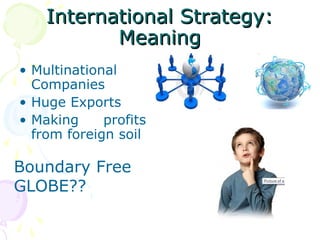
International Strategy:International Strategy:
MeaningMeaning
• Multinational
Companies
• Huge Exports
• Making profits
from foreign soil
Boundary Free
GLOBE??
INTERNATIONAL STRATEGY ANDINTERNATIONAL STRATEGY AND
GLOBAL STRATEGY - WHAT IS THEGLOBAL STRATEGY - WHAT IS THE
DIFFERENCE?DIFFERENCE?
• Global strategy leads to a wide variety of
business strategies, and a high level of
adaptation to the local business
environment. The challenge here is to
develop one single strategy that can be
applied throughout the world while at the
same time maintaining the flexibility to
adapt that strategy to the local business
environment when necessary.
Contd..Contd..
• There are three key differences.
• The first relates to the degree of involvement and
coordination from the centre.
• An international strategy does not require strong
coordination from the centre.
• A global strategy, on the other hand, requires
significant coordination between the activities of
the centre and those of subsidiaries.
• The second difference relates to the degree of
product standardization and responsiveness to
local business environment.
Contd..Contd..
• An international strategy assumes that the
subsidiary should respond to local business needs
unless there is a good reason for not doing so.
• In contrast, the global strategy assumes that the
centre should standardize its operations and
products in all the different countries, unless
there is a compelling reason for not doing so.
• The third difference has to do with strategy
integration and competitive moves. ‘Integration’
and ‘competitive move’ refer to the extent to
which a firm’s competitive moves in major
markets are interdependent.
International Strategy:International Strategy:
Definition :Definition :
• It may be defined as internationally
scattered subsidiaries act independently
and operate as if they were local
companies, with minimum interference
from the parent company
International Strategy:International Strategy:
NeedNeed
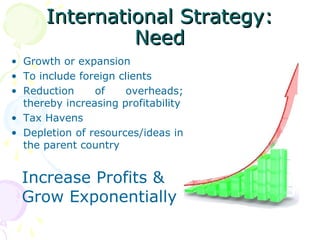
• Growth or expansion
• To include foreign clients
• Reduction of overheads;
thereby increasing profitability
• Tax Havens
• Depletion of resources/ideas in
the parent country
Increase Profits &
Grow Exponentially
HOW DO FIRMS GO INTERNATIONAL?HOW DO FIRMS GO INTERNATIONAL?
– ENTRY STRATEGIES– ENTRY STRATEGIES
• Foreign market entry strategies differ in degree of
risk they present, the control and commitment of
resources they require and the return on
investment they promise. There are two major
types of entry modes:
– 1) non-equity mode, which includes export and
contractual agreements,
– 2) equity mode, which includes joint venture and wholly
owned subsidiaries.
• The market-entry technique that offers the lowest
level of risk and the least market control is export
and import.
International Strategies:International Strategies:
TypesTypes
1. Exporting and importing
2. Licensing
3. Franchising
4. Joint Ventures
5. Strategic Alliances
6. Direct Investments
7. International alliances/Collaboration
The Purpose and Methodology of
Country Evaluation & Selection
– Targeting a new country either as a
market or as a manufacturing location
must be preceded by a detailed analysis
of the country’s past, present, and
future economic situation.
– Emerging trends also must be analysed
to develop an estimate of how the
corporation should respond.
• Country analysis takes many forms
depending on the type of information
sought, the objectives, the required
depth and detail, the time frame being
considered, and so on. In general, four
broad categories serve as starting points.
1. Leading economic indictors at a particular
point in time.
2. Trends in different economic indicators
3. Trends in various specific sectors
4. Analysis of specific areas or sectors of the
economy.
• Preliminary Economic Indicators
– There are certain general economic criteria
that are almost invariably considered.
– The most important of these criteria follow.
• Size of the Economy
– The size of the economy is a basic measure of
a country’s potential as a maket.
• Income Levels
– Income levels of the citizens of a country are a
very important economic indicator.
• The World Bank has formulated four
categories of countries based on their
per capital GNI:
– Low-income countries, with a per capital GNI
of US$1.025 or less.
– Lower-middle-income developing countries,
with a per capita GNI between US$1,026 and
US$4,035.
– Upper-middle-income countries, with a per
capita GNI between US$4,036 and US$12,475.
– High income countries, with a per capita GNI
exceeding US$12,476.
• Countries with a low per capita GNI would
not have a very large potential as a
market for such goods as automobiles and
air conditioners, which are considered
necessities in developed countries but are
luxuries in developing countries.
• On the other hand, countries with a low
per capita income are likely to have lower
labor costs and could prove attractive to
MNCs as sites for manufacturing facilities.
• Income Distribution
– In most developing countries there are
sharp inequalities of wealth, and a large
percentage of the country’s total wealth
is concentrated in the hands of a fairly
small percentage of the population.
– The size of the very high income group
in the total population would reveal the
country’s potential as a market for
luxury goods, such as designer clothes
and luxury automobiles.
• Important indicator of market potential is
the size of the middle income groups
within the overall income distribution.
• In the developed countries, the middle
income groups are usually the largest
proportion of the population, which implies
the existence of big markets for a wide
range of mass-produced consumer
products.
• Personal Consumption
– In addition to the income distribution patterns
prevalent in a country, the prevailing
consumption patterns influence a country’s
potent ional as a market.
• Growth and Stability Patterns
– The size of the economy, income levels and
distribution, and personal consumption are
static indicators, in as much as they represent
the position of a country at a particular point
of time.
• Countries seeking rapid rates of growth
aim to achieve this largely by increases in
industrialization levels, by the
modernization of existing industries, and
by the introduction of new industries and
new technologies.
• Rapidly growing economies are also
characterized by the development of a
professional middle class, which evens out
the distribution of income relative to that
in previous years and provides a market
base for an MNC’s consumer products.
Population
• The population of a country represents an
important statistic. It is an important
factor in influencing the size of market
potential for a large number of goods and
services, especially goods for personal
consumption.
• Population density (the number of persons
living per square mile) is a particularly
relevant factor.
• Geographical distribution of the population
is also important.
• The educational level of the population is
also extremely important.
• The rate of population growth is another
trend worth watching.
• The age structure of a population should
also be considered. In developed
countries, large proportions of the
po9pulation tend to be over the age of
eighteen, and there are a sizable number
of people in the over sixty age group.
Sector Analysis
• It is also important to analyze different sectors of
the country’s economy, to identify the particular
areas that could offer business opportunities.
• On a broader level, sector analylsis suggests the
state of a country’s overall economic
development. From a macroeconomic standpoint,
economic activity is divide into three broad
categories. The primary sector incorporates
traditional economic activities, such as
agriculture. The secondary sector comprises
primarily manufacturing and industrial activity.
The tertiary sector refers to services and related
industries.
• Industrialized and developed countries are
characterized by a high proportion of their
economic activity in the secondary and tertiary
sectors.
Inflationary Trends
• Local inflationary trends must also be closely
watched
• Inflation is the increase in prices over time
measured against a certain benchmark, usually
known as the base year. Different indices,
consisting of different commodities at different
market levels, are constructed to gauge the
overall degree of price increases in a country.
High inflation can have severe economic
consequences.
• Increased inflation in a particular overseas
manufacturing location would also bave
serious effects on the competitiveness of
the products produced in that location if
they were to be exported to overseas
markets.
External Financial Position: Extent
of Debt
– The primary indicator of the strength of
a country’s external sector is its
balance of payments position.
– Analysis of current and future trnds is
perhaps more important in this area
than in any other, as the balance of
payments scenario changes quite
rapidly.
Exchange-Rate Levels and Policies
• Exchange-rate trends are another vital
consideration for MNCs contemplating
overseas direct investment.
Banking and Financial Markets
• Finance is a crucial resource to any
business operation.
• The banking sector must be well
developed and able to provide the needed
working capital and term financing for
meeting the MNC’s operational
requirements within the investee country.
• Comparison of Similar Economies
• Tax Systems
– A very important constituent of the
analysis is the prevailing tax system.
– Tax systems and tax rates vary
considerably across the world.
• Fiscal and Monetary Policy
Situations
– The fiscal and monetary situation of any
country is a key indicator of its
economic health and the direction of
future economic trends.
– Any analysis has to bear in mind the
current and indicative future effects of
the continued deficits of a country.
• Economic Planning Ideology and
Practices
• Market Demand Forecasting
• Purposes
– Market demand forecasting is usually a
secondary stage in the analysis of a country as
a potential market and is attempted after the
overall macroeconomic environment and
business climate are found conducive to a
marketing effort.
– The basic objective is to obtain reliable, current
information to fashion a successful marketing
program.
– This data can also be used to weigh the costs
of exporting products to foreign countries
against the prospective benefit of
manufacturing these goods in those markets.
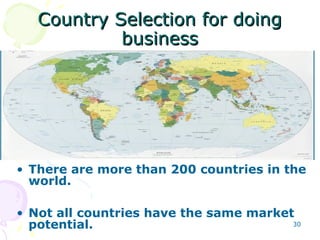
Country Selection for doingCountry Selection for doing
businessbusiness
• Country selection is a difficult task.
• There are more than 200 countries in the
world.
• Not all countries have the same market
potential. 30
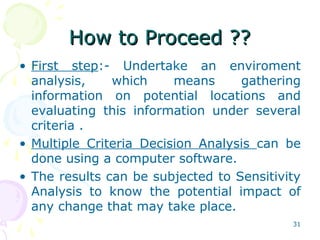
How to Proceed ??How to Proceed ??
• First step:- Undertake an enviroment
analysis, which means gathering
information on potential locations and
evaluating this information under several
criteria .
• Multiple Criteria Decision Analysis can be
done using a computer software.
• The results can be subjected to Sensitivity
Analysis to know the potential impact of
any change that may take place.
31
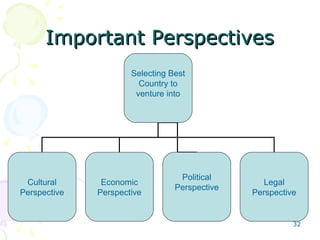
Important PerspectivesImportant Perspectives
Selecting Best
Country to
venture into
Cultural
Perspective
Economic
Perspective
Legal
Perspective
Political
Perspective
32
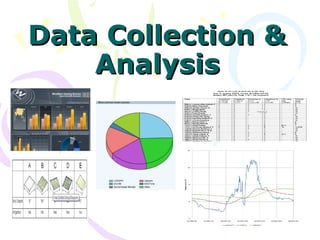
Data Collection &Data Collection &
AnalysisAnalysis
• Data Collection and Sources
• Primary Research
• Areas of Research
• Designing Initial market Strategy
– Firms use the tools and procedures for
identifying economic trends and market
demand to develop an overall marketing plan,
which incorporates the firm’s objectives into a
strategy for approaching new markets
successfully or for evaluating existing
operations in foreign markets.
• One method of viewing the exiting
situation in foreign markets is to compare
estimate of market demand and company
share with actual company performance.
• Though such a comparison, the firm can
identify competitive gaps in the market
between its potential and actual shares of
markets, which it can actively attempt to
narrow through increases in sales and
expanded market coverage.
• If the company is absolutely intent
on marketing in the new country and
expects to reap large benefits in
terms of increased sales and profits,
it might be wise to spend resources
to conduct primary research in that
market area.
Different ways of DataDifferent ways of Data
CollectionCollection
• Primary data
Primary data is data that writer collects himself, specifically
for the current research, using such methods as direct
observation, surveys, interviews and logs
• Secondary Data
Secondary data is collected from external sources such as:
1. Journals
• TV, radio, internet
• Magazines, Newspapers
• Reviews
• Research articles
• Stories told by people writer
37
International BusinessInternational Business
Marketing StrategyMarketing Strategy
• Brand and product strategy
• Distribution
• Promotion
38
Environmental AnalysisEnvironmental Analysis
• Culture
• Language
• Education
• Religion
• Political system
• Legislation
• Economy
• Government
39
Local AdaptationLocal Adaptation
• Product strategy
• Distribution strategy
• Promotion strategy
40
Thank You

600397589 bznet strategy

  • 1.
    International BusinessInternational Business Strategy,CountryStrategy, Country Evaluation and SelectionEvaluation and Selection Dr. (Mrs.) Vijaya Katti Professor & Chairperson (MDPs) Indian Institute of Foreign Trade New Delhi Session on: 29th May 2017
  • 2.
    Objectives of Presentation •Whether the aspiring international business is large, midsize, or small, the analysis done before venturing into foreign markets is crucial for success • The analysis of national economies is an ongoing process. • In order to respond in a timely manner, a solid foundation of understanding of the various markets is vital.
  • 3.
    International Strategy:International Strategy: MeaningMeaning •Multinational Companies • Huge Exports • Making profits from foreign soil Boundary Free GLOBE??
  • 4.
    INTERNATIONAL STRATEGY ANDINTERNATIONALSTRATEGY AND GLOBAL STRATEGY - WHAT IS THEGLOBAL STRATEGY - WHAT IS THE DIFFERENCE?DIFFERENCE? • Global strategy leads to a wide variety of business strategies, and a high level of adaptation to the local business environment. The challenge here is to develop one single strategy that can be applied throughout the world while at the same time maintaining the flexibility to adapt that strategy to the local business environment when necessary.
  • 5.
    Contd..Contd.. • There arethree key differences. • The first relates to the degree of involvement and coordination from the centre. • An international strategy does not require strong coordination from the centre. • A global strategy, on the other hand, requires significant coordination between the activities of the centre and those of subsidiaries. • The second difference relates to the degree of product standardization and responsiveness to local business environment.
  • 6.
    Contd..Contd.. • An internationalstrategy assumes that the subsidiary should respond to local business needs unless there is a good reason for not doing so. • In contrast, the global strategy assumes that the centre should standardize its operations and products in all the different countries, unless there is a compelling reason for not doing so. • The third difference has to do with strategy integration and competitive moves. ‘Integration’ and ‘competitive move’ refer to the extent to which a firm’s competitive moves in major markets are interdependent.
  • 7.
    International Strategy:International Strategy: Definition:Definition : • It may be defined as internationally scattered subsidiaries act independently and operate as if they were local companies, with minimum interference from the parent company
  • 8.
    International Strategy:International Strategy: NeedNeed •Growth or expansion • To include foreign clients • Reduction of overheads; thereby increasing profitability • Tax Havens • Depletion of resources/ideas in the parent country Increase Profits & Grow Exponentially
  • 9.
    HOW DO FIRMSGO INTERNATIONAL?HOW DO FIRMS GO INTERNATIONAL? – ENTRY STRATEGIES– ENTRY STRATEGIES • Foreign market entry strategies differ in degree of risk they present, the control and commitment of resources they require and the return on investment they promise. There are two major types of entry modes: – 1) non-equity mode, which includes export and contractual agreements, – 2) equity mode, which includes joint venture and wholly owned subsidiaries. • The market-entry technique that offers the lowest level of risk and the least market control is export and import.
  • 10.
    International Strategies:International Strategies: TypesTypes 1.Exporting and importing 2. Licensing 3. Franchising 4. Joint Ventures 5. Strategic Alliances 6. Direct Investments 7. International alliances/Collaboration
  • 11.
    The Purpose andMethodology of Country Evaluation & Selection – Targeting a new country either as a market or as a manufacturing location must be preceded by a detailed analysis of the country’s past, present, and future economic situation. – Emerging trends also must be analysed to develop an estimate of how the corporation should respond.
  • 12.
    • Country analysistakes many forms depending on the type of information sought, the objectives, the required depth and detail, the time frame being considered, and so on. In general, four broad categories serve as starting points. 1. Leading economic indictors at a particular point in time. 2. Trends in different economic indicators 3. Trends in various specific sectors 4. Analysis of specific areas or sectors of the economy.
  • 13.
    • Preliminary EconomicIndicators – There are certain general economic criteria that are almost invariably considered. – The most important of these criteria follow. • Size of the Economy – The size of the economy is a basic measure of a country’s potential as a maket. • Income Levels – Income levels of the citizens of a country are a very important economic indicator.
  • 14.
    • The WorldBank has formulated four categories of countries based on their per capital GNI: – Low-income countries, with a per capital GNI of US$1.025 or less. – Lower-middle-income developing countries, with a per capita GNI between US$1,026 and US$4,035. – Upper-middle-income countries, with a per capita GNI between US$4,036 and US$12,475. – High income countries, with a per capita GNI exceeding US$12,476.
  • 15.
    • Countries witha low per capita GNI would not have a very large potential as a market for such goods as automobiles and air conditioners, which are considered necessities in developed countries but are luxuries in developing countries. • On the other hand, countries with a low per capita income are likely to have lower labor costs and could prove attractive to MNCs as sites for manufacturing facilities.
  • 16.
    • Income Distribution –In most developing countries there are sharp inequalities of wealth, and a large percentage of the country’s total wealth is concentrated in the hands of a fairly small percentage of the population. – The size of the very high income group in the total population would reveal the country’s potential as a market for luxury goods, such as designer clothes and luxury automobiles.
  • 17.
    • Important indicatorof market potential is the size of the middle income groups within the overall income distribution. • In the developed countries, the middle income groups are usually the largest proportion of the population, which implies the existence of big markets for a wide range of mass-produced consumer products.
  • 18.
    • Personal Consumption –In addition to the income distribution patterns prevalent in a country, the prevailing consumption patterns influence a country’s potent ional as a market. • Growth and Stability Patterns – The size of the economy, income levels and distribution, and personal consumption are static indicators, in as much as they represent the position of a country at a particular point of time.
  • 19.
    • Countries seekingrapid rates of growth aim to achieve this largely by increases in industrialization levels, by the modernization of existing industries, and by the introduction of new industries and new technologies. • Rapidly growing economies are also characterized by the development of a professional middle class, which evens out the distribution of income relative to that in previous years and provides a market base for an MNC’s consumer products.
  • 20.
    Population • The populationof a country represents an important statistic. It is an important factor in influencing the size of market potential for a large number of goods and services, especially goods for personal consumption. • Population density (the number of persons living per square mile) is a particularly relevant factor.
  • 21.
    • Geographical distributionof the population is also important. • The educational level of the population is also extremely important. • The rate of population growth is another trend worth watching. • The age structure of a population should also be considered. In developed countries, large proportions of the po9pulation tend to be over the age of eighteen, and there are a sizable number of people in the over sixty age group.
  • 22.
    Sector Analysis • Itis also important to analyze different sectors of the country’s economy, to identify the particular areas that could offer business opportunities. • On a broader level, sector analylsis suggests the state of a country’s overall economic development. From a macroeconomic standpoint, economic activity is divide into three broad categories. The primary sector incorporates traditional economic activities, such as agriculture. The secondary sector comprises primarily manufacturing and industrial activity. The tertiary sector refers to services and related industries.
  • 23.
    • Industrialized anddeveloped countries are characterized by a high proportion of their economic activity in the secondary and tertiary sectors. Inflationary Trends • Local inflationary trends must also be closely watched • Inflation is the increase in prices over time measured against a certain benchmark, usually known as the base year. Different indices, consisting of different commodities at different market levels, are constructed to gauge the overall degree of price increases in a country. High inflation can have severe economic consequences.
  • 24.
    • Increased inflationin a particular overseas manufacturing location would also bave serious effects on the competitiveness of the products produced in that location if they were to be exported to overseas markets.
  • 25.
    External Financial Position:Extent of Debt – The primary indicator of the strength of a country’s external sector is its balance of payments position. – Analysis of current and future trnds is perhaps more important in this area than in any other, as the balance of payments scenario changes quite rapidly.
  • 26.
    Exchange-Rate Levels andPolicies • Exchange-rate trends are another vital consideration for MNCs contemplating overseas direct investment. Banking and Financial Markets • Finance is a crucial resource to any business operation. • The banking sector must be well developed and able to provide the needed working capital and term financing for meeting the MNC’s operational requirements within the investee country.
  • 27.
    • Comparison ofSimilar Economies • Tax Systems – A very important constituent of the analysis is the prevailing tax system. – Tax systems and tax rates vary considerably across the world. • Fiscal and Monetary Policy Situations – The fiscal and monetary situation of any country is a key indicator of its economic health and the direction of future economic trends.
  • 28.
    – Any analysishas to bear in mind the current and indicative future effects of the continued deficits of a country. • Economic Planning Ideology and Practices • Market Demand Forecasting
  • 29.
    • Purposes – Marketdemand forecasting is usually a secondary stage in the analysis of a country as a potential market and is attempted after the overall macroeconomic environment and business climate are found conducive to a marketing effort. – The basic objective is to obtain reliable, current information to fashion a successful marketing program. – This data can also be used to weigh the costs of exporting products to foreign countries against the prospective benefit of manufacturing these goods in those markets.
  • 30.
    Country Selection fordoingCountry Selection for doing businessbusiness • Country selection is a difficult task. • There are more than 200 countries in the world. • Not all countries have the same market potential. 30
  • 31.
    How to Proceed??How to Proceed ?? • First step:- Undertake an enviroment analysis, which means gathering information on potential locations and evaluating this information under several criteria . • Multiple Criteria Decision Analysis can be done using a computer software. • The results can be subjected to Sensitivity Analysis to know the potential impact of any change that may take place. 31
  • 32.
    Important PerspectivesImportant Perspectives SelectingBest Country to venture into Cultural Perspective Economic Perspective Legal Perspective Political Perspective 32
  • 33.
    Data Collection &DataCollection & AnalysisAnalysis
  • 34.
    • Data Collectionand Sources • Primary Research • Areas of Research • Designing Initial market Strategy – Firms use the tools and procedures for identifying economic trends and market demand to develop an overall marketing plan, which incorporates the firm’s objectives into a strategy for approaching new markets successfully or for evaluating existing operations in foreign markets.
  • 35.
    • One methodof viewing the exiting situation in foreign markets is to compare estimate of market demand and company share with actual company performance. • Though such a comparison, the firm can identify competitive gaps in the market between its potential and actual shares of markets, which it can actively attempt to narrow through increases in sales and expanded market coverage.
  • 36.
    • If thecompany is absolutely intent on marketing in the new country and expects to reap large benefits in terms of increased sales and profits, it might be wise to spend resources to conduct primary research in that market area.
  • 37.
    Different ways ofDataDifferent ways of Data CollectionCollection • Primary data Primary data is data that writer collects himself, specifically for the current research, using such methods as direct observation, surveys, interviews and logs • Secondary Data Secondary data is collected from external sources such as: 1. Journals • TV, radio, internet • Magazines, Newspapers • Reviews • Research articles • Stories told by people writer 37
  • 38.
    International BusinessInternational Business MarketingStrategyMarketing Strategy • Brand and product strategy • Distribution • Promotion 38
  • 39.
    Environmental AnalysisEnvironmental Analysis •Culture • Language • Education • Religion • Political system • Legislation • Economy • Government 39
  • 40.
    Local AdaptationLocal Adaptation •Product strategy • Distribution strategy • Promotion strategy 40
  • 41.