

Copyright © 2011 Pearson Education, Inc. publishing as Prentice Hall
International Business
Environments and Operations
Part Two
Comparative Environmental
Frameworks
3-1
Copyright © 2011 Pearson Education, Inc. publishing as Prentice Hall
3-2
Chapter
Three
The Political
and Legal
Environments
Facing
Business
Copyright © 2011 Pearson Education, Inc. publishing as Prentice Hall
3-3
• To discuss the philosophies and practices of a political system
• To profile trends in contemporary political systems
• To explain the idea of political risk and describe approaches to
managing it
• To discuss philosophies and practices of the legal system
• To describe trends in contemporary legal systems
• To explain legal issues facing international companies
Chapter Objectives
Copyright © 2011 Pearson Education, Inc. publishing as Prentice Hall
3-4
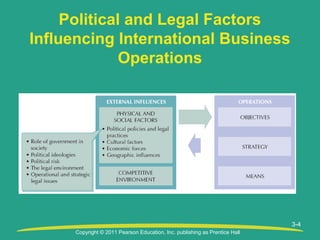
Political and Legal Factors
Influencing International Business
Operations
Copyright © 2011 Pearson Education, Inc. publishing as Prentice Hall
3-5
Definition of a Political System
• The complete set of institutions, political
organizations, and interest groups,
• The relationships among institutions, and
the political norms and rules that govern
their functions
Copyright © 2011 Pearson Education, Inc. publishing as Prentice Hall
3-6
Individualism vs. Collectivism
• Individualism: primacy of the rights and
role of the individual
• Collectivism: primacy of the rights and role
of the community
Copyright © 2011 Pearson Education, Inc. publishing as Prentice Hall
3-7
Political Ideology
• The system of ideas that expresses the
goals, theories, and aims of a
sociopolitical program
• Most modern societies are pluralistic—
different groups champion competing
political ideologies
Copyright © 2011 Pearson Education, Inc. publishing as Prentice Hall
3-8
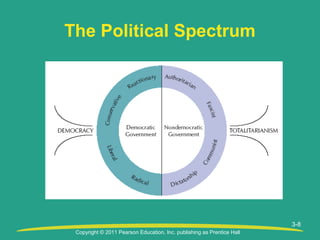
The Political Spectrum
Copyright © 2011 Pearson Education, Inc. publishing as Prentice Hall
3-9
Democracy
• Wide participation by citizens in the
decision-making process
• Five types:
 Parliamentary
 Liberal
 Multiparty
 Representative
 Social
Copyright © 2011 Pearson Education, Inc. publishing as Prentice Hall
3-10
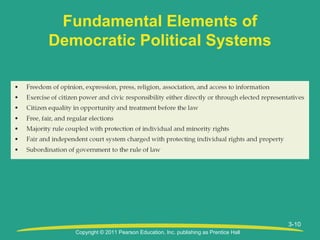
Fundamental Elements of
Democratic Political Systems
Copyright © 2011 Pearson Education, Inc. publishing as Prentice Hall
3-11
Totalitarianism
• Restricts decision making to a few
individuals
• Types:
 Authoritarianism
 Fascism
 Secular totalitarianism
 Theocratic totalitarianism
Copyright © 2011 Pearson Education, Inc. publishing as Prentice Hall
3-12
Trends in Political Systems
• Third Wave of Democracy
• Engines of Democracy
1. The failure of totalitarian regimes to deliver
economic progress
2. Improved communications technology
3. Economic dividends of increasing political
freedom
Copyright © 2011 Pearson Education, Inc. publishing as Prentice Hall
3-13
Definition of Political Risk
• The risk that political decisions or events
in a country negatively affect the
profitability or sustainability of an
investment
• Types:
 Systemic
 Procedural
 Distributive
 Catastrophic
Copyright © 2011 Pearson Education, Inc. publishing as Prentice Hall
3-14
Definition of a Legal System
• The mechanism for creating, interpreting,
and enforcing the laws in a specified
jurisdiction
• Types:
 Common law
 Civil law
 Theocratic law
 Customary law
 Mixed systems
Copyright © 2011 Pearson Education, Inc. publishing as Prentice Hall
3-15
Trends in Legal Systems
• The preference for stability
• The influence of national legacies
Copyright © 2011 Pearson Education, Inc. publishing as Prentice Hall
3-16
Bases of Rules
• Rule of Man-ultimate power resides in a
person
• Rule of Law-institutes a just political and
social environment, guarantees the
enforceability of commercial contracts and
business transactions, and safeguards
personal property and individual freedom
Copyright © 2011 Pearson Education, Inc. publishing as Prentice Hall
3-17
Operational Concerns that Face
Managers Worldwide
• Starting a business
• Entering and enforcing contracts
• Hiring and firing local workers
• Closing down the business
Copyright © 2011 Pearson Education, Inc. publishing as Prentice Hall
3-18
Strategic Concerns that Face
Managers Worldwide
• Product safety and liability
• Marketplace behavior
• Product origin and local content
• Legal jurisdiction
• Arbitration
Copyright © 2011 Pearson Education, Inc. publishing as Prentice Hall
3-19
• Intangible property rights that are a result
of intellectual effort
• Intellectual property rights refer to the right
to control and derive the benefits from
writing, inventions, processes, and
identifiers
• Local attitudes play a large role in piracy
Intellectual Property
Copyright © 2011 Pearson Education, Inc. publishing as Prentice Hall
3-20
Legacies, Economics, and
Orientation
• Legal Legacies
• Wealth, Poverty, and Protection
• Cultural Orientation
Copyright © 2011 Pearson Education, Inc. publishing as Prentice Hall
3-21
The Driver of Change
Countries that generate
intellectual property are
strong
advocates of protecting the
ownership rights.
Copyright © 2011 Pearson Education, Inc. publishing as Prentice Hall
3-22
All rights reserved. No part of this publication may
be reproduced, stored in a retrieval system, or
transmitted, in any form or by any means,
electronic, mechanical, photocopying, recording, or
otherwise, without the prior written permission of
the publisher. Printed in the United States of
America.

Daniels ib13 ppt_03

  • 1.
    Copyright © 2011Pearson Education, Inc. publishing as Prentice Hall International Business Environments and Operations Part Two Comparative Environmental Frameworks 3-1
  • 2.
    Copyright © 2011Pearson Education, Inc. publishing as Prentice Hall 3-2 Chapter Three The Political and Legal Environments Facing Business
  • 3.
    Copyright © 2011Pearson Education, Inc. publishing as Prentice Hall 3-3 • To discuss the philosophies and practices of a political system • To profile trends in contemporary political systems • To explain the idea of political risk and describe approaches to managing it • To discuss philosophies and practices of the legal system • To describe trends in contemporary legal systems • To explain legal issues facing international companies Chapter Objectives
  • 4.
    Copyright © 2011Pearson Education, Inc. publishing as Prentice Hall 3-4 Political and Legal Factors Influencing International Business Operations
  • 5.
    Copyright © 2011Pearson Education, Inc. publishing as Prentice Hall 3-5 Definition of a Political System • The complete set of institutions, political organizations, and interest groups, • The relationships among institutions, and the political norms and rules that govern their functions
  • 6.
    Copyright © 2011Pearson Education, Inc. publishing as Prentice Hall 3-6 Individualism vs. Collectivism • Individualism: primacy of the rights and role of the individual • Collectivism: primacy of the rights and role of the community
  • 7.
    Copyright © 2011Pearson Education, Inc. publishing as Prentice Hall 3-7 Political Ideology • The system of ideas that expresses the goals, theories, and aims of a sociopolitical program • Most modern societies are pluralistic— different groups champion competing political ideologies
  • 8.
    Copyright © 2011Pearson Education, Inc. publishing as Prentice Hall 3-8 The Political Spectrum
  • 9.
    Copyright © 2011Pearson Education, Inc. publishing as Prentice Hall 3-9 Democracy • Wide participation by citizens in the decision-making process • Five types:  Parliamentary  Liberal  Multiparty  Representative  Social
  • 10.
    Copyright © 2011Pearson Education, Inc. publishing as Prentice Hall 3-10 Fundamental Elements of Democratic Political Systems
  • 11.
    Copyright © 2011Pearson Education, Inc. publishing as Prentice Hall 3-11 Totalitarianism • Restricts decision making to a few individuals • Types:  Authoritarianism  Fascism  Secular totalitarianism  Theocratic totalitarianism
  • 12.
    Copyright © 2011Pearson Education, Inc. publishing as Prentice Hall 3-12 Trends in Political Systems • Third Wave of Democracy • Engines of Democracy 1. The failure of totalitarian regimes to deliver economic progress 2. Improved communications technology 3. Economic dividends of increasing political freedom
  • 13.
    Copyright © 2011Pearson Education, Inc. publishing as Prentice Hall 3-13 Definition of Political Risk • The risk that political decisions or events in a country negatively affect the profitability or sustainability of an investment • Types:  Systemic  Procedural  Distributive  Catastrophic
  • 14.
    Copyright © 2011Pearson Education, Inc. publishing as Prentice Hall 3-14 Definition of a Legal System • The mechanism for creating, interpreting, and enforcing the laws in a specified jurisdiction • Types:  Common law  Civil law  Theocratic law  Customary law  Mixed systems
  • 15.
    Copyright © 2011Pearson Education, Inc. publishing as Prentice Hall 3-15 Trends in Legal Systems • The preference for stability • The influence of national legacies
  • 16.
    Copyright © 2011Pearson Education, Inc. publishing as Prentice Hall 3-16 Bases of Rules • Rule of Man-ultimate power resides in a person • Rule of Law-institutes a just political and social environment, guarantees the enforceability of commercial contracts and business transactions, and safeguards personal property and individual freedom
  • 17.
    Copyright © 2011Pearson Education, Inc. publishing as Prentice Hall 3-17 Operational Concerns that Face Managers Worldwide • Starting a business • Entering and enforcing contracts • Hiring and firing local workers • Closing down the business
  • 18.
    Copyright © 2011Pearson Education, Inc. publishing as Prentice Hall 3-18 Strategic Concerns that Face Managers Worldwide • Product safety and liability • Marketplace behavior • Product origin and local content • Legal jurisdiction • Arbitration
  • 19.
    Copyright © 2011Pearson Education, Inc. publishing as Prentice Hall 3-19 • Intangible property rights that are a result of intellectual effort • Intellectual property rights refer to the right to control and derive the benefits from writing, inventions, processes, and identifiers • Local attitudes play a large role in piracy Intellectual Property
  • 20.
    Copyright © 2011Pearson Education, Inc. publishing as Prentice Hall 3-20 Legacies, Economics, and Orientation • Legal Legacies • Wealth, Poverty, and Protection • Cultural Orientation
  • 21.
    Copyright © 2011Pearson Education, Inc. publishing as Prentice Hall 3-21 The Driver of Change Countries that generate intellectual property are strong advocates of protecting the ownership rights.
  • 22.
    Copyright © 2011Pearson Education, Inc. publishing as Prentice Hall 3-22 All rights reserved. No part of this publication may be reproduced, stored in a retrieval system, or transmitted, in any form or by any means, electronic, mechanical, photocopying, recording, or otherwise, without the prior written permission of the publisher. Printed in the United States of America.

Editor's Notes

  • #5 Managers study political and legal situations in order to adapt company activities to local conditions. Determining where, when, and how to adjust business practices to local environments without undermining the basis for success is an enduring challenge of international business. The study of successful companies indicates that they begin with the realization that when it comes to politics and laws, countries’ decidedly different ideas result in decidedly different political and legal environments.
  • #6 The fundamental goal of a political system is to integrate the elements of society. The ultimate test of a political system: uniting a society in the face of diverse and divisive viewpoints. The political system defines the institutions, political organizations, and interest groups along with the political norms and rules that govern the activities of political actors. The fundamental purpose of any political system is straightforward: integrate different groups into a functioning, self-sustaining, and self-governing society. Correspondingly, the decisive test of any political system is its ability to unite a society in the face of diverse and divisive viewpoints. Success supports peace and prosperity. Failure leads to instability, insurrection, and, ultimately, national disintegration.
  • #7 The business implications of individualism hold that each person commands the right to make economic decisions largely free of rules and regulations. Countries with an individualist orientation shape their marketplace with the idea of laissez-faire. Literally meaning “leave things alone,” laissez-faire holds that government should not interfere in business affairs. Instead, agents behave and the market operates according to the neoliberal principles of market fundamentalism. Individuals are presumed to be self-regulating in promoting economic prosperity and growth, acting fairly and justly to maximize personal performance without threatening the welfare of society. Collectivism in the business world holds that the ownership of assets, the structure of industries, the conduct of companies, and the actions of managers must improve the welfare of society. Business decisions are made by the group and, therefore, group members assume joint responsibility. Systems that feature a collectivist orientation hold that government intervene in market situations to ensure that business practices benefit society.
  • #8 The prevalence of pluralism, no matter its particular catalyst, spurs managers to understand its dynamic of interplay and the implications to governing the business environment. Pluralism rests upon ideas drawn from the sociology of small groups. When translated to the level of a society, these ideas make sense of the relationships and interactions between and within groups as they champion and contest political ideologies. In a pluralistic society, government does not command the authority to act unilaterally. Rather, government’s task is to balance the initiatives and pressures championed by the various groups. The fact that these groups anchor their agendas in different political ideologies calls upon governments to negotiate solutions and compromises. Consequently, ambiguity often marks decision making in pluralistic societies.
  • #9 Spectrum analysis, by specifying a basic conceptual structure, guides the assessment of a complex issue—in this case, the issue of political ideology. Essentially, configuring ideologies along the central axis lets us model different political ideologies in relation to each other. The goal of relativity depends on specifying credible ideas to anchor the endpoints of the axis; reasonably set, one can then position alternative ideas. In practice, purely democratic and totalitarian systems are extreme exceptions. Looking around the world, one finds that there are variations of each political ideology. For example, democratic systems range from radical on one side (advocates of extreme political reform) to reactionary (advocates of a return to past conditions). Likewise, totalitarian systems emphasize different degrees of state control; fascism aims to control people’s minds, souls, and daily existence, whereas authoritarianism confines itself to political control of the state. Figure 3.2 communicates that the majority of political ideologies fall between democracy and totalitarianism.
  • #10 In a parliamentary democracy, citizens exercise political power by electing representatives to a legislative branch of government called a parliament. The executive branch typically consists of a cabinet, headed by a prime minister who is regarded as the head of government. There is an independent judiciary but no formal separation of powers between the executive and legislative branches. Examples include India and Australia. • A liberal democracy originates in a constitution that protects certain individual freedoms (such as freedom of speech, assembly, and religion) and certain individual liberties (such as the right to property and privacy). All citizens, both public and private, are treated equally before the law and receive due process under it. All liberal democracies, such as Japan or New Zealand, are representative democracies. • A multiparty democracy defines the political system whereby three or more political parties, whether separately or as part of a coalition, have the right to direct the government. The multiparty system prevents the leadership of a single party from setting policy without negotiating compromises among the opposition parties. Canada, Germany, Italy, and Israel all feature multiparty systems. • A representative democracy, such as the United States, is one in which the people’s elected representatives hold ultimate sovereignty. Representatives are charged with the responsibility of acting in the people’s interest and not merely as their proxy representatives. In other words, officials represent voters and, while mindful of voter preferences, still command the authority to act as they see fit. • A social democracy advocates the use of democratic means to achieve a gradual transition from capitalism to socialism. This view of democracy rests on the belief that society must regulate and reform capitalism to control its intrinsic tendency toward injustice and opportunism. The term social democracy is largely interchangeable with democratic socialism. Examples of social democracy are Norway and Sweden.
  • #12 Authoritarianism: In an authoritarian form of government, the regime tolerates no deviation from state ideology. Day-to-day life reflects unquestioning obedience to state authority. Fascism is totalitarian and the Fascist State, as a synthesis and a unit which includes all values, interprets, develops, and lends additional power to the whole life of a people. The fascist ideal is the control of people’s minds, souls, and daily existence. Secular totalitarianism: In this system, a single political party forms a government in which only party members hold office, elections are controlled through unfair laws, dissent is tolerated as long as it does not challenge the state, and organized religions are suppressed. Theocratic totalitarianism: Under this system, government is an expression of the preferred deity, with leaders often claiming to represent the deity’s interests on earth. Procedurally, the theocratic state follows ancient dogma in place of modern political or legal principles.
  • #13 The number of nations that made the transition from non-democratic to democratic political systems, particularly during the 1970s and 1980s, gave rise to the so-called third wave of democratization. The third wave of democratization was worldwide: Countries from Africa, Asia, Latin America, South America, and Eastern Europe abandoned totalitarian political systems. In their place emerged democracies based on greater individual freedoms and expanded civil liberties. Furthermore, societies spoke of and began building fairer civic institutions, independent media, objective judiciaries, and stronger property rights. Today, as a result of the third wave of democratization, more people live in countries with elected democratic governments than at any other time in history. The failure of totalitarian regimes to deliver economic progress led to deepening legitimacy problems. Aggrieved citizens contested the right of political officials to govern. (i.e. Berlin Wall) Improved communications technology eroded the ability of totalitarian states to control access to information. Democracy benefits from an informed public. The median per capita gross domestic product, a measure of the general standard of living, is almost seven times higher for the freest countries than for not free countries. In many countries, economic advances fostered the rise of a new middle class. Momentum of Democracy: Longitudinal data confirms the slowing momentum of democracy. In 1987, there were 66 electoral democracies in the world; in 1997, there were 117; in 2006 there were 123; and by 2008, there were 119. Freedom in the World 2009 reports further deterioration. Freedom retreated in much of the world; 34 countries registered declines in the degree of freedom in their political systems while 14 registered improvements. Worldwide, powerful regimes have imposed “forceful measures designed to suppress democratic reformers, international assistance to those reformers and ultimately the very idea of democracy itself.”
  • #14 Systemic Risks—risks that impact all firms who operate in the particular political system Procedural Risk—Each day, people, products, and funds move from point to point in the global market. Each move creates a procedural transaction between the units involved, whether units of a company or units of a country. Political actions sometimes create frictions that interfere with these transactions. Distributive Risk—As foreign investors generate more profits in the local economy, the host country may begin to question the distributive justice of the rewards of operating in its market. In other words, as the business grows more successful, officials may question whether they are receiving their “fair” share of the growing profits. Catastrophic Risk—includes random political developments that adversely affect the operations of every company in a country. Typically, it arises from specific flash points, such as ethnic discord, illegal regime change, civil disorder, or insurrection. It disrupts the business environment in a way that affects every firm in the country. If such disruptions spiral out of control, they devastate companies and nations.
  • #15 Common Law: system is based on tradition, judge-made precedent, and usage. It assigns a preeminent position to existing case law as a guide to dispute resolution. Judicial officials refer to statutory codes and legislation, but only after they have considered the rules of the court, custom, judicial reasoning, prior court decisions, and principles of equity. Civil Law: system is based on the systematic codification of laws and codes. Civil law systems charge political officials—not government-employed judges—with responsibility for specifying accessible, detailed, and written law that applies to all citizens. Rather than create law, as they do in the common law system, judges in the civil law system apply existing legal and procedural codes to resolve disputes. Theocratic Law: system relies on religious doctrine, precepts, and beliefs to define the legal environment. Ultimate legal authority is vested in religious leaders, who apply religious law to regulate business transactions and social relations. Unlike civil and common systems, theocratic laws see no separation of church and state. The ruling theocracy controls all public and private matters and, as a result, government, law, and religion are one. Customary Law: Customary law is based on norms of behavior practiced over a long period. Customary laws play important roles in many indigenous, local, and other traditional communities. The legitimacy of customary law follows not from the power of a powerful individual or institution but from individuals recognizing the benefits of behaving in line with the expectation of fellow individuals. Mixed Systems: when a nation uses two or more of the four legal systems.
  • #16 First, the pushback against democracy powers a rise in totalitarianism. This political ideology emphasizes collective order at the expense of individual freedoms. Second, the emergence of developing countries, like Brazil, India, and China, is resetting how managers interpret the legal environments of international business. Most notably, the scale and scope of the market performance of these emerging economies requires reassessing the philosophical basis of law. Emerging markets, once consigned to the periphery of the global economy, increasingly command center stage.
  • #17 The rule of man holds that ultimate power resides in a person. His word and whim, no matter how unfair or unjust, is law. The rule of law holds that governmental authority is legitimately exercised only in accordance with written, publicly disclosed laws that have been adopted and are enforced in accordance with established procedure. As such, no individual—public official or private citizen—stands above the law. Perhaps the primary purpose of the legal system is to regulate and restrain the behavior of the “man” as symbolized by government officials.
  • #18 Uncertainty about the basis of law in a particular country creates challenging situations for managers. Starting a business involves many legal activities: registering its name, choosing the appropriate tax structure, getting licenses and permits, arranging credit, and securing insurance. Some countries greatly expedite this process, while others do not. Entering/Enforcing Contracts: A contract is a binding legal agreement that formally exchanges promises, the breach of which triggers legal proceedings. The sanctity of a contract is vital to business transactions. Standards vary across types of legal systems and specific countries. As for legal systems, countries with common law systems tend to encourage precise, detailed contracts. In countries with civil law systems where the civil code deals with many pertinent issues, the law encourages shorter and less specific contracts. Hiring and Firing Local Workers: No matter where you are operating, you will have to hire and, when necessary, fire workers. One would think that common sense would provide enough guidance to make legally appropriate decisions. However, legal issues around the world are rarely as straightforward as you may think. Singapore, New Zealand, and the United States are among the countries with the most flexible labor-regulation statutes. China has the most flexibility in hiring and firing plus the greatest discretion in setting employment conditions (work hours, minimum wages, and benefits). In contrast, Angola, Belarus, and Paraguay place rigid restrictions on firing: You have to provide documentation on the grounds for termination, establish detailed firing procedures, and furnish both generous prior notification and severance payments. Closing Down the Business: Finally, some countries make the task of closing a business difficult. Under ordinary circumstances, there is far more involved in shutting down operations than padlocking the doors. In the United States, for example, the Internal Revenue Service requires completing a series of forms that report, among many others points, changes in the business structure, the sale of assets, payments to subcontractors, and termination of a retirement plan.
  • #19 Product Safety and Liability: International companies often customize products to comply with local standards. Often, these standards differ due to cultural values or social norms; companies then adapt the product to boost its appeal to local consumers. Countries often impose product-safety and liability laws that require a company to adapt a product or else forsake market access. Marketplace Behavior: National laws determine permissible practices in all forms of business activities, including sourcing, distributing, advertising, and pricing products. Hence, countries permit and prohibit activities that then spur companies to adjust their manufacturing configuration, their supply chain coordination, and their marketing strategy. Product Origin/Local Content: National laws affect the flow of products across borders. To determine charges for the right to import a product, host governments devise laws that consider the product’s country of origin, namely the country of manufacture, production, or growth where a product comes from. Governments are also keen to pressure foreign producers to make a greater share of a given product in the local market. To spur reluctant investors, governments often resort to local content regulations. Governments impose these sorts of regulations in order to favor companies at the expense of their foreign competitors. Legal Jurisdiction: Countries stipulate laws that set the criteria for litigation when agents—whether legal residents of the same or of different countries—are unable to resolve a dispute. While court protocol differs depending on the type of legal system, in all cases the power of courts is indisputable. Usually, in the face of a cross-national dispute, each company petitions its home-country court to claim jurisdiction, in the belief that it is likely to receive more favorable treatment. Arbitration: Both parties agree on an impartial third party to settle the matter. Most arbitration is governed by the worldwide standards set by the New York Convention. This convention, instituted in 1958, allows parties to choose their own mediators and resolve disputes on neutral ground.
  • #20 The International Anti-Counterfeiting Coalition estimates that international trade in counterfeit products alone runs more than U.S. $600 billion a year—approximately 5 to 7 percent of world trade. Furthermore, piracy has grown over 10,000 percent in the past two decades, given its astounding profitability—gross margins of more than 1,000 percent have been reported for any number of counterfeited products. The pervasiveness of piracy worldwide shows just how hard it is to enforce IPRs. Poor compliance and enforcement in certain political systems, particularly those marked by the rule-of-man legal systems and totalitarian political tendencies, impose obstacles. Problems arise because not all countries formally support the various agreements developed to protect IPRs. Matters of jurisdiction further complicate protection. An IPR protected by, say, a U.S. patent, trademark registration, copyright, or design registration extends only to the United States and its territories and possessions. It confers no protection in a foreign country. Furthermore, there’s no shortcut to worldwide protection: Companies cannot register a “global” patent, trademark, or copyright.
  • #21 Legal Legacies: Most counterfeit goods are made in markets in which the rule of man is the basis of the legal system (example: China). Officially, China has a battery of laws that comply with international standards for market access, nondiscrimination, and transparency. The enduring legacy of the rule of man in China, however, means that neither the typical Chinese citizen nor the typical Chinese official see as legitimate those laws passed by foreign governments. The vigor of IPR protection often reflects a country’s stage of economic development. Typically, poorer countries provide weaker legal protection than richer countries. Generally, developed countries contend that protecting ideas is the only way to energize the incentive to innovate. The perspective in poorer countries, and increasingly in wealthier countries, rejects this reasoning. They contend that intellectual property protection • Inhibits local development and lowers global welfare by constraining the use of existing knowledge. • Creates intellectual monopolies that protect business interests, bestow monopoly profits, and lessen the efficiency gains of free trade. • Inflates the prices that poor nations pay for products and processes that are available only from wealthy nations. • Results in licensing fees and regulations burdens that increase the cost of idea creation and slow the rate of diffusion of new ideas. In addition, cultural orientation explains local differences in attitudes toward the protection of IP. Countries with an individualist orientation, such as the United States and Australia, tend to regard the concept of individual ownership of an idea as intrinsically legitimate; few dispute that if you create something, you should have the right to say who can copy it or use it for any given purpose. In contrast, countries with a collectivist orientation, such as South Korea, Thailand, and China, extol the virtue of sharing over individual ownership; few dispute that if you create something, it should improve the welfare of society.
  • #22 Many pin hope on the future success of companies in those countries that presently do not rigorously protect intellectual property. When these companies, now idea consumers, become idea creators and begin to market products based on their own intellectual property, the benefits of protection will eclipse their gains from piracy. Generally, history shows that countries that create intellectual property—no matter the particular legal, economic, or cultural characteristics of those countries—enforce ownership rights.