Copyright © 2011 Pearson Education
12-1
International Business
Environments and Operations,
13/e
Global Edition
Part 5
Global Strategy, Structure, and
Implementation
Copyright © 2011 Pearson Education
12-2
Chapter 12
Country
Evaluation
and
Selection
Copyright © 2011 Pearson Education
12-3
Chapter Objectives
• To grasp company strategies for sequencing the penetration of
countries
• To see how scanning techniques can help managers both limit
geographic alternatives and consider otherwise overlooked areas
• To discern the major opportunity and risk variables a company should
consider when deciding whether and where to expand abroad
• To know the methods and problems of collecting and comparing
international information
• To understand some simplifying tools for helping decide where to
operate
• To consider how companies allocate emphasis among the countries
where they operate
• To comprehend why location decisions do not necessarily compare
different countries’ possibilities
Copyright © 2011 Pearson Education
12-4
Introduction
Because all companies have limited resources,
they must be careful in making the following decisions:
1. In which countries to locate sales, production, and
administrative and auxiliary services
2. The sequence for entering different countries
3. The amount of resources and efforts to allocate to
each country where they operate
Copyright © 2011 Pearson Education
12-5
Location Decisions Affecting
International Operations
Copyright © 2011 Pearson Education
12-6
Scanning versus Detailed Analysis
Without scanning, a company may:
• Overlook opportunities and risks
• Examine too many or too few possibilities
Copyright © 2011 Pearson Education
12-7
What Information is Important in
Scanning?
• Opportunities
– Sales Expansion
– Resource Acquisition
• Risks
– Political Risk
– Monetary Risk
– Competitive Risk
Copyright © 2011 Pearson Education
12-8
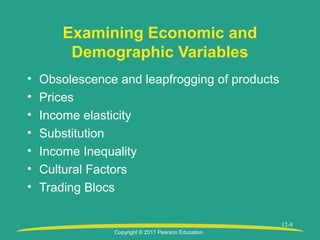
Examining Economic and
Demographic Variables
• Obsolescence and leapfrogging of products
• Prices
• Income elasticity
• Substitution
• Income Inequality
• Cultural Factors
• Trading Blocs
Copyright © 2011 Pearson Education
12-9
Cost Considerations of Resource
Acquisition
• Labor
• Infrastructure
• Ease of Transportation and Communications
• Government Incentives and Disincentives
Copyright © 2011 Pearson Education
12-10
Factors to Consider in Analyzing
Risk
• Companies and their managers differ in their
perceptions of what is risky.
• One company’s risk may be another’s
opportunity.
• There are means by which companies may
reduce their risks other than avoiding
locations.
• There are trade-offs among risks.
Copyright © 2011 Pearson Education
12-11
Political Risk
• Analyzing Past Patterns
• Analyzing Opinions
• Examining Social and Economic
Conditions
Copyright © 2011 Pearson Education
12-12
Monetary Risk
• Exchange Rate Changes
– Differences in the exchange rates can
create gains or losses
• Mobility of Funds
– Liquidity among countries varies
Copyright © 2011 Pearson Education
12-13
Competitive Risk
• Making Operations Compatible
• Spreading Risk
• Following Competitors of Customers
• Heading Off Competition
Copyright © 2011 Pearson Education
12-14
Collecting and Analyzing Data
Information is needed at all levels of
control.
• Companies should compare the cost of
information with its value.
Copyright © 2011 Pearson Education
12-15
Problems With Research Results
and Data
• Limited Resources
• Misleading Data
• Reliance on Legally Reported Market
Activities
• Poor Research Methodology
• Noncomparable Information
Copyright © 2011 Pearson Education
12-16
External Sources of Information
• Individualized Reports
• Specialized Studies
• Service Companies
• Government Agencies
• International Organizations and Agencies
• Trade Associations
Copyright © 2011 Pearson Education
12-17
Country Comparison Tools
• Grids
– May depict acceptable or unacceptable
conditions
– Rank countries by important variables
• Matrices allow companies to:
– Decide on indicators and weight them
– Evaluate each country on the weighted indicators
Copyright © 2011 Pearson Education
12-18
Allocating Among Locations
• Alternative Gradual Commitments
• Geographic Diversification versus
Concentration
• Reinvestment and Harvesting
Copyright © 2011 Pearson Education
12-19
Alternative Gradual Commitments
Companies may reduce risks from the liability of
foreignness by:
• Going first to countries with characteristics similar to
those of their home countries.
• Having experienced intermediaries handle operations
for them.
• Operating in formats requiring commitment of fewer
resources abroad.
• Moving initially to one or a few, rather than many,
foreign countries.
Copyright © 2011 Pearson Education
12-20
Geographic Diversification versus
Concentration
• Growth rate in each market
• Sales stability in each market
• Competitive lead time
• Spillover Effects
• Need for product, communication, and
distribution adaptation
• Program control requirements
Copyright © 2011 Pearson Education
12-21
Reinvestment and Harvesting
• FDI-financial and human capital invested
abroad
• Depending on the success of the investment,
the company may reinvest or consider using
the capital elsewhere
Copyright © 2011 Pearson Education
12-22
Noncomparative Decision Making
Most companies examine proposals one
at a time and accept them if they meet
minimum threshold criteria.
Copyright © 2011 Pearson Education
12-23
Future: Will Prime Locations
Change?
• Future growth rates will have
implications for locations of markets
and labor forces
• Technological innovation allows for new
trends in urbanization as more people
are able to work from locations of their
choosing
Copyright © 2011 Pearson Education
12-24
All rights reserved. No part of this publication may be
reproduced, stored in a retrieval system, or transmitted, in
any form or by any means, electronic, mechanical,
photocopying, recording, or otherwise, without the prior
written permission of the publisher. Printed in the
United States of America.

719899171 12

  • 1.
    Copyright © 2011Pearson Education 12-1 International Business Environments and Operations, 13/e Global Edition Part 5 Global Strategy, Structure, and Implementation
  • 2.
    Copyright © 2011Pearson Education 12-2 Chapter 12 Country Evaluation and Selection
  • 3.
    Copyright © 2011Pearson Education 12-3 Chapter Objectives • To grasp company strategies for sequencing the penetration of countries • To see how scanning techniques can help managers both limit geographic alternatives and consider otherwise overlooked areas • To discern the major opportunity and risk variables a company should consider when deciding whether and where to expand abroad • To know the methods and problems of collecting and comparing international information • To understand some simplifying tools for helping decide where to operate • To consider how companies allocate emphasis among the countries where they operate • To comprehend why location decisions do not necessarily compare different countries’ possibilities
  • 4.
    Copyright © 2011Pearson Education 12-4 Introduction Because all companies have limited resources, they must be careful in making the following decisions: 1. In which countries to locate sales, production, and administrative and auxiliary services 2. The sequence for entering different countries 3. The amount of resources and efforts to allocate to each country where they operate
  • 5.
    Copyright © 2011Pearson Education 12-5 Location Decisions Affecting International Operations
  • 6.
    Copyright © 2011Pearson Education 12-6 Scanning versus Detailed Analysis Without scanning, a company may: • Overlook opportunities and risks • Examine too many or too few possibilities
  • 7.
    Copyright © 2011Pearson Education 12-7 What Information is Important in Scanning? • Opportunities – Sales Expansion – Resource Acquisition • Risks – Political Risk – Monetary Risk – Competitive Risk
  • 8.
    Copyright © 2011Pearson Education 12-8 Examining Economic and Demographic Variables • Obsolescence and leapfrogging of products • Prices • Income elasticity • Substitution • Income Inequality • Cultural Factors • Trading Blocs
  • 9.
    Copyright © 2011Pearson Education 12-9 Cost Considerations of Resource Acquisition • Labor • Infrastructure • Ease of Transportation and Communications • Government Incentives and Disincentives
  • 10.
    Copyright © 2011Pearson Education 12-10 Factors to Consider in Analyzing Risk • Companies and their managers differ in their perceptions of what is risky. • One company’s risk may be another’s opportunity. • There are means by which companies may reduce their risks other than avoiding locations. • There are trade-offs among risks.
  • 11.
    Copyright © 2011Pearson Education 12-11 Political Risk • Analyzing Past Patterns • Analyzing Opinions • Examining Social and Economic Conditions
  • 12.
    Copyright © 2011Pearson Education 12-12 Monetary Risk • Exchange Rate Changes – Differences in the exchange rates can create gains or losses • Mobility of Funds – Liquidity among countries varies
  • 13.
    Copyright © 2011Pearson Education 12-13 Competitive Risk • Making Operations Compatible • Spreading Risk • Following Competitors of Customers • Heading Off Competition
  • 14.
    Copyright © 2011Pearson Education 12-14 Collecting and Analyzing Data Information is needed at all levels of control. • Companies should compare the cost of information with its value.
  • 15.
    Copyright © 2011Pearson Education 12-15 Problems With Research Results and Data • Limited Resources • Misleading Data • Reliance on Legally Reported Market Activities • Poor Research Methodology • Noncomparable Information
  • 16.
    Copyright © 2011Pearson Education 12-16 External Sources of Information • Individualized Reports • Specialized Studies • Service Companies • Government Agencies • International Organizations and Agencies • Trade Associations
  • 17.
    Copyright © 2011Pearson Education 12-17 Country Comparison Tools • Grids – May depict acceptable or unacceptable conditions – Rank countries by important variables • Matrices allow companies to: – Decide on indicators and weight them – Evaluate each country on the weighted indicators
  • 18.
    Copyright © 2011Pearson Education 12-18 Allocating Among Locations • Alternative Gradual Commitments • Geographic Diversification versus Concentration • Reinvestment and Harvesting
  • 19.
    Copyright © 2011Pearson Education 12-19 Alternative Gradual Commitments Companies may reduce risks from the liability of foreignness by: • Going first to countries with characteristics similar to those of their home countries. • Having experienced intermediaries handle operations for them. • Operating in formats requiring commitment of fewer resources abroad. • Moving initially to one or a few, rather than many, foreign countries.
  • 20.
    Copyright © 2011Pearson Education 12-20 Geographic Diversification versus Concentration • Growth rate in each market • Sales stability in each market • Competitive lead time • Spillover Effects • Need for product, communication, and distribution adaptation • Program control requirements
  • 21.
    Copyright © 2011Pearson Education 12-21 Reinvestment and Harvesting • FDI-financial and human capital invested abroad • Depending on the success of the investment, the company may reinvest or consider using the capital elsewhere
  • 22.
    Copyright © 2011Pearson Education 12-22 Noncomparative Decision Making Most companies examine proposals one at a time and accept them if they meet minimum threshold criteria.
  • 23.
    Copyright © 2011Pearson Education 12-23 Future: Will Prime Locations Change? • Future growth rates will have implications for locations of markets and labor forces • Technological innovation allows for new trends in urbanization as more people are able to work from locations of their choosing
  • 24.
    Copyright © 2011Pearson Education 12-24 All rights reserved. No part of this publication may be reproduced, stored in a retrieval system, or transmitted, in any form or by any means, electronic, mechanical, photocopying, recording, or otherwise, without the prior written permission of the publisher. Printed in the United States of America.