Copyright © 2015 Pearson Education, Inc. 3-1
International
Business
Environments & Operations
15e
Daniels ● Radebaugh ● Sullivan
Copyright © 2015 Pearson Education, Inc. 3-2
Chapter 3
The Political and
Legal Environments
Facing Business
Copyright © 2015 Pearson Education, Inc. 3-3
Learning Objectives
 Discuss the philosophy and practices of the
political environment
 Profile trends in contemporary political systems
 Describe current trends in political ideologies and
their implications to MNE’s choices
 Explain political risk management
 Compare the relative benefits and drawbacks of
proactive versus passive political risk
management
 Discuss the principles and practices of the legal
system
Learning Objectives
 Profile trends in contemporary legal
systems
 Identify and describe key legal issues
facing international companies
Copyright © 2015 Pearson Education, Inc. 3-4
Copyright © 2015 Pearson Education, Inc. 3-5
Introduction
Learning Objective:
Discuss the philosophy and practices of
the political environment
Copyright © 2015 Pearson Education, Inc. 3-6
Introduction
 Every country has its own political and
legal environment
 Companies must determine where, when,
and how to adjust their business practices
without undermining the basis for success
Copyright © 2015 Pearson Education, Inc. 3-7
Introduction
Political and Legal Factors Influencing International Business Operations
Copyright © 2015 Pearson Education, Inc. 3-8
The Political Environment
 Managers evaluate, monitor, and forecast
political environments
 A country’s political system refers to the
structural dimensions and power dynamics
of its government that specify institutions,
organizations, and interest groups, and
define the norms that govern political
activities
Copyright © 2015 Pearson Education, Inc. 3-9
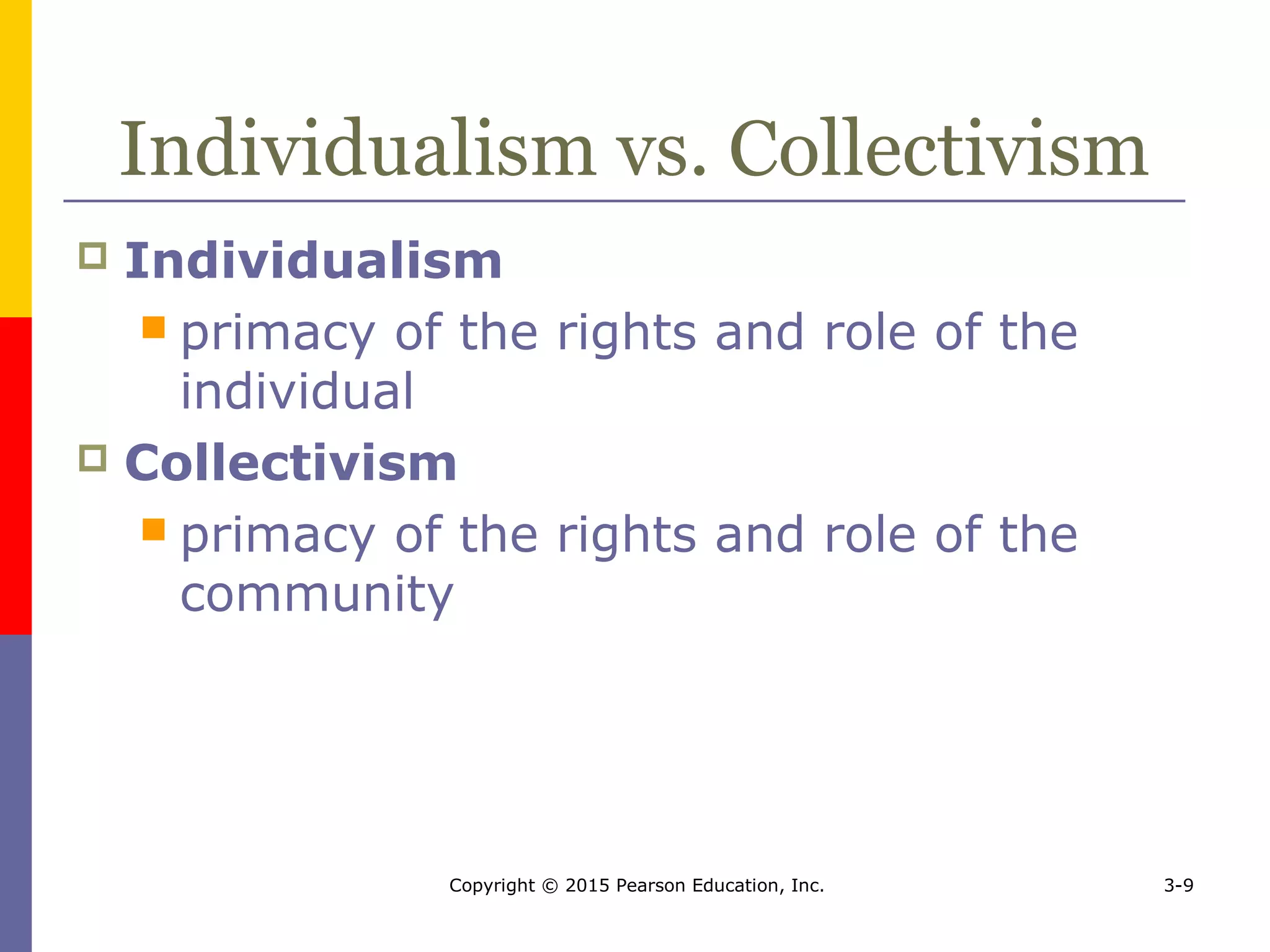
Individualism vs. Collectivism
 Individualism
 primacy of the rights and role of the
individual
 Collectivism
 primacy of the rights and role of the
community
Copyright © 2015 Pearson Education, Inc. 3-10
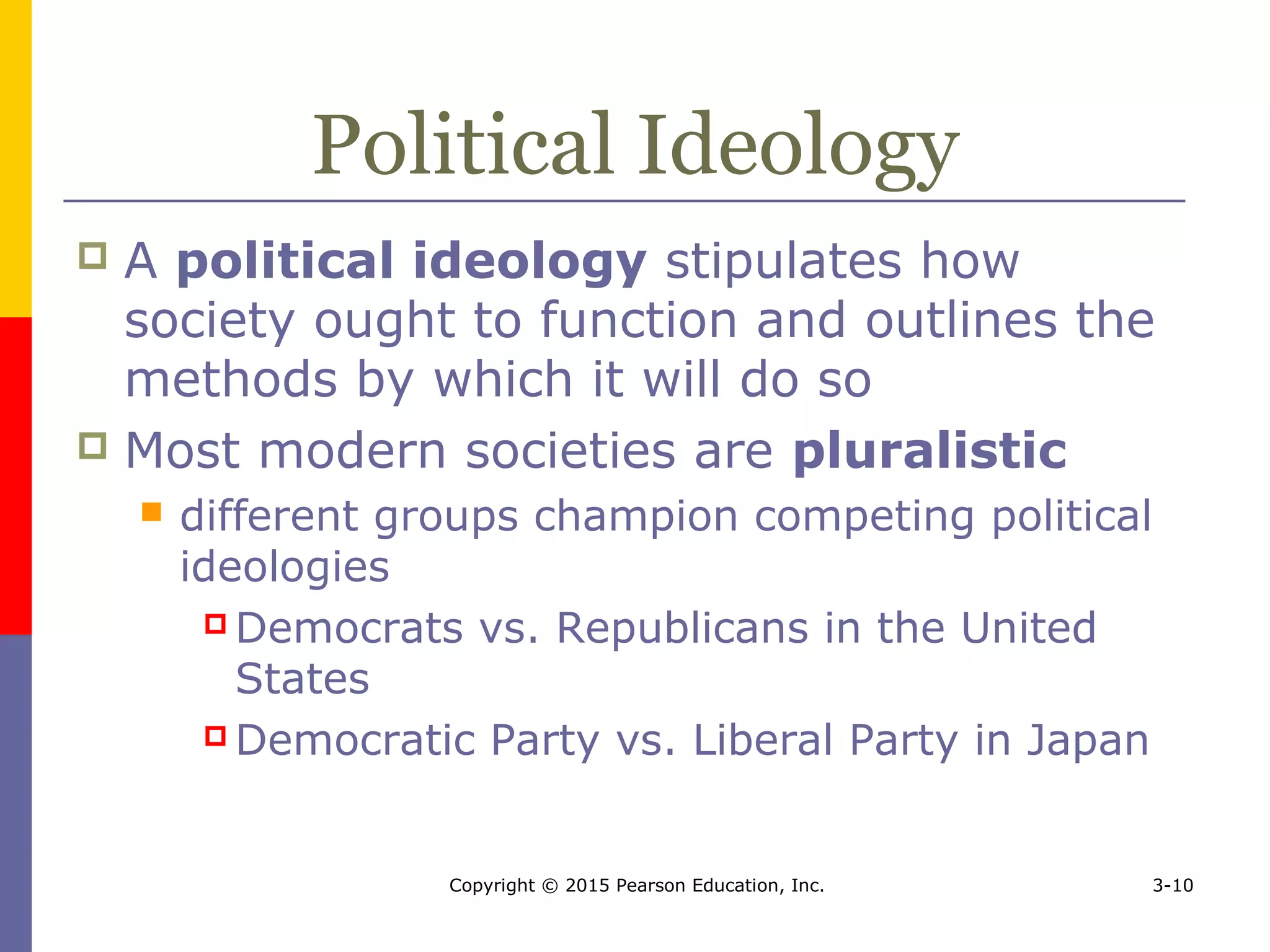
Political Ideology
 A political ideology stipulates how
society ought to function and outlines the
methods by which it will do so
 Most modern societies are pluralistic
 different groups champion competing political
ideologies
 Democrats vs. Republicans in the United
States
 Democratic Party vs. Liberal Party in Japan
Copyright © 2015 Pearson Education, Inc. 3-11
Spectrum Analysis
 A political spectrum outlines the various
forms of political ideology
 Political freedom measures
 the degree to which fair and competitive
elections occur
 the extent to which individual and group
freedoms are guaranteed
 the legitimacy ascribed to the general rule of
law
 the freedom expression
Copyright © 2015 Pearson Education, Inc. 3-12
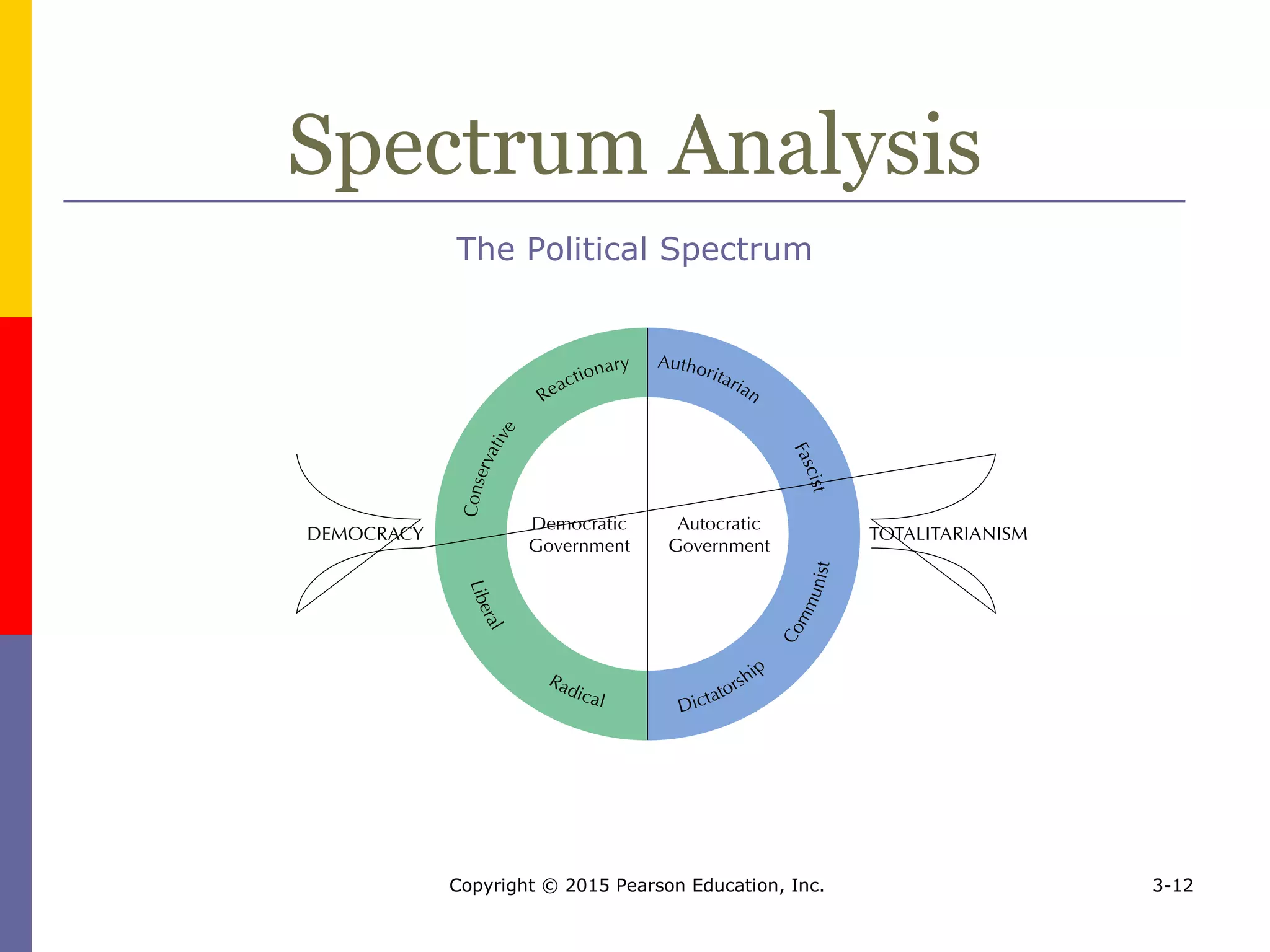
Spectrum Analysis
The Political Spectrum
Copyright © 2015 Pearson Education, Inc. 3-13
Democracy
 In a democracy
 all citizens are politically and legally equal
 all are equally entitled to freedom of thought,
opinion, belief, speech, and association
 all equally command sovereign power over
public officials
 Prominent types of democracy include
 Representative
 Multiparty
 Parliamentary
 Social
Copyright © 2015 Pearson Education, Inc. 3-14
Totalitarianism
 A totalitarian system subordinates the
individual to the interests of the collective
 dissent is eliminated through indoctrination,
persecution, surveillance, propaganda,
censorship, and violence
 Prominent types of totalitarianism include
 Authoritarianism
 Fascism
 Secular
 Theocratic
Copyright © 2015 Pearson Education, Inc. 3-15
The Standard of Freedom
 Freedom House, and independent
watchdog organization, assesses political
and civil freedom around the world
 Freedom House recognizes three types of
political systems
 Free
 Partly free
 Not free
Copyright © 2015 Pearson Education, Inc. 3-16
The Standard of Freedom
Map of Political Freedom, 2013
Copyright © 2015 Pearson Education, Inc. 3-17
Trends in Political Ideologies
Learning Objective:
Profile trends in contemporary political
systems
Copyright © 2015 Pearson Education, Inc. 3-18
Third Wave of Democratization
 Third Wave of Democratization
 number of democracies doubled in two
decades
 Engines of Democracy
1. The failure of totalitarian regimes to deliver
economic progress
2. Improved communications technology
3. Economic dividends of increasing political freedom
Copyright © 2015 Pearson Education, Inc. 3-19
Democracy:
Recession and Retreat
 Democracy’s retreat
 just 26 of the world’s democracies are full
democracies
 Engines of Authoritarianism
 Political economy of growth
 Rhetoric vs. Reality - Inconsistencies
 Economic problems
 Who defines Democracy?
Copyright © 2015 Pearson Education, Inc. 3-20
Democracy:
Recession and Retreat
Freedom in the World: Gains and Declines
Copyright © 2015 Pearson Education, Inc. 3-21
Political Ideology and the MNE
 What will the political map look like in the
future?
 The Washington Consensus
 The Beijing Consensus
 The Clash of Civilizations
Copyright © 2015 Pearson Education, Inc. 3-22
Political Risk
Learning Objective:
Explain political risk management
Copyright © 2015 Pearson Education, Inc. 3-23
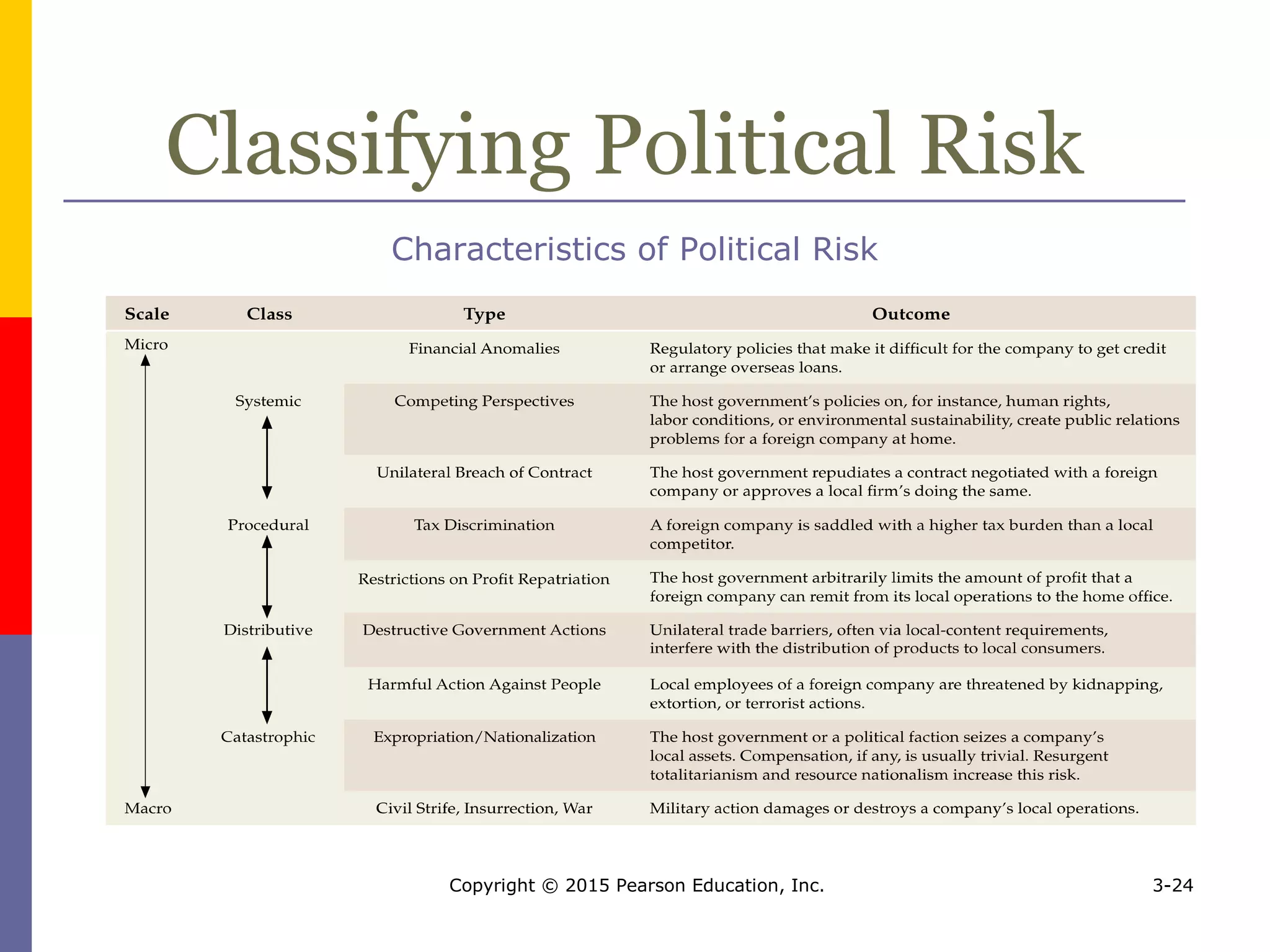
Political Risk
 Political risk refers to the risk that
political decisions or events in a country
negatively affect the profitability or
sustainability of an investment
 Types:
 Systemic
 Procedural
 Distributive
 Catastrophic
Copyright © 2015 Pearson Education, Inc. 3-24
Classifying Political Risk
Characteristics of Political Risk
Copyright © 2015 Pearson Education, Inc. 3-25
The Legal Environment
Learning Objective:
Discuss the principles and practices of the
legal system
Copyright © 2015 Pearson Education, Inc. 3-26
The Legal Environment
 The legal system is the mechanism for
creating, interpreting, and enforcing the
laws in a specified jurisdiction
 Types:
 Common law
 Civil law
 Theocratic law
 Customary law
 Mixed systems
Copyright © 2015 Pearson Education, Inc. 3-27
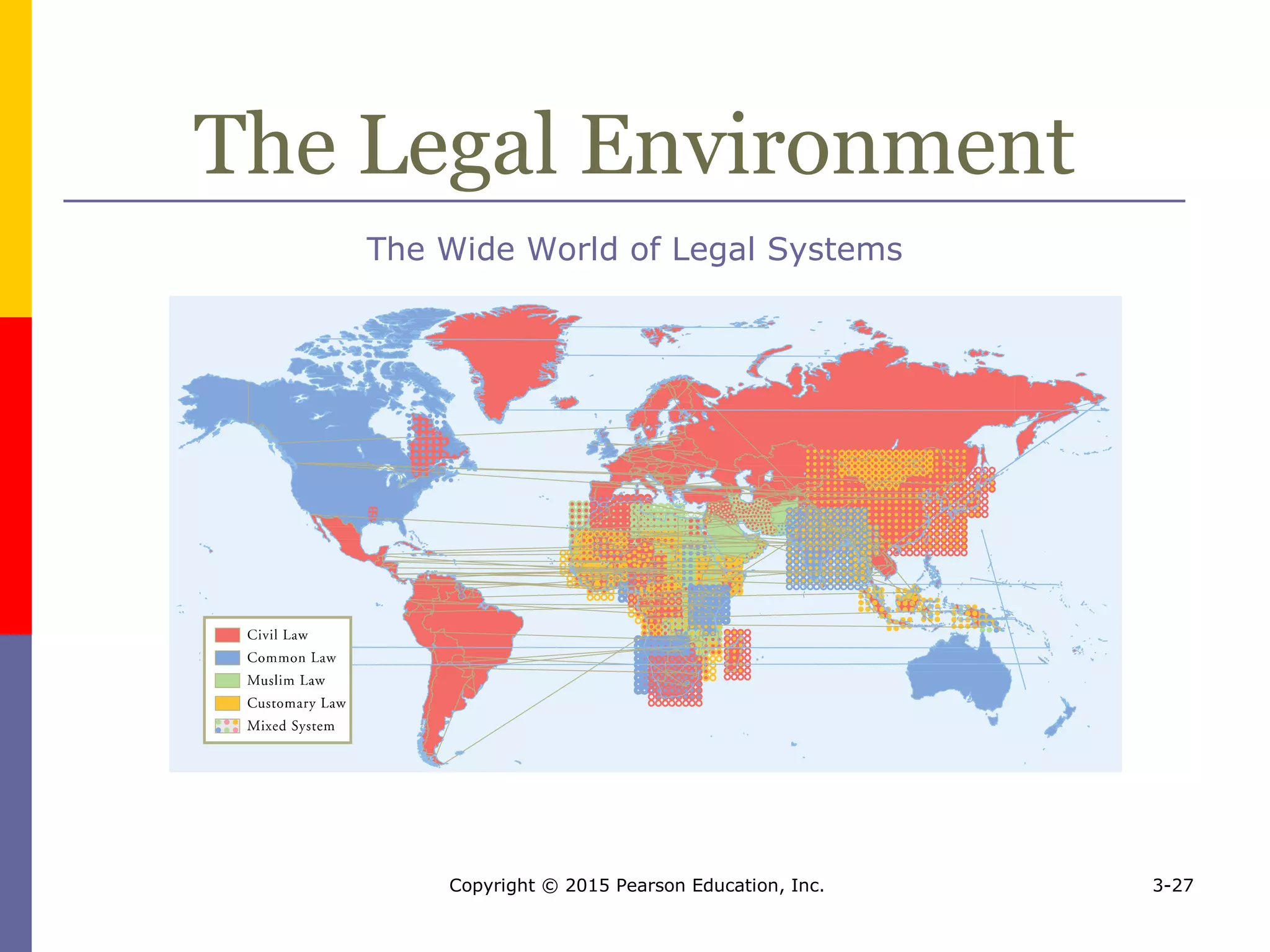
The Legal Environment
The Wide World of Legal Systems
Copyright © 2015 Pearson Education, Inc. 3-28
Trends in Legal Systems
Learning Objective:
Profile trends in contemporary legal
systems
Copyright © 2015 Pearson Education, Inc. 3-29
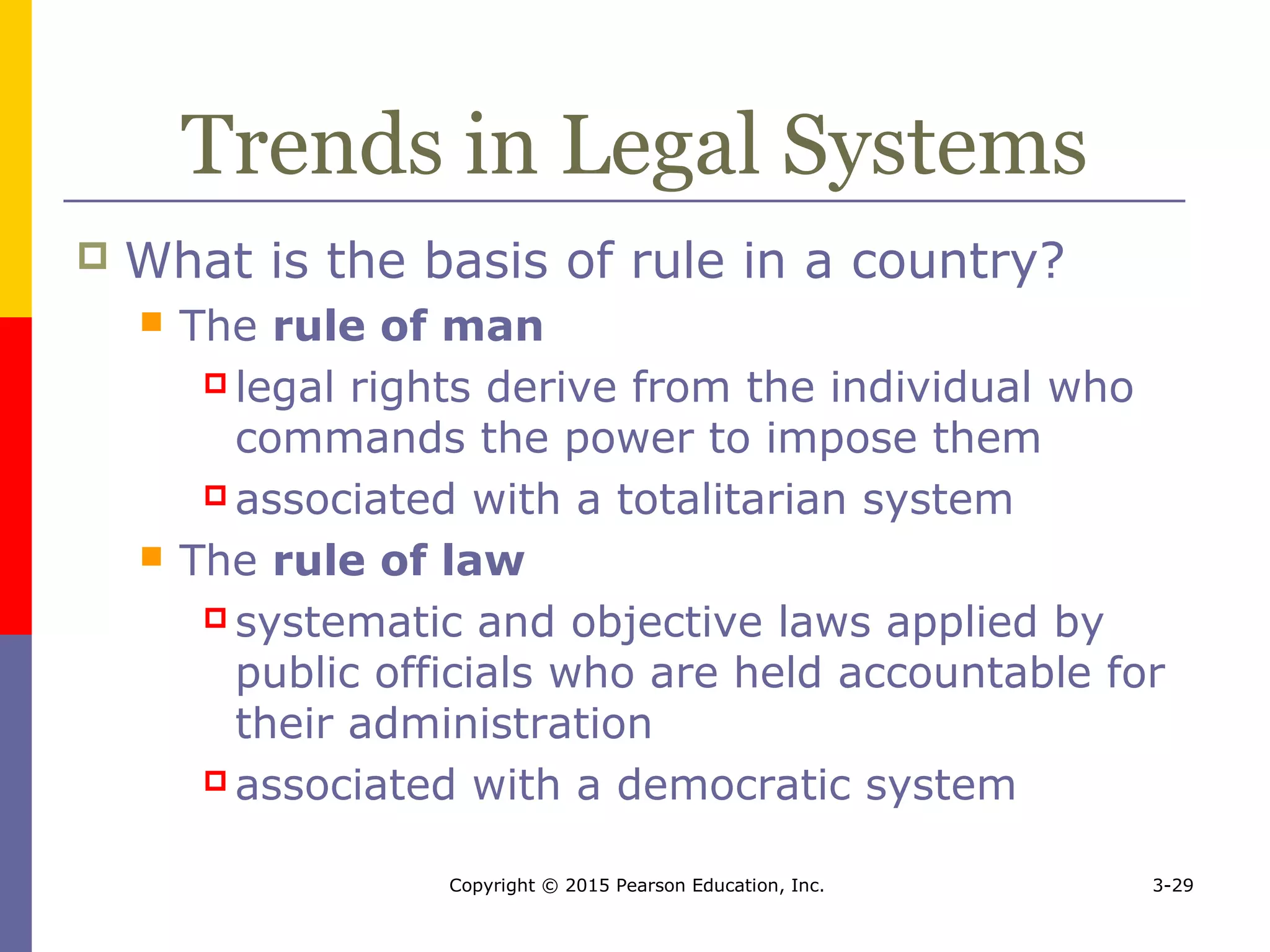
Trends in Legal Systems
 What is the basis of rule in a country?
 The rule of man
 legal rights derive from the individual who
commands the power to impose them
 associated with a totalitarian system
 The rule of law
 systematic and objective laws applied by
public officials who are held accountable for
their administration
 associated with a democratic system
Copyright © 2015 Pearson Education, Inc. 3-30
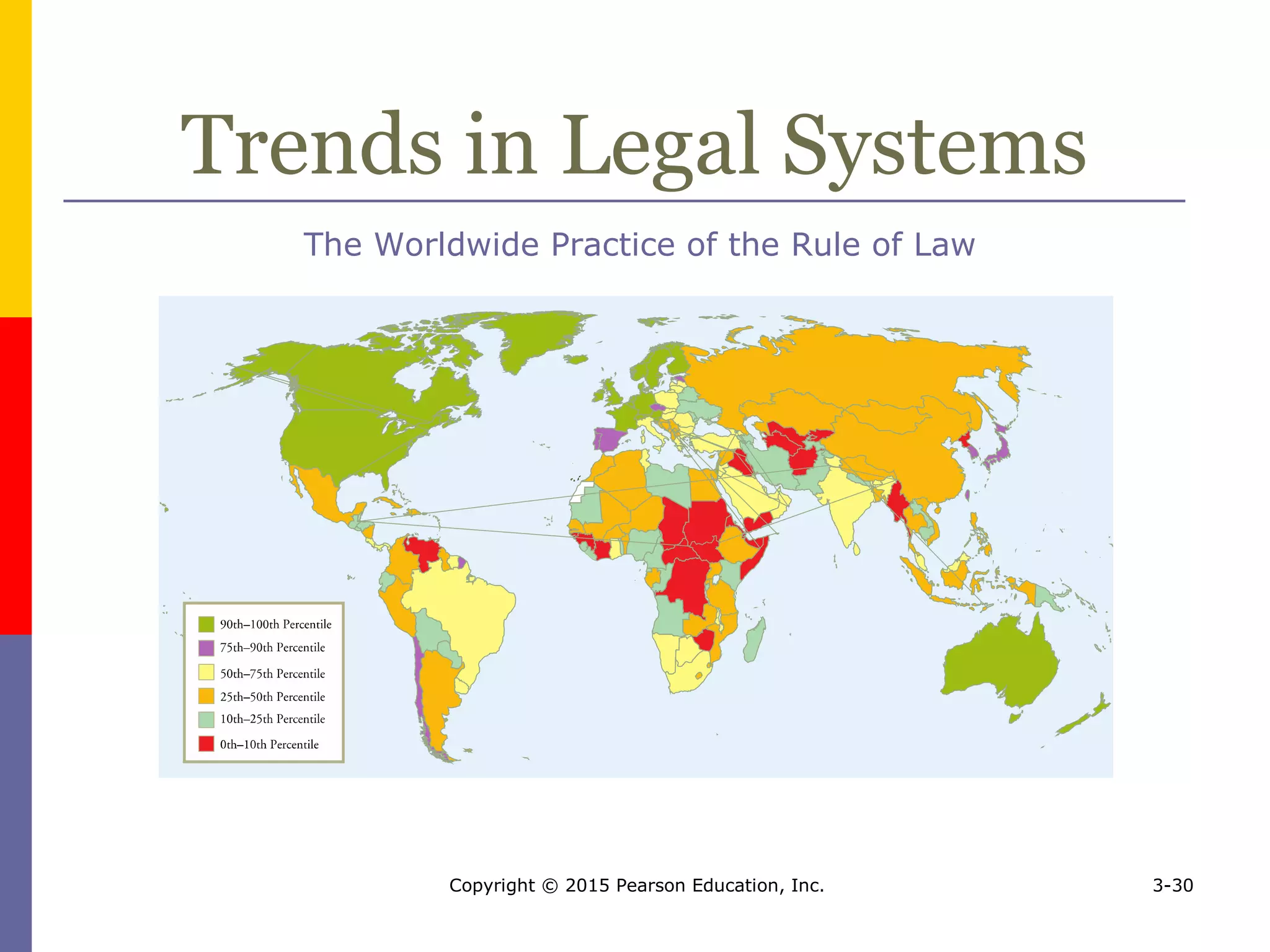
Trends in Legal Systems
The Worldwide Practice of the Rule of Law
Copyright © 2015 Pearson Education, Inc. 3-31
Legal Issues in IB
Learning Objective:
Identify and describe key legal issues
facing international companies
Copyright © 2015 Pearson Education, Inc. 3-32
Operational Concerns
 Operational issues
 Starting a business
 Making and enforcing contracts
 Hiring and firing local workers
 Closing down the business
 In general
 rich countries regulate less
 poor countries regulate more
Copyright © 2015 Pearson Education, Inc. 3-33
Strategic Concerns
 Country Characteristics
 Product safety and liability
 Legal jurisdiction
 Intellectual property
Copyright © 2015 Pearson Education, Inc. 3-34
Intellectual Property:
Rights and Protection
 Intellectual property refers to creative
ideas, expertise, or intangible insights that
grant its owner a competitive advantage
 Intellectual property rights refer to the
right to control and derive the benefits
from writing, inventions, processes, and
identifiers
 no “global” patent, trademark or copyright
exists
Copyright © 2015 Pearson Education, Inc. 3-35
Intellectual Property:
Rights and Protection
 Attitudes towards intellectual property
 Historical legacies
 rule of man versus rule of law
 Economic circumstances
 levels of economic development
 Cultural orientation
 individualism versus collectivism
Copyright © 2015 Pearson Education, Inc. 3-36
All rights reserved. No part of this publication may be reproduced, stored in
a retrieval system, or transmitted, in any form or by any means, electronic,
mechanical, photocopying, recording, or otherwise, without the prior
written permission of the publisher. Printed in the United States of America.

Daniels ib15inppt 03

  • 1.
    Copyright © 2015Pearson Education, Inc. 3-1 International Business Environments & Operations 15e Daniels ● Radebaugh ● Sullivan
  • 2.
    Copyright © 2015Pearson Education, Inc. 3-2 Chapter 3 The Political and Legal Environments Facing Business
  • 3.
    Copyright © 2015Pearson Education, Inc. 3-3 Learning Objectives  Discuss the philosophy and practices of the political environment  Profile trends in contemporary political systems  Describe current trends in political ideologies and their implications to MNE’s choices  Explain political risk management  Compare the relative benefits and drawbacks of proactive versus passive political risk management  Discuss the principles and practices of the legal system
  • 4.
    Learning Objectives  Profiletrends in contemporary legal systems  Identify and describe key legal issues facing international companies Copyright © 2015 Pearson Education, Inc. 3-4
  • 5.
    Copyright © 2015Pearson Education, Inc. 3-5 Introduction Learning Objective: Discuss the philosophy and practices of the political environment
  • 6.
    Copyright © 2015Pearson Education, Inc. 3-6 Introduction  Every country has its own political and legal environment  Companies must determine where, when, and how to adjust their business practices without undermining the basis for success
  • 7.
    Copyright © 2015Pearson Education, Inc. 3-7 Introduction Political and Legal Factors Influencing International Business Operations
  • 8.
    Copyright © 2015Pearson Education, Inc. 3-8 The Political Environment  Managers evaluate, monitor, and forecast political environments  A country’s political system refers to the structural dimensions and power dynamics of its government that specify institutions, organizations, and interest groups, and define the norms that govern political activities
  • 9.
    Copyright © 2015Pearson Education, Inc. 3-9 Individualism vs. Collectivism  Individualism  primacy of the rights and role of the individual  Collectivism  primacy of the rights and role of the community
  • 10.
    Copyright © 2015Pearson Education, Inc. 3-10 Political Ideology  A political ideology stipulates how society ought to function and outlines the methods by which it will do so  Most modern societies are pluralistic  different groups champion competing political ideologies  Democrats vs. Republicans in the United States  Democratic Party vs. Liberal Party in Japan
  • 11.
    Copyright © 2015Pearson Education, Inc. 3-11 Spectrum Analysis  A political spectrum outlines the various forms of political ideology  Political freedom measures  the degree to which fair and competitive elections occur  the extent to which individual and group freedoms are guaranteed  the legitimacy ascribed to the general rule of law  the freedom expression
  • 12.
    Copyright © 2015Pearson Education, Inc. 3-12 Spectrum Analysis The Political Spectrum
  • 13.
    Copyright © 2015Pearson Education, Inc. 3-13 Democracy  In a democracy  all citizens are politically and legally equal  all are equally entitled to freedom of thought, opinion, belief, speech, and association  all equally command sovereign power over public officials  Prominent types of democracy include  Representative  Multiparty  Parliamentary  Social
  • 14.
    Copyright © 2015Pearson Education, Inc. 3-14 Totalitarianism  A totalitarian system subordinates the individual to the interests of the collective  dissent is eliminated through indoctrination, persecution, surveillance, propaganda, censorship, and violence  Prominent types of totalitarianism include  Authoritarianism  Fascism  Secular  Theocratic
  • 15.
    Copyright © 2015Pearson Education, Inc. 3-15 The Standard of Freedom  Freedom House, and independent watchdog organization, assesses political and civil freedom around the world  Freedom House recognizes three types of political systems  Free  Partly free  Not free
  • 16.
    Copyright © 2015Pearson Education, Inc. 3-16 The Standard of Freedom Map of Political Freedom, 2013
  • 17.
    Copyright © 2015Pearson Education, Inc. 3-17 Trends in Political Ideologies Learning Objective: Profile trends in contemporary political systems
  • 18.
    Copyright © 2015Pearson Education, Inc. 3-18 Third Wave of Democratization  Third Wave of Democratization  number of democracies doubled in two decades  Engines of Democracy 1. The failure of totalitarian regimes to deliver economic progress 2. Improved communications technology 3. Economic dividends of increasing political freedom
  • 19.
    Copyright © 2015Pearson Education, Inc. 3-19 Democracy: Recession and Retreat  Democracy’s retreat  just 26 of the world’s democracies are full democracies  Engines of Authoritarianism  Political economy of growth  Rhetoric vs. Reality - Inconsistencies  Economic problems  Who defines Democracy?
  • 20.
    Copyright © 2015Pearson Education, Inc. 3-20 Democracy: Recession and Retreat Freedom in the World: Gains and Declines
  • 21.
    Copyright © 2015Pearson Education, Inc. 3-21 Political Ideology and the MNE  What will the political map look like in the future?  The Washington Consensus  The Beijing Consensus  The Clash of Civilizations
  • 22.
    Copyright © 2015Pearson Education, Inc. 3-22 Political Risk Learning Objective: Explain political risk management
  • 23.
    Copyright © 2015Pearson Education, Inc. 3-23 Political Risk  Political risk refers to the risk that political decisions or events in a country negatively affect the profitability or sustainability of an investment  Types:  Systemic  Procedural  Distributive  Catastrophic
  • 24.
    Copyright © 2015Pearson Education, Inc. 3-24 Classifying Political Risk Characteristics of Political Risk
  • 25.
    Copyright © 2015Pearson Education, Inc. 3-25 The Legal Environment Learning Objective: Discuss the principles and practices of the legal system
  • 26.
    Copyright © 2015Pearson Education, Inc. 3-26 The Legal Environment  The legal system is the mechanism for creating, interpreting, and enforcing the laws in a specified jurisdiction  Types:  Common law  Civil law  Theocratic law  Customary law  Mixed systems
  • 27.
    Copyright © 2015Pearson Education, Inc. 3-27 The Legal Environment The Wide World of Legal Systems
  • 28.
    Copyright © 2015Pearson Education, Inc. 3-28 Trends in Legal Systems Learning Objective: Profile trends in contemporary legal systems
  • 29.
    Copyright © 2015Pearson Education, Inc. 3-29 Trends in Legal Systems  What is the basis of rule in a country?  The rule of man  legal rights derive from the individual who commands the power to impose them  associated with a totalitarian system  The rule of law  systematic and objective laws applied by public officials who are held accountable for their administration  associated with a democratic system
  • 30.
    Copyright © 2015Pearson Education, Inc. 3-30 Trends in Legal Systems The Worldwide Practice of the Rule of Law
  • 31.
    Copyright © 2015Pearson Education, Inc. 3-31 Legal Issues in IB Learning Objective: Identify and describe key legal issues facing international companies
  • 32.
    Copyright © 2015Pearson Education, Inc. 3-32 Operational Concerns  Operational issues  Starting a business  Making and enforcing contracts  Hiring and firing local workers  Closing down the business  In general  rich countries regulate less  poor countries regulate more
  • 33.
    Copyright © 2015Pearson Education, Inc. 3-33 Strategic Concerns  Country Characteristics  Product safety and liability  Legal jurisdiction  Intellectual property
  • 34.
    Copyright © 2015Pearson Education, Inc. 3-34 Intellectual Property: Rights and Protection  Intellectual property refers to creative ideas, expertise, or intangible insights that grant its owner a competitive advantage  Intellectual property rights refer to the right to control and derive the benefits from writing, inventions, processes, and identifiers  no “global” patent, trademark or copyright exists
  • 35.
    Copyright © 2015Pearson Education, Inc. 3-35 Intellectual Property: Rights and Protection  Attitudes towards intellectual property  Historical legacies  rule of man versus rule of law  Economic circumstances  levels of economic development  Cultural orientation  individualism versus collectivism
  • 36.
    Copyright © 2015Pearson Education, Inc. 3-36 All rights reserved. No part of this publication may be reproduced, stored in a retrieval system, or transmitted, in any form or by any means, electronic, mechanical, photocopying, recording, or otherwise, without the prior written permission of the publisher. Printed in the United States of America.

Editor's Notes

  • #2 International Business Environments and Operations 15e by Daniels, Radebaugh, and Sullivan
  • #3 Chapter 3: The Political and Legal Environments Facing Business
  • #4 The learning objectives for this chapter are To discuss the philosophy and practices of the political environment To profile trends in contemporary political systems To explain the idea of political risk and approaches to managing it To discuss the philosophy and practices of the legal system To describe trends in contemporary legal systems To explain legal issues facing international companies
  • #6 Learning Objective : To discuss the philosophy and practices of the political environment.
  • #7 Companies doing business internationally must navigate different philosophies, laws, and attitudes concerning political freedom, property rights, and social responsibility. Managers that understand the differences between countries are in a better position to compete.
  • #8 This Figure shows the political and legal factors that influence international business operations.
  • #9 The goal of a country’s political system is to integrate the diverse elements of a society. A successful political system unites a society in the face of differing viewpoints. So for example, the peace and prosperity that exists in countries like Sweden and Australia illustrate the success of the political systems in those countries, while the instability and insurrection of Libya’s political system shows its failings.
  • #10 One standard way to assess a political system is exploring the degree to which it emphasizes individualism versus collectivism. Individualism champions the rights of the individual over those of society. From a business perspective, this suggests that managers have the right to make economic decisions largely free of rules and regulations. You might be aware that countries that have an individualist orientation shape their marketplace with the idea of laissez-faire and support the idea that government should not interfere in business affairs. Under this perspective, individuals are presumed to be self-regulating in promoting economic prosperity and growth, acting fairly and justly to maximize personal performance without threatening the welfare of society. In contrast, collectivism encourages the government to intervene to improve the welfare of the group at the expense of the individual. For business, this means that the ownership of assets, the structure of industries, the conduct of companies, and the actions of managers must improve the welfare of society. Therefore, group members accept the responsibility for making decisions that will benefit everyone. Countries taking a collectivist orientation hold that government will intervene in market situations to ensure that business practices benefit society.
  • #11 Most countries have competing ideologies. In the United States for example, the Democratic Party competes with the Republican Party to not only describe a vision for the future, but also the means of achieving that future. Most societies today are pluralistic – they have different groups championing different ideologies.
  • #12 A political spectrum outlines the various forms of political ideology including anarchism, conservatism, secularism, environmentalism, liberalism, feminism, nationalism, socialism, and theocracy. Managers are concerned with the degree of political freedom in a country and its effect on investment choices and operations decisions.
  • #13 This Figure shows a political spectrum of the various forms of political ideologies. By configuring ideologies along the central axis we can model different political ideologies in relation to each other. The goal of relativity depends on specifying credible ideas to anchor the endpoints of the axis; reasonably set, one can then position alternative ideas. In practice, purely democratic and totalitarian systems are extreme exceptions. Looking around the world, one finds that there are variations of each political ideology. For example, democratic systems range from radical on one side (advocates of extreme political reform) to reactionary (advocates of a return to past conditions). Likewise, totalitarian systems emphasize different degrees of state control; fascism aims to control people’s minds, souls, and daily existence, whereas authoritarianism confines itself to political control of the state. This Figure shows that the majority of political ideologies fall between democracy and totalitarianism.
  • #14 Understanding the ideals and means of democracy and totalitarianism can help explain the other points on the political spectrum. Democracy calls for participation by citizens in a fair and just decision-making process. Since it supports individualism, companies can make investment and operational decisions based on economic rather than political standards. Under a democracy, commerce and trade is promoted.
  • #15 A totalitarian system champions the power of a few over the many. Under a totalitarian system, the government maintains control over many aspects of life, the individual is subordinated to the state, and all opposing political and cultural expression is suppressed. Managers operating in a totalitarian state must make decisions based on political rather than economic standards. Typically, local companies are favored over foreign firms forcing multinational companies to make business deals that would not occur in a democratic environment.
  • #16 Freedom House classifies countries according to their political and civil freedom. A free country has open political competition, respect for civil liberties, independent civic life, and independent media. A partly free country has limited political rights and civil liberties, corruption, weak rules of law, ethnic and religious strife, unfair elections, and censorship. A not free country has few or no political rights and civil liberties.
  • #17 This Map shows the three types of political freedom identified by Freedom House.
  • #18 Learning Objective : To profile trends in contemporary political systems.
  • #19 The Third Wave of Democratization refers to the third major surge of democracy in the 20th century that began in 1974. During this time the number of democratic countries doubled. This steady diffusion of democratic ideology resulted in a situation in which today, some 50 percent of the world’s population lives in a democracy. The rise of democracy was a result of the failure of totalitarian regimes to deliver economic progress, improved communications technology, and economic dividends of increasing political freedom. However, despite these gains, over the last five years, some of the gains in political freedom have declined.
  • #20 While democracy still retains its appeal worldwide, there are signs that it may actually be in retreat. According to the Economist Intelligence Unit many countries are democracies in name only. The EIU classifies four types of political systems – full democracy, flawed democracy, hybrid regime, and authoritarian regime. Today, 12 percent of the world’s population lives in a full democracy, 37 percent in a flawed democracy, 14 percent in a hybrid regime, and 37 percent in an authoritarian regime. What’s fueling this trend? Several things. One is the growing uncertainty of the relationship between democracy and levels of economic development. A second involves the democracy setbacks in several European countries. Third, the economic problems and in particular the global financial crisis that has plagued the world over the last few years. Finally is the question of just how democracy should be defined and what its standards should be.
  • #21 This Figure shows the gains and declines in freedom. Notice that early on, freedom exceeds declines, but that more recently, that trend has reversed.
  • #22 What happens in the future? Managers must watch carefully and adapt their operations and decisions accordingly. The Washington Consensus champions democracy, freedom, the rule of law, and human rights. The Beijing Consensus calls for a one-party system in which elected representatives, preapproved by the ruling party, oversee a nominal democratic system whose citizens, though granted the right to vote, cannot participate in decision making. Under the Clash of Civilizations scenario irreconcilable cultural and religious differences between Islam and the West will trigger a backlash against Western political ideals and their crystallization in the ideologically interventionist Washington Consensus.
  • #23 Learning Objective : To explain the idea of political risk and approaches to managing it.
  • #24 Political risk represents a very real threat for companies today especially in fast-growing, emerging markets where weak legal systems, makeshift institutions, volatile cities, and fragile regimes complicate the business environment. Moreover, the global credit crisis has aggravated political risk across both developed and developing markets. There are four categories of political risk. Systemic Risks are risks that impact all firms that operate in the particular political system. Procedural Risk refers to the risk evolving from the daily movement of people, products, and funds from point to point in the global market. Each move creates a procedural transaction between the units involved, whether units of a company or units of a country. Political actions sometimes create frictions that interfere with these transactions. Distributive Risk is a result of the profits generated by foreign companies in the local economy. If the host country questions the distributive justice of the rewards of operating in its market, it may wonder whether, as the business grows more successful, it is receiving its “fair” share of the growing profits. Finally, Catastrophic Risk includes random political developments that adversely affect the operations of every company in a country. Typically, it arises from specific flash points, such as ethnic discord, illegal regime change, civil disorder, or insurrection. It disrupts the business environment in a way that affects every firm in the country. If such disruptions spiral out of control, they devastate companies and nations.
  • #25 This Table shows the characteristics of political risk.
  • #26 Learning Objective : To discuss the philosophy and practices of the legal system.
  • #27 International managers must be aware of how a country develops, interprets, and enforces its laws. Legal systems vary across counties because of variations in traditions, precedent, usage, custom, and religious precepts. Modern legal systems are composed of constitutional law which preserves an open and just political order, criminal law which safeguards the social order, and civil and commercial laws which promote fairness. There are five types of legal systems. A common law system is based on tradition, precedent, custom, usage, and interpretation by the courts. A civil law system relies on a systematic collection of codes and statues that judges must follow. A theocratic system is based on religious precepts. A customary legal system follows the wisdom of daily experience. Finally, a mixed legal system combines elements of the other systems.
  • #28 This Map shows the different legal systems being used by countries today.
  • #29 Learning Objective : To describe trends in contemporary legal systems.
  • #30 The retreat of democracy is also changing the legal environment. As countries shift toward totalitarian regimes, the legal system changes to one in which business activity is regulated by the government to support state objectives. Managers must determine what the basis of rule is in a given country – the rule of man or the rule of law. The rule of man is the basis of a totalitarian system, while the rule of law is the basis of democracy.
  • #31 This Map shows the distribution of the rule of law across the world. Note that the rule of law prevails in wealthier, Westernized countries, but that the rule of man is in place in many emerging economies. In the past, it was common for managers to avoid countries where the rule of man prevailed, but slow growth in countries dominated by the rule of law is forcing managers to reconsider this approach.
  • #32 Learning Objective : To explain legal issues facing international companies.
  • #33 Managers doing business abroad face a complex political and legal environment that makes decision- making in the multinational company challenging. Just starting a new business creates several concerns related to registering the new company’s name, choosing the appropriate tax structure, getting licenses and permits, arranging credit, and securing insurance. Some countries facilitate this process, while others do not. Managers must also be aware of how a country’s political and legal environment affects both entering and enforcing contracts. A contract, which is essential to business transactions, is a binding legal agreement that formally exchanges promises, the breach of which triggers legal proceedings. Countries with common law systems tend to encourage precise, detailed contracts, but countries with civil law systems where the civil code deals with many pertinent issues, encourage shorter and less specific contracts. Another area that managers must explore is related to hiring and firing local workers. However, laws and practices in this area vary greatly across the world. Singapore, New Zealand, and the United States are among the countries with the most flexible labor-regulation statutes. China has the most flexibility in hiring and firing plus the greatest discretion in setting employment conditions, but, Angola, Belarus, and Paraguay place rigid restrictions on firing. Finally, how a business is closed down must be explored. Some countries make the process quite difficult. In the United States, for example, the Internal Revenue Service requires completing a series of forms that report, among many others points, changes in the business structure, the sale of assets, payments to subcontractors, and termination of a retirement plan. Other countries like Ireland, Japan, and Canada allow companies to close their doors much more easily. In general we say that there is an inverse relationship between a nation’s wealth and its tendency to regulate business.
  • #34 In addition to basic operation decisions managers must also consider longer term strategic issues and how the political and legal environment might influence them. A product’s country of origin – where the product was grown, produced, or manufactured – is important for determining import charges. Many countries require companies to ensure that a certain percentage of a good is made locally. These regulations are called local content rules. Today’s slow economic growth have made “buy-local” campaigns very popular. Marketplace behavior can make strategic decisions challenging especially where rule of man prevails. Governments determine what is permissible in all forms of business activities, including sourcing, distributing, advertising, and pricing products. So managers are vulnerable to abrupt changes that could require them to adjust their manufacturing configuration, their supply chain coordination, and their marketing strategy. Product safety and liability is another strategic areas of concern for managers. Local standards may require companies to customize their products. Since these standards often reflect cultural values or social norms, companies must adapt the product to boost its appeal to local consumers. Countries also have legal jurisdiction to stipulate laws that set the criteria for litigation when agents—whether legal residents of the same or of different countries—are unable to resolve a dispute. Typically, in a cross-national dispute, each company petitions its home-country court to claim jurisdiction hoping that this will ensure more favorable treatment. Finally, companies must consider intellectual property rights and protection in a given country.
  • #35 The protection of intellectual property has become a hot topic in today’s global economy. Product piracy has become common, and many countries feel that others are not doing enough to safeguard the rights of those who own intellectual property. It is difficult for companies to maintain control over their intellectual property because no “global” patent, trademark, or copyright exists. Therefore, managers must be especially vigilant to ensure that product piracy does not occur. Yet, it can be exceedingly difficult to do so. The business of intellectual property theft is huge. Some estimates suggest that international trade in pirated goods is more than $600 billion a year.
  • #36 How do countries decide how and if to protect intellectual property? Well, every country’s policies regarding intellectual property are different and reflect the nation’s legal legacies, economic development, and cultural orientation. The largest share of pirated products is made in countries where the rule of man is dominant. Protection tends to be much better in countries where the rule of law prevails. A country’s economic level of development also plays a role in the protection of intellectual property. Poorer countries typically impose fewer regulations compared to wealthier countries. Similarly, intellectual property rights protection tends to be better in countries where individualism is emphasized, whereas in collectivist societies, protection is much lower. Can protection be improved? Perhaps, but it could take awhile. Over time, countries that become idea creators tend to improve their protection of intellectual property. China for example, has long been known for product piracy, but as it has become an idea lab in recent years, it has been making a better effort to protect intellectual property. In general, countries that generate intellectual property are strong advocates of protecting ownership rights.