Course Outcomes
Atthe end of the course, the students will be able to:
Explain the management science approach to
identification, analysis, decision, and implementation of
problem solving.
Discuss management problems that can be analyzed by
linear programming.
Demonstrate the transportation method to solve problems
manually and with the northwest corner method.
3.
Course Outcomes
Atthe end of the course, the students will be able to:
Explain the importance of forecasting in organizations.
Describe the EOQ model and its variations or expansions.
Construct models for a variety of PERT/CPM.
Illustrate the decision tree method of analysis for decision
making under risk and under certainty and expected value.
4.
Module 1 (Introduction)
ProblemSolving and Decision Making
Quantitative Analysis and Decision Making
Quantitative Analysis
Model of Cost, Revenue, and Profit
Management Science Techniques
5.
What is ManagementScience?
can be defined as a concept that is
“concerned with developing and applying
models and concepts that help to illuminate
issues and solve managerial problems”
Lancaster University.
6.
What is ManagementScience?
Management Science is a mathematical approach to
solving problems, the application of it requires the
examination of different fields.
Management Science uses analytical data, statistics
and methods for increasing efficiency of management
systems and it finds the tools from fields like:
Economics, Business Administration, Psychology,
Sociology
7.
Management Science makesa few General
Assumptions of Management.
The assumptions are:
Management is a problem-solving mechanism, which can be
boosted by mathematical tools and techniques.
Problems in management can be quantified and described in
mathematical terms.
Managerial problems can best be resolved through
mathematical tools, simulations and models.
8.
Some Benefits ofManagement Science
ability to design measures that can be used to identify
and evaluate the effectiveness of the processes
currently in use.
looks at the current situation and compares it with
other possibilities, creating measurable predictions.
9.
Some Benefits ofManagement Science
analysis of processes and decision-making can help
the organization identify the problem areas, as well as
the systems that are already working efficiently.
using processes and decision-making approaches that
provide the best results in terms of the achieving the
organization’s objectives.
10.
Problem Solving andDecision Making
Problem Solving is a process of
identifying a difference between the
actual and the desired state of affairs
and then taking action to resolve the
difference.
11.
Problem solving isan analytical process
used to identify the possible solutions to
the situation at hand.
Making decisions is a part of problem
solving.
Problem solving is a complex process, and
judgement calls – or decisions – will have
to be made on the way.
12.
Problem Solving andDecision Making
Decision Making is a term generally
associated with the first five steps of the
problem-solving process.
Hence, the first steps of decision making
is to identify and define the problem and
ends with the choosing of alternative
which is an act of making the decision.
13.
Decision making isa choice made by using one’s
judgement. The art of making sound decisions is a
particularly important skill for leaders and
managers.
You may need to make numerous decisions as
part of the problem-solving process.
Leaders and managers will need to use their
decision-making skills to determine which solution
to pursue.
14.
Steps in DecisionMaking
1. Use problem solving to identify potential solutions –
this may involve decision making, such as deciding to
hold meetings with stakeholders or assigning team
members to tackle particular areas of the problem
2. Determine which solution is the best fit for the
problem at hand
3. Make a decision on next steps to action the chosen
solution
15.
Steps of ProblemSolving Process
1. Identify and define the problem
2. Determine the set of alternative solutions
3. Determine the criterion or criteria that will be used
to evaluate the alternatives
4. Evaluate the alternatives
5. Choose an alternatives
6. Implement the selected alternative
7. Evaluate the results to determine whether a
satisfactory solution has been attained
16.
Figure 1. Therelationship between problem solving and decision making
Problem
Solving
Define the
Problem
Identify the
Alternatives
Determine
the Criteria
Evaluate the
Alternatives
Choose an
Alternative
Implement
the Decision
Evaluate the
Results
Decision
Making
Decision
17.
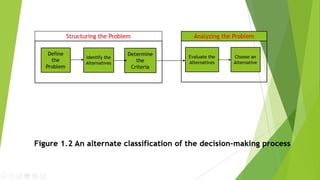
Figure 1.2 Analternate classification of the decision-making process
Structuring the Problem
Define
the
Problem
Identify the
Alternatives
Determine
the
Criteria
Analyzing the Problem
Evaluate the
Alternatives
Choose an
Alternative
18.
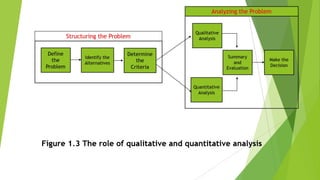
Figure 1.3 Therole of qualitative and quantitative analysis
Structuring the Problem
Define
the
Problem
Identify the
Alternatives
Determine
the
Criteria
Analyzing the Problem
Qualitative
Analysis
Quantitative
Analysis
Summary
and
Evaluation
Make the
Decision
19.
Qualitative Analysis
is basedprimarily on the manager’s judgment
and experience; it includes the manager’s
intuitive ‘feel’ for the problem and it is more on
art than a science.
20.
Quantitative Analysis
analysis ofa situation or event, especially a
financial market, by means of complex
mathematical and statistical modeling.
uses subjective judgment to analyze a
company's value or prospects based on non-
quantifiable information, such as management
expertise, industry cycles, strength of research
and development, and labor relations.