Typhoons, and Cyclones
By
Kella Randolph M.Ed.
HURRICANES
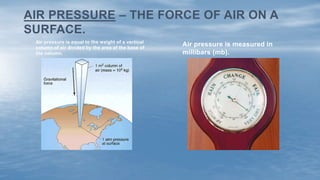
Air pressure is measured in
millibars (mb).
Air pressure is equal to the weight of a vertical
column of air divided by the area of the base of
the column.
AIR PRESSURE – THE FORCE OF AIR ON A
SURFACE.
• A HURRICANE WARNING issued for
your part of the coast indicates that
sustained winds of at least 74 mph
are expected within 24 hours or less.
Once this warning has been issued,
your family should be in the process
of completing protective actions and
deciding the safest location to be
during the storm.
• A HURRICANE WATCH issued for
your part of the coast indicates the
possibility that you could experience
hurricane conditions within 36 hours.
This watch should trigger your family's
disaster plan, and protective
measures should be initiated,
especially those actions that require
extra time such as securing a boat,
leaving a barrier island, etc.
WATCH VS WARNING
KNOW THE DIFFERENCE
• Typhoon — (the Northwest Pacific
Ocean west of the dateline)
• Severe Tropical Cyclone — (the
Southwest Pacific Ocean west of
160E or Southeast Indian Ocean east
of 90E)
• Severe Cyclonic Storm — (the
North Indian Ocean)
• Tropical Cyclone — (the Southwest
Indian Ocean)
• A hurricane is a severe tropical storm
that forms in the North Atlantic Ocean,
the Northeast Pacific Ocean east of
the dateline, or the South Pacific
Ocean east of 160E. Hurricanes need
warm tropical oceans, moisture and
light winds above them. If the right
conditions last long enough, a
hurricane can produce violent winds,
incredible waves, torrential rains and
floods. In other regions of the world,
these types of storms have different
names.
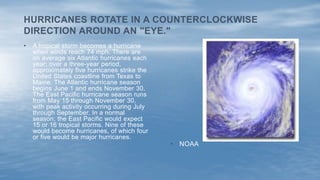
• A tropical storm becomes a hurricane
when winds reach 74 mph. There are
on average six Atlantic hurricanes each
year; over a three-year period,
approximately five hurricanes strike the
United States coastline from Texas to
Maine. The Atlantic hurricane season
begins June 1 and ends November 30.
The East Pacific hurricane season runs
from May 15 through November 30,
with peak activity occurring during July
through September. In a normal
season, the East Pacific would expect
15 or 16 tropical storms. Nine of these
would become hurricanes, of which four
or five would be major hurricanes.
HURRICANES ROTATE IN A COUNTERCLOCKWISE
DIRECTION AROUND AN "EYE."
• NOAA
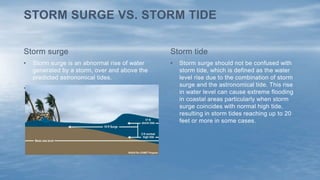
• Storm surge is an abnormal rise of water
generated by a storm, over and above the
predicted astronomical tides.
•
• Storm surge should not be confused with
storm tide, which is defined as the water
level rise due to the combination of storm
surge and the astronomical tide. This rise
in water level can cause extreme flooding
in coastal areas particularly when storm
surge coincides with normal high tide,
resulting in storm tides reaching up to 20
feet or more in some cases.
Storm tideStorm surge
STORM SURGE VS. STORM TIDE
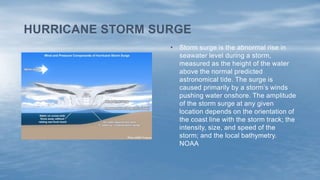
• Storm surge is the abnormal rise in
seawater level during a storm,
measured as the height of the water
above the normal predicted
astronomical tide. The surge is
caused primarily by a storm’s winds
pushing water onshore. The amplitude
of the storm surge at any given
location depends on the orientation of
the coast line with the storm track; the
intensity, size, and speed of the
storm; and the local bathymetry.
NOAA
HURRICANE STORM SURGE
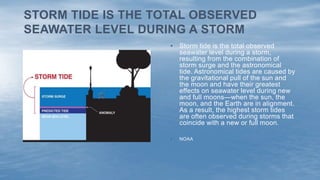
• Storm tide is the total observed
seawater level during a storm,
resulting from the combination of
storm surge and the astronomical
tide. Astronomical tides are caused by
the gravitational pull of the sun and
the moon and have their greatest
effects on seawater level during new
and full moons—when the sun, the
moon, and the Earth are in alignment.
As a result, the highest storm tides
are often observed during storms that
coincide with a new or full moon.
• NOAA
STORM TIDE IS THE TOTAL OBSERVED
SEAWATER LEVEL DURING A STORM
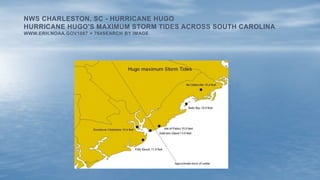
NWS CHARLESTON, SC - HURRICANE HUGO
HURRICANE HUGO'S MAXIMUM STORM TIDES ACROSS SOUTH CAROLINA
WWW.ERH.NOAA.GOV1087 × 764SEARCH BY IMAGE
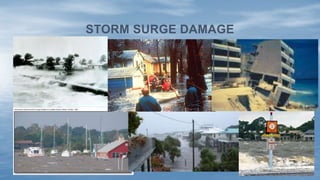
STORM SURGE DAMAGE
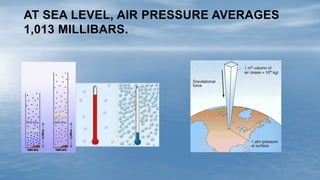
AT SEA LEVEL, AIR PRESSURE AVERAGES
1,013 MILLIBARS.
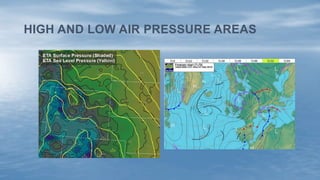
HIGH AND LOW AIR PRESSURE AREAS
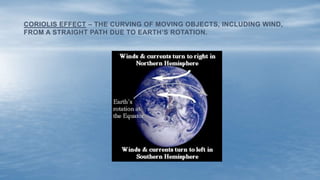
CORIOLIS EFFECT – THE CURVING OF MOVING OBJECTS, INCLUDING WIND,
FROM A STRAIGHT PATH DUE TO EARTH’S ROTATION.
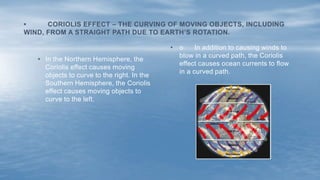
• o In addition to causing winds to
blow in a curved path, the Coriolis
effect causes ocean currents to flow
in a curved path.
• In the Northern Hemisphere, the
Coriolis effect causes moving
objects to curve to the right. In the
Southern Hemisphere, the Coriolis
effect causes moving objects to
curve to the left.
• CORIOLIS EFFECT – THE CURVING OF MOVING OBJECTS, INCLUDING
WIND, FROM A STRAIGHT PATH DUE TO EARTH’S ROTATION.
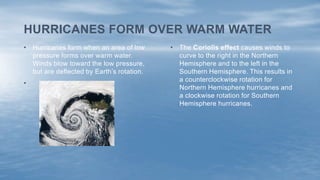
• The Coriolis effect causes winds to
curve to the right in the Northern
Hemisphere and to the left in the
Southern Hemisphere. This results in
a counterclockwise rotation for
Northern Hemisphere hurricanes and
a clockwise rotation for Southern
Hemisphere hurricanes.
• Hurricanes form when an area of low
pressure forms over warm water.
Winds blow toward the low pressure,
but are deflected by Earth’s rotation.
•
HURRICANES FORM OVER WARM WATER
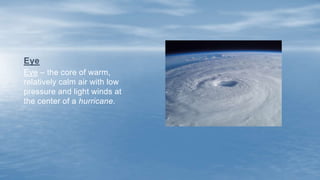
Eye – the core of warm,
relatively calm air with low
pressure and light winds at
the center of a hurricane.
Eye
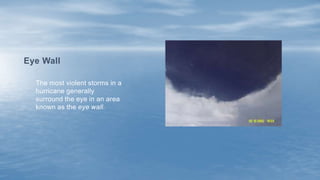
The most violent storms in a
hurricane generally
surround the eye in an area
known as the eye wall.
Eye Wall
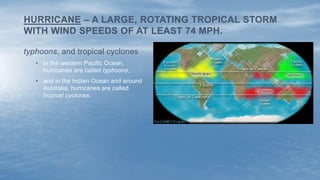
• In the western Pacific Ocean,
hurricanes are called typhoons,
• and in the Indian Ocean and around
Australia, hurricanes are called
tropical cyclones.
typhoons, and tropical cyclones
HURRICANE – A LARGE, ROTATING TROPICAL STORM
WITH WIND SPEEDS OF AT LEAST 74 MPH.
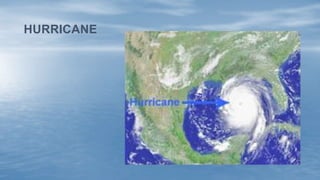
HURRICANE
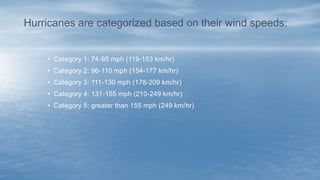
• Category 1: 74-95 mph (119-153 km/hr)
• Category 2: 96-110 mph (154-177 km/hr)
• Category 3: 111-130 mph (178-209 km/hr)
• Category 4: 131-155 mph (210-249 km/hr)
• Category 5: greater than 155 mph (249 km/hr)
Hurricanes are categorized based on their wind speeds:
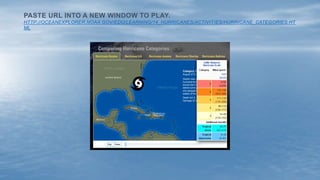
PASTE URL INTO A NEW WINDOW TO PLAY.
HTTP://OCEANEXPLORER.NOAA.GOV/EDU/LEARNING/14_HURRICANES/ACTIVITIES/HURRICANE_CATEGORIES.HT
ML
Category 1: A Minimal Hurricane
Winds: 74-95 mph, 64-83 kts, 119-153 km/h
Minimum surface pressure: higher than 980 mbar
Storm surge: 3-5 ft, 1.0-1.7 m
Damage primarily to shrubbery, trees, foliage, and unanchored homes. No real
damage to other structures. Some damage to poorly constructed signs. Low-lying
coastal roads inundated, minor pier damage, some small craft in exposed anchorage
torn from moorings. Example: Hurricane Jerry (1989).
Category 1: 74-95 mph (119-153 km/hr)
• Category 2: A Moderate Hurricane
• Winds: 96-110 mph, 84-96 kts, 154-177 km/h
• Minimum surface pressure: 979-965 mbar
• Storm surge: 6-8 ft, 1.8-2.6 m
• Considerable damage to shrubbery and tree foliage; some trees blown down. Major
damage to exposed mobile homes. Extensive damage to poorly constructed signs. Some
damage to roofing materials of buildings; some window and door damage. No major
damage to buildings. Coast roads and low-lying escape routes inland cut by rising water 2
to 4 hours before arrival of hurricane center. Considerable damage to piers. Marinas
flooded. Small craft in unprotected anchorages torn from moorings. Evacutation of some
shoreline residences and low-lying areas required. Example: Hurricane Bob (1991).
Category 2: 96-110 mph (154-177 km/hr)
• Category 3: An Extensive Hurricane
• Winds: 111-130 mph, 97-113 kts, 178-209 km/h
• Minimum surface pressure: 964-945 mbar
• Storm surge: 9-12 ft, 2.7-3.8 m
• Foliage torn from trees; large trees blown down. Practically all poorly constructed signs
blown down. Some damage to roofing materials of buildings; some wind and door
damage. Some structural damage to small buildings. Mobile homes destroyed. Serious
flooding at coast and many smaller structures near coast destroyed; larger structures near
coast damaged by battering waves and floating debris. Low-lying escape routes inland cut
by rising water 3 to 5 hours before hurricane center arrives. Flat terrain 5 feet or less
above sea level flooded inland 8 miles or more. Evacuation of lowlying residences within
several blocks of shoreline possibly required. Example: Hurricane Gloria (1985).
Category 3: 111-130 mph (178-209 km/hr)
• Category 4: An Extreme Hurricane
• Winds: 131-155 mph, 114-135 kts, 210-249 km/h
• Minimum surface pressure: 944-920 mbar
• Storm surge: 13-18 ft, 3.9-5.6 m
• Shrubs and trees blown down; all signs down. Extensive damage to roofing materials,
windows, and doors. Complete failure of roofs on many small residences. Complete
destruction of mobile homes. Flat terrain 10 feet or less above sea level flooded inland as
far as 6 miles. Major damage to lower floors of structures near shore due to flooding and
battering by waves and floating debris. Low-lying escape roues inland cut by rising water 3
to 5 hours before hurricane center arrives. Major erosion of beaches. Massive evacuation
of all residences within 500 yards of shore possibly required, and of single story
residences within 2 miles of shore. Example: Hurricane Charley (2004).
Category 4: 131-155 mph (210-249 km/hr)
• Category 5: A Catastrophic Hurricane
• Winds: greater than 155 mph, 135 kts, 249 km/h
• Minimum surface pressure: lower than 920 mbar
• Storm surge: higher than 18 ft, 5.6m
• Shrubs and trees blown down; considerable damage to roofs of buildings; all signs down.
Very severe and extensive damage to windows and doors. Complete failure of roofs on
many reisdences and industrial buildings. Extensive shattering of glass in windows and
doors. Some complete building failures. Small buildings overturned or blown away.
Complete destruction of all structures less than 15 feet above sea level within 500 yards of
shore. Low-lying escape routes inland cut by rising water 3 to 5 hours before hurricane
center arrives. Massive evacuation of residential areas on low ground within 5 to 10 miles
of shore possibly required. Example: Hurricane Camille (1969).
Category 5: greater than 155 mph (249 km/hr)
A nautical mile measures
distance and a knot measures
speed (NOAA)
A nautical mile is based on the
circumference of the earth, and is
equal to one minute of latitude. It
is slightly more than a statute
(land measured) mile (1 nautical
mile = 1.1508 statute miles).
Nautical miles are used for
charting and navigating.
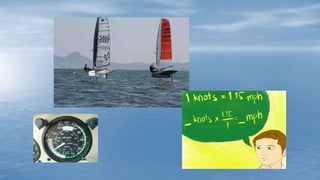
Knot – a unit of speed
equal to 1.151 miles
per hour.
• A knot is one nautical mile per hour (1 knot = 1.15
miles per hour). The term knot dates from the 17th
century, when sailors measured the speed of their
ship by using a device called a "common log." This
device was a coil of rope with uniformly spaced
knots, attached to a piece of wood shaped like a
slice of pie. The piece of wood was lowered from
the back of the ship and allowed to float behind it.
The line was allowed to pay out freely from the coil
as the piece of wood fell behind the ship for a
specific amount of time. When the specified time
had passed, the line was pulled in and the number
of knots on the rope between the ship and the
wood were counted. The speed of the ship was
said to be the number of knots counted (Bowditch,
1984).
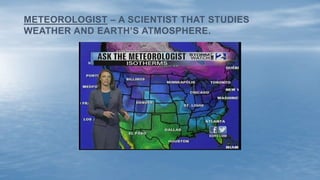
METEOROLOGIST – A SCIENTIST THAT STUDIES
WEATHER AND EARTH’S ATMOSPHERE.
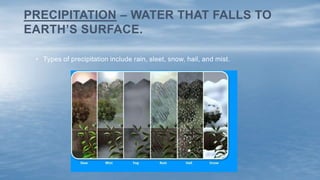
• Types of precipitation include rain, sleet, snow, hail, and mist.
PRECIPITATION – WATER THAT FALLS TO
EARTH’S SURFACE.
• Related Links
• Multimedia Discovery Missions: Lesson 14 - Hurricanes
• Multimedia Discovery Missions: Home
• NOAA Ocean Explorer: Education
RELATED LINKS
• All content and photos from NOAA
THANKS TO NOAA

11.0 hurricanes

  • 1.
    Typhoons, and Cyclones By KellaRandolph M.Ed. HURRICANES
  • 2.
    Air pressure ismeasured in millibars (mb). Air pressure is equal to the weight of a vertical column of air divided by the area of the base of the column. AIR PRESSURE – THE FORCE OF AIR ON A SURFACE.
  • 3.
    • A HURRICANEWARNING issued for your part of the coast indicates that sustained winds of at least 74 mph are expected within 24 hours or less. Once this warning has been issued, your family should be in the process of completing protective actions and deciding the safest location to be during the storm. • A HURRICANE WATCH issued for your part of the coast indicates the possibility that you could experience hurricane conditions within 36 hours. This watch should trigger your family's disaster plan, and protective measures should be initiated, especially those actions that require extra time such as securing a boat, leaving a barrier island, etc. WATCH VS WARNING KNOW THE DIFFERENCE
  • 4.
    • Typhoon —(the Northwest Pacific Ocean west of the dateline) • Severe Tropical Cyclone — (the Southwest Pacific Ocean west of 160E or Southeast Indian Ocean east of 90E) • Severe Cyclonic Storm — (the North Indian Ocean) • Tropical Cyclone — (the Southwest Indian Ocean) • A hurricane is a severe tropical storm that forms in the North Atlantic Ocean, the Northeast Pacific Ocean east of the dateline, or the South Pacific Ocean east of 160E. Hurricanes need warm tropical oceans, moisture and light winds above them. If the right conditions last long enough, a hurricane can produce violent winds, incredible waves, torrential rains and floods. In other regions of the world, these types of storms have different names.
  • 5.
    • A tropicalstorm becomes a hurricane when winds reach 74 mph. There are on average six Atlantic hurricanes each year; over a three-year period, approximately five hurricanes strike the United States coastline from Texas to Maine. The Atlantic hurricane season begins June 1 and ends November 30. The East Pacific hurricane season runs from May 15 through November 30, with peak activity occurring during July through September. In a normal season, the East Pacific would expect 15 or 16 tropical storms. Nine of these would become hurricanes, of which four or five would be major hurricanes. HURRICANES ROTATE IN A COUNTERCLOCKWISE DIRECTION AROUND AN "EYE." • NOAA
  • 6.
    • Storm surgeis an abnormal rise of water generated by a storm, over and above the predicted astronomical tides. • • Storm surge should not be confused with storm tide, which is defined as the water level rise due to the combination of storm surge and the astronomical tide. This rise in water level can cause extreme flooding in coastal areas particularly when storm surge coincides with normal high tide, resulting in storm tides reaching up to 20 feet or more in some cases. Storm tideStorm surge STORM SURGE VS. STORM TIDE
  • 7.
    • Storm surgeis the abnormal rise in seawater level during a storm, measured as the height of the water above the normal predicted astronomical tide. The surge is caused primarily by a storm’s winds pushing water onshore. The amplitude of the storm surge at any given location depends on the orientation of the coast line with the storm track; the intensity, size, and speed of the storm; and the local bathymetry. NOAA HURRICANE STORM SURGE
  • 8.
    • Storm tideis the total observed seawater level during a storm, resulting from the combination of storm surge and the astronomical tide. Astronomical tides are caused by the gravitational pull of the sun and the moon and have their greatest effects on seawater level during new and full moons—when the sun, the moon, and the Earth are in alignment. As a result, the highest storm tides are often observed during storms that coincide with a new or full moon. • NOAA STORM TIDE IS THE TOTAL OBSERVED SEAWATER LEVEL DURING A STORM
  • 9.
    NWS CHARLESTON, SC- HURRICANE HUGO HURRICANE HUGO'S MAXIMUM STORM TIDES ACROSS SOUTH CAROLINA WWW.ERH.NOAA.GOV1087 × 764SEARCH BY IMAGE
  • 10.
  • 11.
    AT SEA LEVEL,AIR PRESSURE AVERAGES 1,013 MILLIBARS.
  • 12.
    HIGH AND LOWAIR PRESSURE AREAS
  • 14.
    CORIOLIS EFFECT –THE CURVING OF MOVING OBJECTS, INCLUDING WIND, FROM A STRAIGHT PATH DUE TO EARTH’S ROTATION.
  • 15.
    • o Inaddition to causing winds to blow in a curved path, the Coriolis effect causes ocean currents to flow in a curved path. • In the Northern Hemisphere, the Coriolis effect causes moving objects to curve to the right. In the Southern Hemisphere, the Coriolis effect causes moving objects to curve to the left. • CORIOLIS EFFECT – THE CURVING OF MOVING OBJECTS, INCLUDING WIND, FROM A STRAIGHT PATH DUE TO EARTH’S ROTATION.
  • 16.
    • The Corioliseffect causes winds to curve to the right in the Northern Hemisphere and to the left in the Southern Hemisphere. This results in a counterclockwise rotation for Northern Hemisphere hurricanes and a clockwise rotation for Southern Hemisphere hurricanes. • Hurricanes form when an area of low pressure forms over warm water. Winds blow toward the low pressure, but are deflected by Earth’s rotation. • HURRICANES FORM OVER WARM WATER
  • 17.
    Eye – thecore of warm, relatively calm air with low pressure and light winds at the center of a hurricane. Eye
  • 18.
    The most violentstorms in a hurricane generally surround the eye in an area known as the eye wall. Eye Wall
  • 19.
    • In thewestern Pacific Ocean, hurricanes are called typhoons, • and in the Indian Ocean and around Australia, hurricanes are called tropical cyclones. typhoons, and tropical cyclones HURRICANE – A LARGE, ROTATING TROPICAL STORM WITH WIND SPEEDS OF AT LEAST 74 MPH.
  • 20.
  • 21.
    • Category 1:74-95 mph (119-153 km/hr) • Category 2: 96-110 mph (154-177 km/hr) • Category 3: 111-130 mph (178-209 km/hr) • Category 4: 131-155 mph (210-249 km/hr) • Category 5: greater than 155 mph (249 km/hr) Hurricanes are categorized based on their wind speeds:
  • 22.
    PASTE URL INTOA NEW WINDOW TO PLAY. HTTP://OCEANEXPLORER.NOAA.GOV/EDU/LEARNING/14_HURRICANES/ACTIVITIES/HURRICANE_CATEGORIES.HT ML
  • 23.
    Category 1: AMinimal Hurricane Winds: 74-95 mph, 64-83 kts, 119-153 km/h Minimum surface pressure: higher than 980 mbar Storm surge: 3-5 ft, 1.0-1.7 m Damage primarily to shrubbery, trees, foliage, and unanchored homes. No real damage to other structures. Some damage to poorly constructed signs. Low-lying coastal roads inundated, minor pier damage, some small craft in exposed anchorage torn from moorings. Example: Hurricane Jerry (1989). Category 1: 74-95 mph (119-153 km/hr)
  • 24.
    • Category 2:A Moderate Hurricane • Winds: 96-110 mph, 84-96 kts, 154-177 km/h • Minimum surface pressure: 979-965 mbar • Storm surge: 6-8 ft, 1.8-2.6 m • Considerable damage to shrubbery and tree foliage; some trees blown down. Major damage to exposed mobile homes. Extensive damage to poorly constructed signs. Some damage to roofing materials of buildings; some window and door damage. No major damage to buildings. Coast roads and low-lying escape routes inland cut by rising water 2 to 4 hours before arrival of hurricane center. Considerable damage to piers. Marinas flooded. Small craft in unprotected anchorages torn from moorings. Evacutation of some shoreline residences and low-lying areas required. Example: Hurricane Bob (1991). Category 2: 96-110 mph (154-177 km/hr)
  • 25.
    • Category 3:An Extensive Hurricane • Winds: 111-130 mph, 97-113 kts, 178-209 km/h • Minimum surface pressure: 964-945 mbar • Storm surge: 9-12 ft, 2.7-3.8 m • Foliage torn from trees; large trees blown down. Practically all poorly constructed signs blown down. Some damage to roofing materials of buildings; some wind and door damage. Some structural damage to small buildings. Mobile homes destroyed. Serious flooding at coast and many smaller structures near coast destroyed; larger structures near coast damaged by battering waves and floating debris. Low-lying escape routes inland cut by rising water 3 to 5 hours before hurricane center arrives. Flat terrain 5 feet or less above sea level flooded inland 8 miles or more. Evacuation of lowlying residences within several blocks of shoreline possibly required. Example: Hurricane Gloria (1985). Category 3: 111-130 mph (178-209 km/hr)
  • 26.
    • Category 4:An Extreme Hurricane • Winds: 131-155 mph, 114-135 kts, 210-249 km/h • Minimum surface pressure: 944-920 mbar • Storm surge: 13-18 ft, 3.9-5.6 m • Shrubs and trees blown down; all signs down. Extensive damage to roofing materials, windows, and doors. Complete failure of roofs on many small residences. Complete destruction of mobile homes. Flat terrain 10 feet or less above sea level flooded inland as far as 6 miles. Major damage to lower floors of structures near shore due to flooding and battering by waves and floating debris. Low-lying escape roues inland cut by rising water 3 to 5 hours before hurricane center arrives. Major erosion of beaches. Massive evacuation of all residences within 500 yards of shore possibly required, and of single story residences within 2 miles of shore. Example: Hurricane Charley (2004). Category 4: 131-155 mph (210-249 km/hr)
  • 27.
    • Category 5:A Catastrophic Hurricane • Winds: greater than 155 mph, 135 kts, 249 km/h • Minimum surface pressure: lower than 920 mbar • Storm surge: higher than 18 ft, 5.6m • Shrubs and trees blown down; considerable damage to roofs of buildings; all signs down. Very severe and extensive damage to windows and doors. Complete failure of roofs on many reisdences and industrial buildings. Extensive shattering of glass in windows and doors. Some complete building failures. Small buildings overturned or blown away. Complete destruction of all structures less than 15 feet above sea level within 500 yards of shore. Low-lying escape routes inland cut by rising water 3 to 5 hours before hurricane center arrives. Massive evacuation of residential areas on low ground within 5 to 10 miles of shore possibly required. Example: Hurricane Camille (1969). Category 5: greater than 155 mph (249 km/hr)
  • 28.
    A nautical milemeasures distance and a knot measures speed (NOAA) A nautical mile is based on the circumference of the earth, and is equal to one minute of latitude. It is slightly more than a statute (land measured) mile (1 nautical mile = 1.1508 statute miles). Nautical miles are used for charting and navigating. Knot – a unit of speed equal to 1.151 miles per hour. • A knot is one nautical mile per hour (1 knot = 1.15 miles per hour). The term knot dates from the 17th century, when sailors measured the speed of their ship by using a device called a "common log." This device was a coil of rope with uniformly spaced knots, attached to a piece of wood shaped like a slice of pie. The piece of wood was lowered from the back of the ship and allowed to float behind it. The line was allowed to pay out freely from the coil as the piece of wood fell behind the ship for a specific amount of time. When the specified time had passed, the line was pulled in and the number of knots on the rope between the ship and the wood were counted. The speed of the ship was said to be the number of knots counted (Bowditch, 1984).
  • 30.
    METEOROLOGIST – ASCIENTIST THAT STUDIES WEATHER AND EARTH’S ATMOSPHERE.
  • 31.
    • Types ofprecipitation include rain, sleet, snow, hail, and mist. PRECIPITATION – WATER THAT FALLS TO EARTH’S SURFACE.
  • 32.
    • Related Links •Multimedia Discovery Missions: Lesson 14 - Hurricanes • Multimedia Discovery Missions: Home • NOAA Ocean Explorer: Education RELATED LINKS
  • 33.
    • All contentand photos from NOAA THANKS TO NOAA