TYPHOONS 
A typhoon refers to a tropical cyclone that 
originates in the China Sea. They have steep 
pressure gradient and are most frequent 
between July and October.
The same storm may be 
considered a typhoon in one 
region of the ocean and a 
hurricane in another region. In the 
Northern Hemisphere it rotates in 
anticlockwise direction and in 
clockwise direction in the Southern 
Hemisphere.
A typhoon usually follows three different 
directions: straight, recurving and northward. A 
straight path is defined as a westward path; the 
storm will head toward the Philippines, the south 
of China, Taiwan and Vietnam. A storm that 
follows a recurving path will head towards the 
east of China, Taiwan, Korea and Japan. A 
northward path occurs when the storm simply 
heads north of its point of origin. This will affect 
small islands throughout the Pacific Ocean.
(a)The surface winds blow inward in a counter clockwise direction toward 
the center. 
(b)The tropical cyclone may show no cooling, or very little, toward the 
storm center. 
(c) In mature tropical cyclones, almost all the cloud forms are present, but 
by and large the most significant clouds are the heavy cumulus and 
cumulonimbus which spiral inward toward the outer edge of the eye. 
tropical cyclone may show no cooling, or very little, toward the storm 
center. 
(d) The eye’s diameter averages about 15 miles, but it may attain 40 miles in 
large typhoons. The eye is constantly undergoing transformation and does 
not stay in a steady state. 
(e) The winds of a tropical cyclone produce wind waves which move 
outward from its center. 
(f)There will be high precipitation
Classification 
Internationally if any storm is having a speed of more than 
65 knots is called a typhoon. 
(a)Typhoon-----118-149km/hr 
(b)Severe typhoon ----150-184km/hr 
(c)Super typhoon------185km/hr or above. 
Saffir Simpson Hurricane Wind Scale gives 6 categories. 
Category 6 ----156 knots 
Category 5 ---- 137knots 
Category 4 ----113-136knots 
Category 3 ---- 96-112knots 
Category 2 ----83-95knots 
Category 1 ----64-82knots
Formation 
Tropical cyclones form only over warm ocean waters near the equator. 
To form a cyclone, warm,moist air over the ocean rises upward from 
near the surface. As this air moves up and away from the ocean surface, 
it leaves less air near the surface. So basically as the warm air rises, it 
causes an area of low air pressure below. Air from surrounding areas 
with higher pressure pushes in to the low pressure area. Then this new 
cool air becomes warm and moist and rises, too. And the cyclone 
continues. As the warmed, moist air rises and cools the water in the air 
forms clouds and wind spins and grows, fed by the ocean’s heat and 
water evaporates from the ocean surface. As the storm system rotates 
faster and faster, a eye forms in the centre. It is very calm and clear in 
the eye, with very low air pressure. Higher pressure air from above flows 
down into eyes.
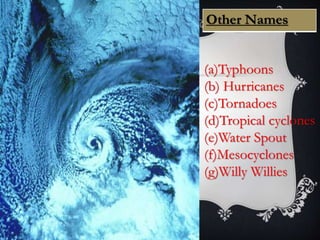
Other Names 
(a)Typhoons 
(b) Hurricanes 
(c)Tornadoes 
(d)Tropical cyclones 
(e)Water Spout 
(f)Mesocyclones 
(g)Willy Willies
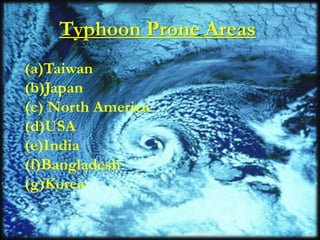
Typhoon Prone Areas 
(a)Taiwan 
(b)Japan 
(c) North America 
(d)USA 
(e)India 
(f)Bangladesh 
(g)Korea
Historic Typhoons 
(a)Typhoon Nancy in 1961, Northwest Pacific 
Ocean 
(b)Bhola Cyclone in 1970, Bangladesh. 
(c)Typhoon Nina in 1975, China. 
(d)Hurricane Katrina in 2005, United States. 
(e)Cyclone Yasi in 2011, Australia.
Effects 
Cyclone create several dangers for people around tropical 
areas . The most destructive force of a cyclone comes 
from the fierce winds. 
(a)These winds easily topple fences, sheds, trees, power 
poles and caravans, while hurling helpless people through 
the air. 
(b)Many people are killed when the cyclone winds cause 
buildings to collapse and houses to completely blow away . 
(c)It causes high rainfall which leads to flooding and 
landslides.
Forecast of Typhoons 
Satellite and radar technology is used for 
forecasting the typhoons. Surface charts are 
analysed on hourly basis to provide information 
on position, direction and intensity. The science 
of tropical cyclone forecasting is by no means 
perfect. The volatile nature of tropical cyclones, 
with their inherent fluctuation in both motion 
and intensity, is also partly to blame for this.
Disaster Management 
Typhoon is a natural disaster so it is difficult to prevent it 
but we can reduce the scale of destruction by taking 
certain precautions. 
If we decide to take shelter at home: 
•Turn off all electricity, gas and water and unplug all 
appliances 
•Keep your Emergency Kit close at hand 
•Bring your family into the strongest part of the house 
•Keep listening to the radio for cyclone updates and 
remain indoors until advised. 
We must stay inside unless it is officially declared safe to 
go outside.
The time immediately after a cyclone is often just as 
dangerous as the initial event itself. Once we have been 
advised that the typhoon has passed, we must adhere to 
the following: 
•Listen to our radio and remain indoors until advised. 
•If we are told to return to our home, we must do so 
using the recommended routes only. 
•We should not use electrical appliances which have been 
wet until they are checked for safety.
Typhoon
Typhoon

Typhoon

  • 2.
    TYPHOONS A typhoonrefers to a tropical cyclone that originates in the China Sea. They have steep pressure gradient and are most frequent between July and October.
  • 3.
    The same stormmay be considered a typhoon in one region of the ocean and a hurricane in another region. In the Northern Hemisphere it rotates in anticlockwise direction and in clockwise direction in the Southern Hemisphere.
  • 4.
    A typhoon usuallyfollows three different directions: straight, recurving and northward. A straight path is defined as a westward path; the storm will head toward the Philippines, the south of China, Taiwan and Vietnam. A storm that follows a recurving path will head towards the east of China, Taiwan, Korea and Japan. A northward path occurs when the storm simply heads north of its point of origin. This will affect small islands throughout the Pacific Ocean.
  • 5.
    (a)The surface windsblow inward in a counter clockwise direction toward the center. (b)The tropical cyclone may show no cooling, or very little, toward the storm center. (c) In mature tropical cyclones, almost all the cloud forms are present, but by and large the most significant clouds are the heavy cumulus and cumulonimbus which spiral inward toward the outer edge of the eye. tropical cyclone may show no cooling, or very little, toward the storm center. (d) The eye’s diameter averages about 15 miles, but it may attain 40 miles in large typhoons. The eye is constantly undergoing transformation and does not stay in a steady state. (e) The winds of a tropical cyclone produce wind waves which move outward from its center. (f)There will be high precipitation
  • 6.
    Classification Internationally ifany storm is having a speed of more than 65 knots is called a typhoon. (a)Typhoon-----118-149km/hr (b)Severe typhoon ----150-184km/hr (c)Super typhoon------185km/hr or above. Saffir Simpson Hurricane Wind Scale gives 6 categories. Category 6 ----156 knots Category 5 ---- 137knots Category 4 ----113-136knots Category 3 ---- 96-112knots Category 2 ----83-95knots Category 1 ----64-82knots
  • 7.
    Formation Tropical cyclonesform only over warm ocean waters near the equator. To form a cyclone, warm,moist air over the ocean rises upward from near the surface. As this air moves up and away from the ocean surface, it leaves less air near the surface. So basically as the warm air rises, it causes an area of low air pressure below. Air from surrounding areas with higher pressure pushes in to the low pressure area. Then this new cool air becomes warm and moist and rises, too. And the cyclone continues. As the warmed, moist air rises and cools the water in the air forms clouds and wind spins and grows, fed by the ocean’s heat and water evaporates from the ocean surface. As the storm system rotates faster and faster, a eye forms in the centre. It is very calm and clear in the eye, with very low air pressure. Higher pressure air from above flows down into eyes.
  • 9.
    Other Names (a)Typhoons (b) Hurricanes (c)Tornadoes (d)Tropical cyclones (e)Water Spout (f)Mesocyclones (g)Willy Willies
  • 11.
    Typhoon Prone Areas (a)Taiwan (b)Japan (c) North America (d)USA (e)India (f)Bangladesh (g)Korea
  • 12.
    Historic Typhoons (a)TyphoonNancy in 1961, Northwest Pacific Ocean (b)Bhola Cyclone in 1970, Bangladesh. (c)Typhoon Nina in 1975, China. (d)Hurricane Katrina in 2005, United States. (e)Cyclone Yasi in 2011, Australia.
  • 13.
    Effects Cyclone createseveral dangers for people around tropical areas . The most destructive force of a cyclone comes from the fierce winds. (a)These winds easily topple fences, sheds, trees, power poles and caravans, while hurling helpless people through the air. (b)Many people are killed when the cyclone winds cause buildings to collapse and houses to completely blow away . (c)It causes high rainfall which leads to flooding and landslides.
  • 14.
    Forecast of Typhoons Satellite and radar technology is used for forecasting the typhoons. Surface charts are analysed on hourly basis to provide information on position, direction and intensity. The science of tropical cyclone forecasting is by no means perfect. The volatile nature of tropical cyclones, with their inherent fluctuation in both motion and intensity, is also partly to blame for this.
  • 15.
    Disaster Management Typhoonis a natural disaster so it is difficult to prevent it but we can reduce the scale of destruction by taking certain precautions. If we decide to take shelter at home: •Turn off all electricity, gas and water and unplug all appliances •Keep your Emergency Kit close at hand •Bring your family into the strongest part of the house •Keep listening to the radio for cyclone updates and remain indoors until advised. We must stay inside unless it is officially declared safe to go outside.
  • 16.
    The time immediatelyafter a cyclone is often just as dangerous as the initial event itself. Once we have been advised that the typhoon has passed, we must adhere to the following: •Listen to our radio and remain indoors until advised. •If we are told to return to our home, we must do so using the recommended routes only. •We should not use electrical appliances which have been wet until they are checked for safety.