
TORNADO 
THE DEVIL 
STORM 
A Short Research made by Shriya 
Mohanty
What is Tornado? 
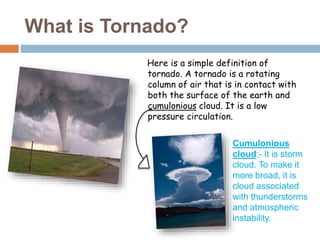
Here is a simple definition of 
tornado. A tornado is a rotating 
column of air that is in contact with 
both the surface of the earth and 
cumulonious cloud. It is a low 
pressure circulation. 
Cumulonious 
cloud:- It is storm 
cloud. To make it 
more broad, it is 
cloud associated 
with thunderstorms 
and atmospheric 
instability.
Cause of Tornado 
Factors causing a Tornado are : 
(1) Instability in weather: It refers to unusually warm 
and humid conditions in the lower atmosphere, and 
possibly cooler than usual conditions in the upper 
atmosphere. 
(2) Wind Shear: It refers to the wind direction 
changing, and the wind speed increasing, with 
height. 
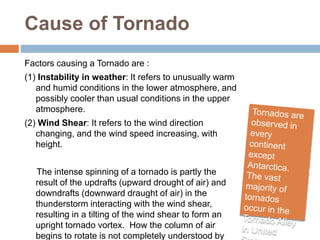
The intense spinning of a tornado is partly the 
result of the updrafts (upward drought of air) and 
downdrafts (downward draught of air) in the 
thunderstorm interacting with the wind shear, 
resulting in a tilting of the wind shear to form an 
upright tornado vortex. How the column of air 
begins to rotate is not completely understood by
The Information… 
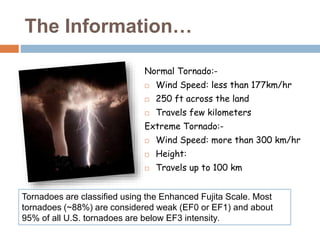
Normal Tornado:- 
 Wind Speed: less than 177km/hr 
 250 ft across the land 
 Travels few kilometers 
Extreme Tornado:- 
 Wind Speed: more than 300 km/hr 
 Height: 
 Travels up to 100 km 
Tornadoes are classified using the Enhanced Fujita Scale. Most 
tornadoes (~88%) are considered weak (EF0 or EF1) and about 
95% of all U.S. tornadoes are below EF3 intensity.
Disaster caused by Tornado: 
 Tornados can cause rapid 
destruction of homes and 
property, as well as injury 
and death to humans and 
animals. 
 As nicknamed the devil 
storm, it is responsible for 
the loss of many lives. 
In the United States, on average, 1000 
tornadoes are reported nationwide each year, 
resulting in 70 deaths and over 1,500 injuries. 
They occur most frequently east of the Rocky 
Mountains during the spring and summer 
months. Tornado Alley is a nickname given to an 
area in the southern plains of the central U.S. 
that consistently experiences a high frequency 
of tornadoes each year.
Precautions: 
 Gather information. 
Read the complete at: 
http://www.mnn.com/family/protection-safety/ 
 Know the warning signals of your area. 
 Obtain insurance for your family and home. 
stories/safety-precautions-for-tornadoes 
 Choose a post hazard meeting place for your family, neighbors. 
 Make a family communication plan. 
 Share this information with your family, neighbors. 
 In a public building such as a store or office, go to a designated shelter 
area such as a safe room, basement, storm cellar, or the lowest building 
level. 
 If there is no basement, go to the center of an interior room such as a 
bathroom or closet on the lowest level away from corners, windows, 
doors and outside walls. 
 At home, go to a basement or the most interior room on the first floor. 
 If caught in the open, lie flat in a nearby ditch or depression and cover 
your head with your hands to protect yourself from flying debris. Flying 
debris from tornadoes causes most fatalities and injuries. 
 Be alert to hazards created by tornado damage such gas leaks, broken 
glass and exposed electrical wires. Check for injuries, but don’t try to 
move someone who is seriously injured unless they are in immediate 
danger of death or further injury.
Disastrous 
Tornadoes of the 
World…
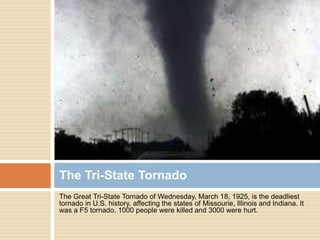
The Tri-State Tornado 
The Great Tri-State Tornado of Wednesday, March 18, 1925, is the deadliest 
tornado in U.S. history, affecting the states of Missourie, Illinois and Indiana. It 
was a F5 tornado. 1000 people were killed and 3000 were hurt.
Daulatpur-Saturia Tornado, Bangladesh 
he Daulatpur–Saturia, Bangladesh tornado was an extremely 
destructive tornado that occurred in the Manikganj District, Bangladesh on April 
26, 1989. It was the costliest and deadliest tornado in Bangladesh's history. 
There is great uncertainty about the death toll, but estimates indicate that it 
killed around 1,300 people, which would make it the deadliest tornado in the 
world history.
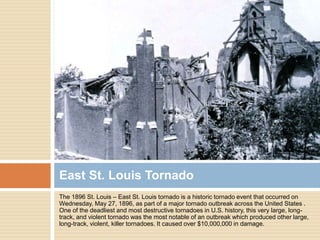
East St. Louis Tornado 
The 1896 St. Louis – East St. Louis tornado is a historic tornado event that occurred on 
Wednesday, May 27, 1896, as part of a major tornado outbreak across the United States . 
One of the deadliest and most destructive tornadoes in U.S. history, this very large, long-track, 
and violent tornado was the most notable of an outbreak which produced other large, 
long-track, violent, killer tornadoes. It caused over $10,000,000 in damage.
1936 Tupelo–Gainesville tornado 
outbreak 
The 1936 Tupelo–Gainesville tornado outbreak was an outbreak of at 
least 12 tornadoes that struck the Southeastern United States from April 
5–6, 1936. Approximately 454 people were killed by these tornadoes— 
419 by two tornadoes alone. This outbreak is the second deadliest ever 
recorded in US history
Oklahoma Tornado 
The 2013 Moore tornado was an F5 tornado that struck Moore, Oklahoma 
and adjacent areas on the afternoon of May 20, 2013; with peak winds 
estimated at 210 mph (340 km/h), killing 24 people and injuring 377 others.
I hope everyone takes necessary 
precautions during tornado or any other 
natural disaster so that they may stay 
safe. 
THANK YOU ! 
THE END.

Tornado

  • 1.
    TORNADO THE DEVIL STORM A Short Research made by Shriya Mohanty
  • 2.
    What is Tornado? Here is a simple definition of tornado. A tornado is a rotating column of air that is in contact with both the surface of the earth and cumulonious cloud. It is a low pressure circulation. Cumulonious cloud:- It is storm cloud. To make it more broad, it is cloud associated with thunderstorms and atmospheric instability.
  • 3.
    Cause of Tornado Factors causing a Tornado are : (1) Instability in weather: It refers to unusually warm and humid conditions in the lower atmosphere, and possibly cooler than usual conditions in the upper atmosphere. (2) Wind Shear: It refers to the wind direction changing, and the wind speed increasing, with height. The intense spinning of a tornado is partly the result of the updrafts (upward drought of air) and downdrafts (downward draught of air) in the thunderstorm interacting with the wind shear, resulting in a tilting of the wind shear to form an upright tornado vortex. How the column of air begins to rotate is not completely understood by
  • 4.
    The Information… NormalTornado:-  Wind Speed: less than 177km/hr  250 ft across the land  Travels few kilometers Extreme Tornado:-  Wind Speed: more than 300 km/hr  Height:  Travels up to 100 km Tornadoes are classified using the Enhanced Fujita Scale. Most tornadoes (~88%) are considered weak (EF0 or EF1) and about 95% of all U.S. tornadoes are below EF3 intensity.
  • 5.
    Disaster caused byTornado:  Tornados can cause rapid destruction of homes and property, as well as injury and death to humans and animals.  As nicknamed the devil storm, it is responsible for the loss of many lives. In the United States, on average, 1000 tornadoes are reported nationwide each year, resulting in 70 deaths and over 1,500 injuries. They occur most frequently east of the Rocky Mountains during the spring and summer months. Tornado Alley is a nickname given to an area in the southern plains of the central U.S. that consistently experiences a high frequency of tornadoes each year.
  • 6.
    Precautions:  Gatherinformation. Read the complete at: http://www.mnn.com/family/protection-safety/  Know the warning signals of your area.  Obtain insurance for your family and home. stories/safety-precautions-for-tornadoes  Choose a post hazard meeting place for your family, neighbors.  Make a family communication plan.  Share this information with your family, neighbors.  In a public building such as a store or office, go to a designated shelter area such as a safe room, basement, storm cellar, or the lowest building level.  If there is no basement, go to the center of an interior room such as a bathroom or closet on the lowest level away from corners, windows, doors and outside walls.  At home, go to a basement or the most interior room on the first floor.  If caught in the open, lie flat in a nearby ditch or depression and cover your head with your hands to protect yourself from flying debris. Flying debris from tornadoes causes most fatalities and injuries.  Be alert to hazards created by tornado damage such gas leaks, broken glass and exposed electrical wires. Check for injuries, but don’t try to move someone who is seriously injured unless they are in immediate danger of death or further injury.
  • 7.
  • 8.
    The Tri-State Tornado The Great Tri-State Tornado of Wednesday, March 18, 1925, is the deadliest tornado in U.S. history, affecting the states of Missourie, Illinois and Indiana. It was a F5 tornado. 1000 people were killed and 3000 were hurt.
  • 9.
    Daulatpur-Saturia Tornado, Bangladesh he Daulatpur–Saturia, Bangladesh tornado was an extremely destructive tornado that occurred in the Manikganj District, Bangladesh on April 26, 1989. It was the costliest and deadliest tornado in Bangladesh's history. There is great uncertainty about the death toll, but estimates indicate that it killed around 1,300 people, which would make it the deadliest tornado in the world history.
  • 10.
    East St. LouisTornado The 1896 St. Louis – East St. Louis tornado is a historic tornado event that occurred on Wednesday, May 27, 1896, as part of a major tornado outbreak across the United States . One of the deadliest and most destructive tornadoes in U.S. history, this very large, long-track, and violent tornado was the most notable of an outbreak which produced other large, long-track, violent, killer tornadoes. It caused over $10,000,000 in damage.
  • 11.
    1936 Tupelo–Gainesville tornado outbreak The 1936 Tupelo–Gainesville tornado outbreak was an outbreak of at least 12 tornadoes that struck the Southeastern United States from April 5–6, 1936. Approximately 454 people were killed by these tornadoes— 419 by two tornadoes alone. This outbreak is the second deadliest ever recorded in US history
  • 12.
    Oklahoma Tornado The2013 Moore tornado was an F5 tornado that struck Moore, Oklahoma and adjacent areas on the afternoon of May 20, 2013; with peak winds estimated at 210 mph (340 km/h), killing 24 people and injuring 377 others.
  • 13.
    I hope everyonetakes necessary precautions during tornado or any other natural disaster so that they may stay safe. THANK YOU ! THE END.