Hurricane Preparation Guidelines
for International Students

By: Inthira Pandey


 What?   When?   Why?   How?   Contact   Sources
What?   When?   Why?   How?   Contact    Sources


What is Hurricane?
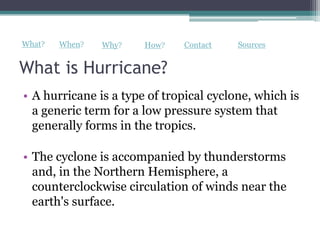
• A hurricane is a type of tropical cyclone, which is
  a generic term for a low pressure system that
  generally forms in the tropics.

• The cyclone is accompanied by thunderstorms
  and, in the Northern Hemisphere, a
  counterclockwise circulation of winds near the
  earth's surface.
What?       When?          Why?         How?        Contact   Sources


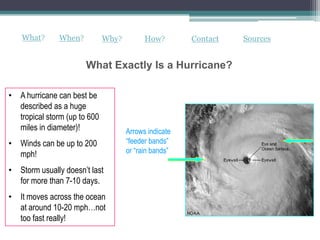
                       What Exactly Is a Hurricane?

• A hurricane can best be
  described as a huge
  tropical storm (up to 600
  miles in diameter)!                Arrows indicate
• Winds can be up to 200             “feeder bands”
  mph!                               or “rain bands”

• Storm usually doesn’t last
  for more than 7-10 days.
• It moves across the ocean
  at around 10-20 mph…not
  too fast really!
What?    When?     Why?     How?       Contact       Sources


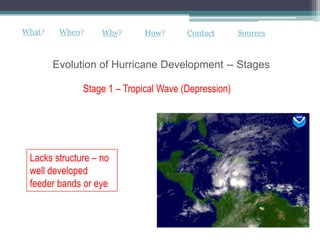
        Evolution of Hurricane Development -- Stages

              Stage 1 – Tropical Wave (Depression)


 Lacks structure – no
 well developed
 feeder bands or eye
What?     When?      Why?      How?       Contact   Sources


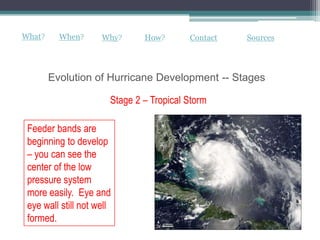
        Evolution of Hurricane Development -- Stages

                       Stage 2 – Tropical Storm

 Feeder bands are
 beginning to develop
 – you can see the
 center of the low
 pressure system
 more easily. Eye and
 eye wall still not well
 formed.
What?   When?      Why?      How?      Contact     Sources


    Evolution of Hurricane Development -- Stages
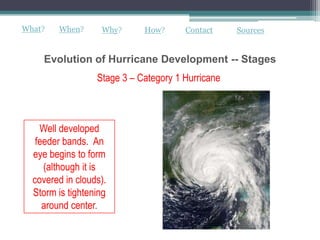
                  Stage 3 – Category 1 Hurricane


    Well developed
   feeder bands. An
  eye begins to form
     (although it is
  covered in clouds).
  Storm is tightening
     around center.
What?   When?      Why?     How?      Contact     Sources


    Evolution of Hurricane Development -- Stages
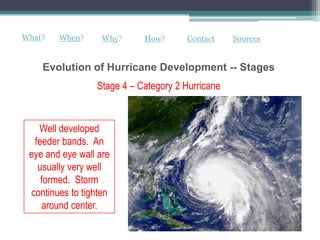
                 Stage 4 – Category 2 Hurricane


   Well developed
  feeder bands. An
 eye and eye wall are
   usually very well
    formed. Storm
 continues to tighten
    around center.
What?   When?      Why?      How?      Contact    Sources


    Evolution of Hurricane Development -- Stages
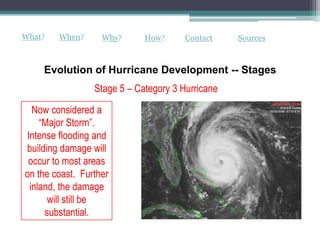
                 Stage 5 – Category 3 Hurricane

  Now considered a
    “Major Storm”.
Intense flooding and
building damage will
 occur to most areas
on the coast. Further
 inland, the damage
      will still be
     substantial.
What?      When?           Why?   How?   Contact   Sources


        Evolution of Hurricane Development -- Stages
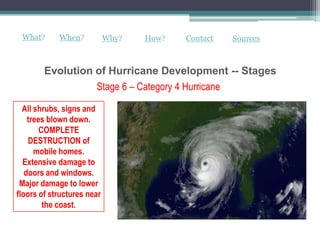
                  Stage 6 – Category 4 Hurricane

  All shrubs, signs and
    trees blown down.
        COMPLETE
    DESTRUCTION of
      mobile homes.
  Extensive damage to
   doors and windows.
 Major damage to lower
floors of structures near
         the coast.
What?      When?          Why?   How?   Contact   Sources


         Evolution of Hurricane Development -- Stages
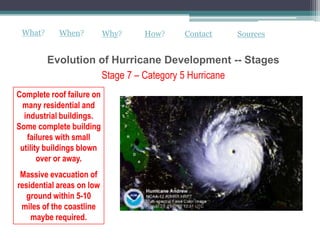
                   Stage 7 – Category 5 Hurricane
Complete roof failure on
 many residential and
  industrial buildings.
Some complete building
   failures with small
 utility buildings blown
       over or away.
 Massive evacuation of
residential areas on low
  ground within 5-10
 miles of the coastline
    maybe required.
What?     When?      Why?      How?      Contact    Sources

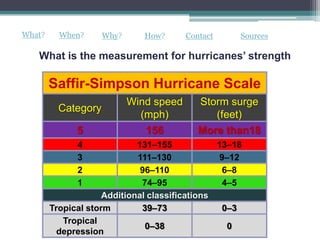
   What is the measurement for hurricanes’ strength

        Saffir-Simpson Hurricane Scale
                            Wind speed      Storm surge
          Category
                              (mph)            (feet)
              5                156          More than18
              4              131–155            13–18
              3              111–130             9–12
              2               96–110             6–8
              1               74–95              4–5
                     Additional classifications
        Tropical storm        39–73              0–3
           Tropical
                               0–38               0
          depression
What?   When?   Why?     How?       Contact   Sources


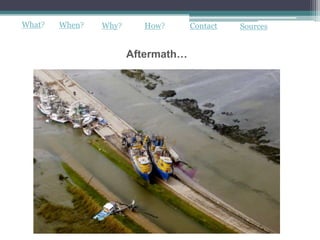
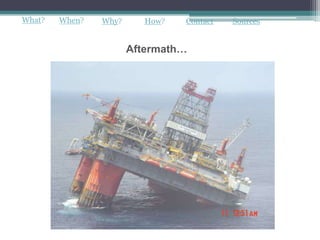
                       Aftermath…
What?   When?   Why?      How?   Contact   Sources

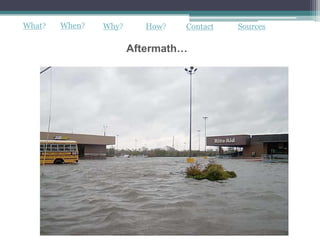
                       Aftermath…
What?   When?   Why?      How?   Contact   Sources


                       Aftermath…
What?   When?       Why?          How?     Contact   Sources


Quiz
What is a hurricane?

  A) A severe thunderstorm with wind


  B) A wind storm with a funnel


  C) A storm with wind of 75 mph or more
What?    When?   Why?   How?   Contact   Sources


Quiz
At which category is the wind speed higher than
130 mph?
 A) Category 1


 B) Category 2


 C) Category 4
What?   When?   Why?   How?   Contact   Sources


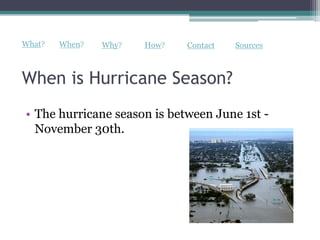
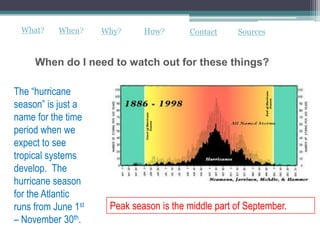
When is Hurricane Season?
• The hurricane season is between June 1st -
  November 30th.
What?     When?     Why?     How?       Contact     Sources


     When do I need to watch out for these things?

The “hurricane
season” is just a
name for the time
period when we
expect to see
tropical systems
develop. The
hurricane season
for the Atlantic
runs from June 1st    Peak season is the middle part of September.
– November 30th.
What?   When?   Why?   How?    Contact   Sources


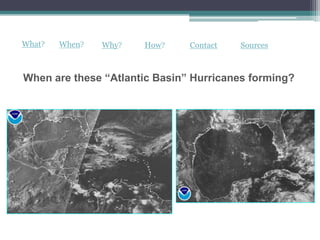
When are these “Atlantic Basin” Hurricanes forming?
What?   When?          Why?   How?   Contact   Sources


Quiz
When is the hurricane season?

  A) January till March


  B) May till August


  C) June till November
What?     When?      Why?       How?       Contact       Sources


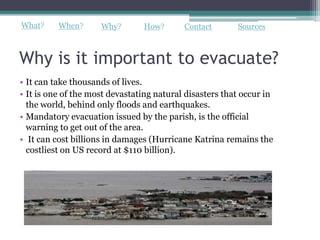
Why is it important to evacuate?
• It can take thousands of lives.
• It is one of the most devastating natural disasters that occur in
  the world, behind only floods and earthquakes.
• Mandatory evacuation issued by the parish, is the official
  warning to get out of the area.
• It can cost billions in damages (Hurricane Katrina remains the
  costliest on US record at $110 billion).
What?     When?       Why?         How?   Contact   Sources


Quiz
Why is it important to evacuate?

  A) To get a few days off from school


  B) To take a vacation


  C) To avoid a potential life threat
What?   When?    Why?     How?    Contact   Sources


How to get ready for an evacuation?
Decide in advance the destination of your egress:
This decision should be made as soon as possible. Hotels
and motels may be sold out everywhere within 300 miles of
the evacuation point, making it really important to have
somewhere established to evacuate to (for example, a
friend's or relative's house in a nearby state, etc.). Make
plans to evacuate with friends in advance as well.
What?   When?    Why?     How?     Contact   Sources


How to get ready for an evacuation?
Decide on the route to your safe location, as well
as an alternate path:
Major highways will be backed up for miles. Find an
alternative, winding path if one is available. You may and
most likely will find it necessary. Having GPS can be
helpful in this instance but also have road maps with you
in case the GPS hasn't covered everything or it doesn't
work.
What?   When?   Why?      How?    Contact    Sources


How to get ready for an evacuation?
Be prepared to spend at least 12 hours on the
road:
Ensure you have enough to eat, drink, and stay
entertained, as well as allowing ample time for restroom
breaks. Failing to prepare for hours on the road can turn
gloomy trip into a nightmare!
What?   When?   Why?     How?     Contact   Sources


How to get ready for an evacuation?
Purchase two large gasoline cans long before you
might ever need them:
Gasoline cans will become impossible to find when the
storm approaches. Keep one can empty and another can
full, then store them in a locked trunk for safekeeping.
What?   When?   Why?    How?     Contact   Sources


How to get ready for an evacuation?
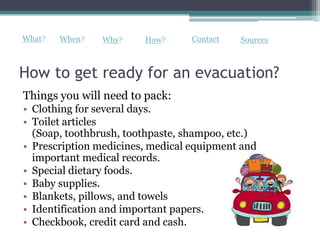
Things you will need to pack:
• Clothing for several days.
• Toilet articles
  (Soap, toothbrush, toothpaste, shampoo, etc.)
• Prescription medicines, medical equipment and
  important medical records.
• Special dietary foods.
• Baby supplies.
• Blankets, pillows, and towels
• Identification and important papers.
• Checkbook, credit card and cash.
What?    When?   Why?   How?   Contact   Sources


Quiz
For many hours should you be prepared to be on
the road?
 A) 6 hours

 B) 8 hours

 C) 12 hours

 D) 24 hours
What?    When?      Why?    How?   Contact   Sources


Quiz
Which of these items should NOT be packed for
the evacuation?
 A) Prescription Medicine

 B) Clothing


 C) Pillows and Blankets

 D) Television
What?   When?   Why?   How?   Contact   Sources


Who to contact?
Calcasieu Parish Office of Emergency
Preparedness (337-721-3800)
Federal Emergency Management Agency (FEMA)
(1800-621-3362)
What?   When?   Why?   How?   Contact   Sources


Sources
www.fema.gov
www.noaa.gov
www.wnyc.org

CBI Project

  • 1.
    Hurricane Preparation Guidelines forInternational Students By: Inthira Pandey What? When? Why? How? Contact Sources
  • 2.
    What? When? Why? How? Contact Sources What is Hurricane? • A hurricane is a type of tropical cyclone, which is a generic term for a low pressure system that generally forms in the tropics. • The cyclone is accompanied by thunderstorms and, in the Northern Hemisphere, a counterclockwise circulation of winds near the earth's surface.
  • 3.
    What? When? Why? How? Contact Sources What Exactly Is a Hurricane? • A hurricane can best be described as a huge tropical storm (up to 600 miles in diameter)! Arrows indicate • Winds can be up to 200 “feeder bands” mph! or “rain bands” • Storm usually doesn’t last for more than 7-10 days. • It moves across the ocean at around 10-20 mph…not too fast really!
  • 4.
    What? When? Why? How? Contact Sources Evolution of Hurricane Development -- Stages Stage 1 – Tropical Wave (Depression) Lacks structure – no well developed feeder bands or eye
  • 5.
    What? When? Why? How? Contact Sources Evolution of Hurricane Development -- Stages Stage 2 – Tropical Storm Feeder bands are beginning to develop – you can see the center of the low pressure system more easily. Eye and eye wall still not well formed.
  • 6.
    What? When? Why? How? Contact Sources Evolution of Hurricane Development -- Stages Stage 3 – Category 1 Hurricane Well developed feeder bands. An eye begins to form (although it is covered in clouds). Storm is tightening around center.
  • 7.
    What? When? Why? How? Contact Sources Evolution of Hurricane Development -- Stages Stage 4 – Category 2 Hurricane Well developed feeder bands. An eye and eye wall are usually very well formed. Storm continues to tighten around center.
  • 8.
    What? When? Why? How? Contact Sources Evolution of Hurricane Development -- Stages Stage 5 – Category 3 Hurricane Now considered a “Major Storm”. Intense flooding and building damage will occur to most areas on the coast. Further inland, the damage will still be substantial.
  • 9.
    What? When? Why? How? Contact Sources Evolution of Hurricane Development -- Stages Stage 6 – Category 4 Hurricane All shrubs, signs and trees blown down. COMPLETE DESTRUCTION of mobile homes. Extensive damage to doors and windows. Major damage to lower floors of structures near the coast.
  • 10.
    What? When? Why? How? Contact Sources Evolution of Hurricane Development -- Stages Stage 7 – Category 5 Hurricane Complete roof failure on many residential and industrial buildings. Some complete building failures with small utility buildings blown over or away. Massive evacuation of residential areas on low ground within 5-10 miles of the coastline maybe required.
  • 11.
    What? When? Why? How? Contact Sources What is the measurement for hurricanes’ strength Saffir-Simpson Hurricane Scale Wind speed Storm surge Category (mph) (feet) 5 156 More than18 4 131–155 13–18 3 111–130 9–12 2 96–110 6–8 1 74–95 4–5 Additional classifications Tropical storm 39–73 0–3 Tropical 0–38 0 depression
  • 12.
    What? When? Why? How? Contact Sources Aftermath…
  • 13.
    What? When? Why? How? Contact Sources Aftermath…
  • 14.
    What? When? Why? How? Contact Sources Aftermath…
  • 15.
    What? When? Why? How? Contact Sources Quiz What is a hurricane? A) A severe thunderstorm with wind B) A wind storm with a funnel C) A storm with wind of 75 mph or more
  • 16.
    What? When? Why? How? Contact Sources Quiz At which category is the wind speed higher than 130 mph? A) Category 1 B) Category 2 C) Category 4
  • 17.
    What? When? Why? How? Contact Sources When is Hurricane Season? • The hurricane season is between June 1st - November 30th.
  • 18.
    What? When? Why? How? Contact Sources When do I need to watch out for these things? The “hurricane season” is just a name for the time period when we expect to see tropical systems develop. The hurricane season for the Atlantic runs from June 1st Peak season is the middle part of September. – November 30th.
  • 19.
    What? When? Why? How? Contact Sources When are these “Atlantic Basin” Hurricanes forming?
  • 20.
    What? When? Why? How? Contact Sources Quiz When is the hurricane season? A) January till March B) May till August C) June till November
  • 21.
    What? When? Why? How? Contact Sources Why is it important to evacuate? • It can take thousands of lives. • It is one of the most devastating natural disasters that occur in the world, behind only floods and earthquakes. • Mandatory evacuation issued by the parish, is the official warning to get out of the area. • It can cost billions in damages (Hurricane Katrina remains the costliest on US record at $110 billion).
  • 22.
    What? When? Why? How? Contact Sources Quiz Why is it important to evacuate? A) To get a few days off from school B) To take a vacation C) To avoid a potential life threat
  • 23.
    What? When? Why? How? Contact Sources How to get ready for an evacuation? Decide in advance the destination of your egress: This decision should be made as soon as possible. Hotels and motels may be sold out everywhere within 300 miles of the evacuation point, making it really important to have somewhere established to evacuate to (for example, a friend's or relative's house in a nearby state, etc.). Make plans to evacuate with friends in advance as well.
  • 24.
    What? When? Why? How? Contact Sources How to get ready for an evacuation? Decide on the route to your safe location, as well as an alternate path: Major highways will be backed up for miles. Find an alternative, winding path if one is available. You may and most likely will find it necessary. Having GPS can be helpful in this instance but also have road maps with you in case the GPS hasn't covered everything or it doesn't work.
  • 25.
    What? When? Why? How? Contact Sources How to get ready for an evacuation? Be prepared to spend at least 12 hours on the road: Ensure you have enough to eat, drink, and stay entertained, as well as allowing ample time for restroom breaks. Failing to prepare for hours on the road can turn gloomy trip into a nightmare!
  • 26.
    What? When? Why? How? Contact Sources How to get ready for an evacuation? Purchase two large gasoline cans long before you might ever need them: Gasoline cans will become impossible to find when the storm approaches. Keep one can empty and another can full, then store them in a locked trunk for safekeeping.
  • 27.
    What? When? Why? How? Contact Sources How to get ready for an evacuation? Things you will need to pack: • Clothing for several days. • Toilet articles (Soap, toothbrush, toothpaste, shampoo, etc.) • Prescription medicines, medical equipment and important medical records. • Special dietary foods. • Baby supplies. • Blankets, pillows, and towels • Identification and important papers. • Checkbook, credit card and cash.
  • 28.
    What? When? Why? How? Contact Sources Quiz For many hours should you be prepared to be on the road? A) 6 hours B) 8 hours C) 12 hours D) 24 hours
  • 29.
    What? When? Why? How? Contact Sources Quiz Which of these items should NOT be packed for the evacuation? A) Prescription Medicine B) Clothing C) Pillows and Blankets D) Television
  • 30.
    What? When? Why? How? Contact Sources Who to contact? Calcasieu Parish Office of Emergency Preparedness (337-721-3800) Federal Emergency Management Agency (FEMA) (1800-621-3362)
  • 31.
    What? When? Why? How? Contact Sources Sources www.fema.gov www.noaa.gov www.wnyc.org

Editor's Notes

  • #20 Click on the NOAA logo to check the current situation in Gulf of Mexico and Western Atlantic visible-loop
  • #24 Click on the picture to move to the next slide on how to get ready for an evacuation
  • #25 Click on the picture to move to the next slide on how to get ready for an evacuation
  • #26 Click on the picture to move to the next slide on how to get ready for an evacuation
  • #27 Click on the picture to move to the next slide on how to get ready for an evacuation
  • #28 Click on the picture to see the Hurricane Preparedness video from the weather channel
  • #29 Click on the picture to move to the next slide on the quiz