ClassificationClassification
Grouping & IdentifyingGrouping & Identifying
Living ThingsLiving Things
This Powerpoint is hosted on www.worldofteaching.com
Please visit for 100’s more free powerpoints
Why classify?Why classify?
Think of three examples where weThink of three examples where we
group things.group things.
Why do we group these things?Why do we group these things?
Classifying Living ThingsClassifying Living Things
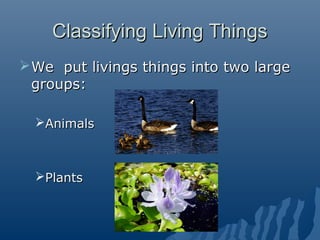
We put livings things into two largeWe put livings things into two large
groups:groups:
AnimalsAnimals
PlantsPlants
AnimalsAnimals
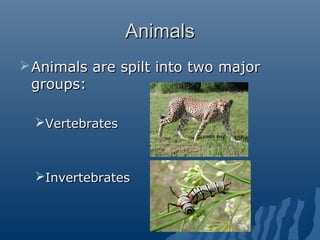
Animals are spilt into two majorAnimals are spilt into two major
groups:groups:
VertebratesVertebrates
InvertebratesInvertebrates
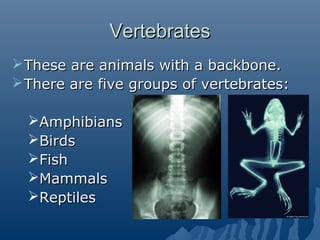
VertebratesVertebrates
These are animals with a backbone.These are animals with a backbone.
There are five groups of vertebrates:There are five groups of vertebrates:
AmphibiansAmphibians
BirdsBirds
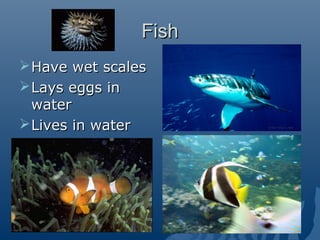
FishFish
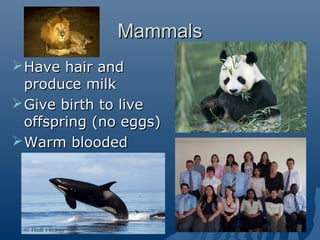
MammalsMammals
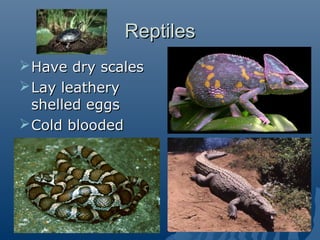
ReptilesReptiles
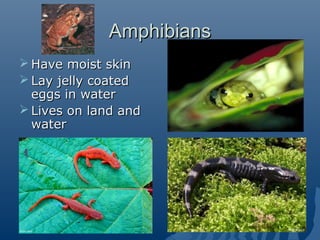
AmphibiansAmphibians
 Have moist skinHave moist skin
 Lay jelly coatedLay jelly coated
eggs in watereggs in water
 Lives on land andLives on land and
waterwater
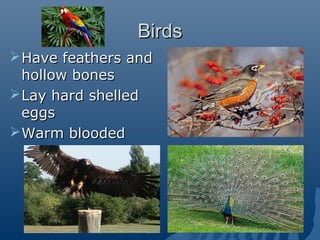
BirdsBirds
Have feathers andHave feathers and
hollow boneshollow bones
Lay hard shelledLay hard shelled
eggseggs
Warm bloodedWarm blooded
FishFish
Have wet scalesHave wet scales
Lays eggs inLays eggs in
waterwater
Lives in waterLives in water
MammalsMammals
Have hair andHave hair and
produce milkproduce milk
Give birth to liveGive birth to live
offspring (no eggs)offspring (no eggs)
Warm bloodedWarm blooded
ReptilesReptiles
Have dry scalesHave dry scales
Lay leatheryLay leathery
shelled eggsshelled eggs
Cold bloodedCold blooded
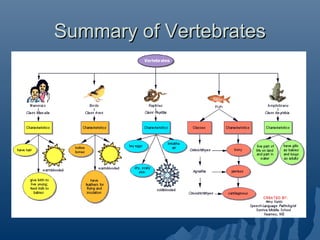
Summary of VertebratesSummary of Vertebrates
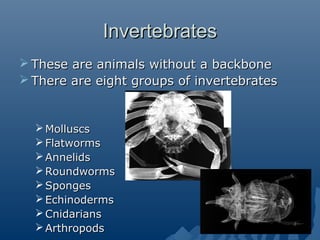
InvertebratesInvertebrates
 These are animals without a backboneThese are animals without a backbone
 There are eight groups of invertebratesThere are eight groups of invertebrates
 MolluscsMolluscs
 FlatwormsFlatworms
 AnnelidsAnnelids
 RoundwormsRoundworms
 SpongesSponges
 EchinodermsEchinoderms
 CnidariansCnidarians
 ArthropodsArthropods
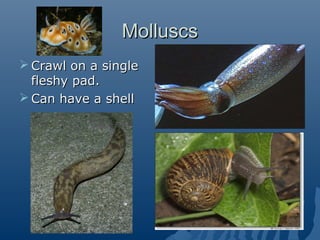
MolluscsMolluscs
 Crawl on a singleCrawl on a single
fleshy pad.fleshy pad.
 Can have a shellCan have a shell
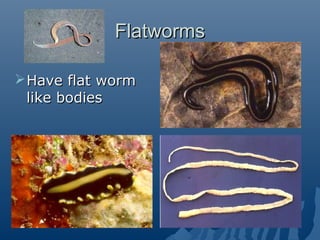
FlatwormsFlatworms
Have flat wormHave flat worm
like bodieslike bodies
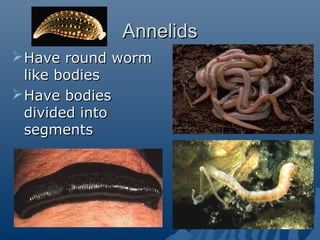
AnnelidsAnnelids
Have round wormHave round worm
like bodieslike bodies
Have bodiesHave bodies
divided intodivided into
segmentssegments
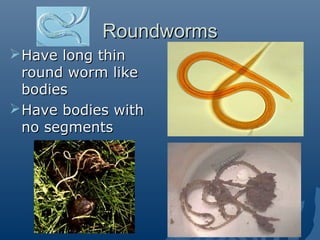
RoundwormsRoundworms
Have long thinHave long thin
round worm likeround worm like
bodiesbodies
Have bodies withHave bodies with
no segmentsno segments
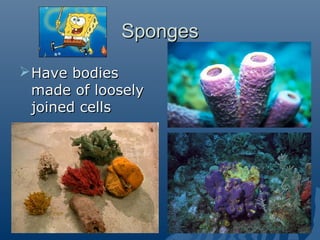
SpongesSponges
Have bodiesHave bodies
made of looselymade of loosely
joined cellsjoined cells
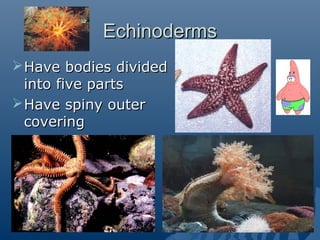
EchinodermsEchinoderms
Have bodies dividedHave bodies divided
into five partsinto five parts
Have spiny outerHave spiny outer
coveringcovering
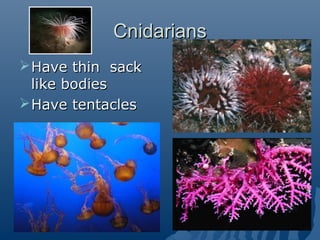
CnidariansCnidarians
Have thin sackHave thin sack
like bodieslike bodies
Have tentaclesHave tentacles
ArthropodsArthropods
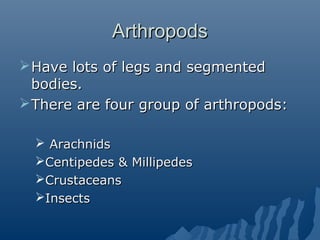
Have lots of legs and segmentedHave lots of legs and segmented
bodies.bodies.
There are four group of arthropods:There are four group of arthropods:
 ArachnidsArachnids
Centipedes & MillipedesCentipedes & Millipedes
CrustaceansCrustaceans
InsectsInsects
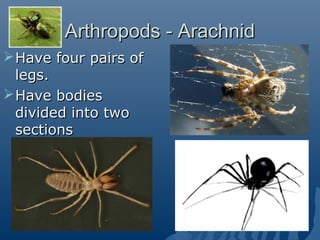
Arthropods - ArachnidArthropods - Arachnid
Have four pairs ofHave four pairs of
legs.legs.
Have bodiesHave bodies
divided into twodivided into two
sectionssections
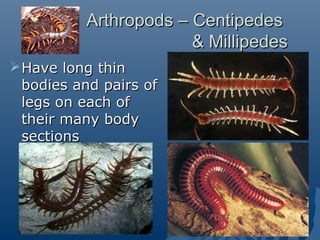
Arthropods – CentipedesArthropods – Centipedes
& Millipedes& Millipedes
Have long thinHave long thin
bodies and pairs ofbodies and pairs of
legs on each oflegs on each of
their many bodytheir many body
sectionssections
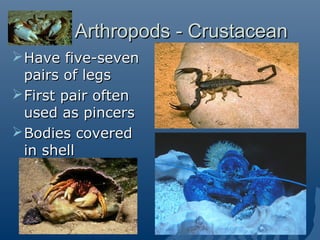
Arthropods - CrustaceanArthropods - Crustacean
Have five-sevenHave five-seven
pairs of legspairs of legs
First pair oftenFirst pair often
used as pincersused as pincers
Bodies coveredBodies covered
in shellin shell
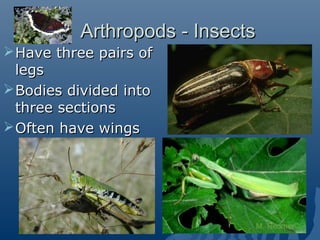
Arthropods - InsectsArthropods - Insects
Have three pairs ofHave three pairs of
legslegs
Bodies divided intoBodies divided into
three sectionsthree sections
Often have wingsOften have wings

Classification of animals