Sensitivity: Internal
PUSAT TUISYEN PRIMA
INTELEK
SCIENCE FORM 5
CHAPTER 1:
MICROORGANISMS
Sensitivity: Internal
1.1. WORLD OF MICROORGANISMS
WORLD OF
MICROORGANISMS
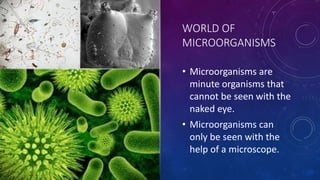
• Microorganisms are
minute organisms that
cannot be seen with the
naked eye.
• Microorganisms can
only be seen with the
help of a microscope.
NORMAL FLORA
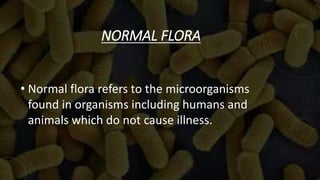
• Normal flora refers to the microorganisms
found in organisms including humans and
animals which do not cause illness.
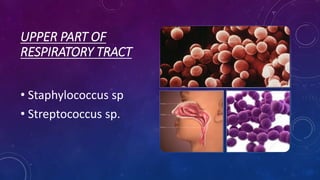
UPPER PART OF
RESPIRATORY TRACT
• Staphylococcus sp
• Streptococcus sp.
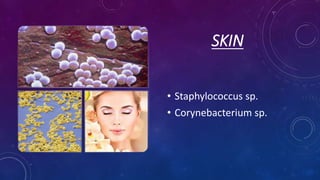
SKIN
• Staphylococcus sp.
• Corynebacterium sp.
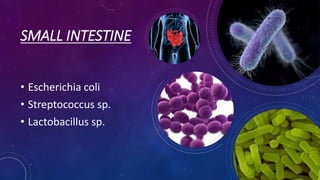
SMALL INTESTINE
• Escherichia coli
• Streptococcus sp.
• Lactobacillus sp.
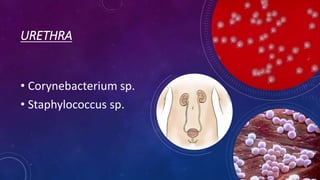
URETHRA
• Corynebacterium sp.
• Staphylococcus sp.
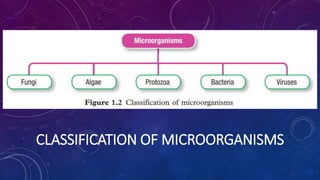
CLASSIFICATION OF MICROORGANISMS
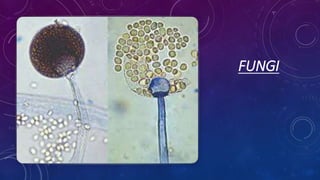
FUNGI
SIZE
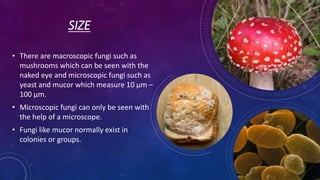
• There are macroscopic fungi such as
mushrooms which can be seen with the
naked eye and microscopic fungi such as
yeast and mucor which measure 10 μm –
100 μm.
• Microscopic fungi can only be seen with
the help of a microscope.
• Fungi like mucor normally exist in
colonies or groups.
SHAPE
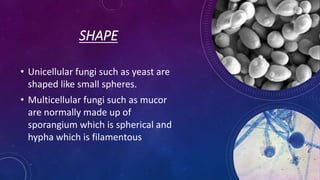
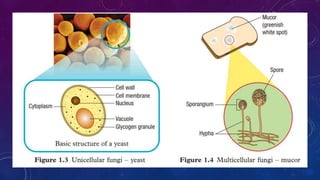
• Unicellular fungi such as yeast are
shaped like small spheres.
• Multicellular fungi such as mucor
are normally made up of
sporangium which is spherical and
hypha which is filamentous
NUTRITION
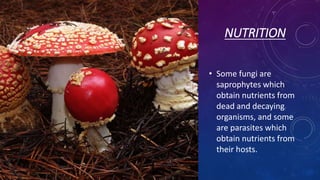
• Some fungi are
saprophytes which
obtain nutrients from
dead and decaying
organisms, and some
are parasites which
obtain nutrients from
their hosts.
HABITAT
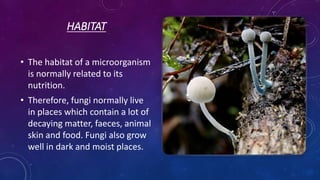
• The habitat of a microorganism
is normally related to its
nutrition.
• Therefore, fungi normally live
in places which contain a lot of
decaying matter, faeces, animal
skin and food. Fungi also grow
well in dark and moist places.
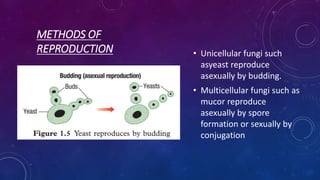
METHODS OF
REPRODUCTION • Unicellular fungi such
asyeast reproduce
asexually by budding.
• Multicellular fungi such as
mucor reproduce
asexually by spore
formation or sexually by
conjugation
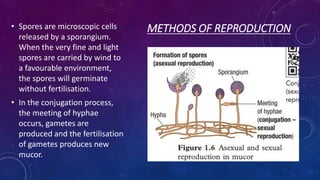
METHODS OF REPRODUCTION
• Spores are microscopic cells
released by a sporangium.
When the very fine and light
spores are carried by wind to
a favourable environment,
the spores will germinate
without fertilisation.
• In the conjugation process,
the meeting of hyphae
occurs, gametes are
produced and the fertilisation
of gametes produces new
mucor.
ALGAE
NUTRITION
• Most algae are green in colour because of the presence of
chlorophyll in their cells.
• This also differentiates microscopic algae from other
microorganisms.
• Chlorophyll enables algae to carry out photosynthesis to
produce their own food.
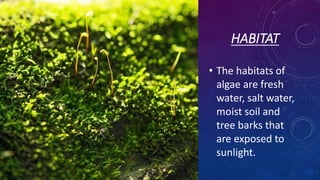
HABITAT
• The habitats of
algae are fresh
water, salt water,
moist soil and
tree barks that
are exposed to
sunlight.
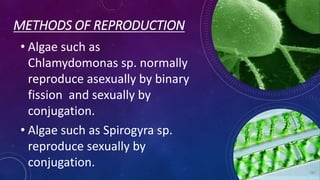
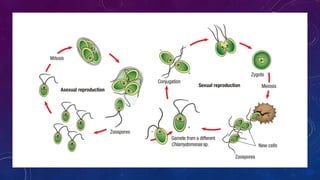
METHODS OF REPRODUCTION
• Algae such as
Chlamydomonas sp. normally
reproduce asexually by binary
fission and sexually by
conjugation.
• Algae such as Spirogyra sp.
reproduce sexually by
conjugation.
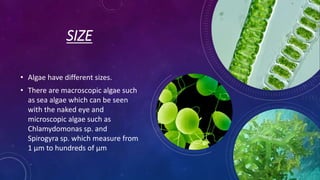
SIZE
• Algae have different sizes.
• There are macroscopic algae such
as sea algae which can be seen
with the naked eye and
microscopic algae such as
Chlamydomonas sp. and
Spirogyra sp. which measure from
1 μm to hundreds of μm
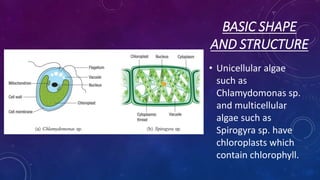
BASIC SHAPE
AND STRUCTURE
• Unicellular algae
such as
Chlamydomonas sp.
and multicellular
algae such as
Spirogyra sp. have
chloroplasts which
contain chlorophyll.
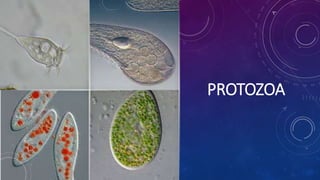
PROTOZOA
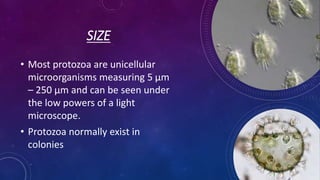
SIZE
• Most protozoa are unicellular
microorganisms measuring 5 μm
– 250 μm and can be seen under
the low powers of a light
microscope.
• Protozoa normally exist in
colonies
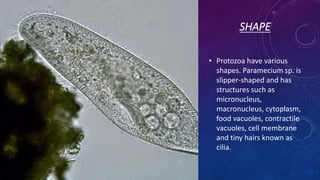
SHAPE
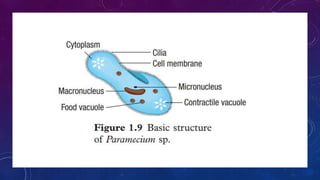
• Protozoa have various
shapes. Paramecium sp. is
slipper-shaped and has
structures such as
micronucleus,
macronucleus, cytoplasm,
food vacuoles, contractile
vacuoles, cell membrane
and tiny hairs known as
cilia.
SHAPE
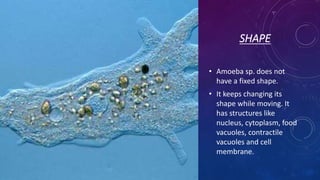
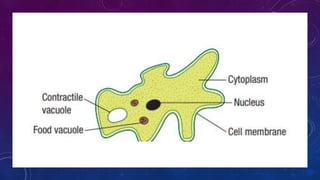
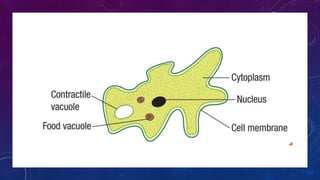
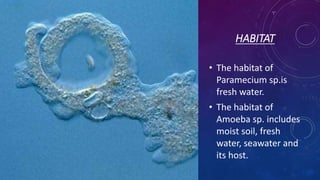
• Amoeba sp. does not
have a fixed shape.
• It keeps changing its
shape while moving. It
has structures like
nucleus, cytoplasm, food
vacuoles, contractile
vacuoles and cell
membrane.
NUTRITION
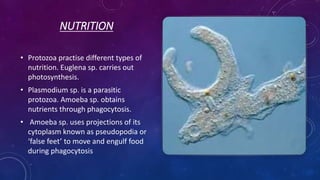
• Protozoa practise different types of
nutrition. Euglena sp. carries out
photosynthesis.
• Plasmodium sp. is a parasitic
protozoa. Amoeba sp. obtains
nutrients through phagocytosis.
• Amoeba sp. uses projections of its
cytoplasm known as pseudopodia or
‘false feet’ to move and engulf food
during phagocytosis
METHODS OF
REPRODUCTION
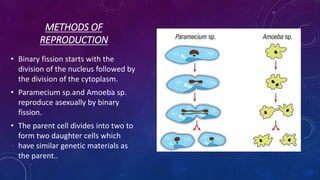
• Binary fission starts with the
division of the nucleus followed by
the division of the cytoplasm.
• Paramecium sp.and Amoeba sp.
reproduce asexually by binary
fission.
• The parent cell divides into two to
form two daughter cells which
have similar genetic materials as
the parent..
METHODS OF
REPRODUCTION
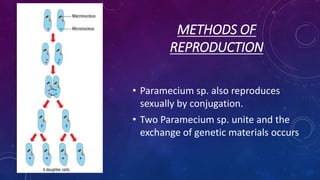
• Paramecium sp. also reproduces
sexually by conjugation.
• Two Paramecium sp. unite and the
exchange of genetic materials occurs
HABITAT
• The habitat of
Paramecium sp.is
fresh water.
• The habitat of
Amoeba sp. includes
moist soil, fresh
water, seawater and
its host.
BACTERIA
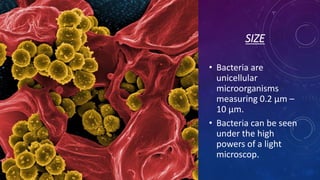
SIZE
• Bacteria are
unicellular
microorganisms
measuring 0.2 μm –
10 μm.
• Bacteria can be seen
under the high
powers of a light
microscop.
SHAPE
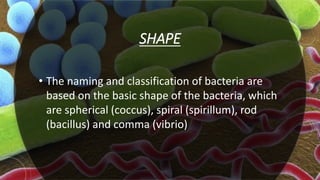
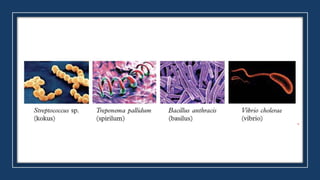
• The naming and classification of bacteria are
based on the basic shape of the bacteria, which
are spherical (coccus), spiral (spirillum), rod
(bacillus) and comma (vibrio)
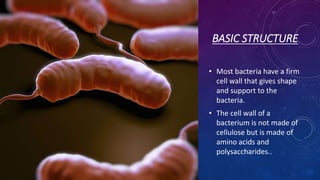
BASIC STRUCTURE
• Most bacteria have a firm
cell wall that gives shape
and support to the
bacteria.
• The cell wall of a
bacterium is not made of
cellulose but is made of
amino acids and
polysaccharides..
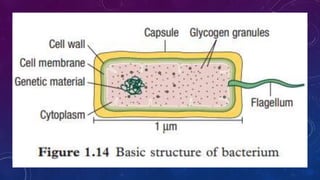
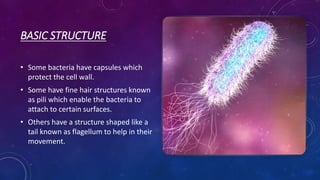
BASIC STRUCTURE
• Some bacteria have capsules which
protect the cell wall.
• Some have fine hair structures known
as pili which enable the bacteria to
attach to certain surfaces.
• Others have a structure shaped like a
tail known as flagellum to help in their
movement.
NUTRITION
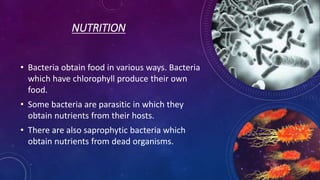
• Bacteria obtain food in various ways. Bacteria
which have chlorophyll produce their own
food.
• Some bacteria are parasitic in which they
obtain nutrients from their hosts.
• There are also saprophytic bacteria which
obtain nutrients from dead organisms.
HABITAT
• Bacteria can be found
in air, water, soil and
all decaying organisms
and materials.
METHODS OF REPRODUCTION
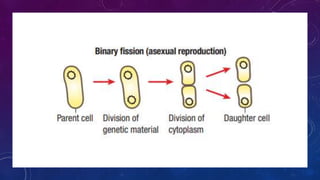
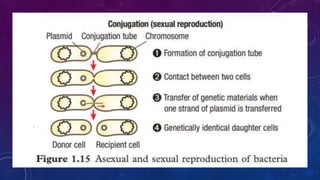
• Bacteria reproduce asexually, that is by binary fission
and also sexually by conjugation
BACTERIA
CONJUGATION
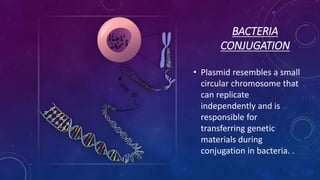
• Plasmid resembles a small
circular chromosome that
can replicate
independently and is
responsible for
transferring genetic
materials during
conjugation in bacteria. .
SPECIAL
CHARACTERISTICS
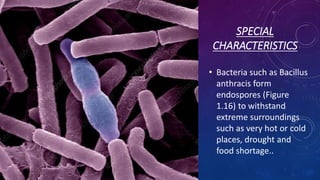
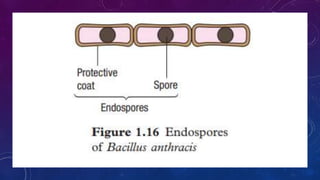
• Bacteria such as Bacillus
anthracis form
endospores (Figure
1.16) to withstand
extreme surroundings
such as very hot or cold
places, drought and
food shortage..
SPECIAL CHARACTERISTICS
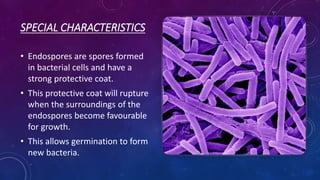
• Endospores are spores formed
in bacterial cells and have a
strong protective coat.
• This protective coat will rupture
when the surroundings of the
endospores become favourable
for growth.
• This allows germination to form
new bacteria.
VIRUS
SIZE
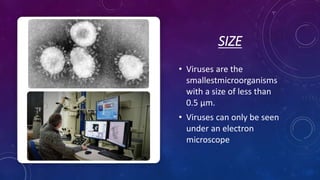
• Viruses are the
smallestmicroorganisms
with a size of less than
0.5 μm.
• Viruses can only be seen
under an electron
microscope
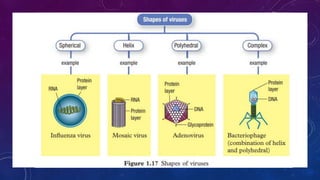
SHAPE
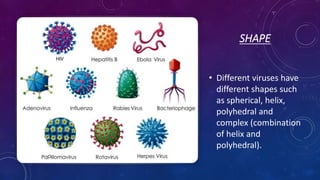
• Different viruses have
different shapes such
as spherical, helix,
polyhedral and
complex (combination
of helix and
polyhedral).
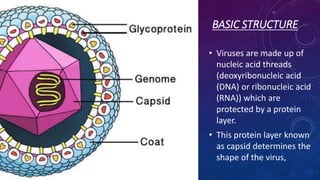
BASIC STRUCTURE
• Viruses are made up of
nucleic acid threads
(deoxyribonucleic acid
(DNA) or ribonucleic acid
(RNA)) which are
protected by a protein
layer.
• This protein layer known
as capsid determines the
shape of the virus,
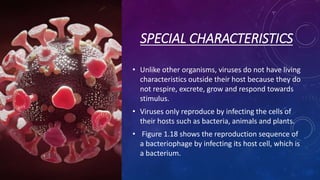
SPECIAL CHARACTERISTICS
• Unlike other organisms, viruses do not have living
characteristics outside their host because they do
not respire, excrete, grow and respond towards
stimulus.
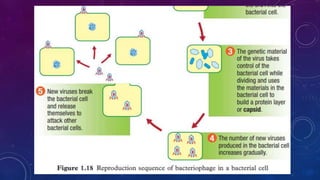
• Viruses only reproduce by infecting the cells of
their hosts such as bacteria, animals and plants.
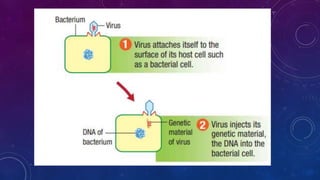
• Figure 1.18 shows the reproduction sequence of
a bacteriophage by infecting its host cell, which is
a bacterium.
FACTORS THAT AFFECT THE GROWTH
OF MICROORGANISMS
• Humidity
• Light
• Temperature
• pH Value
• Nutrients
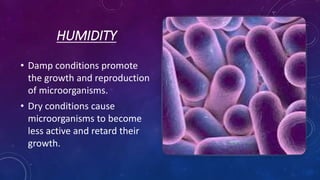
HUMIDITY
• Damp conditions promote
the growth and reproduction
of microorganisms.
• Dry conditions cause
microorganisms to become
less active and retard their
growth.
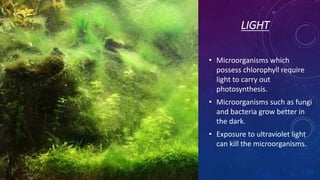
LIGHT
• Microorganisms which
possess chlorophyll require
light to carry out
photosynthesis.
• Microorganisms such as fungi
and bacteria grow better in
the dark.
• Exposure to ultraviolet light
can kill the microorganisms.
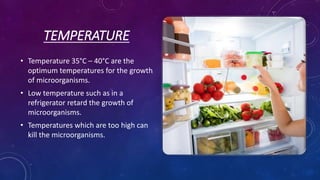
TEMPERATURE
• Temperature 35°C – 40°C are the
optimum temperatures for the growth
of microorganisms.
• Low temperature such as in a
refrigerator retard the growth of
microorganisms.
• Temperatures which are too high can
kill the microorganisms.
PH VALUE
• pH 7 (neutral pH) is the optimum pH value for the growth of
most microorganisms.
• There are certain microorganisms that can live in slightly
acidic or alkaline environments.
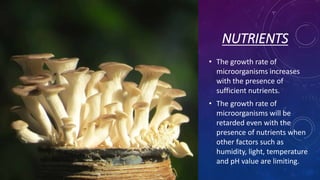
NUTRIENTS
• The growth rate of
microorganisms increases
with the presence of
sufficient nutrients.
• The growth rate of
microorganisms will be
retarded even with the
presence of nutrients when
other factors such as
humidity, light, temperature
and pH value are limiting.
Sensitivity: Internal
1.2. USEFUL MICROORGANISMS
APPLICATIONS OF
USEFUL
MICROORGANISMS IN
DAILY LIFE
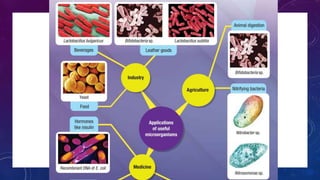
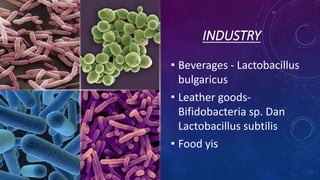
INDUSTRY
• Beverages - Lactobacillus
bulgaricus
• Leather goods-
Bifidobacteria sp. Dan
Lactobacillus subtilis
• Food yis
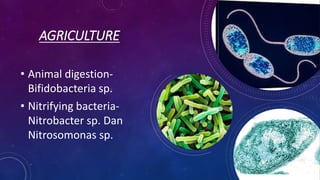
AGRICULTURE
• Animal digestion-
Bifidobacteria sp.
• Nitrifying bacteria-
Nitrobacter sp. Dan
Nitrosomonas sp.
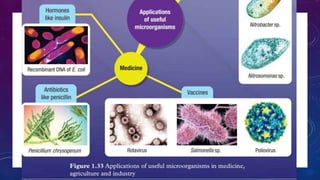
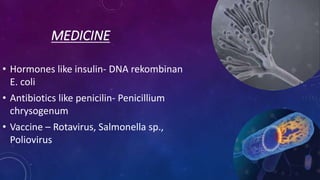
MEDICINE
• Hormones like insulin- DNA rekombinan
E. coli
• Antibiotics like penicilin- Penicillium
chrysogenum
• Vaccine – Rotavirus, Salmonella sp.,
Poliovirus
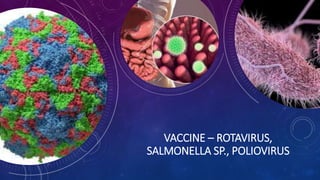
VACCINE – ROTAVIRUS,
SALMONELLA SP., POLIOVIRUS
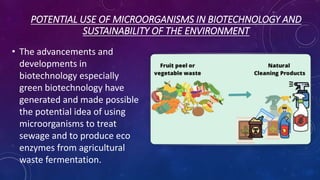
POTENTIAL USE OF MICROORGANISMS IN BIOTECHNOLOGY AND
SUSTAINABILITY OF THE ENVIRONMENT
• The advancements and
developments in
biotechnology especially
green biotechnology have
generated and made possible
the potential idea of using
microorganisms to treat
sewage and to produce eco
enzymes from agricultural
waste fermentation.
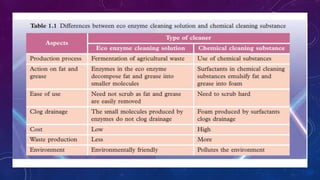
ECO ENZYME CLEANING SOLUTION
• Eco enzyme is a natural product obtained from the fermentation of
agricultural waste such as fruit or vegetable waste. .
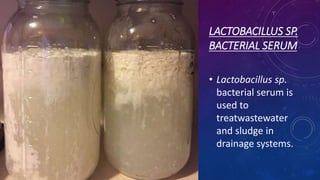
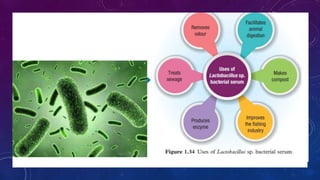
LACTOBACILLUS SP.
BACTERIAL SERUM
• Lactobacillus sp.
bacterial serum is
used to
treatwastewater
and sludge in
drainage systems.
Sensitivity: Internal
1.3. PREVENTION AND TREATMENT OF DISEASES
CAUSED BY MICROORGANISMS
PREVENTION AND TREATMENT
OF DISEASES CAUSED BY
MICROORGANISMS
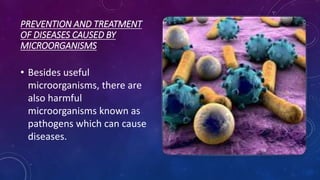
• Besides useful
microorganisms, there are
also harmful
microorganisms known as
pathogens which can cause
diseases.
ASEPTIC TECHNIQUE
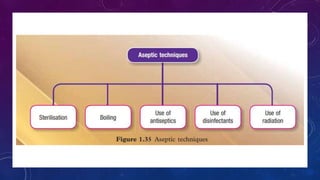
• Aseptic technique refers to the healthcare procedure carried out to
prevent infections caused by pathogens or to remove existing
pathogens.
• As such, the aseptic technique is in line with the phrase ‘prevention is
better than cure’.
• This means preventing someone from being infected with pathogens
is better than treating someone who has been infected by the
pathogens.
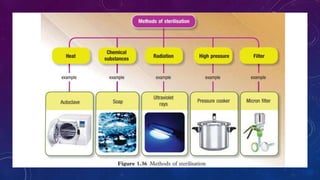
STERILISATION
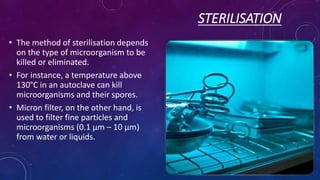
• The method of sterilisation depends
on the type of microorganism to be
killed or eliminated.
• For instance, a temperature above
130°C in an autoclave can kill
microorganisms and their spores.
• Micron filter, on the other hand, is
used to filter fine particles and
microorganisms (0.1 μm – 10 μm)
from water or liquids.
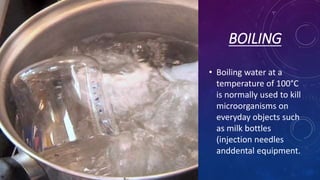
BOILING
• Boiling water at a
temperature of 100°C
is normally used to kill
microorganisms on
everyday objects such
as milk bottles
(injection needles
anddental equipment.
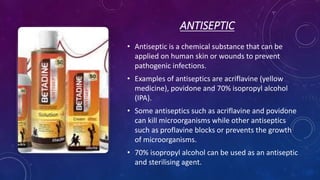
ANTISEPTIC
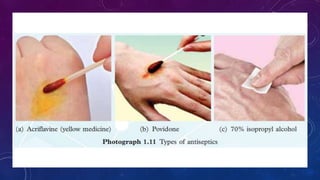
• Antiseptic is a chemical substance that can be
applied on human skin or wounds to prevent
pathogenic infections.
• Examples of antiseptics are acriflavine (yellow
medicine), povidone and 70% isopropyl alcohol
(IPA).
• Some antiseptics such as acriflavine and povidone
can kill microorganisms while other antiseptics
such as proflavine blocks or prevents the growth
of microorganisms.
• 70% isopropyl alcohol can be used as an antiseptic
and sterilising agent.
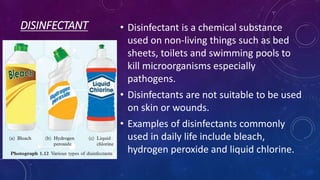
DISINFECTANT • Disinfectant is a chemical substance
used on non-living things such as bed
sheets, toilets and swimming pools to
kill microorganisms especially
pathogens.
• Disinfectants are not suitable to be used
on skin or wounds.
• Examples of disinfectants commonly
used in daily life include bleach,
hydrogen peroxide and liquid chlorine.
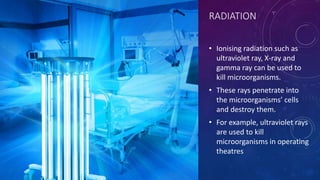
RADIATION
• Ionising radiation such as
ultraviolet ray, X-ray and
gamma ray can be used to
kill microorganisms.
• These rays penetrate into
the microorganisms’ cells
and destroy them.
• For example, ultraviolet rays
are used to kill
microorganisms in operating
theatres
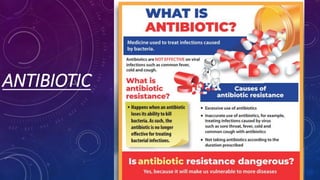
ANTIBIOTIC
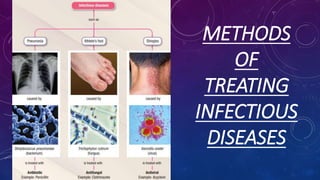
METHODS
OF
TREATING
INFECTIOUS
DISEASES
Sensitivity: Internal
THE END QUESTIONS????

SCIENCE FORM 5 CHAPTER 1_MICROORGANISMS KSSM

  • 1.
    Sensitivity: Internal PUSAT TUISYENPRIMA INTELEK SCIENCE FORM 5 CHAPTER 1: MICROORGANISMS
  • 2.
  • 3.
    WORLD OF MICROORGANISMS • Microorganismsare minute organisms that cannot be seen with the naked eye. • Microorganisms can only be seen with the help of a microscope.
  • 4.
    NORMAL FLORA • Normalflora refers to the microorganisms found in organisms including humans and animals which do not cause illness.
  • 5.
    UPPER PART OF RESPIRATORYTRACT • Staphylococcus sp • Streptococcus sp.
  • 6.
  • 7.
    SMALL INTESTINE • Escherichiacoli • Streptococcus sp. • Lactobacillus sp.
  • 8.
  • 10.
  • 11.
  • 12.
    SIZE • There aremacroscopic fungi such as mushrooms which can be seen with the naked eye and microscopic fungi such as yeast and mucor which measure 10 μm – 100 μm. • Microscopic fungi can only be seen with the help of a microscope. • Fungi like mucor normally exist in colonies or groups.
  • 13.
    SHAPE • Unicellular fungisuch as yeast are shaped like small spheres. • Multicellular fungi such as mucor are normally made up of sporangium which is spherical and hypha which is filamentous
  • 15.
    NUTRITION • Some fungiare saprophytes which obtain nutrients from dead and decaying organisms, and some are parasites which obtain nutrients from their hosts.
  • 16.
    HABITAT • The habitatof a microorganism is normally related to its nutrition. • Therefore, fungi normally live in places which contain a lot of decaying matter, faeces, animal skin and food. Fungi also grow well in dark and moist places.
  • 17.
    METHODS OF REPRODUCTION •Unicellular fungi such asyeast reproduce asexually by budding. • Multicellular fungi such as mucor reproduce asexually by spore formation or sexually by conjugation
  • 18.
    METHODS OF REPRODUCTION •Spores are microscopic cells released by a sporangium. When the very fine and light spores are carried by wind to a favourable environment, the spores will germinate without fertilisation. • In the conjugation process, the meeting of hyphae occurs, gametes are produced and the fertilisation of gametes produces new mucor.
  • 19.
  • 20.
    NUTRITION • Most algaeare green in colour because of the presence of chlorophyll in their cells. • This also differentiates microscopic algae from other microorganisms. • Chlorophyll enables algae to carry out photosynthesis to produce their own food.
  • 21.
    HABITAT • The habitatsof algae are fresh water, salt water, moist soil and tree barks that are exposed to sunlight.
  • 22.
    METHODS OF REPRODUCTION •Algae such as Chlamydomonas sp. normally reproduce asexually by binary fission and sexually by conjugation. • Algae such as Spirogyra sp. reproduce sexually by conjugation.
  • 24.
    SIZE • Algae havedifferent sizes. • There are macroscopic algae such as sea algae which can be seen with the naked eye and microscopic algae such as Chlamydomonas sp. and Spirogyra sp. which measure from 1 μm to hundreds of μm
  • 25.
    BASIC SHAPE AND STRUCTURE •Unicellular algae such as Chlamydomonas sp. and multicellular algae such as Spirogyra sp. have chloroplasts which contain chlorophyll.
  • 26.
  • 27.
    SIZE • Most protozoaare unicellular microorganisms measuring 5 μm – 250 μm and can be seen under the low powers of a light microscope. • Protozoa normally exist in colonies
  • 28.
    SHAPE • Protozoa havevarious shapes. Paramecium sp. is slipper-shaped and has structures such as micronucleus, macronucleus, cytoplasm, food vacuoles, contractile vacuoles, cell membrane and tiny hairs known as cilia.
  • 30.
    SHAPE • Amoeba sp.does not have a fixed shape. • It keeps changing its shape while moving. It has structures like nucleus, cytoplasm, food vacuoles, contractile vacuoles and cell membrane.
  • 32.
    NUTRITION • Protozoa practisedifferent types of nutrition. Euglena sp. carries out photosynthesis. • Plasmodium sp. is a parasitic protozoa. Amoeba sp. obtains nutrients through phagocytosis. • Amoeba sp. uses projections of its cytoplasm known as pseudopodia or ‘false feet’ to move and engulf food during phagocytosis
  • 34.
    METHODS OF REPRODUCTION • Binaryfission starts with the division of the nucleus followed by the division of the cytoplasm. • Paramecium sp.and Amoeba sp. reproduce asexually by binary fission. • The parent cell divides into two to form two daughter cells which have similar genetic materials as the parent..
  • 35.
    METHODS OF REPRODUCTION • Parameciumsp. also reproduces sexually by conjugation. • Two Paramecium sp. unite and the exchange of genetic materials occurs
  • 36.
    HABITAT • The habitatof Paramecium sp.is fresh water. • The habitat of Amoeba sp. includes moist soil, fresh water, seawater and its host.
  • 37.
  • 38.
    SIZE • Bacteria are unicellular microorganisms measuring0.2 μm – 10 μm. • Bacteria can be seen under the high powers of a light microscop.
  • 39.
    SHAPE • The namingand classification of bacteria are based on the basic shape of the bacteria, which are spherical (coccus), spiral (spirillum), rod (bacillus) and comma (vibrio)
  • 41.
    BASIC STRUCTURE • Mostbacteria have a firm cell wall that gives shape and support to the bacteria. • The cell wall of a bacterium is not made of cellulose but is made of amino acids and polysaccharides..
  • 43.
    BASIC STRUCTURE • Somebacteria have capsules which protect the cell wall. • Some have fine hair structures known as pili which enable the bacteria to attach to certain surfaces. • Others have a structure shaped like a tail known as flagellum to help in their movement.
  • 44.
    NUTRITION • Bacteria obtainfood in various ways. Bacteria which have chlorophyll produce their own food. • Some bacteria are parasitic in which they obtain nutrients from their hosts. • There are also saprophytic bacteria which obtain nutrients from dead organisms.
  • 45.
    HABITAT • Bacteria canbe found in air, water, soil and all decaying organisms and materials.
  • 46.
    METHODS OF REPRODUCTION •Bacteria reproduce asexually, that is by binary fission and also sexually by conjugation
  • 49.
    BACTERIA CONJUGATION • Plasmid resemblesa small circular chromosome that can replicate independently and is responsible for transferring genetic materials during conjugation in bacteria. .
  • 50.
    SPECIAL CHARACTERISTICS • Bacteria suchas Bacillus anthracis form endospores (Figure 1.16) to withstand extreme surroundings such as very hot or cold places, drought and food shortage..
  • 51.
    SPECIAL CHARACTERISTICS • Endosporesare spores formed in bacterial cells and have a strong protective coat. • This protective coat will rupture when the surroundings of the endospores become favourable for growth. • This allows germination to form new bacteria.
  • 53.
  • 54.
    SIZE • Viruses arethe smallestmicroorganisms with a size of less than 0.5 μm. • Viruses can only be seen under an electron microscope
  • 55.
    SHAPE • Different viruseshave different shapes such as spherical, helix, polyhedral and complex (combination of helix and polyhedral).
  • 57.
    BASIC STRUCTURE • Virusesare made up of nucleic acid threads (deoxyribonucleic acid (DNA) or ribonucleic acid (RNA)) which are protected by a protein layer. • This protein layer known as capsid determines the shape of the virus,
  • 58.
    SPECIAL CHARACTERISTICS • Unlikeother organisms, viruses do not have living characteristics outside their host because they do not respire, excrete, grow and respond towards stimulus. • Viruses only reproduce by infecting the cells of their hosts such as bacteria, animals and plants. • Figure 1.18 shows the reproduction sequence of a bacteriophage by infecting its host cell, which is a bacterium.
  • 61.
    FACTORS THAT AFFECTTHE GROWTH OF MICROORGANISMS • Humidity • Light • Temperature • pH Value • Nutrients
  • 62.
    HUMIDITY • Damp conditionspromote the growth and reproduction of microorganisms. • Dry conditions cause microorganisms to become less active and retard their growth.
  • 63.
    LIGHT • Microorganisms which possesschlorophyll require light to carry out photosynthesis. • Microorganisms such as fungi and bacteria grow better in the dark. • Exposure to ultraviolet light can kill the microorganisms.
  • 64.
    TEMPERATURE • Temperature 35°C– 40°C are the optimum temperatures for the growth of microorganisms. • Low temperature such as in a refrigerator retard the growth of microorganisms. • Temperatures which are too high can kill the microorganisms.
  • 65.
    PH VALUE • pH7 (neutral pH) is the optimum pH value for the growth of most microorganisms. • There are certain microorganisms that can live in slightly acidic or alkaline environments.
  • 66.
    NUTRIENTS • The growthrate of microorganisms increases with the presence of sufficient nutrients. • The growth rate of microorganisms will be retarded even with the presence of nutrients when other factors such as humidity, light, temperature and pH value are limiting.
  • 67.
  • 68.
  • 71.
    INDUSTRY • Beverages -Lactobacillus bulgaricus • Leather goods- Bifidobacteria sp. Dan Lactobacillus subtilis • Food yis
  • 72.
    AGRICULTURE • Animal digestion- Bifidobacteriasp. • Nitrifying bacteria- Nitrobacter sp. Dan Nitrosomonas sp.
  • 73.
    MEDICINE • Hormones likeinsulin- DNA rekombinan E. coli • Antibiotics like penicilin- Penicillium chrysogenum • Vaccine – Rotavirus, Salmonella sp., Poliovirus
  • 74.
  • 75.
    POTENTIAL USE OFMICROORGANISMS IN BIOTECHNOLOGY AND SUSTAINABILITY OF THE ENVIRONMENT • The advancements and developments in biotechnology especially green biotechnology have generated and made possible the potential idea of using microorganisms to treat sewage and to produce eco enzymes from agricultural waste fermentation.
  • 76.
    ECO ENZYME CLEANINGSOLUTION • Eco enzyme is a natural product obtained from the fermentation of agricultural waste such as fruit or vegetable waste. .
  • 78.
    LACTOBACILLUS SP. BACTERIAL SERUM •Lactobacillus sp. bacterial serum is used to treatwastewater and sludge in drainage systems.
  • 80.
    Sensitivity: Internal 1.3. PREVENTIONAND TREATMENT OF DISEASES CAUSED BY MICROORGANISMS
  • 81.
    PREVENTION AND TREATMENT OFDISEASES CAUSED BY MICROORGANISMS • Besides useful microorganisms, there are also harmful microorganisms known as pathogens which can cause diseases.
  • 82.
    ASEPTIC TECHNIQUE • Aseptictechnique refers to the healthcare procedure carried out to prevent infections caused by pathogens or to remove existing pathogens. • As such, the aseptic technique is in line with the phrase ‘prevention is better than cure’. • This means preventing someone from being infected with pathogens is better than treating someone who has been infected by the pathogens.
  • 84.
    STERILISATION • The methodof sterilisation depends on the type of microorganism to be killed or eliminated. • For instance, a temperature above 130°C in an autoclave can kill microorganisms and their spores. • Micron filter, on the other hand, is used to filter fine particles and microorganisms (0.1 μm – 10 μm) from water or liquids.
  • 86.
    BOILING • Boiling waterat a temperature of 100°C is normally used to kill microorganisms on everyday objects such as milk bottles (injection needles anddental equipment.
  • 87.
    ANTISEPTIC • Antiseptic isa chemical substance that can be applied on human skin or wounds to prevent pathogenic infections. • Examples of antiseptics are acriflavine (yellow medicine), povidone and 70% isopropyl alcohol (IPA). • Some antiseptics such as acriflavine and povidone can kill microorganisms while other antiseptics such as proflavine blocks or prevents the growth of microorganisms. • 70% isopropyl alcohol can be used as an antiseptic and sterilising agent.
  • 89.
    DISINFECTANT • Disinfectantis a chemical substance used on non-living things such as bed sheets, toilets and swimming pools to kill microorganisms especially pathogens. • Disinfectants are not suitable to be used on skin or wounds. • Examples of disinfectants commonly used in daily life include bleach, hydrogen peroxide and liquid chlorine.
  • 90.
    RADIATION • Ionising radiationsuch as ultraviolet ray, X-ray and gamma ray can be used to kill microorganisms. • These rays penetrate into the microorganisms’ cells and destroy them. • For example, ultraviolet rays are used to kill microorganisms in operating theatres
  • 91.
  • 92.
  • 93.