Sales Leadership,
Management, and Supervision
Module Seven
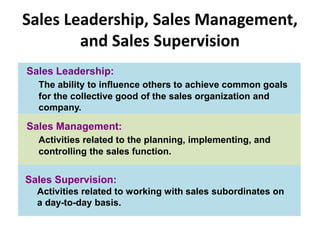
Sales Leadership, Sales Management,
and Sales Supervision
Sales Leadership:
The ability to influence others to achieve common goals
for the collective good of the sales organization and
company.
Sales Management:
Activities related to the planning, implementing, and
controlling the sales function.
Sales Supervision:
Activities related to working with sales subordinates on
a day-to-day basis.
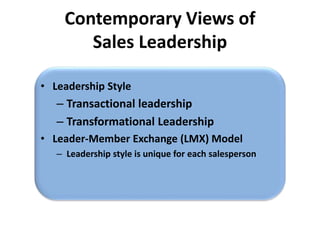
Contemporary Views of
Sales Leadership
• Leadership Style
– Transactional leadership
– Transformational Leadership
• Leader-Member Exchange (LMX) Model
– Leadership style is unique for each salesperson
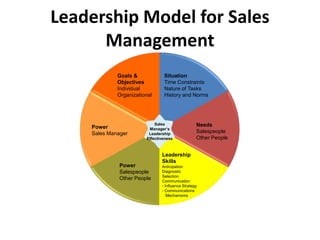
Situation
Time Constraints
Nature of Tasks
History and Norms
Needs
Salespeople
Other People
Leadership
Skills
Anticipation
Diagnostic
Selection
Communication
- Influence Strategy
- Communications
Mechanisms
Power
Salespeople
Other People
Power
Sales Manager
Goals &
Objectives
Individual
Organizational
Sales
Manager’s
Leadership
Effectiveness
Leadership Model for Sales
Management
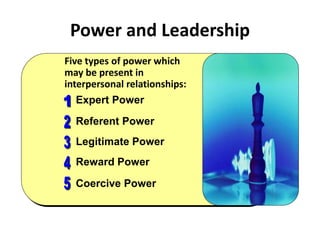
Power and Leadership
Five types of power which
may be present in
interpersonal relationships:
Referent Power
Legitimate Power
Reward Power
Coercive Power
Expert Power
Situational Factors
• Trait Approach – identify traits of an
effective leader
• Behavior Approach – identify behaviors
associated with effective leadership
• Contingency Approach – leadership style
is contingent upon situation
Needs and Wants of Salespeople
• Important when coercive power is not being
utilized
• Realize all needs and wants cannot be met
• Not all leadership directives need to be
based on needs and wants
• Consider each salesperson as a unique
individual
• Leadership is easier when personal
goals and objectives of the salespeople
are consistent with those of the
organization.
• Sales managers strive to seek balance
and consistency between
organizational goals and their
salespeople’s goals.
Goals and Objectives
Leadership Skills
• Anticipating and Seeking Feedback
• Diagnostic
• Selection and Matching
• Communication
Communication Skills:
Influence Strategies
• Threats (coercive power)
• Promises (reward power)
• Persuasion (expert or referent power)
• Relationships (referent or legitimate power)
• Manipulation
Coaching
• Take a we approach
• Address only one or two problems at a time
• Don’t focus on criticizing poor performance, reinforce good performance
• Foster involvement
• Recognize differences in salespeople and coach accordingly
• Coordinate coaching with more formal sales training
• Encourage continual growth and improvement
• Insist salespeople evaluate themselves
• Obtain agreement with respect to punishments and rewards
• Keep good records
The continuous development of salespeople through
supervisory feedback and role modeling. Suggestions for
affective coaching include:
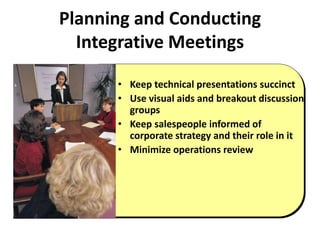
Planning and Conducting
Integrative Meetings
• Keep technical presentations succinct
• Use visual aids and breakout discussion
groups
• Keep salespeople informed of
corporate strategy and their role in it
• Minimize operations review
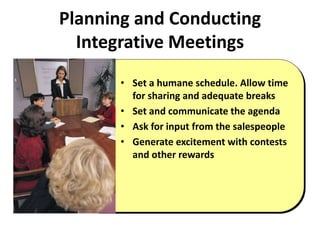
Planning and Conducting
Integrative Meetings
• Set a humane schedule. Allow time
for sharing and adequate breaks
• Set and communicate the agenda
• Ask for input from the salespeople
• Generate excitement with contests
and other rewards
Approaches to Management
Ethics
Immoral Management
– Intentional and consistent management activity
conflicting with what is moral (ethical).
– Exploits opportunities for corporate gain. Cut corners
when it appears useful.
– Seeks profitability and organizational success at any
price.
– Selfish – Management cares only about its or the
company’s gain.
Approaches to Management
Ethics
Amoral Management
– Management activity that is neither consistently moral or
immoral. Decisions lie outside the sphere to which moral
judgments apply.
– Give managers free rein. Personal ethics may apply but
only if managers choose. Respond to legal mandates if
caught and required to do so.
– Seeks profitability. Other goals are not considered.
– Well-Intentioned but selfish in the sense that impact on
others is not considered.
Approaches to Management
Ethics
Moral Management
– Management activity conforms to a standard of ethical or
moral behavior.
– Live by sound ethical standards. Assume leadership
position when ethical dilemmas arise. Enlightened self-
interest.
– Seeks profitability within the confines of legal obedience
and ethical standards
– Management wants to succeed but only within the
confines of sound ethical precepts.
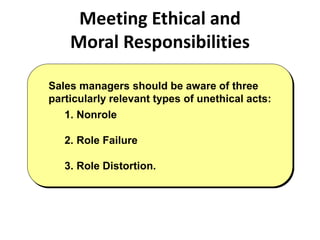
Meeting Ethical and
Moral Responsibilities
Sales managers should be aware of three
particularly relevant types of unethical acts:
1. Nonrole
2. Role Failure
3. Role Distortion.
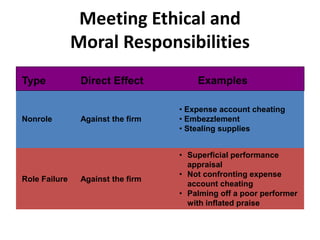
Meeting Ethical and
Moral Responsibilities
Nonrole Against the firm
• Expense account cheating
• Embezzlement
• Stealing supplies
Type Direct Effect Examples
Role Failure Against the firm
• Superficial performance
appraisal
• Not confronting expense
account cheating
• Palming off a poor performer
with inflated praise
Type Direct Effect Examples
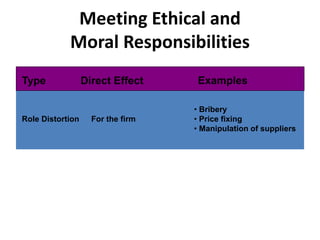
Meeting Ethical and
Moral Responsibilities
Role Distortion For the firm
• Bribery
• Price fixing
• Manipulation of suppliers
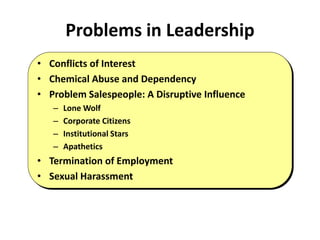
Problems in Leadership
• Conflicts of Interest
• Chemical Abuse and Dependency
• Problem Salespeople: A Disruptive Influence
– Lone Wolf
– Corporate Citizens
– Institutional Stars
– Apathetics
• Termination of Employment
• Sexual Harassment

10_6e sale management module 07

  • 1.
    Sales Leadership, Management, andSupervision Module Seven
  • 2.
    Sales Leadership, SalesManagement, and Sales Supervision Sales Leadership: The ability to influence others to achieve common goals for the collective good of the sales organization and company. Sales Management: Activities related to the planning, implementing, and controlling the sales function. Sales Supervision: Activities related to working with sales subordinates on a day-to-day basis.
  • 3.
    Contemporary Views of SalesLeadership • Leadership Style – Transactional leadership – Transformational Leadership • Leader-Member Exchange (LMX) Model – Leadership style is unique for each salesperson
  • 4.
    Situation Time Constraints Nature ofTasks History and Norms Needs Salespeople Other People Leadership Skills Anticipation Diagnostic Selection Communication - Influence Strategy - Communications Mechanisms Power Salespeople Other People Power Sales Manager Goals & Objectives Individual Organizational Sales Manager’s Leadership Effectiveness Leadership Model for Sales Management
  • 5.
    Power and Leadership Fivetypes of power which may be present in interpersonal relationships: Referent Power Legitimate Power Reward Power Coercive Power Expert Power
  • 6.
    Situational Factors • TraitApproach – identify traits of an effective leader • Behavior Approach – identify behaviors associated with effective leadership • Contingency Approach – leadership style is contingent upon situation
  • 7.
    Needs and Wantsof Salespeople • Important when coercive power is not being utilized • Realize all needs and wants cannot be met • Not all leadership directives need to be based on needs and wants • Consider each salesperson as a unique individual
  • 8.
    • Leadership iseasier when personal goals and objectives of the salespeople are consistent with those of the organization. • Sales managers strive to seek balance and consistency between organizational goals and their salespeople’s goals. Goals and Objectives
  • 9.
    Leadership Skills • Anticipatingand Seeking Feedback • Diagnostic • Selection and Matching • Communication
  • 10.
    Communication Skills: Influence Strategies •Threats (coercive power) • Promises (reward power) • Persuasion (expert or referent power) • Relationships (referent or legitimate power) • Manipulation
  • 11.
    Coaching • Take awe approach • Address only one or two problems at a time • Don’t focus on criticizing poor performance, reinforce good performance • Foster involvement • Recognize differences in salespeople and coach accordingly • Coordinate coaching with more formal sales training • Encourage continual growth and improvement • Insist salespeople evaluate themselves • Obtain agreement with respect to punishments and rewards • Keep good records The continuous development of salespeople through supervisory feedback and role modeling. Suggestions for affective coaching include:
  • 12.
    Planning and Conducting IntegrativeMeetings • Keep technical presentations succinct • Use visual aids and breakout discussion groups • Keep salespeople informed of corporate strategy and their role in it • Minimize operations review
  • 13.
    Planning and Conducting IntegrativeMeetings • Set a humane schedule. Allow time for sharing and adequate breaks • Set and communicate the agenda • Ask for input from the salespeople • Generate excitement with contests and other rewards
  • 14.
    Approaches to Management Ethics ImmoralManagement – Intentional and consistent management activity conflicting with what is moral (ethical). – Exploits opportunities for corporate gain. Cut corners when it appears useful. – Seeks profitability and organizational success at any price. – Selfish – Management cares only about its or the company’s gain.
  • 15.
    Approaches to Management Ethics AmoralManagement – Management activity that is neither consistently moral or immoral. Decisions lie outside the sphere to which moral judgments apply. – Give managers free rein. Personal ethics may apply but only if managers choose. Respond to legal mandates if caught and required to do so. – Seeks profitability. Other goals are not considered. – Well-Intentioned but selfish in the sense that impact on others is not considered.
  • 16.
    Approaches to Management Ethics MoralManagement – Management activity conforms to a standard of ethical or moral behavior. – Live by sound ethical standards. Assume leadership position when ethical dilemmas arise. Enlightened self- interest. – Seeks profitability within the confines of legal obedience and ethical standards – Management wants to succeed but only within the confines of sound ethical precepts.
  • 17.
    Meeting Ethical and MoralResponsibilities Sales managers should be aware of three particularly relevant types of unethical acts: 1. Nonrole 2. Role Failure 3. Role Distortion.
  • 18.
    Meeting Ethical and MoralResponsibilities Nonrole Against the firm • Expense account cheating • Embezzlement • Stealing supplies Type Direct Effect Examples Role Failure Against the firm • Superficial performance appraisal • Not confronting expense account cheating • Palming off a poor performer with inflated praise
  • 19.
    Type Direct EffectExamples Meeting Ethical and Moral Responsibilities Role Distortion For the firm • Bribery • Price fixing • Manipulation of suppliers
  • 20.
    Problems in Leadership •Conflicts of Interest • Chemical Abuse and Dependency • Problem Salespeople: A Disruptive Influence – Lone Wolf – Corporate Citizens – Institutional Stars – Apathetics • Termination of Employment • Sexual Harassment