Sales Presentation Delivery
Module Seven
Linking Solutions to Needs
• How the buyer’s needs will be met or how an
opportunity can be realized as a result of a purchase.
• How the product features translate, in a functional
sense, into benefits for the buyer.
• Why the buyer should purchase from the salesperson as
opposed to a competitive salesperson.
Salespeople should strive to communicate to the
buyer;
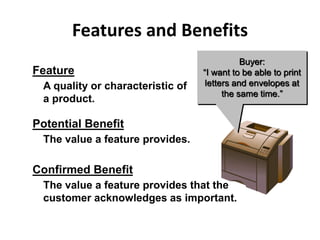
Features and Benefits
Feature
A quality or characteristic of
a product.
Potential Benefit
The value a feature provides.
Confirmed Benefit
The value a feature provides that the
customer acknowledges as important.
This printer has two
separate paper trays.
Two separate paper trays
allows the user to print
letters and envelopes at
the same time.
Buyer:
“I want to be able to print
letters and envelopes at
the same time.”
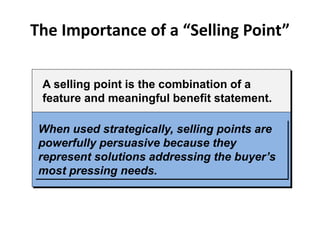
The Importance of a “Selling Point”
A selling point is the combination of a
feature and meaningful benefit statement.
When used strategically, selling points are
powerfully persuasive because they
represent solutions addressing the buyer’s
most pressing needs.
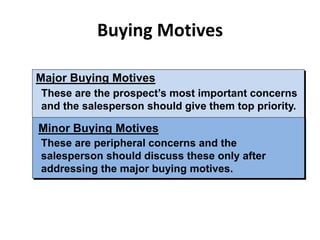
Buying Motives
Major Buying Motives
These are the prospect’s most important concerns
and the salesperson should give them top priority.
Minor Buying Motives
These are peripheral concerns and the
salesperson should discuss these only after
addressing the major buying motives.
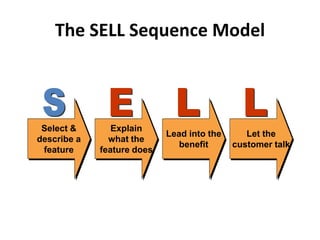
The SELL Sequence Model
Select &
describe a
feature
Explain
what the
feature does
Lead into the
benefit
Let the
customer talk
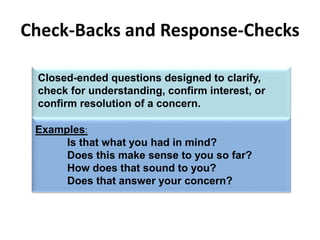
Examples:
Is that what you had in mind?
Does this make sense to you so far?
How does that sound to you?
Does that answer your concern?
Check-Backs and Response-Checks
Closed-ended questions designed to clarify,
check for understanding, confirm interest, or
confirm resolution of a concern.
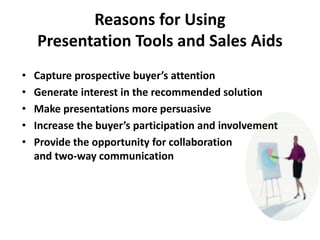
Reasons for Using
Presentation Tools and Sales Aids
• Capture prospective buyer’s attention
• Generate interest in the recommended solution
• Make presentations more persuasive
• Increase the buyer’s participation and involvement
• Provide the opportunity for collaboration
and two-way communication
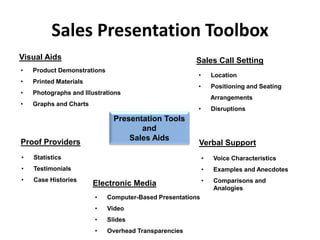
Sales Presentation Toolbox
Visual Aids
• Product Demonstrations
• Printed Materials
• Photographs and Illustrations
• Graphs and Charts
Sales Call Setting
• Location
• Positioning and Seating
Arrangements
• Disruptions
Verbal Support
• Voice Characteristics
• Examples and Anecdotes
• Comparisons and
Analogies
Electronic Media
• Computer-Based Presentations
• Video
• Slides
• Overhead Transparencies
Proof Providers
• Statistics
• Testimonials
• Case Histories
Presentation Tools
and
Sales Aids
Sales Aids: Sales Call Setting
• Location
• Positioning & Seating Arrangements
• Disruptions
Sales Aids: Proof Providers
• Statistics
• Testimonials
• Case Histories
“In January, Fortune
magazine recognized
CDW as the top rated
technology vendor
on the basis of
services provided to
the buying
customer.”
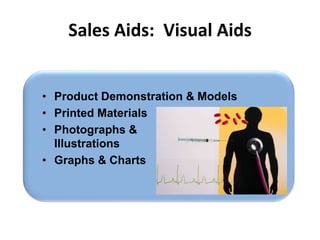
Sales Aids: Visual Aids
• Product Demonstration & Models
• Printed Materials
• Photographs &
Illustrations
• Graphs & Charts
Sales Aids: Electronic Media
• Computer-Based Presentations
• Video
• Slides
• Overhead Transparencies
Group Sales Presentations
“When selling to groups, salespeople can
expect tough questions and should prepare
accordingly”
“When selling to a group, salespeople
should take every opportunity to pre-sell
individual group members prior to the
group presentation”
Sales Tactics for Selling to Groups
• Arrival – Arrive and setup before the buying
group
• Eye Contact – Make periodic eye contact with
each member of the buying group
• Communication – Solicit opinions and feedback
from each member of the buying group and
avoid taking sides
Handling Questions
in Group Presentation
• Listen carefully and maintain eye contact with the
person asking the question
• Repeat or restate the question as necessary to
ensure understanding
• Answer each question succinctly and convincingly
Addressing Concerns
and Earning Commitment
Module Eight
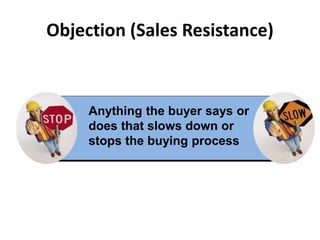
Objection (Sales Resistance)
Anything the buyer says or
does that slows down or
stops the buying process
Reasons Why
Prospects Raise Objections
• The prospect wants to avoid the sales interview.
• The salesperson has failed to prospect and qualify
properly.
• Objecting is a matter of custom.
• The prospect resists change.
• The prospect fails to recognize a need.
• Prospect lacks information.
Examples
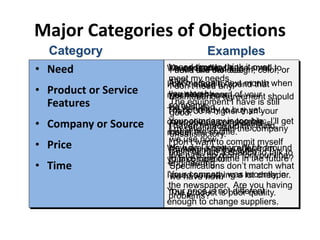
Major Categories of Objections
• Need
• Product or Service
Features
• Company or Source
• Price
• Time
I have all I can use.
I don’t need any.
The equipment I have is still
good.
I’m satisfied with the company
we use now.
We have no room for your line.
I don’t like the design, color, or
style.
Maintenance agreement should
be included.
Performance of product is
unsatisfactory.
Packaging is too bulky.
Specifications don’t match what
we have now.
The product is poor quality.
Your company is too small to
meet my needs.
I’ve never heard of your
company.
Your company is too big; I’ll get
lost in the shuffle.
How do I know you’ll be around
to take care of me in the future?
Your company was recently in
the newspaper. Are you having
problems?
We can’t afford it.
I can’t afford to spend that
much right now.
That’s 30% higher than your
competitor’s comparable
model.
We have a better offer from
your competitor.
I need something a lot cheaper.
Your price is not different
enough to change suppliers.
I need time to think it over.
Ask me again next month when
you stop by.
I’m not ready to buy yet.
I haven’t made up my mind.
I don’t want to commit myself
until I’ve had a chance to talk to
engineering.
Category
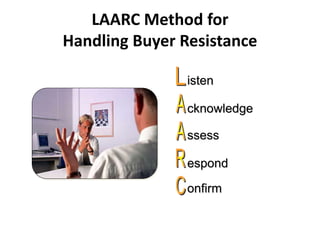
LAARC Method for
Handling Buyer Resistance
isten
cknowledge
ssess
espond
onfirm
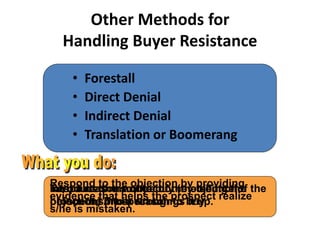
Other Methods for
Handling Buyer Resistance
• Forestall
• Direct Denial
• Indirect Denial
• Translation or Boomerang
Introduce the source of the objection
before the prospect brings it up.
Respond to the objection by telling the
prospect s/he is wrong.
Respond to the objection by providing
evidence that helps the prospect realize
s/he is mistaken.
Turn a reason not to buy (the source of the
objection) into a reason to buy.
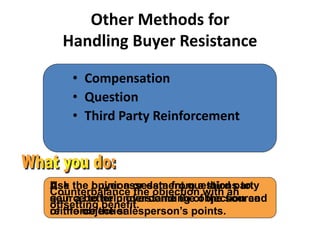
Other Methods for
Handling Buyer Resistance
• Compensation
• Question
• Third Party Reinforcement
Counterbalance the objection with an
offsetting benefit.
Ask the buyer assessment questions to
gain a better understanding of the source
of the objection.
Use the opinion or data from a third party
source to help overcome the objection and
reinforce the salesperson’s points.
Commitment
• The creation of an obligation between the
seller and buyer.
• The seller obtains the buyer’s obligation to a
specific action.
• The specific action is usually linked directly to
one of the sales call objectives.
What Constitutes Commitment
• An Appointment
• Agreement for next meeting
• Agreement for product demo
• A sale
Guidelines for Earning Commitment
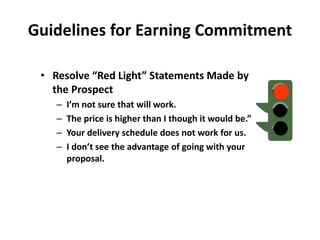
• Resolve “Red Light” Statements Made by
the Prospect
– I’m not sure that will work.
– The price is higher than I though it would be.”
– Your delivery schedule does not work for us.
– I don’t see the advantage of going with your
proposal.
Guidelines for Earning Commitment
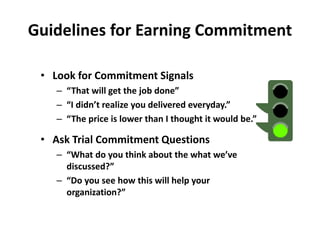
• Look for Commitment Signals
– “That will get the job done”
– “I didn’t realize you delivered everyday.”
– “The price is lower than I thought it would be.”
• Ask Trial Commitment Questions
– “What do you think about the what we’ve
discussed?”
– “Do you see how this will help your
organization?”
Techniques to Earn Commitment
• Ask for the Order/Direct Commitment
– Simply Ask for the Order
• Legitimate Choice/Alternative Choice
– Give the Prospect a Limited Number of Choices
• Summary Commitment
– Summarize All the Confirmed Benefits That Have Been
Agreed To
Techniques to Earn Commitment
• T-Account or Balance Sheet Commitment
– Summary Close on Paper
• Success Story Commitment
– Salesperson Tells a Story of a Business That
Successfully Solved a Problem by Buying His or Her
Product.
Dealing with Yes!
• Obtain the customer’s signature
• Provide a plan of action (i.e., answer the
question “now what?”)
• Answer any remaining questions.
• Assure the buyer you will follow-up
• Thank the customer for the business
Dealing with No!
• Evaluate the customer’s explanation
• Maintain the relationship foundation
• Understand rejection is a fact of life
• Evaluate your performance
• Learn from the situation
• Make improvements

07 module 07

  • 1.
  • 2.
    Linking Solutions toNeeds • How the buyer’s needs will be met or how an opportunity can be realized as a result of a purchase. • How the product features translate, in a functional sense, into benefits for the buyer. • Why the buyer should purchase from the salesperson as opposed to a competitive salesperson. Salespeople should strive to communicate to the buyer;
  • 3.
    Features and Benefits Feature Aquality or characteristic of a product. Potential Benefit The value a feature provides. Confirmed Benefit The value a feature provides that the customer acknowledges as important. This printer has two separate paper trays. Two separate paper trays allows the user to print letters and envelopes at the same time. Buyer: “I want to be able to print letters and envelopes at the same time.”
  • 4.
    The Importance ofa “Selling Point” A selling point is the combination of a feature and meaningful benefit statement. When used strategically, selling points are powerfully persuasive because they represent solutions addressing the buyer’s most pressing needs.
  • 5.
    Buying Motives Major BuyingMotives These are the prospect’s most important concerns and the salesperson should give them top priority. Minor Buying Motives These are peripheral concerns and the salesperson should discuss these only after addressing the major buying motives.
  • 6.
    The SELL SequenceModel Select & describe a feature Explain what the feature does Lead into the benefit Let the customer talk
  • 7.
    Examples: Is that whatyou had in mind? Does this make sense to you so far? How does that sound to you? Does that answer your concern? Check-Backs and Response-Checks Closed-ended questions designed to clarify, check for understanding, confirm interest, or confirm resolution of a concern.
  • 8.
    Reasons for Using PresentationTools and Sales Aids • Capture prospective buyer’s attention • Generate interest in the recommended solution • Make presentations more persuasive • Increase the buyer’s participation and involvement • Provide the opportunity for collaboration and two-way communication
  • 9.
    Sales Presentation Toolbox VisualAids • Product Demonstrations • Printed Materials • Photographs and Illustrations • Graphs and Charts Sales Call Setting • Location • Positioning and Seating Arrangements • Disruptions Verbal Support • Voice Characteristics • Examples and Anecdotes • Comparisons and Analogies Electronic Media • Computer-Based Presentations • Video • Slides • Overhead Transparencies Proof Providers • Statistics • Testimonials • Case Histories Presentation Tools and Sales Aids
  • 10.
    Sales Aids: SalesCall Setting • Location • Positioning & Seating Arrangements • Disruptions
  • 11.
    Sales Aids: ProofProviders • Statistics • Testimonials • Case Histories “In January, Fortune magazine recognized CDW as the top rated technology vendor on the basis of services provided to the buying customer.”
  • 12.
    Sales Aids: VisualAids • Product Demonstration & Models • Printed Materials • Photographs & Illustrations • Graphs & Charts
  • 13.
    Sales Aids: ElectronicMedia • Computer-Based Presentations • Video • Slides • Overhead Transparencies
  • 14.
    Group Sales Presentations “Whenselling to groups, salespeople can expect tough questions and should prepare accordingly” “When selling to a group, salespeople should take every opportunity to pre-sell individual group members prior to the group presentation”
  • 15.
    Sales Tactics forSelling to Groups • Arrival – Arrive and setup before the buying group • Eye Contact – Make periodic eye contact with each member of the buying group • Communication – Solicit opinions and feedback from each member of the buying group and avoid taking sides
  • 16.
    Handling Questions in GroupPresentation • Listen carefully and maintain eye contact with the person asking the question • Repeat or restate the question as necessary to ensure understanding • Answer each question succinctly and convincingly
  • 17.
    Addressing Concerns and EarningCommitment Module Eight
  • 18.
    Objection (Sales Resistance) Anythingthe buyer says or does that slows down or stops the buying process
  • 19.
    Reasons Why Prospects RaiseObjections • The prospect wants to avoid the sales interview. • The salesperson has failed to prospect and qualify properly. • Objecting is a matter of custom. • The prospect resists change. • The prospect fails to recognize a need. • Prospect lacks information.
  • 20.
    Examples Major Categories ofObjections • Need • Product or Service Features • Company or Source • Price • Time I have all I can use. I don’t need any. The equipment I have is still good. I’m satisfied with the company we use now. We have no room for your line. I don’t like the design, color, or style. Maintenance agreement should be included. Performance of product is unsatisfactory. Packaging is too bulky. Specifications don’t match what we have now. The product is poor quality. Your company is too small to meet my needs. I’ve never heard of your company. Your company is too big; I’ll get lost in the shuffle. How do I know you’ll be around to take care of me in the future? Your company was recently in the newspaper. Are you having problems? We can’t afford it. I can’t afford to spend that much right now. That’s 30% higher than your competitor’s comparable model. We have a better offer from your competitor. I need something a lot cheaper. Your price is not different enough to change suppliers. I need time to think it over. Ask me again next month when you stop by. I’m not ready to buy yet. I haven’t made up my mind. I don’t want to commit myself until I’ve had a chance to talk to engineering. Category
  • 21.
    LAARC Method for HandlingBuyer Resistance isten cknowledge ssess espond onfirm
  • 22.
    Other Methods for HandlingBuyer Resistance • Forestall • Direct Denial • Indirect Denial • Translation or Boomerang Introduce the source of the objection before the prospect brings it up. Respond to the objection by telling the prospect s/he is wrong. Respond to the objection by providing evidence that helps the prospect realize s/he is mistaken. Turn a reason not to buy (the source of the objection) into a reason to buy.
  • 23.
    Other Methods for HandlingBuyer Resistance • Compensation • Question • Third Party Reinforcement Counterbalance the objection with an offsetting benefit. Ask the buyer assessment questions to gain a better understanding of the source of the objection. Use the opinion or data from a third party source to help overcome the objection and reinforce the salesperson’s points.
  • 24.
    Commitment • The creationof an obligation between the seller and buyer. • The seller obtains the buyer’s obligation to a specific action. • The specific action is usually linked directly to one of the sales call objectives.
  • 25.
    What Constitutes Commitment •An Appointment • Agreement for next meeting • Agreement for product demo • A sale
  • 26.
    Guidelines for EarningCommitment • Resolve “Red Light” Statements Made by the Prospect – I’m not sure that will work. – The price is higher than I though it would be.” – Your delivery schedule does not work for us. – I don’t see the advantage of going with your proposal.
  • 27.
    Guidelines for EarningCommitment • Look for Commitment Signals – “That will get the job done” – “I didn’t realize you delivered everyday.” – “The price is lower than I thought it would be.” • Ask Trial Commitment Questions – “What do you think about the what we’ve discussed?” – “Do you see how this will help your organization?”
  • 28.
    Techniques to EarnCommitment • Ask for the Order/Direct Commitment – Simply Ask for the Order • Legitimate Choice/Alternative Choice – Give the Prospect a Limited Number of Choices • Summary Commitment – Summarize All the Confirmed Benefits That Have Been Agreed To
  • 29.
    Techniques to EarnCommitment • T-Account or Balance Sheet Commitment – Summary Close on Paper • Success Story Commitment – Salesperson Tells a Story of a Business That Successfully Solved a Problem by Buying His or Her Product.
  • 30.
    Dealing with Yes! •Obtain the customer’s signature • Provide a plan of action (i.e., answer the question “now what?”) • Answer any remaining questions. • Assure the buyer you will follow-up • Thank the customer for the business
  • 31.
    Dealing with No! •Evaluate the customer’s explanation • Maintain the relationship foundation • Understand rejection is a fact of life • Evaluate your performance • Learn from the situation • Make improvements