Sales Organization Structure and
Sales Force Deployment
Module Four
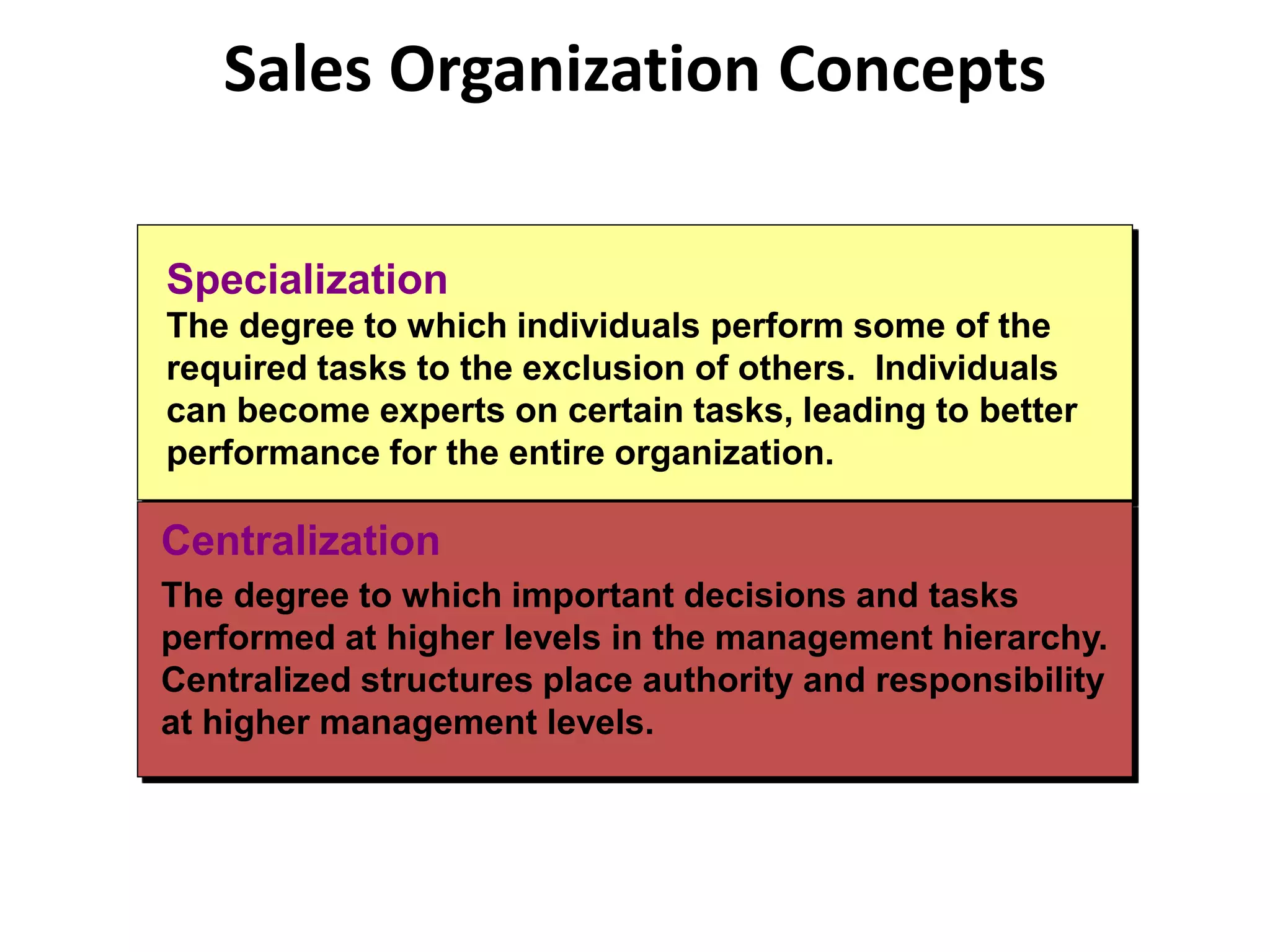
Sales Organization Concepts
Specialization
The degree to which individuals perform some of the
required tasks to the exclusion of others. Individuals
can become experts on certain tasks, leading to better
performance for the entire organization.
Centralization
The degree to which important decisions and tasks
performed at higher levels in the management hierarchy.
Centralized structures place authority and responsibility
at higher management levels.
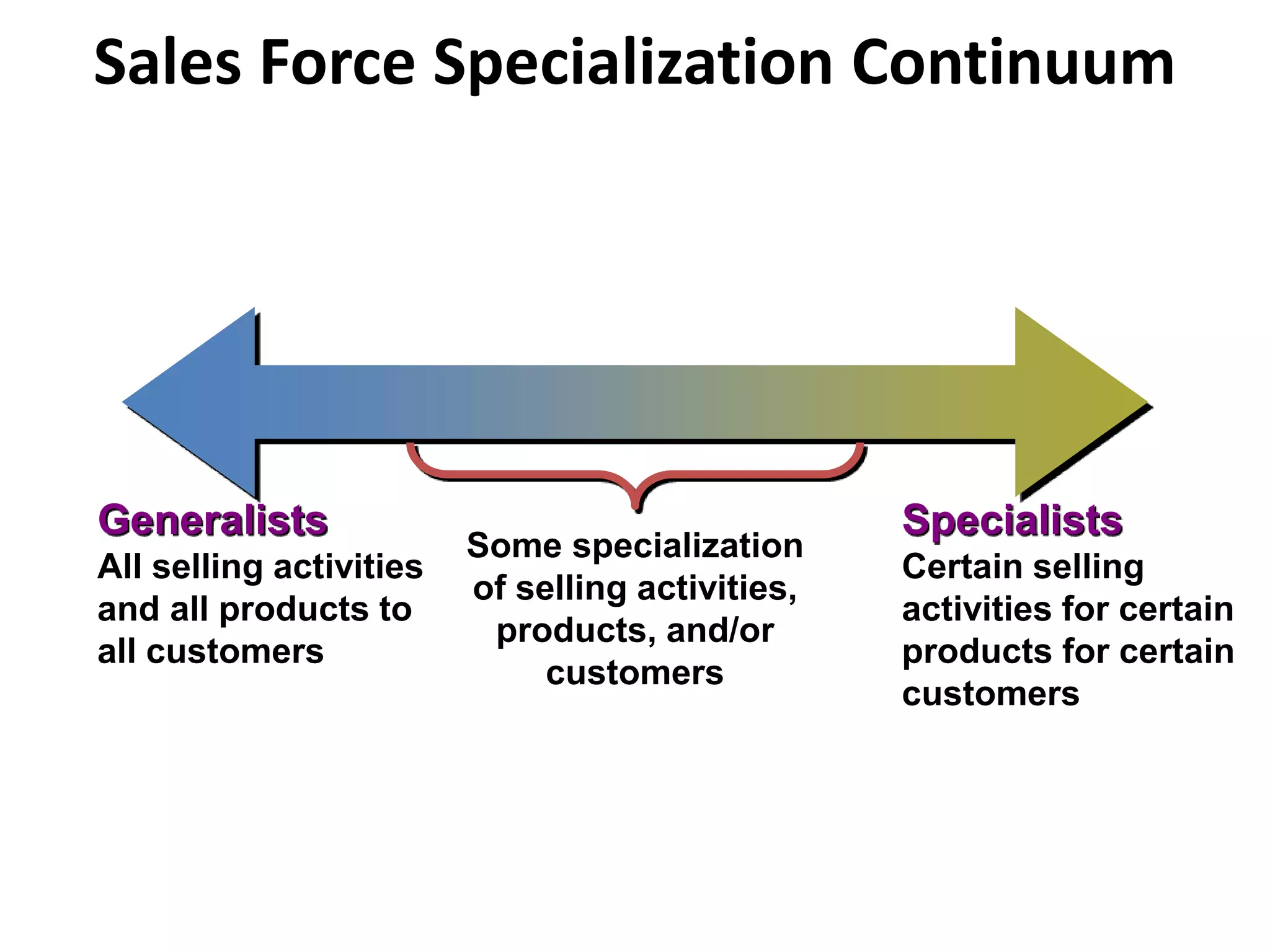
Sales Force Specialization Continuum
Some specialization
of selling activities,
products, and/or
customers
All selling activities
and all products to
all customers
Generalists
Certain selling
activities for certain
products for certain
customers
Specialists
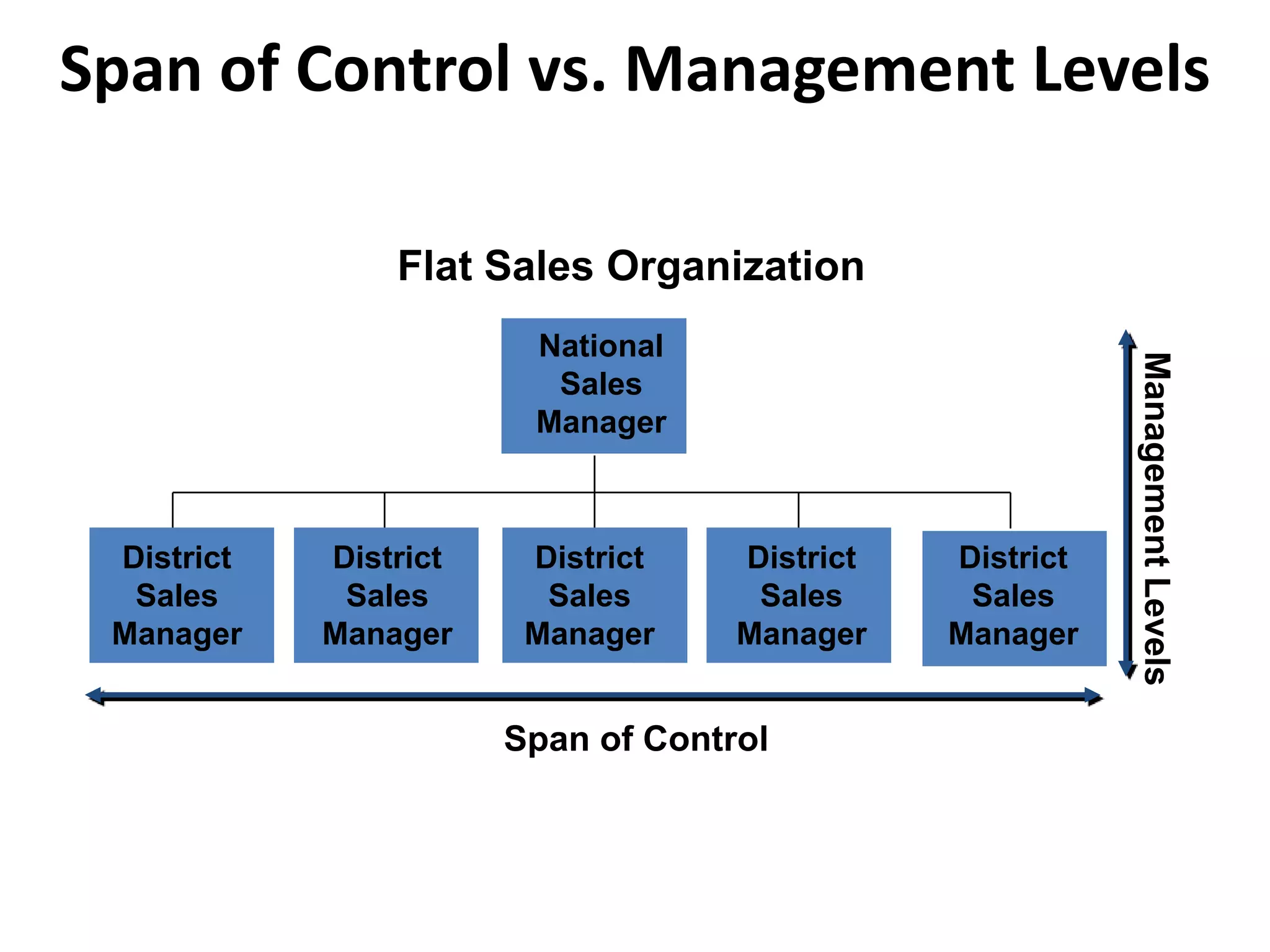
Flat Sales Organization
Span of Control
ManagementLevels
National
Sales
Manager
District
Sales
Manager
District
Sales
Manager
District
Sales
Manager
District
Sales
Manager
District
Sales
Manager
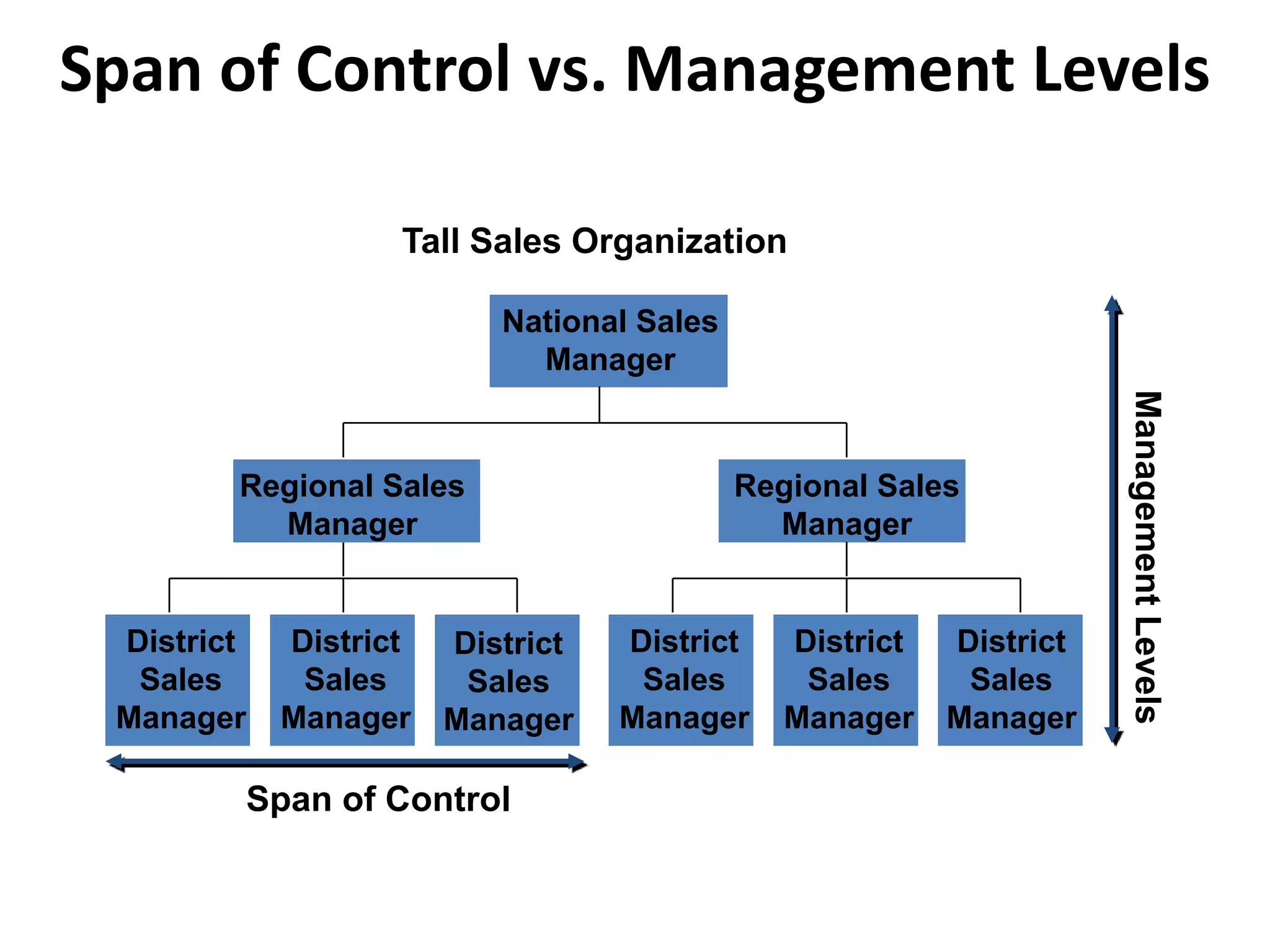
Span of Control vs. Management Levels
Tall Sales Organization
National Sales
Manager
Span of Control
ManagementLevels
District
Sales
Manager
District
Sales
Manager
District
Sales
Manager
District
Sales
Manager
District
Sales
Manager
District
Sales
Manager
Regional Sales
Manager
Regional Sales
Manager
Span of Control vs. Management Levels
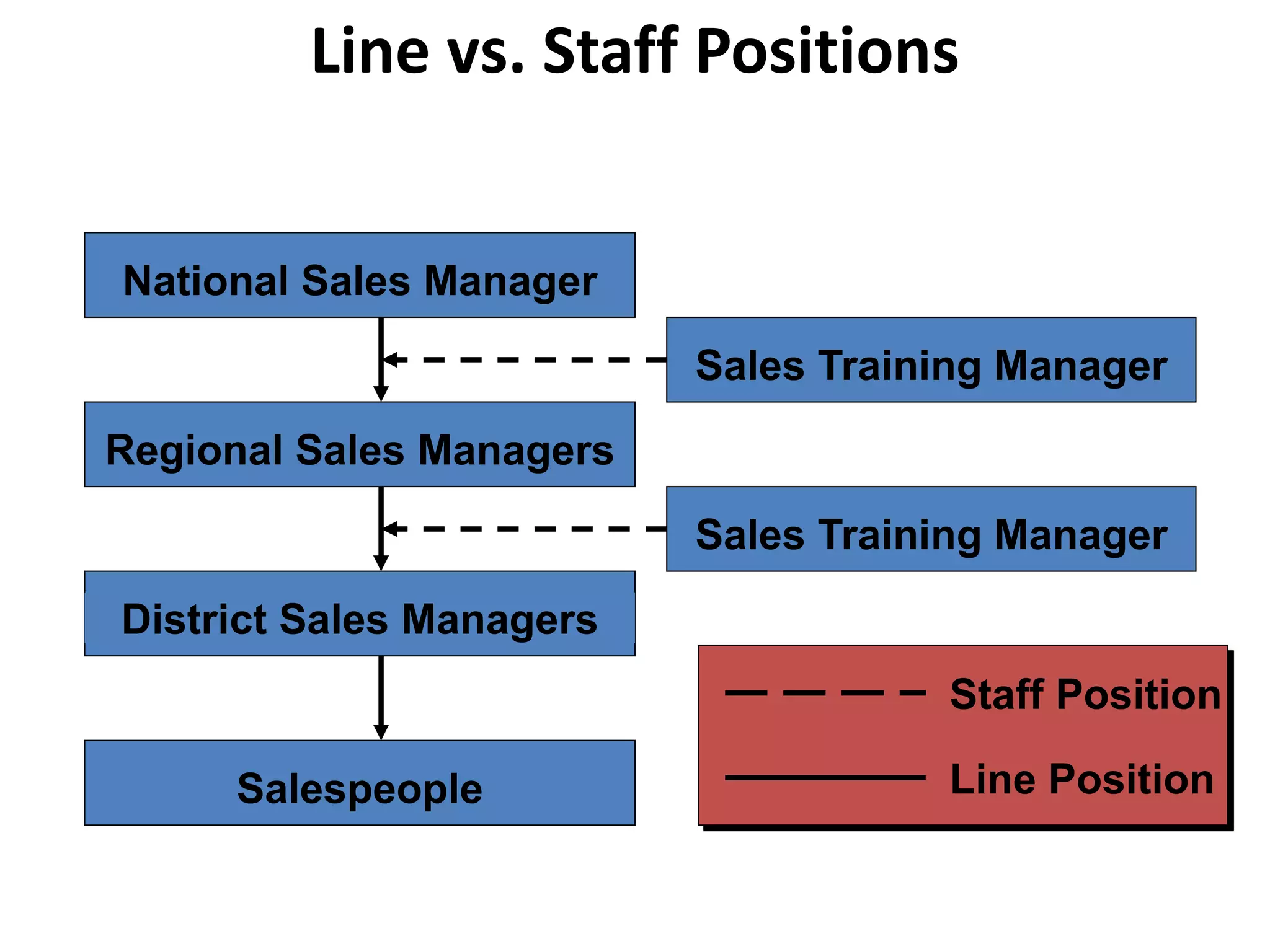
National Sales Manager
Regional Sales Managers
District Sales Managers
Sales Training Manager
Salespeople
Staff Position
Line Position
Line vs. Staff Positions
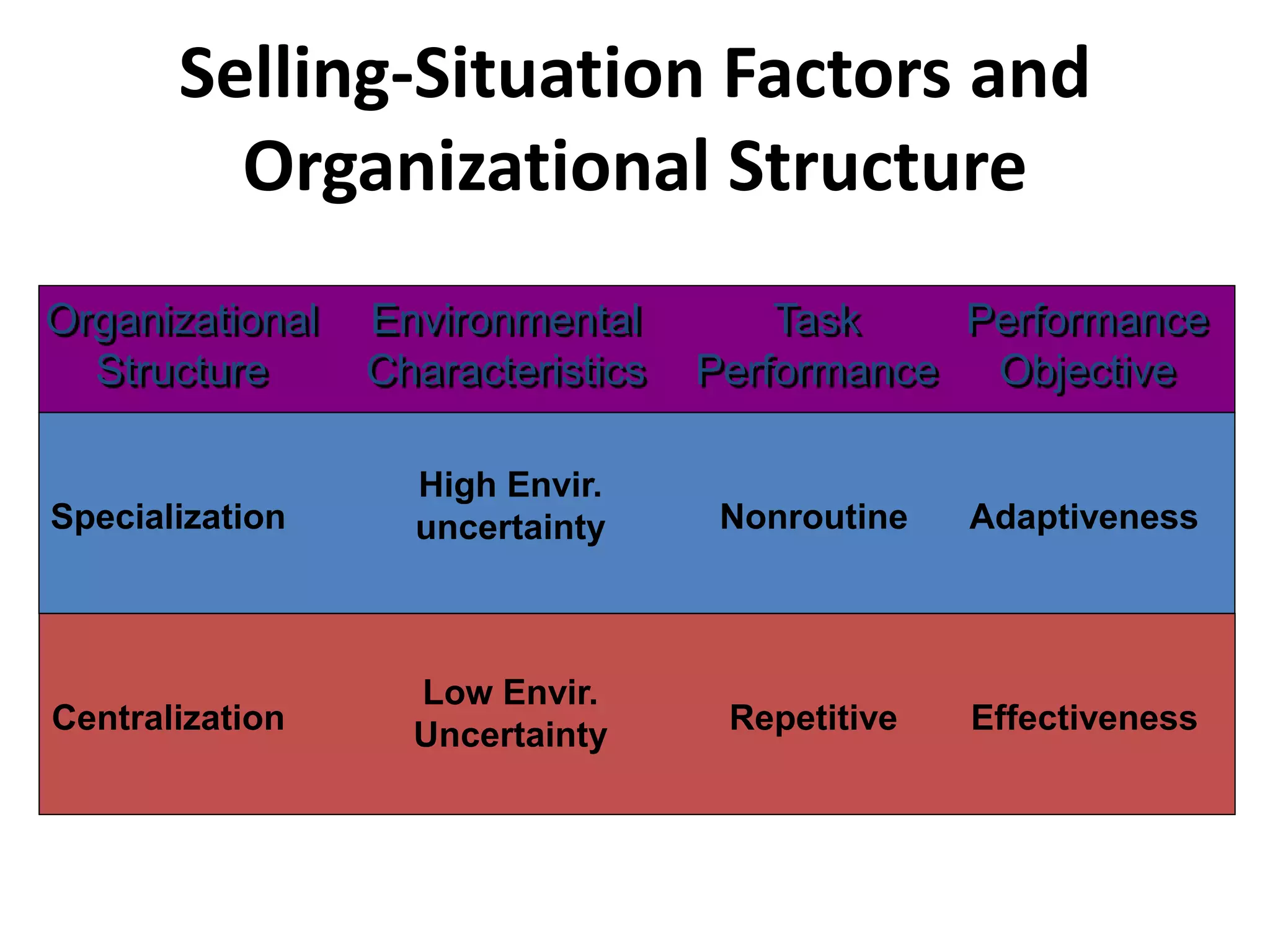
Organizational
Structure
Environmental
Characteristics
Task
Performance
Performance
Objective
Specialization
High Envir.
uncertainty Nonroutine Adaptiveness
Centralization
Low Envir.
Uncertainty Repetitive Effectiveness
Selling-Situation Factors and
Organizational Structure
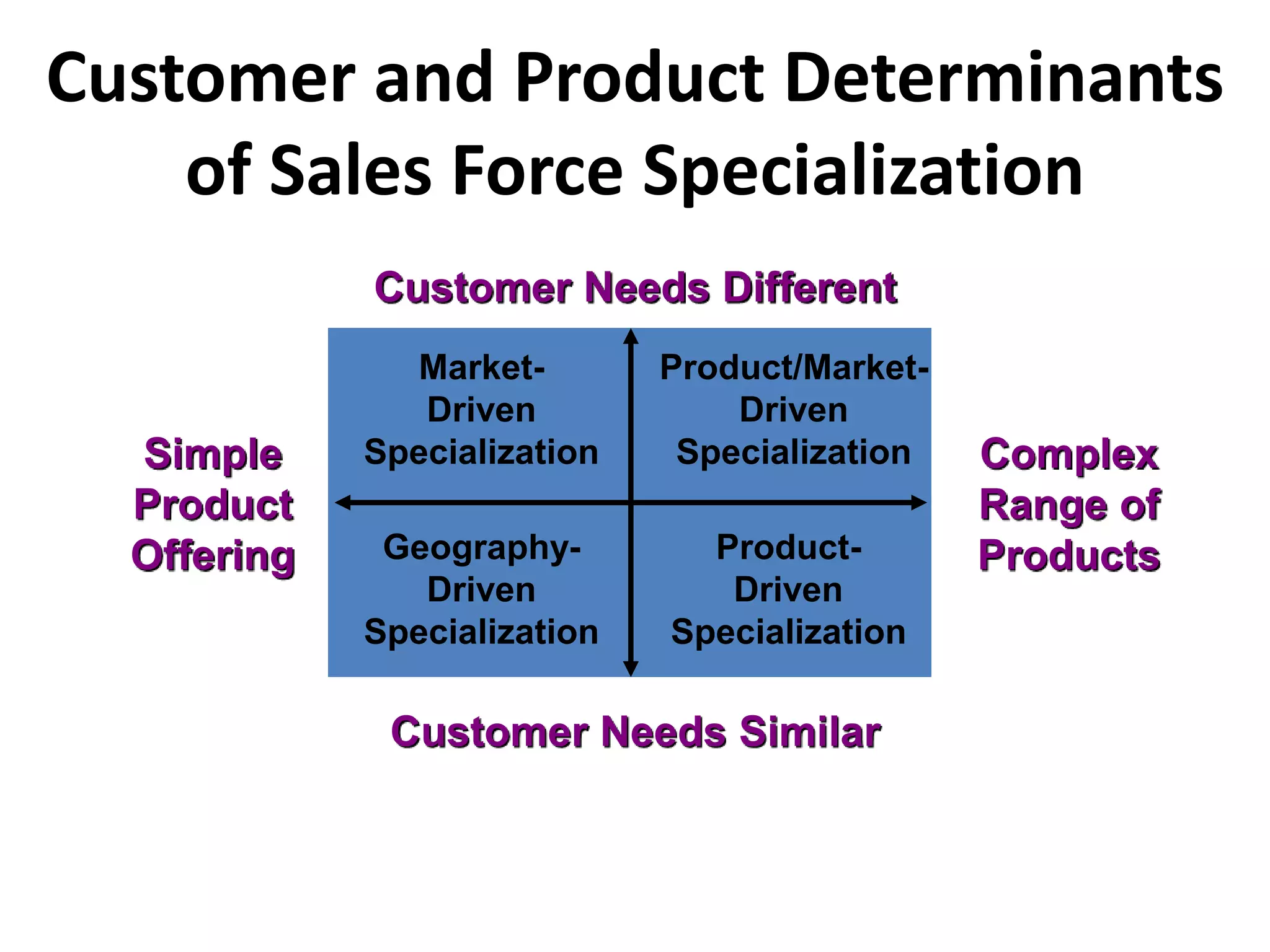
Simple
Product
Offering
Complex
Range of
Products
Customer Needs Different
Customer Needs Similar
Market-
Driven
Specialization
Product/Market-
Driven
Specialization
Geography-
Driven
Specialization
Product-
Driven
Specialization
Customer and Product Determinants
of Sales Force Specialization
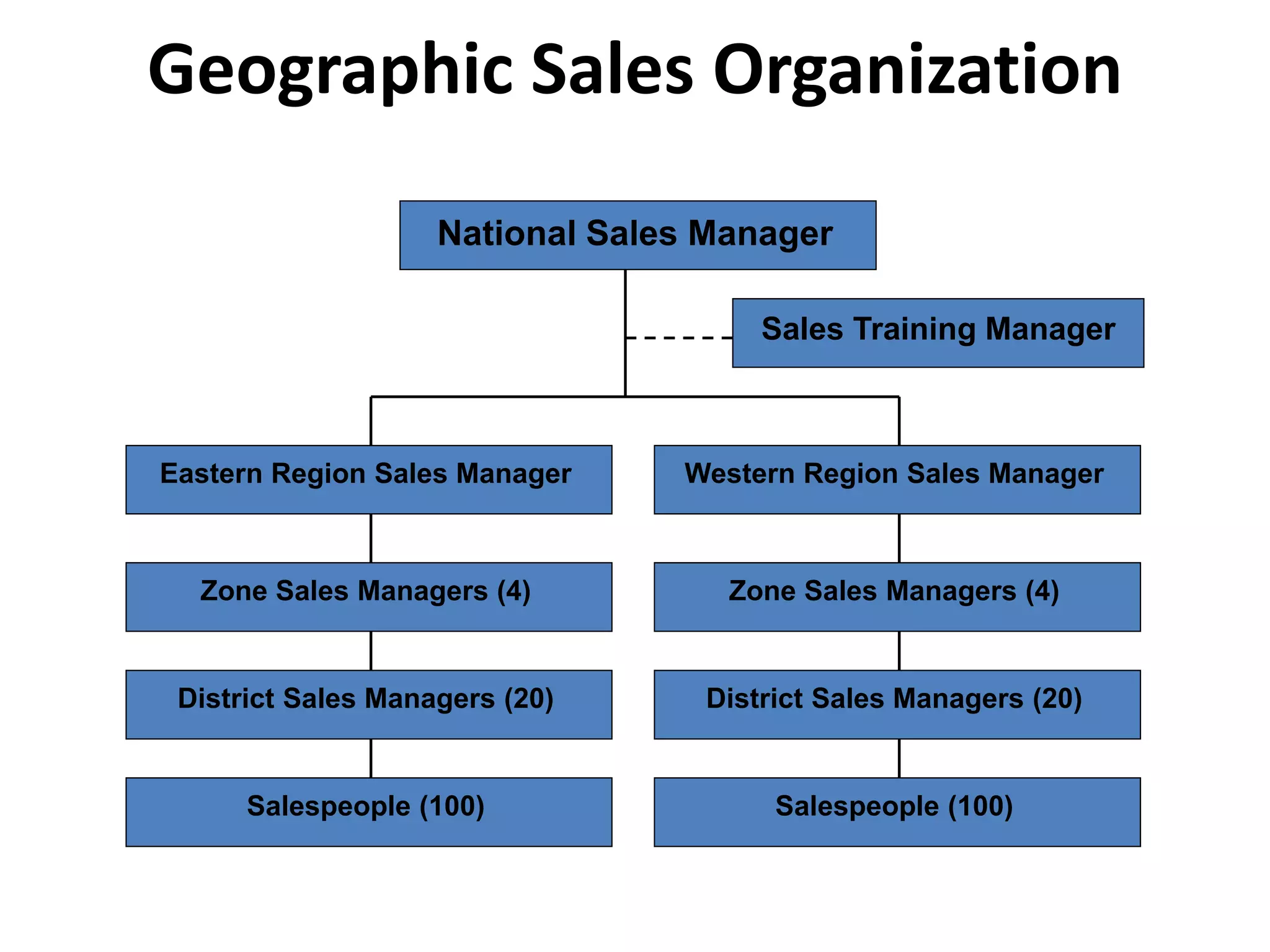
Geographic Sales Organization
National Sales Manager
Zone Sales Managers (4) Zone Sales Managers (4)
District Sales Managers (20)
Salespeople (100) Salespeople (100)
District Sales Managers (20)
Eastern Region Sales Manager Western Region Sales Manager
Sales Training Manager
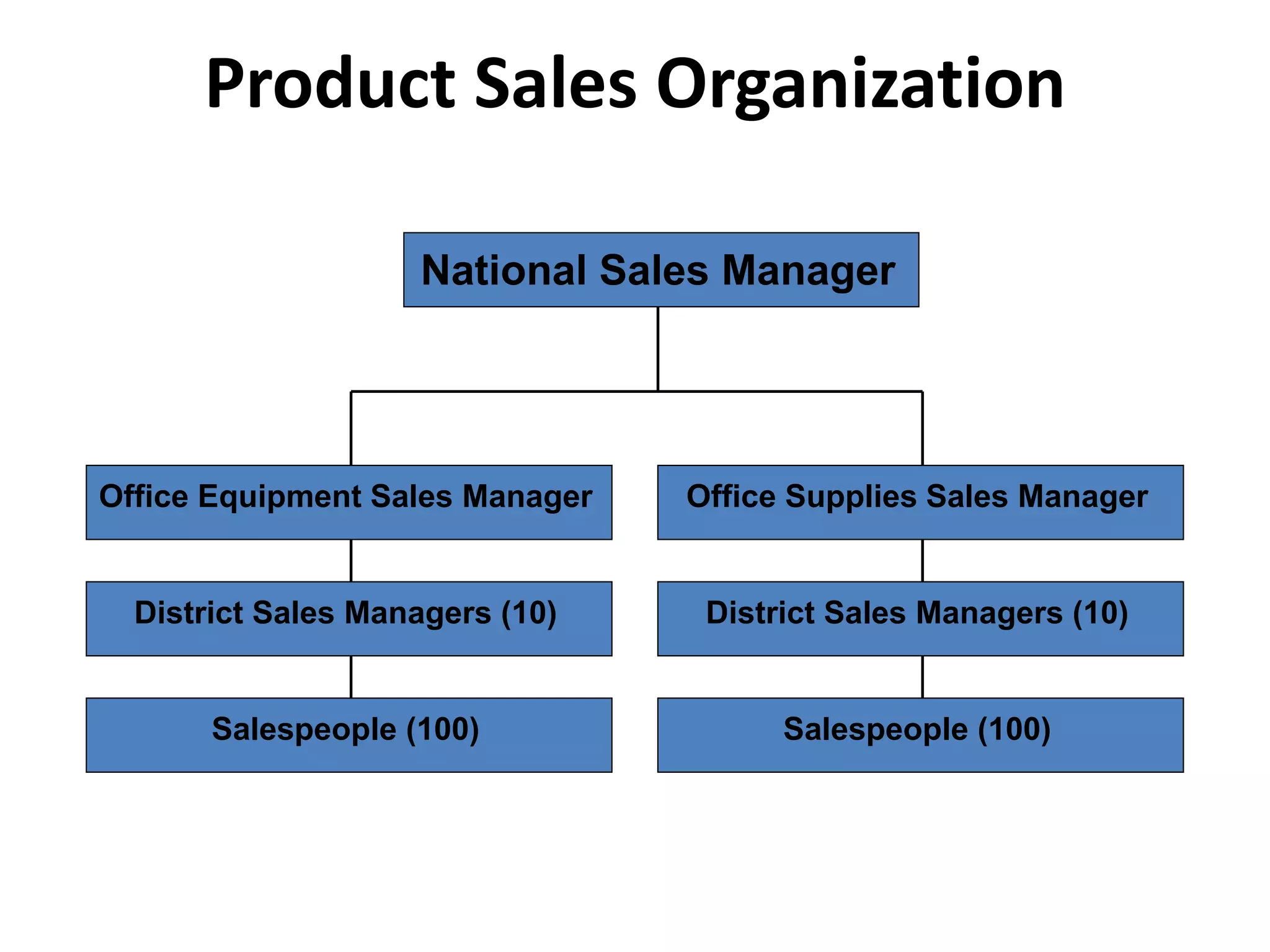
Product Sales Organization
National Sales Manager
Office Equipment Sales Manager Office Supplies Sales Manager
District Sales Managers (10)
Salespeople (100) Salespeople (100)
District Sales Managers (10)
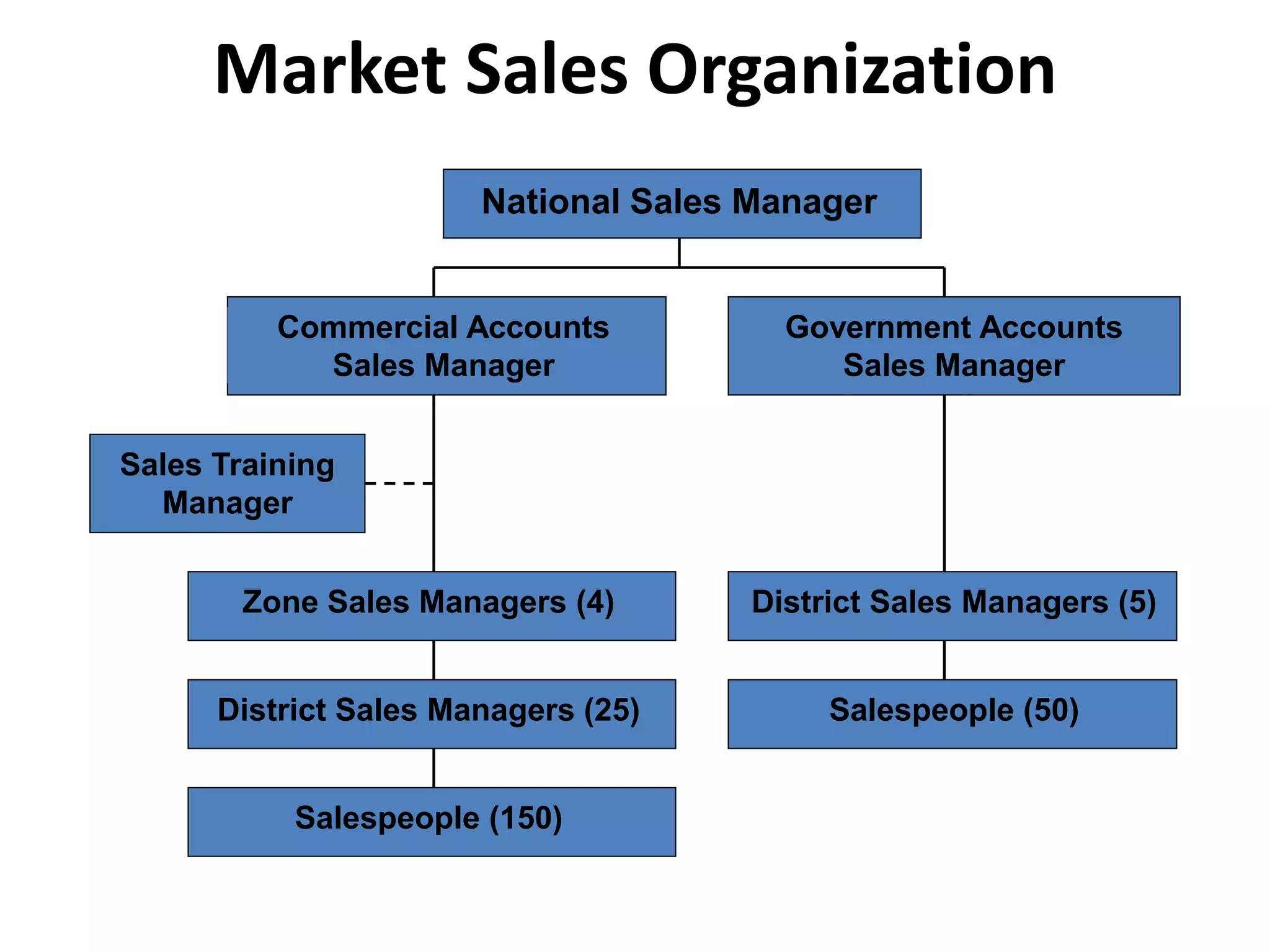
Market Sales Organization
National Sales Manager
Zone Sales Managers (4)
District Sales Managers (25)
Salespeople (150)
District Sales Managers (5)
Commercial Accounts
Sales Manager
Government Accounts
Sales Manager
Sales Training
Manager
Salespeople (50)
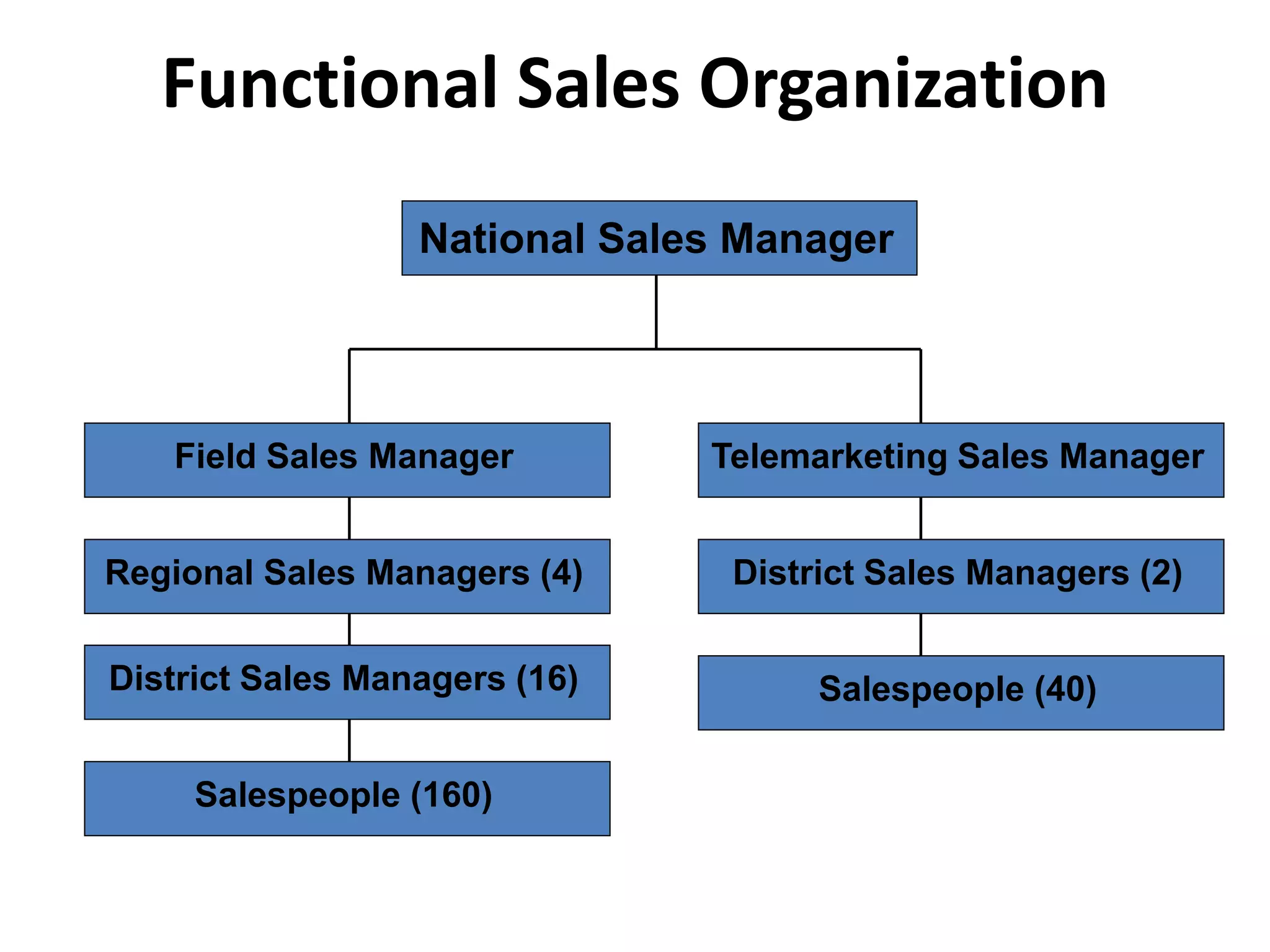
Functional Sales Organization
National Sales Manager
Field Sales Manager Telemarketing Sales Manager
Regional Sales Managers (4)
Salespeople (160)
Salespeople (40)
District Sales Managers (2)
District Sales Managers (16)
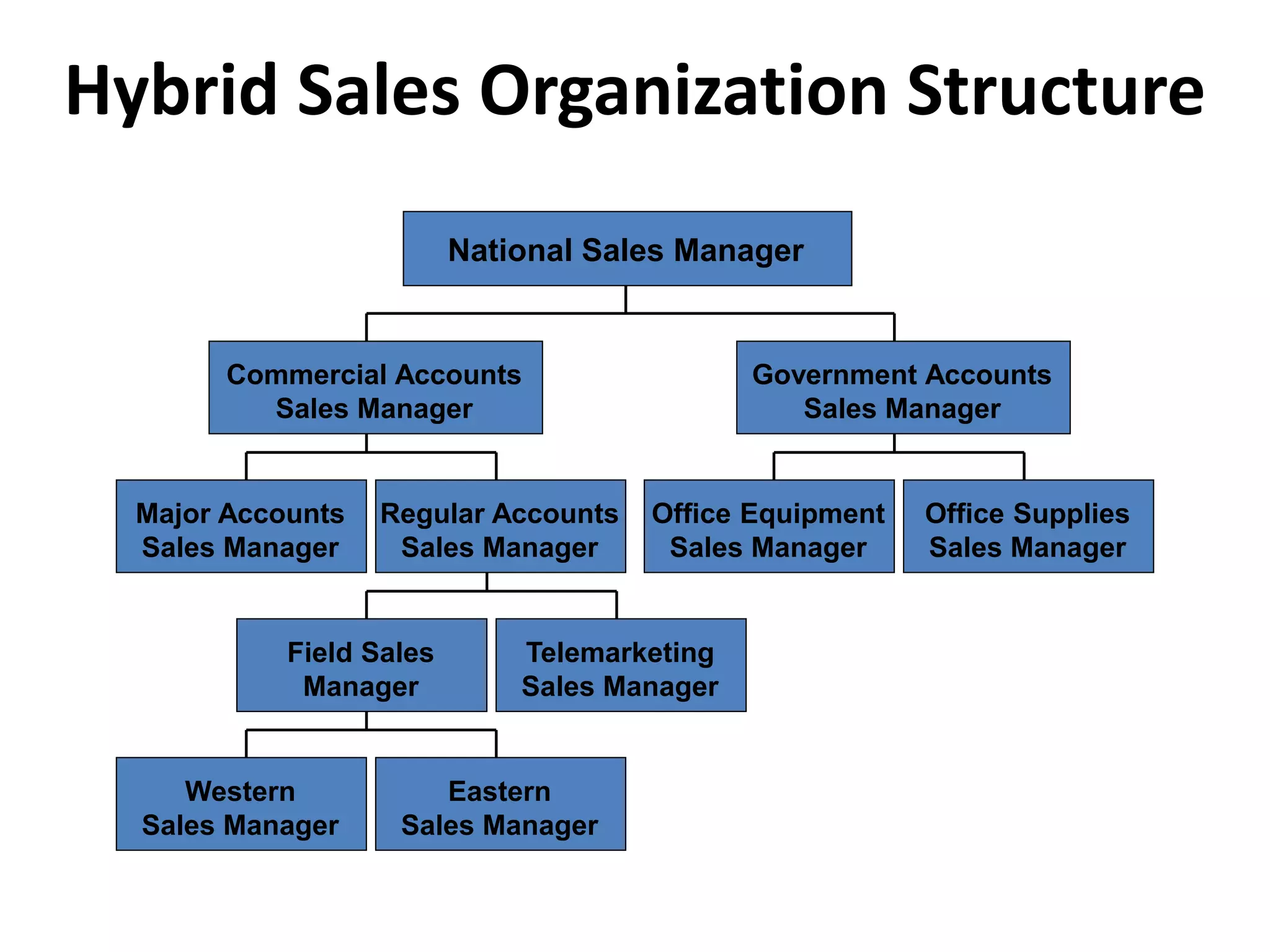
Hybrid Sales Organization Structure
National Sales Manager
Major Accounts
Sales Manager
Regular Accounts
Sales Manager
Office Equipment
Sales Manager
Office Supplies
Sales Manager
Field Sales
Manager
Telemarketing
Sales Manager
Commercial Accounts
Sales Manager
Government Accounts
Sales Manager
Western
Sales Manager
Eastern
Sales Manager
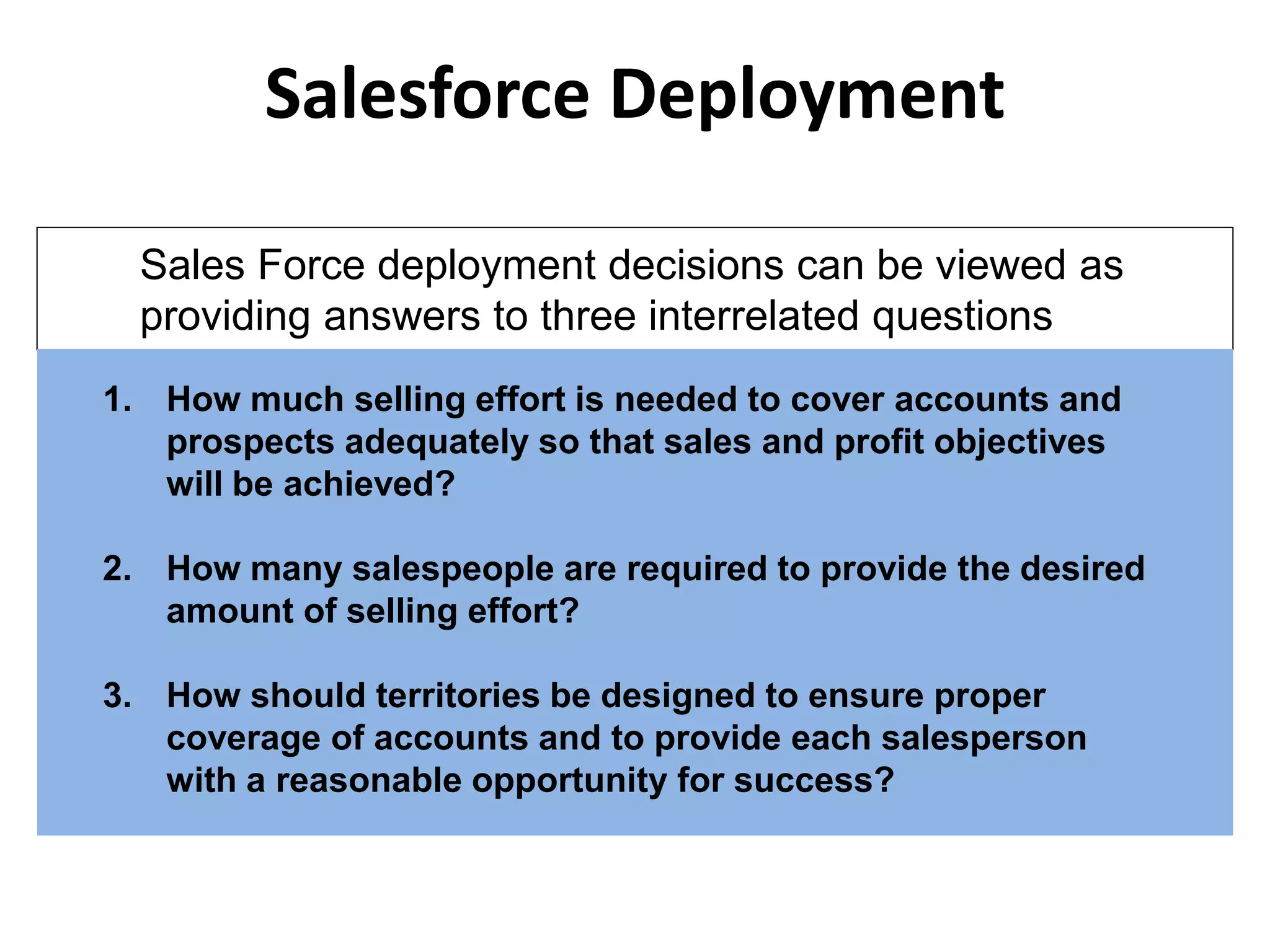
Salesforce Deployment
1. How much selling effort is needed to cover accounts and
prospects adequately so that sales and profit objectives
will be achieved?
2. How many salespeople are required to provide the desired
amount of selling effort?
3. How should territories be designed to ensure proper
coverage of accounts and to provide each salesperson
with a reasonable opportunity for success?
Sales Force deployment decisions can be viewed as
providing answers to three interrelated questions
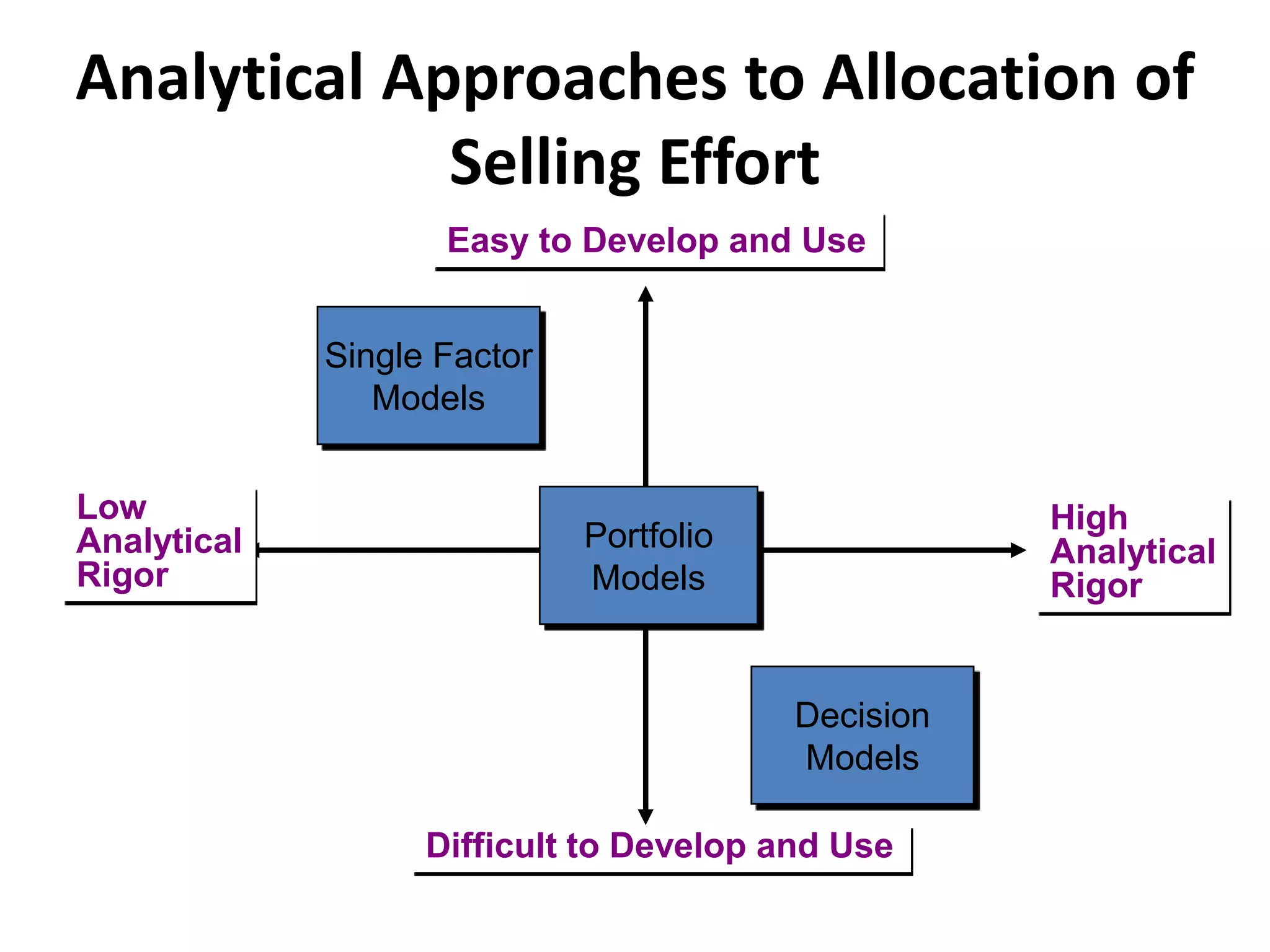
Single Factor
Models
Easy to Develop and Use
Difficult to Develop and Use
Low
Analytical
Rigor
High
Analytical
Rigor
Portfolio
Models
Decision
Models
Analytical Approaches to Allocation of
Selling Effort
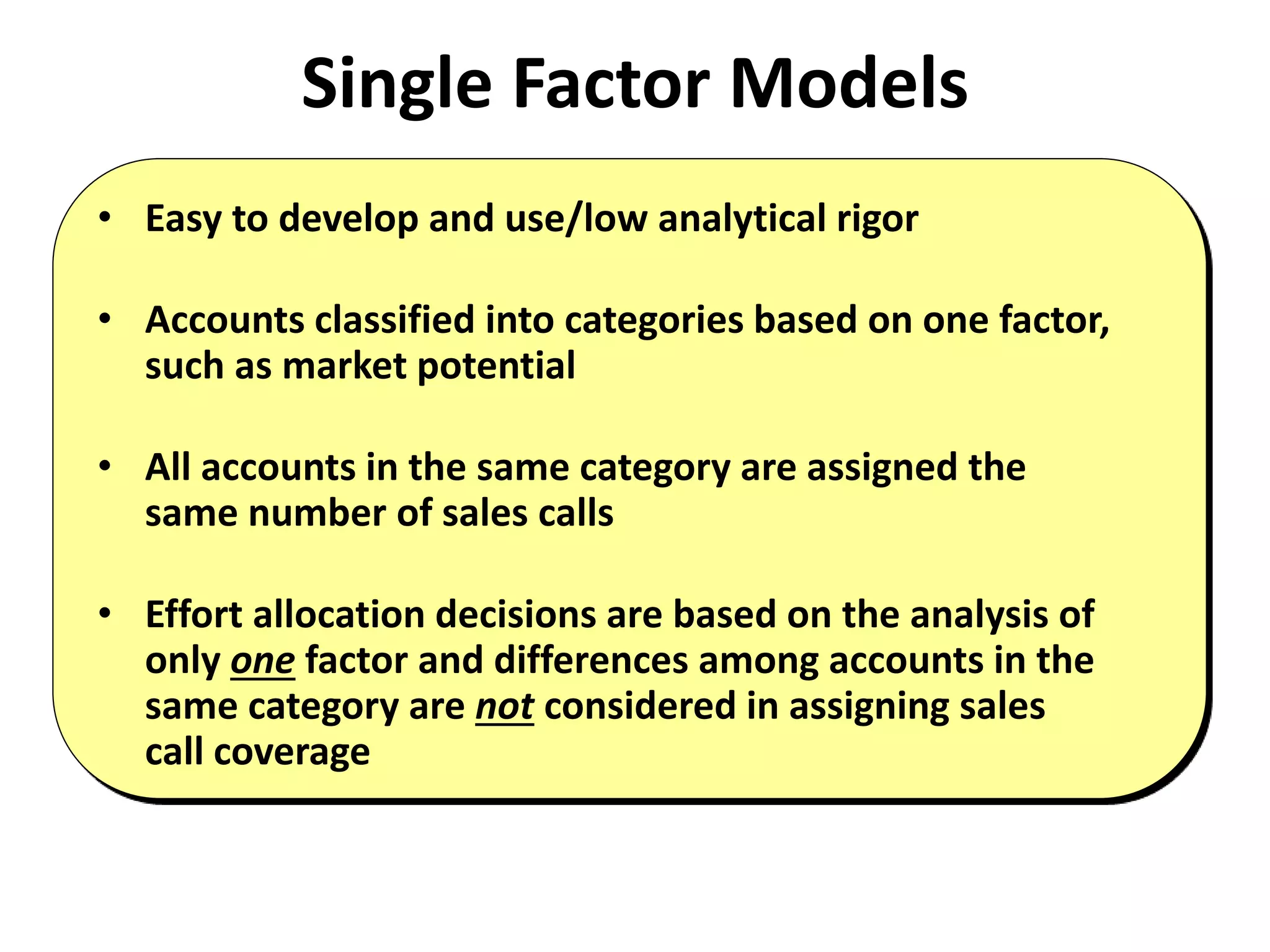
Single Factor Models
• Easy to develop and use/low analytical rigor
• Accounts classified into categories based on one factor,
such as market potential
• All accounts in the same category are assigned the
same number of sales calls
• Effort allocation decisions are based on the analysis of
only one factor and differences among accounts in the
same category are not considered in assigning sales
call coverage
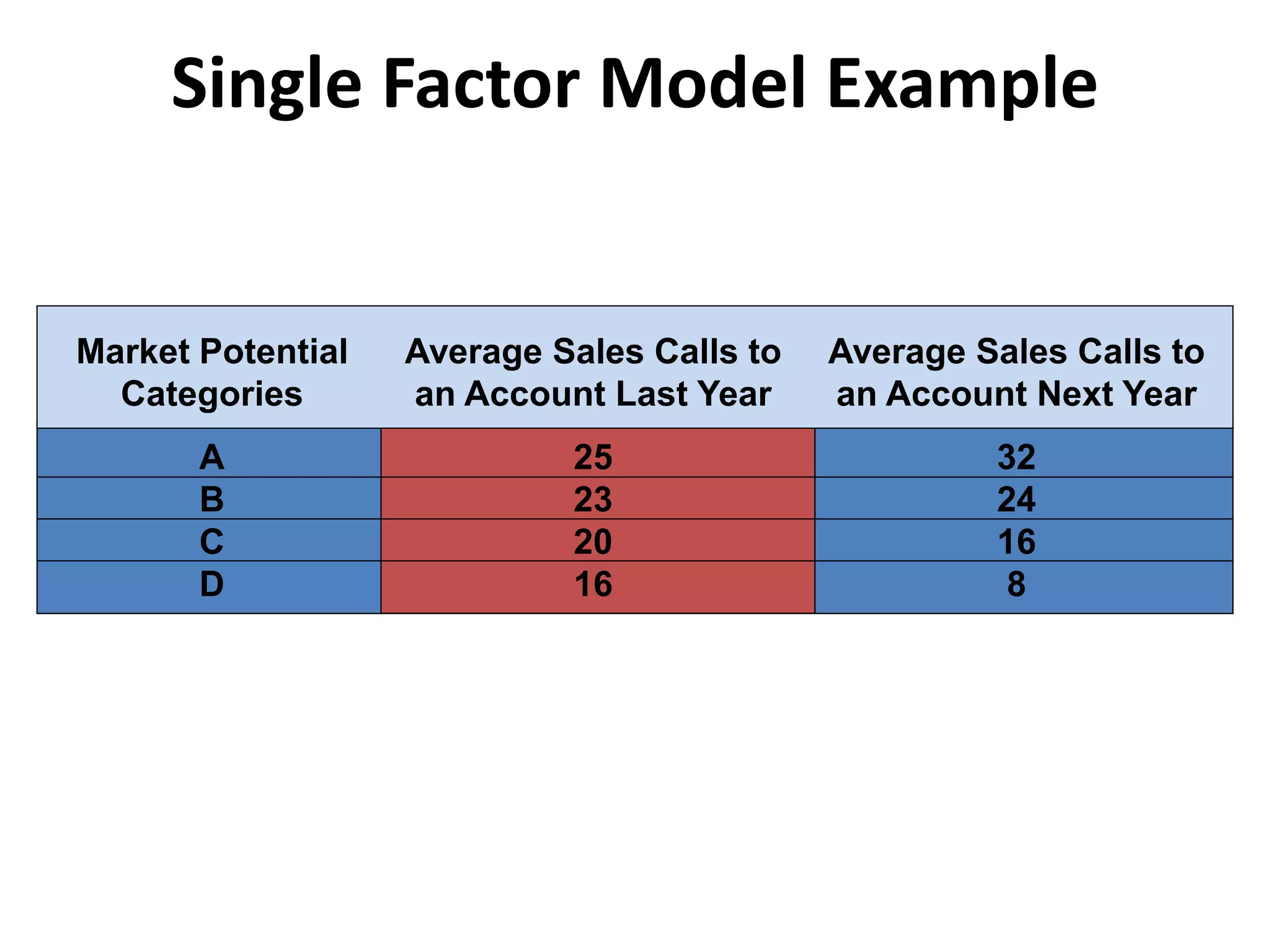
Single Factor Model Example
Market Potential
Categories
A
B
C
D
Average Sales Calls to
an Account Last Year
25
23
20
16
Average Sales Calls to
an Account Next Year
32
24
16
8
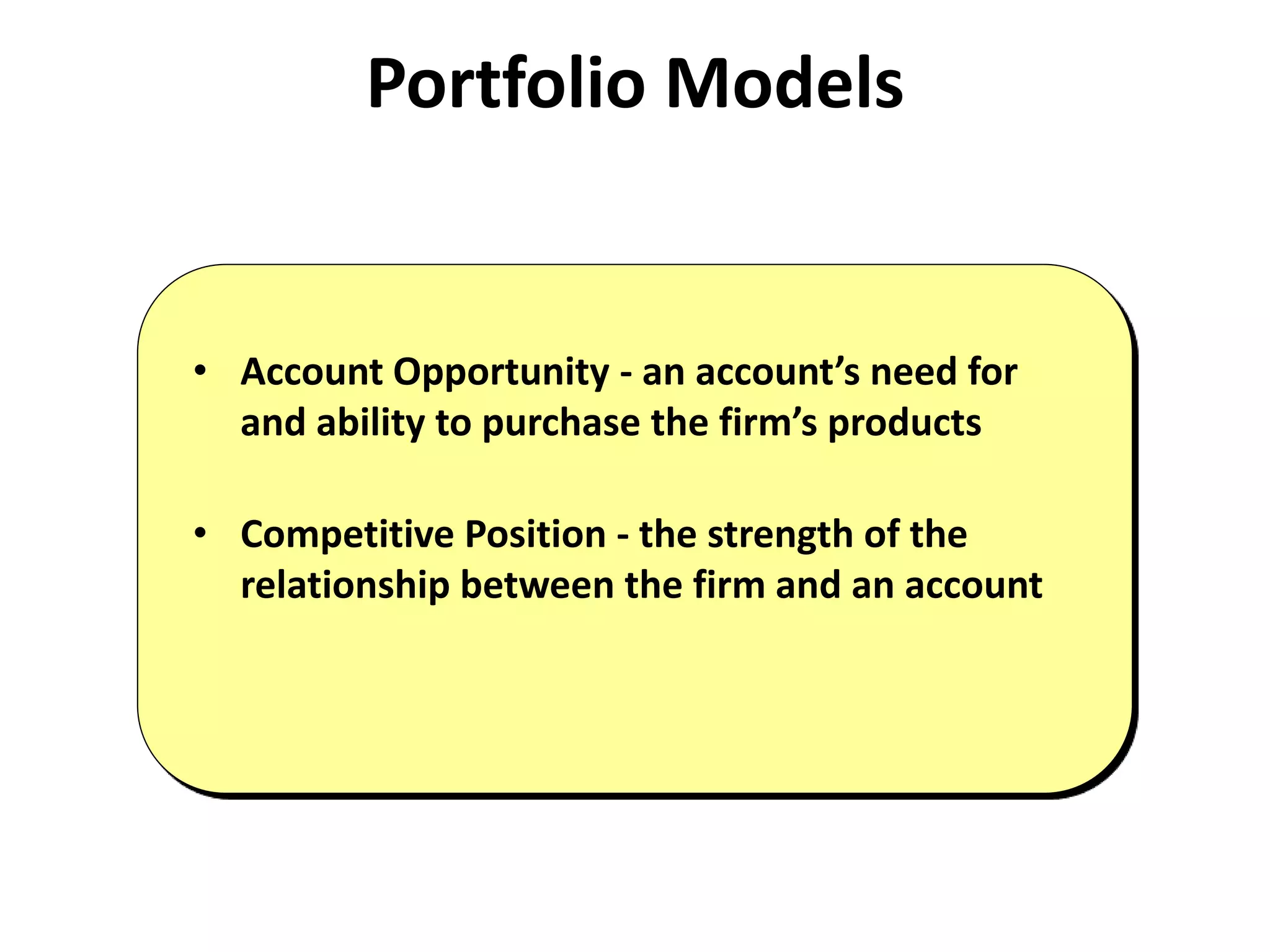
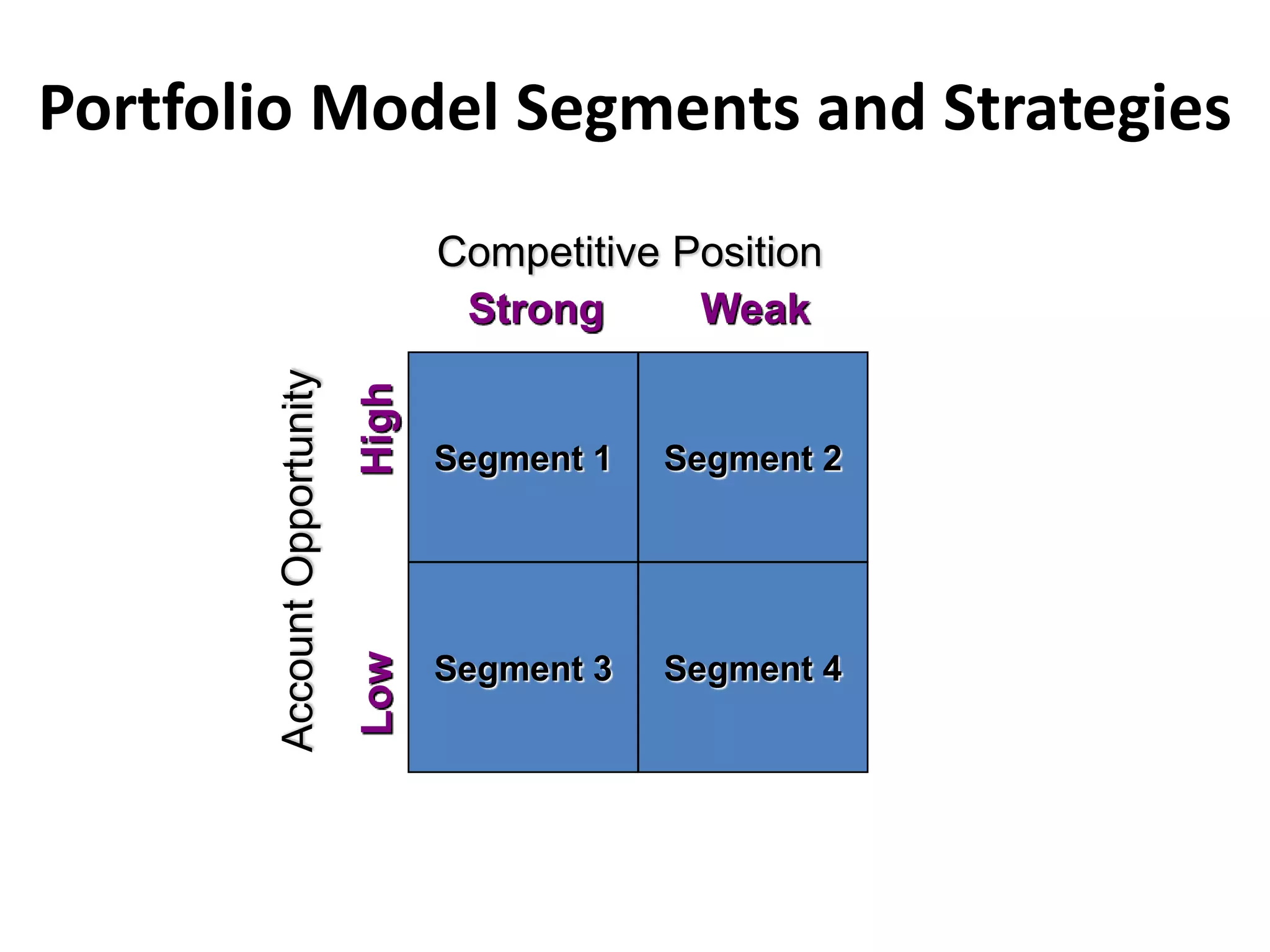
Portfolio Models
• Account Opportunity - an account’s need for
and ability to purchase the firm’s products
• Competitive Position - the strength of the
relationship between the firm and an account
Portfolio Model Segments and Strategies
Competitive Position
Segment 1 Segment 2
Segment 4Segment 3
Strong Weak
LowHigh
AccountOpportunity
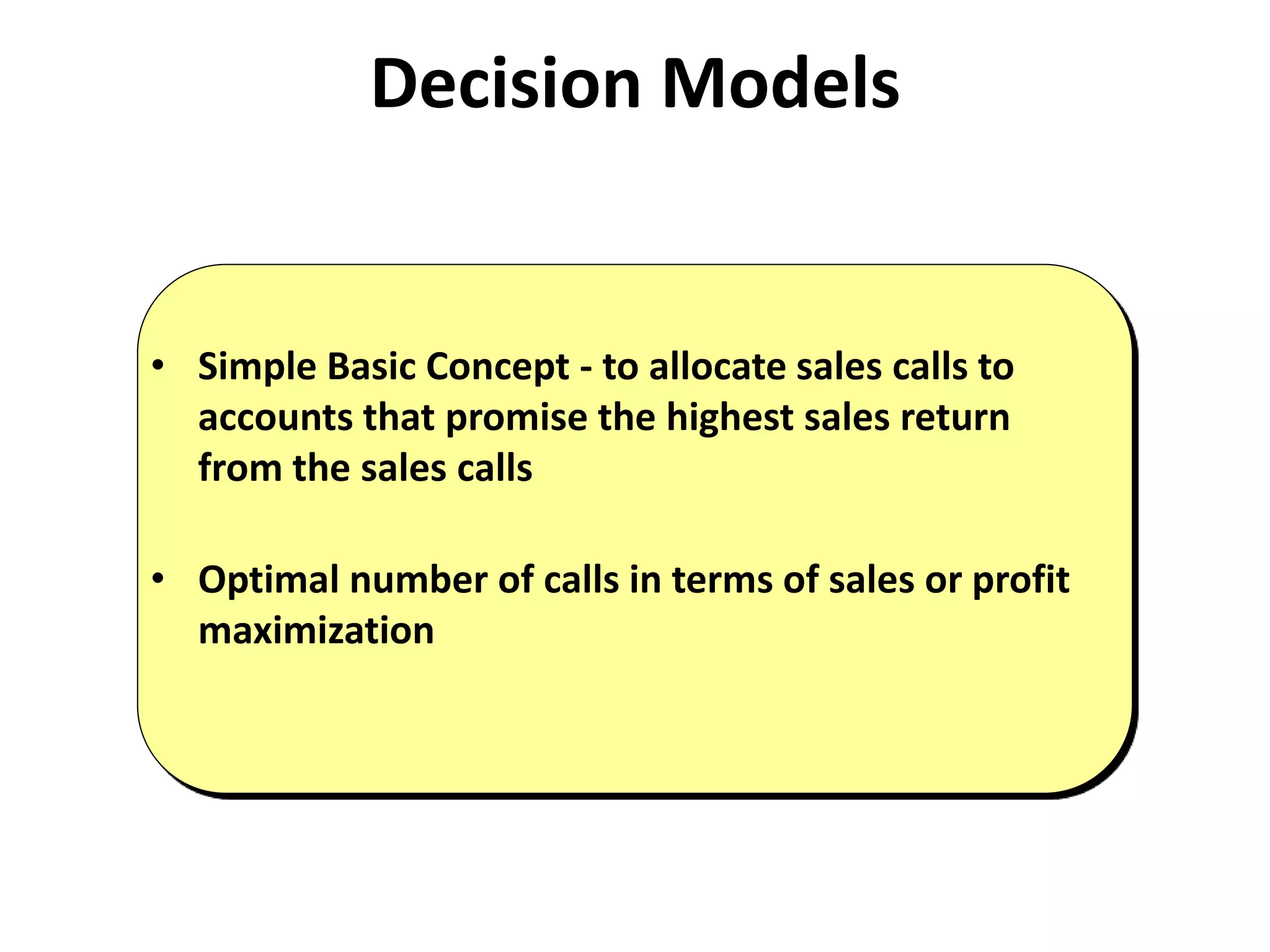
Decision Models
• Simple Basic Concept - to allocate sales calls to
accounts that promise the highest sales return
from the sales calls
• Optimal number of calls in terms of sales or profit
maximization
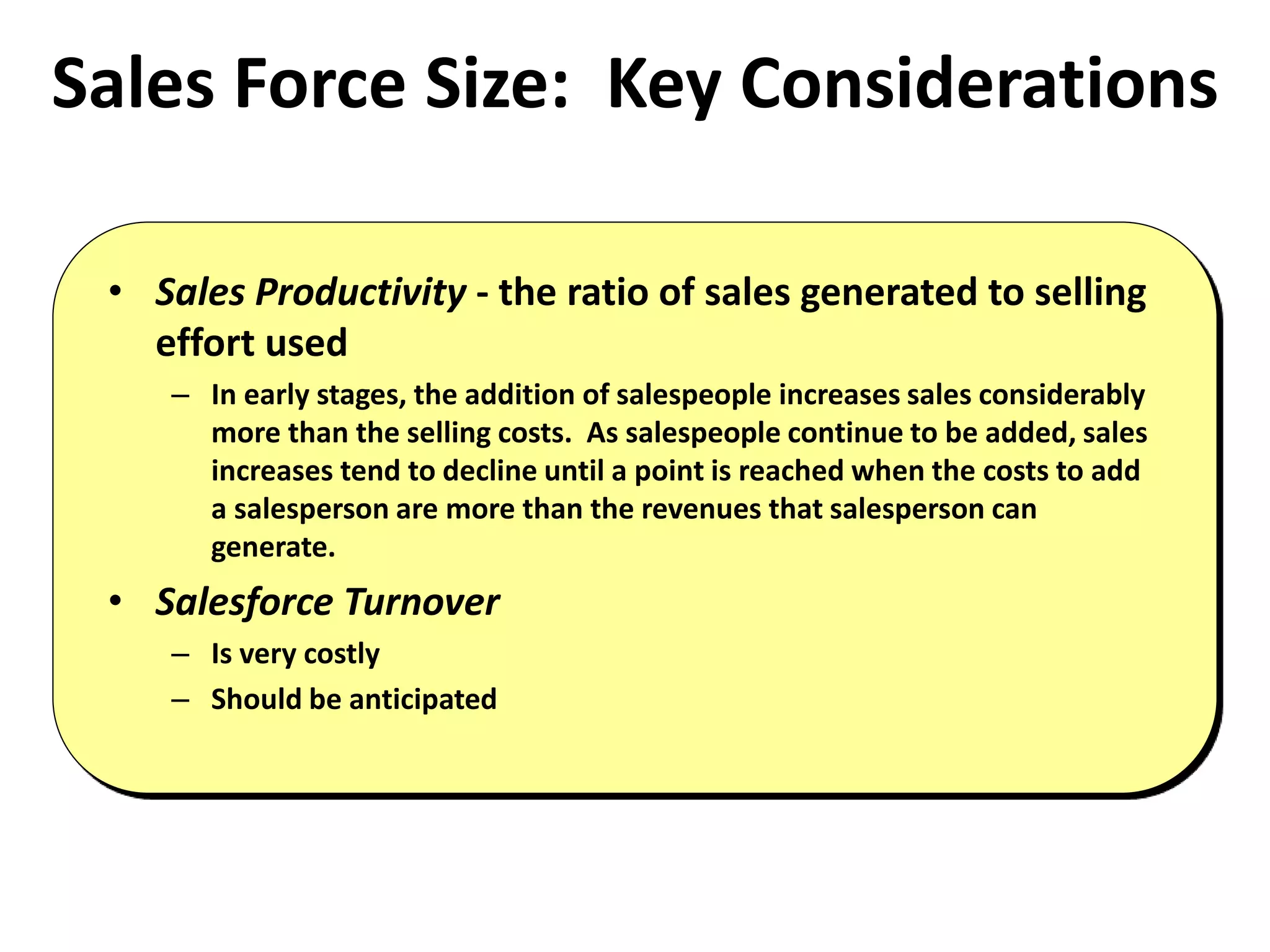
Sales Force Size: Key Considerations
• Sales Productivity - the ratio of sales generated to selling
effort used
– In early stages, the addition of salespeople increases sales considerably
more than the selling costs. As salespeople continue to be added, sales
increases tend to decline until a point is reached when the costs to add
a salesperson are more than the revenues that salesperson can
generate.
• Salesforce Turnover
– Is very costly
– Should be anticipated
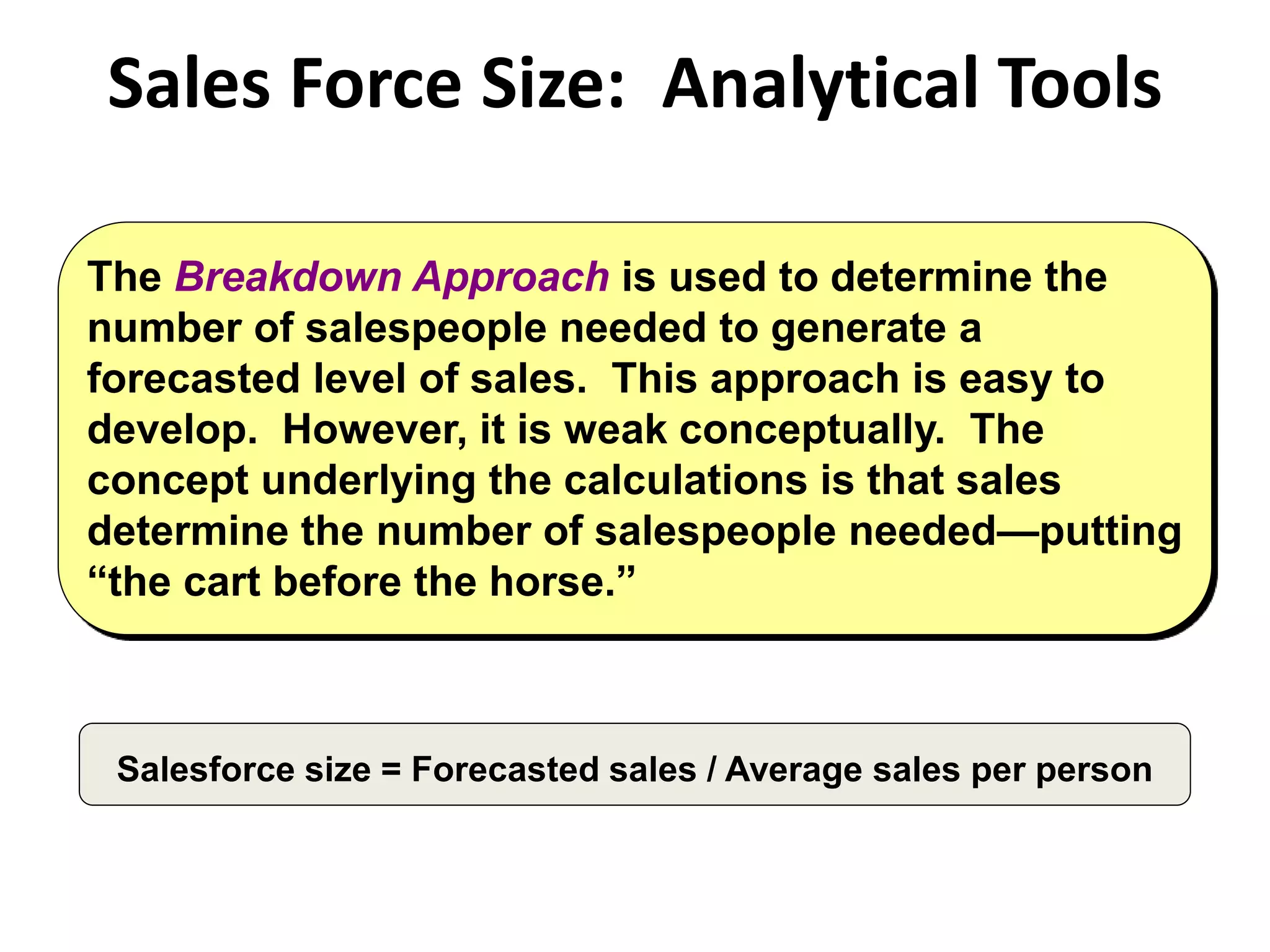
Sales Force Size: Analytical Tools
Salesforce size = Forecasted sales / Average sales per person
The Breakdown Approach is used to determine the
number of salespeople needed to generate a
forecasted level of sales. This approach is easy to
develop. However, it is weak conceptually. The
concept underlying the calculations is that sales
determine the number of salespeople needed—putting
“the cart before the horse.”
Sales Force Size: Analytical Tools
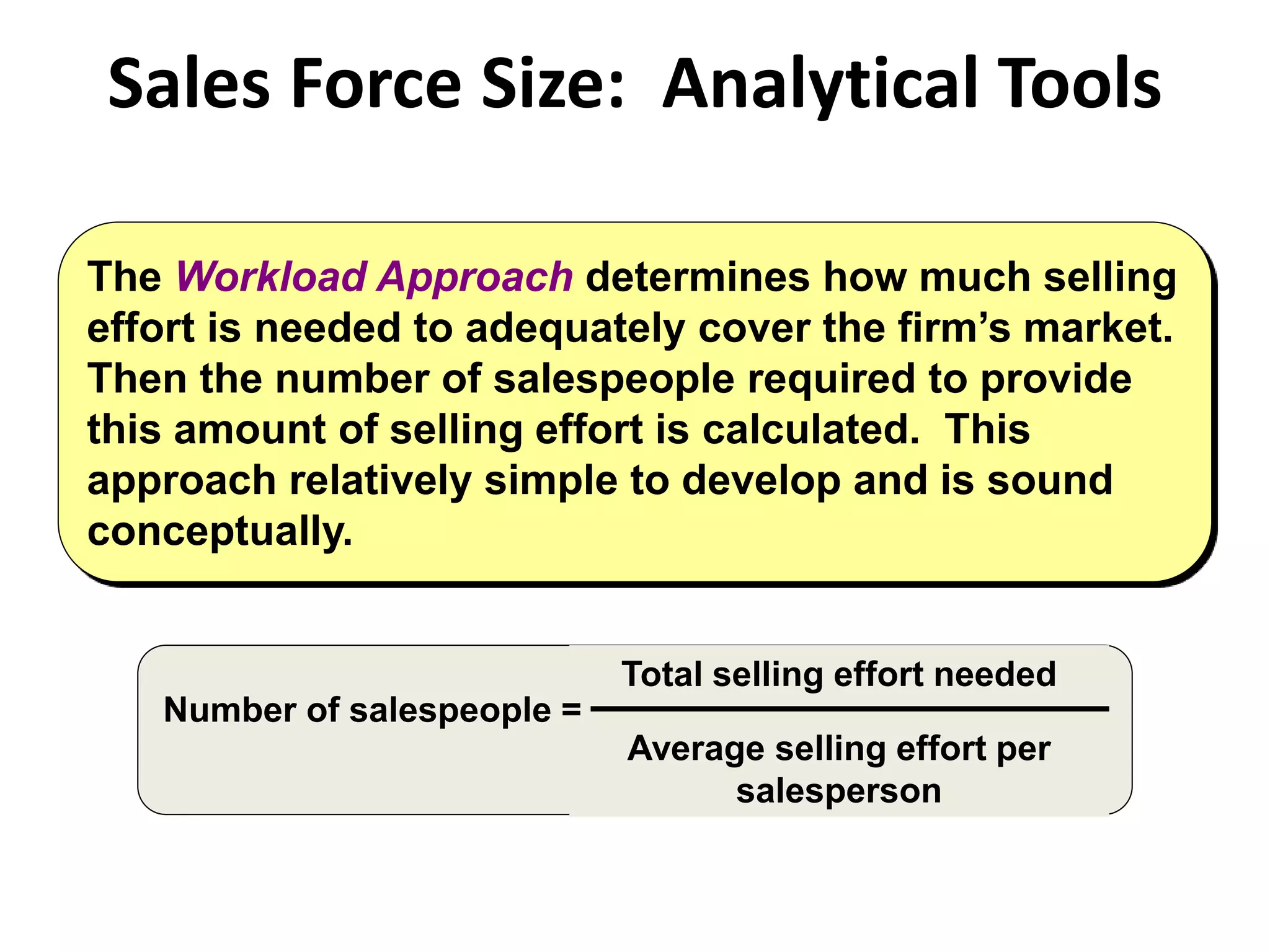
The Workload Approach determines how much selling
effort is needed to adequately cover the firm’s market.
Then the number of salespeople required to provide
this amount of selling effort is calculated. This
approach relatively simple to develop and is sound
conceptually.
Number of salespeople =
Total selling effort needed
Average selling effort per
salesperson
Sales Force Size: Analytical Tools
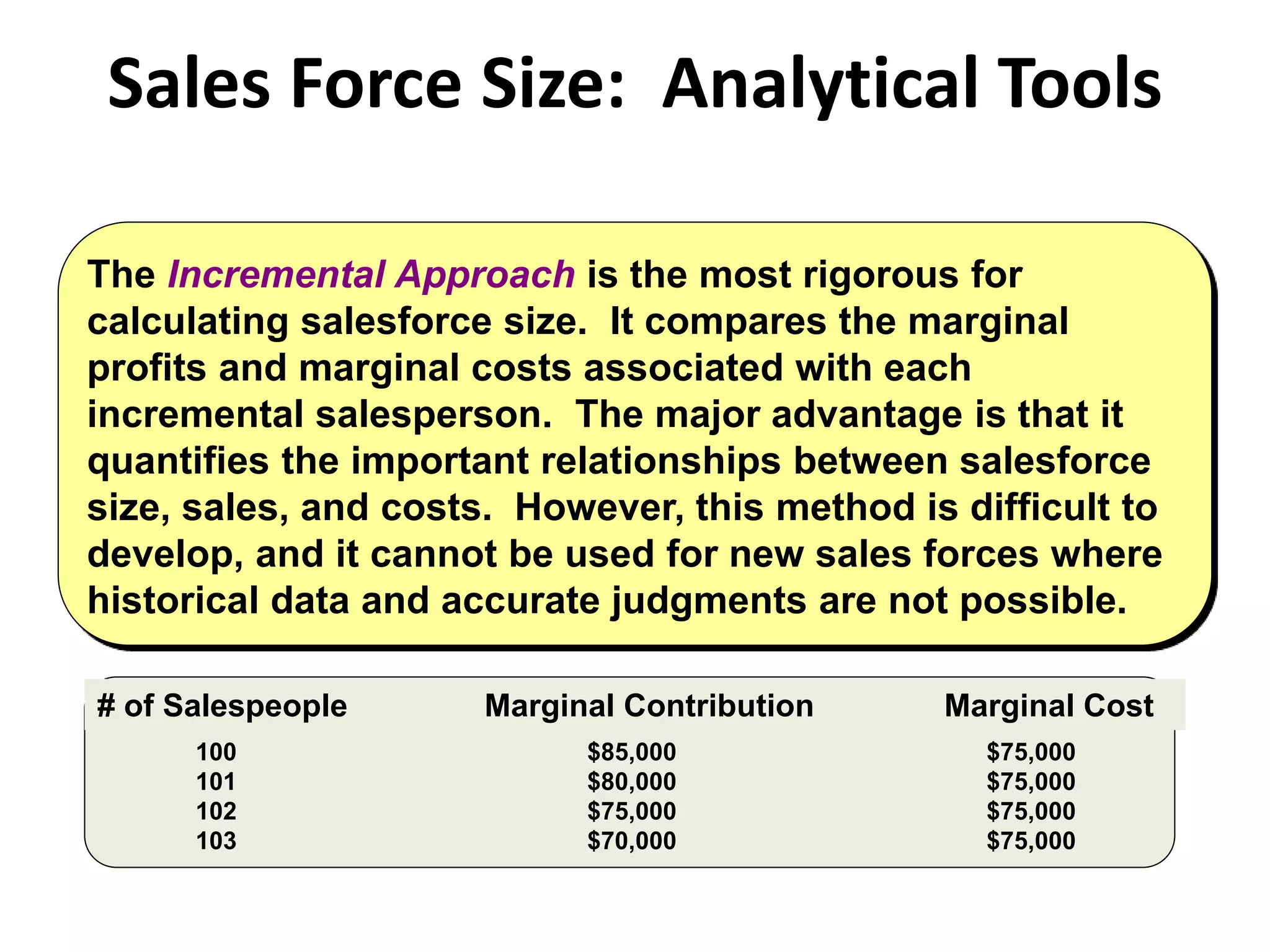
The Incremental Approach is the most rigorous for
calculating salesforce size. It compares the marginal
profits and marginal costs associated with each
incremental salesperson. The major advantage is that it
quantifies the important relationships between salesforce
size, sales, and costs. However, this method is difficult to
develop, and it cannot be used for new sales forces where
historical data and accurate judgments are not possible.
# of Salespeople Marginal Contribution Marginal Cost
100
101
102
103
$85,000
$80,000
$75,000
$70,000
$75,000
$75,000
$75,000
$75,000
Designing Territories
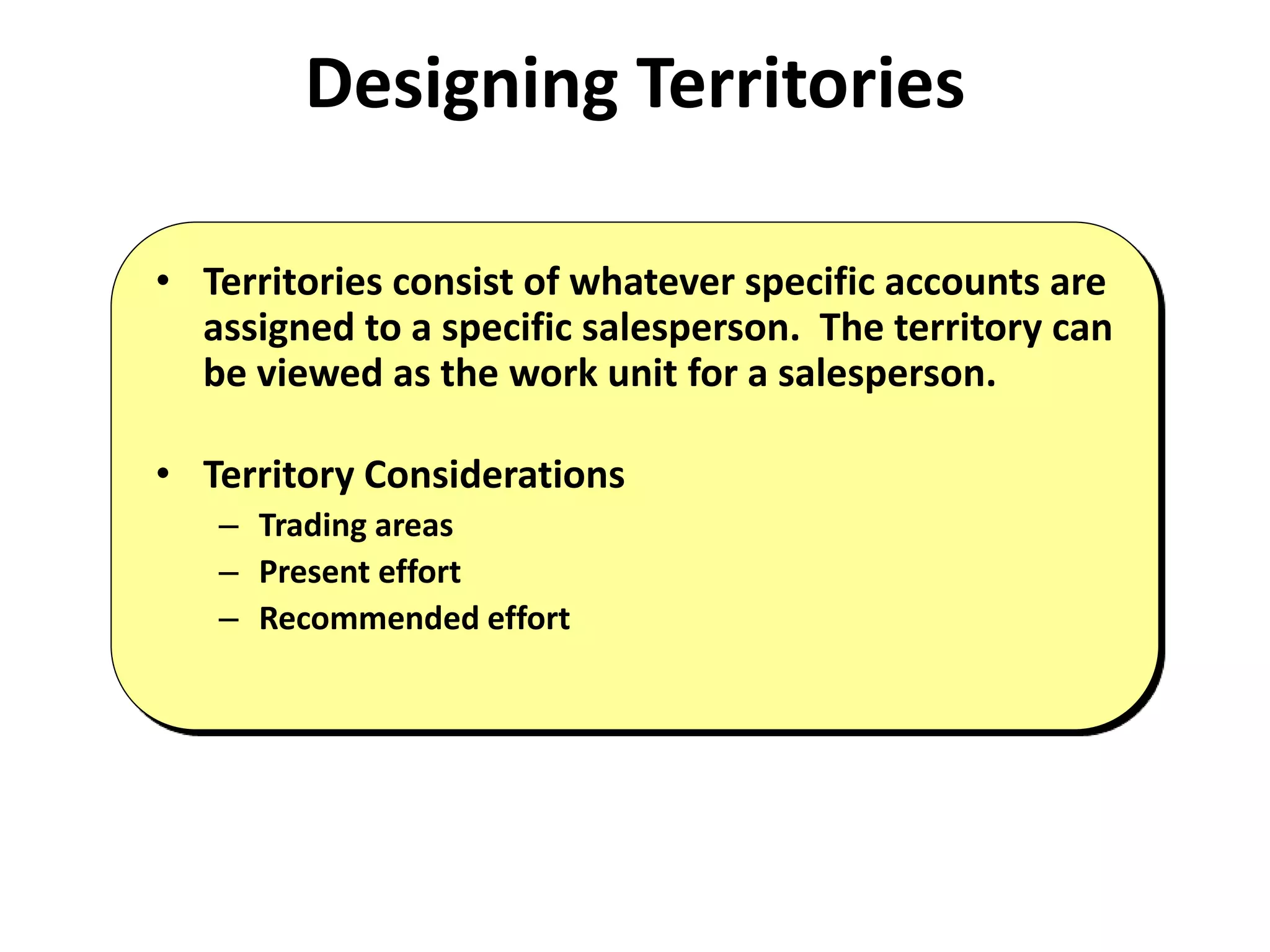
• Territories consist of whatever specific accounts are
assigned to a specific salesperson. The territory can
be viewed as the work unit for a salesperson.
• Territory Considerations
– Trading areas
– Present effort
– Recommended effort
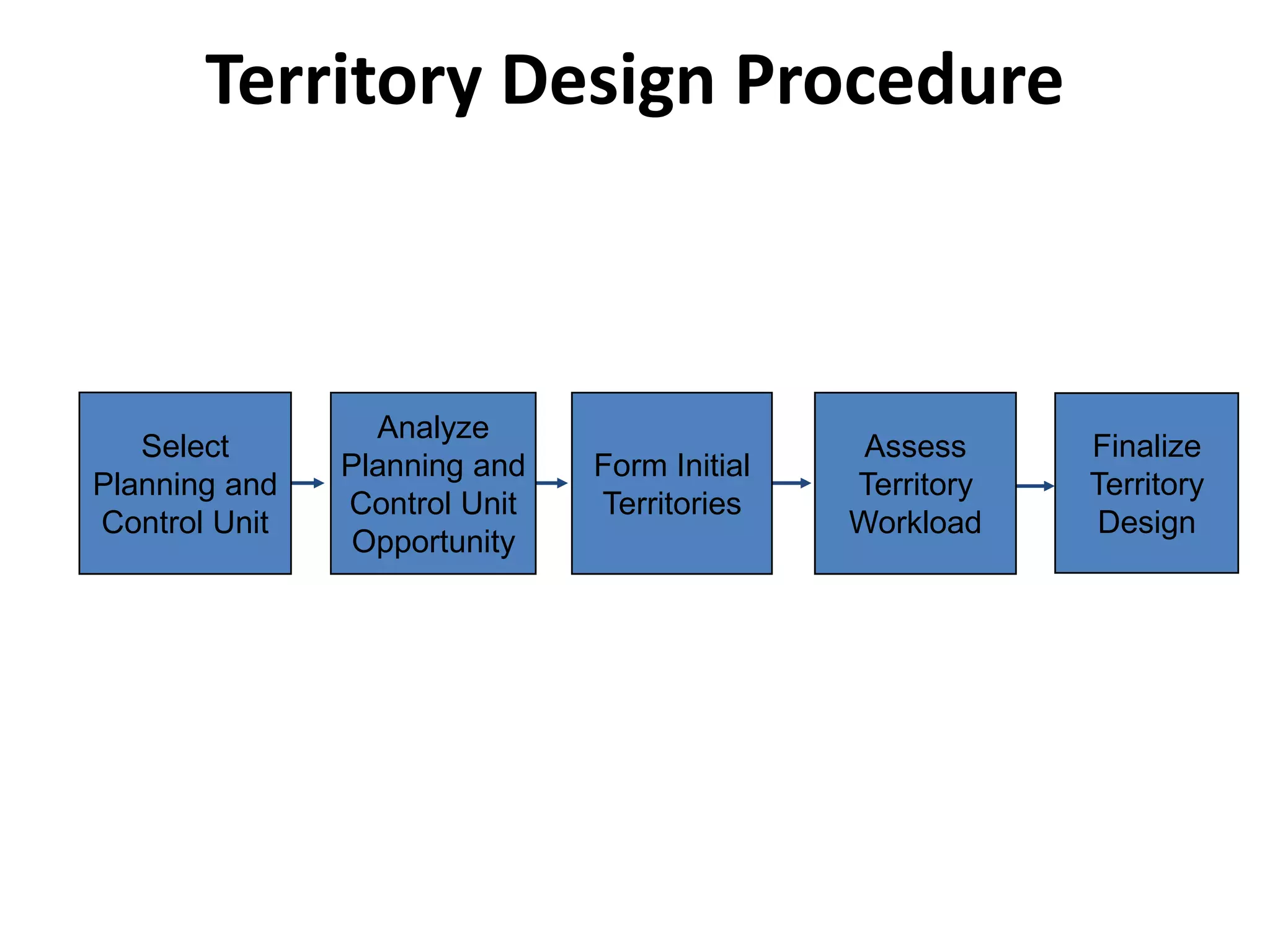
Territory Design Procedure
Finalize
Territory
Design
Assess
Territory
Workload
Form Initial
Territories
Analyze
Planning and
Control Unit
Opportunity
Select
Planning and
Control Unit

05 6e Sale Management module 04

  • 1.
    Sales Organization Structureand Sales Force Deployment Module Four
  • 2.
    Sales Organization Concepts Specialization Thedegree to which individuals perform some of the required tasks to the exclusion of others. Individuals can become experts on certain tasks, leading to better performance for the entire organization. Centralization The degree to which important decisions and tasks performed at higher levels in the management hierarchy. Centralized structures place authority and responsibility at higher management levels.
  • 3.
    Sales Force SpecializationContinuum Some specialization of selling activities, products, and/or customers All selling activities and all products to all customers Generalists Certain selling activities for certain products for certain customers Specialists
  • 4.
    Flat Sales Organization Spanof Control ManagementLevels National Sales Manager District Sales Manager District Sales Manager District Sales Manager District Sales Manager District Sales Manager Span of Control vs. Management Levels
  • 5.
    Tall Sales Organization NationalSales Manager Span of Control ManagementLevels District Sales Manager District Sales Manager District Sales Manager District Sales Manager District Sales Manager District Sales Manager Regional Sales Manager Regional Sales Manager Span of Control vs. Management Levels
  • 6.
    National Sales Manager RegionalSales Managers District Sales Managers Sales Training Manager Sales Training Manager Salespeople Staff Position Line Position Line vs. Staff Positions
  • 7.
    Organizational Structure Environmental Characteristics Task Performance Performance Objective Specialization High Envir. uncertainty NonroutineAdaptiveness Centralization Low Envir. Uncertainty Repetitive Effectiveness Selling-Situation Factors and Organizational Structure
  • 8.
    Simple Product Offering Complex Range of Products Customer NeedsDifferent Customer Needs Similar Market- Driven Specialization Product/Market- Driven Specialization Geography- Driven Specialization Product- Driven Specialization Customer and Product Determinants of Sales Force Specialization
  • 9.
    Geographic Sales Organization NationalSales Manager Zone Sales Managers (4) Zone Sales Managers (4) District Sales Managers (20) Salespeople (100) Salespeople (100) District Sales Managers (20) Eastern Region Sales Manager Western Region Sales Manager Sales Training Manager
  • 10.
    Product Sales Organization NationalSales Manager Office Equipment Sales Manager Office Supplies Sales Manager District Sales Managers (10) Salespeople (100) Salespeople (100) District Sales Managers (10)
  • 11.
    Market Sales Organization NationalSales Manager Zone Sales Managers (4) District Sales Managers (25) Salespeople (150) District Sales Managers (5) Commercial Accounts Sales Manager Government Accounts Sales Manager Sales Training Manager Salespeople (50)
  • 12.
    Functional Sales Organization NationalSales Manager Field Sales Manager Telemarketing Sales Manager Regional Sales Managers (4) Salespeople (160) Salespeople (40) District Sales Managers (2) District Sales Managers (16)
  • 14.
    Hybrid Sales OrganizationStructure National Sales Manager Major Accounts Sales Manager Regular Accounts Sales Manager Office Equipment Sales Manager Office Supplies Sales Manager Field Sales Manager Telemarketing Sales Manager Commercial Accounts Sales Manager Government Accounts Sales Manager Western Sales Manager Eastern Sales Manager
  • 15.
    Salesforce Deployment 1. Howmuch selling effort is needed to cover accounts and prospects adequately so that sales and profit objectives will be achieved? 2. How many salespeople are required to provide the desired amount of selling effort? 3. How should territories be designed to ensure proper coverage of accounts and to provide each salesperson with a reasonable opportunity for success? Sales Force deployment decisions can be viewed as providing answers to three interrelated questions
  • 17.
    Single Factor Models Easy toDevelop and Use Difficult to Develop and Use Low Analytical Rigor High Analytical Rigor Portfolio Models Decision Models Analytical Approaches to Allocation of Selling Effort
  • 18.
    Single Factor Models •Easy to develop and use/low analytical rigor • Accounts classified into categories based on one factor, such as market potential • All accounts in the same category are assigned the same number of sales calls • Effort allocation decisions are based on the analysis of only one factor and differences among accounts in the same category are not considered in assigning sales call coverage
  • 19.
    Single Factor ModelExample Market Potential Categories A B C D Average Sales Calls to an Account Last Year 25 23 20 16 Average Sales Calls to an Account Next Year 32 24 16 8
  • 20.
    Portfolio Models • AccountOpportunity - an account’s need for and ability to purchase the firm’s products • Competitive Position - the strength of the relationship between the firm and an account
  • 21.
    Portfolio Model Segmentsand Strategies Competitive Position Segment 1 Segment 2 Segment 4Segment 3 Strong Weak LowHigh AccountOpportunity
  • 22.
    Decision Models • SimpleBasic Concept - to allocate sales calls to accounts that promise the highest sales return from the sales calls • Optimal number of calls in terms of sales or profit maximization
  • 23.
    Sales Force Size:Key Considerations • Sales Productivity - the ratio of sales generated to selling effort used – In early stages, the addition of salespeople increases sales considerably more than the selling costs. As salespeople continue to be added, sales increases tend to decline until a point is reached when the costs to add a salesperson are more than the revenues that salesperson can generate. • Salesforce Turnover – Is very costly – Should be anticipated
  • 24.
    Sales Force Size:Analytical Tools Salesforce size = Forecasted sales / Average sales per person The Breakdown Approach is used to determine the number of salespeople needed to generate a forecasted level of sales. This approach is easy to develop. However, it is weak conceptually. The concept underlying the calculations is that sales determine the number of salespeople needed—putting “the cart before the horse.”
  • 25.
    Sales Force Size:Analytical Tools The Workload Approach determines how much selling effort is needed to adequately cover the firm’s market. Then the number of salespeople required to provide this amount of selling effort is calculated. This approach relatively simple to develop and is sound conceptually. Number of salespeople = Total selling effort needed Average selling effort per salesperson
  • 26.
    Sales Force Size:Analytical Tools The Incremental Approach is the most rigorous for calculating salesforce size. It compares the marginal profits and marginal costs associated with each incremental salesperson. The major advantage is that it quantifies the important relationships between salesforce size, sales, and costs. However, this method is difficult to develop, and it cannot be used for new sales forces where historical data and accurate judgments are not possible. # of Salespeople Marginal Contribution Marginal Cost 100 101 102 103 $85,000 $80,000 $75,000 $70,000 $75,000 $75,000 $75,000 $75,000
  • 27.
    Designing Territories • Territoriesconsist of whatever specific accounts are assigned to a specific salesperson. The territory can be viewed as the work unit for a salesperson. • Territory Considerations – Trading areas – Present effort – Recommended effort
  • 28.
    Territory Design Procedure Finalize Territory Design Assess Territory Workload FormInitial Territories Analyze Planning and Control Unit Opportunity Select Planning and Control Unit