Sales & Logistics Management
Dr. Karpagam
Director – Academics
ISBR Business School
Bangalore
1
Sales management
2
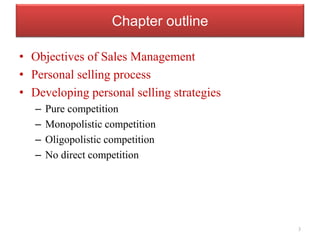
Chapter outline
• Objectives of Sales Management
• Personal selling process
• Developing personal selling strategies
– Pure competition
– Monopolistic competition
– Oligopolistic competition
– No direct competition
3
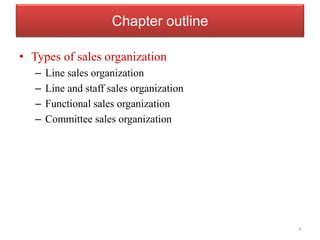
Chapter outline
• Types of sales organization
– Line sales organization
– Line and staff sales organization
– Functional sales organization
– Committee sales organization
4
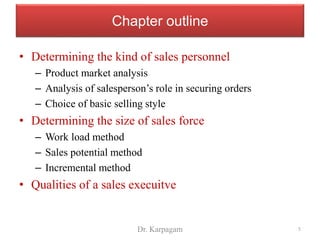
Chapter outline
• Determining the kind of sales personnel
– Product market analysis
– Analysis of salesperson’s role in securing orders
– Choice of basic selling style
• Determining the size of sales force
– Work load method
– Sales potential method
– Incremental method
• Qualities of a sales execuitve
5Dr. Karpagam
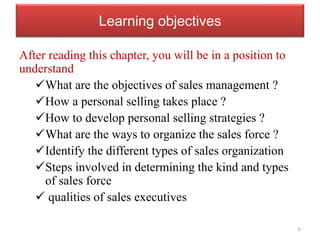
Learning objectives
After reading this chapter, you will be in a position to
understand
What are the objectives of sales management ?
How a personal selling takes place ?
How to develop personal selling strategies ?
What are the ways to organize the sales force ?
Identify the different types of sales organization
Steps involved in determining the kind and types
of sales force
 qualities of sales executives
6
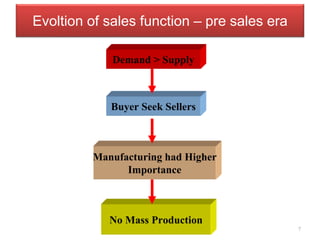
Evoltion of sales function – pre sales era
Demand > Supply
Buyer Seek Sellers
Manufacturing had Higher
Importance
No Mass Production
7
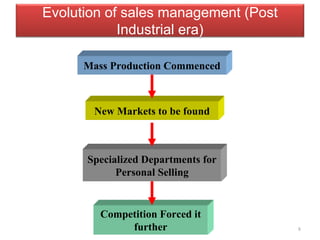
Evolution of sales management (Post
Industrial era)
Mass Production Commenced
New Markets to be found
Specialized Departments for
Personal Selling
Competition Forced it
further 8
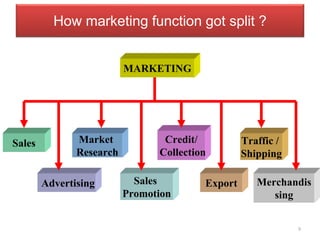
How marketing function got split ?
MARKETINGMARKETING
Sales
Advertising
Market
Research
Sales
Promotion
Credit/
Collection
Export
Traffic /
Shipping
Merchandis
sing
9
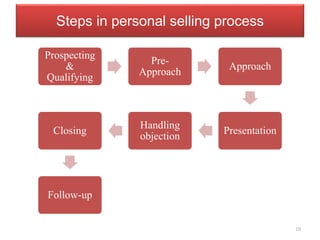
Steps in personal selling process
Prospecting
&
Qualifying
Pre-
Approach
Approach
Presentation
Handling
objection
Closing
Follow-up
10
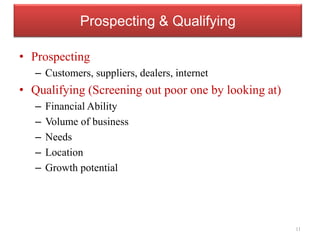
Prospecting & Qualifying
• Prospecting
– Customers, suppliers, dealers, internet
• Qualifying (Screening out poor one by looking at)
– Financial Ability
– Volume of business
– Needs
– Location
– Growth potential
11
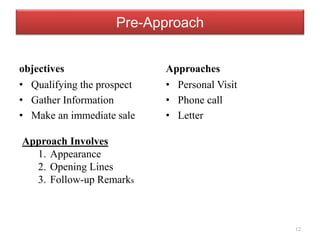
Pre-Approach
objectives
• Qualifying the prospect
• Gather Information
• Make an immediate sale
Approaches
• Personal Visit
• Phone call
• Letter
Approach Involves
1. Appearance
2. Opening Lines
3. Follow-up Remarks
12
Presentation
• Need Satisfaction Approach
– Buyers Want Solutions
– Salespeople should listen & respond with the right products
& Services to solve customer problems
• Buyers dislike salespeople that are
– Pushy, late, deceitful, disorganized, unprepared
• Buyers appreciate people that are
– Good listeners, Empathetic, Honest, Dependable, Through,
Follow-up types
13
Handling objections
• It is the process where salesperson resolve problems
that are
– logical, psychological (or) Unspoken
14
closing
• It is the process where salespeople should recognize
signals from the buyer, including
– Physical actions
– Comments &
– Questions to close the sale
15
Closing
• Closing technique
– Asking for the order
– Reviewing points of agreement
– Offering to help write up the order
– Asking if the buyer wants this model or another one
– Making note that the buyer will lose out if the order is not
placed
– Offering incentives to buy, including lower price (or)
additional quantity
16
Competitive strategy and personal selling
strategy
• Industries differ as to maturity and the number of
competitors
1. Pure competition
2. Monopolistic competition
3. Oligopolistic competition
4. No direct competition
17
Pure competition
• Assumptions :
1. No single buyer or seller is so large relative to the market
2. All seller’s product are identical (Buyers are indifferent)
3. No artificial restraints on price exist
a) Governmental price fixing
b) Administering of prices by individual companies, trade
associations, labour unions
4. All buyers are always informed about all seller’s price
• Important Assumptions :
– Sellers and buyers are in direct contact, making it
unnecessary to worry about marketing channels or physical
distribution
18
2. Monopolistic competition
• It Exists when
– Large numbers of sellers of a generic kind of product
– But each seller’s brand is in some way differentiated from
every other brand
– It is easy for additional competitors to enter the market
• Private label competitors
• Sellers differentiate their market offering through
– Individualizing one or several components of overall
marketing strategy
19
Cont’d..
• Unique packaging may differentiate the product
• Unusual distribution method (Such as house to house
selling)
• Pricing gimmicks (Psychological pricing)
• In Market-growth and market-maturity stages ,
seller can differentiate it through promotional
strategy
• Personal selling ensures the desired distribution
intensity is secured and maintained
– Middlemen provide the needed push
20
3. Oligopolistic competition
• Competitive Setting where
– The number of competitors is small enough that they are
individually identified
– Known to each other
– Difficult for new competitors to enter
• Each organization is large enough with large enough
market share
• Develops in
– Marketing many products either during a late phase of their
market growth
– An early phase of market maturity
21
Cont’d..
• Competitive moves of one affects the entire market
• Changes in
– Competitor’s product
– In its distribution
– In its promotion
• Encountered by competitors and launch counter
offensives
• Personal Selling Strategy :
– Building and maintaining dealer cooperation
– Servicing the distribution network
22
No direct competition
• Neither the monopolist nor Innovative marketer
• Both have indirect competitors
Monopolist – on a long term basis
Innovative Marketer – limited period
 Initiate and stimulate primary demand
Through personal selling and advertising
 Distribution strategies
 Pricing strategies
Monopolist – charging what the traffic will bear
Innovative marketer – Price Skimming or a penetration
pricing
23
Determining the kind of sales personnel
• Understand what is expected of them
1. The Job objectives
2. The duties and responsibilities
3. The performance measures
• Qualitative personal selling objectives have some
degree of distinctiveness
– What it sells ?
– Whom it sells to ?
– Its pricing strategy and competitive setting
24
Cont’d….
• It is common for different salesperson in the same
company to have quite different jobs
• This can be done by
1. Product Market Analysis
2. Choice of Basic Selling Style
25
Product Market Analysis
• All kinds of products can’t be sold to all kinds of
customer
• Salesperson sells
1. Single products to many kinds of customers
2. Wide line products to a single kind of customers
3. Sell some products to some kinds of customers
• One way of categorizing selling jobs
1. Product Specialist
2. Market Specialist
3. Combination of product and market specialization
26
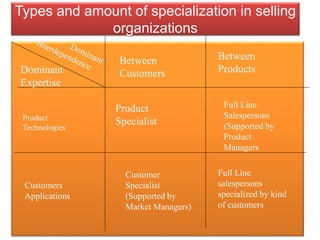
Dominant
Expertise
Product
Technologies
Customers
Applications
Customer
Specialist
(Supported by
Market Managers)
Full Line
Salespersons
(Supported by
Product
Managers
Full Line
salespersons
specialized by kind
of customers
Between
Customers
Between
Products
Product
Specialist
Types and amount of specialization in selling
organizations
27
Choice of basic selling style
1. Trade Selling
2. Missionary Selling
3. Technical selling
4. Non-Business Selling
28
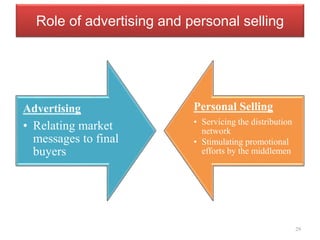
Role of advertising and personal selling
Advertising
• Relating market
messages to final
buyers
Personal Selling
• Servicing the distribution
network
• Stimulating promotional
efforts by the middlemen
29
Setting up a sales organization
1. Defining the objectives
2. Delineating the necessary activities
3. Grouping activities into “jobs” or “positions”
4. Assigning personnel to positions
5. Providing for coordination and control
30
Basic types of organizational structures
1. Line sales organization
2. Line and staff organization
3. Functional sales organization
4. Committee sales organization
31
1. Line sales organization
• Widely used in smaller firms
• Chain of command runs from top sales executive
down through subordinates
• All executives exercise authority
• Each subordinate is responsible only to one person
• Authority is definitely fixed
• Sees its greatest use – sales executives- directly
reports to CEO
• Preoccupied with active supervision
• More than two layers are present –occassionaly
32
Cont’d..
• Advantages
1. Reports to only one
person
2. Problem of discipline
and control are small
3. Lines of authority and
responsibility are clear
4. Simplicity
5. Frequently strong
leaders
6. Administrative expenses
are low
• Disadvantages
1. Much depends upon the
department head
2. Head should be a all-
rounder
3. Insufficient time for
policy making and
planning
4. Often make decisions
and take action without
benefit of planning
5. Results are often
disappointing
33
2. Line and staff sales organization
• Often found in large and medium based enterprise
• Selling diversified product lines
• Provides the top sales executives with a group of
specialist expert
– Dealers, distributor relations, sales analysis, traffic and
warehousing
• Conserves top executives and frees them from
excessively detailed work
• Delegating problems to staff executives – Top exe-
higher priority matters.
34
Line and staff sales organization
Advantages
1. Pool of experts provide
advice
2. Apparently unrelated
problems are brought into
focus
3. Concentrate on control and
coordination of subordinates
4. Staff assume much of the
burden of solving problems in
their areas
5. Top sales executive focus
more on human aspects of
administration
Disadvantages
1. Close control over staff-
line relations is essential
2. Time between problem
recognition and corrective
action tends to widen
3. Confusion may happen
especially if experts
overstep their authority
4. Administrative expenses
may increase
35
Qualities of sales executive
Ability to
1. To define the position’s exact function and duties in
relation to the company’s goals.
2. To select and train capable subordinates
3. Willingness to delegate sufficient authority to carry
out the task with minimum supervision
4. To utilize time efficiently
5. To allocate sufficient time for thinking and planning
6. Exercise skilled leadership
36

Sales & Logistics Management by Dr. Karpagam Director – Academics, ISBR Business School, Bangalore

  • 1.
    Sales & LogisticsManagement Dr. Karpagam Director – Academics ISBR Business School Bangalore 1
  • 2.
  • 3.
    Chapter outline • Objectivesof Sales Management • Personal selling process • Developing personal selling strategies – Pure competition – Monopolistic competition – Oligopolistic competition – No direct competition 3
  • 4.
    Chapter outline • Typesof sales organization – Line sales organization – Line and staff sales organization – Functional sales organization – Committee sales organization 4
  • 5.
    Chapter outline • Determiningthe kind of sales personnel – Product market analysis – Analysis of salesperson’s role in securing orders – Choice of basic selling style • Determining the size of sales force – Work load method – Sales potential method – Incremental method • Qualities of a sales execuitve 5Dr. Karpagam
  • 6.
    Learning objectives After readingthis chapter, you will be in a position to understand What are the objectives of sales management ? How a personal selling takes place ? How to develop personal selling strategies ? What are the ways to organize the sales force ? Identify the different types of sales organization Steps involved in determining the kind and types of sales force  qualities of sales executives 6
  • 7.
    Evoltion of salesfunction – pre sales era Demand > Supply Buyer Seek Sellers Manufacturing had Higher Importance No Mass Production 7
  • 8.
    Evolution of salesmanagement (Post Industrial era) Mass Production Commenced New Markets to be found Specialized Departments for Personal Selling Competition Forced it further 8
  • 9.
    How marketing functiongot split ? MARKETINGMARKETING Sales Advertising Market Research Sales Promotion Credit/ Collection Export Traffic / Shipping Merchandis sing 9
  • 10.
    Steps in personalselling process Prospecting & Qualifying Pre- Approach Approach Presentation Handling objection Closing Follow-up 10
  • 11.
    Prospecting & Qualifying •Prospecting – Customers, suppliers, dealers, internet • Qualifying (Screening out poor one by looking at) – Financial Ability – Volume of business – Needs – Location – Growth potential 11
  • 12.
    Pre-Approach objectives • Qualifying theprospect • Gather Information • Make an immediate sale Approaches • Personal Visit • Phone call • Letter Approach Involves 1. Appearance 2. Opening Lines 3. Follow-up Remarks 12
  • 13.
    Presentation • Need SatisfactionApproach – Buyers Want Solutions – Salespeople should listen & respond with the right products & Services to solve customer problems • Buyers dislike salespeople that are – Pushy, late, deceitful, disorganized, unprepared • Buyers appreciate people that are – Good listeners, Empathetic, Honest, Dependable, Through, Follow-up types 13
  • 14.
    Handling objections • Itis the process where salesperson resolve problems that are – logical, psychological (or) Unspoken 14
  • 15.
    closing • It isthe process where salespeople should recognize signals from the buyer, including – Physical actions – Comments & – Questions to close the sale 15
  • 16.
    Closing • Closing technique –Asking for the order – Reviewing points of agreement – Offering to help write up the order – Asking if the buyer wants this model or another one – Making note that the buyer will lose out if the order is not placed – Offering incentives to buy, including lower price (or) additional quantity 16
  • 17.
    Competitive strategy andpersonal selling strategy • Industries differ as to maturity and the number of competitors 1. Pure competition 2. Monopolistic competition 3. Oligopolistic competition 4. No direct competition 17
  • 18.
    Pure competition • Assumptions: 1. No single buyer or seller is so large relative to the market 2. All seller’s product are identical (Buyers are indifferent) 3. No artificial restraints on price exist a) Governmental price fixing b) Administering of prices by individual companies, trade associations, labour unions 4. All buyers are always informed about all seller’s price • Important Assumptions : – Sellers and buyers are in direct contact, making it unnecessary to worry about marketing channels or physical distribution 18
  • 19.
    2. Monopolistic competition •It Exists when – Large numbers of sellers of a generic kind of product – But each seller’s brand is in some way differentiated from every other brand – It is easy for additional competitors to enter the market • Private label competitors • Sellers differentiate their market offering through – Individualizing one or several components of overall marketing strategy 19
  • 20.
    Cont’d.. • Unique packagingmay differentiate the product • Unusual distribution method (Such as house to house selling) • Pricing gimmicks (Psychological pricing) • In Market-growth and market-maturity stages , seller can differentiate it through promotional strategy • Personal selling ensures the desired distribution intensity is secured and maintained – Middlemen provide the needed push 20
  • 21.
    3. Oligopolistic competition •Competitive Setting where – The number of competitors is small enough that they are individually identified – Known to each other – Difficult for new competitors to enter • Each organization is large enough with large enough market share • Develops in – Marketing many products either during a late phase of their market growth – An early phase of market maturity 21
  • 22.
    Cont’d.. • Competitive movesof one affects the entire market • Changes in – Competitor’s product – In its distribution – In its promotion • Encountered by competitors and launch counter offensives • Personal Selling Strategy : – Building and maintaining dealer cooperation – Servicing the distribution network 22
  • 23.
    No direct competition •Neither the monopolist nor Innovative marketer • Both have indirect competitors Monopolist – on a long term basis Innovative Marketer – limited period  Initiate and stimulate primary demand Through personal selling and advertising  Distribution strategies  Pricing strategies Monopolist – charging what the traffic will bear Innovative marketer – Price Skimming or a penetration pricing 23
  • 24.
    Determining the kindof sales personnel • Understand what is expected of them 1. The Job objectives 2. The duties and responsibilities 3. The performance measures • Qualitative personal selling objectives have some degree of distinctiveness – What it sells ? – Whom it sells to ? – Its pricing strategy and competitive setting 24
  • 25.
    Cont’d…. • It iscommon for different salesperson in the same company to have quite different jobs • This can be done by 1. Product Market Analysis 2. Choice of Basic Selling Style 25
  • 26.
    Product Market Analysis •All kinds of products can’t be sold to all kinds of customer • Salesperson sells 1. Single products to many kinds of customers 2. Wide line products to a single kind of customers 3. Sell some products to some kinds of customers • One way of categorizing selling jobs 1. Product Specialist 2. Market Specialist 3. Combination of product and market specialization 26
  • 27.
    Dominant Expertise Product Technologies Customers Applications Customer Specialist (Supported by Market Managers) FullLine Salespersons (Supported by Product Managers Full Line salespersons specialized by kind of customers Between Customers Between Products Product Specialist Types and amount of specialization in selling organizations 27
  • 28.
    Choice of basicselling style 1. Trade Selling 2. Missionary Selling 3. Technical selling 4. Non-Business Selling 28
  • 29.
    Role of advertisingand personal selling Advertising • Relating market messages to final buyers Personal Selling • Servicing the distribution network • Stimulating promotional efforts by the middlemen 29
  • 30.
    Setting up asales organization 1. Defining the objectives 2. Delineating the necessary activities 3. Grouping activities into “jobs” or “positions” 4. Assigning personnel to positions 5. Providing for coordination and control 30
  • 31.
    Basic types oforganizational structures 1. Line sales organization 2. Line and staff organization 3. Functional sales organization 4. Committee sales organization 31
  • 32.
    1. Line salesorganization • Widely used in smaller firms • Chain of command runs from top sales executive down through subordinates • All executives exercise authority • Each subordinate is responsible only to one person • Authority is definitely fixed • Sees its greatest use – sales executives- directly reports to CEO • Preoccupied with active supervision • More than two layers are present –occassionaly 32
  • 33.
    Cont’d.. • Advantages 1. Reportsto only one person 2. Problem of discipline and control are small 3. Lines of authority and responsibility are clear 4. Simplicity 5. Frequently strong leaders 6. Administrative expenses are low • Disadvantages 1. Much depends upon the department head 2. Head should be a all- rounder 3. Insufficient time for policy making and planning 4. Often make decisions and take action without benefit of planning 5. Results are often disappointing 33
  • 34.
    2. Line andstaff sales organization • Often found in large and medium based enterprise • Selling diversified product lines • Provides the top sales executives with a group of specialist expert – Dealers, distributor relations, sales analysis, traffic and warehousing • Conserves top executives and frees them from excessively detailed work • Delegating problems to staff executives – Top exe- higher priority matters. 34
  • 35.
    Line and staffsales organization Advantages 1. Pool of experts provide advice 2. Apparently unrelated problems are brought into focus 3. Concentrate on control and coordination of subordinates 4. Staff assume much of the burden of solving problems in their areas 5. Top sales executive focus more on human aspects of administration Disadvantages 1. Close control over staff- line relations is essential 2. Time between problem recognition and corrective action tends to widen 3. Confusion may happen especially if experts overstep their authority 4. Administrative expenses may increase 35
  • 36.
    Qualities of salesexecutive Ability to 1. To define the position’s exact function and duties in relation to the company’s goals. 2. To select and train capable subordinates 3. Willingness to delegate sufficient authority to carry out the task with minimum supervision 4. To utilize time efficiently 5. To allocate sufficient time for thinking and planning 6. Exercise skilled leadership 36