ANARA EMPIRE
LEADERSHIP
QUINN MILL DEFINE LEADERSHIP AS A PROCESS BY WHICH ONE
PERSON INFLUENCES THE THOUGHTS, ATTITUDES, AND
BEHAVIORS OF OTHERS.
INTRODUCTION TO
LEADERSHIP
 Leaders set a direction for the rest of us; they help us see what lies
ahead; they help us visualize what we might achieve; they encourage
us and inspire us.
 Without leadership a group of human beings quickly degenerates into
argument and conflict, because we see things in different ways and
lean toward different solutions.
 Leadership helps to point us in the same direction and harness our
efforts jointly.
 Leadership is the ability to get other people to do something significant
that they might not otherwise do. It’s energizing people toward a goal.
 Leadership is the collective action of everyone you influence. It is the
ability of establishing a vision and translating it into strategy and
practices as the element of effective leadership.
An effective leader is a person who:
 Creates an inspiring vision of the future.
 Motivates and inspires people to engage with that vision.
 Manages delivery of the vision.
 Coaches and builds a team, so that it is more effective at achieving the
vision.
Leadership is ability, meaning a leader has a capacity to do something
through talent and skill. Talent is natural ability and skill is proficiency
gained through training and experience. Talent certainly helps, but it isn’t
required.
Leadership is adaptive, meaning that the leader makes adjustments. A
leader who fails to adjust to the territory will lose their way. Only fools
willingly follow someone who is lost.
LEADERSHIP STYLE
DAVIS LEADERSHIP STYLES(1993) DEFINE LEADERSHIP STYLES AS THE
MANNER AND APPROACH OF PROVIDING DIRECTION, IMPLEMENTING
PLANS AND MOTIVATING PEOPLE
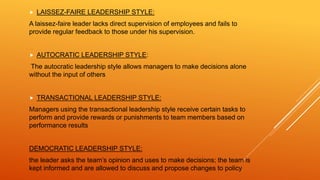
 LAISSEZ-FAIRE LEADERSHIP STYLE:
A laissez-faire leader lacks direct supervision of employees and fails to
provide regular feedback to those under his supervision.
 AUTOCRATIC LEADERSHIP STYLE:
The autocratic leadership style allows managers to make decisions alone
without the input of others
 TRANSACTIONAL LEADERSHIP STYLE:
Managers using the transactional leadership style receive certain tasks to
perform and provide rewards or punishments to team members based on
performance results
DEMOCRATIC LEADERSHIP STYLE:
the leader asks the team’s opinion and uses to make decisions; the team is
kept informed and are allowed to discuss and propose changes to policy
CLOMURUCO (2007) DESCRIBE QUALITIES AS THE DEGREE OF
EXCELLENCE OR DISTINCTIVE ATTRIBUTES
QUALITIES OF A
LEADER
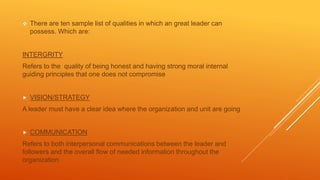
 There are ten sample list of qualities in which an great leader can
possess. Which are:
INTERGRITY
Refers to the quality of being honest and having strong moral internal
guiding principles that one does not compromise
 VISION/STRATEGY
A leader must have a clear idea where the organization and unit are going
 COMMUNICATION
Refers to both interpersonal communications between the leader and
followers and the overall flow of needed information throughout the
organization
 RELATIONSHIPS
Relationships develop from good interpersonal and group communication
skills hence a leader who can initiate and deepen relationships with
others, has a great leadership advantage
 PERSUASION
The ability to influence others and cause them to move in a particular
direction.
 ADAPTABILITY
Ability to move easing to one set of circumstance to the next. Adaptability
and flexibility in not being bound by a plan are important success factors
in leadership.
 TEAMWORK
No one can do it all, therefore a leader form a team, comprised of others
with different set of skills
 COACHING AND DEVELOPMENT
Encouraging others to expand their capabilities
 DECISION- MAKING
Ability to wade through information, comprehend what is relevant
 PLANNING
Making certain assumption about the future and taking actions in the
present to positively influence the future
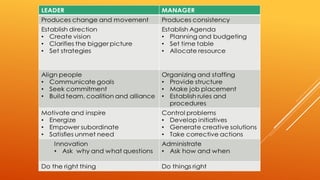
THE TABLE BELOW OUTLINE THE DIFFERENCES BETWEEN A
LEADER AND MANAGER
LEADERSHIP VS
MANAGEMENT
Taking a leadership position means:
 Having a vision about what can be accomplished.
 Making a commitment to the mission and to the people you lead.
 Taking responsibility for the accomplishment of the mission and the
welfare of those you lead.
 Assuming risk of loss and failure.
 Accepting recognition for success.
The elements of management are:
 • Making rules and regulations
 • Making decisions that apply and interpret rules and regulations
 • Keeping records
 • Filling out forms
THE TERM ‘ETHICS’ IS DEFINED BY THE OXFORD
DICTIONARY AS ‘A SET OF MORAL PRINCIPLES’.
IMPORTANCE OF
ETHICS
ETHICS
 Ethics are the principles and values an individual uses to govern his activities and
decisions. In an organization, a code of ethics is a set of principles that guide the
organization in its programs, policies and decisions for the business. The ethical
philosophy an organization uses to conduct business can affect the reputation,
productivity and bottom line of the business.
 The discourse on ethics and ethical conduct is therefore about universal values and
concepts of right and wrong, good and bad. In simple words, ethics and morals both
relate to “right” and “wrong” conduct. However, ethics refer to the series of rules
provided to an individual by an external source, e.g. their profession or religion.
 Morals refer to an individual’s own principles regarding right and wrong. A great deal
of attention has been given to these issues in the literature on the subject.
Leadership Ethics
 The ethics that leaders in an organization use to manage employees may have an
effect on the morale and loyalty of workers. The code of ethics leaders use
determines discipline procedures and the acceptable behavior for all workers in an
organization.
 When leaders have high ethical standards, it encourages workers in the
organization to meet that same level. Ethical leadership also enhances the
company’s reputation in the financial market and community. A solid reputation for
ethics and integrity in the community may improve the community
 Ethics are of immense importance in leadership decision-making.
 This is the area where ethical dilemmas often have to be resolved and
where difficult choices have to be made between right or wrong, good or
bad. One of the suggested ways of bringing ethics into business
organisations is through an ‘Ethical Orientation’ plan
 The plan looks at strategic decisions from an ethical perspective. This can
have an impact at all levels of the organisation by making them more
attuned to ethical norms and considerations. This would be a long-term
initiative that includes processes of management responsibility, employee
and contract areas, audits, etc. The ‘Implementation Plan for an Ethical
Orientation’
 (Ibid: 258) includes, for example, questions based on an ethical
perspective:
 “How has an ethical orientation been integrated with strategy?”
 “How is senior management accountable for ethical performance?”
 “How is ethical orientation expressed in recruiting and hiring?” and
 “Do all individuals in the company understand the ethical orientation
BRIEF INFORMATION ABOUT THE ORGANISATION
ORGANISATION
DESCRIPTION
RAPDL CONSTRUCTION
RAPDL construction provides the state-of-the art civil construction and building
solution to the private and public sectors in line with meeting the sectorial
demand of the rapidly transforming South Africa. The company aim to engage
with their clients and provide quality service.
EXPOSITION OF THE FACTUAL
INFORMATION OF RAPDL
CONSTRUCTION IN RELATION TO
LEADERSHIP
 The RADPL believe that teamwork and communication is the key to get
things done on time and which is the interpersonal communication
between the leader and followers and overall flow of needed
information throughout the organization. Mr. madala Mathabela is the
executive director of RADPL is the very skilful leader who worked for
Hullers Aluminum for 10 years said he use Transformational leadership
style: The transformational leadership style depends on high levels of
communication from management to meet goals. Leaders motivate
employees and enhance productivity and efficiency through
communication and high visibility
Leadership is a process by which one person influences the thoughts,
attitudes, and behaviors of others leadership acts on a setting, meaning a
leader adjusts to the state of the surroundings and people. a leader
carefully observes those states and separates significance looking for how
to adapt the setting most effectively. A leader possess certain qualities
which include integrity, vision, communication, relationship and et cetera.
There are different styles of leadership which include transformational
leadership and others. A good leader follows certain ethics which is used
to manage employees and may have an effect on the morale and loyalty
of workers. Leadership empowers, meaning a leader inspires confidence
and self-esteem.
CONCLUSION

ANAR empire

  • 1.
  • 2.
  • 3.
    QUINN MILL DEFINELEADERSHIP AS A PROCESS BY WHICH ONE PERSON INFLUENCES THE THOUGHTS, ATTITUDES, AND BEHAVIORS OF OTHERS. INTRODUCTION TO LEADERSHIP
  • 4.
     Leaders seta direction for the rest of us; they help us see what lies ahead; they help us visualize what we might achieve; they encourage us and inspire us.  Without leadership a group of human beings quickly degenerates into argument and conflict, because we see things in different ways and lean toward different solutions.  Leadership helps to point us in the same direction and harness our efforts jointly.  Leadership is the ability to get other people to do something significant that they might not otherwise do. It’s energizing people toward a goal.  Leadership is the collective action of everyone you influence. It is the ability of establishing a vision and translating it into strategy and practices as the element of effective leadership.
  • 5.
    An effective leaderis a person who:  Creates an inspiring vision of the future.  Motivates and inspires people to engage with that vision.  Manages delivery of the vision.  Coaches and builds a team, so that it is more effective at achieving the vision. Leadership is ability, meaning a leader has a capacity to do something through talent and skill. Talent is natural ability and skill is proficiency gained through training and experience. Talent certainly helps, but it isn’t required. Leadership is adaptive, meaning that the leader makes adjustments. A leader who fails to adjust to the territory will lose their way. Only fools willingly follow someone who is lost.
  • 6.
    LEADERSHIP STYLE DAVIS LEADERSHIPSTYLES(1993) DEFINE LEADERSHIP STYLES AS THE MANNER AND APPROACH OF PROVIDING DIRECTION, IMPLEMENTING PLANS AND MOTIVATING PEOPLE
  • 7.
     LAISSEZ-FAIRE LEADERSHIPSTYLE: A laissez-faire leader lacks direct supervision of employees and fails to provide regular feedback to those under his supervision.  AUTOCRATIC LEADERSHIP STYLE: The autocratic leadership style allows managers to make decisions alone without the input of others  TRANSACTIONAL LEADERSHIP STYLE: Managers using the transactional leadership style receive certain tasks to perform and provide rewards or punishments to team members based on performance results DEMOCRATIC LEADERSHIP STYLE: the leader asks the team’s opinion and uses to make decisions; the team is kept informed and are allowed to discuss and propose changes to policy
  • 8.
    CLOMURUCO (2007) DESCRIBEQUALITIES AS THE DEGREE OF EXCELLENCE OR DISTINCTIVE ATTRIBUTES QUALITIES OF A LEADER
  • 9.
     There areten sample list of qualities in which an great leader can possess. Which are: INTERGRITY Refers to the quality of being honest and having strong moral internal guiding principles that one does not compromise  VISION/STRATEGY A leader must have a clear idea where the organization and unit are going  COMMUNICATION Refers to both interpersonal communications between the leader and followers and the overall flow of needed information throughout the organization
  • 10.
     RELATIONSHIPS Relationships developfrom good interpersonal and group communication skills hence a leader who can initiate and deepen relationships with others, has a great leadership advantage  PERSUASION The ability to influence others and cause them to move in a particular direction.  ADAPTABILITY Ability to move easing to one set of circumstance to the next. Adaptability and flexibility in not being bound by a plan are important success factors in leadership.
  • 11.
     TEAMWORK No onecan do it all, therefore a leader form a team, comprised of others with different set of skills  COACHING AND DEVELOPMENT Encouraging others to expand their capabilities  DECISION- MAKING Ability to wade through information, comprehend what is relevant  PLANNING Making certain assumption about the future and taking actions in the present to positively influence the future
  • 12.
    THE TABLE BELOWOUTLINE THE DIFFERENCES BETWEEN A LEADER AND MANAGER LEADERSHIP VS MANAGEMENT
  • 14.
    Taking a leadershipposition means:  Having a vision about what can be accomplished.  Making a commitment to the mission and to the people you lead.  Taking responsibility for the accomplishment of the mission and the welfare of those you lead.  Assuming risk of loss and failure.  Accepting recognition for success. The elements of management are:  • Making rules and regulations  • Making decisions that apply and interpret rules and regulations  • Keeping records  • Filling out forms
  • 15.
    THE TERM ‘ETHICS’IS DEFINED BY THE OXFORD DICTIONARY AS ‘A SET OF MORAL PRINCIPLES’. IMPORTANCE OF ETHICS
  • 16.
    ETHICS  Ethics arethe principles and values an individual uses to govern his activities and decisions. In an organization, a code of ethics is a set of principles that guide the organization in its programs, policies and decisions for the business. The ethical philosophy an organization uses to conduct business can affect the reputation, productivity and bottom line of the business.  The discourse on ethics and ethical conduct is therefore about universal values and concepts of right and wrong, good and bad. In simple words, ethics and morals both relate to “right” and “wrong” conduct. However, ethics refer to the series of rules provided to an individual by an external source, e.g. their profession or religion.  Morals refer to an individual’s own principles regarding right and wrong. A great deal of attention has been given to these issues in the literature on the subject. Leadership Ethics  The ethics that leaders in an organization use to manage employees may have an effect on the morale and loyalty of workers. The code of ethics leaders use determines discipline procedures and the acceptable behavior for all workers in an organization.  When leaders have high ethical standards, it encourages workers in the organization to meet that same level. Ethical leadership also enhances the company’s reputation in the financial market and community. A solid reputation for ethics and integrity in the community may improve the community
  • 17.
     Ethics areof immense importance in leadership decision-making.  This is the area where ethical dilemmas often have to be resolved and where difficult choices have to be made between right or wrong, good or bad. One of the suggested ways of bringing ethics into business organisations is through an ‘Ethical Orientation’ plan  The plan looks at strategic decisions from an ethical perspective. This can have an impact at all levels of the organisation by making them more attuned to ethical norms and considerations. This would be a long-term initiative that includes processes of management responsibility, employee and contract areas, audits, etc. The ‘Implementation Plan for an Ethical Orientation’  (Ibid: 258) includes, for example, questions based on an ethical perspective:  “How has an ethical orientation been integrated with strategy?”  “How is senior management accountable for ethical performance?”  “How is ethical orientation expressed in recruiting and hiring?” and  “Do all individuals in the company understand the ethical orientation
  • 18.
    BRIEF INFORMATION ABOUTTHE ORGANISATION ORGANISATION DESCRIPTION
  • 19.
    RAPDL CONSTRUCTION RAPDL constructionprovides the state-of-the art civil construction and building solution to the private and public sectors in line with meeting the sectorial demand of the rapidly transforming South Africa. The company aim to engage with their clients and provide quality service.
  • 20.
    EXPOSITION OF THEFACTUAL INFORMATION OF RAPDL CONSTRUCTION IN RELATION TO LEADERSHIP  The RADPL believe that teamwork and communication is the key to get things done on time and which is the interpersonal communication between the leader and followers and overall flow of needed information throughout the organization. Mr. madala Mathabela is the executive director of RADPL is the very skilful leader who worked for Hullers Aluminum for 10 years said he use Transformational leadership style: The transformational leadership style depends on high levels of communication from management to meet goals. Leaders motivate employees and enhance productivity and efficiency through communication and high visibility
  • 21.
    Leadership is aprocess by which one person influences the thoughts, attitudes, and behaviors of others leadership acts on a setting, meaning a leader adjusts to the state of the surroundings and people. a leader carefully observes those states and separates significance looking for how to adapt the setting most effectively. A leader possess certain qualities which include integrity, vision, communication, relationship and et cetera. There are different styles of leadership which include transformational leadership and others. A good leader follows certain ethics which is used to manage employees and may have an effect on the morale and loyalty of workers. Leadership empowers, meaning a leader inspires confidence and self-esteem. CONCLUSION